Disclosure: airfryerkitchensupply.com is reader-supported. When you buy through links on our site, we may earn an affiliate commission at no extra cost to you.
Choosing the best fifth wheel toilets is a different job from choosing a travel-trailer toilet, because a fifth wheel gives you more to work with: more height in the bathroom, more black-tank capacity, and in many floorplans a residential-style raised platform or a straight drop into the tank. The toilets that suit it are fixed-mount RV toilets — porcelain or polymer, foot-pedal gravity flush — from the two makers that dominate the verified listings, Dometic and Thetford. This guide ranks six of them, every one confirmed against its manufacturer listing, and it deliberately excludes portable cassette toilets: a fifth wheel has a real black tank, and its toilet should be plumbed to it.
Read the picks by the three measurements that decide fit in a fifth wheel: profile height — standard versus low-profile for platform-mounted installs; bowl shape and material — porcelain elongated at the residential end, lightweight polymer at the weight-conscious end; and rough-in, the distance from the wall to the flange bolts, which in an RV is fixed by the builder and not negotiable. The buying guide covers winterization, water-valve service and pedal mechanisms, because in an RV the toilet is a system that includes your fresh-water pump, your black tank and your freeze exposure.
Where to buy
The six toilets below are sold through Amazon, where you can check the current price on Amazon and confirm profile, color and bowl material on the listing — several models exist in white and bone, standard and low profile, with near-identical names. Start with these confirmed options:
- Dometic 320 Series Standard Height RV Toilet — Best Overall: Check the current price on Amazon
- Dometic 310 Gravity Toilet — Best Porcelain Value: Check the current price on Amazon
- Thetford Aqua-Magic Style II High Profile — Best Thetford Porcelain: Check the current price on Amazon
- Thetford Aqua-Magic VI High Profile — Best Lightweight: Check the current price on Amazon
- Dometic 300 Series Standard Height Toilet — Best Budget Fixed-Mount: Check the current price on Amazon
- Dometic 301 Low Profile Toilet — Best for Raised Platforms: Check the current price on Amazon
Confirm the exact variant before ordering: profile and color are separate listings for most of these models, and an RV toilet is a bulky return. Measure your rough-in and your platform height first, using the guide below.
In this guide
Quick Picks
- Best Overall: Dometic 320 Series Standard Height RV Toilet — Porcelain elongated bowl at standard height — the closest thing to a home toilet that a fifth wheel flange accepts — Check the current price on Amazon
- Best Porcelain Value: Dometic 310 Gravity Toilet — Porcelain bowl and standard height in the 310 pattern — the residential upgrade at a step below the 320 — Check the current price on Amazon
- Best Thetford Porcelain: Thetford Aqua-Magic Style II High Profile — Full china bowl on a polymer body with dual-action foot flush and a full-size residential seat — Check the current price on Amazon
- Best Lightweight: Thetford Aqua-Magic VI High Profile — Space-saving polymer toilet with a residential-size slow-close seat and the deepest bowl Thetford offers for RVs — Check the current price on Amazon
- Best Budget Fixed-Mount: Dometic 300 Series Standard Height Toilet — The polymer entry point to the Dometic fixed-mount line — standard height, white, and stocked everywhere — Check the current price on Amazon
- Best for Raised Platforms: Dometic 301 Low Profile Toilet — Low-profile Dometic for the raised-platform installs common in fifth wheel bathrooms — Check the current price on Amazon
How These Picks Were Chosen
Each toilet was verified by searching brand and model through the airfry site’s Amazon listing data connection and matching the returned title — only fixed-mount RV toilets with confirmed listings are ranked. Portable and cassette toilets were excluded by design: they solve a problem a fifth wheel does not have, and including them would mislead the comparison.
Ranking weighed bowl material and shape, profile fit for platform and floor-level installs, pedal and water-valve serviceability — the parts that actually fail in RV toilets — and the depth of each model’s installed base, because an RV toilet’s water valve or seal needing replacement at a campground is a when, not an if. Models from Dometic and Thetford dominate because their service parts are stocked everywhere RVers travel.
The 6 Best Options for Best Fifth Wheel Toilets

Dometic 320 Series Standard Height RV Toilet — Best Overall
The Dometic 320 is the benchmark fifth wheel toilet: a full porcelain elongated bowl at standard height, with a foot-pedal gravity flush and a bowl rinse that behaves like the toilet at home. In a fifth wheel — where the bathroom is the largest of any towable and the black tank can take real use — that residential character is exactly what the rig rewards. The 320 is the toilet long-term fifth wheelers upgrade to, and the one whose seat height and bowl depth make extended stays feel unremarkable, which is the highest praise an RV fixture can earn.
Strengths
- Porcelain elongated bowl — residential comfort, easy to keep clean, no plastic flex
- Standard height suits floor-level installs in most fifth wheel bathrooms
- Deep bowl and effective rinse reduce the brushing an RV toilet usually demands
Trade-offs
- Porcelain is heavy and unforgiving — two-person handling and care on install
- Standard height is wrong for platform-mounted flanges, where the low-profile sibling belongs
- Premium positioning within RV toilets
| Model | Dometic 320 Series (302320081) |
| Profile | Standard height |
| Color | White (per listing title) |
| Type | Fixed-mount gravity flush RV toilet |
The 320 ownership experience is defined by its serviceability as much as its bowl. The water valve and bowl seal — the two wear parts on any RV toilet — are replaceable without removing the toilet from the flange in most cases, and both are stocked wherever RV parts are sold, because the 310/320 platform is everywhere. A slow leak at the bowl seal shows up as a bowl that will not hold water; a failing water valve shows up as a trickle that will not stop. Both fixes are campground-afternoon jobs with this model, and that matters more on the road than any specification.
Fit the 320 where the flange is at floor level and the rough-in allows an elongated bowl — most fifth wheel main bathrooms qualify, many half-baths do not. If your toilet sits on a raised platform, the added seat height of a standard toilet on a platform makes feet dangle; that is the low-profile case covered by the Dometic 301 below. Measured correctly, the 320 is the default recommendation for a fifth wheel main bath.
Best for: fifth wheel main bathrooms with floor-level flanges / Not suited for: platform-mounted installs and tight half-baths
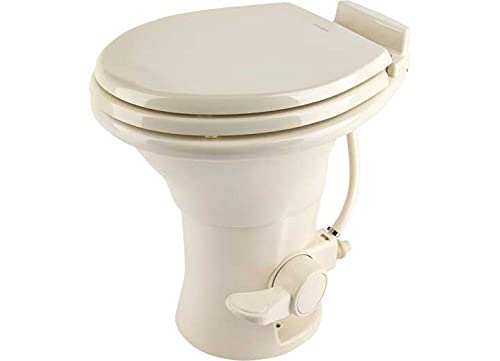
Dometic 310 Gravity Toilet — Best Porcelain Value
The Dometic 310 is the 320 working-class sibling: porcelain bowl, standard height, gravity flush, in the same service-friendly platform family. The verified listing here is the bone colorway at standard height. Where the 320 is the elongated flagship, the 310 keeps the porcelain advantages — rigidity, cleanability, a bowl that holds water against a proper seal — in a slightly more compact and more affordable pattern that suits fifth wheels whose bathroom is generous but not sprawling.
Strengths
- Porcelain bowl at a friendlier tier than the 320
- Shares the 310/320 platform service parts ecosystem — valves and seals are easy to find
- Standard height for floor-level installs
Trade-offs
- Round-front character versus the 320 elongated bowl — a comfort difference on long stays
- Bone colorway of this listing will not match a white bathroom suite
- Same porcelain handling care on install
| Model | Dometic 310 Gravity Toilet |
| Profile | Standard height |
| Color | Bone (per listing title) |
| Type | Fixed-mount gravity flush RV toilet |
Choose between the 310 and 320 by bowl shape and budget tier, in that order. If your rough-in and door swing give you the room, elongated wins for adult comfort and the 320 is worth its premium. If the bathroom is tighter, or the toilet is the second one in a half-bath, the 310 delivers ninety percent of the experience — porcelain, proper height, honest flush — and the savings can go to the parts RVers actually consume, like a spare water valve for the road kit.
One ownership note applies to both porcelain Dometics: never let the bowl freeze with water in it, and keep the bowl seal conditioned — a dry seal is the usual cause of the classic RV complaint that the bowl will not hold water overnight. The seal is a wear item priced like one; replacing it is a gloves-and-ten-minutes job described in the maintenance part of the buying guide.
Best for: fifth wheel bathrooms wanting porcelain without the flagship premium / Not suited for: bathrooms needing an elongated bowl or a white finish on this listing

Thetford Aqua-Magic Style II High Profile — Best Thetford Porcelain
Thetford answer to the porcelain Dometic is the Aqua-Magic Style II, and its construction is a deliberate hybrid: a full china bowl — the listing is explicit — carried on a polymer body, which keeps the part you sit on and clean feeling residential while trimming the weight and cost a full-porcelain body would add. The dual-action foot pedal lets you add water to the bowl with a light press and flush with a full press, a small control distinction experienced RVers use constantly to manage black-tank water. This high-profile version suits floor-level flanges in a fifth wheel main bath.
Strengths
- Full china bowl with a full-size residential seat — home-toilet feel
- Dual-action pedal separates bowl fill from flushing, saving tank water
- Polymer body keeps weight below full-porcelain rivals
Trade-offs
- Hybrid construction feels less monolithic than the Dometic porcelain bodies
- High profile is the wrong variant for platform installs — the low-profile Style II exists for those
- Thetford water valves and seals are model-specific; carry the correct spare
| Model | Thetford Aqua-Magic Style II 42058 |
| Profile | High profile |
| Bowl | Full china bowl, polymer body (per listing title) |
| Flush | Dual-action foot flush (per listing title) |
Brand loyalty in RV toilets is mostly parts loyalty. If your fifth wheel came with Thetford plumbing habits — or your last rig was Thetford and your road kit already carries its water valve — the Style II keeps you in that ecosystem with a genuinely residential bowl. The dual-action pedal deserves its emphasis: in dry camping, the ability to add a little water without a full flush is the difference between a black tank that lasts the stay and one that does not.
As with the Dometics, the bowl seal and water valve are the service items, and both are Thetford-specific. The Style II long production run means both are stocked at RV parts counters nationwide. For a Thetford household, this is the main-bath pick; for a Dometic household, the 320 is — cross-shopping between them should be decided by ecosystem and bowl shape, not by chasing small specification differences.
Best for: Thetford-ecosystem fifth wheels wanting a china bowl / Not suited for: platform installs — take the low-profile Style II instead

Thetford Aqua-Magic VI High Profile — Best Lightweight
The Aqua-Magic VI is the modern lightweight pattern: an all-polymer, space-saving body that its listing pairs with two comfort features that used to require porcelain — a residential-sized slow-close seat and the deepest toilet bowl Thetford offers for RVs. Bowl depth is not a vanity spec in an RV; a deep bowl is what keeps a gravity flush clean and splashing contained on the road. For a fifth wheel half-bath, a bunk-model second bathroom, or any install where payload discipline matters, the VI is the current Thetford answer.
Strengths
- Lightweight polymer body — the payload-friendly choice
- Deep bowl design contains the flush better than shallow RV bowls
- Residential-size slow-close seat included, per the listing
Trade-offs
- Polymer bowl flexes and scratches more readily than china or porcelain
- Space-saving footprint gives a smaller seating feel than the Style II or Dometic 320
- Foot flush only — no dual-action water control like the Style II pedal
| Model | Thetford Aqua-Magic VI |
| Profile | High profile |
| Seat | Residential sized, SloClose (per listing title) |
| Design | Space-saving, foot flush (per listing title) |
The VI makes the most sense where the fifth wheel bathroom is a compromise space — the half-bath in a bunkhouse or mid-bunk floorplan, where a full porcelain toilet is physically possible but crowds the room and adds weight exactly where the floorplan can least use it. Its easy-install positioning is also real: a light toilet is a one-person swap, which matters when the job happens at a storage lot rather than a workshop.
Care differs from porcelain in one respect: use RV-safe, non-abrasive cleaners on the polymer bowl, because scratched plastic holds stains and odors in a way glazed ceramic does not. Keep that discipline and the VI serves for years; ignore it and the bowl looks old before the mechanism is. Weight, space and price all argue for this toilet in the right room — just do not ask it to be the main-bath throne in a full-time rig.
Best for: half-baths, bunk floorplans and weight-conscious installs / Not suited for: full-time main bathrooms where porcelain comfort leads

Dometic 300 Series Standard Height Toilet — Best Budget Fixed-Mount
The Dometic 300 is the budget fixed-mount standard: a lightweight polymer toilet at standard height that has been the factory fit in countless towables and remains the like-for-like replacement when an original 300 cracks, stains or tires. Its listing is plain — series, height, color — and that plainness is the product: a known quantity, available everywhere, whose water valve and seals are the same road-kit parts the Dometic ecosystem runs on. In a fifth wheel it suits the second bathroom or a budget-conscious main-bath replacement where porcelain is not the priority.
Strengths
- Lowest tier of the fixed-mount Dometics — the value replacement
- Standard height and white finish match the most common factory installs
- Dometic service parts availability is as deep as the category offers
Trade-offs
- Polymer bowl — the comfort and care compromises of plastic apply
- Basic feature set: no slow-close residential seat story here
- In a full-time fifth wheel main bath, most owners eventually upgrade past it
| Model | Dometic 300 Series (302300071) |
| Profile | Standard height |
| Color | White (per listing title) |
| Type | Fixed-mount gravity flush RV toilet |
The honest case for the 300 is replacement economics. If the toilet in a used fifth wheel is a tired 300, a new 300 restores full function for the lowest outlay and zero fit risk — same footprint, same connections, same pedal feel. The upgrade path to a 310 or 320 is equally real and covered by the picks above; the choice is whether this purchase is a restoration or an improvement. Neither answer is wrong, and this guide ranks the 300 exactly where that logic puts it: the sensible floor of the category.
One caution from the field applies to all polymer RV toilets and the 300 most of all, because so many are in service: overtightening flange bolts on a plastic base cracks mounting ears. Snug the bolts evenly, use a new flange seal, and let the seal — not bolt torque — make the joint. The buying guide install notes repeat this because it is the most common way a cheap toilet becomes two toilets.
Best for: like-for-like replacement and second bathrooms on a budget / Not suited for: full-time main bathrooms ready for a porcelain upgrade

Dometic 301 Low Profile Toilet — Best for Raised Platforms
Many fifth wheel bathrooms mount the toilet on a raised platform — the black tank sits directly below in the basement bay, and the platform is how the builder gets the drop. A standard-height toilet on that platform puts the seat at a height that leaves shorter users feet dangling and taller users knees high. The Dometic 301 exists for exactly this geometry: the low-profile version of the 300 platform, in white, restoring a normal seat height once the platform is added. Its listing is as plain as the 300 — the profile is the entire point.
Strengths
- Low profile corrects seat height on platform-mounted flanges
- Dometic platform parts and service ecosystem
- White finish matches standard fifth wheel bathroom suites
Trade-offs
- Wrong everywhere else — on a floor-level flange it sits uncomfortably low
- Polymer construction with the usual care requirements
- Profile must be confirmed against your platform height before ordering
| Model | Dometic 301 Low Profile |
| Profile | Low profile |
| Color | White (per listing title) |
| Type | Fixed-mount gravity flush RV toilet |
Measure before you buy this or any low-profile toilet: sit on the current toilet and note whether your feet rest flat. If they do not, and the flange is on a platform, a low-profile model is the fix — the platform height plus low-profile body should land the seat near a comfortable residential height. If your feet do rest flat, your install is effectively floor-level and the standard-height picks above are your list. This single observation prevents the most common RV toilet return.
Within its niche the 301 is the safe Dometic choice, and the Thetford low-profile Style II and Aqua-Magic VI variants serve the same geometry for Thetford households. Choose by ecosystem. What you should not do is solve a platform problem with cushions, steps or resignation — the correct-profile toilet costs no more than the wrong one and fixes the ergonomics every single day.
Best for: fifth wheels with platform-mounted toilet flanges / Not suited for: floor-level installs of any kind
Comparison Table
Compare on profile and bowl first — those decide fit and comfort — then on material, which decides weight and care. Specifications are drawn from the verified listing titles; where a title is brief, the entry says so instead of inventing figures.
| Pick | Badge | Key spec | Best for |
|---|---|---|---|
| Dometic 320 Series Standard Height RV Toilet | Best Overall | Porcelain elongated; standard height | Residential comfort in the main bath |
| Dometic 310 Gravity Toilet | Best Porcelain Value | Porcelain; standard height; bone | Porcelain upgrade, mid tier |
| Thetford Aqua-Magic Style II High Profile | Best Thetford Porcelain | China bowl, polymer body; dual-action pedal | Thetford main-bath upgrade |
| Thetford Aqua-Magic VI High Profile | Best Lightweight | Polymer; deep bowl; SloClose seat | Lightweight second-bathroom duty |
| Dometic 300 Series Standard Height Toilet | Best Budget Fixed-Mount | Polymer; standard height | Budget fixed-mount replacement |
| Dometic 301 Low Profile Toilet | Best for Raised Platforms | Low profile; polymer | Platform installs, correct seat height |
How to Choose a Toilet for a Fifth Wheel
Start with geometry, because an RV toilet is fitted to a fixed flange. Measure the rough-in — wall to the center of the flange bolts — and compare it with the listing requirement; fifth wheels commonly differ from the residential standard, and an elongated bowl that fits the flange can still foul the wall or the door swing. Then establish the platform question: flange at floor level takes a standard or high profile; flange on a raised platform takes a low profile. Getting those two facts right eliminates most wrong purchases before brand is even discussed.
Next, bowl material. Porcelain and china bowls feel residential, clean easily and resist scratching, at the cost of weight and fragility in handling. Polymer bowls save meaningful weight, tolerate rough roads without cracking risk, and demand non-abrasive cleaning to stay presentable. In a fifth wheel main bath used full-time, porcelain earns its keep; in a half-bath or a weight-critical floorplan, polymer is the rational choice — which is why this guide ranks both without pretending one wins universally.
Water management: pedals, valves and the black tank
A dual-action pedal, like the Style II, meters bowl water separately from the flush — a genuine conservation tool when dry camping stretches a black tank. Single-action pedals are simpler and one less technique for guests to learn. Either way, the water valve is the wear part: carry the correct spare for your brand, because a valve that trickles at a campground fills a black tank and empties a fresh tank simultaneously, and the nearest parts counter may be a day away.
Living With an RV Toilet: Seals, Valves and Winterization
The bowl seal is the RV toilet equivalent of a flapper: a rubber ring the flush ball or blade seals against, which must hold an inch of water in the bowl between uses. That water is the odor barrier. When the bowl stops holding water, clean the seal first — debris and scale are the usual cause — condition it with a plumber-safe lubricant, and replace it if the rubber has hardened. Every model in this guide has a replaceable seal; none requires a new toilet for this fault.
Winterization is non-negotiable in a fifth wheel stored below freezing: drain the fresh system, run RV antifreeze through the toilet until it colors the bowl, and leave antifreeze standing in the bowl to keep the seal wet and protected. A porcelain bowl left with plain water in it can crack in a hard freeze — the one failure in this category that converts a toilet into a full replacement in a single night.
Black Tank Reality: How Toilet Choice Meets Tank Management
An RV toilet does not flush into a sewer; it flushes into a holding tank you must empty, and toilet choice shapes that chore. Water per flush is the lever: dual-action pedals that let you add a little bowl water without a full flush, and bowls designed to rinse clean with less water, stretch a black tank across more days of dry camping. The fifth wheel advantage is capacity — its black tanks are typically the largest in towables — but capacity wasted on over-rinsing is capacity lost, and experienced full-timers treat flush water as a budget line, not a free good.
Chemistry and paper matter downstream of every pick in this guide equally: use RV-rated paper or paper that breaks down fast, keep enough water in the tank to keep solids submerged, and never let the bowl seal dry out and vent tank odor into the bathroom while stored. The toilet models differ in bowl rinse and pedal control; the tank discipline that makes any of them pleasant is the same.
Road Worthiness: Vibration, Weight Distribution and Mounting
A fifth wheel bathroom lives through thousands of road miles, and a toilet installation must be road-worthy in a way a house never demands. Porcelain bowls are rigid and heavy: their mass rides fine when the flange bolts are evenly snug and the floor beneath is sound, but a soft floor patch under a porcelain toilet concentrates flex at the mounting ears with every mile. Polymer toilets forgive marginal floors and weigh a fraction as much, which is why they dominate factory installs in lighter floorplans even where porcelain would fit.
Whatever the material, recheck flange nut snugness after the first trip with a new toilet — seating and road vibration settle seals — and inspect the basement bay below after the first tank of use. RV plumbing faults announce themselves in the bay long before they announce themselves in the bathroom, and the habit of looking is the cheapest insurance in this entire guide.
Second Bathrooms and Half-Baths in Fifth Wheels
Bunkhouse and mid-bunk fifth wheels often carry a half-bath whose toilet brief is completely different from the main bath: compact, light, durable, and used by kids and guests rather than full-time adults. That brief is why the Aqua-Magic VI and the Dometic 300 earn their rankings — in the small room they are not the cheap option, they are the correct one. Judging a half-bath toilet by main-bath standards leads to porcelain wedged into a room that needed the space and the payload margin more.
The reverse discipline matters too: a full-time couple who buy a fifth wheel for its main bathroom should not let a lightweight factory toilet talk them out of the porcelain upgrade the room was built for. Match each toilet to its room duty cycle — daily residential use in the main bath, intermittent utility in the half-bath — and the six picks in this guide sort themselves almost automatically.
Installing for the Slide-Out Bathroom and Other Fifth Wheel Quirks
Fifth wheel floorplans introduce two toilet contexts houses never have. Some bathrooms sit in or beside slide-outs, where floor flex is a design fact: a rigid porcelain toilet on a flexing slide floor wants its flange bolts checked seasonally, and polymer earns consideration it would not get in the main bath of a fixed floorplan. Other fifth wheels place the toilet directly over the black tank in a basement bay with minimal drop, which is where the raised platforms and low-profile picks come from — geometry dictated by the tank, not by fashion.
Access is the third quirk: the water connection behind an RV toilet can range from open to nearly unreachable depending on floorplan. Before ordering any replacement, reach the existing connection once with your hand. If you cannot, plan the job with the access panel or the bay-side approach your rig provides, and favor the models whose water valve can be serviced from the front — a detail that decides whether a roadside valve swap is twenty minutes or a disassembly.
Toilet Paper, Chemicals and the Systems Around the Toilet
No toilet in this guide works alone: it works with the paper you feed it, the chemicals you dose the tank with, and the vent that lets the tank breathe. Rapid-dissolving paper is the cheapest reliability upgrade available to any RV toilet — hold a sheet of your household paper and a sheet of RV-rated paper in water for an hour and the difference explains a season of clog complaints that were blamed on toilets. Tank treatments that attack the bowl seal or the flush mechanism rubber are the opposite error; use products rated safe for RV seals, because the seal is a wear part whose life you are either extending or spending.
The vent deserves one sentence because it is so often the real culprit: a blocked or wasp-nested roof vent makes any toilet burp and smell regardless of model, seal or chemistry. When a good toilet in this guide seems to misbehave on odor, check the vent before the toilet. Systems thinking is the whole skill of RV ownership, and the toilet is where most owners learn it.
When the Factory Toilet Is Fine: The Upgrade Decision
Many fifth wheels ship with a polymer 300-series or Aqua-Magic-class toilet that works perfectly well, and the upgrade question deserves an honest frame. Upgrade when the main bath is a daily, long-stay space and the porcelain comfort difference will be felt thousands of times; when the factory bowl will not hold water despite a new seal; or when the pedal or valve has failed and the replacement labor is already committed. Keep the factory toilet when it serves a half-bath, when payload margin is precious, or when the rig is a weekend tool rather than a residence.
The middle path is sequencing: replace the wear parts on the factory toilet now — seal and water valve, both cheap — and let the porcelain decision wait for a season of use to reveal how the household actually lives in the rig. Fifth wheel ownership teaches its own requirements; the toilet that seemed inadequate at the dealership sometimes proves perfectly matched to the travel pattern, and the upgrade money finds better work elsewhere in the rig.
Pedal Mechanisms and Cold-Weather Operation on the Road
The foot pedal is the RV toilet control surface, and its feel is diagnostic. A pedal that returns crisply and stops the water dead is healthy. A pedal that creeps back, or a flush ball that closes slowly, is announcing cable stretch, pivot wear or a dry seal — in that order of likelihood — and each is a small-parts service rather than a toilet replacement on every model in this guide. Learn your pedal normal feel when the toilet is new; your foot will detect the first deviation months before your eyes would.
Cold-weather travel adds one operational rule to the winterization guidance in the buying guide: a toilet used in freezing conditions between winterized storage periods must be re-protected after every use, because the water standing in the bowl and valve is exactly the water that cracks porcelain and splits valve bodies. Full-timers who winter in cold climates keep the bowl seal conditioned and the bathroom heat honest; occasional winter users should treat the toilet as winterized equipment that happens to flush, and dose antifreeze accordingly after each trip.
Carrying Spares: The Fifth Wheel Toilet Road Kit
Every experienced fifth wheeler carries a small toilet kit, and its contents are standardized by the failure statistics of the road: one water valve for the installed brand, one bowl seal, a flange seal for a full reseat, and the hand tools those three jobs need. With that kit aboard, every common toilet failure in this guide is a same-day repair at a campsite table. Without it, the same failures are a parts hunt in an unfamiliar town — the difference between an anecdote and a ruined week.
Build the kit when the toilet is new or newly serviced, labeled by model, and store it where water damage cannot reach it. The picks in this guide were ranked partly on exactly this ecosystem depth: Dometic and Thetford valves and seals are stocked across the continent precisely because so many rigs carry these toilets. Choosing the toilet is, in part, choosing the road kit — and choosing a stocked one is choosing your future weekends.
How to Replace a Fixed-Mount RV Toilet
Swapping an RV toilet is simpler than a residential one — no wax ring wrestling at arm length, no tank separate from the bowl — but the flange seal and bolt discipline decide whether it leaks into the basement bay. Allow an unhurried hour, and have a new flange seal on hand before you start; reusing the old seal is the classic false economy.
- Turn off the fresh-water pump and city water, then flush the pedal to relieve pressure. Disconnect the water supply line at the toilet valve and cap or towel the line.
- Remove the two flange nuts at the base — access covers or caps hide them on most models — and lift the old toilet straight off the flange bolts.
- Scrape the old flange seal from the flange and the toilet base completely; inspect the flange for cracks and the floor around it for softness or old leak damage.
- Fit the new flange seal to the new toilet base per its instructions — orientation matters, and most seals are not symmetric.
- Set the toilet onto the flange bolts in one vertical motion, then rock it gently to seat the seal before any nuts are tightened.
- Run the flange nuts down alternately, a little at a time, until the base is snug and does not rock. On polymer bases especially, stop at snug — cracked mounting ears come from one more turn.
- Reconnect the water line hand-tight plus a small turn, restore water pressure, and check the valve connection with a dry fingertip through several fills.
- Test the flush repeatedly: the pedal should snap back, the bowl should rinse around its rim, and the bowl should hold an inch of standing water afterward.
- Check the basement bay below after the first several flushes — a dry bay confirms the flange seal; any moisture means reseating now, not after the trip.
Finish by confirming the seat height feels right for the household and that the lid and door clear the bowl through their full swings. An RV toilet that fits the flange but fouls the door is a return, and discovering it before the first trip is the entire value of testing at home.
Common Buying Mistakes
Ordering by brand loyalty without measuring
Rough-in and platform height decide fit; brand decides parts. A beloved brand in the wrong profile is still the wrong toilet. Measure first, then shop within the measurements.
Reusing the flange seal
The seal is a crush part that takes a set. A reused seal is the leading cause of the leak that quietly damages the bathroom floor and the bay below.
Overtightening polymer base bolts
Plastic mounting ears crack under torque that porcelain tolerates. Alternate the nuts, stop at snug and stable, and let the seal do the sealing.
Ignoring the bowl-holds-water test
A bowl that will not hold standing water has a seal problem and will vent black-tank odor into the bathroom. Diagnose it on day one — cleaning or a seal — not after a season of air fresheners.
Skipping winterization on a stored rig
Water left in a porcelain bowl or a water valve freezes and cracks the part. Antifreeze through the toilet, left standing in the bowl, is minutes of work against a replacement toilet.
Final Recommendation
For a fifth wheel main bathroom at floor level, the Dometic 320 is the recommendation — porcelain, elongated, serviceable anywhere. Thetford households take the Aqua-Magic Style II for the same room, and the Dometic 310 splits the difference on price. Polymer earns its place in the half-bath with the Aqua-Magic VI, in the budget replacement with the Dometic 300, and on raised platforms with the low-profile Dometic 301. Measure the rough-in and the platform, then check price on Amazon on the exact profile and color before ordering.
- Dometic 320 Series Standard Height RV Toilet: Check the current price on Amazon
- Dometic 310 Gravity Toilet: Check the current price on Amazon
- Thetford Aqua-Magic Style II High Profile: Check the current price on Amazon
Keep exploring the cluster: Best Fill Valves For Toilets Best Flapper Toilets Best Fill Valve Toilets Best Flapper For Older Toilets Best Flapper Seal For Toilets
Frequently Asked Questions
Can I install a residential toilet in a fifth wheel?
Generally no. Residential toilets need a 12-inch-class rough-in, a floor flange of a different pattern, far more flush water than an RV black tank should receive, and they are not built for road vibration or foot-pedal gravity systems. The porcelain RV toilets in this guide exist to give the residential feel within RV constraints.
How do I know if I need a low-profile RV toilet?
If your toilet flange sits on a raised platform and your feet do not rest flat when seated, the total height is too much — a low-profile model restores normal seat height. If the flange is at floor level, choose standard or high profile instead.
Why will my RV toilet bowl not hold water?
The bowl seal is dirty, dry or worn. Clean it, condition it, and replace it if the rubber has hardened — the seal is an inexpensive wear part on every model here. A bowl that holds water is also your odor barrier, so treat the fault promptly.
How long do RV toilet water valves last?
They are the main wear part and life varies with water quality and use; grit in campground water shortens it. The practical strategy is not prediction but preparation: carry the correct spare valve for your brand in the road kit, because replacement is a short job with the part in hand.
Porcelain or plastic for a full-time fifth wheel?
For the main bathroom, porcelain or china — the Dometic 320 or Thetford Style II — for comfort and cleanability over years of daily use. Polymer serves well in second bathrooms and where weight matters. Full-timers feel the difference daily, which settles the question for the main bath.
What rough-in do fifth wheel toilets need?
It varies by floorplan and is fixed by the builder — measure from the wall to the flange bolt center on your current install and match the listing requirement for the replacement. Do not assume the residential standard applies.


