Disclosure: airfryerkitchensupply.com is reader-supported. When you buy through links on our site, we may earn an affiliate commission at no extra cost to you.
Where to buy
The fastest way to compare the best farmhouse kitchen sinks 60 40 in this guide is on Amazon, where each verified pick below links directly to its product page. A 60/40 farmhouse sink is a specific tool — a large main bowl with a smaller companion bowl behind an apron front — so buy the exact ratio and material you intend from a listing you can verify. Every pick below was checked against a live Amazon listing through our product research, including a dedicated search for true 60/40 apron-front models; follow the links to check price on Amazon and confirm the bowl split, divider height and cabinet size for the model you choose.
- KRAUS Standart Pro KHF203-33 Apron Front 60/40 Farmhouse Sink — check price on Amazon
- Elkay SWUF3320WH Fireclay 60/40 Farmhouse Sink with Aqua Divide — check price on Amazon
- Lordear 33 Inch Farmhouse Sink Double Bowl 60/40 — check price on Amazon
- Sarlai 36 Inch Stainless Farmhouse Sink Double Bowl 60/40 — check price on Amazon
- SHACO Double Bowl 60/40 Black Farmhouse Sink 33×22 — check price on Amazon
- Kichae 33 Farmhouse Sink 60/40 Low Divide Workstation — check price on Amazon
The best farmhouse kitchen sinks 60 40 solve a very specific kitchen problem: you love the apron front and the forward, ergonomic bowl, but your wash-up life is two-sided. One bowl is never enough when pans soak while vegetables rinse, when a disposal side and a prep side keep a big cook moving, or when glassware needs sanctuary from the roasting tin. The 60/40 split is the farmhouse answer — roughly sixty percent of the basin given to a main bowl that still takes serious cookware, forty percent to a companion bowl that works as rinse station, prep bay or soak tank — and this guide ranks the true 60/40 apron-front sinks worth buying, in stainless, fireclay and even gunmetal black.
That specificity matters, because the market blurs it. Plenty of double farmhouse sinks are 50/50, and plenty of 60/40 sinks have no apron at all. Every pick here is both: a genuine apron-front farmhouse sink with a genuine 60/40 division, verified against a current listing — several of them found through a dedicated 60/40 apron search of the catalogue for this article. Kraus’s Standart PRO anchors the stainless end, Elkay brings fireclay with its Aqua Divide, and Lordear, Sarlai, SHACO and Kichae cover value, large-format, black and workstation variations of the split.
If you have read the sibling farmhouse guides and kept saying ‘yes, but I need two bowls’, this is your list. Check the divider details carefully — low dividers that let long pans bridge both bowls are a quiet superpower — and choose the material your cabinet and kitchen agree on.
In this guide
Quick Picks
KRAUS Standart Pro KHF203-33 Apron Front 60/40 Farmhouse Sink — Best Overall 60/40: the reference 60/40 apron sink: 33 inches, 16 gauge, a true split from the Standart PRO line. — check price on Amazon
Elkay SWUF3320WH Fireclay 60/40 Farmhouse Sink with Aqua Divide — Best Fireclay 60/40: white fireclay, a true 60/40 split and Elkay’s Aqua Divide — the traditional material does the split properly. — check price on Amazon
Lordear 33 Inch Farmhouse Sink Double Bowl 60/40 — Best Value 60/40: a 33 inch, 16 gauge stainless 60/40 apron sink at a value maker’s positioning — the split without the premium. — check price on Amazon
Sarlai 36 Inch Stainless Farmhouse Sink Double Bowl 60/40 — Best Large 60/40: a 36×21 apron sink with a 60/40 split, 16 gauge and round corners — the split at entertaining scale. — check price on Amazon
SHACO Double Bowl 60/40 Black Farmhouse Sink 33×22 — Best Black 60/40: gunmetal black, 33×22, a 60/40 split and workstation character — the modern-dramatic farmhouse option. — check price on Amazon
Kichae 33 Farmhouse Sink 60/40 Low Divide Workstation — Best Low-Divide Workstation: a low-divide 60/40 workstation with a cutting board — the split that behaves like a single bowl when you need it to. — check price on Amazon
How These Picks Were Chosen
We applied a double filter that most roundups skip. First, the apron test: an exposed farmhouse front and a forward-set bowl, verified in the listing. Second, the ratio test: the listing itself had to state a 60/40 division — not ‘double bowl’, not ‘offset’, but the actual split this search promises. Sinks failing either test were excluded however good they are, and several appear in the sibling guides instead. A dedicated catalogue search for 60/40 apron models was run for this article, which is how the value and black-finish picks below were verified alongside the established names.
Within the true 60/40 field we ranked by workflow quality. Divider design mattered most: low dividers and low-divide workstations let sheet pans and long utensils bridge the bowls, recovering much of the single-bowl flexibility the split otherwise costs. Main-bowl size came next — a 60/40 whose sixty is too small betrays the concept — then material range, because fireclay, stainless and black-finish buyers are different households, and finally cabinet honesty: every pick’s stated cabinet class is in its review, because apron sinks remain cabinet commitments.
No prices are printed, per programme rules, and no ratio, dimension or feature appears that the verified listing did not state. Check price on Amazon for the exact model, confirm which side the large bowl sits on — 60/40 sinks are handed, and your kitchen’s workflow has a dominant side — and plan the cabinet before ordering. Handedness is the detail 60/40 buyers most often discover too late; this guide’s reviews flag it for a reason.
The 6 Best Farmhouse Kitchen Sinks 60 40

KRAUS Standart Pro KHF203-33 Apron Front 60/40 Farmhouse Sink — Best Overall 60/40
Choose the KHF203-33 if you want the 60/40 farmhouse concept executed by its most established maker: a 33-inch apron front, 16-gauge stainless, and a genuine 60/40 division that gives the main bowl real pan capacity while the companion bowl handles rinse and prep. It is the default recommendation for this exact keyword.
Strengths
- True 60/40 split in a 16-gauge apron sink from a proven line
- Main bowl keeps genuine cookware capacity — the concept done properly
- Kraus support and accessory ecosystem behind a specialist format
Trade-offs
- Stainless apron shows spots and prints; wiping is part of ownership
- Divided format still will not take the largest sheet pans flat in one bowl
- Apron cabinet and support requirements apply in full
| Specification | Detail |
|---|---|
| Size | 33 in (from Amazon title) |
| Split | 60/40 double bowl (from Amazon title) |
| Gauge | 16 gauge (from Amazon title) |
| Style | Apron front farmhouse |
| Model | KHF203-33 |
Most 60/40 farmhouse sinks are variations; this is the template. Kraus’s Standart PRO line is the maker’s serious stainless range, and the KHF203-33 applies it to the split apron format without diluting either idea: the apron is crisp and architectural, the steel is the full 16 gauge, and the 60/40 division is proportioned so the large bowl remains a working basin rather than a token. In a busy kitchen the split pays for itself nightly — the roasting pan soaks in the sixty while the forty rinses, drains and preps, and the disposal, fitted to the side your workflow favours, keeps the whole operation moving.
Ownership is the stainless farmhouse standard: sound, bright and honest, with an apron that likes a wipe in hard-water homes and a bowl that rewards a grid. The cabinet conversation is the usual apron one — planned support, measured cut — and Kraus’s documentation culture makes that conversation easier than most. If your shortlist for this search has one name on it before reading ours, it should be this one; after reading, we expect it still to be.
Ownership, week to week, is where KRAUS Standart Pro KHF203-33 Apron Front 60/40 Farmhouse Sink makes its quiet case. Its defining specification — 33 in, 60/40, 16 gauge apron — turns out to matter in the small moments rather than the dramatic ones: the ordinary Tuesday load, the quick rinse between tasks, the clean-down at the end of the evening. Because it is built for most 60/40 farmhouse buyers wanting the proven execution, those moments accumulate in its favour, and the compromises noted above fade into routine within the first month. Keep the basics right — the care its material asks for, the accessories it was designed around, a check of fittings and finishes each season — and this is the kind of purchase that stops being a product and becomes part of the kitchen’s furniture of habits. That, more than any single feature, is what the badge Best Overall 60/40 is claiming, and on the evidence of its specification and its maker’s support, the claim is a fair one.
Best for: most 60/40 farmhouse buyers wanting the proven execution / Not suited for: single-bowl devotees or fireclay traditionalists
Check the current price on Amazon

Elkay SWUF3320WH Fireclay 60/40 Farmhouse Sink with Aqua Divide — Best Fireclay 60/40
Take the Elkay if your 60/40 farmhouse must be fireclay: the traditional white basin with a genuine 60/40 division and Elkay’s Aqua Divide divider concept, from the most established name in American sinks. It suits traditional kitchens that wash in parallel and refuse to give up the ceramic look.
Strengths
- Fireclay 60/40 is a rare combination — most fireclay farmhouse sinks are single bowl
- Aqua Divide divider design is made for bridging long items between bowls
- Elkay heritage: documentation, consistency and support assured
Trade-offs
- Fireclay weight and cabinet support demands are the heaviest class here
- White glaze care: non-abrasive cleaning and a grid under pans
- Divided fireclay cannot take sheet pans flat — the format’s constant
| Specification | Detail |
|---|---|
| Split | 60/40 double bowl (from Amazon title) |
| Material | Fireclay |
| Divider | Aqua Divide (from Amazon title) |
| Colour | White |
| Model | SWUF3320WH |
Fireclay farmhouse sinks are overwhelmingly single-bowl, because the traditional pattern is one basin — which makes this Elkay the connoisseur’s find: the full traditional material and apron presence, with a true 60/40 division engineered in. The Aqua Divide is the thoughtful part, a divider concept designed to sit lower than a full-height wall so long items — baguettes of the utensil world, roasting racks, long pans — can bridge across both bowls when a job demands it. That bridging recovers, on demand, much of the single-bowl flexibility that split-sink sceptics rightly miss.
The rest is Elkay fireclay virtue: a glossy white basin with real substance, an apron that reads as furniture, and a maker’s documentation that installers trust. The commitments are fireclay’s own — support, careful lifting, kind cleaning — plus the handedness check every 60/40 buyer must make. For traditional kitchens with a two-sided wash-up life, no other pick in this guide comes close.
A month into living with Elkay SWUF3320WH Fireclay 60/40 Farmhouse Sink with Aqua Divide, the specification sheet gives way to a shorter list of things you actually notice. You notice that Fireclay 60/40, Aqua Divide suits the rhythm of your kitchen more often than it fights it. You notice the trade-offs are real but located where you rarely go, which is the mark of a well-aimed design: it spends its compromises on lightweight installs or strict single-bowl cooks, and its strengths on the daily work. Maintenance settles into a light routine — a wipe, a rinse, an occasional deeper clean — and the support behind the product means a question or a part is a search away rather than a research project. For households whose brief is traditional kitchens wanting fireclay with a genuine split bowl, that settled, unremarkable reliability is the highest praise a working kitchen gives, and it is the standard this pick was chosen against.
Best for: traditional kitchens wanting fireclay with a genuine split bowl / Not suited for: lightweight installs or strict single-bowl cooks
Check the current price on Amazon

Lordear 33 Inch Farmhouse Sink Double Bowl 60/40 — Best Value 60/40
Choose the Lordear if the 60/40 apron concept is right but the flagship pricing is not: it delivers the same format — 33 inches, 16-gauge stainless, true 60/40 — from a value-focused maker, for kitchens and rentals being lifted to farmhouse standard on a disciplined budget.
Strengths
- Full 60/40 apron specification in 16 gauge at a value position
- 33-inch size matches the standard farmhouse cabinet class
- Stainless format keeps install and care straightforward
Trade-offs
- Value maker’s accessory and support ecosystem is thinner than Kraus’s
- Finish refinement is a step behind the flagship lines
- Confirm the large bowl’s side against your workflow before ordering
| Specification | Detail |
|---|---|
| Size | 33 in (from Amazon title) |
| Split | 60/40 double bowl (from Amazon title) |
| Gauge | 16 gauge (from Amazon title) |
| Style | Apron front |
Value picks earn their place by keeping the specification honest, and the Lordear’s specification is the headline: a true 60/40 split, an apron front, 16-gauge steel and the standard 33-inch footprint — the same four facts as the flagship pick, at a value maker’s positioning. In the bowl, that translates to the full split workflow: soak in the sixty, rinse in the forty, disposal where your handedness wants it. For a rental being upgraded, a first farmhouse kitchen or a budget that must also stretch to cabinets and counters, that honesty is exactly what value should mean.
The trades live in refinement and ecosystem: the finish is good rather than jewellery-grade, and if you want matching accessories in five years, a value catalogue is a smaller place than Kraus’s — mitigated by standard drain sizing. Judge it as the format democratised: the 60/40 farmhouse experience, complete, for kitchens that count their money carefully.
There is also the question of how Lordear 33 Inch Farmhouse Sink Double Bowl 60/40 ages, because the best purchases in a kitchen are the ones whose second year is better than their first. The materials and format behind 33 in 60/40 value stainless are chosen for that arc: nothing here depends on a coating behaving forever or a mechanism staying novel; the value is in the shape, the substance and the fit for budget-disciplined farmhouse projects and quality rentals. Owners typically report the same progression — a week of learning its particular habits, a month of it becoming the default, and then the long plateau where it simply is the kitchen working as intended. Set against the alternatives that ask you to accept their compromises daily, that plateau is the whole argument. It is why this pick holds the Best Value 60/40 badge in a list where every entry had to earn its place against verified listings and honest trade-offs.
Best for: budget-disciplined farmhouse projects and quality rentals / Not suited for: buyers wanting the deepest accessory ecosystem and finish
Check the current price on Amazon

Sarlai 36 Inch Stainless Farmhouse Sink Double Bowl 60/40 — Best Large 60/40
Pick the Sarlai 36 if your kitchen and cabinet have the scale for it: at 36 by 21 inches the 60 side becomes a genuinely large basin and the 40 a full second sink, with round corners for easier cleaning and undermount farm fitting. It is the entertainer’s 60/40.
Strengths
- Largest 60/40 here — both bowls are full working size
- Round corners resist buildup and wipe clean easily
- 16-gauge stainless keeps the big format manageable to install
Trade-offs
- 36-inch class demands a genuinely large apron cabinet
- Big sink, big commitment — measure the whole run before ordering
- Value-maker ecosystem caveats apply as with the Lordear
| Specification | Detail |
|---|---|
| Size | 36 x 21 in (from Amazon title) |
| Split | 60/40 double bowl (from Amazon title) |
| Gauge | 16 gauge (from Amazon title) |
| Corners | Round corner (from Amazon title) |
| Mount | Undermount farm style |
Scale changes what a 60/40 is. In a 33-inch sink the split is a clever division of a normal basin; in the Sarlai’s 36 by 21 inches it becomes two real sinks sharing an apron — a main bowl that takes the entertaining load whole and a companion that behaves like the prep sink in a professional kitchen. Cooking for a crowd with a helper becomes genuinely parallel: one person washes at the sixty, another preps at the forty, and the apron keeps both of you close to the work. The round corners are a working detail, not a styling one — big sinks collect big messes, and corners that wipe clean in one pass matter at this scale.
The cabinet is the gatekeeper: this sink needs the large apron cabinet its dimensions imply, planned and supported before delivery. Kitchens with that cabinet — big islands, long farmhouse runs, serious entertaining spaces — get the most capable split-bowl farmhouse in this guide. Kitchens without it should take the 33-inch picks and be just as happy.
Ownership, week to week, is where Sarlai 36 Inch Stainless Farmhouse Sink Double Bowl 60/40 makes its quiet case. Its defining specification — 36×21, 60/40, round corner — turns out to matter in the small moments rather than the dramatic ones: the ordinary Tuesday load, the quick rinse between tasks, the clean-down at the end of the evening. Because it is built for large kitchens and entertainers with a 36-inch-class apron cabinet, those moments accumulate in its favour, and the compromises noted above fade into routine within the first month. Keep the basics right — the care its material asks for, the accessories it was designed around, a check of fittings and finishes each season — and this is the kind of purchase that stops being a product and becomes part of the kitchen’s furniture of habits. That, more than any single feature, is what the badge Best Large 60/40 is claiming, and on the evidence of its specification and its maker’s support, the claim is a fair one.
Best for: large kitchens and entertainers with a 36-inch-class apron cabinet / Not suited for: standard or compact cabinets
Check the current price on Amazon
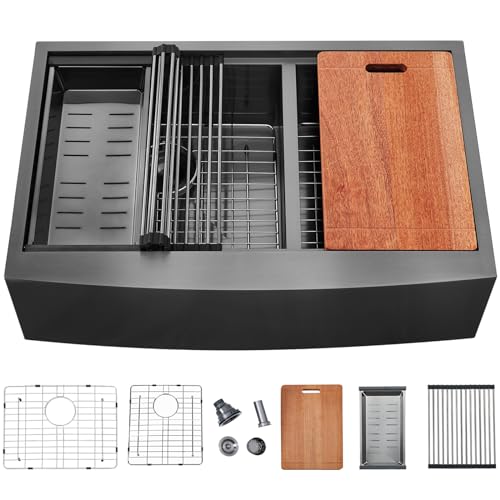
SHACO Double Bowl 60/40 Black Farmhouse Sink 33×22 — Best Black 60/40
Choose the SHACO if your farmhouse scheme is the modern one — black finishes, dramatic contrast, industrial-country styling: a gunmetal black apron sink with a true 60/40 divided basin and workstation character, in the generous 33×22 footprint.
Strengths
- Gunmetal black apron is unique in this guide — a genuine design statement
- 60/40 divided basin with workstation positioning per the listing
- 33×22 footprint gives the split generous room
Trade-offs
- Dark finishes show water spots and light scratches more visibly than brushed steel
- Black farmhouse is a committed look — it will anchor your whole scheme
- Value-maker support ecosystem; confirm accessories at purchase
| Specification | Detail |
|---|---|
| Size | 33 x 22 in (from Amazon title) |
| Split | 60/40 double bowl (from Amazon title) |
| Finish | Gunmetal black (from Amazon title) |
| Style | Apron front farm workstation |
Farmhouse does not have to mean white. The SHACO takes the full 60/40 apron format and finishes it in gunmetal black, and the effect in the right kitchen — black range, dark timbers, industrial-country or modern-rustic schemes — is striking in a way no white sink attempts. Beneath the finish it is a complete specification: a divided 60/40 basin at a generous 33 by 22, apron front, workstation character for prep over the bowl. It is the pick for buyers whose farmhouse mood board was never pastel.
Dark finishes ask honest care: water spots show, and the sink rewards a wipe-down habit that brushed steel forgives. Treat that as the price of the statement. The format underneath needs no apology — the split works, the size works, the apron works — and in a scheme built around it, the SHACO will be the fitting guests ask about.
A month into living with SHACO Double Bowl 60/40 Black Farmhouse Sink 33×22, the specification sheet gives way to a shorter list of things you actually notice. You notice that 33×22 black 60/40 suits the rhythm of your kitchen more often than it fights it. You notice the trade-offs are real but located where you rarely go, which is the mark of a well-aimed design: it spends its compromises on traditional white farmhouse kitchens or low-maintenance finish seekers, and its strengths on the daily work. Maintenance settles into a light routine — a wipe, a rinse, an occasional deeper clean — and the support behind the product means a question or a part is a search away rather than a research project. For households whose brief is modern-rustic and black-finish farmhouse schemes, that settled, unremarkable reliability is the highest praise a working kitchen gives, and it is the standard this pick was chosen against.
Best for: modern-rustic and black-finish farmhouse schemes / Not suited for: traditional white farmhouse kitchens or low-maintenance finish seekers
Check the current price on Amazon

Kichae 33 Farmhouse Sink 60/40 Low Divide Workstation — Best Low-Divide Workstation
Take the Kichae if you want the split’s workflow and the single bowl’s escape hatch: its low divide lets long pans and boards bridge across both bowls, the workstation format adds a cutting board over the basin, and the handmade 16-gauge build keeps it substantial.
Strengths
- Low divide bridges long items across bowls — split and single in one sink
- Workstation format with cutting board included per the listing
- Handmade 16-gauge stainless construction
Trade-offs
- Low divide means the small bowl’s separation is partial — true parallel soaking is reduced
- Workstation accessories are model-specific
- Handmade character includes slight finish variation — inspect on arrival
| Specification | Detail |
|---|---|
| Size | 33 x 21 in (from Amazon title) |
| Split | 60/40 low divide (from Amazon title) |
| Gauge | 16 gauge (from Amazon title) |
| Included | Cutting board (from Amazon title) |
The low divide is the split-bowl idea’s best refinement, and the Kichae builds a whole sink around it. Set the divider low and two things become true at once: day to day, you still have a 60 side and a 40 side for soak-and-rinse work; on the day a long roasting pan, a fish kettle or a baguette board arrives, it bridges straight across the divide and the sink behaves like the single basin you thought you had given up. Add the workstation ledge and included cutting board, and the apron becomes a prep station whose bowl adapts to the job instead of dictating it.
The trade is definitional: a low divide separates less completely, so a bowl of soaking water sits lower and the two sides mingle sooner. Households whose wash-up is strictly parallel should take a full-divider pick above. Households whose cooking swings between parallel days and big-pan days will find the Kichae the most adaptable sink in this guide — the 60/40 for people who could not quite commit to a split, solved.
There is also the question of how Kichae 33 Farmhouse Sink 60/40 Low Divide Workstation ages, because the best purchases in a kitchen are the ones whose second year is better than their first. The materials and format behind 33 in low-divide workstation are chosen for that arc: nothing here depends on a coating behaving forever or a mechanism staying novel; the value is in the shape, the substance and the fit for cooks who want split workflow with a single-bowl escape hatch. Owners typically report the same progression — a week of learning its particular habits, a month of it becoming the default, and then the long plateau where it simply is the kitchen working as intended. Set against the alternatives that ask you to accept their compromises daily, that plateau is the whole argument. It is why this pick holds the Best Low-Divide Workstation badge in a list where every entry had to earn its place against verified listings and honest trade-offs.
Best for: cooks who want split workflow with a single-bowl escape hatch / Not suited for: strict parallel washers needing a full-height divider
Check the current price on Amazon
Comparison Table
| Pick | Badge | Key spec | Best for |
|---|---|---|---|
| KRAUS Standart Pro KHF203-33 Apron Front 60/40 Farmhouse Sink | Best Overall 60/40 | 33 in, 60/40, 16 gauge apron | most 60/40 farmhouse buyers wanting the proven execution |
| Elkay SWUF3320WH Fireclay 60/40 Farmhouse Sink with Aqua Divide | Best Fireclay 60/40 | Fireclay 60/40, Aqua Divide | traditional kitchens wanting fireclay with a genuine split bowl |
| Lordear 33 Inch Farmhouse Sink Double Bowl 60/40 | Best Value 60/40 | 33 in 60/40 value stainless | budget-disciplined farmhouse projects and quality rentals |
| Sarlai 36 Inch Stainless Farmhouse Sink Double Bowl 60/40 | Best Large 60/40 | 36×21, 60/40, round corner | large kitchens and entertainers with a 36-inch-class apron cabinet |
| SHACO Double Bowl 60/40 Black Farmhouse Sink 33×22 | Best Black 60/40 | 33×22 black 60/40 | modern-rustic and black-finish farmhouse schemes |
| Kichae 33 Farmhouse Sink 60/40 Low Divide Workstation | Best Low-Divide Workstation | 33 in low-divide workstation | cooks who want split workflow with a single-bowl escape hatch |
All six are true 60/40 apron sinks, so compare on the second-order questions. Divider: full height for strict separation (Kraus, Elkay, Lordear, Sarlai, SHACO) versus low divide for bridging flexibility (Kichae, with Elkay’s Aqua Divide the fireclay take on the same idea). Material: stainless for most kitchens, fireclay for traditionalists, black for modern schemes. Size: 33 inches for standard cabinets, 36 for large ones. And handedness — confirm the large bowl’s side matches your dominant workflow before any of them is ordered. The right 60/40 is the one whose divider, material, size and handedness all agree with your kitchen at once.
How to Choose the Best Farmhouse Kitchen Sinks 60/40
Begin by confirming you actually want the split, because 60/40 is a workflow commitment. Watch a week of wash-ups: if a second bowl is constantly occupied — rinsing while soaking, prepping while washing, separating glassware from pans — the split will pay you daily. If your cooking is pan-led and single-basin, the sibling single-bowl guides serve you better. Next, handedness: a 60/40 sink has a large side and a small side, and your kitchen has a dominant hand and a disposal position. Decide which side the sixty belongs on — usually under your dominant working side, with the disposal in the bowl you scrape into — and order that orientation; many models are made in both, but the box that arrives is one of them.
Then the divider. Full-height dividers give complete separation and independent water levels; low dividers trade some separation for the ability to bridge long items across both bowls, which many cooks find is the best of both formats. Elkay’s Aqua Divide applies the same thinking in fireclay. After that, the familiar farmhouse agreements apply: cabinet class and support for the material’s weight, apron style for your scheme, and a grid for the bowl. Choose the 60/40 whose divider philosophy matches your messiest normal day, and the format will feel designed rather than divided.
Why 60/40 and Not 50/50 or a Single Bowl?
The ratios encode different kitchens. A 50/50 double treats both bowls as equals, which suits pure wash-and-rinse households whose pans are modest. A single bowl treats capacity as king, which suits pan-led modern cooking. The 60/40 is the compromise that is not a compromise: the sixty stays large enough for the roasting pan and the soaking load that define family cooking, while the forty is honestly sized for its real jobs — rinsing, draining, vegetable prep, a disposal side — rather than pretending to be a second main bowl. In an apron sink, where the whole basin is already generous, that asymmetry maps to how kitchens actually divide their labour.
There is also an ergonomic argument unique to the farmhouse format. Because the apron brings both bowls close, the smaller bowl is genuinely usable as a workstation — board across it, colander in it, disposal under it — rather than the far, shallow afterthought it becomes in set-back double sinks. If your kitchen runs two tasks at the sink simultaneously with any regularity, 60/40 is the ratio designed for you, and this guide’s six are its verified best expressions.
Living With a Split Apron Sink: Workflow Patterns That Work
Three patterns cover most happy 60/40 households. The soak-and-rinse pattern parks the big load in the sixty — roasting pan, casserole, the day’s pans — while the forty runs as a clean rinse-and-drain station with the rack over it. The cook-and-prep pattern gives the forty to vegetables and the board, with scraps to the disposal, while the sixty stays the washing bowl; two cooks can share an apron sink this way without a negotiation. The batch pattern, for preserving and baking days, fills the sixty with produce washing and the forty with jars, lids and utensils in rotation.
Whichever pattern you adopt, two habits multiply the format’s value. Keep a rack or board that fits the forty, so its surface works as counter when it is not a bowl; and keep the divider’s top wiped and the grid in the sixty, where the heavy pans live. A split sink rewards a small amount of system, and repays it with a kitchen that handles its busiest hour without the sink becoming the bottleneck.
Disposals, Dishwashers and the 60/40: Plumbing the Split Properly
A 60/40 sink doubles the bowl plumbing of a single sink, and planning it properly is the difference between a split that sings and one that gurgles. Each bowl drains through its own strainer into a shared trap arrangement, and the disposal — fitted to one bowl — becomes part of that geometry. The decisions are few but permanent: which bowl carries the disposal, how the dishwasher’s drain joins the system (commonly through the disposal or an air gap, per local code), and whether the trap run keeps the fall it needs inside a cabinet that also houses an apron sink’s support structure. None of this is exotic, but all of it belongs on paper before the cabinet is closed.
The workflow logic should drive the plumbing logic. The disposal belongs in the bowl that receives the scraping — in most family kitchens that is the large bowl beside the dishwasher’s loading side; in prep-led kitchens it is sometimes the small bowl under the chopping station. Decide by standing in your kitchen and acting out a normal dinner’s clearing, plate in hand. Where your hand goes, the disposal goes. Get that one decision right and the 60/40’s plumbing disappears into the background for the life of the kitchen, which is the highest praise plumbing can earn.
Two Cooks, One Apron: Sharing a 60/40 Sink
The scenario the 60/40 farmhouse sink is secretly designed for is the two-cook kitchen. One basin per person, an apron that lets both stand close without the cabinet face pushing either back, and a natural division of territory that ends the sink negotiations every shared cooking session otherwise requires. The cook preps at the forty — board across it, scraps to the disposal, colander draining — while the washer keeps the sixty in motion, and a big meal’s production flows instead of queuing. Couples who cook together nightly are, in our judgement, the most under-served buyers in the sink market, and the 60/40 apron format is their fitting.
Making the sharing work is a matter of small systems: a rack that lives in the forty so it doubles as draining space, a grid in the sixty where the heavy pans land, and an agreement about which bowl is soaking territory during a cook versus after it. The picks in this guide all support that life; the low-divide Kichae adds the further grace of letting a shared roasting pan bridge both territories when the meal demands it. If your kitchen’s best hours are two-person hours, let that decide the format — and then the only argument left is who gets the sixty.
How to Install a 60/40 Farmhouse Sink and Set Up Its Workflow
Step 1: Confirm orientation before the cabinet is cut. Decide which side carries the large bowl and where the disposal goes, mark it on the template, and verify against your dominant hand and dishwasher position. This decision is permanent once plumbed.
Step 2: Build the apron support. Fit the rails or frame the manufacturer specifies, level and strong — split sinks carry uneven loads, full on one side and empty on the other, and the support must not care.
Step 3: Dry-fit and set. With help, dry-fit the sink, align the apron with the cabinet face, then seal and set in one movement, fastening evenly and cleaning the apron face immediately.
Step 4: Plumb both bowls deliberately. Fit strainers to both bowls, the disposal to your chosen side, and a trap arrangement with proper fall. Fill each bowl separately and check every joint — two bowls means twice the joints to verify.
Step 5: Accessorise by bowl. Grid in the large bowl, rack or board fitted to the small one, and run one full busy wash-up as the acceptance test. Your split workflow is now a system, not a hope.
Common Buying Mistakes
Ordering the wrong handedness. The classic 60/40 error: the large bowl lands on the side your workflow did not want, forever. Decide the orientation on paper, with your dishwasher and dominant hand in the picture.
Assuming any double farmhouse is a 60/40. Many are 50/50. If the split matters to you — and this search says it does — buy only a listing that states 60/40, as every pick here does.
Expecting sheet pans to lie flat. No divided sink does this; low dividers bridge them, which is the honest solution. Choose the divider for your pans, not your hopes.
Putting the disposal in the wrong bowl. The disposal belongs where the scraping happens — usually the large bowl in a family kitchen, sometimes the small in a prep-led one. Decide from your patterns, not from habit.
Neglecting the small bowl’s accessories. A rack or board sized to the forty turns it into workspace. Without one, the small bowl underperforms its design and the split feels like a loss.
Final Recommendation
The Kraus KHF203-33 is the 60/40 farmhouse benchmark: the true split, properly gauged, from the line that defines it. Traditionalists should take Elkay’s fireclay Aqua Divide; disciplined budgets the Lordear; large kitchens the Sarlai 36; black-scheme kitchens the SHACO; and bridging cooks the low-divide Kichae workstation. Set this list against its siblings before ordering: Best Farmhouse Kitchen Sinks Best Farm House Kitchen Sinks Best Farmhouse & Apron Kitchen Sinks Best Double Bowl Kitchen Sinks Best Kitchen Sinks Decide the handedness, choose the divider, and your 60/40 apron sink will run a two-sided kitchen from one beautiful front.
Frequently Asked Questions
What does 60/40 mean in a kitchen sink?
The basin is divided into two bowls sized roughly sixty and forty percent of the total. The larger bowl handles main washing and big pans; the smaller handles rinsing, draining, prep or the disposal. In a farmhouse sink, both sit behind an exposed apron front with the forward, ergonomic set of the pattern.
Is a 60/40 sink better than a 50/50 double bowl?
For most family kitchens, yes: the 60 side stays large enough for roasting pans and soaking loads, which a 50/50’s equal bowls often cannot claim, while the 40 remains plenty for rinse and prep work. Pure wash-and-rinse households with modest pans are the exception that may prefer equal bowls.
Which side should the large bowl be on?
The side your workflow dominates: usually beneath your dominant hand and adjacent to the dishwasher’s loading flow, with the disposal in the bowl you scrape food into. There is no universal answer — which is why you must decide before ordering, since the sink is handed.
Can long pans fit in a 60/40 farmhouse sink?
Not flat in one bowl — that is the split’s honest cost. Low-divide models like the Kichae, and Elkay’s Aqua Divide in fireclay, let long items bridge across both bowls, recovering most of the single-bowl convenience. If flat sheet-pan soaking is a daily need, choose a single-bowl farmhouse instead.
Are 60/40 farmhouse sinks available in fireclay?
Yes, though they are rarer than single-bowl fireclay — the Elkay SWUF3320WH in this guide is a true fireclay 60/40 with the Aqua Divide. Stainless offers the widest 60/40 choice, including black finishes and low-divide workstations, all verified in the picks above.
Do I need two drains and a disposal decision for a 60/40 sink?
Both bowls have their own strainer and waste connection, joining at the trap. A disposal fits one bowl — choose the scraping side deliberately. Budget and plumb for two bowl kits from the start; it is the one installation difference from a single-bowl farmhouse sink.


