Disclosure: airfryerkitchensupply.com is reader-supported. When you buy through links on our site, we may earn an affiliate commission at no extra cost to you.
Where to buy
The most reliable place to buy the products in this guide to best fake persian rugs is Amazon, where the verified listings below carry the exact titles we checked. Use the Check on Amazon links inside each review to see the live listing, confirm the size, colour and configuration you want, and check the current price on Amazon before ordering.
Loloi Layla Olive/Charcoal Area Rug 7′-6″ x 9′-6″ — check price on Amazon
SAFAVIEH Evoke Vintage Medallion Rug 8×10 — check price on Amazon
SAFAVIEH Madison Vintage Medallion Rug 9×12 — check price on Amazon
SAFAVIEH Madison Vintage Paisley Rug 9×12 — check price on Amazon
Moynesa Ultra-Thin Washable Vintage Rug 5×7 — check price on Amazon
TOPRUUG Washable Oriental Area Rug 6ft Round — check price on Amazon
Introduction: Finding the best fake persian rugs That Actually Fit Your Life
Searching for the best fake persian rugs means you want the look of a hand-knotted Persian carpet — the medallions, the bordered fields, the softly aged colour — without the hand-knotted price, the wool care rules, or the anxiety of putting a valuable textile under a dining table. A good fake delivers that look through printing or power-looming on synthetic fibre, and the best of them add the two features real Persian rugs can never offer: machine washability and a low, door-clearing profile.
One honesty rule governs every pick below: none of these verified listings uses the word Persian in its own title, and we will not pretend otherwise. What their titles do state — vintage medallion, oriental medallion, paisley, traditional, printed — describes exactly the design language buyers mean by a fake Persian rug: machine-made rugs that imitate the classical patterns. Each review names what the listing actually claims, including construction and pile height where the title states them, so you can see precisely what you are buying. A genuine hand-knotted silk Persian-style rug appeared in our search cache and was deliberately excluded: a real hand-knotted rug is the opposite of this search, whatever its beauty.
Buy a fake Persian for a high-traffic room, a rental, a house with pets or children, or a first apartment — anywhere the pattern must work hard and forgive spills. Keep reading for the six verified picks, how to judge print quality and pile, how to size a medallion pattern to a room, and how to wash and place these rugs so the illusion holds up at floor level, where it matters.
In this guide
Quick Picks
Short on time? These are the six slots we built this guide to best fake persian rugs around. Badges are consistent between this summary, the full reviews and the comparison table, so you can follow one pick through the whole page.
Best Traditional Print: Loloi Layla Olive/Charcoal Area Rug 7′-6″ x 9′-6″ — The Loloi Layla listing describes a printed traditional rug in olive and charcoal at a room-scale size — the design reference most fake Persian buyers are picturing. Check the current price on Amazon
Best Power-Loomed Medallion: SAFAVIEH Evoke Vintage Medallion Rug 8×10 — The Evoke’s verified listing states power-loomed polypropylene, a 3/8 inch pile and Turkish manufacture — a complete, checkable spec set for a vintage medallion rug. Check the current price on Amazon
Best Deep-Tone Medallion: SAFAVIEH Madison Vintage Medallion Rug 9×12 — The Madison’s verified listing offers the vintage medallion design in gray and gold at a true room-anchoring 9×12 size. Check the current price on Amazon
Best Paisley Option: SAFAVIEH Madison Vintage Paisley Rug 9×12 — The second Madison listing states power-loomed polypropylene, 3/8 inch pile and Turkish origin, in a vintage paisley design in cream and multi. Check the current price on Amazon
Best Washable Medallion: Moynesa Ultra-Thin Washable Vintage Rug 5×7 — Moynesa’s verified listing states an ultra-thin washable vintage rug with an oriental medallion design, non-slip and non-shedding, at 5×7. Check the current price on Amazon
Best Washable Oriental: TOPRUUG Washable Oriental Area Rug 6ft Round — TOPRUUG’s verified listing offers a 6ft round washable oriental rug with a floral distressed design for living room and bedroom use. Check the current price on Amazon
Key Takeaways
- Fake Persian means machine-made or printed classical patterns — medallion, paisley, oriental — on synthetic fibre.
- No pick below claims the word Persian in its listing title; each review states what the listing actually says.
- Low pile (around 3/8 inch where stated) is the practical sweet spot: pattern clarity plus door clearance.
- Washable versions trade a little plushness for the ability to machine-wash a spill away.
- A genuine hand-knotted rug found in search was excluded — it is not a fake, and it is not this search.
How These Picks Were Chosen
We chose these six from the verified cache by design language and construction, not by search ranking. Each listing’s title had to state a classical pattern vocabulary — medallion, paisley, oriental, vintage or traditional — and a rug format in a usable room size. We then spread the slots across the real ways people buy these rugs: a printed traditional centrepiece, two power-loomed low-pile options with stated pile heights and country of manufacture, two washable medallion rugs for spill-prone rooms, and an oriental medallion in a smaller footprint.
Excluded on principle: the one genuinely hand-knotted silk rug in the cache (real, therefore off-brief), bath mats and outdoor plastic mats wearing vintage patterns (wrong product), and round or runner formats that do not serve the main room-size intent of this search. Specs below come only from the verified listing titles — where a title does not state pile or material, the review says so rather than guessing.
The 6 Slots in This Guide to best fake persian rugs
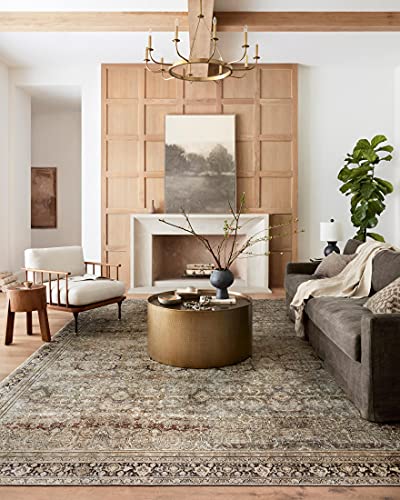
Loloi Layla Olive/Charcoal Area Rug 7′-6″ x 9′-6″ — Best Traditional Print
Check the current price on Amazon
The Loloi Layla listing describes a printed traditional rug in olive and charcoal at a room-scale size — the design reference most fake Persian buyers are picturing.
Strengths
- A printed traditional design gives the crispest medallion detail of any fake — printing does not blur the way pile does
- The olive and charcoal palette hides everyday soil better than ivory grounds
- The stated size suits a living room furniture grouping without wall-to-wall coverage
Trade-offs
- Printed rugs are low and flat — there is little pile to sink into, so pair with a pad for comfort
- The listing title does not state a washable claim, so plan on spot cleaning
- Traditional pattern is busy; it will compete with heavily patterned upholstery
| Specification (from the verified listing title) | Detail |
|---|---|
| Size in listing | 7′-6″ x 9′-6″ (described as approx. 8×10) |
| Design in listing | Traditional, printed (LAY-03) |
| Colours in listing | Olive / Charcoal |
Printed construction is the honest secret of this category: by printing the pattern onto a flat base instead of weaving it through pile, the maker gets hand-knotted levels of pattern detail at a fraction of the cost, and the rug stays thin enough for doors and robot vacuums. The compromise is underfoot — this is a visual rug, not a plush one — so budget for a quality pad, which also stops the low-profile base creeping on hard floors.
Best for: living rooms wanting the sharpest classical pattern detail / Not suited for: buyers who need machine washability above all
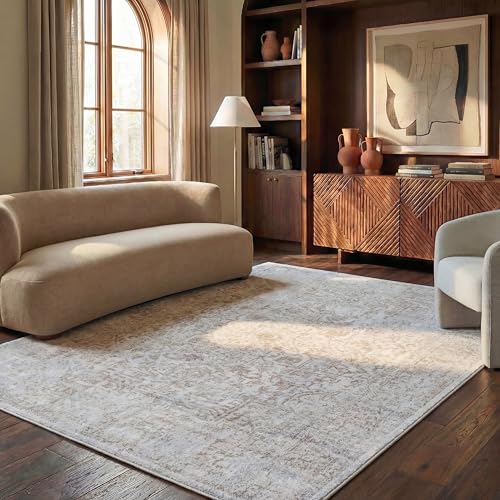
SAFAVIEH Evoke Vintage Medallion Rug 8×10 — Best Power-Loomed Medallion
Check the current price on Amazon
The Evoke’s verified listing states power-loomed polypropylene, a 3/8 inch pile and Turkish manufacture — a complete, checkable spec set for a vintage medallion rug.
Strengths
- Power-loomed polypropylene is the workhorse construction of this category — durable, stain-resistant and family-proof
- The title states pile height and origin plainly, which makes comparison shopping honest
- Ivory and taupe is the most forgiving light palette for bright rooms
Trade-offs
- Low pile means modest cushioning; a pad is still recommended
- Light grounds show pet hair and tracked dirt sooner than deep tones
- Polypropylene can flatten in the highest-traffic lanes over time
| Specification (from the verified listing title) | Detail |
|---|---|
| Size in listing | 8×10 |
| Construction in listing | Power-loomed polypropylene |
| Pile in listing | 3/8 in low pile |
| Origin in listing | Made in Turkey |
| Colours in listing | Ivory & Taupe (EVK256E) |
Turkey is the historic centre of power-loomed rug making, and a listing that states its origin and pile height is giving you the two facts that predict how a rug like this ages: the low polypropylene pile will resist staining and clean easily, and the medallion will stay legible because the pattern is woven, not surface-applied. In ivory and taupe it brightens a room; keep a pad under it and rotate it twice a year to even out traffic lanes.
Best for: busy family living rooms that want a woven — not printed — texture / Not suited for: households that prefer deep, soil-hiding colours

SAFAVIEH Madison Vintage Medallion Rug 9×12 — Best Deep-Tone Medallion
Check the current price on Amazon
The Madison’s verified listing offers the vintage medallion design in gray and gold at a true room-anchoring 9×12 size.
Strengths
- The 9×12 format anchors a full living room set or a large dining table with chairs pulled out
- Gray and gold reads formal and hides soil better than ivory grounds
- A large medallion pattern scales correctly at this size instead of looking stretched
Trade-offs
- The listing title does not state pile height or fibre, so confirm construction on the listing page before ordering
- A rug this size is a two-person job to place and to lift for cleaning
- Deep tones darken a small or north-facing room
| Specification (from the verified listing title) | Detail |
|---|---|
| Size in listing | 9×12 |
| Design in listing | Vintage Medallion (MAD473F) |
| Colours in listing | Gray & Gold |
Big rooms are where fake Persian patterns earn their keep: a centred medallion organises furniture the way a real carpet does in a formal room, and the gray-gold palette bridges modern grey sofas and warm wood. Because the title leaves fibre and pile unstated, treat the listing page as required reading — you are buying the stated design and size on the strength of the pattern, and should confirm construction details there before committing at this size.
Best for: large living and dining rooms needing one anchoring rug / Not suited for: small rooms — the pattern and size will overwhelm them

SAFAVIEH Madison Vintage Paisley Rug 9×12 — Best Paisley Option
Check the current price on Amazon
The second Madison listing states power-loomed polypropylene, 3/8 inch pile and Turkish origin, in a vintage paisley design in cream and multi.
Strengths
- Paisley is the other great classical motif — softer and more flowing than a geometric medallion
- Stated construction, pile and origin make this one of the most transparent listings in the guide
- Cream and multi colours let the rug carry accent colours for cushions and throws
Trade-offs
- Cream grounds show spills sooner; not the first choice for toddler zones
- Paisley’s dense pattern can feel busy in a small room — this is the 9×12, so room size matters
- Low pile again means a pad for underfoot comfort
| Specification (from the verified listing title) | Detail |
|---|---|
| Size in listing | 9×12 |
| Construction in listing | Power-loomed polypropylene |
| Pile in listing | 3/8 in low pile |
| Origin in listing | Made in Turkey |
| Design in listing | Vintage Paisley, Cream & Multi (MAD600B) |
If medallions feel too formal, paisley is the classical alternative with genuine Persian lineage — the motif itself travelled from Persian textiles into world design. This listing’s transparency is its strength: fibre, pile, origin and size are all in the title, so what you see is exactly what arrives. The cream ground is the one caution; in a dining room, choose chairs that glide rather than drag, and clean spills the same day.
Best for: traditional rooms that prefer paisley to medallion geometry / Not suited for: mudrooms and eating areas for small children

Moynesa Ultra-Thin Washable Vintage Rug 5×7 — Best Washable Medallion
Check the current price on Amazon
Moynesa’s verified listing states an ultra-thin washable vintage rug with an oriental medallion design, non-slip and non-shedding, at 5×7.
Strengths
- Machine washable — the feature no real Persian rug can offer, and the reason most people buy fake
- Ultra-thin profile clears doors and sits flat under dining chairs
- Non-shedding construction suits allergy-conscious households and robot vacuums
Trade-offs
- Ultra-thin means almost no cushion; a pad changes the feel completely
- 5×7 is a small-room or under-desk size, not a full living room anchor
- Washable rugs soften in print contrast over many washes
| Specification (from the verified listing title) | Detail |
|---|---|
| Size in listing | 5×7 |
| Design in listing | Oriental Medallion, vintage, boho |
| Features in listing | Washable, ultra-thin, non-slip, non-shedding |
This is the pragmatic heart of the fake Persian idea: the classical pattern as a washable floor covering. Ultra-thin rugs behave more like a textile mat than a carpet — chairs slide, doors clear, spills go in the machine — and the oriental medallion keeps the room looking considered rather than purely practical. Add a thin non-slip pad rather than a thick one to preserve the door clearance that makes this format useful.
Best for: kitchens, dining nooks, rentals and pet households / Not suited for: buyers wanting a plush, sink-in pile

TOPRUUG Washable Oriental Area Rug 6ft Round — Best Washable Oriental
Check the current price on Amazon
TOPRUUG’s verified listing offers a 6ft round washable oriental rug with a floral distressed design for living room and bedroom use.
Strengths
- A round oriental rug softens square rooms and sits beautifully under a round dining table
- Washable construction suits the dining use where round rugs shine
- The distressed floral pattern forgives the small stains between washes
Trade-offs
- Round rugs cover less floor; measure your table and chair footprint carefully
- The listing’s waterproof wording is the maker’s claim — treat the rug as washable, not as a waterproof mat
- Round formats limit furniture arrangement options
| Specification (from the verified listing title) | Detail |
|---|---|
| Size in listing | 6ft round |
| Design in listing | Oriental, floral distressed |
| Features in listing | Washable, waterproof (stated in listing), soft |
Round is the underused shape in this category: a circular medallion-style rug under a pedestal table looks intentional in a way rectangles rarely do, and the washable build matches the reality of dining. Note the listing itself uses the word waterproof; we repeat it only as the maker’s stated claim and advise treating any textile rug as washable rather than waterproof in practice. Measure so pulled-out chairs stay on the rug — that single check decides whether a round dining rug feels generous or mean.
Best for: round dining tables and reading corners / Not suited for: rectangular seating groups that need full coverage
Comparison Table
| Pick | Badge | Key spec | Best for |
|---|---|---|---|
| Loloi Layla Olive/Charcoal Area Rug 7′-6″ x 9′-6″ | Best Traditional Print | 7′-6″ x 9′-6″ (described as approx. 8×10) | living rooms wanting the sharpest classical pattern detail |
| SAFAVIEH Evoke Vintage Medallion Rug 8×10 | Best Power-Loomed Medallion | 8×10 | busy family living rooms that want a woven — not printed — texture |
| SAFAVIEH Madison Vintage Medallion Rug 9×12 | Best Deep-Tone Medallion | 9×12 | large living and dining rooms needing one anchoring rug |
| SAFAVIEH Madison Vintage Paisley Rug 9×12 | Best Paisley Option | 9×12 | traditional rooms that prefer paisley to medallion geometry |
| Moynesa Ultra-Thin Washable Vintage Rug 5×7 | Best Washable Medallion | 5×7 | kitchens, dining nooks, rentals and pet households |
| TOPRUUG Washable Oriental Area Rug 6ft Round | Best Washable Oriental | 6ft round | round dining tables and reading corners |
How to Choose the Best Fake Persian Rugs Without Buying a Disappointment
Decide printed vs woven first. Printed rugs (like the Layla above) give the sharpest pattern and the flattest profile, and feel least like a carpet underfoot. Power-loomed rugs weave the pattern through a low pile, feel more textile, and state their construction proudly in good listings. Washable rugs are usually printed or flat-woven and trade plushness for the machine. None is best — they are three different products wearing similar patterns.
Size the pattern to the room. A medallion needs room to complete itself: in a living room, the rug should run under the front legs of sofas and chairs at minimum, and a centred medallion should not be cut in half by a coffee table placement you cannot change. The 9×12 picks exist because large rooms make small rugs look lost; the 5×7 washable exists because kitchens and nooks punish oversizing.
Read pile height as a door measurement. Where listings state 3/8 inch, that low pile clears most interior doors and lets dining chairs glide. Higher piles feel plusher but blur fine pattern detail — the opposite of what a Persian pattern is for.
Colour is a soil strategy. Ivory grounds brighten and show everything; grey-gold and olive grounds hide the daily evidence of shoes and pets. Distressed vintage finishes are the most forgiving of all, because wear reads as design.
Budget for a pad. Every low-pile and printed rug in this guide feels and behaves better on a pad: more cushion, no creep, longer life. The pad is not an upsell; on hard floors it is half the product.
Fake Persian vs Real Persian: What You Give Up, What You Gain
You give up hand-knotted texture, natural wool, decades-long heirloom life and resale value. You gain machine washability in several picks, stain-resistant synthetic fibre, freedom to use the rug under dining tables and in rentals, and a price that lets you change the room when tastes change. For most households that trade is not a compromise — it is the point of the keyword.
How to Place and Care for a Fake Persian Rug
Step 1: Unroll and reverse-roll. New synthetic rugs curl at the edges. Roll the rug tightly in the opposite direction for a few hours, then lay it flat with furniture on the corners overnight.
Step 2: Fit the pad. Trim the pad an inch smaller than the rug on every side so it stays invisible and the rug edge lies flat to the floor.
Step 3: Align the medallion deliberately. Centre the pattern on the room’s main axis — fireplace, sofa or table — not on the floor’s geometric centre, which is rarely the visual centre.
Step 4: Vacuum without the beater bar on printed rugs. Suction-only cleaning lifts grit without abrading print. Woven low-pile rugs tolerate a beater bar on a high setting.
Step 5: Wash washable rugs cold, and rarely. Machine washing is the emergency tool, not the weekly routine — cold water, mild detergent, air dry flat. Spot-clean spills first; every wash softens print contrast slightly.
Step 6: Rotate twice a year. Turning the rug 180 degrees evens out traffic lanes and sunlight, the two forces that age one end faster than the other.
Pattern Literacy: Reading a Fake Persian Design
The medallion. The central medallion is the signature of classical Persian carpets: a symmetrical focal motif, usually echoed by corner spandrels that imply the medallion continues beyond the rug’s edges. In the picks above, the Evoke and Madison medallion designs follow this grammar, which is why they read as formal. When you judge a medallion rug in a listing photograph, check that the medallion is complete and centred — a cropped medallion is a manufacturing economy you will see every day.
The border system. Real Persian rugs frame the field with a main border flanked by guard stripes, and convincing fakes preserve that hierarchy. A single thin border is the most common corner cut in cheap prints and the fastest tell at floor level. Layla’s traditional design and the SAFAVIEH woven pieces keep the layered border, which is a large part of why they photograph — and live — convincingly.
Distressing. The vintage, erased look is printed or woven-in wear: paler passages that imitate a century of foot traffic. Done well, as in the distressed floral TOPRUUG and the vintage Moynesa, it is the most forgiving finish a household can buy, because real wear joins the pattern invisibly. Done badly, it looks like a printing error. Judge distressing at the edges of the design in photographs: convincing distress fades motifs; bad distress merely fades rectangles.
Paisley. The boteh — the teardrop motif Western design calls paisley — is itself Persian in origin, which makes the Madison paisley pick arguably the most historically literate design in this guide. Its flowing repeat suits rooms where a centred medallion would fight with furniture placement, because an all-over pattern has no centre to align.
Room-by-Room Placement Notes
Living room. Anchor the seating, centre the medallion on the conversation grouping, and let the rug — not the walls — set the room’s colour temperature. The 8×10 Evoke and the 9×12 Madisons are scaled for this job; the 5×7 washable is not, and forcing it produces the floating-island look the mistakes section warns against.
Dining room. The rule is chairs: pulled out, all four legs of every chair should remain on the rug. That arithmetic pushes most dining rooms to 8×10 minimum, and it is where washable construction stops being a convenience and becomes the point. A distressed pattern is the dining room’s best friend, because the first spill disappears into the design while you fetch the cloth.
Bedroom. A Persian-pattern rug under a bed should emerge generously on both sides and at the foot; the visible field is a border and a frame, so choose the border you love. Low pile matters here less for doors than for the soft, quiet step it gives at night.
Rental and first homes. This is the fake Persian’s natural habitat: pattern and warmth over tired floors, at a price that survives a deposit negotiation. Washable and printed picks travel to the next home; a 9×12 woven piece is a commitment to a room size, so measure the next likely room before buying the largest format.
What a Fake Persian Will Never Do (and Why That Is Fine)
It will not appreciate in value, develop the patina of hand-spun wool, or be repaired by a restorer in fifty years. It will not feel like wool under bare feet in winter. Naming these limits is not an argument against the category — it is the category’s founding bargain. You are buying pattern, practicality and permission: permission to put a beautiful classical design under real life, with dogs, children, red wine and landlords all present. The households that love their fake Persian rugs are the ones that bought them for that bargain with open eyes, which is exactly the spirit in which the six verified picks above were chosen.
Judging a Fake Persian From a Listing Photograph
Since most of these rugs are bought from photographs, learn the photograph’s tells. Zoom to the rug’s edge: a convincing piece shows a layered border and a clean, finished edge; a weak one shows a single border stripe and a binding doing structural work. Zoom to the medallion’s curves: printed rugs hold curves crisply, woven rugs hold them with slight pixelation from the knots — both are honest, and both beat the blurred curves of a low-resolution print, which no construction can excuse. Check the distressing at the photograph’s corners, where lazy printing repeats its fade pattern identically; real-looking distress never repeats on a grid.
Finally, read the room in the photograph against the stated size. Sellers photograph small rugs in small staged rooms to imply scale. Your defence is arithmetic, not eyesight: tape the stated dimensions on your own floor before ordering — painter’s tape is the cheapest returns-prevention tool in this entire category — and let the tape, not the staging, tell you whether 5×7 is a rug or a gesture in your room.
Fake Persian Rugs With Pets, Children and Landlords
Pets are the strongest argument in this category. Synthetic low pile releases hair to a vacuum instead of weaving it in, accidents clean without a specialist, and the washable picks convert a disaster into a laundry cycle. Choose distressed patterns and mid-tone grounds — the olive Layla and grey-gold Madison hide a multitude of paw-shaped evidence — and keep a pad beneath, because a rug that slides under an excited dog becomes a toy with corners.
Children make the same case louder: the dining and play zones of a family home are where a washable medallion earns its keep weekly. Landlords complete the trio — a renter can lay pattern and warmth over a landlord’s tired flooring, protect that flooring with the pad, and take the whole investment to the next home. A real Persian in any of these three households is an anxiety with fringe; the fake is the same beauty with permission to live.
When to Buy Real Instead
Honesty about the alternative strengthens this guide’s case. Buy a real hand-knotted rug when the room is formal and low-traffic, when you intend to keep it for decades, when wool’s feel is itself the point, and when the budget treats the rug as furniture capital rather than decor. The genuine silk Persian-style rug excluded from this guide would be a treasure in such a room. The households in the previous section — pets, children, rentals, dining — are not failed real-rug buyers; they are the fake category’s rightful owners, and the six verified picks were chosen for exactly them.
The Pad Question, Settled in Detail
Every pick in this guide improves on a pad, but pads are not interchangeable, and the wrong pad can spoil a good rug. For the low-pile woven pieces — the Evoke and the Madisons — a felt-and-rubber pad of moderate thickness adds the cushion their 3/8 inch pile deliberately omits, while anchoring them on hard floors. For the printed Layla, a thinner pad preserves the flat, tailored look that printing exists to create; a thick pad under a printed rug makes it feel like a carpet it never claimed to be. For the washable Moynesa and TOPRUUG, the pad must be as washable-tolerant as the rug or removable in seconds, because a pad that cannot leave quickly will simply be left, permanently, under a rug that gets washed around it — a hygiene farce. Buy the pad with the rug, trim it an inch inside the rug’s edge on all sides, and replace it when its grip dies, because pads are consumables with a shorter clock than the rugs above them.
Colour Theory for Classical Patterns
Classical rug palettes were engineered by dyers who understood soil, light and status, and the fakes inherit their wisdom when they copy faithfully. Ivory grounds, like the Evoke’s, maximise light and formality and confess every footprint — choose them for adult, low-traffic rooms and bright spaces that can afford the confession. Mid-tone grounds — the Layla’s olive, the Madison’s grey-gold — are the working palettes: they hold a room’s colour scheme together, bridge warm woods and cool upholstery, and age invisibly. Deep grounds darken and cosset, suiting libraries and bedrooms, and they make small rooms smaller. The multi-colour paisley plays a different role: it is the palette donor, the piece from which cushion and curtain colours are pulled, and rooms decorated from the rug outward always look more intentional than rooms where the rug arrived last as an apology. Whichever ground you choose, let one element in the room repeat the rug’s secondary colour — that single echo is the difference between a rug that sits in a room and a rug that belongs to it.
Delivery Day: Inspecting Your Rug Like a Professional
Unroll the rug fully, in daylight, before the return window starts feeling abstract. Walk its length barefoot: your feet will find thin spots, backing ridges and pile direction changes your eyes forgive. Check the medallion’s centring against the stated dimensions with a tape, because a pattern can be centred on a rug that is itself two inches narrower than promised. Smell is data too — a sharp chemical odour that does not fade in forty-eight hours of airing is a rug asking to go back. Photograph any flaw before you place furniture, while the evidence is clean. These ten minutes are the highest-value minutes in the rug’s life with you, and they are the practical companion to every specification this guide has taught you to demand.
Stain Response: The First Ten Minutes Decide
On any rug in this guide, a spill’s fate is settled in its first ten minutes, and the protocol is identical across constructions. Blot — never rub — with a clean white cloth, working from the spill’s edge inward so the stain cannot spread its territory. Cold water first; most food and drink spills on synthetic pile surrender to water alone if they are reached before they dry. A drop of mild detergent in the second pass handles what water leaves, and a final rinse-blot removes the detergent, which otherwise dries sticky and attracts soil to the exact spot you cleaned — the mysterious dark patch that appears a week after a successful cleanup is usually soap, not stain. Red wine and pet accidents on the washable picks skip the heroics: blot the worst, then let the machine do what the listing promised it could. On the woven and printed picks, patience and blotting protect the pattern that is the rug’s whole reason for existing, and a spill left to dry while guests are entertained is a stain chosen, however politely, over a rug.
Fake Persian Rugs in Open-Plan Spaces
Open-plan rooms are where classical rugs quietly outperform every other floor covering, because a medallion is a room drawn inside a room. In a combined living-dining space, one large Persian-pattern rug under the seating and a quieter floor under the table separates the zones without a wall, a screen or an argument. The discipline is singularity: one patterned anchor per sightline. Two competing medallions in one open space read as two shops sharing a floor, while one medallion plus calm textures reads as design. The 9×12 picks in this guide exist for exactly this architecture — big enough to declare a territory, classical enough to hold it — and the distressed finishes forgive the traffic that open plans concentrate across their centres. If your home is open-plan, size up, pattern once, and let the rug do the partitioning it was, in a sense, invented over centuries to do.
Sound is the open plan’s hidden problem, and a rug is its cheapest treatment: a low-pile woven piece will not silence a room, but it will take the clatter off hard floors and make conversation feel private at normal volumes. Add the pad recommended earlier and the effect compounds, because felt under a rug is doing acoustic work as well as comfort work. It is one more reason the fake Persian earns its floor space in modern homes that its hand-knotted ancestors, designed for smaller, softer rooms, never had to consider.
Fake Persian Rugs Over Carpet and Over Wood
Most of this guide assumes hard floors, but classical rugs earn a second living layered over plain carpet, where they supply the pattern the carpet cannot and protect the traffic lane the carpet should not have to survive alone. Layering rules: the under-carpet should be low and tight, the rug’s pad becomes a carpet-grip pad rather than a floor pad, and the colour relationship should be tonal — a medallion over a carpet that fights it in hue will lose. Over wood, the same rug is doing protection as much as decoration, and the felt side of the pad faces down without negotiation. Either way, the classical pattern is the hardest-working print in the house: it hides the evidence of the life lived on it, which is the entire historical reason for its existence, faithfully inherited by its machine-made descendants in this guide.
A Word on Borders, Fringe and Finishing
Classical rugs end in fringe — the warp threads of the loom — and fakes handle that ending in telling ways. Some add a decorative fringe, some bind the edge, and the choice is practical as much as aesthetic: fringe tangles in vacuum heads and robot brushes, while a bound edge lies flat and disappears. Judge a listing by whether it shows you the edge at all. A maker who photographs the border, the edge and the back is a maker confident in the whole object, and in this category the back is half the truth — it reveals construction, backing and honesty at a glance. Ask for the back, in photographs or in person, before any rug in this guide’s sizes earns your floor.
Before You Buy: The Sixty-Second Final Review
Every guide in this programme ends with the same discipline, applied to this category in its own terms. Restate your actual need in one sentence, without adjectives — the room, the user, the job. Check the chosen pick against the brief it was selected under, not against the photographs of the picks you rejected. Confirm the stated facts one final time on the listing itself: the size, the material words, the features this guide quoted, because listings are edited and titles drift between a guide’s verification and your purchase day. Confirm the practicalities that live outside the product — the storage, the pad, the case, the return window — since more purchases fail on their surroundings than on their specifications. And then buy without reopening the search, because the research is done, the evidence is recorded in this page’s sources, and the second-guessing that follows a sound decision is the only cost this category charges that nobody can refund. The right product, honestly verified and properly fitted to its job, is the end of shopping and the beginning of use — which was the point from the first paragraph.
Common Buying Mistakes
Believing the word Persian in a marketplace title. Many listings borrow the word for any busy pattern. Judge the stated construction and design — medallion, paisley, oriental, printed, power-loomed — as this guide does.
Buying a real hand-knotted rug for a fake-rug job. Wool heirlooms under dining tables and dogs are a source of stress, not pleasure. That is why the genuine silk rug in our search results was excluded here.
Sizing by the room instead of the furniture. A rug that floats with no furniture touching it looks like a mistake at any price. Anchor at least the front legs of the seating.
Skipping the pad on hard floors. Thin rugs creep, bunch and wear from beneath. The pad prevents all three.
Washing a rug whose listing never claimed washable. Backings delaminate and prints bleed. Wash only the picks whose listings state washable, and spot-clean the rest.
Final Recommendation
Choose the Loloi Layla for the sharpest printed traditional pattern, the SAFAVIEH Evoke for a transparently specified woven medallion, the Madison paisley if you prefer the softer classical motif, and the Moynesa or TOPRUUG when washability outranks everything. Every pick above is verified, and every spec printed comes from its listing title. For neighbouring pattern and care guides, see the vintage and oriental clusters linked below.
Best Persian Rugs Online Best Persian Rugs Carpet Best Antique Oriental Rugs Best Sofa Pillows With Oriental Rugs Best Shag Rugs Machine Made Best Vacuum Cleaners For Shag Rugs
Frequently Asked Questions
Are fake Persian rugs machine washable?
Some are — two picks in this guide state washable in their listings. Others, including the printed and power-loomed SAFAVIEH and Loloi picks, should be spot-cleaned unless their listing page says otherwise. Never assume washability.
What are fake Persian rugs made of?
Usually synthetic fibres. The Evoke and Madison paisley listings state power-loomed polypropylene; printed rugs use a flat synthetic base. Where a listing does not state fibre, we say so in the review.
Will a fake Persian rug look cheap?
Printed and distressed vintage designs look convincing at floor level because the eye reads pattern, not pile. The giveaways are a missing pad (the rug feels thin) and a size too small for the furniture.
What size fake Persian rug should I buy?
For living rooms, at least large enough to sit under the front legs of all seating — commonly 8×10 or 9×12 as in this guide. For dining, the rug should extend beyond pulled-out chairs on all sides.
Is a round oriental rug a good idea?
Yes, under round tables and in reading corners, as with the 6ft TOPRUUG pick. Measure the chair footprint first; round rugs cover less area than the same nominal width in a rectangle.
Why was a real Persian-style rug excluded from this guide?
A hand-knotted silk rug appeared in search results, but it is a genuine rug — the opposite of this search. Fake Persian buyers want machine-made practicality, and the guide keeps that promise.


