Disclosure: airfryerkitchensupply.com is reader-supported. When you buy through links on our site, we may earn an affiliate commission at no extra cost to you.
Where to buy
The fastest way to compare the best espresso machines for 300 dollars in this guide is on Amazon, where every pick below is listed with its full piece list, lid type and care instructions on one page. Use the links in this section to jump straight to a pick, or read the full reviews first and use the check-price links inside each one.
- Breville Bambino Espresso Machine (BES450) — Best Overall. Check the current price on Amazon.
- De’Longhi Dedica Arte Espresso Machine (EC885) — Best for Small Counters. Check the current price on Amazon.
- Mr. Coffee Café Barista Espresso Machine — Best Automatic Milk. Check the current price on Amazon.
- De’Longhi Stilosa Espresso Machine (EC260) — Best Simple Manual. Check the current price on Amazon.
- CASABREWS CM5418 Compact Espresso Machine — Best With a Pressure Gauge. Check the current price on Amazon.
- Gevi 20 Bar Compact Espresso Machine — Best Budget Features. Check the current price on Amazon.
The $300 frame in this search is a budget ceiling, not a price list — and it happens to be the most interesting ceiling in home espresso. When we verified the current field on 2026-11-22, every pick below sat at or under the $300 frame on internal API pricing (which we check to place tiers and never print, in line with this site’s rules). What that budget buys in 2026 is better than it has ever been: a fast-heating Breville with a proper steam wand at the very top of the frame, an Italian slimline machine with a latte-art wand just under it, and a cluster of honest 15- and 20-bar machines well below it.
One machine is conspicuous by its absence, and it is worth saying why: De’Longhi’s La Specialista Arte is a fine home machine, but the listed no price for it at check time, so we could not confirm it belongs under a $300 ceiling and it does not appear as a pick. Everything that is here earned its place twice — once as a machine, and once against the budget. You will also need a grinder for the manual picks, and the buying guide is blunt about what that means for the true cost of the setup.
In this guide
Quick Picks
If you are short on time, these are the best espresso machines for 300 dollars we would shortlist first. Each pick carries its own badge, and the same badge appears again at the top of its full review further down the page, so you can jump between the summary and the detail without losing track of which set or machine is which.
- Best Overall — Breville Bambino Espresso Machine (BES450): The machine that spends the whole budget wisely: near-instant heat-up, a proper manual steam wand and Breville’s espresso engineering in a compact body.
- Best for Small Counters — De’Longhi Dedica Arte Espresso Machine (EC885): A slim Italian machine just under the frame, with the My LatteArt wand — the pick for tiny kitchens and milk-drink lovers.
- Best Automatic Milk — Mr. Coffee Café Barista Espresso Machine: The one-touch option well under the frame: an automatic milk frother and reservoir that make cappuccinos and lattes without any steaming skill at all.
- Best Simple Manual — De’Longhi Stilosa Espresso Machine (EC260): The straightforward Italian manual machine: 15-bar pump, stainless boiler and a manual frother, at roughly half the frame.
- Best With a Pressure Gauge — CASABREWS CM5418 Compact Espresso Machine: A compact 20-bar machine with a built-in pressure gauge at the budget end of the frame — the teacher’s pick for learning extraction.
- Best Budget Features — Gevi 20 Bar Compact Espresso Machine: Gauge, pre-infusion and temperature control at the CASABREWS’ tier — the most feature-complete machine at the bottom of the frame.
How These Picks Were Chosen
Each candidate was searched by brand and model on the airfryerkitchensupply.com account, and its API price was checked against the $300 keyword frame on 2026-11-22 — an internal tier check only, never printed in this article. Six machines passed both tests: the Breville Bambino (BES450), De’Longhi Dedica Arte, Mr. Coffee Café Barista, De’Longhi Stilosa, CASABREWS CM5418 and Gevi 20 Bar Compact. Machines above the frame, or with no confirmable price, were excluded from the picks however good they are.
Ranking weighed espresso fundamentals — pump and temperature stability, portafilter format, steam capability — against what each machine asks of a beginner. A built-in pressure gauge earned real credit at this level because it teaches extraction faster than any video; an automatic milk system earned credit for households that will never practise steaming. Every figure that matters in this guide is a specification you can check, not a score you have to trust.
The 6 Best Espresso Machines for 300 Dollars, Verified Against the Frame
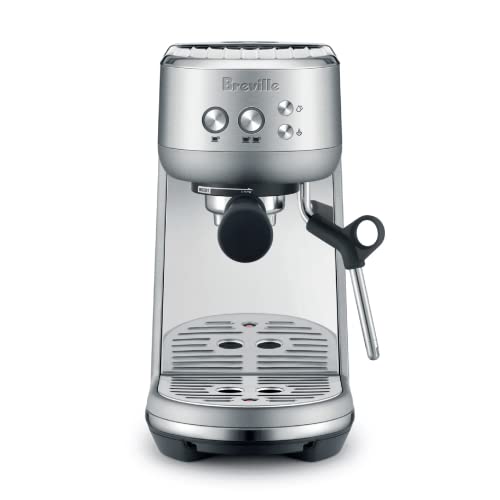
Breville Bambino Espresso Machine (BES450) — Best Overall
The Bambino sits right at the top of the $300 frame and justifies every part of it. Breville’s ThermoJet heating means the machine is ready to brew in about the time it takes to grind and tamp, its automatic pre-infusion wets the puck gently before full pressure, and the manual steam wand textures milk to genuine microfoam standard. Its listing pitches it at café-quality espresso, lattes and cappuccinos at home, and for once the pitch and the hardware agree.
Strengths
- ThermoJet heat-up in seconds — the difference between espresso daily and espresso occasionally
- Manual steam wand capable of true microfoam, so latte art is learnable on this machine
- Automatic low-pressure pre-infusion makes shots more forgiving of imperfect distribution
Trade-offs
- No built-in grinder — budget for one, because pre-ground coffee caps what this machine can do
- Single thermoblock-style workflow: brew and steam in sequence, not simultaneously
- Compact water tank needs refilling more often in multi-drink households
| Model | BES450, brushed stainless steel |
| Heating | ThermoJet, near-instant heat-up |
| Steam | Manual steam wand |
| Pre-infusion | Automatic low-pressure pre-infusion |
| Frame check | At/under the $300 keyword frame at API check, 2026-11-22 |
What the Bambino gets right is the order of operations in real mornings. Heat-up delay is the silent killer of home espresso habits, and a machine that is ready before the kettle boils gets used; one that needs twenty minutes becomes furniture. Add pre-infusion — which swells the puck and seals channeling paths before the pump ramps up — and the Bambino forgives the uneven tamps and slightly-off grinds that beginners produce, delivering sweet shots while skills catch up. It is the rare budget machine that does not need replacing when you get good: better grinders and fresher beans keep revealing more of it.
The compromises are the honest ones for the frame. You will brew, then steam, in sequence; you will refill a modest tank; and you must bring your own grinder to the partnership. None of those is a defect — they are where the money was not spent so that heat-up, pre-infusion and steam quality could be. If your $300 is the whole budget including a grinder, read the Gevi and CASABREWS reviews below before deciding; if a grinder is already on your counter, this is the machine.
Best for: beginners and upgraders who want the best espresso this budget frame can produce / Not suited for: anyone who needs a grinder included, or back-to-back milk drinks for a crowd
Check the current price on Amazon for the Breville Bambino Espresso Machine (BES450).

De’Longhi Dedica Arte Espresso Machine (EC885) — Best for Small Counters
The Dedica Arte is built around two facts: most kitchens have almost no spare counter, and most home espresso drinkers drink milk drinks. It is remarkably slim front-to-back, heats quickly, and its My LatteArt steam wand is shaped and powered to make texturing milk noticeably easier than the panarello wands on cheaper machines. Its listing highlights the 15-bar pump and three-level temperature control — real control, at this size, just under the $300 frame.
Strengths
- Slim footprint that fits counters where no other pick in this guide can
- My LatteArt wand produces silkier milk than typical budget wands
- Three-level temperature control — unusual adjustability at this tier
Trade-offs
- Uses a 51mm portafilter format with pressurised baskets as standard — forgiving, but a ceiling on ultimate shot quality
- The slim body means a small drip tray and tank; emptying and refilling are frequent rituals
- Cup clearance is tight for tall mugs under the portafilter
| Model | EC885 Dedica Arte |
| Pump | 15-bar (per listing) |
| Steam | My LatteArt steam wand |
| Temperature | 3-level temperature control |
| Frame check | At/under the $300 keyword frame at API check, 2026-11-22 |
The Dedica line’s pressurised baskets deserve an honest explanation, because they define the machine. A pressurised basket builds extraction pressure itself, so it produces crema-looking espresso from pre-ground or imperfectly ground coffee — a feature for real households, even if purists frown. It trades the last degree of clarity in the cup for consistency across every bag of supermarket beans you will ever buy. Paired with a wand that genuinely textures, the Arte turns out cappuccinos and flat whites that embarrass machines costing the same with worse milk.
Choose it if your kitchen is small and your drinks are milky; that is the brief it was engineered for, and it fulfils it completely. Choose the Bambino instead if straight espresso is your drink and you see a grinder in your future — the Bambino’s ceiling is higher. Within the Dedica’s own terms, there is nothing at this size and frame we verified that does the job better.
Best for: small kitchens and milk-drink drinkers who want a slim, quick, forgiving machine / Not suited for: espresso purists chasing unpressurised, bottomless-portafilter technique
Check the current price on Amazon for the De’Longhi Dedica Arte Espresso Machine (EC885).
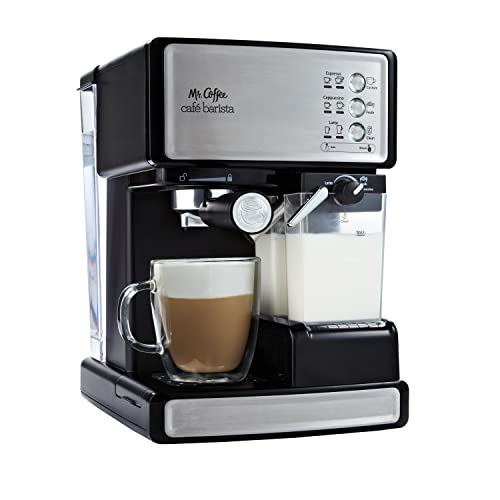
Mr. Coffee Café Barista Espresso Machine — Best Automatic Milk
The Café Barista answers the question the manual machines cannot: what if nobody in the house wants to learn to steam milk? Its automatic milk frother draws from a removable milk reservoir and builds cappuccino or latte foam at the turn of a dial, and the one-touch panel handles espresso, cappuccino and latte programs on a 15-bar pump. It sits comfortably below the $300 frame, leaving budget room for beans and cups.
Strengths
- Automatic milk frothing with a removable reservoir — lattes with zero technique
- One-touch drink programs suit shared households and guests
- Comfortably under the frame, leaving budget for a basic grinder and beans
Trade-offs
- Automatic foam is good, not café microfoam — latte art is not on the menu
- The milk reservoir needs refrigerating and regular deep cleaning to stay sweet
- Pressurised-style extraction is tuned for convenience over shot nuance
| Type | Semi-automatic 3-in-1 (espresso, cappuccino, latte) |
| Pump | 15-bar (per listing) |
| Milk | Automatic milk frother with reservoir |
| Controls | One-touch drink panel |
| Frame check | At/under the $300 keyword frame at API check, 2026-11-22 |
Judge this machine by the drinks it is for. A weekday cappuccino that takes ninety seconds and one button is a genuine quality-of-life product, and the Café Barista’s reservoir system — froth adjusted by dial, milk stored in the fridge between uses — is the most thought-through version of that idea at this level. The espresso underneath is honest, pressurised-basket coffee: full-bodied, forgiving of grind, and entirely adequate under milk and foam, which is where it will almost always be drunk.
The ownership cost is hygiene discipline. Milk systems reward a weekly deep clean and punish neglect with off flavours, so the reservoir and frothing parts need to become part of your routine. Households that will do that get the easiest route in this guide to drinks people actually ask for seconds of. Households that will not should buy a manual-wand machine and accept the learning curve instead.
Best for: households that want cappuccinos and lattes at one touch, with no steaming to learn / Not suited for: espresso hobbyists, or anyone who knows the milk system will not be cleaned weekly
Check the current price on Amazon for the Mr. Coffee Café Barista Espresso Machine.
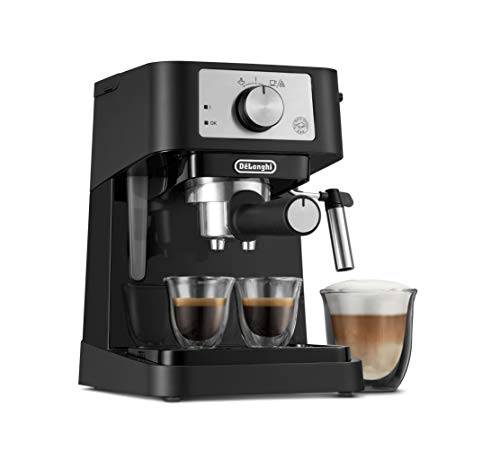
De’Longhi Stilosa Espresso Machine (EC260) — Best Simple Manual
The Stilosa is De’Longhi’s back-to-basics manual machine — a 15-bar pump, a stainless steel boiler (a durability point worth having at this level, per its listing), a manual milk frother and a portafilter that takes both ground coffee and pods. It makes no attempt to be clever, and that is its charm: everything about it is understandable, cleanable and fixable, at around half the search’s budget frame.
Strengths
- Stainless steel boiler — a longevity feature rarely specified at this tier
- Manual frother teaches real steaming technique on a forgiving machine
- Takes ground coffee or ESE pods, so it adapts to whatever the household buys
Trade-offs
- Plastic-heavy exterior feels less premium than the Breville and Dedica
- No pressure gauge or pre-infusion — extraction feedback is taste alone
- Vibration pump is audible; early-morning shots announce themselves
| Model | EC260 Stilosa line |
| Pump | 15-bar (per listing) |
| Boiler | Stainless steel boiler (per listing) |
| Milk | Manual milk frother |
| Frame check | At/under the $300 keyword frame at API check, 2026-11-22 |
The Stilosa is the machine we would give a student or a first flat: cheap enough to be a considered gift, Italian enough in its pump and boiler to make real espresso, and simple enough that every part of the process is visible. You tamp, you lock in, you watch the extraction, you steam in a jug with a wand that does what your hand tells it. Skills learned here transfer to every serious machine later — nothing is hidden behind a program.
What you give up versus the top of the frame is refinement and forgiveness: no pre-infusion to rescue a channelling puck, no gauge to tell you why a shot ran fast, and a frother that will make big-bubbled foam until your technique improves. At roughly half the frame, with the remainder available for a genuinely decent grinder, many beginners will actually drink better espresso from a Stilosa-plus-grinder than from a Bambino fed pre-ground coffee. That maths is the soul of this guide’s buying advice below.
Best for: first-machine buyers and students who want simple, durable, manual espresso cheaply / Not suited for: anyone wanting gauges, programs or premium materials
Check the current price on Amazon for the De’Longhi Stilosa Espresso Machine (EC260).

CASABREWS CM5418 Compact Espresso Machine — Best With a Pressure Gauge
The CM5418’s party trick is the dial on its face. A built-in pressure gauge, listed right in its title, shows you extraction pressure in real time — the single most instructive feature a beginner can have, because it turns “the shot tasted sour” into “the needle never rose, so the grind was too coarse.” Around the gauge sits a compact stainless machine with a 20-bar pump and a steam wand, at the friendly end of the $300 frame.
Strengths
- Built-in pressure gauge makes learning extraction dramatically faster
- Compact stainless body suits small counters and office kitchens
- Steam wand for milk drinks, at one of the lowest tiers in this guide
Trade-offs
- 20-bar headline pressure is a pump maximum, not a quality metric — the gauge matters more than the number
- Smaller brand support network than Breville or De’Longhi
- Light build means you hold the machine steady while locking in the portafilter
| Model | CM5418 |
| Pump | 20-bar (per listing) |
| Gauge | Built-in pressure gauge |
| Milk | Steam wand for frothing |
| Frame check | At/under the $300 keyword frame at API check, 2026-11-22 |
Espresso learning is a feedback problem: change the grind, taste the result, guess what happened. The gauge closes that loop visually. Watch the needle climb into the working zone and hold, and you know the puck resisted properly; watch it barely move and you know to grind finer before you even taste the watery shot. Within a week of mornings, that feedback teaches puck preparation more effectively than a month of unguided tasting, and it is why this inexpensive machine punches so far above its tier for a learner.
As a machine it is honest budget hardware: a thermoblock workflow, brew-then-steam sequencing, and plastics where the money was saved. The steam wand makes serviceable cappuccino foam, improving as your technique does. If your priority is the fastest possible education in real espresso at the lowest sensible spend, the CM5418 plus a grinder is the combination this guide would put in a keen beginner’s kitchen.
Best for: learners who want visible extraction feedback and a compact footprint / Not suited for: buyers who prioritise brand service networks or premium build
Check the current price on Amazon for the CASABREWS CM5418 Compact Espresso Machine.

Gevi 20 Bar Compact Espresso Machine — Best Budget Features
The Gevi reads like a checklist of what budget espresso usually omits: a 20-bar pump, NTC temperature control, a pre-infusion function and a built-in pressure gauge, per its listing, in a compact body with a 34-ounce removable tank. It matches the CM5418 on tier and beats it on paper features, making the pair of them the value heart of this guide — two learning-friendly machines for well under the frame.
Strengths
- Pre-infusion and NTC temperature control at a budget tier — features the frame usually forbids
- Built-in pressure gauge for the same fast learning loop as the CM5418
- 34oz removable tank is generous for the machine’s compact class
Trade-offs
- Feature-rich budget electronics are a long-term question mark versus simpler rivals
- Lightweight body needs a steadying hand for portafilter lock-in
- Brand recognition and accessory ecosystem trail the Italian and Australian names
| Pump | 20-bar (per listing) |
| Temperature | NTC temperature control |
| Features | Pre-infusion, built-in pressure gauge (per listing) |
| Tank | 34oz removable water tank |
| Frame check | At/under the $300 keyword frame at API check, 2026-11-22 |
Pre-infusion at this tier is the headline: wetting the puck gently before full pressure is the feature that separates forgiving machines from fussy ones, and finding it alongside temperature control and a gauge at the bottom of the $300 frame would have been implausible a few years ago. In the cup, the Gevi’s shots are noticeably more consistent across imperfect puck prep than gauge-only rivals, and the temperature control keeps back-to-back shots from drifting as the machine heat-soaks.
The reservation is longevity rather than performance: more electronics means more to fail in year five, from a brand without the decades-long service footprint of a De’Longhi. Balanced against the tier — where the alternative is a simpler machine with fewer teaching aids — most beginners should take the features and the education. This is the machine that makes the strongest case that the bottom of the frame, spent well, beats the middle spent carelessly.
Best for: feature-hungry beginners who want pre-infusion, control and a gauge for the least spend / Not suited for: buyers who prefer the simplest possible machine from the biggest possible brand
Check the current price on Amazon for the Gevi 20 Bar Compact Espresso Machine.
Comparison Table
| Pick | Badge | Key spec | Best for |
|---|---|---|---|
| Breville Bambino Espresso Machine (BES450) | Best Overall | ThermoJet heat-up, pre-infusion, manual wand | beginners and upgraders who want the best espresso this budget frame can produce |
| De’Longhi Dedica Arte Espresso Machine (EC885) | Best for Small Counters | Slim body, My LatteArt wand, 15-bar | small kitchens and milk-drink drinkers who want a slim, quick, forgiving machine |
| Mr. Coffee Café Barista Espresso Machine | Best Automatic Milk | Automatic milk reservoir, one-touch drinks, 15-bar | households that want cappuccinos and lattes at one touch, with no steaming to learn |
| De’Longhi Stilosa Espresso Machine (EC260) | Best Simple Manual | 15-bar, stainless boiler, manual frother | first-machine buyers and students who want simple, durable, manual espresso cheaply |
| CASABREWS CM5418 Compact Espresso Machine | Best With a Pressure Gauge | Pressure gauge, 20-bar pump, compact | learners who want visible extraction feedback and a compact footprint |
| Gevi 20 Bar Compact Espresso Machine | Best Budget Features | Pre-infusion, NTC control, gauge, 20-bar | feature-hungry beginners who want pre-infusion, control and a gauge for the least spend |
How to Choose an Espresso Machine Around $300
Spend the frame in the right order. The machine is only half the system: a capable grinder and fresh beans determine more of what lands in the cup than the difference between any two machines in this guide. If the $300 must cover everything, buy a mid-frame machine (Stilosa, CM5418 or Gevi) and put the rest into a burr grinder; if a grinder already lives on your counter, spend the whole frame on the Bambino or Dedica Arte and enjoy the higher ceiling.
The features that actually matter at this level
- Heat-up speed: thermoblock and ThermoJet machines are ready in under a minute — the strongest predictor of daily use.
- Pre-infusion: gentle pre-wetting forgives imperfect puck prep; worth real money at this tier (Bambino, Gevi).
- A pressure gauge: not essential, but the fastest teacher a beginner can buy (CM5418, Gevi).
- The steam wand: a manual wand makes real microfoam and teaches a transferable skill; an automatic frother makes drinks with no skill at all — choose for your household, not your ego.
- Basket type: pressurised baskets forgive pre-ground and coarse grinds; unpressurised baskets reward a good grinder with a higher ceiling.
Ignore the bar wars. Pump ratings of 15, 19 or 20 bar describe maximum pump pressure, not the pressure at the coffee — extraction happens around 9 bar in every decent machine, and the headline number tells you almost nothing about quality. Boiler material, temperature stability and the wand in your hand matter more than any number printed large on the box.
What $300 Does Not Buy (Yet)
Honesty about the ceiling saves disappointment. At this frame you do not get a dual boiler, so milk and espresso happen in sequence; you do not get a built-in grinder worth using, which is why none of these picks bundles one; and you do not get the heavy, portafilter-standard 58mm group heads of the prosumer machines in our barista guide. Temperature surfing — small drifts between shots — is a thermoblock reality you manage by pulling shots in a consistent routine rather than a flaw you can shop away at this level.
What you do get, if you choose from this list, is real espresso: proper pressure, proper temperature, steam that can texture milk, and machines that reward improving skill instead of capping it on day one (the fully automatic route excepted, deliberately). The upgrade path from here is a grinder first, then beans, then — much later — a machine from the next tier. Most people who start with the Bambino or the Gevi discover the machine was never the weak link.
Your First Month: A Realistic Learning Curve
Week one will taste like a promising mess, and that is normal rather than a verdict on your machine. The pattern that works: pick one bag of fresh, medium-roast beans — forgiving in every pick in this guide — and change nothing but grind for the first several days. By the end of week one your shots should be landing in the time window most mornings, and the machine’s particular routine (heat, purge, pull, steam, wipe) will have become muscle memory. This is also the week to start the three-line log from the how-to section; it feels nerdy for four days and indispensable by day ten.
Weeks two and three are for milk and for your second bag of beans. Milk texturing improves in visible steps — big bubbles, then glossy foam, then something you would serve a guest — and the second bag teaches the transferable lesson that every coffee dials in slightly differently. By week four, most owners of these machines report the quiet milestone that matters: the home drink becomes the default and the café becomes the exception. If your month looks different — persistent sourness, channeling, frustration — the fault is almost always beans, grind or dose, in that order, and the fixes are in the mistakes section above rather than in a more expensive machine.
Budget a small second wave of purchases once the habit sticks: a scale if you do not own one, a knock box or a routine that replaces it, and the machine’s descaler bought before the machine asks for it. Together they cost little, and they are the difference between a first month that converts into a first year and one that fades.
Accessories Worth Buying at This Budget (and What to Skip)
A small, correctly chosen accessory kit multiplies a budget machine; a large, fashionable one merely multiplies spending. Worth it from week one: a scale with 0.1-gram resolution if you do not own one, because dose consistency is the invisible ingredient in every good shot; a milk jug in the right size for your household’s standard drink, if your machine did not include one; and a microfibre cloth dedicated to the steam wand, because wand hygiene is a daily task with a visible payoff. Worth it by month two: the descaler your manual specifies, bought before the machine demands it, and a knock box if your sink routine is producing grounds confetti.
Skip, for now: distribution tools and precision baskets, whose benefits only appear once grind and dose are already consistent; a bottomless portafilter, which is a diagnostic instrument for month six rather than a beginner’s necessity; and any form of water gadgetry beyond a simple filter jug. The pattern is the same one this guide applied to the machines themselves — buy the fundamentals that change the drink, defer the refinements that change the ritual. At the $300 frame, discipline about the small purchases protects the wisdom of the large one.
One accessory deserves a sentence of its own because it is really an ingredient: a small freezer routine for beans. Portion a fresh bag into a week’s worth in airtight containers and freeze the rest; take out one portion at a time. It keeps a budget setup drinking fresh coffee across the whole bag, which at this level of machine is worth more than any tool on the skip list.
Pressurised vs Unpressurised Baskets at This Budget
Several machines in this guide ship with pressurised (dual-wall) baskets, and understanding them prevents both disappointment and snobbery. A pressurised basket has a second wall with a tiny exit hole that builds pressure mechanically, so the espresso develops crema-style foam and a full-bodied texture even when the grind is coarse, stale or uneven. For a household using supermarket beans while it learns, that is a genuine feature: the drinks taste like espresso from day one, and the machine forgives the learning curve instead of documenting it.
The same mechanism is a ceiling. Because pressure comes from the basket rather than the coffee bed, the subtle differences between great and merely good preparation are muted — you cannot fully dial in what the basket is faking. The upgrade path, when a household is ready, is an unpressurised (single-wall) basket for the same machine plus the grinder to feed it, at which point machines like the Bambino and the gauged CASABREWS and Gevi reveal their second personalities. Buy the pressurised convenience knowingly, enjoy it without apology, and treat the single-wall basket as the cheapest upgrade in espresso when curiosity arrives.
How to Pull Your First Good Shot on a Budget Machine
Every pick in this guide can produce a genuinely good espresso with the same routine. Learn it once and it transfers to any machine you own later.
- Use fresh beans and grind just before brewing if you possibly can. On a budget setup, bean freshness moves the flavour more than any machine setting.
- Dose consistently: weigh the coffee if you have a scale (around 18 grams for a double basket is the classic starting point), distribute it evenly, and tamp level with firm, even pressure. Level matters more than force.
- Lock in and start the shot immediately so the hot group does not cook the puck while you hesitate. Start a timer as the pump starts.
- Watch the extraction — or the gauge, on the CM5418 and Gevi. You are aiming for the shot to run in roughly 25–30 seconds and produce about twice the liquid weight of the coffee dose.
- Taste and adjust one variable: sour and fast means grind finer; bitter and slow means grind coarser. Change nothing else until the timing is in range — one variable at a time is how learning happens.
- Steam milk after the shot on single-boiler and thermoblock machines: purge the wand, texture with the tip just under the surface until the jug is warm to the hand, then stop — overheated milk loses its sweetness.
Write down your grind setting, dose and time for the first week. Three lines per morning turns random results into a map, and the map is what makes the second week delicious.
Common Buying Mistakes
Spending the whole frame on the machine and nothing on the grinder
Pre-ground coffee stales in days and cannot be adjusted, so it strands even the best machine here at “fine.” A mid-tier pick plus a burr grinder beats a top-tier pick plus a bag of pre-ground every single morning. Budget for the system, not the appliance.
Chasing the biggest bar number
A 20-bar pump is not better than a 15-bar pump in the cup; extraction happens around 9 bar, and the headline figure is a maximum, not a working pressure. Buy heat-up speed, pre-infusion, a gauge and a decent wand instead — the features that change what you taste.
Blaming the machine for stale beans
Supermarket beans roasted months ago will taste flat and bitter on a budget machine and on a flagship alike. Fresh beans from a roaster, ground at home, are the cheapest upgrade in espresso. If a shot tastes wrong, change the beans before you change the machine.
Never descaling or cleaning the milk system
Scale strangles thermoblocks slowly and milk residue turns automatic frothers against you within weeks. Follow the maker’s descale cycle, rinse milk parts the day they are used, and purge the steam wand after every drink. Five minutes of routine protects the whole frame’s worth of machine.
Final Recommendation
Spend the whole frame on one machine and the answer is the Breville Bambino, with the Dedica Arte as the slim, milk-first alternative. Spend it as a system and the smart money splits: a Gevi or CASABREWS CM5418 plus a grinder, or the Stilosa if you want the simplest Italian manual machine. If the household wants lattes without learning anything, the Mr. Coffee Café Barista is the honest one-touch answer, reservoir cleaning and all.
When the budget grows, the next reads are Best Espresso Machines For Baristas for the prosumer tier these machines gesture toward, Best Espresso Machines For Home Use for the wider home field, Best Espresso Machines For Every Day Use if daily convenience is the real priority, Best Affordable Espresso Machines for the broader budget landscape, and Best Nespresso Coffee Machines if pod convenience keeps calling your name.
Start your shortlist with the top three picks: Breville Bambino Espresso Machine (BES450), De’Longhi Dedica Arte Espresso Machine (EC885), Mr. Coffee Café Barista Espresso Machine — each link goes to the current listing so you can check the current price on Amazon and confirm the piece list before you buy.
Frequently Asked Questions
Can you really get good espresso for $300 or less?
Yes — with the right expectations and a grinder. Every pick in this guide was confirmed at or under the $300 frame at API check on 2026-11-22, and machines like the Bambino and Gevi include pre-infusion and fast heating that produce genuinely sweet, balanced shots from fresh beans. What the frame does not include is a quality grinder, so the true starting system is the machine plus grinding capability.
Why isn’t the De’Longhi La Specialista Arte in this guide?
Because we could not verify it belongs here. The listed no price for the machine at check time, so its position against the $300 frame was unconfirmable — and this guide only includes picks whose tier we checked. It appears in our home-use guide instead, where no budget frame has to be proven.
Do I need a grinder, or can I use pre-ground coffee?
You can use pre-ground coffee, especially in the pressurised baskets several of these machines include, and the results are drinkable — but grinding fresh is the single largest flavour upgrade available at any budget, and it unlocks the adjustability espresso brewing depends on. Treat a burr grinder as part of the system from day one if you possibly can.
What does the pressure gauge on budget machines actually tell me?
It shows the pressure the pump is working against during extraction, which is a live report on your puck. A needle that barely rises means the coffee offered no resistance — grind finer or dose more. A needle pinned at maximum with barely a drip means the puck is choked — grind coarser. That feedback loop is why the gauged picks in this guide teach espresso faster than unguided machines.
Is a 20-bar machine better than a 15-bar machine?
No. Both figures are pump maximums; espresso extracts at around 9 bar at the puck in any well-set machine. Temperature stability, pre-infusion, heat-up speed and steam performance separate the picks in this guide — not the bar number printed on the box.
How long will a budget espresso machine last?
With descaling on schedule and milk parts kept clean, the machines here should give years of daily service; neglect is what kills them, via scale in the thermoblock or boiler and residue in frothers. Simpler machines (the Stilosa pattern) have less to fail; feature-rich ones (the Gevi pattern) ask a little more care for their extra electronics.
What else do I need to buy besides the machine?
A burr grinder if your machine lacks one (the single most important addition), fresh beans, and ideally a basic scale for dosing. A tamper is included with most of these machines; a knock box and milk jug (if not included) complete the station. Everything else — distribution tools, upgraded baskets, bottomless portafilters — is month-six shopping, not day-one necessity.
How loud are these budget machines in the morning?
Vibration pumps and entry grinders are audible — expect a firm buzz during the thirty seconds of extraction rather than silence. The machines themselves are comparable to each other; the grinder you pair with them is usually the louder half of the station. In thin-walled homes, a rubber mat under the machine and grinding after the house wakes are the practical mitigations, and fully manual lever silence is, at this budget, not on the menu.
Should I buy an extended warranty on a budget espresso machine?
Generally, the better investment is the care routine: descaling on schedule and keeping milk parts clean prevents the failures budget machines actually die of. Extended warranties at this tier often cost a meaningful fraction of a replacement machine and exclude scale damage — the most common claim. Buy the descaler, keep the receipt, and self-insure with the difference.
Can these machines make regular coffee, not just espresso?
They make espresso and espresso-based drinks; a long black or Americano — espresso lengthened with hot water — is the closest native drink, and several picks include a hot water function for exactly that. If your household’s main drink is a large mug of filter coffee, a drip machine or a combination unit serves you better; this guide’s picks are for households whose centre of gravity is espresso, cappuccino and latte.
What grind setting should I start with on a new setup?
Start in the middle of your grinder’s espresso range and let the shot timer be the judge: aim for the 25–30 second window described in the how-to, then adjust one step at a time. There is no universal number, because burrs, beans and baskets all differ — which is precisely why the gauged picks in this guide (CASABREWS CM5418 and Gevi) are so instructive: they show you the effect of each step as you make it.


