Disclosure: airfryerkitchensupply.com is reader-supported. When you buy through links on our site, we may earn an affiliate commission at no extra cost to you.
Where to buy
Every pick in this guide to the best entry level meat grinders was confirmed through the Amazon Creators catalogue for this site before it earned a link, so the model names and configurations below match what you will actually find on the product page. Start with the shortlist here, then read the full reviews before you decide: Cuisinart MG-100 · Sunmile SM-G50 · LEM #8 Countertop · KitchenAid KSMMGA · STX Turboforce 3000 · AAOBOSI Touch Grinder. On each product page, use the “check price on Amazon” habit rather than trusting any number quoted elsewhere, because sink, grinder and footwear pricing moves with size, finish and season.
The best entry level meat grinders share a philosophy: grind your first fifty pounds of burgers, sausage and meatloaf mix beautifully, teach you whether grinding is your hobby, and do it without demanding commercial money or a dedicated corner of the garage. An entry-level grinder is not a weak grinder — it is a correctly sized one, matched to household batches of two to ten pounds, with plates and stuffing tubes included so the first sausage attempt happens the same weekend as the first grind.
The entry market divides into three honest shapes. Compact countertop electrics like the Cuisinart and Sunmile do everything a beginner needs in a footprint that stores in a cupboard. Slightly larger #8 and #12 electrics from LEM and STX trade storage ease for metal gearing and faster throughput. And the KitchenAid attachment route turns a mixer you already own into a grinder for the price of an accessory. All six picks were confirmed through this site’the Amazon catalogue, and the reviews are blunt about where each one’s ceiling sits.
One expectation to set before you spend: wattage numbers on small grinders are marketing weather, not climate. What predicts your experience is grinder size (#5, #8, #12), gear material, throat diameter and how honestly the maker rates throughput. The guide sections after the reviews explain how to read those specs like someone who has cleaned sinew out of a plate at midnight — so your first grinder is a teacher, not a warning.
In this guide
Quick Picks
If you only have two minutes, this is the whole guide to the best entry level meat grinders in one screen. Each pick carries the same badge it keeps in its full review further down, so you can jump straight to the detailed section for the one that fits your kitchen, your budget tier and the way you actually cook, clean or unwind at home.
- Cuisinart Electric Meat Grinder, Stainless Steel (MG-100) — Best Overall for Beginners. A compact, stainless countertop grinder from a kitchen brand beginners trust — the lowest-friction first grinder we verified. Check price on Amazon
- Sunmile SM-G50 ETL Electric Meat Grinder — Best Value Electric. Metal gears, reverse, a circuit breaker and stainless blade and plates — the value electric with the grown-up internals. Check price on Amazon
- LEM #8 Countertop Meat Grinder, 575 Watt — Best Compact Step-Up. LEM’s compact #8: the beginner grinder from the company serious grinders graduate to, in a countertop size. Check price on Amazon
- KitchenAid KSMMGA Metal Food Grinder Attachment — Best If You Own the Mixer. A metal grinder head for any KitchenAid stand mixer, with tray, plates and stuffing tubes — grinding without another appliance. Check price on Amazon
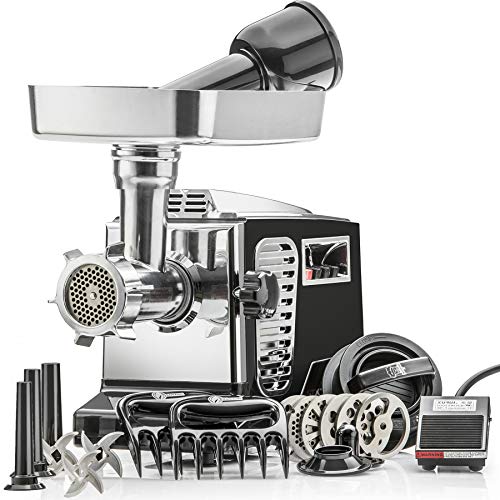
- STX International Turboforce 3000 Series Electric Meat Grinder — Best Accessory Bundle. A 6-in-1 bundle with five grinding dies, three blades, stuffer and kubbe maker — the beginner who wants every attachment in one box. Check price on Amazon
- AAOBOSI Electric Meat Grinder with 3-Speed Touch Screen Control — Best Modern Budget Electric. Touch-screen three-speed control, built-in accessory storage and a 3-in-1 kit — the modern, tidy budget electric. Check price on Amazon
How These Picks Were Chosen
Every pick was verified by brand and model connection, with the returned title confirming the configuration — grinder size, motor class and included functions — before any link was granted. Entry-level listings are especially prone to inflated wattage claims, so we credited only what the catalogue title and the maker’s established specification support, and we describe throughput in the conservative, real-world terms the reviews use.
Judging for beginners weighted forgiveness: reverse functions for the inevitable jam, included plates in both coarse and fine, stuffing tubes in the box, parts that wash without drama, and a footprint a real kitchen can store. Raw speed mattered least — a beginner grinds five pounds, not fifty, and a grinder that handles five pounds calmly beats a faster one that clogs, smears and teaches you to hate the process.
The six picks spread across the three entry shapes on purpose: two compact countertop electrics, two step-up electrics for beginners who already know they will grind often, one accessory-stuffed value electric, and the mixer attachment for households whose counter is already spoken for. There is a correct first grinder here for every kitchen that wants one.
The 6 Best entry level meat grinders
The six reviews below are ordered by how we would recommend the best entry level meat grinders to most households, not by price. The first pick is the one to buy if you do not want to think about the category again for years; the later picks win on a specific strength — a tighter budget tier, a particular layout, a material or a use case — that matters more to some homes than all-round polish.

1. Cuisinart Electric Meat Grinder, Stainless Steel (MG-100) — Best Overall for Beginners
The Cuisinart MG-100 is the grinder we recommend to the beginner who wants the fewest possible surprises. It is compact, stainless-finished, simple to run and backed by a brand whose support line a first-time owner might actually call. Assembly is intuitive, the parts wash without a puzzle, and the machine handles the beginner’s curriculum — burger blends, meatloaf, a first batch of breakfast sausage — with calm competence.
Its limits are the honest limits of its class. The throat takes modest strips, so your knife work matters; throughput is household-paced, so a ten-pound batch is a project with pauses rather than a sprint; and like all small electrics it prefers well-chilled, sinew-trimmed meat to a warm, stringy chuck. Learn those habits on this machine and they will serve you on any grinder you ever own — which is precisely what an entry-level tool should teach.
Buy it if your grinding future is promising but unproven. It costs a fraction of the step-up machines, stores where a toaster stores, and resells or hands down gracefully if the hobby catches fire and you graduate. Beginners who start here rarely regret the tuition.
Strengths
- Compact footprint stores in a standard cupboard
- Simple controls suit a genuine first grind
- Cuisinart support and parts availability
Trade-offs
- Household throughput — big batches need patience and rests
- Smaller throat means meat must be cut to modest strips
- Not built for bone or heavy game work
| Format | Countertop electric |
|---|---|
| Finish | Stainless steel |
| Use class | Household / entry level |
| Functions | Grinding and sausage stuffing |
Six months in, the MG-100’s owners tend to fall into two honest camps: those for whom it became the permanent grinder, because their batches never grew, and those who graduated and kept it as the small-batch and backup machine. Both camps rate the purchase as money well spent, which is the definition of a good entry tool. Its stainless finish also survives the sink-and-store cycle without the dulling that makes owners hide lesser machines in the back of the cupboard.
Best for: First-time grinders who want simple, storable and reputable / Not suited for: Anyone planning weekly ten-pound batches

2. Sunmile SM-G50 ETL Electric Meat Grinder — Best Value Electric
The SM-G50’s specification reads like a checklist written by someone who has killed a cheap grinder: metal gears instead of plastic, a reverse button for the jam every beginner eventually creates, a circuit breaker so a stall trips a reset instead of a motor, and stainless blade and plates that will not rust in the sink. At its value tier, that internal honesty is rare enough to earn the pick on its own.
In use, treat the headline power figures as enthusiasm and the machine as what it is: a strong household grinder for batches in the two-to-six-pound range, ground in a steady rhythm with chilled meat. Worked that way, it produces clean burger grind and respectable sausage texture, and the reverse earns its keep the first time a piece of sinew wraps the auger — a thirty-second fix instead of a full teardown.
This is the value answer for the beginner who reads specifications. If your budget stretches, the LEM and STX below buy throughput and accessory depth; if it does not, the Sunmile’s metal-geared core will still be grinding long after prettier plastic-geared rivals have stripped their drive. Spend the savings on good casing and a scale.
Strengths
- Metal gears at a value tier — the durability feature that matters most
- Reverse function clears beginner jams without disassembly
- Circuit breaker protects the motor from overload stalls
Trade-offs
- Peak wattage figures flatter it — judge by batch behaviour, not the box
- Accessory set is functional rather than generous
- Household duty cycle — rest it between large batches
| Format | Countertop electric |
|---|---|
| Gearing | Metal gears |
| Safety | Circuit breaker, ETL listed |
| Features | Reverse function, stainless blade and plates |
The Sunmile’s metal gears write its ownership story: while plastic-geared contemporaries develop a worrying whine and then a funeral silence, the SM-G50 keeps its mechanical composure season after season of household batches. Owners who read the specification before buying — this pick’s natural audience — report the circuit breaker saving the motor exactly once, which is all it ever needs to do to have justified itself.
Best for: Budget buyers who still want metal gearing and safety features / Not suited for: Anyone needing large-batch continuous throughput

3. LEM #8 Countertop Meat Grinder, 575 Watt — Best Compact Step-Up
Buying a first grinder from LEM is buying into the ecosystem you will want if the hobby sticks: standard #8 plates in every grind size, stuffing tubes, and a maker whose catalogue scales from this countertop unit to the BigBite machines in our game-grinder guide. The #8 Countertop is the gentle end of that world — compact, 575-watt class, and built with the tolerances that make LEM’s name.
The #8 size is the beginner’s sweet spot for a dedicated electric: large enough that plates are standard and cheap, small enough that the machine stores sensibly and cleans quickly. Burgers, sausage and pet-food batches in the household range run through it steadily, and its manners with chilled, well-trimmed meat are noticeably calmer than the budget class — less smearing, fewer pauses, cleaner texture in the bowl.
The body is aluminum rather than stainless at this model, and the tier is a step above the Cuisinart and Sunmile. What the step buys is headroom: this is the entry grinder least likely to be replaced within two years, because it was never really a toy. For the beginner who already suspects they are a grinder person, start here and skip a rung of the ladder.
Strengths
- LEM build quality and a deep accessory ecosystem
- #8 plates and parts are widely available
- Compact enough for real kitchens, strong enough for regular use
Trade-offs
- Aluminum body rather than stainless at this model
- Tier sits above the true budget picks
- #8 throat still asks for sensible strip cutting
| Size | #8 grinder |
|---|---|
| Power | 575 watt class |
| Format | Countertop, aluminum body |
| Brand | LEM Products |
LEM ownership compounds: the #8 plates you buy for this grinder fit the ecosystem you may grow into, the techniques you learn transfer directly up the range, and the machine’s resale value reflects the badge in a way unbranded grinders cannot match. Owners describe the jump in grind quality over budget machines as the noticeable thing — cleaner particles, less paste — which on a burger translates directly into texture you can taste.
Best for: Beginners who expect to keep grinding and want the LEM upgrade path / Not suited for: Anyone who wants the cheapest possible first grinder
4. KitchenAid KSMMGA Metal Food Grinder Attachment — Best If You Own the Mixer
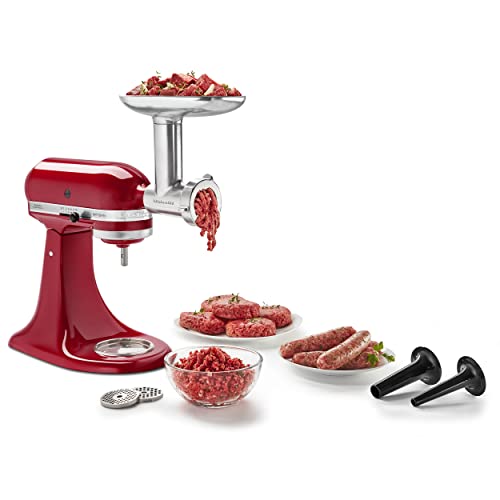
If a KitchenAid stand mixer already lives on your counter, the KSMMGA is the most rational first grinder in this guide: a metal grinder head that borrows the mixer’s motor, with a food tray, pusher, grinding plates and sausage stuffer tubes in the box. The metal construction is the headline — the older plastic attachment class taught owners to expect flex and short life, and this head answers that reputation directly.
Set expectations by physics. The mixer motor is strong, but the attachment’s throat and plates are compact, so batches are household-sized and the pace is steady rather than fast. For burgers for the family, a few pounds of sausage, breadcrumbs, relishes and the rest of the attachment’s repertoire, that pace is entirely sufficient — and the whole kit returns to a drawer when you are done, which no countertop grinder can claim.
The attachment also makes a fine honesty test: grind on it for a season, and you will know exactly how much grinding your household does, which tells you whether a dedicated #12 or #22 machine is a need or a fantasy. Many households discover the attachment was the destination all along.
Strengths
- No new appliance — uses the mixer motor you already own
- Metal head is a major step over the plastic attachment class
- Stores in a drawer; tray and tubes included
Trade-offs
- Throughput limited by the mixer’s power and the attachment’s size
- Adds wear cycles to your mixer’s hub
- Useless to households without a KitchenAid stand mixer
| Format | Stand mixer attachment |
|---|---|
| Body | Metal grinder head |
| Includes | Food tray, pusher, grinding plates, sausage stuffer tubes |
| Fit | All KitchenAid stand mixers |
Attachment ownership has a rhythm of its own: the mixer comes out, the head clicks on, a batch happens, and everything returns to a drawer — grinding as an episode rather than an installation. Owners who grind monthly rate that ephemerality as the entire point. The metal head also changes the cleaning calculus versus the old plastic attachments: it tolerates a proper hot wash and dries without the flex-creak that made owners nervous about longevity.
Best for: KitchenAid owners with limited counter and storage space / Not suited for: Anyone without a stand mixer, or grinding large batches often

5. STX International Turboforce 3000 Series Electric Meat Grinder — Best Accessory Bundle
The Turboforce 3000 sells a beginner a complete playground: five grinding dies for textures from coarse chilli grind to fine, three stainless blades, a sausage stuffer, a kubbe maker and even a juicer function, driven by a three-speed motor. For the new grinder whose interest is precisely in experimenting — What is kubbe? How fine can this go? — no other box at this tier answers so many curiosities at once.
Used with discipline, it teaches well. The speed range lets you slow down for control while learning how chilled meat should feed, and the die selection makes texture differences tangible in a single session. The accessories are genuinely usable rather than decorative, which is why this model has remained a fixture of the entry category while flashier bundles vanished.
The disciplines are storage and honesty. A 6-in-1 kit has parts that need a home and a wash after every session, and the headline wattage is a peak figure — treat the machine as the capable household grinder it is, feed it chilled meat in sensible strips, and it rewards you. Treat it as a commercial unit and it will file its complaint through the circuit protection.
Strengths
- Widest accessory bundle here — five dies, three blades, stuffer, kubbe
- Three speeds give beginners control while learning textures
- One purchase covers a season of experiments
Trade-offs
- Peak wattage marketing — judge it as a household machine
- Many accessories mean many parts to wash and store
- Jack-of-all-trades design is less focused than a dedicated grinder
| Format | Countertop electric, 6-in-1 |
|---|---|
| Speeds | 3-speed |
| Plates | 5 grinding dies |
| Blades | 3 stainless steel blades |
| Extras | Sausage stuffer, kubbe maker, juicer function |
The Turboforce’s bundle writes a diary of experiments: burgers in week one, a first sausage by week three, kubbe attempted — with YouTube open — by month two. Owners who bought it for that curiosity consistently report using more of the kit than they expected, while minimalists who bought it for burgers alone report a drawer of honourable but unemployed accessories. Know which buyer you are; the machine serves both, but only one gets the value.
Best for: Experimenters who want to try sausage, kubbe and more immediately / Not suited for: Minimalists who only ever grind burgers

6. AAOBOSI Electric Meat Grinder with 3-Speed Touch Screen Control — Best Modern Budget Electric
The AAOBOSI represents the newest school of entry grinder: a touch-screen panel with three speeds, a 3-in-1 kit covering grinding, sausage and kubbe-style work, and — the detail experienced owners will appreciate most — built-in storage for its own accessories. Beginner grinders rarely die of weak motors; they die of lost plates in the back of a drawer. This design attacks the actual failure mode.
The maker’s stated pace suits the household batches this guide is about, and the controls lower the learning curve: pick a speed, feed chilled strips steadily, and let the machine’s rhythm teach you the rest. Cleanup is designed to be easy, which matters more than any specification — a grinder that is annoying to wash is a grinder that stops being used, whatever its power.
The trade is pedigree. AAOBOSI does not carry LEM’s decades or Cuisinart’s support network, and its headline wattage deserves the same scepticism as every small grinder’s. Buy it for the tidy, modern usability at a budget tier, with clear eyes about the brand’s youth, and it is a sensible first machine for a small kitchen.
Strengths
- Built-in storage keeps plates and tubes with the machine
- Touch controls and three speeds are beginner-friendly
- Easy-cleanup design suits first-time owners
Trade-offs
- Newer brand — shorter track record than LEM or Cuisinart
- Peak wattage figures should be read as marketing
- Touch panel is one more thing to keep dry and clean
| Format | Countertop electric |
|---|---|
| Controls | 3-speed touch screen |
| Kit | 3-in-1: grind, sausage, kubbe/pet food use |
| Storage | Built-in accessory storage |
The AAOBOSI’s built-in storage proves itself in the specific way its designers intended: at month six, every plate and tube is still with the machine, a claim few beginner setups can make. The touch panel also ages better than sceptics expect when it is wiped dry as part of the cleaning routine — a ten-second habit. For small kitchens, that combination of tidiness and survival is the ownership headline.
Best for: Small kitchens that value tidy storage and simple controls / Not suited for: Purists who prefer mechanical switches and metal everything
Comparison Table
Use this table to compare the six best entry level meat grinders side by side on the one specification that decides most purchases in this category, then read the full review of your top two before ordering.
| Pick | Badge | Key spec | Best for |
|---|---|---|---|
| Cuisinart Electric Meat Grinder, Stainless Steel (MG-100) | Best Overall for Beginners | Countertop electric, stainless finish, household batch size | First-time grinders who want simple, storable and reputable |
| Sunmile SM-G50 ETL Electric Meat Grinder | Best Value Electric | Electric, metal gears, reverse function, ETL listed | Budget buyers who still want metal gearing and safety features |
| LEM #8 Countertop Meat Grinder, 575 Watt | Best Compact Step-Up | #8 size, 575 watt, countertop format, LEM ecosystem | Beginners who expect to keep grinding and want the LEM upgrade path |
| KitchenAid KSMMGA Metal Food Grinder Attachment | Best If You Own the Mixer | Attachment for KitchenAid mixers, metal body, plates + stuffer tubes | KitchenAid owners with limited counter and storage space |
| STX International Turboforce 3000 Series Electric Meat Grinder | Best Accessory Bundle | 6-in-1 electric, 5 grinding dies, 3 blades, stuffer + kubbe included | Experimenters who want to try sausage, kubbe and more immediately |
| AAOBOSI Electric Meat Grinder with 3-Speed Touch Screen Control | Best Modern Budget Electric | 3-speed touch control, built-in storage, 3-in-1 kit | Small kitchens that value tidy storage and simple controls |
What Size Grinder Does a Beginner Actually Need?
Grinder sizes — #5, #8, #12, #22 — describe the plate diameter family, and with it the throat size, throughput and parts ecosystem. For beginners, #8 is the sweet spot in a dedicated electric: plates and tubes are standard and inexpensive, the throat takes sensible strips without heroic knife work, and the machine still stores like a kitchen appliance. #5 machines and attachments suit occasional, small-batch grinding. #12 is the step-up for households that quickly graduate to ten-pound sessions.
Match size to your honest batch, not your aspirational one. A household grinding two to five pounds for burgers and the occasional sausage weekend is perfectly served by every pick in this guide. The beginner error is buying a #22 commercial frame for a five-pound life — it stores badly, cleans slowly and teaches nothing a #8 would not.
Parts availability is the hidden size benefit. Standard sizes mean replacement plates in multiple grind patterns, extra tubes and third-party accessories for years. Whatever you buy, confirm its size family first; an orphan size is a grinder with an expiry date.
How Do You Get a Good Grind on Your First Try?
Cold is the whole secret, and it is not close. Chill cubed meat until it is firm at the edges — many grinders put the metal parts in the freezer alongside — because cold fat cuts cleanly while warm fat smears, and smearing is what makes home-ground texture pasty. Cut strips that fit the throat without forcing, trim heavy sinew that wraps augers, and feed at the machine’s pace rather than yours.
Choose the plate for the product: coarse for chilli and rustic sausage, medium for burgers, fine for emulsified styles and a second pass for meatloaf blends. Grind once for texture, twice only when the recipe truly wants it, and keep the receiving bowl cold for anything headed to sausage. Season after grinding for burgers; season before the final grind only when a sausage recipe directs it.
Clean immediately, while everything is cold and nothing has dried. Disassemble, wash hot and soapy, dry the blade and plates thoroughly — carbon-steel parts rust if put away damp — and store plates oiled lightly or in rice if your kitchen is humid. Five minutes now is the difference between a tool and a science project.
What Should a Beginner Budget Beyond the Grinder?
The grinder is most of the cost, but four small companions complete the hobby. A kitchen scale makes ratios repeatable — fat percentage is a number, not a mood. Natural or collagen casings and a proper stuffer tube turn ground meat into sausage; the grinders here include tubes, though a dedicated vertical stuffer is the first upgrade serious sausage makers buy. A instant-read thermometer keeps grinding sessions honest about temperature. And freezer space — real, organised freezer space — is where ground meat’s convenience actually lives.
Buy meat with the grinder’s economics in mind. Whole chuck, pork shoulder and trim bought on sale and ground at home routinely beat pre-ground prices while tasting noticeably fresher, and grinding day-old bread ends or vegetables for blends stretches batches further. The entry grinder pays for itself through the meat case long before it pays through any single recipe.
Resist accessory sprawl in month one. Learn the plates in the box, master temperature, and let your actual habits nominate the first upgrade. Most beginners discover they need less than the internet insists — and the money saved buys better meat, which improves results more than any attachment.
Manual vs Electric: Should a Beginner Start with a Hand Grinder?
The hand-crank grinder has genuine virtues — no motor to burn, a price that barely registers, and a direct physical education in how meat behaves under a plate. For a camper, a small-batch traditionalist or a household grinding a pound at a time, it remains a legitimate starting point, and the arm workout is honest. Its limits are equally real: throughput is slow, sausage stuffing by crank is a two-person negotiation, and a five-pound batch is an event rather than a task.
Electric entry grinders — every pick in this guide — exist because most beginners’ real question is whether they enjoy grinding at all, and enjoyment is easier to discover when the machine does the turning. The electric also enforces a steadier feed rate, which quietly improves texture for learners whose hand-crank rhythm would wander.
Our advice: start electric unless your batches are tiny or your interest is specifically in the traditional process. The hand grinder will still be there, charming and cheap, if you later want the analogue experience; the reverse journey — from hand-crank frustration to electric relief — is the one that leaves a grinder unused in a garage.
What Meats and Blends Should a Beginner Grind First?
Start with the forgiving classics. Beef chuck alone makes a burger with enough fat to be juicy and enough structure to teach you what clean grind looks like. Pork shoulder is the sausage beginner’s friend — well-marbled, economical and tolerant of seasoning experiments. A fifty-fifty chuck-and-short-rib or chuck-and-brisket blend is the first ‘butcher’s blend’ worth trying once plain chuck is mastered, because the difference is delicious and instructive.
Chicken and turkey reward care: partially frozen, well-chilled grinding is essential, since poultry fat smears at temperatures beef tolerates, and scrupulous cleaning afterwards is non-negotiable. Lamb makes superb burgers and kofta and is more forgiving than its price suggests. In every case, buy whole cuts rather than pre-trimmed stew meat when you can — you control the fat ratio, the freshness and the trim quality, which is the entire point of owning the machine.
Keep a grinding notebook from the first batch: cut, ratio, plate, seasoning, verdict. Five lines per batch. By batch ten you will own something no grinder can be sold with — your household’s proven recipes.
When Should a Beginner Upgrade — and to What?
Upgrade when your habits, not your envy, file the request. The honest signals are specific: batches regularly exceeding your machine’s comfortable wave size, a sausage practice that has outgrown stuffing through the grinder and wants a dedicated vertical stuffer, a hunting season that has entered your life, or a plate size you need that your grinder’s family does not offer. Each signal names its own upgrade — a #12 dedicated machine, a stuffer, a game-class grinder — and buying to the signal keeps the bench purposeful.
The stuffer deserves its early place in that queue. Most beginners who grind regularly discover that grinding was the easy half and stuffing through a grinder’s auger — slow, warming, texture-compromising — is the bottleneck. A modest vertical stuffer transforms sausage day more than a grinder twice as powerful would, and it is usually the cheapest transformation on the bench.
What should not trigger an upgrade is a single hard batch. Every entry grinder in this guide has a ceiling, and meeting it once a year is what ceilings are for. Live with the machine across a full season of your real habits, keep the grinding notebook this guide keeps recommending, and let its pages — not a sale, not a video — tell you what the second purchase should be.
How Should You Store and Maintain an Entry Grinder Between Uses?
Storage is where entry grinders quietly die, so give yours a system. Wash and — the step that matters — dry every part completely before storage, because blades and plates stored damp rust in the dark and announce it at the next session. Many owners store plates in a small container with a handful of dry rice or a food-safe oil wipe, cheap insurance in humid kitchens. Keep every plate, tube and pusher with the machine, in one box or drawer bay; a grinder whose parts live together gets used, and one whose parts scatter gets replaced by supermarket mince within a year.
Maintenance across the year is light but real. Inspect the blade’s edge and the plates’ holes each season: a dull knife smears rather than cuts, and plates with worn, bell-mouthed holes produce paste instead of crumbles — both are inexpensive replacements that restore a machine to new behaviour. Keep the maker’s manual with the machine, note which plate is which if the markings are subtle, and run the grinder empty for a few seconds after washing only if the maker approves it for drying the drive.
Treated this way, an entry grinder’s lifespan is measured in many seasons of household batches. Treated as a wet appliance thrown in a cupboard, even the best pick in this guide will disappoint by its second year. The machine’s durability is half purchased and half practised.
How to Grind Your First Batch of Burgers, Step by Step
Start the night before or the morning of: cube your meat into strips that fit the throat, spread them on a tray and chill until firm at the edges but not frozen solid. Put the grinder’s head, blade, plate and a mixing bowl in the freezer for the last half hour. Assemble the cold head with a medium plate, set the cold bowl under the outlet, and lay out a scale if you are blending cuts — an 80/20 lean-to-fat target is the classic burger starting point.
Grind in a steady rhythm, alternating fattier and leaner pieces so the blend self-mixes, and never force the pusher — pressure smears fat and heats the grind. If the output turns pale and pasty, stop: the meat has warmed. Return everything to the freezer for fifteen minutes and resume; that pause, learned once, is the mark of someone who will grind well forever. Collect the grind loosely — do not pack or knead it — because overworked ground meat cooks up dense.
Form patties with a light hand, salt them on the outside only, and cook one test patty before seasoning the batch in your head forever. Then clean the grinder immediately and completely while the lesson is fresh: hot soapy water, thorough drying of blade and plates, and parts stored together. Your first batch, done this way, will beat most supermarket ground beef — and the second batch will be better, because now you have a process.
Common Buying Mistakes
Beginner grinding has a short, well-documented list of failure modes. Every one is a habit, not a talent — which means every one is fixable tonight.
- Grinding warm meat. Warm fat smears and ruins texture. Chill the meat and the metal parts; pause and re-chill mid-batch if output turns pasty.
- Believing the wattage on the box. Peak watts are marketing. Judge a grinder by its size family, gearing and how it handles a real batch.
- Forcing the feed. Crushing meat through with the pusher heats and smears it. Cut strips to size and let the auger pull.
- Skipping the sinew trim. Heavy connective tissue wraps the auger and causes the classic beginner jam. Trim it; use reverse when it happens anyway.
- Putting parts away damp. Blades and plates rust quietly in drawers. Wash, dry completely, and store dry — every single time.
Notice that none of these mistakes is about buying the wrong grinder — they are about temperature, patience and drying racks. Master those three and any pick in this guide will make you look like you have been grinding for years.
Final Recommendation
For most beginners, the Cuisinart MG-100 is the first grinder to buy: simple, compact, reputable and honestly sized for household batches. Specification readers on a budget should take the Sunmile SM-G50’s metal gears; beginners who expect the hobby to stick should start on the LEM #8 and skip a rung; KitchenAid owners should attach the KSMMGA and spend nothing on counter space. Experimenters get the STX’s playground of a bundle, and tidy small kitchens get the AAOBOSI’s built-in storage.
Whichever you choose, learn the cold discipline from your first batch, and check price on Amazon for the exact model — entry grinders are frequently bundled differently by season, and the box contents matter more than a small price difference.
Ready to order? Start with the top three: Cuisinart MG-100 · Sunmile SM-G50 · LEM #8 Countertop — and check price on Amazon for the exact configuration you measured or sized for.
Best Meat Grinders Best Game Meat Grinders Best Meat Grinders For Home Use
Frequently Asked Questions
How much meat can an entry-level grinder handle at once?
Comfortably, batches of two to six pounds are the entry class’s home territory, ground in a steady rhythm with chilled meat. Larger batches are possible with pauses to re-chill and rest the motor — and if ten-pound sessions become your normal, that is the signal to step up a size.
Can a beginner grinder make sausage?
Yes. Every pick here includes or supports stuffing tubes, and coarse-to-medium ground pork shoulder with seasoning and casing is a forgiving first sausage. A dedicated vertical stuffer is easier for large batches, but it is an upgrade, not a prerequisite.
What is the difference between #8 and #12 grinders?
The number is the size family: a #12 has larger plates, a wider throat and faster throughput than a #8, at the cost of size, weight and price. Beginners are usually best served by #8; #12 suits households grinding larger batches regularly.
Why does my ground meat look mushy?
Almost always temperature. Warm meat and warm grinder parts smear fat instead of cutting it. Chill everything, work in smaller waves, and re-chill mid-batch — the texture difference is dramatic and immediate.
Can I grind bones in an entry-level grinder?
No. Small electrics and attachments are not built for bone, and attempting it risks the gears and plates. Pet-food bone grinding belongs to heavy-duty machines rated for it; keep entry grinders to meat and soft ingredients.
How do I stop the grinder from clogging?
Trim heavy sinew, cut strips to the throat, feed steadily without forcing, and keep everything cold. When a clog happens, stop, use reverse if fitted, and clear it — never push harder and never reach into a running throat.
How loud is an entry-level meat grinder?
Expect conversation-interrupting but not alarming — roughly blender territory while under load. Metal-geared and larger machines sound deeper and steadier; small machines whine more. None should be run during a sleeping baby’s nap in the next room.
Can I grind vegetables and other foods in it?
Yes — most entry grinders happily handle vegetables for relishes and falafel, breadcrumbs, cooked grains and cheese for spreads, within the maker’s guidance. It is one of the format’s under-sung virtues, and a good way to learn the machine before meat day.
Can an entry grinder handle frozen meat?
Firm, near-frozen meat is ideal; fully frozen solid meat is not. Let frozen cuts temper until a knife can cube them with effort, then grind while they are still stiff and cold. Forcing rock-frozen blocks through a small grinder strains the drive and dulls the knife — the two repairs a beginner least wants to meet.
What grind plate should a beginner use for burgers?
A medium plate is the burger standard — coarse enough for a loose, juicy texture, fine enough to hold a patty together. Grind once, handle the meat gently, and salt after forming. If your first batch tastes right but feels dense, the fix is almost never the plate; it is warmer meat or harder handling than the grind deserved.
Best Sausage Stuffers Best Meat Grinder Attachments