Disclosure: airfryerkitchensupply.com is reader-supported. When you buy through links on our site, we may earn an affiliate commission at no extra cost to you.
Where to buy
The most reliable place to buy the best economy water saver toilets in this guide is Amazon, where bowl, tank, seat and rough-in configuration are stated on one listing and returns are straightforward if the porcelain arrives damaged. Start with the best overall pick, the TOTO Drake Two-Piece Elongated 1.28 GPF Universal Height Toilet: Check on Amazon. Every linked pick below was verified against the retailer catalogue for this site on 2026-11-21; any model we could not verify is written about honestly as a pick with no purchase link, rather than given an invented link. Always confirm the exact configuration on the listing before ordering, because toilets are heavy, freight-damaged returns are a hassle, and a wrong rough-in cannot be fixed at install time.
- TOTO Drake Two-Piece Elongated 1.28 GPF Universal Height Toilet (Best Overall) — Check on Amazon
- Niagara Conservation Original Single Flush Elongated Toilet (Best for Lowest Water Use) — Check on Amazon
- Kohler Wellworth Pressure Lite Elongated 1.1 GPF Toilet (Best Pressure-Assist Value) — Check on Amazon
- American Standard H2Option Dual Flush Elongated Toilet (Best Dual Flush) — Check on Amazon
- WOODBRIDGE One-Piece Chair Height Dual Flush 1.28 GPF Toilet (Best One-Piece Value) — Check on Amazon
- TOTO Entrada Two-Piece Elongated 1.28 GPF Universal Height Toilet (Best Budget Brand-Name Buy) — Check on Amazon
Introduction: What Shoppers Need to Know First
The best economy water saver toilets solve a simple equation honestly: they cut the water bill every single day without costing so much up front that the saving never pays back, and without flushing so weakly that you flush twice and lose the saving anyway. That balance is the whole subject of this guide. A cheap toilet that needs a second flush is not economical, and a very efficient toilet at a premium price can take many years to return its extra cost in a household that does not pay much for water. We judged both sides of that ledger for every pick below.
The market reality is encouraging. Mainstream 1.28 gallon-per-flush models from major brands are now the default rather than a premium option, dual-flush designs let light waste use even less, and one long-running ultra-low-flush family works at well under a gallon. At the same time, the very cheapest no-name toilets often save money in exactly the wrong place — thin glazing, small trapways and valves that leak silently — so this guide favours proven models whose replacement parts are cheap and everywhere, because a water saver that leaks at the flapper wastes more than it ever saved.
Every linked pick was verified on 2026-11-21. Where a famous budget name could not be verified as a complete toilet listing — Glacier Bay full toilets, for example, returned only tanks and parts in verification — we say so plainly instead of linking you to a tank and calling it a toilet. Read the buying guide for the payback maths, then choose by how your household actually flushes.
Key Takeaways
- Economy means lowest cost of ownership, not lowest shelf price — parts, leaks and double flushes decide the real bill.
- A proven 1.28 GPF toilet that clears first time out-saves a weaker toilet with a lower headline figure.
- Dual flush wins in disciplined households; ultra-low designs win where water, sewer or septic costs are high.
- Always confirm the listing is a complete toilet — bowl-only listings are this category’s classic trap.
- Set the tank waterline to the mark and dye-test twice a year; those two free habits protect the entire saving.
- Price the whole job: seat inclusion, supply line and returns policy move true cost more than model differences.
In this guide
Quick Picks
- TOTO Drake Two-Piece Elongated 1.28 GPF Universal Height Toilet — Best Overall: The economy benchmark: proven 1.28 GPF clearing, cheap parts everywhere, fair tier. — Check on Amazon
- Niagara Conservation Original Single Flush Elongated Toilet — Best for Lowest Water Use: The ultra-low-flush specialist from the Stealth family, for expensive water and septic homes. — Check on Amazon
- Kohler Wellworth Pressure Lite Elongated 1.1 GPF Toilet — Best Pressure-Assist Value: Pressure-assist power at 1.1 GPF for homes tired of weak low-flow flushes. — Check on Amazon
- American Standard H2Option Dual Flush Elongated Toilet — Best Dual Flush: Two flush choices, chair height, mainstream price tier and parts. — Check on Amazon
- WOODBRIDGE One-Piece Chair Height Dual Flush 1.28 GPF Toilet — Best One-Piece Value: One-piece easy-clean body and dual flush at a value tier. — Check on Amazon
- TOTO Entrada Two-Piece Elongated 1.28 GPF Universal Height Toilet — Best Budget Brand-Name Buy: TOTO engineering at the entry tier, 1.28 GPF, simple and serviceable. — Check on Amazon
How These Picks Were Chosen
We weighted five things: verified flush volume, real clearing ability, purchase tier, cost and availability of service parts, and how the model behaves after years rather than weeks. Economy was judged as total cost of ownership — purchase, water, parts and the plumber visits a bad toilet eventually causes — not as the smallest number on a shelf tag, and no prices are printed here because listings change; use the check-price links to see the current figure.
Models that save water only on paper were cut. A low gallon figure means nothing if the bowl wash is poor, the trapway is narrow, or the flush valve design is known for silent leaks. Equally, we kept one ultra-low-flush option for households on expensive municipal water or septic systems where every gallon genuinely counts, and we flag its bowl-only buying trap clearly in its review.
The 6 Best Economy Water Saver Toilets

TOTO Drake Two-Piece Elongated 1.28 GPF Universal Height Toilet — Best Overall
The Drake earns the top spot in an economy guide not by being the cheapest toilet here, but by being the cheapest toilet to own for fifteen years. Its 1.28 gallon flush is genuinely effective — this is the model plumbers recommend when a customer says the last water saver disappointed them — and that reliability is what protects the saving, because a toilet that clears first time at 1.28 gallons beats a weaker toilet that averages two flushes at a nominally lower figure. The glazed bowl helps each flush rinse properly, which matters more as volume falls.
Ownership costs stay low in the boring ways that count. Fill valves, flappers and seats for this platform are stock items everywhere, a handy owner can service everything with basic tools, and the two-piece format keeps freight and replacement costs sane if one part is ever damaged. If your water is moderately priced and you want one safe recommendation that saves water, clears properly and never becomes a parts hunt, this is it — check price on Amazon and compare it against the dual-flush pick if your household produces mostly liquid waste.
Strengths
- Strong, well-proven 1.28 GPF flush that rarely needs a second try
- Replacement parts are inexpensive and available almost anywhere
- Glazed bowl surface helps the low water volume still clean well
Trade-offs
- Two-piece styling looks plainer than one-piece rivals
- Costs more up front than the very cheapest store brands
- Seat and configuration vary by listing — confirm before ordering
| Specification | Verified detail |
|---|---|
| Flush volume | 1.28 GPF, verified from Amazon title |
| Configuration | Two-piece, elongated, universal height |
| Seat | SoftClose seat included in this listing |
Best for: Most households wanting water savings without risk / Not suited for: Shoppers chasing the absolute lowest purchase price regardless of parts support
Check on Amazon — check price on Amazon for the current listing, configuration and delivery options.

Niagara Conservation Original Single Flush Elongated Toilet — Best for Lowest Water Use
Niagara built its name on one idea: a toilet that uses dramatically less water per flush through a different flush mechanism rather than a smaller version of the same old flapper design. For a household paying high combined water and sewer rates, or running a septic system where every gallon of throughput matters, that difference compounds thousands of times a year. This verified elongated single-flush model is the pick when minimising volume is the first priority and purchase price is the second.
The caution is buying format, and we state it plainly: Niagara sells bowls, tanks and complete toilets under similar names, and our verification also returned bowl-only listings. Use the link in this guide, then read the listing title and contents list twice to confirm you are ordering a complete toilet, not a bowl. Do that check and you get the most water-frugal mainstream option here; skip it and you may receive half a toilet. Households who find that ambiguity annoying should take the Drake instead and accept its higher flush volume.
Strengths
- Built around ultra-low water use — the lowest-flush approach in this guide
- Flapperless-style design philosophy reduces the classic silent-leak failure
- Elongated bowl keeps comfort despite the efficiency focus
Trade-offs
- Sold in several configurations — some Niagara listings are bowl-only, so verify the listing carefully
- Flush feel is different and quieter, which takes adjustment
- Brand support network is smaller than TOTO or Kohler
| Specification | Verified detail |
|---|---|
| Configuration | Single flush, elongated, verified from Amazon title |
| Family | Niagara Stealth ultra-high-efficiency line |
Best for: Homes on costly municipal water, septic systems, or strict water budgets / Not suited for: Buyers who do not want to check whether a listing is a complete toilet
Check on Amazon — check price on Amazon for the current listing, configuration and delivery options.

Kohler Wellworth Pressure Lite Elongated 1.1 GPF Toilet — Best Pressure-Assist Value
Some houses defeat gentle toilets: long drain runs, old cast iron with rough interiors, or a slight belly in the line mean a soft 1.28 gallon gravity flush leaves material behind. The Wellworth Pressure Lite answers with a sealed pressure vessel inside the tank that releases its 1.1 gallons with real force. It uses less water than the Drake while flushing harder than it — a rare combination — and for problem plumbing it can be the most economical choice of all because it ends the double-flushing that quietly doubles a weak toilet’s true consumption.
Read the listing carefully: this configuration is sold less seat, which is normal for this line but must be added to your true purchase cost before comparing it with seat-included rivals. The flush is also assertively loud — a short, sharp whoosh rather than a swirl — which bothers some households at night. Accept those two facts and this is the connoisseur’s economy pick: commercial-grade clearing, tiny volume, and a brand whose parts will still exist in twenty years.
Strengths
- Pressure-assist vessel delivers a forceful flush on just 1.1 gallons
- Excellent choice where drain lines are long or old
- Kohler parts and service network is nationwide
Trade-offs
- Listed less seat — budget for a seat separately
- Pressure vessel makes a louder, sharper flush sound
- Vessel replacement, if it ever fails, costs more than a flapper
| Specification | Verified detail |
|---|---|
| Flush volume | 1.1 GPF pressure assist, verified from Amazon title |
| Configuration | Elongated; seat not included in this listing |
Best for: Homes with older plumbing that defeated gravity low-flow toilets / Not suited for: Light sleepers with a bathroom beside the bedroom who hate flush noise
Check on Amazon — check price on Amazon for the current listing, configuration and delivery options.

American Standard H2Option Dual Flush Elongated Toilet — Best Dual Flush
Dual flush is the economy idea at its most honest: most flushes in any home are for liquid waste and simply do not need a full tank. The H2Option gives you a reduced flush for those and a full flush when needed, in a chair-height elongated body from a brand any plumber knows. In a disciplined household the average gallons per flush drops below what any single-flush 1.28 model can reach, and it does so with conventional, cheap-to-service internals rather than an exotic mechanism.
The saving is behavioural, and we will not pretend otherwise. If your household presses the big button every time out of habit, you have bought a normal toilet at a dual-flush price. Households with young children or frequent guests should expect a learning curve. But for a family willing to build the habit — and it does become automatic within a month — this is the best water-per-dollar route in the guide, with none of the buying-format traps of the ultra-low-flush specialist.
Strengths
- Dual flush lets liquid waste use the reduced flush most of the time
- Chair height suits most adults and mixed households
- American Standard parts are stocked everywhere
Trade-offs
- Dual-flush buttons take a week of guest confusion to become normal
- Real saving depends on household discipline in choosing the small flush
- Two-piece design has the usual tank-to-bowl seam to keep clean
| Specification | Verified detail |
|---|---|
| Configuration | Two-piece, dual flush, elongated, chair height — verified from Amazon title |
Best for: Families who will actually use the reduced flush for liquid waste / Not suited for: Households wanting a familiar brand at a mid tier
Check on Amazon — check price on Amazon for the current listing, configuration and delivery options.

WOODBRIDGE One-Piece Chair Height Dual Flush 1.28 GPF Toilet — Best One-Piece Value
One-piece toilets used to be a premium indulgence; value brands changed that. This WOODBRIDGE pairs the format’s real economy — no tank-to-bowl joint to leak, seep or harbour grime, and a skirted profile that wipes down in seconds — with dual flush at a 1.28 gallon full setting and a soft-closing seat in the box. Over a decade, the absence of a tank joint removes one of the commonest slow-leak and repair scenarios entirely, which is a genuine if unglamorous saving.
The trade is ecosystem. If a proprietary flush component fails in year nine, you will order it online rather than picking it up locally the same morning, and the toilet’s weight makes installation a definite two-person job. For a confident DIY household that values easy cleaning and modern looks at a value tier, that is a fair exchange. For a rental property where a caretaker needs same-day parts, the Drake or H2Option remains the smarter economy buy.
Strengths
- One-piece body removes the tank seam that collects grime
- Dual flush with a strong stated clearing score in the listing
- Soft-closing seat included in this configuration
Trade-offs
- Brand service network is thinner than the legacy names
- One-piece toilets are heavy — plan a two-person lift
- Replacement internals are less universal than TOTO or American Standard parts
| Specification | Verified detail |
|---|---|
| Flush | Dual flush, 1.28 GPF full flush, verified from Amazon title |
| Configuration | One-piece, chair height, soft-closing seat |
Best for: Buyers wanting one-piece cleanliness without a premium brand tier / Not suited for: Confident DIY installers comfortable sourcing parts online
Check on Amazon — check price on Amazon for the current listing, configuration and delivery options.
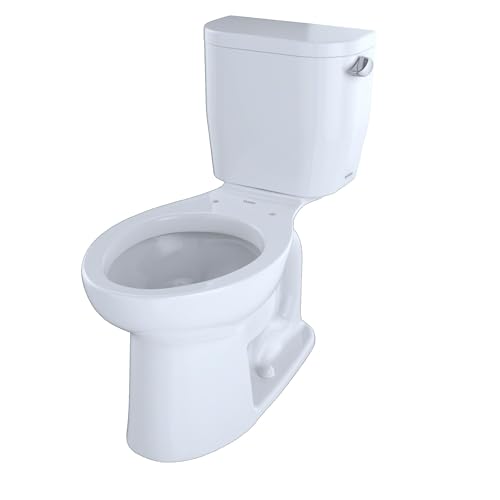
TOTO Entrada Two-Piece Elongated 1.28 GPF Universal Height Toilet — Best Budget Brand-Name Buy
The Entrada is how you buy TOTO discipline on an economy budget. It strips the Drake formula back — a straightforward 1.28 gallon two-piece elongated toilet at universal height — and keeps the things that matter for ownership cost: honest clearing, standard service parts and a manufacturer that will still answer for this model in fifteen years. For landlords and anyone renovating two bathrooms at once, that combination of entry tier and brand depth is exactly the point.
You give up refinement, not function. The bowl rinse is less polished than the Drake’s, the styling is plain, and seat inclusion depends on the listing, so read the contents before comparing its price with seat-included rivals. Judged fairly — as the cheapest safe way to put a verified, efficient, serviceable toilet in a bathroom — it completes this guide’s ladder: ultra-low specialist, pressure-assist, dual flush, one-piece value, and this, the budget brand-name benchmark.
Strengths
- Entry point into a premium brand’s parts and support ecosystem
- Simple, proven 1.28 GPF gravity design
- Universal height suits most adults
Trade-offs
- Plainer bowl wash than the Drake above it
- Seat inclusion varies by listing — verify contents
- Fewer comfort refinements than higher TOTO lines
| Specification | Verified detail |
|---|---|
| Flush volume | 1.28 GPF, verified from Amazon title |
| Configuration | Two-piece, elongated, universal height |
Best for: Budget buyers who still want a major brand behind the toilet / Not suited for: Rental and second-bathroom upgrades done in multiples
Check on Amazon — check price on Amazon for the current listing, configuration and delivery options.
Comparison Table
| Pick | Badge | Key spec | Best for |
|---|---|---|---|
| TOTO Drake Two-Piece Elongated 1.28 GPF Universal Height Toilet | Best Overall | 1.28 GPF, verified from Amazon title | Most households wanting water savings without risk |
| Niagara Conservation Original Single Flush Elongated Toilet | Best for Lowest Water Use | Single flush, elongated, verified from Amazon title | Homes on costly municipal water, septic systems, or strict water budgets |
| Kohler Wellworth Pressure Lite Elongated 1.1 GPF Toilet | Best Pressure-Assist Value | 1.1 GPF pressure assist, verified from Amazon title | Homes with older plumbing that defeated gravity low-flow toilets |
| American Standard H2Option Dual Flush Elongated Toilet | Best Dual Flush | Two-piece, dual flush, elongated, chair height — verified from Amazon title | Families who will actually use the reduced flush for liquid waste |
| WOODBRIDGE One-Piece Chair Height Dual Flush 1.28 GPF Toilet | Best One-Piece Value | Dual flush, 1.28 GPF full flush, verified from Amazon title | Buyers wanting one-piece cleanliness without a premium brand tier |
| TOTO Entrada Two-Piece Elongated 1.28 GPF Universal Height Toilet | Best Budget Brand-Name Buy | 1.28 GPF, verified from Amazon title | Budget buyers who still want a major brand behind the toilet |
How to Choose an Economy Water Saver Toilet
Start with your water and sewer bill, not the toilet shelf. Combined water-plus-sewer pricing varies enormously between municipalities, and sewer is usually charged on water consumed, so a toilet saving applies twice. Find your combined cost per thousand gallons, estimate household flushes per day, and you can work out in minutes whether moving from an old high-volume toilet to 1.28 gallons — or further, to dual flush or ultra-low — pays back in one year or in ten. In a cheap-water town, buy the reliable 1.28 and stop optimising; on expensive water, the ultra-low and dual-flush picks genuinely earn their place.
Next, match flush technology to your plumbing. Modern, correctly sloped drain lines work happily with any pick here. Older homes with long runs, rough pipe or a history of slow clearing should seriously consider the pressure-assist pick, because a toilet that needs a plunger or a second flush has no real economy at all. Dual flush suits disciplined households; single flush suits everyone else. Be honest about which household yours is — the best economy toilet is the one whose saving survives contact with your family’s actual habits.
Finally, price the whole installation, not the box. Seat included or not, wax ring or silicone ring, new supply line, and whether the listing is a complete toilet or a bowl only — these details move the true cost more than small differences between models. Freight damage is the other hidden cost with porcelain: buy from a listing with straightforward returns, inspect the bowl before the installer is booked, and keep packaging until the first successful flush. Economy is a system, and the purchase process is part of it.
One more economy variable deserves a paragraph: who installs it. A straightforward two-piece swap is a comfortable DIY job for a handy household, which keeps the total project cost at the price of the toilet plus small consumables. One-piece and pressure-assist models are equally installable but heavier or less familiar, and a single plumber visit for a bathroom you are unsure about is still cheaper than a cracked bowl from a forced bolt. Economy includes not breaking anything on the way in.
What Gallons Per Flush Really Means for Your Bill
Gallons per flush is a laboratory figure for one full flush, but your bill is written by average consumption: full flushes, reduced flushes, double flushes and leaks combined. That is why this guide keeps returning to clearing reliability. A well-engineered 1.28 gallon toilet that clears first time will use less water in a real home than a nominal 1.0 gallon toilet that needs help twice a week, and far less than any toilet with a worn flapper leaking silently into the bowl around the clock. When you replace an old toilet, replace the supply line and check the new flush valve seal after a month — the cheapest water audit there is.
Dual flush changes the average rather than the maximum. Because the majority of domestic flushes are liquid-only, a reduced flush used consistently can pull a household’s average well below the full-flush rating. Ultra-low single-flush designs attack the same average from the engineering side, using flush mechanics rather than user choice. Neither approach is automatically superior: choice-based saving fails in undisciplined households, engineering-based saving demands the buying care described in the Niagara review. Pick the failure mode you can live with.
Do not overlook the septic angle. For homes on septic systems, lower flush volume is not only about bills — less hydraulic load extends drain-field life and lengthens the interval between pump-outs, which are real money. That is why the ultra-low pick earns its place despite its buying-format caution, and why even a move from a legacy high-volume toilet to any 1.28 pick here is one of the highest-return changes a septic household can make. Conversely, pressure-assist models discharge faster, which some very old septic setups tolerate less happily — another reason to match technology to plumbing rather than chasing the smallest number.
It is also worth saying what a water saver does not change. It will not fix low supply pressure, a partly blocked drain or a bathroom whose real water waste is a running tap and long showers. Put the toilet in proportion: in a home with an old high-volume toilet it is usually the single largest water saving available; in a home already at modern volumes, its saving is smaller and the purchase should be justified by reliability and comfort as much as by the meter.
How to Install a Water Saver Toilet and Verify the Saving
Installation follows the standard sequence, with two efficiency-specific checks. Set the toilet on a new ring, confirm the flange height is correct — a flange sitting too low is the classic cause of the slow rock and eventual seal failure that wastes both water and flooring — and connect a new braided supply line. Once filled, check the tank waterline against the manufacturer’s mark: an overfilled tank quietly converts your efficient toilet into a wasteful one, and the adjustment takes a minute with the fill valve. Mark the waterline check on your calendar for a month later, after everything has settled.
Then verify performance properly over the first week. Every pick should clear typical loads first time; if one does not, check the basics before blaming the model — tank water level, chain slack, and whether the bowl rim jets are clear. Put a few drops of food colouring in the tank, wait twenty minutes without flushing, and look for colour in the bowl: that simple dye test catches the silent flapper or flush-valve leak that can erase an efficient toilet’s entire saving, and it is worth repeating twice a year for the life of the toilet.
Safety and sense: porcelain is heavy and unforgiving, so lift with two people and never overtighten closet bolts — cracked bases come from enthusiasm, not weakness. Keep the old toilet’s shutoff knowledge current: know where the bathroom stop valve is before you start, and if it has not moved in a decade, expect to replace it and budget the small extra time. If your rough-in turns out to be an unusual size, stop and measure rather than forcing the fit; several picks here have compact or alternative rough-in siblings elsewhere in this programme.
While the toilet is out, look at the floor and flange with fresh eyes — this is the cheapest moment in a decade to discover soft flooring, a corroded flange or a shutoff valve that no longer turns. Ten minutes of inspection during a planned swap prevents an emergency later, and emergencies are the least economical events in home ownership. Photograph the shutoff and flange before the new toilet goes down; future you, ordering a part, will be grateful.
Budget Tiers: What Each Level of Spend Buys
At the entry tier, represented here by the Entrada class, you buy honest function: a proven flush at an efficient volume, standard parts and a major brand’s support, in a plain body with few refinements. For second bathrooms, rentals and multi-room renovations this tier is not a compromise — it is the correct allocation, because the difference between it and the mid tier is refinement, not reliability, and refinement in a spare bathroom is money that earns nothing.
The mid tier — the Drake and the dual-flush and one-piece value picks — buys the refinements that compound: better bowl glazing so low volumes rinse cleanly, quieter and softer seats included in the box, dual-flush choice, and one-piece bodies that remove leak paths and cleaning burden. Households living with the toilet daily for a decade-plus recover this tier’s difference in satisfaction and in avoided minor repairs, which is why our Best Overall sits here rather than at the floor.
Above that, in this category, money buys specialisation rather than general betterness: pressure assistance for difficult plumbing, ultra-low engineering for extreme water costs. Neither is an upgrade for a normal house — both are answers to specific constraints, priced accordingly. Reading the tiers this way protects you from the two classic errors: under-buying into false economy, and over-buying a specialist solution to a problem your house does not have.
Whichever tier you choose, hold one line: never let the tier decision compromise the parts ecosystem. A toilet is a fifteen-to-twenty-year fixture whose valves, seals and seats are consumables; the cheapest toilet to own is the one whose consumables are cheap, standard and stocked nearby. That principle, more than any single model recommendation, is the economy guide’s real content — the picks are simply its current best examples.
Water Saving Beyond the Toilet: A Quick Household Audit
Because you are already thinking about water, a five-minute audit multiplies this purchase’s value. Check every toilet in the house with the dye test — one silently leaking older toilet can waste more than your new saver will save, and its repair is usually a single inexpensive valve seal. Look under sinks for weeping supply connections, and note any tap that drips at rest. None of this requires a plumber, and all of it is cheaper than any product in this guide.
Then consider where the household’s water actually goes. In most homes the toilet is the largest single indoor use, which is why this guide exists — but showers and laundry follow, and habits outweigh hardware at the margin: a minute off a shower is a saving no fixture can match. The point of the audit is proportion. Buy the efficient toilet because it works every day without asking anything of anyone; then take the free behavioural savings where they are painless, and ignore the rest without guilt.
Septic households should add one item: know your tank’s pumping interval and keep to it. An efficient toilet reduces hydraulic load, but solids still accumulate on schedule, and a neglected tank costs more than a decade of water savings. Landlords get a parallel note: an efficient, reliable toilet in a rental is not generosity, it is arithmetic — the water bill, the callouts and the floor damage from leaks all price into the same ledger.
Finally, re-run the dye test on the new toilet after its first month and twice a year thereafter, and teach one other person in the household how it works. Water saving fails silently or not at all; a household that knows how to check is a household whose efficient toilet stays efficient. That, more than the model on the invoice, is the lasting deliverable of an economy purchase done properly.
What to Do With the Old Toilet
A replaced toilet is bulky, heavy and surprisingly reusable — plan its exit before the new one arrives, because a porcelain fixture parked in a hallway has a way of staying there. If the old toilet works, local reuse charities and salvage yards in many areas accept clean fixtures, and a working standard toilet is genuinely useful to someone renovating on a shoestring. Drain it fully, tape the tank lid to the bowl, and move it with two people and a dolly; porcelain chips floors and toes with equal indifference.
If it is not reusable, check your municipality’s bulky-waste rules before assuming the kerb will take it — many require a booked collection or a trip to a transfer station, and some porcelain recycling programmes grind old fixtures into aggregate. Breaking a toilet for disposal is a last resort and a gloved, goggled, outdoor job if it ever comes to that; intact removal is safer in every direction. Never leave a removed toilet where children can climb on it — an unbolted tank lid is a real household hazard.
Keep the paperwork loop closed: photograph the old toilet’s model markings before it leaves if there is any chance a sibling fixture elsewhere in the house shares them, because the part you need next year is always for the toilet you did not replace. And if the replacement was motivated by water saving, note the change and the date; when the next few water bills arrive, you will be able to see your own saving rather than trusting this guide’s arithmetic — the most satisfying verification in the whole project.
Total Cost of Ownership, Worked Through One Example Household
Abstract economy advice becomes clearer with a worked pattern, so consider a representative household replacing one legacy high-volume toilet used by three people. The flush count lands somewhere in the mid-teens per day across the household, which annualises into several thousand flushes. Against a legacy toilet, every pick in this guide removes the majority of the water from each of those events; the dual-flush and ultra-low picks remove more again, because most of those thousands of events are liquid-only. Even without pricing a single gallon, the shape of the saving is unmistakable: it is not a one-off discount, it is a small refund attached to a daily habit the household was going to perform anyway.
Now run the costs on the same pattern. The purchase is one event. The seat, ring and supply line are one event. The likely services across fifteen years — a flush-valve seal, perhaps a fill valve, perhaps a seat — are small, standard and, on the mainstream picks here, priced like hardware rather than like spare parts for a luxury car. The failure that would actually damage the household budget is not a part at all; it is an unnoticed leak running for a season, which is why this guide’s recurring dye-test sermon is, in strict accounting terms, the most valuable paragraph in it.
The comparison that emerges is why economy guides should be written in decades rather than in shelf prices. The difference between the cheapest acceptable toilet and the mid-tier benchmark in this guide is real money on the day of purchase and very little money indeed when spread across the thousands of days it will serve — while the difference in parts support, glazing and clearing reliability is felt weekly. Households that internalise that arithmetic stop asking which toilet is cheapest and start asking which toilet is finished — bought once, serviced cheaply, and never thought about again.
That is also the honest frame for the specialist picks. Pressure assist and ultra-low engineering cost more because they solve constraints — bad drain lines, punitive water pricing, septic capacity — that have their own price tags when ignored. An economy purchase is not the least money spent; it is the least money spent across the whole problem, including the problem’s plumbing, its water rates and its next fifteen years of mornings.
Common Buying Mistakes
The costliest mistake in this category is comparing shelf prices instead of ownership costs — choosing the cheapest toilet available, then paying for it in double flushes, early valve failures and a plunger kept permanently beside it. The second is the incomplete listing: bowls, tanks and complete toilets share near-identical names, especially in ultra-efficient lines, and more than one buyer has unboxed half a toilet. Read contents lists literally. The third is ignoring the seat: a less-seat listing compared against a seat-included listing is not cheaper, it is unfinished.
Shoppers also over-rotate on the gallon figure. Dropping from 1.28 to an ultra-low design saves a real but modest amount in a typical cheap-water household, and it is not worth accepting a toilet your family dislikes using — a disliked toilet gets replaced early, which is the least economical outcome of all. Conversely, households on expensive water sometimes buy a stylish 1.6 gallon model out of habit and donate the difference to the water company every month for a decade. Run your own numbers once; they take five minutes and they settle the question properly.
Finally, do not throw away the saving at install time. An unlevel flange, a reused wax ring, an overfilled tank or a chain adjusted to hold the flapper open a beat too long will each quietly tax every flush. The dye test and waterline check in the how-to section cost nothing and protect the entire investment. Economy water saving is mostly a game of small disciplines — which is good news, because small disciplines are cheap.
A final small discipline: keep the receipt, model number and a note of the seat and valve sizes in your home records, and write the install date on the inside of the tank lid with a marker, as plumbers do. When a part is needed in year seven, that thirty seconds of administration turns a research project into a single ordered part — and small, prompt repairs are where lifetime economy is actually won or lost.
Final Recommendation
For most households, start and finish with the TOTO Drake: it saves water reliably, clears first time and costs little to own. If your combined water and sewer rates are high, or you are on septic, step to the Niagara ultra-low-flush pick and take the extra minute to confirm you are ordering a complete toilet. Problem plumbing points to the Kohler pressure-assist, disciplined families to the H2Option dual flush, one-piece fans to the WOODBRIDGE, and multi-bathroom budgets to the Entrada.
Whichever you choose, do the two free verifications after install — waterline and dye test — and the saving you bought will be the saving you actually get, month after month.
Start your shortlist here: TOTO Drake Two-Piece Elongated 1.28 GPF Universal Height Toilet for the guide’s main recommendation, and Niagara Conservation Original Single Flush Elongated Toilet as the first alternative to compare on configuration and current pricing — check price on Amazon for both before deciding.
Related guides in this programme: Best Efficient Toilets · Best Efficient High Tech Toilets · Best Elongated 14.5 Inch Tall Toilets · Best Elevated Toilets · Best Electric Toilets
Frequently Asked Questions
How much water does a water saver toilet actually save?
Against a legacy toilet using several gallons per flush, any 1.28 GPF pick here cuts flush water by well over half, and dual-flush or ultra-low models can cut the household average further. Your bill saving depends on your combined water and sewer rate and flush count — high-rate and septic households save the most.
Is 1.28 GPF enough to clear properly?
In a well-designed model, yes — the picks in this guide were chosen because their clearing is proven at that volume. Poorly designed low-flow toilets gave the category a bad name years ago; trapway design, glazing and flush engineering matter more than the raw gallon figure.
Dual flush or single flush — which saves more?
Dual flush saves more in households that reliably use the reduced flush for liquid waste, since most flushes are liquid-only. Single-flush ultra-low designs save without needing the habit. Choose based on your household’s discipline, honestly assessed.
What is the buying trap with ultra-efficient toilets?
Incomplete listings. Some ultra-efficient lines sell bowls and tanks separately under similar names. Always confirm the listing is a complete toilet with tank, bowl and internals before ordering — our Niagara review flags this in detail.
Can a water saver toilet work on a septic system?
Yes, and it is one of the best upgrades a septic household can make: lower volume means less hydraulic load on the drain field. Pressure-assist models discharge more abruptly, so very old septic setups should check compatibility first.
How do I know if my efficient toilet is secretly wasting water?
Do the dye test: colour the tank water, wait twenty minutes without flushing, and check whether colour appears in the bowl. If it does, the flush valve seal is leaking silently — usually a cheap, quick part replacement that restores the saving.

