Disclosure: airfryerkitchensupply.com is reader-supported. When you buy through links on our site, we may earn an affiliate commission at no extra cost to you.
Where to buy
The fastest way to buy any of the best eco friendly blankets below is Amazon, where stock, colour and size options are widest and returns are straightforward if a pick does not suit your space. Linked picks go straight to the verified product page — check price on Amazon on the listing itself, because options and availability change often.
- Bedsure Cooling Cotton Waffle Blanket, Ivory Queen (Best Overall): check price on Amazon
- Pendleton National Park Blanket, 100% Wool (Best Heirloom Wool): check price on Amazon
- PHF Lightweight 100% Cotton Waffle Blanket, Queen (Best Pure Cotton): check price on Amazon
- Arcturus Tahoe Wool Bed Blanket, Queen Stone Gray (Best Wool for Bed Use): check price on Amazon
- Arcturus Bighorn 100% Virgin Wool Blanket, Queen (Best Heavyweight Wool): check price on Amazon
- Woolly Mammoth Merino Wool Blanket (Best for Camping and Outdoors): check price on Amazon
The best eco friendly blankets are not a separate species of bedding — they are ordinary blankets judged by a stricter standard: what the blanket is made of, how long it will serve, and what happens when it finally wears out. By that standard the aisle divides cleanly. Natural fibres — wool, cotton and bamboo-derived rayon — biodegrade and avoid shedding plastic microfibres in every wash; virgin polyester fleece does neither, however soft it feels in the shop. This guide ranks the natural-fibre blankets that also perform, because an eco blanket you replace in two years has failed its own brief.
Wool dominates the warm end of the guide, and honestly so: it is renewable, temperature-regulating, odour-resistant enough to need less washing, and durable enough that wool blankets are the ones found still working in grandparents’ houses. Cotton and bamboo-blend waffles own the warm-weather end, breathing through summer nights that wool would overheat. The six picks below cover both ends and the crossover between them, each verified against Amazon’s catalogue data for this site before inclusion.
One honesty note: ‘eco friendly’ is a direction, not a certification. Where a pick’s claim rests on fibre choice and longevity, the review says exactly that rather than dressing it in green language — and no prices are printed, since they vary by size and colourway; check price on Amazon and judge each blanket inside its tier.
In this guide
Quick Picks
- Bedsure Cooling Cotton Waffle Blanket, Ivory Queen — Best Overall. A cotton and bamboo-derived rayon waffle weave that breathes through warm nights — the natural-fibre summer blanket most sleepers will reach for. — Check on Amazon
- Pendleton National Park Blanket, 100% Wool — Best Heirloom Wool. The buy-it-for-decades wool blanket: 100% wool, national-park stripes, and the opposite of disposable bedding. — Check on Amazon
- PHF Lightweight 100% Cotton Waffle Blanket, Queen — Best Pure Cotton. A 100% cotton waffle blanket, pre-washed for softness — the simplest eco story in the guide: one natural fibre, no blends. — Check on Amazon
- Arcturus Tahoe Wool Bed Blanket, Queen Stone Gray — Best Wool for Bed Use. A full queen-size wool bed blanket that is washable — the practical wool pick for the main bed, not the display shelf. — Check on Amazon
- Arcturus Bighorn 100% Virgin Wool Blanket, Queen — Best Heavyweight Wool. The heavyweight: 100% virgin wool, thick and cabin-grade — for cold rooms, cabins and anyone who sleeps cold. — Check on Amazon
- Woolly Mammoth Merino Wool Blanket — Best for Camping and Outdoors. A merino wool camping blanket that works as hard outdoors as in — the one-blanket-for-everywhere pick. — Check on Amazon
How These Picks Were Chosen
Picks were chosen fibre-first. Every linked blanket is wool, cotton or a cotton/bamboo-derived blend; virgin synthetic fleece was excluded regardless of performance, because a guide with ‘eco friendly’ in the title cannot recommend the blanket category with the worst microfibre-shedding and end-of-life profile and keep a straight face.
Longevity was the second filter, judged by construction signals: dense weaves, single-fibre compositions that mend and recycle cleanly, washable builds that will actually be cared for, and brands whose blankets are known for decade-scale service. A blanket’s footprint is its purchase impact divided by its years of use, so durability is not a side criterion here — it is the main one.
Performance still had to be earned. Each pick was assigned the job its fibre genuinely does best — summer breathing, heirloom warmth, main-bed practicality, heavyweight cold, outdoor crossover — and no blanket is praised for a season it would fail in. Sizes and fibre contents quoted in the reviews come from the verified listings.
The 6 Best Eco Friendly Blankets

Bedsure Cooling Cotton Waffle Blanket, Ivory Queen — Best Overall
Check the current price on Amazon
This is the pick for hot sleepers who want natural fibres doing the cooling rather than a synthetic ‘cool-touch’ finish. The waffle weave traps small air pockets that insulate lightly without sealing heat in, and the cotton-bamboo blend stays breathable through a warm night. It suits summer bedding, warm flats and anyone who kicks off a duvet by 2 a.m. but still wants a layer. As a bed blanket it covers a queen in the ivory colourway verified here.
Strengths
- Natural-fibre blend: cotton with rayon derived from bamboo per Amazon listing
- Waffle texture breathes and layers without trapping heat
- Lightweight enough for summer yet useful as a shoulder-season layer
Trade-offs
- A summer-weight blanket — cold sleepers will need more in winter
- Rayon blends prefer gentler washing than pure cotton
- Ivory shows marks sooner than deeper colourways
| Detail | What to know |
|---|---|
| Blend | 50% cotton, 50% rayon derived from bamboo per Amazon listing |
| Weave | Waffle weave per Amazon listing |
| Size verified | Queen, Ivory per Amazon listing |
Waffle weave is the honest engineering in this blanket: the grid of pockets holds a thin layer of air, which is why the blanket feels like something rather than a sheet, while the open structure lets body heat escape instead of building up. Synthetic cooling blankets often feel cold for the first ten minutes and ordinary after; a breathable natural weave performs the same at hour six as at minute one.
The eco case rests on fibre choice: cotton and bamboo-derived rayon are plant-based and biodegradable at end of life, unlike the polyester fleece that dominates the blanket aisle. Bamboo rayon is a processed fibre and honest guides say so — but as a step away from virgin plastic textiles, this blend is a genuine one.
Best for: hot sleepers wanting a breathable natural-fibre summer layer / Not suited for: cold sleepers needing a single winter-weight blanket

Pendleton National Park Blanket, 100% Wool — Best Heirloom Wool
Check the current price on Amazon
Pendleton’s park blankets are the eco argument made by longevity: a 100% wool blanket bought once and used for decades beats a cheap fleece replaced every few years on every environmental measure that matters. The iconic park stripes make it a display piece as much as bedding — draped on a sofa, folded at a bed’s foot, taken to cabins and kept for the next generation. It suits buyers who think in decades and gift-givers who want the blanket to still be in the family in twenty years.
Strengths
- 100% wool — natural, breathable, temperature-regulating in both seasons
- Built and finished to heirloom standard rather than seasonal fast fashion
- Iconic design doubles as home decor, not just bedding
Trade-offs
- Premium tier — the highest budget commitment in this guide
- Wool needs gentler care than cotton or fleece
- Too warm as a summer night layer for most sleepers
| Detail | What to know |
|---|---|
| Fibre | 100% wool per Amazon listing |
| Design | National Park stripes per Amazon listing |
| Finish | Napped texture per Amazon listing |
Wool’s sustainability story is unusually complete: it is renewable annually, biodegradable at end of life, naturally odour-resistant so it needs less washing, and warm without the bulk of synthetic insulation because the fibres regulate temperature rather than simply trapping heat. A wool blanket also airs back to freshness on a line, which is why wool households wash blankets a fraction as often as fleece households.
The honest caveat is care and cost. Wool wants cool, gentle washing or dry cleaning and storage away from moths, and the purchase price sits firmly in the premium tier. Owners who accept both tend to keep these blankets for a very long time — which is precisely the point.
Best for: buy-once households and meaningful gifts / Not suited for: buyers needing machine-wash-and-forget bedding on a tight budget
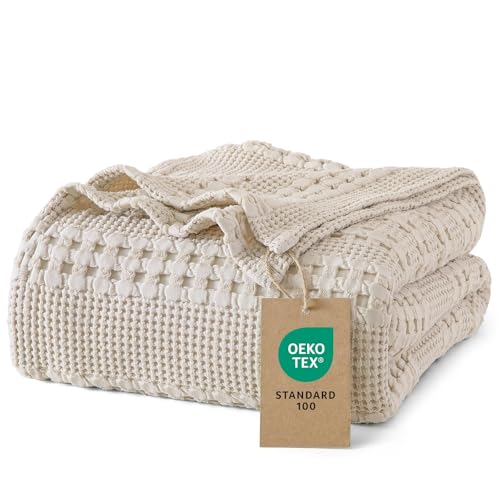
PHF Lightweight 100% Cotton Waffle Blanket, Queen — Best Pure Cotton
Check the current price on Amazon
Choose the PHF if your eco preference is specifically ‘no synthetics and no blends’: the blanket is 100% cotton in a breathable waffle weave, pre-washed so it arrives soft rather than stiff. It suits layering households — over a sheet in summer, under a duvet in winter — and anyone with skin that prefers plain cotton against it. The light taupe colourway verified here hides everyday marks better than white or ivory.
Strengths
- 100% cotton with no synthetic content per Amazon listing
- Pre-washed for softness from the first night
- Waffle weave layers cleanly in both summer and winter setups
Trade-offs
- Lightweight — a layer, not a standalone winter blanket
- Cotton takes longer to dry than synthetic blankets
- Waffle texture can snag on rough jewellery or Velcro
| Detail | What to know |
|---|---|
| Fibre | 100% cotton per Amazon listing |
| Weave | Waffle, pre-washed per Amazon listing |
| Size verified | Queen, Light Taupe per Amazon listing |
Single-fibre textiles have an underappreciated end-of-life advantage: a 100% cotton blanket is straightforwardly biodegradable and, while it lasts, easy to wash, mend and eventually demote to pet bedding, dust sheets and rags. Blends and synthetics complicate every one of those steps. For households organising their buying around that logic, this is the cleanest pick in the guide.
As a performer it is the classic cotton waffle: breathable, softening with every wash, and honest about its weight. Layer it rather than asking it to be a winter blanket and it will be in service twelve months a year.
Best for: no-blends households and year-round layering / Not suited for: anyone wanting one thick blanket for cold nights

Arcturus Tahoe Wool Bed Blanket, Queen Stone Gray — Best Wool for Bed Use
Check the current price on Amazon
The Tahoe is wool for people who will actually sleep under it nightly: a generous 90 x 96 inch queen cut, a washable construction that removes the dry-clean objection, and year-round positioning that reflects how wool genuinely behaves — warm in winter, surprisingly breathable in shoulder seasons. It suits main-bed use in homes that heat modestly and anyone converting a bed from synthetic layers to natural fibres one piece at a time.
Strengths
- Full 90 x 96 in queen coverage per Amazon listing
- Washable wool — the care objection answered
- Year-round temperature regulation wool is known for
Trade-offs
- Heavier in the wash than cotton blankets
- Wool feel is not for everyone against bare skin — many use it over a sheet
- Stone gray is practical but not a decorative statement
| Detail | What to know |
|---|---|
| Size | Queen, 90 x 96 in per Amazon listing |
| Fibre | Wool bed blanket per Amazon listing |
| Care | Washable per Amazon listing |
Washability changes wool’s real-world footprint: a blanket that can be gently machine-washed at home gets washed appropriately and lasts, while a dry-clean-only blanket gets washed rarely and replaced sooner than it should be. Arcturus built the Tahoe around that practical reality, and the size is properly generous — enough drop on a queen bed that the blanket stays tucked through the night.
For eco-minded buyers the comparison that matters is against the microfibre and fleece blankets it replaces: natural fibre, no plastic shedding in the wash, and a service life measured in many years. That is the profile of a purchase you make once and stop thinking about.
Best for: main-bed wool warmth with home washing / Not suited for: shoppers wanting a light summer-only layer

Arcturus Bighorn 100% Virgin Wool Blanket, Queen — Best Heavyweight Wool
Check the current price on Amazon
The Bighorn is the winter end of this guide: 100% virgin wool in a thick, durable weave positioned for home and cabin, the blanket for unheated spare rooms, mountain stays and cold sleepers who find every other blanket insufficient. Virgin wool means fibres not recycled from reclaimed textiles, giving the blanket its full loft and durability. It suits buyers in cold climates building a natural-fibre bed that needs no electric assistance.
Strengths
- 100% virgin wool for maximum warmth and durability per Amazon listing
- Thick, cabin-grade construction
- Natural fibre warmth without electric blankets or synthetic fill
Trade-offs
- Too warm for summer or well-heated modern homes
- The heaviest pick here — noticeable in the wash
- Premium natural-fibre pricing tier
| Detail | What to know |
|---|---|
| Fibre | 100% virgin wool per Amazon listing |
| Character | Thick, warm and durable per Amazon listing |
| Setting | Home and cabin use per Amazon listing |
There is a quiet eco logic to a genuinely warm blanket: a bed that stays comfortable in a cooler room is a thermostat turned down at night, and the Bighorn’s thick virgin wool is built exactly for that trade. Cabins and older houses with uneven heating are its natural habitat, and owners in those settings describe this class of blanket as the difference between sleeping well and sleeping in socks and a jumper.
Durability is the other half of its case. Dense virgin wool resists the pilling and thinning that retire synthetic blankets, and a blanket that serves fifteen winters has a footprint per use that no fast-fashion fleece can approach.
Best for: cold sleepers, cabins and cool rooms / Not suited for: warm homes or summer use

Woolly Mammoth Merino Wool Blanket — Best for Camping and Outdoors
Check the current price on Amazon
Merino is the fine-wool upgrade: softer against skin than standard wool, naturally odour-resistant over multi-day use, and warm even in damp conditions that defeat cotton completely. The Woolly Mammoth is positioned as a fall camping blanket, which makes it the pick for people whose blanket lives several lives — sofa throw in winter, car blanket year-round, camp bedding in autumn. It suits outdoors households and anyone who wants one natural blanket that travels.
Strengths
- Merino wool: finer, softer feel than standard wool
- Performs in damp conditions where cotton fails outdoors
- Odour resistance suits multi-day trips without washing
Trade-offs
- Camping size is a throw/bed-topper scale, not a full queen bed blanket
- Merino wants gentle handling compared with hard-wearing cabin wool
- Outdoor use means it will gather the marks of outdoor life
| Detail | What to know |
|---|---|
| Fibre | Merino wool per Amazon listing |
| Positioning | Fall camping blanket per Amazon listing |
| Character | Natural odour resistance typical of merino, per fibre type |
Every outdoor household learns the cotton lesson once: a cotton blanket that gets damp at a campsite stays cold and clammy, while wool keeps insulating. Merino adds next-to-skin softness to that resilience, which is why this blanket crosses over to sofa and car duty instead of living in a kit bag. One blanket doing three jobs is its own kind of sustainability.
Care is the trade: merino rewards gentle washing and flat or line drying, and repays it with years of service. Treat it like the quality natural textile it is, rather than like a fleece, and it will outlast several of the fleeces.
Best for: campers and one-blanket households / Not suited for: buyers needing full queen-bed coverage
Comparison Table
| Pick | Badge | Key spec | Best for |
|---|---|---|---|
| Bedsure Cooling Cotton Waffle Blanket, Ivory Queen | Best Overall | Cotton/bamboo-rayon waffle, queen | hot sleepers wanting a breathable natural-fibre summer layer |
| Pendleton National Park Blanket, 100% Wool | Best Heirloom Wool | 100% wool, heirloom construction | buy-once households and meaningful gifts |
| PHF Lightweight 100% Cotton Waffle Blanket, Queen | Best Pure Cotton | 100% cotton waffle, pre-washed | no-blends households and year-round layering |
| Arcturus Tahoe Wool Bed Blanket, Queen Stone Gray | Best Wool for Bed Use | Washable wool, 90 x 96 in queen | main-bed wool warmth with home washing |
| Arcturus Bighorn 100% Virgin Wool Blanket, Queen | Best Heavyweight Wool | 100% virgin wool, heavyweight | cold sleepers, cabins and cool rooms |
| Woolly Mammoth Merino Wool Blanket | Best for Camping and Outdoors | Merino wool, camping and crossover use | campers and one-blanket households |
Short on time? Start with the Best Overall pick, then use the table to check whether a specialist badge matches your actual room, routine or household better before you check price on Amazon.
How to Choose the Best Eco Friendly Blankets
Choose the fibre for the season first. Summer and hot sleepers: cotton or cotton-bamboo waffle weaves, which breathe and layer. Winter and cold rooms: wool, in a weight matched to your heating — medium for modern insulated homes, heavyweight for cabins and older houses. Shoulder seasons and travel: merino and mid-weight wool, which regulate across the widest range.
Then interrogate the eco claim with three questions. What is it made of — and is that stated as a percentage, or hidden behind words like ‘natural feel’? How long will it last — dense weave, single fibre, repairable? What happens at the end — biodegradable fibre, or plastic that fragments? A listing that answers all three plainly is selling a real eco blanket; one that answers none is selling a colour palette.
Finally, size generously. A blanket slightly too large drapes, tucks and layers; one slightly too small rides up and gets replaced — and replacement is the least eco outcome of all. For a main bed, look for dimensions that give real overhang on both sides of your mattress size.
Wool vs Cotton vs Bamboo Blends: The Honest Fibre Comparison
Wool is the performance and longevity champion: warm without bulk, breathable enough for shoulder seasons, odour-resistant so it washes least, and the longest-lived fibre in this guide. Its costs are price, weight in the wash, and care that ranges from gentle machine cycles (the washable picks here) to specialist cleaning. Cotton is the easy-care natural fibre: washable without ceremony, soft against skin, ideal in waffle weaves for warm weather — but it insulates poorly when damp and wears faster than wool.
Bamboo-derived rayon, usually blended with cotton as in the Bedsure pick, adds softness and breathability for hot sleepers. Be clear-eyed about it: the fibre begins as a fast-growing plant but is chemically processed into rayon, so it sits between cotton and synthetics in any honest ranking — plant-based and biodegradable, not untouched nature. Recycled synthetics, absent from this guide’s picks, are the other middle path: better than virgin plastic, still shedding microfibres.
Reading Green Claims Without Being Greenwashed
The vocabulary to distrust is the vocabulary with no numbers: ‘earth-friendly feel’, ‘conscious collection’, ‘natural-inspired’. The vocabulary to trust is percentages, certifications named in full, and construction details — fibre content by weight, weave type, where the blanket is made. A seller who prints ‘100% wool’ or ‘50% cotton, 50% bamboo-derived rayon’ on the listing is making a checkable claim; that checkability is the difference between marketing and information.
Also weigh what is not claimed. None of the picks here promise to save the planet; they offer natural fibres, long service and clean end-of-life, which is the real, modest, verifiable eco case for a blanket. Any product promising more than that for a piece of bedding is selling the promise, not the blanket.
Making a Blanket Last: Care as an Eco Practice
The greenest blanket is the one already in your house, kept in service. Wool needs the least washing — airing on a line restores freshness — and when washing is needed, cool and gentle is the rule, with storage in a breathable bag against moths. Cotton tolerates normal washing and improves in softness; waffle weaves should be kept away from Velcro and rough zips that snag the texture.
Repair small damage early: a snagged thread pulled through, a fraying edge re-hemmed, a small hole darned in wool before it ladders. Ten minutes with a needle extends a blanket’s service by years, and a blanket demoted gracefully — bed to sofa, sofa to car, car to pet — extracts every season of use its fibres have to give.
How to Layer Natural-Fibre Blankets for Every Season
A small set of natural blankets, layered deliberately, replaces a cupboard of single-season synthetics.
- Summer: sleep under a single cotton or cotton-bamboo waffle blanket over a sheet — the weave breathes and the layer is easy to kick half-off at 3 a.m.
- Shoulder seasons: add the waffle under a mid-weight wool blanket, or fold the wool at the bed’s foot to pull up only if the night turns cold.
- Winter: put the heavyweight wool over your duvet or as the main blanket with a cotton layer beneath it against the skin if you find wool’s texture strong.
- For guests and spare rooms, stack the layers folded at the foot of the bed so visitors can build their own combination instead of overheating under one thick blanket.
- Outdoors, take the merino or wool blanket, never the cotton — wool keeps insulating if dew or drizzle reaches it.
- Rotate blankets between bed and sofa duty each season; even wear is longer wear, and airing each blanket on a line as it rotates keeps washing rare.
If a wool blanket develops a stale cupboard smell, a day aired outside in moving air — not harsh midday sun — restores it without a wash. Washing is wool’s main wear event, so every wash avoided is service life gained.
The Full Lifecycle: Where Blanket Fibres Come From and Go To
Wool begins as a fleece shorn annually from sheep that regrow it — a genuinely renewable input — and its processing is comparatively mechanical: washing, carding, spinning, weaving. Cotton begins as a thirsty crop whose footprint depends heavily on how and where it is grown, which is why cotton’s eco case in this guide rests on longevity and clean end-of-life rather than on the field. Bamboo rayon begins as fast-growing bamboo and passes through significant chemical processing to become fibre; the guide scores it honestly between the two.
At end of life the ranking clarifies. Wool and cotton biodegrade in soil conditions over months to a few years, returning carbon to the ground; polyester persists, fragmenting into microplastics across decades. That single difference, multiplied by every blanket in every house, is most of what ‘eco friendly’ can truthfully mean for bedding — and it is why fibre content, stated in percentages, is the first thing to check on any listing.
The middle of the lifecycle matters too: microfibre shedding happens at every wash of a synthetic blanket, entering water systems in quantities no home filter fully stops. Natural-fibre blankets shed natural fibres, which water systems and soils handle as they handle leaf litter. Choosing wool or cotton is therefore a decision about your washing machine’s output as much as your bed’s comfort.
Building a Natural-Fibre Bed, One Purchase at a Time
Nobody needs to replace a bed’s textiles in one expensive purge — and throwing away working bedding to buy eco bedding is its own waste. The sane sequence replaces each piece as it wears out, in the order pieces actually die: sheets first (they wear fastest), then blankets, then duvets and pillows. Each replacement is chosen natural, sized generously and built to last, and within a few years the bed has converted itself without a single usable item landfilled early.
Prioritise by skin contact and wash frequency. The layers washed most — sheets, pillowcases — repay natural fibres fastest in comfort and in reduced microfibre shedding per wash. The blanket layer, washed least, is where heirloom thinking pays best, which is why this guide’s wool picks emphasise decades of service over seasonal styling.
Keep a small repair habit alongside: a needle and matching thread for cotton hems, a darning mushroom or patch for wool. Ten-minute repairs, done when damage is small, are the difference between a natural textile’s theoretical lifespan and its real one — the greenest skill in this entire guide costs almost nothing.
Buying Scenarios: First Flat, Family Home, Cabin and Gift
The first flat needs versatility per pound spent: one cotton waffle for summer and layering, one mid-weight wool as the winter and sofa blanket — the PHF and the Tahoe in this guide — covers every night of the year and both double as guest bedding. Two natural blankets, bought once, replace the pile of seasonal synthetics a first home otherwise accumulates.
The family home runs on washability and spares: washable wool or cotton on the main beds, a Pendleton-class blanket where it will be seen and kept, and the merino travelling between car, sofa and camping kit. Children demote blankets at speed, so the household system — bed to sofa to den to dog — should be planned as a conveyor, with each new purchase entering at the top.
The cabin and the gift are the heirloom scenarios. A cabin bed under a Bighorn-class blanket needs no other winter provision, and a Pendleton given at a wedding or a housewarming is the rare present still in daily use at the silver anniversary. In both cases the premium tier is not indulgence; it is the correct specification for a thirty-year job.
What to Check on the Listing Before You Buy an Eco Blanket
Fibre percentages, printed in numbers: ‘100% wool’, ‘50% cotton, 50% bamboo-derived rayon’. A listing that will not quantify its fibres has told you its answer. Second, size in full dimensions against your bed — eco virtue does not excuse a blanket that ends mid-shin, and replacement is the least green outcome in the category.
Third, care instructions you will actually follow: a washable wool suits a busy household better than a finer blanket that needs care it will not get, because an uncared-for blanket is a short-lived one. Fourth, construction signals — weave density, edge finishing, weight in grams where stated — which predict the decade-scale service the whole eco case rests on.
Fifth, the seller’s own restraint: listings that claim fibre content, size and care plainly, without planet-saving rhetoric, correlate strongly with blankets that deliver. In this category, modest claims are a quality signal, and this guide’s picks were chosen partly on exactly that evidence.
Wool Blanket Ownership: A Decade in Four Seasons
Year one with a good wool blanket teaches its central surprise: how rarely it asks to be washed. Aired on a line after use in the guest room, shaken and aired monthly on the main bed, a wool blanket stays fresh through a winter that would send a fleece through the machine six times. Owners who expected fragility discover the opposite — wool is the low-maintenance fibre, provided its one rule is kept: air often, wash rarely, and wash cool and gentle when you do.
The shoulder seasons teach the second lesson, temperature regulation. The same blanket that carried a cold January carries a mild October without the midnight kick-off that synthetic insulation provokes, because wool buffers warmth rather than sealing it. This is the property that converts sceptics: a household that sleeps under wool through spring stops thinking of blankets as seasonal equipment and starts thinking of them as furniture — permanent, chosen once, and quietly excellent.
Years three to ten are where the eco argument stops being an argument and becomes a observation: the blanket is simply still there, unpilled, unfaded in the way synthetics fade, doing its job while two generations of fleece have passed through the same bed. Cost per winter, footprint per winter, laundry per winter — every honest metric improves with each year the blanket survives, which is why this guide weights longevity above every other green claim a listing can make.
The decade ends, when it ends, gracefully: a wool blanket thins at its centre after very long service, gets demoted to the car, the dog, the picnic basket, and finally — cut into pieces by keen gardeners — to the compost, where it returns what it borrowed. No stage of that life involves a landfill or a waterway full of microfibres. That full-circle story, available from no synthetic blanket at any price, is what the words eco friendly mean when they are used carefully.
Value, Longevity and the True Price of a Blanket
The arithmetic of this guide deserves one plain restatement. A premium wool blanket bought once and used for twenty winters costs, per winter, less than a budget fleece replaced every three — before counting the fleece’s washing, its shedding, or its disposal. Eco friendly and economical are the same purchase here, viewed over the only timescale blankets actually live on. The barrier is not the total cost; it is paying the decade’s cost in the first year, which is a budgeting problem, not a value problem.
For households solving that barrier, the sequence in the lifecycle section is the practical route: convert the bed one natural piece at a time as synthetics wear out, starting with the layers washed most. Within a few ordinary replacement cycles the bed is natural, the blankets are heirloom class, and no single month carried the whole cost — patience doing the work that a splurge would have done worse, since nothing usable was discarded early.
What remains is to protect the investment with the cheapest insurance in textiles: airing, gentle rare washing, breathable storage and ten-minute repairs. A blanket kept that way does not merely last — it improves, softening into the household’s habits and becoming, in the unshowy way of all good tools, irreplaceable-feeling long before it is worn out.
One Last Check Before the Basket: The Hand Test
If you can handle a candidate blanket in a shop, run the hand test this guide’s fibre sections imply: grip a corner and lift — a blanket with real substance announces itself in weight and drape, while a thin weave at a large size feels like a rumour of a blanket. Rub the surface firmly a dozen times and look at your palm and the fabric: early pilling in the shop predicts heavy pilling at home. Then check the edges, because edges are where blankets are finished honestly or not at all. A blanket that passes weight, surface and edges, in a fibre whose percentages are printed on its label, has earned its place in the basket — and, by this guide’s standards, its place in an eco friendly home.
Common Buying Mistakes
Buying virgin fleece for an ‘eco’ brief
Polyester fleece sheds microfibres in every wash and fragments rather than biodegrades at end of life. Whatever its other virtues, it cannot headline an eco friendly blanket purchase with a straight face.
Believing unnumbered green language
‘Natural feel’ is not a fibre. Demand percentages and named fibres; if a listing will not state its composition plainly, assume the composition is the reason.
Over-washing wool
Wool’s odour resistance means airing usually replaces washing. Every unnecessary hot wash felts and wears the fibres — wash cool, gentle and rarely, and the blanket will outlast the habit.
Buying a blanket too small to save money
An undersized blanket gets replaced, and replacement doubles the footprint the purchase was meant to minimise. Size for overhang and tuck; the generous blanket is the eco blanket.
Storing natural fibres in sealed plastic
Wool and cotton stored airless in plastic invite mildew and moth interest. Use breathable cotton storage bags, clean and fully dry, in a cool cupboard.
Final Recommendation
Start with the season you struggle with. Hot sleepers: the Bedsure waffle or the pure-cotton PHF. Cold rooms and cabins: the Arcturus Bighorn or the washable Tahoe for the main bed. Buy-once households and gift-givers: the Pendleton. Travellers and campers: the Woolly Mammoth merino. Each is a natural-fibre blanket with a service life that makes its footprint per year genuinely small.
Whichever you choose, read the fibre percentages on the listing before you check price on Amazon, size generously, and care for it the way its fibre asks. An eco blanket is not bought; it is kept — and keeping is the part fully in your control.
Best Blankets Best Wool Blankets Best Cotton Blankets Best Cooling Blankets Best Weighted Blankets Best Throw Blankets
Frequently Asked Questions
What is the most eco friendly blanket material?
For warmth, wool has the strongest overall case: renewable, biodegradable, odour-resistant so it washes least, and exceptionally long-lived. For warm weather, cotton and cotton-bamboo waffle weaves are the natural-fibre answer. Virgin synthetic fleece ranks last on shedding and end-of-life.
Are bamboo blankets really eco friendly?
Partly, and the guide treats them that way. Bamboo rayon starts from a fast-growing plant and the finished fibre is biodegradable, but it is chemically processed. Blends like the cotton/bamboo pick here are a genuine step from synthetics, not a perfect score.
How long should a good natural-fibre blanket last?
Years to decades. Wool blankets in particular are routinely kept for a generation, and cotton waffles serve for many years with normal washing. Longevity is the core of the eco case: footprint divided by years of use.
Can wool blankets be machine washed?
Some can — the Arcturus Tahoe in this guide is a washable wool bed blanket. Others want cool gentle cycles or specialist care. Check the individual listing’s care instructions; washable construction is a real feature worth choosing if you wash blankets often.
Is a heavier blanket always warmer?
Not across fibres. Wool insulates more per weight than cotton and far more than damp cotton, which insulates badly at all. Match fibre to season first, then weight — a heavyweight wool is for cold rooms, not a badge of quality for summer.
What should I do with a natural blanket at end of life?
Demote it first — pet bedding, car blanket, dust sheet — and when it is truly done, wool and cotton biodegrade and can be composted in small cut pieces by keen gardeners, unlike synthetic blankets which belong to textile recycling where available.
Are wool blankets suitable for people who find wool itchy?
Often, yes, with the right wool and placement: merino is the fine, soft option, and any wool blanket can be layered over a cotton sheet so it never touches skin directly. The warmth and longevity benefits remain while the texture question disappears.
Do eco friendly blankets cost more?
At purchase, natural-fibre blankets usually sit in higher tiers than fleece — and cost less per year, because they serve far longer. Judge by cost per winter of service, and the heirloom wool picks in this guide become the economical choice as well as the ecological one.
Are recycled-wool blankets a good eco choice?
They can be: reclaimed wool diverts textile waste and skips new fibre production, though recycled blankets vary in softness and durability depending on the source fibres. Judge them by the same rules as the virgin-wool picks here — stated composition, construction quality, and whether the seller’s claims are numbered rather than adjectival.
How should wool blankets be stored in summer?
Clean, fully dry, and in a breathable cotton bag — never sealed plastic — in a cool cupboard, ideally with a natural moth deterrent nearby. Wash or air the blanket before storing, because moths are attracted to the traces of use, not to clean wool itself.
Can I use an eco blanket outdoors?
Wool is the outdoor natural fibre: it insulates when damp and resists odours across a trip, which is why the merino camping pick exists. Cotton blankets outdoors become cold and heavy if dew reaches them, so keep cotton for the house and take wool for the tent, the car and the picnic.
Do natural-fibre blankets work for allergy-sensitive households?
Wool and cotton blankets can be washed or aired back to freshness and do not rely on chemical finishes, which many sensitive households prefer; wool also resists dust-mite-friendly conditions when kept dry and aired. Anyone with a specific fibre allergy should test that fibre directly — natural does not automatically mean suitable for every individual.
Is one expensive blanket better than two cheaper natural ones?
For a main bed, usually yes: one heirloom-class blanket outperforms and outlasts two thin ones layered in hope. For a household building its collection, two mid-tier natural blankets in different weights — as the first-flat scenario describes — can be the smarter system. The deciding factor is whether the job is one bed done properly or several places covered adequately.


