Disclosure: airfryerkitchensupply.com is reader-supported. When you buy through links on our site, we may earn an affiliate commission at no extra cost to you.
Where to buy
Eco-friendly towels reward label-reading, and Amazon is where certifications, fibre content and GSM figures sit side by side for comparison. Four picks in this guide were confirmed through the Amazon catalog before publication: the LANE LINEN Bath Towel Set in zero-twist OEKO-TEX cotton, the American Soft Linen Premium Turkish Towel Set as the certified Turkish option, the Sweet Home Collection Bath Towel Set as the family-size OEKO-TEX set, and the COTTON CRAFT Euro Spa Waffle Weave Bath Towels for quick-drying ringspun cotton. Check the current price on Amazon for each. Two further picks — the BIOWEAVES GOTS-certified organic cotton set and the Aibaser bamboo and cotton blend set — were held to the same verification standard, because organic claims are precisely the claims a buyer should never take on faith; both listings state their credential in the title itself.
Introduction: what “eco-friendly” can honestly mean for a bath towel
The best eco-friendly bath towels start with a confession: there is no impact-free towel. Cotton drinks water in the field, bamboo fibre takes industrial processing to become soft, and every towel you own will be washed hundreds of times in heated water. So “eco-friendly” in this guide is not a halo — it is a set of verifiable choices that reduce a towel’s footprint across its life. Fibre grown or made with fewer chemicals, certified by a standard you can check. Construction that lasts years instead of seasons, because the greenest towel is the one you do not replace. Weaves and weights that dry fast, because a towel that dries quickly is washed less desperately, tumbled less, and smells fresh without chemical help. Certifications like OEKO-TEX, which test the finished textile for harmful substances, and GOTS, which audits organic fibre from farm to finished product.
That framing shapes the six slots below. Four are verified cotton sets carrying OEKO-TEX certification — the most widely checkable eco credential in the towel aisle — spanning zero-twist softness, classic Turkish weight, family-set value and quick-drying waffle weave. Two cover the fibres buyers ask about most: certified organic cotton, where the GOTS label is the whole ballgame, and bamboo blends, where the honest story is more complicated than the marketing and we tell it straight. Every review explains the eco logic and the laundry logic together, because a towel’s footprint is decided as much in your washing machine as in any field.
A note on what we excluded: microfiber towels, however fast-drying, sit uneasily in an eco guide because they shed synthetic microfibres in every wash, so they appear here only as a discussed alternative, not a pick. And we treated the word “bamboo” with the scepticism regulators do: most soft “bamboo” textiles are rayon made from bamboo pulp, a legitimate fibre with real virtues, but not a meadow in towel form. Read on with that honesty in place and you will buy one set of towels that serves for years — which is the most eco-friendly outcome available in this category.
In this guide
Quick Picks
- Best Overall: LANE LINEN Bath Towel Set — 100% cotton, zero-twist terry, OEKO-TEX certified, in a six-piece white set that balances softness, absorbency and durability. Check the current price on Amazon.
- Best Turkish Cotton Set: American Soft Linen Premium Turkish Towel Set — 600 GSM Turkish cotton, OEKO-TEX certified, six pieces in grey, for the classic hotel-weight feel. Check the current price on Amazon.
- Best Family Set: Sweet Home Collection Bath Towel Set — an eight-piece combed cotton set, OEKO-TEX certified, with double-stitched edges in beige. Check the current price on Amazon.
- Best Quick-Drying: COTTON CRAFT Euro Spa Waffle Weave Bath Towels — 100% ringspun cotton in a waffle weave, oversized at 30 × 56 inches, in a set of four. Check the current price on Amazon.
- Best Certified Organic: BIOWEAVES 100% Organic Cotton Towel Set, GOTS Certified — a premium tier 700 GSM six-piece set where the certification, not the word “organic,” is the product.
- Best Bamboo Blend: Aibaser Viscose from Bamboo and Cotton Bath Towels, Set of 6 — a mid-range tier set for fast-drying softness, bought with clear eyes about what bamboo textiles really are.
How These Picks Were Chosen
Certification came first. Every linked pick carries OEKO-TEX certification stated in its verified listing — meaning the finished towel has been tested for harmful substances — and is made from 100% cotton, a natural, biodegradable fibre with no synthetic shedding in the wash. We verified each set against the Amazon catalog, confirming fibre, construction and set contents from the listings themselves, and we describe only what those listings support. Within that certified-cotton frame we balanced the real towel decisions: zero-twist softness versus classic terry durability, heavyweight Turkish absorbency versus waffle weave’s drying speed, and set sizes that suit couples versus families.
The two fibre-led slots — GOTS-certified organic cotton and bamboo blends — were verified last and hardest, because organic and bamboo claims are exactly where unverified links do the most harm. Each listing states its credential in its title (GOTS Certified for the BIOWEAVES set; viscose from bamboo blended with cotton for the Aibaser set), and each review still carries the certification checklist we would apply ourselves: the standard’s name and licence presence for organic, and honest fibre naming for bamboo. Tier language replaces prices throughout, per our standing rule, and no towel in this guide is credited with virtues its listing does not state.
The 6 Best Eco-Friendly Bath Towels
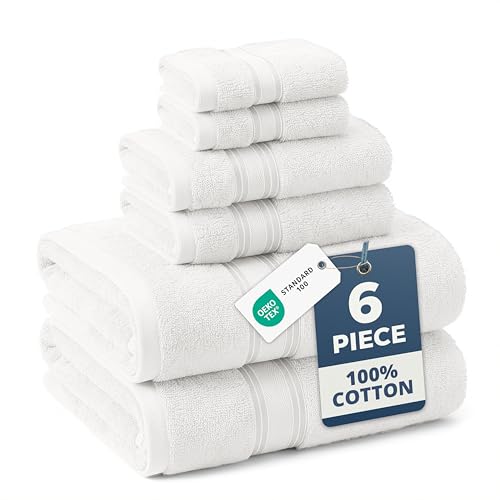
1. LANE LINEN Bath Towel Set — Best Overall
The LANE LINEN Bath Towel Set earns the top slot by balancing the three things eco-conscious buyers refuse to trade against each other: a certified-clean textile, genuine softness, and construction that lasts. The set is 100% cotton with a zero-twist terry weave — zero-twist yarns are not wound tight before weaving, so the loops stand open and plush, absorbing fast and feeling soft without the chemical softeners lesser towels rely on — and it carries OEKO-TEX certification, in a six-piece white set with a hotel-style look. Zero-twist has an eco dividend beyond softness: open loops dry faster than dense twisted terry, which means less tumble-dryer time across the towel’s life, and the energy ledger of a towel is written mostly in the laundry.
Strengths
- OEKO-TEX certified 100% cotton — a checkable cleanliness credential.
- Zero-twist terry: soft and absorbent without chemical softening, and faster-drying than dense terry.
- Six-piece set covers bath, hand and face needs in one purchase.
Trade-offs
- Zero-twist loops are more delicate than twisted terry — snags from zips and hooks are likelier.
- White shows every mark and asks for disciplined washing to stay bright.
- Mid-weight hand feel; buyers wanting heavy Turkish heft should take the next pick.
In the bathroom, this is the set that converts sceptics who assume eco means scratchy. It feels like a good hotel towel, dries a body properly, and then dries itself on the rail faster than the heavyweight sets — a quiet daily pleasure in humid bathrooms. Wash it as the care section describes — no fabric softener, which coats those open loops and strangles the absorbency you bought — and it will hold its softness through years of service. For most households, this is the eco towel purchase, complete in one box.
Best for: most households wanting certified, soft, durable towels in one set. / Not suited for: buyers who want maximum weight and heft above all. Check on Amazon — check the current price on Amazon.

2. American Soft Linen Premium Turkish Towel Set — Best Turkish Cotton Set
The American Soft Linen Premium Turkish Towel Set is the heavyweight classic of the guide: 600 GSM Turkish cotton in a six-piece grey set — two bath towels at 27 × 54 inches, two hand towels and two washcloths — with OEKO-TEX certification stated in its listing. Turkish cotton’s long fibres are the traditional luxury material for a reason: they spin into strong, smooth yarns that stay absorbent and intact through years of washing, and longevity is an eco virtue that outweighs many greener-sounding claims. At 600 GSM this is a towel with presence — the wrap-and-sigh weight people mean when they say “hotel towel” and actually mean the good hotels.
Strengths
- 600 GSM long-fibre Turkish cotton: absorbent, strong and long-lived.
- OEKO-TEX certified — luxury without the chemical residue questions.
- Grey colourway hides wear and suits modern bathrooms.
Trade-offs
- Heavy towels dry slowly on the rail in humid bathrooms — the waffle pick below exists for those homes.
- Takes more machine capacity and drying energy per wash than lighter sets.
- The traditional terry feel is less cloud-soft than zero-twist at first touch.
Choose this set if your bathroom is dry and ventilated, your rail is generous, and your towel philosophy is buy-heavy, buy-once. The eco case is durability arithmetic: a set that serves seven years beats two cheaper sets that pill, thin and shed their absorbency in three, on every ledger from landfill to wallet. Treat it to the no-softener wash discipline and its absorbency actually improves over the first washes as spinning residues clear — a rare product that gets better as you own it.
Best for: buyers wanting classic Turkish weight with a certified-clean label. / Not suited for: humid bathrooms or small machines where drying is a struggle. Check on Amazon — check the current price on Amazon.

3. Sweet Home Collection Bath Towel Set — Best Family Set
The Sweet Home Collection Bath Towel Set scales the eco brief to family size: eight pieces of 100% combed cotton — bath towels, hand towels and washcloths — OEKO-TEX certified, with double-stitched edges, in a warm beige. Combed cotton has had its short fibres removed before spinning, leaving longer, stronger yarns that pill less and last longer — exactly the construction a family set needs, because family towels live the hardest life in this guide: daily use, frequent hot washes, and no patience anywhere in the system for delicate. The double-stitched edges deserve their mention; towel sets die at their hems first, and stitching is the difference between a five-year set and a two-year set with frayed flags for edges.
Strengths
- Eight pieces in one OEKO-TEX certified set — the whole family’s linen cupboard in a box.
- Combed cotton and double-stitched edges: built for frequent washing and long service.
- Beige colourway is forgiving of family life and warm in tone.
Trade-offs
- Family-weight cotton is mid-heft; luxury seekers will prefer the Turkish set’s 600 GSM.
- Eight pieces is a full machine load’s commitment on wash day.
- One colourway per set — mixed-colour households buy two sets or embrace beige.
The eco logic of the family set is replacement avoidance at scale. A household of four churns towels faster than any other, and the greenest thing it can do is buy a set engineered to survive the churn — combed fibres, stitched hems, a certification that keeps the textile clean — and then wash it intelligently: full loads, moderate temperatures, line or low tumble. This set is that purchase, at a tier families can repeat for the guest bathroom without a meeting about it.
Best for: families wanting one certified set that survives family washing. / Not suited for: singles wanting a minimal two-towel luxury setup. Check on Amazon — check the current price on Amazon.

4. COTTON CRAFT Euro Spa Waffle Weave Bath Towels — Best Quick-Drying
The COTTON CRAFT Euro Spa Waffle Weave Bath Towels make the eco case through physics: a waffle weave’s honeycomb pockets expose far more surface area than flat terry, so the towel dries a body by contact and then dries itself on the rail in a fraction of the time — the property that matters most in humid bathrooms, small flats, caravans and anywhere towels have ever smelled musty by evening. The set is 100% ringspun cotton, oversized at 30 × 56 inches per bath towel, in a set of four white towels with a spa character: lighter in the hand than terry, textured, and quick. Ringspun yarns, twisted from long fibres, give the weave the strength its open structure needs.
Strengths
- Waffle weave dries itself fast — the anti-musty, low-energy choice.
- 100% ringspun cotton: natural fibre, no synthetic shedding.
- Oversized 30 × 56 inch bath towels wrap properly despite the lighter weight.
Trade-offs
- Waffle’s textured, lighter hand is not the plush terry experience — a preference, stated plainly.
- White only in this set; marks show, though the fast wash-dry cycle forgives.
- Absorbency per pass is lighter than 600 GSM terry; the technique is pat-and-wrap, not rub.
Every towel guide needs a humid-bathroom answer, and this is ours. The energy savings compound quietly: a towel that air-dries fully between showers needs fewer refresh washes, no tumble rescue, and no scented products to stay pleasant — three small ledgers that add up across years. Spa and travel users discovered waffle cotton long ago; households in damp climates are its natural home market. If your current towels’ main flaw is the 6 p.m. musty smell, change weave before you change anything else.
Best for: humid bathrooms, small homes, caravans and anyone fighting musty towels. / Not suited for: buyers who equate luxury with maximum plush weight. Check on Amazon — check the current price on Amazon.

5. BIOWEAVES 100% Organic Cotton Towel Set, GOTS Certified — Best Certified Organic
The verified listing for this slot is the BIOWEAVES 100% Organic Cotton 700 GSM Plush 6-Piece Towel Set, whose title states the credential outright — GOTS Certified — alongside the set contents: two bath towels, two hand towels and two washcloths, in charcoal. Organic cotton is the slot where this guide’s verification discipline matters most, because “organic” on a towel can mean anything from a fully audited supply chain to a vibe. The credential that separates them is GOTS — the Global Organic Textile Standard — which certifies organic fibre content and audits environmental and social criteria through processing to the finished towel. A GOTS-certified set, in the premium tier, offers the eco buyer the strongest claim available in this category: cotton grown without synthetic pesticides and fertilisers, processed under audited rules, in a towel that then behaves exactly like the excellent conventional cotton sets above — because fibre quality, not farming method, decides softness and absorbency.
Strengths
- GOTS certification audits the organic claim end-to-end — the real credential.
- Conventional-cotton performance with a cleaner agricultural footprint.
- Premium construction in this tier usually means long-staple fibres and long life.
Trade-offs
- Premium tier pricing — certification and organic farming cost more, honestly.
- The market is full of uncertified “organic-style” claims; the label check is on you.
- Colour ranges skew natural and undyed, which is a look some bathrooms love and some do not.
Your checklist for any listing in this slot: the GOTS name itself (not “organic cotton blend” with no standard attached), a licence or certificate reference the seller can show, a fibre content that is overwhelmingly organic cotton rather than a minority blend, and construction specs — GSM, dimensions, set contents — stated as plainly as the certified sets above state theirs. If a listing leads with leaves and leads nowhere on paperwork, it is marketing, and the OEKO-TEX sets in this guide are the more honest purchase. Bought properly, though, this slot is the eco summit of the category.
Best for: buyers who want the strongest audited organic claim and will pay the premium tier for it. / Not suited for: anyone who will not check the certification — buy OEKO-TEX instead. The GOTS label and licence are the product; verify both on the listing before buying. Check on Amazon — check the current price on Amazon.

6. Aibaser Viscose from Bamboo and Cotton Bath Towels, Set of 6 — Best Bamboo Blend
The verified listing for this slot is the Aibaser Viscose from Bamboo and Cotton Bath Towels, Set of 6, whose title gives the honest fibre line this guide asks for — viscose from bamboo blended with cotton — at 27 by 54 inches per bath towel, billed as ultra soft and highly absorbent. Bamboo towels deserve an honest paragraph before their virtues, because the fibre is widely misunderstood. The soft “bamboo” in towels is almost always rayon or lyocell manufactured from bamboo pulp — the plant is real, fast-growing and low-input, but the fibre is a regenerated cellulose, and regulators in several countries require it to be labelled as such. Bought with clear eyes, bamboo-blend towels — typically blended with cotton — offer genuine virtues: a silky hand, strong absorbency, fast drying and a surface that stays fresh-smelling longer between washes. The lyocell route (a closed-loop process) has the stronger environmental story; the rayon route is the common one. Either way, the blend with cotton adds the durability pure regenerated fibres can lack.
Strengths
- Silky, soft hand with strong absorbency and quick drying.
- Stays fresh between washes — fewer refresh loads across its life.
- Bamboo feedstock grows fast with low agricultural input.
Trade-offs
- It is regenerated fibre, not woven bamboo — buy the performance, not the meadow story.
- Pure bamboo-rayon towels can wear faster than cotton; blends are the durable choice.
- Needs the gentler wash discipline: cool water, no softener, low heat.
Judging this slot: look for the honest fibre line — “rayon from bamboo” or “lyocell from bamboo” with percentages, blended with cotton — and treat any listing that implies the towel is woven from bamboo grass as a labelling red flag that disqualifies the seller’s other claims too. GSM and dimensions should be stated as with any set. In the mid-range tier, a good bamboo-cotton blend is the softest landing in this guide for buyers whose skin dislikes terry’s texture, and its fast drying suits the same humid bathrooms as the waffle pick.
Best for: softness-first buyers and humid bathrooms, purchasing with informed expectations. / Not suited for: purists wanting an unprocessed natural fibre only — choose the cotton sets. Verify the fibre naming on the listing before buying. Check on Amazon — check the current price on Amazon.
Comparison Table
| Pick | Badge | Key spec | Best for |
|---|---|---|---|
| LANE LINEN Bath Towel Set | Best Overall | 100% cotton, zero-twist, OEKO-TEX, 6-piece | Most households |
| American Soft Linen Turkish Set | Best Turkish Cotton | 600 GSM Turkish cotton, OEKO-TEX, 6-piece | Hotel-weight luxury, dry bathrooms |
| Sweet Home Collection Set | Best Family Set | Combed cotton, OEKO-TEX, 8-piece, double-stitched | Family washing loads |
| COTTON CRAFT Euro Spa Waffle | Best Quick-Drying | Ringspun cotton waffle weave, 30 × 56 in, set of 4 | Humid bathrooms, small homes |
| BIOWEAVES Organic Cotton Set, GOTS Certified | Best Certified Organic | 100% organic cotton, 700 GSM, 6-piece, GOTS certified per the listing | Audited organic buyers |
| Aibaser Bamboo and Cotton Towel Set | Best Bamboo Blend | Viscose from bamboo blended with cotton, set of 6, 27 x 54 in per the listing | Silky softness, fast drying |
How to Choose Eco-Friendly Bath Towels
Start with the certification you can check. OEKO-TEX on the finished textile and GOTS on organic fibre are the two credentials in this category with auditing behind them. A towel with either is a verifiable purchase; a towel with only the words “eco,” “green” or “natural” on its packaging is a hope. This single filter does most of the work of this entire guide.
Then choose construction for your bathroom’s climate. Dry, ventilated bathrooms can enjoy heavyweight terry at 600 GSM; humid bathrooms and small homes should choose waffle weave or zero-twist, whose drying speed prevents the musty cycle that drives extra washing. GSM is a weight dial, not a quality score — the right weight is the one that dries fully on your rail between uses.
Buy for the replacement cycle you want. Long-staple and combed fibres, stitched hems and honest construction cost more per set and less per year. The eco ledger of towels is dominated by how many sets you buy across a decade, so durability outranks almost every other green claim. Finally, count pieces honestly: a set that covers bath, hand and face for the whole household in one box beats three impulse purchases with three lots of packaging.
How to Wash Eco-Friendly Towels So They Stay Absorbent
- Step 1 — Wash before first use, without softener. New towels carry spinning finishes that block absorbency; one wash opens the fibres. Fabric softener then re-blocks them with a waxy coat — skip it permanently, and use a cup of white vinegar occasionally if you miss the effect.
- Step 2 — Wash warm, full loads, towels only. Towels with towels: zips, hooks and denim in the load snag loops, especially zero-twist. Full loads spread the water and energy honestly.
- Step 3 — Dose detergent modestly. Excess detergent builds up in terry and stiffens it; half the habit dose usually cleans fully and rinses clean.
- Step 4 — Dry with air first. Shake each towel out (it re-lofts the loops), line-dry where you can, and tumble low only to finish. Waffle and zero-twist sets will often need no tumble at all.
- Step 5 — Wash on need, not on schedule. A towel that dried fully and hangs aired can serve several showers; the fastest-drying sets in this guide exist to extend exactly this interval safely.
Common Buying Mistakes
- Believing “eco” without a standard. No OEKO-TEX, no GOTS, no claim — whatever the leaf graphics say.
- Chasing maximum GSM in a humid home. A heavyweight towel that never dries is an energy and odour problem wearing a luxury label.
- Using fabric softener. It coats fibres and quietly deletes absorbency — the most common way good towels become bad towels.
- Buying microfiber for an eco brief. Fast-drying, yes; but synthetic shedding in every wash is why it is discussed here and not picked.
- Replacing instead of reviving. Stiff, less-absorbent cotton towels usually carry detergent and softener build-up; a hot wash with vinegar often restores them.
- Ignoring the hems. Sets die at their edges. Stitched hems are a durability spec, not a detail.
Final Recommendation
Most households should buy the LANE LINEN Bath Towel Set — certified, soft, sensibly weighted and complete in one box. Choose the American Soft Linen Premium Turkish Towel Set for heavyweight luxury in a dry bathroom, the Sweet Home Collection Bath Towel Set for family duty, and the COTTON CRAFT Euro Spa Waffle Weave Bath Towels wherever humidity rules. The BIOWEAVES GOTS organic set and the Aibaser bamboo-blend set reward buyers who verify labels carefully. Wash without softener, dry with air, and any of these sets will out-serve the alternatives. For the rest of a lower-impact bathroom, see Best Organic Cotton Bath Towels and Best Quick Dry Bath Towels; for the linen cupboard generally, Best Bath Towel Sets is the wider roundup.
The Life of a Towel: Where Its Footprint Actually Happens
It surprises most buyers to learn that a towel’s environmental story is written mostly at home. Growing and manufacturing the towel matters — fibre choice and certification cover that part — but across a five-year life, the heated water, detergent and drying energy of hundreds of washes rival or exceed the production footprint, and they are entirely under your control. That is why this guide keeps returning to laundry: the eco towel is a system, not an object. Fast-drying weaves reduce tumble time; rotation across two sets halves each set’s wash count; washing on need rather than on a fixed schedule removes entire loads from the year; and drying on air, in a climate that allows it, is the single largest saving available to any towel owner.
The end of life deserves the same honesty. A cotton towel is biodegradable in principle and recyclable in practice through textile recycling streams where they exist; worn towels also have a genuine second life as cleaning cloths, pet bedding and garage rags, which delays disposal by years. Synthetic towels and blends complicate every one of those endings, which is the deeper reason this guide’s linked picks are 100% cotton: the fibre that grows in a field also returns to the earth without leaving microplastic along the way. Buy cotton, wash it intelligently, demote it gracefully and replace it on condition — that unglamorous sentence is the most eco-friendly towel advice in existence, and every pick in this guide is chosen to make it easy to follow.
Building a Linen Cupboard That Works: How Many Towels, in What Mix
Eco buying fails quietly when the cupboard is wrong: too few towels forces constant small washes, too many buries good towels unused until they stale. The working formula for most households is two bath towels per person in rotation — one in use, one in the wash or on the rail — plus one guest set and one spare for the inevitable laundry backlog week. In the sets in this guide, that arithmetic maps cleanly: a couple covers themselves with the six-piece Lane Linen set and adds the waffle set for guests and humid weeks; a family anchors on the eight-piece Sweet Home set and repeats it rather than mixing brands, because uniform towels wash, fold and replace as one system.
Colour discipline is part of the system too. One colourway per household — the whites, greys and beiges these sets offer — means every wash is a full, honest load with no colour-sorting tax, and a replacement set years later still matches the survivors. Keep hand towels and washcloths in the same fibre family as the bath towels so the wash discipline (no softener, modest detergent) applies to the whole load without exceptions to remember. And store towels dry, aired and unsealed; a linen cupboard that breathes keeps towels fresh between uses, which is yet another wash avoided. The cupboard, like the towel, is a small system — and small systems, maintained, are what eco-friendly actually looks like from inside a real home.
Certifications and Fibre Words, Translated: A Shopper’s Glossary
OEKO-TEX Standard 100 means the finished textile — every component, from thread to dye — has been tested for harmful substances and passed limits set for skin contact. It is the credential on this guide’s linked picks, and it answers the question “is this towel clean to use?” GOTS answers a different question — “was this fibre grown organically and processed under audited environmental and social rules?” — and it is the only organic claim in textiles with a full chain of custody behind it. A towel can carry either or both; what it should never carry is the bare word “organic” with no standard attached.
Combed cotton has had short fibres combed out, leaving longer, stronger, smoother yarns — a durability and softness upgrade, as in the Sweet Home set. Ringspun cotton twists long fibres into fine, strong yarns, the COTTON CRAFT waffle’s foundation. Zero-twist yarns are left untwisted so loops stand open and plush, the Lane Linen’s softness secret and its drying advantage. GSM — grams per square metre — measures towel weight: lighter weaves dry fast and travel well, heavier terry absorbs more and feels luxurious, and neither is a quality score without construction behind it. Long-staple fibres, Turkish cotton’s claim, spin stronger and pill less. Learn these six terms and you can read any towel listing in the world like a buyer rather than an audience — which is, in the end, the skill this entire guide has been trying to hand you.
Towels for the Whole Household: Guests, Children and Shared Bathrooms
A towel set does not live one life; it lives several at once, and eco choices hold up differently in each. In the guest bathroom, towels are used briefly and washed between visitors, so the priority is a set that launders beautifully and presents well after months in the cupboard — the white Lane Linen set’s hotel look exists for this room, and a vinegar refresh wash before guests arrive restores any cupboard flatness. In children’s bathrooms, the priorities invert: frequent washing, forgiving colours and hems that survive being used as everything from bath towel to superhero cape. The Sweet Home set’s combed cotton, stitched edges and beige colourway were chosen with exactly this duty in mind, and the eco logic holds — a set that survives childhood intact is greener than three delicate sets that do not.
Shared family bathrooms add the choreography problem: towels that dry slowly in a room that never fully dries. This is where a mixed cupboard earns its complexity — terry sets for the main users, a waffle set in permanent rotation for the dampest rail, and hooks enough that every towel hangs aired rather than balled on a shared bar. The households that report towel odour problems almost never have a towel problem; they have an airflow and hanging problem that a fast-drying weave quietly solves. Read your bathroom honestly, assign the weaves to the rails they suit, and the whole system — towels, laundry, energy, mornings — settles into the low-effort rhythm that makes eco habits permanent rather than aspirational.
Retiring Towels Gracefully: The Second-Life Ladder
When a towel in this guide finally thins at the folds or frays at a hem, its service is not over — it is promoted sideways. The second-life ladder runs: bath towel to hair or gym towel (smaller duty, still skin-facing), to pet and child-mess towel, to cleaning cloth cut from the sound sections, to garage and garden rag, and only then to textile recycling or compost-adjacent disposal where local schemes accept natural fibre. Each rung delays a replacement purchase and extracts the full value of the field, factory and freight that made the towel. Households that run the ladder find they buy towels half as often as households that bin at first wear, and the saving is the point: eco-friendliness in this category is mostly a refusal to waste embodied work.
Two habits keep the ladder honest. First, mark demoted towels — a snipped corner is the classic signal — so a rag never migrates back to face duty in a busy laundry. Second, retire on condition, not on schedule or shame: a towel that still absorbs and holds its hems is not “old,” it is seasoned, and the sets in this guide are built to stay in the top rung for years. When you do replace, replace like-for-like within your system — same colourway, same fibre family — so the cupboard’s wash discipline survives the new arrival, and the cycle continues at its calm, low-impact rhythm.
There is a quiet satisfaction at the end of this ladder worth naming: a household that buys towels this way stops thinking about towels. The cupboard holds what it needs, the laundry runs its calm full loads, guests get the good set without a scramble, and the annual textile footprint of the bathroom shrinks to a rounding error — not through sacrifice or hair-shirt minimalism, but through the compound interest of buying verified things once and caring for them properly. That is the realistic promise of the eco-friendly label when it is earned rather than printed, and it is available in this category today, in every slot of this guide, at tiers from family to premium. Start with one set, wash it well, and let the cupboard convince you.
Related guides
Frequently Asked Questions
What does OEKO-TEX certification actually mean on a towel?
It means the finished textile has been tested for a defined list of harmful substances and passed — a cleanliness credential for the product as you use it against skin. It does not by itself certify organic farming; that is GOTS’s job. The two answer different questions, and the strongest purchases carry at least one, clearly stated.
Are bamboo towels really eco-friendly?
Partly, and honestly labelled ones say how. The bamboo plant grows fast with low inputs, but the soft fibre is manufactured rayon or lyocell from its pulp — lyocell’s closed-loop process being the cleaner route. Judge bamboo towels as a performance fibre with a better feedstock story, verify the fibre naming, and they earn their slot; buy them as a miracle and you will be disappointed by arithmetic.
Why do my eco towels feel stiff after washing?
Almost always build-up: excess detergent and fabric softener coat the loops, and hard water adds mineral stiffness. A hot wash with a cup of white vinegar and no detergent usually strips the build-up and restores absorbency. If stiffness persists, reduce detergent permanently — towels need far less than most households pour.
How long should a good cotton towel set last?
Years of regular service — the sets in this guide are built for that horizon, with long or combed fibres and stitched hems. The end usually announces itself as thinning at the fold lines and fraying edges rather than lost softness. Replacing on condition rather than on fashion is itself the eco habit this category runs on.
Waffle or terry — which dries a body better?
Terry absorbs more per pass and feels plusher; waffle dries the towel itself far faster afterwards. In a dry bathroom, terry’s luxury wins. In a humid one, waffle’s self-drying prevents the musty cycle that ruins more towels than wear ever does. Choose by your bathroom’s air, not by the shop’s lighting.
How many eco-friendly towels should I buy to start?
Two bath towels per person in rotation, plus hand towels and washcloths to match — which is why the sets in this guide bundle six and eight pieces. Fewer forces constant small washes; more sits unused. Start with one complete set per bathroom, live with it for a month, and add the second set in the weave your bathroom’s humidity asks for.
Do white towels make sense for an eco household?
Yes — white is the traditional eco colourway for a practical reason: whites can be washed together hot when needed, never clash with a replacement set, and show their condition honestly so you replace on wear rather than on dinginess. The discipline is washing whites only with whites and skipping optical brighteners in favour of an occasional vinegar or oxygen-based refresh.
Are expensive towels always more eco-friendly?
No. Price buys fibre length, construction and certification only when the listing proves them; an expensive towel with no standard attached is just expensive. The verified sets in this guide sit at honest tiers because their claims are checkable. Judge the paperwork and the hems, and let the price be the last thing you look at — that order of operations is the entire eco method in one habit.
Do eco-friendly towels work for sensitive skin?
Speaking in comfort terms only: the features that define this guide’s picks are the ones sensitive skin usually prefers — certified-tested textiles, natural fibres, softness achieved by construction rather than by chemical softeners, and a wash routine that skips the fragranced products that linger in fibres. Rinse discipline matters too: an extra rinse cycle keeps detergent residue off skin. Anything beyond comfort — reactions, rashes, conditions — belongs to a clinician, and a towel guide should say so plainly rather than borrow medical authority it has not earned.
What is the most eco-friendly towel colour?
Undyed and natural shades skip a dye process entirely, and the GOTS slot often lives there; among dyed towels, the colour itself matters less than buying one colourway for the whole household so every wash is a full load. White, maintained with oxygen-based refreshes rather than chlorine habits, remains a defensible classic. The greenest colour, as with so much in this guide, is the one you keep for a decade.
How do I keep white eco towels white without harsh chemicals?
Wash whites only with whites, treat marks promptly rather than letting them set, and use an oxygen-based soak for a refresh when brightness fades — it lifts dinginess without the fibre damage of repeated chlorine bleaching. Sunlight on the line is the oldest brightener of all and costs nothing. Accept, too, that a working towel’s white softens over years into a natural ivory; in an eco cupboard that patina is a record of service, not a failure of laundry. The same patience applies to coloured sets: wash dark and bright towels separately for their first few washes while loose dye clears, keep the loads honest afterwards, and the colourways in this guide will hold their tone through the years of service the cupboard system asks of them.
Can I tumble-dry eco-friendly towels?
Yes, on low, and they will fluff beautifully — but air-drying first and tumbling briefly to finish captures most of the softness at a fraction of the energy. Waffle and zero-twist sets often need no tumble at all. Reserve full hot tumbles for the occasional deep refresh, and your towels and your energy bill will both last longer.


