Disclosure: airfryerkitchensupply.com is reader-supported. When you buy through links on our site, we may earn an affiliate commission at no extra cost to you.
Where to buy
The best dual fuel gas grills solve a different problem from the charcoal combos elsewhere in this program: ‘dual fuel’ here means one gas grill that can burn propane today and natural gas tomorrow, converted with a kit of different-sized burner orifices and a regulator change. Every pick below was verified, and each one’s listed listing title confirms the convertibility — by name, by conversion kit, or by dual-fuel designation. Check the current price on Amazon, and before ordering, confirm whether the conversion kit is in the box or sold separately; that single detail is the most common surprise in this category.
- Monument Grills Denali 605, 6-Burner Convertible Smart Grill with Conversion Kit (Best Overall) — Check the current price on Amazon
- Monument Grills 4-Burner Propane Gas Grill, Convertible via 97352 Kit (Best Freestanding Value) — Check the current price on Amazon
- Flintex 6-Burner Gas Grill & Griddle, Convertible Propane & Natural Gas, 859 Sq. In. (Best Large Freestanding) — Check the current price on Amazon
- Nexgrill Dual Fuel 4-Burner Gas Grill with Side Burner and Griddle Insert (Best Mid-Size with Griddle) — Check the current price on Amazon
- SPIRE 30-Inch Built-In 5-Burner Dual Fuel Grill, 304 Stainless (Best Built-In) — Check the current price on Amazon
- Brand-Man 40-Inch Built-In 6-Burner Gas Grill Head, Natural Gas Convertible (Best Built-In XL) — Check the current price on Amazon
Best Dual Fuel Gas Grills: Propane Now, Natural Gas When You Are Ready
Propane and natural gas are both excellent grill fuels, and they suit different lives. Propane lives in a tank: portable, independent, available anywhere, and refilled on your schedule — until the schedule fails you mid-cook. Natural gas comes out of the house wall: limitless, always on, impossible to run out of, and tied forever to the spot where the line was run. A dual fuel gas grill refuses to make you choose at the point of purchase. It arrives plumbed for one fuel and converts to the other with a manufacturer kit, so the grill you buy for a rental patio today can be the grill plumbed into your own home’s gas line in five years.
Conversion is real engineering, not a hose swap, and this guide treats it that way. Natural gas runs at much lower pressure than propane and carries less energy per cubic foot, so a converted grill needs larger burner orifices and a different regulator setup — parts the manufacturer’s kit supplies, sized for that exact grill. That is why every pick here is a grill whose maker sells and names the conversion path. A grill that was never designed to convert is not a dual fuel grill, whatever a listing’s adjectives suggest, and converting one anyway is a safety problem rather than a project.
The six verified picks divide by installation. Four are freestanding cart grills — the Monument pair, the Flintex, and the Nexgrill — for patios where a gas line may come later or never. Two are built-in grill heads — the SPIRE and the Brand-Man — for outdoor kitchens, where natural gas is usually the plan from the first drawing. The reviews state, for each one, what the listing confirms about conversion and what you should verify before the order.
In this guide
Quick Picks
Kit included or kit separate, freestanding or built-in — the badges below sort the six picks by the questions that actually decide this purchase. They match the review headings exactly.
- Best Overall: Monument Grills Denali 605, 6-Burner Convertible Smart Grill with Conversion Kit — The flagship done right: six burners, stainless construction, smart-grill features, and — decisively — the natural gas conversion kit in the box. Check price on Amazon
- Best Freestanding Value: Monument Grills 4-Burner Propane Gas Grill, Convertible via 97352 Kit — The same conversion idea at a friendlier tier: four burners, a side burner, LED controls — with the 97352 conversion kit sold separately, stated plainly in the listing. Check price on Amazon
- Best Large Freestanding: Flintex 6-Burner Gas Grill & Griddle, Convertible Propane & Natural Gas, 859 Sq. In. — The big value play: 859 sq. in., six burners plus a griddle surface and side burner, convertible between propane and natural gas, on locking wheels. Check price on Amazon
- Best Mid-Size with Griddle: Nexgrill Dual Fuel 4-Burner Gas Grill with Side Burner and Griddle Insert — A dual-fuel badged four-burner with serious output — 59,000 BTU over 626 sq. in. — porcelain-coated cast iron grates, and a griddle insert for flat-top work. Check price on Amazon
- Best Built-In: SPIRE 30-Inch Built-In 5-Burner Dual Fuel Grill, 304 Stainless — The outdoor-kitchen pick: a 30-inch built-in head in full 304 stainless, five burners plus a ceramic rear burner, 63,000 BTU and 904 sq. in., dual-fuel ready. Check price on Amazon
- Best Built-In XL: Brand-Man 40-Inch Built-In 6-Burner Gas Grill Head, Natural Gas Convertible — The wide-format island head: 40 inches, six burners, 60,000 BTU, cast iron grates plus a griddle, propane drop-in that converts to natural gas. Check price on Amazon
How These Picks Were Chosen
Verification ran on this site’s AffiliateCMS Pro connection, searching specifically for convertible and dual-fuel gas grills. A grill qualified only when its listed title evidenced the conversion path: the words ‘convertible’ or ‘conversion kit’ in the listing, or a dual-fuel designation from a maker whose line is built around propane/natural-gas conversion. Charcoal-and-gas combos — the other meaning of dual fuel, covered in their own guides in this program — were excluded here, as were grills whose listings mentioned only one fuel.
Within the verified shortlist we separated the questions buyers actually face: whether the conversion kit is included or an extra purchase (the listings answer this, and the reviews report it), burner count and total BTU for cooking capability, cooking area where stated, and freestanding versus built-in format. No prices or ratings were used or are printed; tiers are described in words.
- Conversion must be manufacturer-supported: a named kit or convertible designation in the verified listing — no exceptions.
- Kit status reported, not assumed: ‘included’ and ‘sold separately’ are stated per pick, straight from the listing.
- Two installations, two competitions: freestanding carts and built-in heads are ranked within their own formats.
- No charcoal confusion: this guide’s ‘dual fuel’ means propane and natural gas only; gas/charcoal combos live in their own guides.
The 6 Best Dual Fuel Gas Grills
Each review leads with the conversion story — kit included or separate, and what that means for your total project — then covers the grill as a grill. Specs are quoted only where the verified listing title states them.

Monument Grills Denali 605, 6-Burner Convertible Smart Grill with Conversion Kit — Best Overall
The Denali 605 earns best overall on a single decision Monument got right: the conversion kit is included. Its verified listing describes a 6-burner convertible stainless smart grill sold with the kit, which means the dual-fuel promise is complete on delivery day — burn propane now, and the parts to burn natural gas are already in your garage when the line gets run. No second purchase, no discontinued-kit hunt in five years, no ambiguity about which orifices your grill needs.
Around that centerpiece sits a flagship specification: six burners for serious zone cooking, stainless steel construction, and the Denali line’s smart features for monitored cooks. This is the grill for the buyer who wants the conversion question settled permanently and the cooking capability to match.
Strengths
- Conversion kit included — the dual-fuel promise is complete in one purchase
- Six burners: the finest zone control among the freestanding picks
- Stainless construction and smart monitoring features at the flagship tier
Trade-offs
- Premium tier — the most committed freestanding purchase in this guide
- Six burners is more grill than small households will use weekly
- Smart features add components; owners who want zero electronics should look at the simpler Monument below
| Model | Monument Denali 605 |
| Burners | 6 (per listing) |
| Fuels | Propane, convertible to natural gas |
| Conversion kit | Included (per listing) |
| Construction | Stainless steel (per listing) |
The included kit changes the ownership math in a way buyers underestimate. Conversion kits are model-specific and they do get discontinued; a grill bought ‘convertible-ready’ whose kit vanishes from the catalog in year four is a propane grill with a brochure. Monument shipping the kit in the box converts a promise into inventory, and for a flagship purchase intended to last a decade, that is the correct way to buy it.
As a grill, six burners buy you the zone map serious cooks draw: two searing, two medium, two holding — a full party menu at once, or a single steak cooked with the rest of the grill as a warming oven. If that sounds like your Saturdays, the Denali is the answer. If your Saturdays are four burgers, the next pick down is the honest one.
Best for: committed grillers who want conversion settled and maximum zone control / Not suited for: small households or buyers who dislike electronic features on a grill
Check on Amazon — check the current price on Amazon and confirm the exact configuration on the listing before ordering.
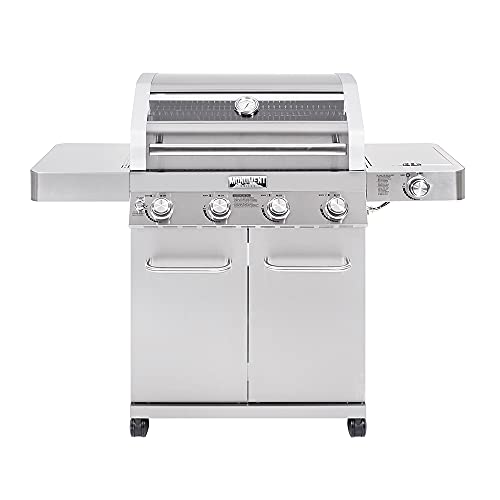
Monument Grills 4-Burner Propane Gas Grill, Convertible via 97352 Kit — Best Freestanding Value
This Monument is the value expression of the convertible idea, and its verified listing is admirably honest about the one thing you must know: the grill converts to natural gas via the 97352 conversion kit, and that kit is not included. Buyers who read that sentence before ordering will be perfectly happy; the category’s regrets almost all trace back to someone not reading it on some listing or other.
What is included is a complete four-burner grill: stainless steel cabinet, LED-lit controls, and a side burner — the configuration most households actually need, at the tier most households actually buy.
Strengths
- Manufacturer-supported conversion with a named kit (97352) — the path is documented, not improvised
- Four burners plus side burner covers the full family cooking rotation
- Stainless cabinet and LED controls at a value-friendlier tier than the flagship
Trade-offs
- Conversion kit is a separate purchase — factor it into the true cost of going natural gas
- Buy the kit when you buy the grill if conversion is certain; kits get discontinued
- Four burners give good zoning, short of the Denali’s six-burner finesse
| Burners | 4 plus side burner (per listing) |
| Fuels | Propane, convertible to natural gas |
| Conversion kit | Monument 97352, not included (per listing) |
| Construction | Stainless steel cabinet, LED controls (per listing) |
The buying strategy for this grill writes itself. If natural gas is a definite plan, order the 97352 kit with the grill and store it — the combined purchase is the true price of your dual-fuel grill, and it protects you against the kit’s future availability. If natural gas is only a possibility, the grill stands on its own as a propane appliance, and the documented conversion path is a free option on a future you may never need.
Monument also sells a larger convertible four-burner variant with the conversion kit bundled, which our API search verified as well — worth a look on the site if you prefer the kit-in-box route at this size. Either way, the four-burner format is the sweet spot of this guide for most patios: big enough for a party, sensible for a Tuesday.
Best for: families wanting a documented conversion path at a mid tier / Not suited for: buyers who want the kit in the box at flagship scale — that is the Denali
Check on Amazon — check the current price on Amazon and confirm the exact configuration on the listing before ordering.

Flintex 6-Burner Gas Grill & Griddle, Convertible Propane & Natural Gas, 859 Sq. In. — Best Large Freestanding
The Flintex brings the convertible concept to the large-and-value corner of the market. Its verified listing states the essentials outright: 859 square inches of cooking area, six burners, a griddle in the mix, a side burner, and conversion between propane and natural gas — wrapped in a cabinet cart with a foldable side shelf and locking wheels. That is a great deal of grill per tier, aimed squarely at hosts.
The locking wheels and folding shelf are not garnish on a grill this size: a six-burner cart is a piece of furniture, and being able to roll it to the gas line’s location — or fold a shelf to fit it through a gate — decides whether it lives where you planned.
Strengths
- 859 sq. in. and six burners: party-scale capacity in the value tier
- Convertible propane/natural gas, stated plainly in the listing
- Griddle surface and side burner broaden the menu without extra appliances
Trade-offs
- Confirm the conversion kit’s inclusion status on the listing before ordering — the title confirms convertibility, not the kit’s packaging
- Value-tier fit and finish versus the Monument pair
- Six burners across a value build means moderate per-burner intensity; preheat fully for searing
| Cooking area | 859 sq. in. (per listing) |
| Burners | 6 plus side burner (per listing) |
| Fuels | Convertible propane and natural gas (per listing) |
| Extras | Griddle, foldable side shelf, storage cabinet, locking wheels (per listing) |
For the natural-gas planner, the Flintex’s proposition is scale: when the line gets run, this is the grill that turns a plumbed patio into a full outdoor kitchen — six burners for the main event, griddle for the breakfast shift, side burner for everything saucy. Its size also makes it the pick most likely to justify the plumber’s visit on capacity alone.
The cautions are the value tier’s usual ones, plus one specific to this guide: verify the conversion hardware situation on the live listing before the order, because ‘convertible’ in a title tells you the grill can convert, not what is in the carton. Do that one check and the Flintex is the most grill in this guide for hosts on a budget.
Best for: hosts who want maximum area and a convertible platform at a value tier / Not suited for: small patios or buyers who rank finish above capacity
Check on Amazon — check the current price on Amazon and confirm the exact configuration on the listing before ordering.

Nexgrill Dual Fuel 4-Burner Gas Grill with Side Burner and Griddle Insert — Best Mid-Size with Griddle
Nexgrill sells this grill under the Dual Fuel name, and its verified listing backs the cooking side of the badge with numbers: 59,000 BTU across four burners and a side burner, 626 square inches of cooking space, porcelain-coated cast iron grates, and stainless steel burners. The griddle insert adds the flat-top dimension — smash burgers, breakfasts, and vegetables — that most gas grills only reach with an accessory purchase.
A note in this guide’s spirit of precision: the listing confirms the dual-fuel designation and the grill’s specification, and Nexgrill’s dual-fuel line is built around propane/natural-gas conversion — but confirm the conversion kit’s details and inclusion on the live listing before ordering, as with every pick here.
Strengths
- 59,000 BTU is the strongest output figure among the freestanding picks — real searing power
- Porcelain-coated cast iron grates: heat retention and sear marks a tier above plain steel
- Griddle insert included in the concept, plus a built-in thermometer and side burner
Trade-offs
- 626 sq. in. is mid-size: family-perfect, party-tight
- Verify conversion kit contents on the listing — the dual-fuel badge is confirmed, the packaging is yours to check
- Cast iron grates, even coated, want drying after washes to protect the coating’s edges
| Output | 59,000 BTU (per listing) |
| Cooking area | 626 sq. in. (per listing) |
| Burners | 4 plus side burner |
| Grates | Porcelain-coated cast iron (per listing) |
| Extras | Griddle insert, built-in thermometer (per listing) |
Heat is this grill’s argument. Many mid-size grills quote respectable totals and deliver them across so much area that no zone ever gets truly fierce; 59,000 BTU over 626 square inches is a concentration that sears properly, and the cast iron grates hold that heat through a batch of steaks instead of surrendering it to the first cold protein.
As a dual-fuel purchase it suits the buyer whose conversion timeline is ‘someday’ and whose cooking standards are ‘now’. The grill earns its place on output and grates alone; the conversion path, verified before ordering, is the option on the future that the badge promises.
Best for: sear-focused cooks who want dual-fuel flexibility in a mid-size cart / Not suited for: large-party hosts — the Flintex’s area serves you better
Check on Amazon — check the current price on Amazon and confirm the exact configuration on the listing before ordering.

SPIRE 30-Inch Built-In 5-Burner Dual Fuel Grill, 304 Stainless — Best Built-In
Built-in grills live a different life from carts: they are masonry-set, plumbed-in, and expected to serve for a decade or more, which is why the SPIRE’s verified specification reads the way it does — an all-304-stainless body (the corrosion-resistant grade that separates outdoor-kitchen equipment from patio furniture), five burners plus a ceramic rear burner for rotisserie work, 63,000 BTU, and 904 square inches of cooking space.
Its dual-fuel designation matters doubly in a built-in. An island grill on natural gas is the dream setup — unlimited fuel, no tanks in the design — but islands get built in stages, and a head that can run propane during the patio’s first season and convert when the line is trenched is a genuinely practical machine.
Strengths
- Full 304 stainless body — the correct material for a permanent outdoor installation
- Ceramic rear burner enables rotisserie cooking most cart grills cannot offer
- 63,000 BTU and 904 sq. in.: serious capacity in a standard 30-inch cutout class
Trade-offs
- Built-in format requires an island or cart structure — this is a component, not a standalone grill
- Premium tier, before the island, plumbing, and installation costs around it
- Interior lighting and electronic ignition add service items over a long life
| Format | 30-inch built-in head |
| Construction | All 304 stainless steel (per listing) |
| Output | 63,000 BTU (per listing) |
| Cooking area | 904 sq. in. (per listing) |
| Extras | Ceramic rear burner, electronic ignition, interior lighting (per listing) |
Judge built-ins by their second five years. The SPIRE’s 304 stainless, rear burner, and lighting are specifications aimed at that horizon, and its dual-fuel design means the fuel decision can be revisited without replacing the head — the most expensive sentence in outdoor kitchens is ‘we have to pull the grill out’, and convertibility is insurance against ever saying it over fuel.
SPIRE also sells a 36-inch, six-burner sibling at 73,000 BTU and 915 square inches, verified in the same API cache as this pick, for islands drawn wider. Between the two, the 30-inch is the standard cutout and the safer long-term bet for parts and resale; the 36 is for cooks who measured their parties and meant it.
Best for: outdoor kitchen builds that want a plumbed, rotisserie-capable centerpiece / Not suited for: renters, cart shoppers, or anyone without an island project
Check on Amazon — check the current price on Amazon and confirm the exact configuration on the listing before ordering.

Brand-Man 40-Inch Built-In 6-Burner Gas Grill Head, Natural Gas Convertible — Best Built-In XL
The Brand-Man head is the scale pick among built-ins: a 40-inch, six-burner drop-in whose verified listing states heavy-duty stainless construction, cast iron grates with a griddle, 60,000 BTU, and natural gas convertibility from its propane configuration. Forty inches is a statement width — this is a grill head for islands designed around entertaining, where two cooks work side by side and the menu runs in parallel.
The included griddle surface is the detail that elevates it from big to versatile: an island this size usually hosts breakfasts and gatherings, not just dinners, and a built-in flat top covers the morning shift without a second appliance in the masonry.
Strengths
- 40-inch, six-burner scale: the largest cooking platform in this guide
- Natural gas convertible, stated in the listing — propane now, plumbed later
- Cast iron grates plus griddle covers searing and flat-top cooking in one head
Trade-offs
- Requires a 40-inch island cutout — a serious masonry commitment
- Heavier tier once island, gas line, and installation are counted
- Six burners at 60,000 BTU is family-party output; small households will light half of it most nights
| Format | 40-inch built-in drop-in head |
| Burners | 6 (per listing) |
| Output | 60,000 BTU (per listing) |
| Fuels | Propane, natural gas convertible (per listing) |
| Surfaces | Cast iron grates and griddle (per listing) |
Wide heads earn their width in one scenario: simultaneous, multi-dish cooking for a crowd, with room to keep finished food warm at the far end while the near end sears. If your island’s social life looks like that, the Brand-Man is the proportionate choice, and its convertibility means the fuel infrastructure can grow from a tank in the island cabinet to a house line without touching the head.
If your gatherings top out at eight, the SPIRE’s 30-inch format delivers the same built-in virtues in the standard cutout, and the masonry you do not build buys a great deal of steak. Scale is a spec like any other: buy the one your calendar justifies.
Best for: large outdoor kitchens built for frequent, crowd-scale entertaining / Not suited for: standard islands or households that cook for four
Check on Amazon — check the current price on Amazon and confirm the exact configuration on the listing before ordering.
Comparison Table
Read the conversion-kit column first — it is this category’s whole story in one column — then compare the grills as grills.
| Pick | Badge | Key spec | Best for |
|---|---|---|---|
| Monument Grills Denali 605, 6-Burner Convertible Smart Grill with Conversion Kit — Check on Amazon | Best Overall | 6-burner convertible, conversion kit included, stainless smart grill | committed grillers who want conversion settled and maximum zone control |
| Monument Grills 4-Burner Propane Gas Grill, Convertible via 97352 Kit — Check on Amazon | Best Freestanding Value | 4-burner + side burner, converts via 97352 kit (separate) | families wanting a documented conversion path at a mid tier |
| Flintex 6-Burner Gas Grill & Griddle, Convertible Propane & Natural Gas, 859 Sq. In. — Check on Amazon | Best Large Freestanding | 859 sq. in., 6-burner + griddle, convertible LP/NG | hosts who want maximum area and a convertible platform at a value tier |
| Nexgrill Dual Fuel 4-Burner Gas Grill with Side Burner and Griddle Insert — Check on Amazon | Best Mid-Size with Griddle | 59,000 BTU, 626 sq. in., cast iron grates + griddle insert | sear-focused cooks who want dual-fuel flexibility in a mid-size cart |
| SPIRE 30-Inch Built-In 5-Burner Dual Fuel Grill, 304 Stainless — Check on Amazon | Best Built-In | 30-in built-in, 304 stainless, 63,000 BTU, rear burner | outdoor kitchen builds that want a plumbed, rotisserie-capable centerpiece |
| Brand-Man 40-Inch Built-In 6-Burner Gas Grill Head, Natural Gas Convertible — Check on Amazon | Best Built-In XL | 40-in built-in, 6-burner, 60,000 BTU, NG convertible | large outdoor kitchens built for frequent, crowd-scale entertaining |
How to Choose a Dual Fuel Gas Grill
The decision order in this category is: installation first, fuel timeline second, grill third. Installation — freestanding cart or built-in head — is nearly permanent and eliminates half the field immediately. Fuel timeline asks when natural gas realistically arrives at your grill’s location: if a line exists or is funded, kit inclusion matters today; if it is a someday idea, a documented conversion path is enough. Only then compare burners, BTU, and area, where the right answer is the familiar one: zones for how you cook, area for how many you feed.
What a conversion actually involves
A manufacturer conversion kit contains replacement burner orifices sized for natural gas (larger, because natural gas carries less energy per volume and arrives at lower pressure), any required regulator changes, and instructions for that exact grill. The work itself is methodical — orifices swap with a wrench, the regulator setup changes, connections are leak-tested with soapy water — and many owners hire it out along with the gas line run, which in most jurisdictions is a permitted, professional job in the first place. Budget the conversion as a project: line, kit, labor. The grill is the cheap part of going natural gas; it is also the part you only buy once if you choose a convertible now.
Propane vs. natural gas as cooking fuels
At the grate, honestly, you will not taste a difference: both burn clean and hot, and a properly converted grill’s temperatures and searing are equivalent on either fuel. The differences are logistical. Propane is portable and independent but finite — tanks empty, usually at the worst moment, unless a spare stands ready. Natural gas is infinite and always on, at the price of permanence: the grill lives where the line ends. Dual fuel exists because households change — rentals become homes, patios become kitchens — and the grill is allowed to change with them.
Budget framing
In tiers: the Flintex and the 4-burner Monument anchor the value end of convertible freestanding; the Nexgrill sits in the middle on output and grates; the Denali 605 is the premium cart, with the kit-in-box completeness to justify it. Built-ins — SPIRE and Brand-Man — price as components of a larger project, where the head’s cost is honestly the smaller half of the island it sits in. Across all tiers, the rule that protects your money is the same: confirm the kit’s status before ordering, and if conversion is certain, buy the kit with the grill.
Natural Gas Line Practicalities: What ‘Plumbed In’ Really Means
Running natural gas to a grill is a modest construction project with an outsized quality-of-life return. A licensed plumber or gas fitter typically tees off the home’s supply, runs a line — buried outdoors or routed along the structure — to the grill’s location, and terminates it with a shutoff valve and a quick-connect fitting. Permits and inspection rules vary by locality and are the professional’s department; your department is placement. Put the termination where the grill will actually live for a decade, with the shutoff reachable, and think about the second appliance — an outdoor kitchen often ends up wanting gas for a side burner, a heater, or a fire feature, and a line sized and stubbed for growth is far cheaper than a second trench.
Living with plumbed gas changes small habits for the better. There is no tank to exchange, no gauge to watch, no mid-cook runout — the category of grill anxiety simply deletes itself. The corresponding discipline is the shutoff: close the line valve when the grill will sit unused for long stretches, and include the grill’s connections in the soapy-water leak check each spring, alongside the burners and hoses you already inspect.
One permanence caveat deserves plain words: a natural-gas grill is a fixture. Moving house means leaving it or re-converting it to propane for the new place — which, if you kept the original orifices and regulator parts from conversion day, is a straightforward reversal. Keep the propane parts, labeled, in a bag in the island cabinet. Future you, or the next owner, will be grateful.
Who Should Stay on Propane (and Skip Conversion Entirely)
Convertibility is an option, not an obligation, and this guide would be overselling if it implied every dual-fuel owner should convert. Stay on propane if you rent, if you move grills between locations (tailgates, cabins, a second home), if your patio layout changes with the seasons, or if your grilling is light enough that a tank lasts you a season anyway. The infrastructure cost of a gas line never pays back for a grill that cooks twice a month.
Convert with confidence if the grill has a permanent home, if you cook outdoors several times a week, if tank runouts have already ruined one dinner too many, or if an outdoor kitchen is on the plans — in which case buy the built-in or the kit-included cart now and let the line catch up. The dual-fuel purchase is really the purchase of timing freedom: the grill stops caring when the infrastructure arrives.
There is a middle path worth naming for the undecided: buy the convertible grill, run it on propane, and let a full year of cooking make the decision with data. Count your tank exchanges, note every runout scare, and watch where the grill actually lives — if it has not moved in twelve months, it has told you it is a fixture, and fixtures are what natural gas lines are for. If it migrated between patio, lawn, and garage all year, propane was never your problem. The convertible grill is the only purchase that lets the evidence accumulate before the trench gets dug, and for a decision that involves both plumbing and permanence, evidence is worth a season.
How to Convert a Dual Fuel Grill from Propane to Natural Gas
This is the manufacturer’s-kit process in outline — your kit’s instructions govern, and the gas line itself is a licensed professional’s job in most places. Never improvise orifices, never drill them out, and never convert a grill that was not designed and listed as convertible.
The conversion, step by step
- Have the natural gas line run and inspected first, terminating in a shutoff valve and quick-connect at the grill’s position.
- With the grill cold and the propane tank disconnected and removed, open the grill and access the burners per the kit instructions.
- Swap each burner orifice for the natural-gas orifice from the kit — they are larger and model-specific. Work one burner at a time so nothing gets mixed.
- Fit the natural-gas regulator or regulator setting the kit specifies, and connect the natural gas hose to the quick-connect.
- Convert or replace any side-burner orifice the kit includes — the step most often forgotten.
- Leak-test every connection you touched with soapy water: bubbles mean stop, refit, retest. No exceptions, no flames anywhere near this step.
- Light each burner and check the flames: steady, blue, and even. Then bag and label the propane orifices and regulator parts and store them in the cabinet.
If any step’s parts do not match the kit’s diagram for your model, stop and contact the manufacturer. Conversion is simple when it is the right kit on the right grill, and it is not a place for creative adaptation. Take a photo of the flame pattern on propane before you begin, and compare it with the natural gas result afterward — the two should look like twins, and the comparison is your final quality check.
Common Buying Mistakes
Assuming ‘dual fuel’ on a listing means propane/natural gas
The same two words also describe gas-and-charcoal combos — an entirely different product, covered in its own guides in this program. Read the listing for the conversion kit or the natural gas mention; the badge alone does not tell you which duality you are buying.
Buying the grill now and the kit ‘later’
Conversion kits are model-specific parts with production runs. When a grill is discontinued, its kit follows it out of the catalog. If conversion is in your plans, the kit goes in the same order as the grill — the Denali’s in-box approach exists because this mistake is so common.
Converting a grill that was never designed for it
Orifice sizing and regulator pressure are engineering, not suggestions. A grill without a manufacturer conversion path stays on its original fuel. The used market is full of ‘converted’ grills with lazy yellow flames and worse; do not add yours to it.
Forgetting the side burner during conversion
Side burners, rear burners, and sear burners each have their own orifices. Convert the main burners and forget the side burner and you will discover it the first time you light it on natural gas — weak, sooty, and wrong. The kit includes those orifices; use all of them.
Skipping the leak test because ‘it was fine before’
Every connection you opened during conversion is a new connection. Soapy water, every joint, every time — thirty seconds of diligence is the entire safety case for doing this job yourself.
Final Recommendation
The Monument Denali 605 is the best dual fuel gas grill for most buyers who are serious about the conversion promise: six burners, stainless build, and the kit in the box, so the promise survives contact with time. The 4-burner Monument is the same idea at a friendlier tier with the kit bought separately — buy them together. The Flintex maximizes area per tier for hosts, the Nexgrill maximizes heat per square inch for sear lovers, and the SPIRE and Brand-Man carry the concept into outdoor kitchens at standard and XL widths respectively.
Whatever you order, run the category’s one essential check first: does the listing confirm the conversion path, and is the kit in the box or in your cart? Answer that, then check the current price on Amazon with a clear conscience.
- Best Overall — Monument Grills Denali 605, 6-Burner Convertible Smart Grill with Conversion Kit: Check on Amazon
- Best Freestanding Value — Monument Grills 4-Burner Propane Gas Grill, Convertible via 97352 Kit: Check on Amazon
- Best Large Freestanding — Flintex 6-Burner Gas Grill & Griddle, Convertible Propane & Natural Gas, 859 Sq. In.: Check on Amazon
- Best Mid-Size with Griddle — Nexgrill Dual Fuel 4-Burner Gas Grill with Side Burner and Griddle Insert: Check on Amazon
- Best Built-In — SPIRE 30-Inch Built-In 5-Burner Dual Fuel Grill, 304 Stainless: Check on Amazon
- Best Built-In XL — Brand-Man 40-Inch Built-In 6-Burner Gas Grill Head, Natural Gas Convertible: Check on Amazon
If your ‘dual fuel’ actually means two cooking fuels, the companion guides cover that meaning in full: Best Dual Charcoal And Gas Grills, Best Dual Bbq Grills, Best Dual Charcoal And Gas Grills With Smoker, Best Dual Grills, and Best Duo Grills.
Frequently Asked Questions
What does dual fuel mean on a gas grill?
On a gas grill, dual fuel means it can run on propane or natural gas, converting between them with a manufacturer kit of replacement burner orifices and regulator parts. Note the term is also used for gas-and-charcoal combo grills — a different product entirely — so always confirm which meaning a listing intends by looking for the conversion kit or natural gas reference.
Is converting a grill to natural gas difficult?
With the correct manufacturer kit, the grill-side work is methodical hand-tool work: swap orifices, change the regulator setup, connect, and leak-test. The gas line run itself is licensed work in most jurisdictions and is usually the larger part of the project. What conversion must never be is improvised — no drilled orifices, no universal kits, no guessing.
Does natural gas grill as hot as propane?
Yes, once properly converted. Natural gas carries less energy per cubic foot and arrives at lower pressure, which is exactly why the conversion kit’s larger orifices exist: they pass the greater volume the burners need. A correctly converted grill reaches the same temperatures and sears the same way on either fuel.
Can I convert my grill back to propane later?
On a manufacturer-convertible grill, yes — the process reverses, provided you kept the original propane orifices and regulator parts. Store them labeled in the grill cabinet at conversion time. This reversibility is a real part of the dual-fuel value proposition: renters become owners, owners move, and the grill adapts both ways.
How much does it cost to run a natural gas line to a grill?
Costs vary widely with distance, trenching, and local permit rules, so this guide prints no figures — get a quote from a licensed gas fitter, who will also handle the permit. Frame it against the alternative honestly: the line is a one-time project, while propane is a small cost repeated forever, plus the occasional ruined dinner when a tank dies mid-cook.
Do I need a conversion kit for each burner?
A proper kit covers every burner on the grill — mains, side burner, rear or sear burners — with orifices sized for each. That completeness is one reason to insist on the manufacturer’s kit for your exact model rather than any generic alternative.


