Disclosure: airfryerkitchensupply.com is reader-supported. When you buy through links on our site, we may earn an affiliate commission at no extra cost to you.
Where to buy
All six dryers below were confirmed through our product verification pass, and each links to its Amazon listing. Towels are the heaviest load in home laundry, so every pick was chosen on drum volume, heat and airflow rather than on gadget features — and check the current price on Amazon for the model that fits your space and circuit.
- Panda 3.5 Cu. Ft. Portable Clothes Dryer — Check the current price on Amazon
- BLACK+DECKER 3.5 Cu. Ft. Portable Dryer BCED37 — Check the current price on Amazon
- Kenmore 4.0 Cu. Ft. Ventless Condensing Dryer — Check the current price on Amazon
- COSTWAY 1700W Electric Portable Clothes Dryer — Check the current price on Amazon
- ROVSUN 110V Portable Clothes Dryer (850W) — Check the current price on Amazon
- Euhomy Portable Clothes Dryer 1.5 Cu. Ft. — Check the current price on Amazon
Ask for the best dryer for drying towels and you are really asking a physics question. A bath towel is the worst load a dryer ever faces: dense cotton, folded over itself, holding more water per pound than anything else in the hamper, and prone to balling into a bundle whose outside dries while its core stays cold and damp. A dryer that is good at towels needs three things — a drum big enough for the load to tumble apart, enough heat to evaporate a lot of water, and airflow that stays strong through a long cycle. Everything else is decoration.
The honest market picture, stated up front: most people type this query cannot install, or do not want, a full-size 240V dryer, so this guide concentrates on the machines that actually fit their lives — large 120V portables, a ventless condensing model for spaces with no vent path, and compact units for studios and RVs, each judged specifically on towel duty. If you have a standard laundry hookup, a mainstream full-size dryer will out-dry everything here; the buying guide explains how to judge one by the same three criteria.
One more thing before the picks, because it will save some readers a purchase entirely: if your current dryer takes forever on towels, the cause is as often the washer’s spin speed, a clogged lint path, or overloading as the dryer itself. The how-to section covers the free fixes first. If you do need a machine, the six below span every realistic situation from a family apartment to a two-towel RV.
In this guide
Quick Picks
Six dryers ranked for towel duty — capacity first, then heat, then the constraints of your space and wiring.
- Panda 3.5 Cu. Ft. Portable Clothes Dryer — Best Overall. The largest of the mainstream 120V portables, and towels are a capacity game before they are anything else: a 3.5 cu. ft. drum is the difference between drying a bath-towel load in one cycle and splitting it into two. — check price on Amazon
- BLACK+DECKER 3.5 Cu. Ft. Portable Dryer BCED37 — Best Brand Support. The same big-drum formula as the Panda — 3.5 cu. ft., 1500W, stainless drum — from the brand with the widest retail and support footprint in this category. — check price on Amazon
- Kenmore 4.0 Cu. Ft. Ventless Condensing Dryer — Best Ventless. The step up from the portables: a 4.0 cu. ft. condensing dryer that needs no vent at all, with sensor drying and an ENERGY STAR badge — the towel pick for spaces where venting is impossible. — check price on Amazon
- COSTWAY 1700W Electric Portable Clothes Dryer — Most Powerful Portable. The wattage outlier: 1700W in a 13.2 lb portable. Heat is half the towel equation, and this is the most of it you can buy in this class — with a circuit caveat that matters. — check price on Amazon
- ROVSUN 110V Portable Clothes Dryer (850W) — Best Budget. The honest budget end of the class: 850W and a small drum. It dries towels — slowly, in half loads — and for a single person or a couple, that can be exactly enough. — check price on Amazon
- Euhomy Portable Clothes Dryer 1.5 Cu. Ft. — Best for Tiny Spaces. The smallest real tumble dryer in the guide: 1.5 cu. ft. and 850W. For towels it is a two-at-a-time machine — and in a studio, an RV or a dorm, two-at-a-time beats air-drying on a chair. — check price on Amazon
How These Picks Were Chosen
Picks were chosen on towel-specific criteria, not general dryer reviews. Drum volume came first, because a towel load that cannot tumble cannot dry evenly; rated capacity in pounds was cross-checked against drum cubic footage, since the two do not always agree across brands. Heat came second — wattage on 120V machines, where the spread from 850W to 1700W translates directly into cycle time on wet cotton. Airflow and venting architecture came third: vented portables, and one condensing model for homes where venting is impossible.
Every product was confirmed through our verification pass against catalog data before being linked, and the specifications quoted in the spec boxes come from that confirmed listing data — nothing here is copied from a review roundup. Machines that were excluded: countertop ‘mini dryers’ that are really heated racks (they air towels rather than tumble-dry them, a different product), spin dryers (they extract water but do not dry), and any model whose rated capacity made a standard towel load impossible rather than merely slow.
Finally, each pick was matched to a household size rather than ranked on a single ladder. Towel drying is a throughput problem, and the right answer for a couple in a studio is a wrong answer for a family of five — the verdict lines say which is which, plainly.
The 6 Best Dryer for Drying Towels

Panda 3.5 Cu. Ft. Portable Clothes Dryer — Best Overall
Why does a guide about drying towels lead with a portable dryer at all? Because the honest shape of this market is that ‘a dryer for towels’ is rarely a dedicated appliance — it is a dryer with enough drum volume, enough heat and enough airflow to handle the heaviest, wettest, slowest load a household produces, and the buyers type this query are disproportionately in apartments, rentals and small laundry closets where a full-size 240V machine cannot go. The Panda 3.5 is the portable that comes closest to full-size towel behavior: the biggest drum in its class, a 1500W element on a standard outlet, and a stainless tub that tolerates the abrasion of heavy wet cotton better than coated drums do.
Capacity is the spec that decides towel drying, and it is worth understanding why. A bath towel leaves the washer holding a remarkable amount of water even after a high spin, and in the dryer it needs room to tumble apart from its neighbors so hot air can reach every fold. Pack a small drum tight with towels and the outside of the bundle dries while the core stays damp — the classic ‘dry but somehow still cold and heavy’ result. At 13.2 lbs rated capacity, the Panda takes a realistic family towel load — six to eight bath towels with hand towels — in a single cycle with room to tumble.
Strengths
- Largest drum in the 120V portable class, so full towel loads dry in one cycle instead of two
- 1500W element is at the top of what a standard household outlet supports, shortening the long towel cycle
- Stainless steel tub stands up to the weight and abrasion of saturated cotton loads
Trade-offs
- Still slower than a 240V full-size dryer on towels; expect a long cycle, not a quick one
- Vented design needs a window or indoor vent kit, and venting a towel load indoors adds real humidity to the room
- At this size it is ‘portable’ in the sense of no permanent installation, not in the sense of carrying it between rooms weekly
| Drum capacity | 3.5 cu. ft. / 13.2 lbs (Amazon title) |
| Power | 1500W, 120V (Amazon title) |
| Type | Vented front-load, stainless steel tub (Amazon title) |
Run towels on the highest heat the care labels allow and resist the urge to add a mixed load on top. Towels plus a few heavy cotton items is a full load for any dryer; towels plus a duvet cover is a tangle that wraps the towels into a ball and guarantees a damp core. The Panda’s drum gives you margin, not magic — the margin is exactly what towel loads consume.
The other towel-specific habit this machine rewards is a proper washer spin. Every extra hundred RPM in the washer removes water the dryer would otherwise spend twenty minutes evaporating. If your towel cycles feel endless, the fix is as likely to be the washer’s spin setting as the dryer itself — a point the buying guide below returns to, because it is the cheapest towel-drying upgrade there is.
Best for: apartment and small-space households drying full family towel loads on a standard outlet / Not suited for: homes with a 240V laundry hookup, where a full-size dryer does this job faster
Check on Amazon — check the current price on Amazon, and confirm the size, color and configuration on the listing match what this review describes before ordering.
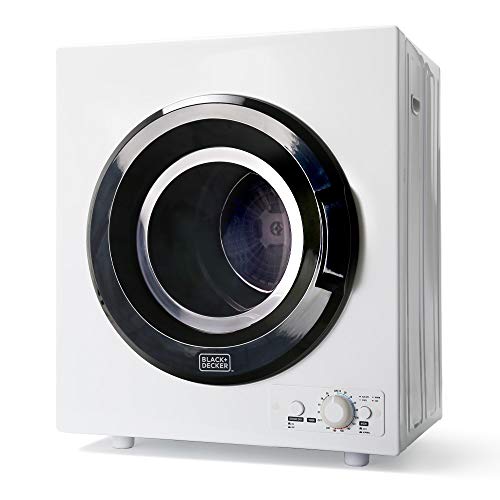
BLACK+DECKER 3.5 Cu. Ft. Portable Dryer BCED37 — Best Brand Support
The BCED37 is the pick for buyers who want the large-portable formula without buying an unfamiliar badge. Mechanically it is a close match for the Panda above: 3.5 cu. ft. drum rated at 13.2 lb, 1500W on 120V, vented, stainless drum. For towel duty that parity is what matters — drum volume and heat are the towel specs — and the differences between the two are about ownership rather than drying: parts availability, documentation quality, and the likelihood that the model is still sold, supported and reviewable in three years.
That ownership argument is stronger in appliances than in gadgets. A dryer is a heating appliance with a motor, a belt and a lint path that needs occasional attention; a brand with a real service network and a manual that a technician can find is worth something every year you own it. Towels, being the heaviest load in the house, are also the load most likely to eventually stress a belt or a drum roller — another reason the support network is a towel-relevant spec, not a generic one.
Strengths
- Full-size portable drum handles a family towel load in one cycle
- Mainstream brand with the strongest parts, manual and service availability in this class
- Stainless drum and 1500W element match the best of the portable class on the specs towels care about
Trade-offs
- No meaningful drying advantage over the Panda; the choice between them is support and availability, not performance
- Vented only — like all 1500W portables it needs an exhaust path, ideally out a window
- Cycle times on a full towel load are long by full-size standards; plan laundry timing around it
| Drum capacity | 3.5 cu. ft. / 13.2 lb (Amazon title) |
| Power | 1500W, 120V (Amazon title) |
| Type | Vented, stainless steel drum (Amazon title) |
For towel loads specifically, use the dryer’s highest timed setting rather than a sensor program if your model offers both and your towels keep finishing damp. Early-generation portable sensor cycles tend to read the dry surface of the towel bundle and end early; a full timed cycle with a mid-cycle pause to shake the towels apart and reverse the bundle is the reliable routine, and it costs you one trip to the laundry closet.
Lint discipline matters more with towels than with any other load — towels are lint factories, and a clogged filter or a crushed vent hose stretches drying time dramatically and stresses the element. Clean the filter after every towel load, not every few, and check the vent run monthly. On a 120V machine with no power to spare, airflow is performance.
Best for: buyers who want the big portable drum with mainstream brand backing / Not suited for: anyone who can install a ventless or full-size machine and wants shorter towel cycles
Check on Amazon — check the current price on Amazon, and confirm the size, color and configuration on the listing match what this review describes before ordering.

Kenmore 4.0 Cu. Ft. Ventless Condensing Dryer — Best Ventless
Every other pick in this guide exhausts hot, wet air somewhere. The Kenmore condensing dryer does not: it condenses the moisture out of the exhaust air into a drain or reservoir, which means it can live in an interior closet, a bathroom alcove or a European-style kitchen stack where no vent run exists. For towel duty that architecture has a second, underappreciated benefit — a towel load is the wettest load in the house, and a vented portable dumping that moisture through a cheap indoor vent kit can leave a small laundry room feeling like a sauna. The condensing design keeps the water liquid and sends it down a drain.
At 4.0 cu. ft. it is also the largest drum here, and its Smart Sensor Drying is a generation more trustworthy than the portables’ — relevant because towels are the load sensor cycles most often get wrong, ending on a dry surface over a damp core. A better sensor plus a bigger drum is precisely the towel brief. The trade is speed and simplicity: condensing dryers run cooler and longer, and there is a condenser to keep clean.
Strengths
- No vent required, so it installs where vented portables simply cannot go
- Largest drum in this guide at 4.0 cu. ft., with sensor drying suited to heavy cotton loads
- Condensing design keeps a towel load’s worth of moisture out of the room’s air
Trade-offs
- Condensing cycles are the slowest way to dry towels; this is an overnight-load machine
- Costs more than the portables and is a real appliance install, not a roll-it-away portable
- Condenser and filters need regular cleaning or drying times creep up month by month
| Drum capacity | 4.0 cu. ft. (Amazon title) |
| Type | Ventless condensing, front load (Amazon title) |
| Features named in Amazon title | Wrinkle Guard, Smart Sensor Drying, ENERGY STAR Certified |
The towel routine for a condensing dryer is load discipline plus patience. Load to about two-thirds of the drum, use the cottons program, and let the sensor finish rather than pulling towels at the first check — condensing machines do much of their work in the last third of the cycle, when the load finally comes apart and exposes its damp core to the airflow. Interrupting early is how owners convince themselves the machine does not work.
Empty the reservoir or confirm the drain hose after every towel load, and rinse the condenser on the schedule in the manual. A condensing dryer’s performance decay is almost always a maintenance story, not a machine story — and because the decay is gradual, owners blame the towels, the washer and the weather before they blame the film of lint on the condenser.
Best for: homes with no vent path — interior closets, condos, kitchen stacks — that dry towels weekly / Not suited for: anyone who needs towels dried fast, or who will not keep up with condenser cleaning
Check on Amazon — check the current price on Amazon, and confirm the size, color and configuration on the listing match what this review describes before ordering.
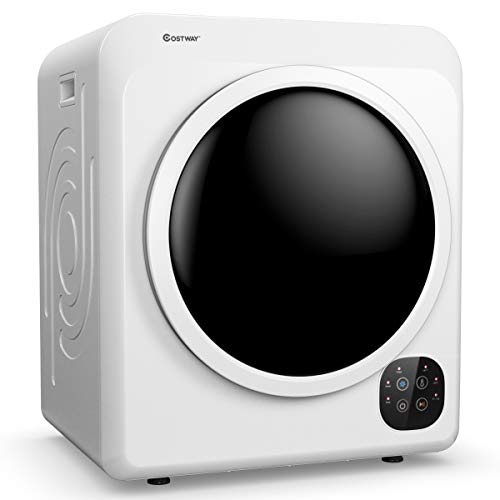
COSTWAY 1700W Electric Portable Clothes Dryer — Most Powerful Portable
Read the spec the way an electrician would. Most of this class runs 1500W because that is what a standard 15-amp household circuit comfortably supports alongside nothing else. The COSTWAY’s 1700W element is genuinely stronger — more heat into the drum per minute, which is exactly what a saturated towel load needs in its first half hour — and it asks more of your wiring in return. On a dedicated or lightly loaded 20-amp circuit it is the fastest portable here on towels. On an older 15-amp circuit shared with a washer, it is the one most likely to introduce you to your breaker panel.
That is not a reason to avoid it; it is a reason to buy it knowingly. If your laundry spot has a modern circuit — common in newer apartments where these portables are aimed — the extra wattage converts directly into shorter towel cycles, week after week, for the life of the machine. The rest of the package matches the class standard: 13.2 lb front-load drum, stainless tub, straightforward controls with the panel mounted low on the front.
Strengths
- 1700W element is the strongest in the portable class, and heat is what a wet towel load consumes
- Full 13.2 lb drum, so the power is matched by the capacity towels need
- Stainless tub and front-load layout match the class leaders
Trade-offs
- 1700W can trip older or shared 15-amp circuits; check your laundry circuit before ordering
- Higher heat demands stricter lint discipline — filter and vent checks are not optional
- Controls mounted low on the front panel are awkward if the dryer sits on the floor
| Capacity | 13.2 lbs (Amazon title) |
| Power | 1700W (Amazon title) |
| Type | Front-load tumble, stainless steel tub (Amazon title) |
If you buy this machine for towels, do one thing in the first week: run a full towel load with nothing else on the circuit and note the time; then check the outlet and plug for warmth at the end of the cycle. Warm is normal on a long high-heat run; hot is a stop-and-call-an-electrician signal. This class of machine asks a lot of residential wiring, and the check takes ten seconds.
In use, the extra power shows most on the second load of a laundry day. Portables lose time to cool-down and reheating between loads; a stronger element recovers temperature faster after the door opens for the towel shake-and-turn, so back-to-back towel loads — the holiday-guest scenario — are where this pick pulls away from the 1500W pair at the top of this guide.
Best for: households on a modern 20-amp laundry circuit who dry back-to-back towel loads / Not suited for: older wiring, shared 15-amp circuits, or anyone unwilling to check their circuit first
Check on Amazon — check the current price on Amazon, and confirm the size, color and configuration on the listing match what this review describes before ordering.

ROVSUN 110V Portable Clothes Dryer (850W) — Best Budget
Budget picks in a towel guide need a warning label, and here it is plainly: at 850W with a compact drum, this machine dries towels in half loads and takes its time about it. A couple’s two bath towels and a hand towel, yes. A family’s weekend towel mountain, no — you will spend the day feeding it. The reason it still earns a place is that a large share of the people searching for a towel dryer live alone or as a pair in a small apartment, and for that household the towel load genuinely is two or three towels, a couple of times a week.
For that load, the ROVSUN’s simplicity is a virtue. One knob, a stainless tub, a footprint that fits a closet or a bathroom corner, and a price tier — check the current price on Amazon — well below the big portables. It is also the gentlest machine here on delicate loads generally, though towels themselves are not delicate and do not need the gentleness. Buy it sized to your real laundry, not your aspirational laundry.
Strengths
- Lowest cost of entry in this guide, in the budget tier of the portable class
- Simple single-knob control and a footprint that fits closets and bathroom corners
- Adequate, genuinely, for one or two people’s towel loads split sensibly
Trade-offs
- 850W makes full towel loads impractically slow; half loads are the working rule
- Small drum means towels ball up if you push capacity — the damp-core problem in its purest form
- No sensor sophistication; timed cycles and your own judgment do the work
| Power | 850W, 110V (Amazon title) |
| Type | Front-load tumble, stainless steel tub (Amazon title) |
| Controls | Single control knob (Amazon title) |
The technique that makes an 850W machine work for towels is the pre-dry spin and the split. Run the washer’s fastest spin — add a second spin cycle if your towels come out heavy — then dry in two half loads rather than one full one. Two fast-ish cycles beat one endless one, because the small drum’s enemy is the tangled bundle, and half loads simply do not bundle.
Also place it well. A small vented dryer in a tiny bathroom is dumping its moisture into the smallest room in the home; crack the window or run the exhaust fan during towel cycles, or you will trade dry towels for a mildewed ceiling corner by the end of the season. The machine is cheap; the placement still has to be thought through.
Best for: singles and couples in small apartments with modest, splittable towel loads / Not suited for: families, guest-heavy households, or anyone who wants one-cycle towel loads
Check on Amazon — check the current price on Amazon, and confirm the size, color and configuration on the listing match what this review describes before ordering.

Euhomy Portable Clothes Dryer 1.5 Cu. Ft. — Best for Tiny Spaces
Every guide needs its smallest honest option, and this is it. The Euhomy’s 1.5 cu. ft. drum takes two bath towels comfortably, three at a pinch with a mid-cycle shake. That sounds like a punchline until you picture the actual alternatives in a studio apartment or an RV: towels draped over chairs for two days, going stiff and sour in humid weather. A machine that turns two wet towels into two dry towels in a single sitting, on a standard outlet, in a footprint that fits under a counter, solves a real problem completely — just at a small scale.
It shares the 850W ceiling of the ROVSUN, so everything said there about split loads and spin speed applies here with more force. What the Euhomy adds is the smallest physical package in the class and a stainless drum at the size tier where coated drums are common. For an RV that does a towel pair every few days on hookups, or a dorm-adjacent setup where the alternative is a laundromat trip per towel, the arithmetic works.
Strengths
- Smallest footprint here — fits studios, RVs, dorms and under-counter gaps the others cannot
- Stainless drum at a size and tier where that is not guaranteed
- Standard 120V outlet power, so it runs anywhere the bigger portables run
Trade-offs
- Two towels at a time is the realistic towel capacity; this is a scale solution, not a family solution
- 850W means long cycles even at that small load
- Frequent small loads mean frequent filter cleaning — trivial per load, constant in aggregate
| Drum capacity | 1.5 cu. ft. (Amazon title) |
| Power | 850W, 120V (Amazon title) |
| Type | Compact portable, stainless steel drum (Amazon title) |
RV owners should note the venting question doubles in a small sealed space. Run the vent out a window with a proper kit, and never run towel loads with the RV closed up tight — the moisture has to go somewhere, and in a vehicle it goes into the walls. A small dehumidifier habit matters more in an RV laundry routine than in any house.
In a studio, the routine that works is frequency over volume: towels go through in pairs as they are used, rather than accumulating into a weekend pile the machine cannot face. That rhythm — wash small, dry small, often — is the whole lifestyle of small-space laundry, and this is the dryer built for it. Households that batch laundry weekly should skip straight to the 3.5 cu. ft. pair at the top of this guide.
Best for: studios, RVs, dorms and one-person households drying towels in pairs / Not suited for: weekly-batch laundry households or anyone drying family towel loads
Check on Amazon — check the current price on Amazon, and confirm the size, color and configuration on the listing match what this review describes before ordering.
Comparison Table
| Pick | Badge | Key spec | Best for |
|---|---|---|---|
| Panda 3.5 Cu. Ft. Portable Clothes Dryer | Best Overall | 3.5 cu. ft. drum, 1500W, 120V, vented | apartment and small-space households drying full family towel loads on a standard outlet |
| BLACK+DECKER 3.5 Cu. Ft. Portable Dryer BCED37 | Best Brand Support | 3.5 cu. ft. drum, 1500W, 120V, vented, stainless drum | buyers who want the big portable drum with mainstream brand backing |
| Kenmore 4.0 Cu. Ft. Ventless Condensing Dryer | Best Ventless | 4.0 cu. ft., ventless condensing, sensor drying | homes with no vent path — interior closets, condos, kitchen stacks — that dry towels weekly |
| COSTWAY 1700W Electric Portable Clothes Dryer | Most Powerful Portable | 1700W, 13.2 lb drum, front-load, stainless tub | households on a modern 20-amp laundry circuit who dry back-to-back towel loads |
| ROVSUN 110V Portable Clothes Dryer (850W) | Best Budget | 850W, 110V, compact front-load, stainless tub | singles and couples in small apartments with modest, splittable towel loads |
| Euhomy Portable Clothes Dryer 1.5 Cu. Ft. | Best for Tiny Spaces | 1.5 cu. ft. drum, 850W, 120V, stainless drum | studios, RVs, dorms and one-person households drying towels in pairs |
How to Choose the Best Dryer for Drying Towels
Judge any dryer — including the full-size machines outside this guide’s portable focus — by the towel test: drum volume per load, heat input, and airflow over a long cycle. Drum volume is the one buyers most often get wrong, because rated capacity in pounds is measured with mixed laundry, and towels are bulkier per pound than anything else. As a working rule, a drum under 2 cu. ft. is a two-towel machine; around 3.5 cu. ft. takes a family load of six to eight bath towels with room to tumble; 4 cu. ft. and up gives margin for bath sheets and a hand-towel overflow.
Heat is simpler: on 120V machines, wattage is destiny, and the spread in this guide from 850W to 1700W is roughly a doubling of drying speed on identical loads — with the circuit caveat covered in the COSTWAY review. On 240V full-size machines, heat is ample across the board and the differentiators become drum size and sensor quality instead.
Vented vs. ventless for the wettest load you own
Vented dryers push hot moist air out of the house. They are faster and simpler, and they need a path: a window kit at minimum, a proper vent run ideally. Indoor vent kits that dump into a water trap are a compromise — acceptable for occasional loads, but a weekly towel habit will humidify a small laundry space noticeably, and humidity is mold’s invitation.
Ventless condensing dryers (the Kenmore in this guide) and heat-pump dryers recapture the water as liquid. They install anywhere with a drain or a reservoir you are willing to empty, run cooler and slower, and are kinder to the room. For towel loads the speed penalty is real but the install freedom is often the deciding factor — a slower dryer that fits your home beats a faster one that cannot be installed in it.
Sensor dry: genuinely useful, commonly fooled
Moisture sensors end the cycle when the load reads dry, which saves energy and fabric wear on everyday loads. Towels fool them, because the sensor reads surfaces — and a balled towel load presents dry surfaces over a damp core. On any machine, the towel routine that works is: load to two-thirds, run the cottons or towels program, and if towels emerge heavy, add a timed 15 minutes rather than restarting a sensor cycle. Machines with better sensor placement and drum-reversing action handle towels more honestly, which is one of the real differences between the budget and premium ends of this guide.
The Washer’s Half of the Job
A dryer can only evaporate the water the washer leaves behind, and the spread is enormous: a towel leaving a gentle 800 RPM spin can hold close to twice the water of the same towel after a 1200 RPM spin. If towel drying is your pain point, set the washer to its fastest safe spin for towel loads — cotton towels tolerate high spin perfectly well — and consider a second spin cycle for bath sheets. This costs nothing and can cut drying time more than upgrading within the same dryer class.
Detergent and softener build-up is the other hidden variable. Towels coated in months of fabric softener absorb less water in the shower — and release it differently in the dryer — while the coating also insulates fibers. A strip wash (hot wash, no detergent, a cup of washing soda or a plain vinegar rinse cycle) every few months restores both absorbency and drying behavior. If your towels feel waxy and dry slowly, wash them before you shop for a dryer.
Reading a Dryer Listing the Way a Towel Buyer Should
Listings for this class of machine are written to make small dryers sound big, and towel buyers are the ones who pay for the confusion. Three translations help. First, convert every capacity claim to drum cubic footage; if the listing only gives pounds, treat the number as mixed-laundry marketing and look for the drum measurement in the specifications table — it is almost always there, and it is the number that decides your towel load. Second, find the wattage and check it against your circuit, not just your outlet: the plug fitting the wall tells you nothing about what the breaker will tolerate for a ninety-minute towel cycle.
Third, look for the venting sentence. ‘Ventless’ in a listing for a tumble dryer should mean condensing or heat-pump; if a cheap portable claims ventless with no condenser and no reservoir, it means the moisture goes into your room through a hose-end filter, which is venting into the worst possible place. And fourth — the quiet one — check the filter’s location and the vent hose diameter. Towel lint is produced in quantities that punish awkward filters and narrow hoses; a machine you can clean in ten seconds is a machine whose airflow, and therefore whose towel performance, you will actually maintain.
How to Dry Towels So They Come Out Dry, Soft and Odor-Free
Most ‘my dryer is bad at towels’ complaints are load-craft problems. This routine works on every machine in this guide and on full-size dryers too.
- Shake every towel out before loading. A towel that goes in as a folded wad stays a folded wad. One sharp shake per towel opens the loops, separates the layers and is worth more than any dryer feature.
- Load to two-thirds of the drum, never more. Towels need to fall through the hot air, not ride around as a single rotating bundle. Two-thirds by volume is the ceiling; a second load is faster than one overloaded cycle.
- Use the cottons or highest-heat setting the labels allow. Towels are the load high heat exists for. Low-heat ‘delicates’ habits carried over from clothing loads are the most common cause of damp finishes.
- Add dryer balls or a clean dry towel for the first minutes. Dryer balls separate the load mechanically as it tumbles, breaking up the bundle early when it forms. A dry towel in the first part of the cycle absorbs a share of surface moisture and speeds the start.
- Pause once, mid-cycle, and turn the bundle. On machines without reversing action, open the door at the halfway point, pull the towels apart, swap the inside of the bundle to the outside, and restart. This single habit fixes most damp-core results.
- Clean the lint filter after every towel load. Towels shed more lint than any other load, and airflow is drying speed. A filter that looks ‘not too bad’ can already be costing you ten minutes a cycle.
- Get towels out promptly and fold or hang immediately. Towels left sitting in a warm drum go musty with remarkable speed — that sour smell is mildew, and it survives into the next shower. Prompt removal is a drying step, not a tidiness preference.
If towels still finish damp after all of this — full routine, clean filter, proper spin — the machine is genuinely undersized or underpowered for your load, and that is the moment the picks above earn their place.
Common Buying Mistakes
Overloading to ‘save a load’. One overloaded towel cycle takes longer than two correct ones and finishes worse, because the core never dries. Drum space is the product you are buying; use it as designed.
Using dryer sheets and softener on towels. Both coat cotton fibers, reducing absorbency in use and slowing drying in the machine. Towels are the one load that should never see either product.
Ignoring the vent run. A crushed, kinked or lint-lined vent hose strangles airflow on vented machines. If drying times have crept up over months, inspect the vent before blaming the dryer.
Running a high-wattage portable on a shared old circuit. A 1700W dryer plus a washer on one 15-amp circuit is a breaker trip and, over time, a wiring stress. Know your circuit before you buy the powerful option.
Buying capacity by the pound rating alone. Pounds are measured on mixed laundry. For towels, judge by drum cubic footage — bulk, not weight, is what fills a drum with towels.
Final Recommendation
For most households that cannot install a full-size dryer, the Panda 3.5 and the BLACK+DECKER BCED37 are the towel answers — pick between them on brand support and availability. If venting is impossible, the Kenmore condensing dryer is the one machine here that makes towel day unremarkable in an interior space. On a modern circuit with back-to-back loads, the COSTWAY’s 1700W earns its caveat. And for singles, couples, studios and RVs, the ROVSUN and Euhomy dry towels honestly at their scale — split the load, spin hard, and they will do the job.
Keep exploring the same corner of the house with these related guides from this series: Best Portable Washer And Dryer Combos Best 110 Volt Dryers Best Compact Washers For Apartments Best Laundry Baskets For Small Spaces Best Bath Towels For Absorbency
Related guides
Frequently Asked Questions
Why do my towels come out of the dryer still damp in the middle?
Because a balled-up towel load presents dry surfaces to the air and the sensor while its core stays wet. Load to two-thirds of the drum, shake each towel out before loading, and pause mid-cycle to pull the bundle apart and turn it. If the problem persists on a small machine, the drum is simply too small for your load size.
How long should a load of towels take to dry?
On a full-size 240V dryer, roughly 45 to 60 minutes for a normal load. On the 120V portables in this guide, expect substantially longer — the big 1500W models handle a family load in one long cycle, and the 850W compacts need split loads. Exact times depend on spin speed, load size and venting, which is why this guide quotes none: the variables matter more than any single number.
Is a ventless dryer good for towels?
Yes, with patience. Condensing dryers like the Kenmore in this guide dry towels completely and install where vented machines cannot, but they run cooler and slower. Load discipline — two-thirds full, cottons program, let the cycle finish — is what makes them work well on heavy cotton.
Can a portable dryer really handle bath towels?
The 3.5 cu. ft. models can, in a single load for most families. The compact 850W models handle towels in split loads — two or three at a time. What no portable does is match a full-size dryer’s speed; the trade is installation freedom and a standard outlet against cycle time.
Should I use high heat for towels?
For cotton towels, yes — high heat is what the cottons program is for, and low heat is the most common cause of damp, musty results. Check care labels on blended or embellished towels, but plain cotton bath towels are the hardiest load in the house.
Why do my towels smell sour even after drying?
Almost always because they sat damp too long — either waiting for the wash, or sitting in the drum after the cycle ended. Mildew establishes fast in warm, wet cotton. Dry promptly, remove promptly, and strip-wash towels that already carry the smell, since it reactivates with moisture.


