Disclosure: airfryerkitchensupply.com is reader-supported. When you buy through links on our site, we may earn an affiliate commission at no extra cost to you.
Where to buy
Every linked pick in this guide to the best direct vent microwaves was verified against Amazon’s catalog on 2026-11-21, so the model names and headline specifications below match the listings you will actually land on. Start with GE Profile 1.2 Cu.Ft Low Profile Over-the-Range Microwave, Samsung 1.1 Cu.Ft Smart SLIM Over-the-Range Microwave, GE JVM3160RFSS 1.6 Cu.Ft Over-the-Range Microwave. Picks that could not be pinned to a verified listing are written unlinked and flagged honestly, with no link attached. Check the current price on Amazon from any pick’s link, because finishes, bundles and stock rotate often.
The best direct vent microwaves are over-the-range models whose exhaust can be ducted straight outside — ‘direct vent’ in this search means external venting, where cooking smoke, steam and grease leave the house through a duct instead of being filtered and blown back into the kitchen. Every over-the-range microwave in this guide ships convertible: it can recirculate through a charcoal filter, vent through the wall behind it, or vent through the roof or soffit above it. Which of those your kitchen gets is decided by the ductwork, and this guide is written for buyers who intend to do it properly — duct it out.
That intention changes what matters. Venting power, measured in CFM, decides how much of your cooking plume the hood captures before it escapes into the room. Duct size, run length and elbows decide how much of that rated CFM survives the journey outside. And the microwave itself still has to cook: capacity, wattage and controls fill the rest of the review. The six picks below span 300 to 550 CFM in verified listings, from a low-profile GE Profile with a 400 CFM hood to Samsung’s slim 550 CFM flagship, all verified on 2026-11-21.
One honest framing before the picks: no over-the-range microwave vents like a dedicated range hood with a deep capture canopy, and a microwave’s intake sits where it sits. Direct venting an OTR is nonetheless a large, real improvement over recirculation — odors and moisture actually leave — provided the duct run is short, smooth and correctly sized. The buying-guide sections explain the duct mathematics in plain terms, and the how-to section walks the planning steps. Choose the oven and the duct together, or you have only chosen half the system.
In this guide
Quick Picks
Six verified over-the-range models with externally ventable hoods made the cut. Each carries its own badge, and the same badge follows it into the full review below so you can track a recommendation from summary to verdict.
- Best Overall — GE Profile 1.2 Cu.Ft Low Profile Over-the-Range Microwave: A low-profile OTR with a verified 400 CFM hood — strong capture in a body that fits tight cabinet spacing. Best suited to kitchens replacing a slim hood or a low-clearance microwave that still cook seriously. Key spec: 1.2 cu ft / 1000W / 400 CFM hood vent, low profile.
- Best Venting Power — Samsung 1.1 Cu.Ft Smart SLIM Over-the-Range Microwave: The strongest verified hood in this guide at 550 CFM, in a slim smart body with sensor cooking. Best suited to heavy stovetop cooks — searing, frying, wok work — in kitchens with limited clearance. Key spec: 1.1 cu ft / 550 CFM hood vent / Wi-Fi, sensor cook.
- Best Value — GE JVM3160RFSS 1.6 Cu.Ft Over-the-Range Microwave: The mainstream benchmark: 1.6 cu ft, 1000W and a verified 300 CFM hood, from the most established OTR line in the guide. Best suited to typical family kitchens ducting out through a straightforward run. Key spec: 1.6 cu ft / 1000W / 300 CFM hood vent.
- Best Mid-Size All-Rounder — Midea 1.7 Cu.Ft Over-the-Range Microwave: A 1.7 cu ft OTR with verified 300 CFM ventilation and a deep menu library. Best suited to families wanting capacity and cooking automation alongside honest venting. Key spec: 1.7 cu ft / 1000W / 300 CFM ventilation, 18 auto cook menus.
- Best Budget — ThermoMate 1.7 Cu.Ft Over-the-Range Microwave: Verified 300 CFM venting and family capacity at the budget tier of this group. Best suited to rental upgrades, first remodels and buyers prioritizing the duct project budget over brand depth. Key spec: 1.7 cu ft / 1000W / 300 CFM, LED lighting.
- Best Large Capacity — Frigidaire FMOS1746BS 1.7 Cu.Ft Over-the-Range Microwave: A full-size 1.7 cu ft Frigidaire OTR from a major appliance group. Best suited to families whose microwave cooking is as big as their stovetop cooking, with convertible venting for the duct plan. Key spec: 1.7 cu ft / over-the-range / stainless steel.
How These Picks Were Chosen
Picks were selected as over-the-range models with convertible venting that supports external ducting, with CFM figures taken only from verified listings. The GE Profile (400 CFM) and Samsung SLIM (550 CFM) anchor the high-capture end; three verified 300 CFM models cover the mainstream; and a 1.7 cu ft Frigidaire represents large capacity, with its review careful to discuss venting in convertible terms rather than inventing a CFM figure its listing does not state. Capacity, cooking power and installation profile — including the low-profile designs that suit cabinets close above the cooktop — decided the badges.
Recirculating-only countertop models were excluded by definition: direct venting requires an over-the-range hood. Every pick below can also recirculate if a buyer’s duct plans change, which this guide treats as a fallback, not the goal. No prices or ratings are printed; tiers are framed in words, and you check price on Amazon for the current listing.
A note on scope, for readers arriving from the countertop guides in this series: direct venting is a property of the installation as much as the appliance, and no purchase completes it alone. Every pick here was verified as an over-the-range model, which is the necessary condition; the duct route in your house is the sufficient one. Buyers who cannot duct — renters, some condos, kitchens boxed in by structure — should read the recirculating fallback guidance in this article honestly and consider the guide’s sister articles on bisque and non-stainless models, which cover the same over-the-range family from the finish side.
The 6 Best Direct Vent Microwaves

Best Overall: GE Profile 1.2 Cu.Ft Low Profile Over-the-Range Microwave
Low-profile over-the-range models exist because many kitchens have limited clearance between cooktop and cabinet, and most of them compromise the hood to fit. The GE Profile’s verified listing leads with a 400 CFM hood vent — capture power a class above the 300 CFM mainstream — inside that slim 1.2 cu ft body.
Strengths
- 400 CFM is strong capture for the OTR category
- Low profile fits tight cooktop-to-cabinet spacing
- GE documentation for vent conversions is thorough
Trade-offs
- 1.2 cu ft cavity is compact for family casseroles
- Low profile means tall pots crowd the cooktop below
- Slim bodies heat small loads fast — watch the power level
| Capacity | 1.2 cu ft |
| Power | 1000W |
| Vent | 400 CFM hood vent |
| Profile | Low profile over-the-range |
| Lighting | LED lighting |
| Defrost | Auto defrost |
For direct venting, capture at the intake is the whole game: exhaust that never enters the hood cannot be ducted anywhere. A 400 CFM fan behind a slim intake, ducted through a short, correctly sized run, will clear a searing session’s smoke plume more completely than a nominally larger hood strangled by a long duct. The GE Profile rewards buyers who plan the duct as carefully as the purchase — which is this guide’s intended reader in a single sentence.
As a microwave it covers daily work without fuss: 1000W, auto defrost, LED cooktop lighting, and a cavity sized for plates and medium dishes rather than party casseroles. Households that cook big in the oven cavity should size up to the 1.7 cu ft picks below and accept the standard profile. Kitchens where clearance is the binding constraint — and the range below does real work — get the strongest venting-per-inch proposition in this guide.
Low-profile models carry one venting subtlety worth understanding: their intakes sit closer to the cooktop than standard OTR intakes, which can actually help capture — the plume has less distance in which to disperse before it reaches the fan. Combined with 400 CFM, that geometry is why this slim unit punches at the level it does. The corresponding duty is clearance discipline: the space between a tall stockpot and the unit is small, so steam-heavy lids should be cracked away from the intake and the cooktop kept as the manual prescribes. Respected, the geometry is an advantage; ignored, it is the one complaint this design earns.
Best for: tight-clearance kitchens that cook seriously and will duct outside / Not suited for: family-size in-microwave cooking or tall-pot stovetop chefs
Check on Amazon — check price on Amazon for the current listing.

Best Venting Power: Samsung 1.1 Cu.Ft Smart SLIM Over-the-Range Microwave
If venting power is the headline, this Samsung is the story: 550 CFM in its verified listing, the highest figure in this guide by a wide margin, packaged in a slim over-the-range body with sensor cooking and smart connectivity. It is built for kitchens where the cooktop does the heavy work and the hood must keep up.
Strengths
- 550 CFM leads this guide’s verified venting figures
- Slim profile preserves cooktop clearance
- Sensor cook covers the microwave side properly
Trade-offs
- 1.1 cu ft is the smallest cavity here
- Smart features are only as useful as your appetite for them
- Highest airflow demands the most honest duct sizing
| Capacity | 1.1 cu ft |
| Vent | 550 CFM hood vent |
| Features | Wi-Fi, voice control, sensor cook |
| Lighting | LED light bar |
| Profile | Smart SLIM over-the-range |
Treat the 550 CFM figure with engineering respect: it is the fan’s capability, realized only if the duct can carry it. A short, smooth, full-size duct run lets this hood genuinely transform a smoky kitchen; a long, elbowed, undersized run will strangle it toward mainstream performance and add noise doing it. The buying-guide section’s duct rules matter more for this pick than for any other — buy it and duct it properly, or save the premium and buy a 300 CFM model.
The microwave side is no afterthought: sensor cooking automates the reheats and cooks, the LED light bar lights the cooktop properly, and Wi-Fi with voice control serves households that run a connected kitchen. The cavity is the compromise — 1.1 cu ft handles plates and bowls, not feasts. This is the pick for cooks whose smoke problem is real and whose microwave needs are ordinary: the hood is the headline and the headline is verified.
The smart layer earns a measured word. Wi-Fi and voice control will not move a single CFM, and this guide does not pretend otherwise. Their venting relevance is behavioral: a fan that can be started by voice while your hands are in a bowl of flour, or nudged from the sofa when the kitchen still smells of fish, is a fan that actually gets used — and a used 550 CFM fan beats an idle one every time. Judge the connectivity as a usage feature layered on a genuinely powerful hood, not as the reason for the premium. The reason for the premium is under the intake, moving air.
Best for: heavy stovetop cooking needing maximum capture in a slim body / Not suited for: large in-microwave cooking or buyers who will not size ducts honestly
Check on Amazon — check price on Amazon for the current listing.

Best Value: GE JVM3160RFSS 1.6 Cu.Ft Over-the-Range Microwave
The JVM3160 series is the closest thing the over-the-range market has to a default choice, and this verified listing shows why: family capacity, full cooking power and a 300 CFM hood in a package whose documentation, parts and installer familiarity are as deep as the category offers.
Strengths
- 300 CFM covers typical family stovetop loads when ducted well
- Enormous installed base — installers know this unit
- Balanced cavity, power and price tier
Trade-offs
- 300 CFM is mainstream, not heavy-duty capture
- Design is utilitarian next to the slim flagships
- No sensor-cooking luxuries of the smart models
| Capacity | 1.6 cu ft |
| Power | 1000W |
| Vent | 300 CFM hood vent |
| Turntable | 12.8-inch removable |
| Lighting | LED lighting |
Most family cooking — boiling pasta, simmering sauces, frying eggs, the occasional steak — produces a plume a well-ducted 300 CFM hood handles comfortably, especially with the rear burners used for the smokiest work where capture is best. The JVM3160RFSS is the pick that matches the median kitchen honestly rather than selling capture the median cook will never need. Its long production run also means the vent-conversion path — recirculating, rear or top ducting — is documented to a fare-thee-well.
Ownership follows the same pattern: parts, filters and documentation are everywhere, and any installer in America has hung one of these. In a guide about venting systems, that ecosystem matters, because the duct conversion hardware and charcoal filters for the fallback mode are consumables you will actually reorder. The value pick is rarely the exciting pick; here it is simply the correct size of answer for most kitchens.
There is a replacement-market argument for this GE that remodelers should hear. Because the JVM3160 footprint and mounting pattern are so standard, it is the unit most likely to drop into an existing OTR position — and onto an existing duct — with minimal carpentry. Kitchens venting an older microwave already have the expensive half of this guide’s advice in the wall; this pick is the cheapest reliable way to put a fresh, known-quantity hood and oven on that duct. In renovation economics, compatibility is a feature, and no model in the category is more compatible with the installed past than this one.
Best for: typical family kitchens with a straightforward duct route outside / Not suited for: heavy wok and searing cooks needing maximum capture
Check on Amazon — check price on Amazon for the current listing.

Best Mid-Size All-Rounder: Midea 1.7 Cu.Ft Over-the-Range Microwave
The Midea pairs the two mainstream numbers — 1.7 cu ft of cavity and 300 CFM of verified ventilation — with the deepest auto-cook library in this guide at 18 menus. It is the all-rounder: nothing leads its class, everything is present and correct.
Strengths
- Capacity and venting both at family-mainstream levels
- 18 auto cook menus cover guided cooking thoroughly
- Smart touch panel keeps the front clean and wipeable
Trade-offs
- Touch panels divide users who prefer tactile buttons
- 300 CFM, like all mainstream hoods, wants a good duct
- Brand ecosystem is younger than GE’s in the US OTR market
| Capacity | 1.7 cu ft |
| Power | 1000W |
| Vent | 300 CFM ventilation |
| Programs | 18 auto cook menus, 10 power levels |
| Panel | Smart touch panel |
All-rounders win on the absence of weaknesses. The cavity takes family dishes, the 1000W matches packaged instructions, the venting matches the GE benchmark figure, and the menu library automates the cooking that feature-focused households actually use. Ducted outside through a competent run, it clears everyday cooking comfortably; recirculating on its charcoal filter, it remains serviceable while you wait for the duct work — a realistic sequence for remodels.
The judgment call is ecosystem age. Midea is a manufacturing giant whose US over-the-range presence is newer than GE’s or Samsung’s, so the installer-familiarity and parts-depth story, while adequate, is thinner. Buyers who weight the cooking package and capacity will choose it happily; buyers who weight decade-long parts trails above all should look at the GE. Both positions are defensible, which is what a mid-guide pick is for.
The Midea’s menu library has a venting-adjacent benefit that deserves a sentence: guided cooking programs standardize how food is cooked in the microwave cavity itself, which reduces the boil-overs and splatter events that load an OTR’s interior and filters with grease when the unit recirculates during a remodel phase. It is a second-order effect, honestly labeled as such — but owners living through phased renovations, cooking for weeks on recirculation before the duct lands, will appreciate every reduction in what the charcoal filter has to swallow.
Best for: families wanting capacity, menus and mainstream venting in one unit / Not suited for: maximum capture or the deepest US parts ecosystem
Check on Amazon — check price on Amazon for the current listing.
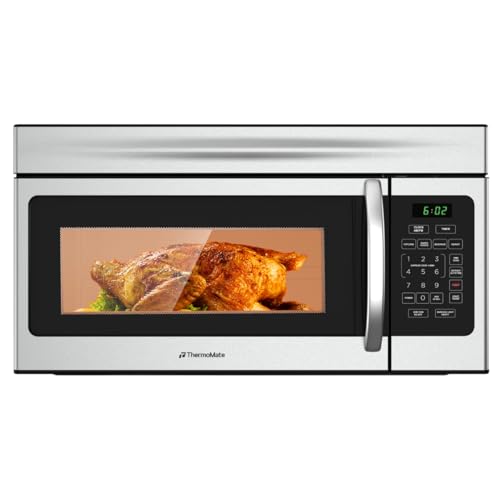
Best Budget: ThermoMate 1.7 Cu.Ft Over-the-Range Microwave
Direct venting projects have two budgets: the appliance and the duct work. The ThermoMate exists for buyers who would rather fund the duct properly — the part that decides whether any of this works — and take their 300 CFM and 1.7 cu ft from a value brand.
Strengths
- Full mainstream venting figure at the lowest tier here
- Family capacity and full cooking power
- One-touch controls keep daily use simple
Trade-offs
- Thinner brand ecosystem — verify parts and filter availability
- Fit and finish trail the majors
- Support runs through younger channels
| Capacity | 1.7 cu ft |
| Power | 1000W |
| Vent | 300 CFM |
| Programs | 10 power levels, one-touch cooking |
| Lighting | LED lighting |
The specification discipline is what earns this pick its place: 300 CFM verified in the listing, 1000W, ten power levels, LED cooktop lighting. Nothing essential was cut to reach the tier. What is thinner is everything around the specification — the documentation depth, the parts pipeline, the installer familiarity — and this guide’s customer-service companion article explains why those matter over a decade. For a rental property, a first home or a phased remodel, the trade can be entirely rational.
Spend the savings where this guide keeps pointing: the duct. A ThermoMate on a short, smooth, correctly sized duct will out-vent a flagship strangled by flex duct and elbows, every single cooking session. Buyers who understand that sentence are exactly the buyers this pick serves — the ones building a system, not just buying an appliance.
A word about who should not buy this pick, in the spirit of the verdicts throughout this guide: anyone whose kitchen is a long-term, high-value installation where the microwave will be expected to serve a decade untouched. The majors’ ecosystems exist for that buyer. The ThermoMate’s buyer is in motion — first house, rental portfolio, a remodel whose budget belongs in the walls — and for that buyer the calculus inverts: the duct is forever, the appliance is for now, and funding forever first is not settling. It is sequencing, and it is correct.
Best for: budget-conscious remodels that fund the duct work properly / Not suited for: buyers prioritizing brand ecosystem and finish
Check on Amazon — check price on Amazon for the current listing.

Best Large Capacity: Frigidaire FMOS1746BS 1.7 Cu.Ft Over-the-Range Microwave
The Frigidaire represents the capacity-first buyer: 1.7 cu ft of microwave in the over-the-range position, from a major appliance group, with the convertible venting architecture this category standardizes on. Its verified listing states capacity and type rather than a CFM figure, and this review follows the listing: confirm the current vent specification on the product page before ordering, as this guide does not invent figures.
Strengths
- Full family capacity in the OTR position
- Major-group brand backing and parts trail
- Convertible venting suits top or rear duct routes
Trade-offs
- Vent CFM not stated in the verified listing — check before buying
- Standard profile needs full cooktop clearance
- Stainless finish only in this listing
| Capacity | 1.7 cu ft |
| Type | Over-the-range |
| Finish | Stainless steel |
| Brand | Frigidaire |
The honest treatment of this pick is itself the point. Over-the-range models in this class are built on convertible venting platforms — the fan can be oriented for top ducting, rear ducting or recirculation at installation — and Frigidaire’s group documentation covers that conversion in the manual you should download before the installer arrives. What this guide will not do is attach a CFM number the verified listing does not carry; venting shoppers should confirm the figure on the current product page and weigh it against the duct rules in this guide.
As a family microwave the case is straightforward: the big cavity, the established brand, the standard installation footprint that makes it a natural replacement for an aging OTR of any major make. Kitchens replacing a dead unit on an existing duct will find the swap conceptually simple — same position, same duct logic, new appliance. Pair it with a duct inspection while the old unit is down; vents are easiest to correct when the microwave is already off the wall.
Frigidaire’s group heritage shows in a place spec sheets ignore: the replacement scenario. When a ten-year-old OTR dies above a finished kitchen, the replacement must fit the space, the bracket logic and the duct position the old unit used. Major-group models are designed against the category’s standard installation envelope precisely because their makers sell replacements into it every day. The FMOS1746BS is therefore the low-drama answer for the most common OTR purchase of all — not the dream kitchen, but the dead microwave on a Tuesday. Confirm the vent figure, book the installer, and the kitchen is whole again.
Best for: families replacing an existing OTR on an established duct route / Not suited for: shoppers who need a verified CFM figure before anything else
Check on Amazon — check price on Amazon for the current listing.
Comparison Table
| Pick | Badge | Key spec | Best for |
|---|---|---|---|
| GE Profile 1.2 Cu.Ft Low Profile Over-the-Range Microwave | Best Overall | 1.2 cu ft / 1000W / 400 CFM hood vent, low profile | tight-clearance kitchens that cook seriously and will duct outside |
| Samsung 1.1 Cu.Ft Smart SLIM Over-the-Range Microwave | Best Venting Power | 1.1 cu ft / 550 CFM hood vent / Wi-Fi, sensor cook | heavy stovetop cooking needing maximum capture in a slim body |
| GE JVM3160RFSS 1.6 Cu.Ft Over-the-Range Microwave | Best Value | 1.6 cu ft / 1000W / 300 CFM hood vent | typical family kitchens with a straightforward duct route outside |
| Midea 1.7 Cu.Ft Over-the-Range Microwave | Best Mid-Size All-Rounder | 1.7 cu ft / 1000W / 300 CFM ventilation, 18 auto cook menus | families wanting capacity, menus and mainstream venting in one unit |
| ThermoMate 1.7 Cu.Ft Over-the-Range Microwave | Best Budget | 1.7 cu ft / 1000W / 300 CFM, LED lighting | budget-conscious remodels that fund the duct work properly |
| Frigidaire FMOS1746BS 1.7 Cu.Ft Over-the-Range Microwave | Best Large Capacity | 1.7 cu ft / over-the-range / stainless steel | families replacing an existing OTR on an established duct route |
Direct Vent, Recirculating and Rear Vent: The Three Configurations
Every over-the-range microwave in this guide leaves the factory able to work three ways, and the installer chooses among them by rotating the fan unit and fitting or omitting duct adapters. Recirculating mode blows air through a charcoal filter and back into the kitchen: it traps some grease and odor, returns all the moisture and heat to the room, and exists for kitchens where ducting is genuinely impossible. Rear venting ducts horizontally through the wall directly behind the unit — the shortest, most efficient route when the range sits on an exterior wall. Top venting ducts vertically through the cabinet above, then to a roof cap or across to a wall cap or soffit.
‘Direct vent’ in this search’s sense means the external configurations — the exhaust leaves the building. The performance gap between recirculating and direct venting is not subtle: steam from a pasta pot, smoke from a sear and the smell of fried fish all exit instead of dispersing through your home. If your range is on an exterior wall, rear venting is usually a modest project. If it is not, top venting through the cabinet is the standard remodel route. Either way, the microwave you buy today supports it; the house is the variable.
CFM and Ducts: Why the Duct Decides What You Get
CFM — cubic feet per minute — is the fan’s airflow rating under test conditions, and the duct system decides how much of it you keep. Airflow hates three things: small ducts, long runs and turns. A duct smaller than the manufacturer’s specified size chokes the fan. Every elbow costs the equivalent of many feet of straight run. Corrugated flex duct, the remodeler’s temptation, adds friction along every ridge and should be avoided in favor of smooth rigid duct wherever the route allows.
Practical rules that preserve rated performance: use the duct size the manual specifies for your model, keep the run as short and straight as the house permits, seal joints with foil tape rather than screws that intrude into the airflow, and terminate with a proper wall or roof cap with a damper that actually opens. A 300 CFM hood on a clean run will out-perform a 550 CFM hood on a strangled one — which is why this guide pairs its highest-CFM pick with its sternest duct warning. Also check local code: high-CFM installations in some jurisdictions trigger make-up air requirements, one more reason the duct plan belongs in the project from day one, not as an afterthought.
Capture Matters as Much as Exhaust
A hood can only duct what it captures, and capture is geometry: the intake’s coverage over the cooktop, its height above the burners, and how much of the rising plume it intercepts before room air currents push the plume sideways. Over-the-range microwaves sit higher and shallower than dedicated hoods, so their capture technique matters: use the rear burners for the smokiest work, since they sit deepest under the intake; start the fan before the pan gets hot, so the airflow column is established; and run the fan for several minutes after cooking, while residual steam and odor are still rising.
Cooktop lighting, present across these picks in LED form, is part of the same system — you cannot manage what you cannot see, and a well-lit cooktop makes the plume visible. None of this requires the most expensive model. It requires the fan running, the right burner chosen and a duct that lets the captured air leave — the unglamorous trio that decides whether direct venting delivers on its promise in your kitchen.
Living With a Direct Vent System: Filters, Noise and Upkeep
A direct vent system has a lighter upkeep load than recirculation — there is no charcoal filter saturating on a schedule — but it is not maintenance-free. The grease filters at the intake still trap the grease that would otherwise coat the duct, and they need regular washing; a dishwasher cycle handles most. A clean grease filter is also an airflow feature: a clogged one throttles the fan as surely as a bad elbow, so the wash rhythm protects the CFM you paid for.
Noise deserves honest treatment. Moving air makes sound, and higher CFM at full speed is audible — plan to cook on lower speeds for everyday work and reserve maximum for the sear and the smoke event, which is how the system is meant to be driven. Finally, check the exterior cap a couple of times a year: dampers stick, screens clog, and nests happen. Two minutes with a flashlight preserves the whole system’s performance, which is the cheapest maintenance bargain in the kitchen.
Direct Venting and Indoor Air: What Actually Leaves the House
Cooking is the largest source of indoor air pollution in most homes, and it is worth being concrete about what that means. A gas burner produces nitrogen dioxide and carbon monoxide alongside its heat; any burner produces fine particles from hot oil and food, plus a surprising volume of water vapor. Recirculating hoods address a fraction of the grease and odor and none of the moisture or combustion gases — the air goes through a filter and comes back into the room carrying most of what it picked up. Direct venting is the only configuration that removes the whole load from the building.
That is the deeper case for the projects this guide describes, beyond smells and clean cabinets. Kitchens that sear, fry and boil daily — which is to say, kitchens where people actually cook — measurably benefit from exhaust that exits. The microwave hoods in this guide are not industrial systems, and this guide has been careful not to oversell their capture geometry. But a 300 to 550 CFM fan on an honest duct, run before and after the cooking peak, removes the bulk of what a home cooktop produces. In indoor-air terms, that is the difference between managing pollution and merely stirring it.
The practical corollary returns to behavior: the fan only cleans the air it is given, so run it early, run it on the rear burners’ behalf, and let it run after the pans come off. Systems thinking again — appliance, duct and habit — is what converts a specification into a result you can breathe.
Questions to Ask Your Installer Before the Work Starts
- Which configuration will you set the fan to, and can you show me the manual page for it? The answer should name top or rear ducting, not a shrug.
- What duct size and material will you run, and how many elbows does the route need? Fewer and smoother is the right direction.
- Where will the exterior cap sit, and does it have a working damper? Ask to see the cap operate before the ladder leaves.
- Will you seal the joints with foil tape and support the duct run so it cannot sag into a trap?
- If my model is one of the higher-CFM picks, does my jurisdiction require make-up air, and who confirms it?
- Will you leave the charcoal filter and the recirculating hardware with me? A phased project may need them, and they are yours.
An installer who answers these fluently is the installer the project wants. The questions are not a test of trivia — they map exactly onto the failure points this guide has catalogued: configuration, friction, termination, sealing, code and fallback. Ask them before the work, while every answer is still cheap to change.
How to Plan a Direct Vent Installation for an Over-the-Range Microwave
The planning below is the owner’s half of the job; the physical installation — electrical work, duct cutting, lifting a heavy appliance onto its bracket — is work for a competent installer or a confident, well-equipped DIYer following the manufacturer’s template. Plan first, and the install day holds no surprises.
- Choose the route: rear through the wall if the range is on an exterior wall; otherwise top through the cabinet toward a roof, wall or soffit cap. Shorter and straighter wins.
- Confirm the duct size and adapter your chosen model specifies, and buy rigid smooth duct, elbows, foil tape and the correct exterior cap before install day.
- Check the cabinet: the unit hangs from a mounting bracket on the wall and is secured through the cabinet above, which must be sound and correctly spaced — verify your cooktop-to-cabinet clearance against the model’s requirements.
- Confirm the electrical: OTR microwaves typically need a dedicated circuit and an outlet in the cabinet above; an electrician can settle this in the same visit as other remodel work.
- Decide the fallback: keep the charcoal filter that ships for recirculating mode, so the kitchen works even if the duct phase of a remodel slips a week.
- After installation, test with a steaming kettle on a rear burner: you should see the plume bend into the intake and feel air moving at the exterior cap.
If the route proves impossible — a duct path blocked by structure, a rental you cannot modify — recirculating mode with a fresh charcoal filter is the honest fallback, maintained on schedule. But price the duct route before assuming it: for exterior-wall ranges especially, direct venting is often a smaller project than buyers fear, and it is the single upgrade that changes how a kitchen smells, feels and ages.
After the first week of cooking on the new system, do the kettle test once more and walk outside while it runs: you should feel a steady push of warm air at the cap and hear the damper settle when the fan stops. That small ritual confirms the whole chain — fan orientation, duct continuity, cap function — in the only way that finally matters, which is physically. File the installer’s paperwork with the manual, note the grease-filter size in the same folder, and the system is documented for whoever services it next, which in a well-kept house may be you, in ten years, glad that someone wrote it down.
Common Buying Mistakes
Venting projects fail in predictable places. Avoid these.
- Buying CFM and ignoring the duct — the fan rating is a ceiling, and a strangled duct sets the real figure far below it.
- Using long runs of flex duct — corrugation is friction; rigid smooth duct preserves airflow and is easier to clean.
- Too many elbows — every turn costs airflow; route planning is performance planning.
- Forgetting the exterior cap damper — a stuck or missing damper leaks weather in and airflow out.
- Recirculating by default without checking the route — many kitchens can duct out with modest work; check before settling.
- Skipping local code — higher-CFM installs can trigger make-up air or other requirements; a permit conversation is cheaper than a correction.
Final Recommendation
For most direct-vent projects the GE Profile is the balanced answer: 400 CFM of verified capture in a profile that fits real kitchens. Heavy stovetop cooks with honest ducts should take the Samsung’s 550 CFM. The JVM3160RFSS remains the mainstream value benchmark, the Midea the all-rounder, the ThermoMate the budget route that funds the duct, and the Frigidaire the capacity-first replacement pick — with its vent figure to confirm on the listing, as its review states plainly. Whichever model you choose, spend as much thought on the duct as on the appliance: in direct venting, the system is the product.
The shortlist, linked: Best Overall — GE Profile 1.2 Cu.Ft Low Profile Over-the-Range Microwave; Best Venting Power — Samsung 1.1 Cu.Ft Smart SLIM Over-the-Range Microwave; Best Value — GE JVM3160RFSS 1.6 Cu.Ft Over-the-Range Microwave; Best Mid-Size All-Rounder — Midea 1.7 Cu.Ft Over-the-Range Microwave; Best Budget — ThermoMate 1.7 Cu.Ft Over-the-Range Microwave; Best Large Capacity — Frigidaire FMOS1746BS 1.7 Cu.Ft Over-the-Range Microwave. Check price on Amazon from any of these links to see the current listing for that model.
Keep exploring the microwave range with these related guides: Best Direct Vent Microwaves Bisque Best Direct Vent Microwaves Not Stainless Steel Best Customer Service Microwaves Best Countertop Microwaves For Reheating Food Best Countertop Microwaves With Trim Kits
Frequently Asked Questions
What does direct vent mean for a microwave?
It means the over-the-range hood exhausts outside the building through a duct — also called external venting — instead of filtering the air and recirculating it into the kitchen. Smoke, steam, grease and odors leave the house. All over-the-range models in this guide are convertible and support external ducting when installed with a duct route.
How many CFM do I need for an over-the-range microwave?
For typical family cooking, a well-ducted 300 CFM hood handles the load. Heavy searing, frying and wok work justify the 400–550 CFM models — provided the duct is sized and routed to carry it, because duct losses, not the fan rating, decide delivered performance.
Can I convert my existing over-the-range microwave to direct vent?
Most OTR models are convertible by design: the fan unit is reoriented at installation and a duct adapter fitted. If your current unit was installed recirculating, conversion means adding the duct route — a modest project on an exterior wall, a bigger one otherwise. The model manual documents the conversion; an installer can confirm feasibility in one visit.
Is direct venting better than recirculating?
Yes, decisively, when a duct route exists. Recirculating filters trap some grease and odor but return all moisture and heat to the kitchen. Direct venting removes smoke, steam and cooking smells from the house entirely. Recirculating remains the fallback for kitchens where ducting is genuinely impossible.
What duct should I use for an over-the-range microwave?
The size and type your model’s manual specifies, in smooth rigid duct, with the shortest and straightest run the house allows, sealed with foil tape and terminated in a proper cap with a working damper. Avoid long flex-duct runs — their corrugation costs airflow every inch of the way.
Do I need make-up air with a high-CFM microwave hood?
Possibly — some local codes require make-up air above certain CFM thresholds, and tightly sealed modern homes can need it for good function regardless of code. This is jurisdiction- and house-specific, so confirm with your installer or building department when planning a high-CFM installation.


