Disclosure: airfryerkitchensupply.com is reader-supported. When you buy through links on our site, we may earn an affiliate commission at no extra cost to you.
Where to buy
Every slipper below was verified against its Amazon listing, and the comfort features named in the reviews — memory foam, arch support, adjustable fits, orthotic-style insoles — are the listings’ own words. This guide talks about comfort and cushioning only: slippers are not medical devices, nothing here treats or diagnoses any condition, and persistent foot pain belongs to a clinician, not a buying guide. That conversation is worth having alongside any purchase, and the guide returns to it in the FAQ.
- Vionic Women’s Indulge Carlin Flannel Mule Slipper — Check on Amazon
- Orthofeet Charlotte Orthopedic Women’s Slippers — Check on Amazon
- Orthofeet Capri Orthopedic Women’s Moccasin Slippers — Check on Amazon
- COFACE Women’s Memory Foam Slippers with Arch Support — Check on Amazon
- KuaiLu Women’s Fuzzy Memory Foam Slippers with Arch Support — Check on Amazon
- RockDove Women’s Original Two-Tone Memory Foam Slipper — Check on Amazon
The best cushioned slippers for forefoot pain start from a simple observation about houses: the forefoot — the ball of the foot and the toes — does its hardest indoor work on the hardest surfaces, in the thinnest footwear we own. Kitchen tile, bathroom floors and long evenings of standing concentrate pressure exactly where a worn-out slipper offers nothing. This guide is about the cushioning answer: six verified house slippers whose listings state the features that spread and soften forefoot load — deep memory foam, structured arch support, adjustable uppers and orthotic-style insoles.
The framing matters, so it is stated once here and held throughout: this is a comfort guide. The picks are presented for cushioning, fit and all-day wearability, in the language of comfort. Readers with persistent, worsening or unexplained foot pain should treat that as a reason to see a professional — the slippers here can make a comfortable house more comfortable; they are not a treatment.
All six picks are house slippers in the strict sense: indoor footwear, several with soles rated by their listings for light indoor-outdoor use. Ballet flats, sandals, slides and massage footwear were excluded by rule. Two brands anchor the structured end (Vionic and Orthofeet), memory-foam specialists anchor the plush end (RockDove, COFACE, KuaiLu), and every spec box quotes only what its listing states.
In this guide
Quick Picks
Six verified house slippers, arranged from structured support to plush foam. Forefoot comfort usually wants both cushioning under the ball of the foot and enough structure that the foam does not bottom out — the badges tell you which way each pick leans.

Vionic Women’s Indulge Carlin Flannel Mule Slipper — Best Structured Support
A flannel mule whose listing states a three-zone comfort design with an orthotic insole and arch support — the structure-first pick.
Check the current price on Amazon

Orthofeet Charlotte Orthopedic Women’s Slippers — Best Adjustable Fit
A hands-free, adjustable slip-on with arch support and a faux-fur finish — the pick for feet whose size changes across the day.
Check the current price on Amazon

Orthofeet Capri Orthopedic Women’s Moccasin Slippers — Best Moccasin Style
A faux-fur-lined moccasin with supportive, ergonomic construction per its listing — traditional looks, modern footbed thinking.
Check the current price on Amazon

COFACE Women’s Memory Foam Slippers with Arch Support — Best Plush Memory Foam
Memory foam plus stated arch support in a warm moccasin with a faux-fur collar — the plush pick that did not skip the structure.
Check the current price on Amazon
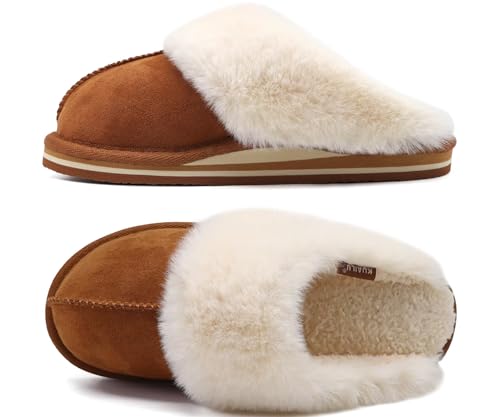
KuaiLu Women’s Fuzzy Memory Foam Slippers with Arch Support — Best Warm Lined Foam
A fuzzy, faux-fur-lined memory foam slipper with stated arch support, in a slip-on scuff shape — winter’s version of the plush pick.
Check the current price on Amazon

RockDove Women’s Original Two-Tone Memory Foam Slipper — Best Washable Everyday Pair
The everyday classic: memory foam, a non-slip indoor-outdoor sole and machine washability stated in the listing — the rotation pair.
Check the current price on Amazon
Key Takeaways
- Forefoot comfort = cushioning thickness under the ball of the foot plus enough support that the cushion does not collapse by evening.
- This is a comfort guide, not a medical one: persistent foot pain deserves a clinician, not just new slippers.
- Structured picks (Vionic, Orthofeet) state orthotic-style insoles and arch support in their listings; plush picks state deep memory foam.
- Adjustable uppers (Orthofeet Charlotte) matter when feet swell across the day — a common forefoot comfort factor.
- Rotate two pairs: foam footbeds recover between wears, and rotation doubles useful cushioning life.
How These Picks Were Chosen
Candidates came from the verified slippers pool in Amazon listing data cache, filtered by the standing slipper rules: house slippers only; no sandals, slides or flip-flops; no ballet, dance or sport footwear; no massage shoes; no baby or children’s sizes; and no listing whose main pitch is medical treatment language — listings leaning on clinical claims were excluded even when the product itself was a legitimate slipper, because this guide’s standard is comfort vocabulary backed by stated construction.
Within the survivors, selection favoured stated forefoot-relevant construction: memory foam footbeds, arch support named in the title, adjustable fits, and structured insoles described by their makers in comfort terms. Two configurations were deduplicated — the Vionic Carlin appears in the cache in two colourways under two ASINs and is reviewed once.
The 6 Best Cushioned Slippers for Forefoot Pain — the Comfort Shortlist
Vionic Women’s Indulge Carlin Flannel Mule Slipper — Best Structured Support
Vionic builds its name on structured footbeds, and the Carlin is its house slipper expression: a flannel mule whose listing states three-zone comfort with an orthotic insole and arch support. For forefoot comfort, that architecture is the point — the arch zone carries load that would otherwise concentrate at the ball of the foot, while the insole cushions what remains. This is the pick for readers whose slippers must perform all day, not just feel soft at first step.
Strengths
- Stated three-zone comfort with orthotic insole and arch support
- Structured footbed resists the bottoming-out of pure foam
- Flannel mule is an easy slip-on for all-day house wear
Trade-offs
- Structured feel is firmer than plush picks — a preference divide
- Mule style offers less heel security on stairs
- Flannel upper is a cool-season fabric
| Spec | Detail (from the verified listing title) |
|---|---|
| Type | House slipper, mule |
| Footbed | Orthotic insole, arch support (per listing title) |
| Comfort system | Three-Zone Comfort (per listing title) |
| Upper | Flannel |
The honest way to describe the Carlin’s feel is “supportive first, soft second” — the reverse of the memory-foam picks, and the reason it leads this guide for standing households. Readers transitioning from flat slippers sometimes need a few evenings to adjust to a present arch; the two-week audit in the how-to section is written for exactly that adjustment. Once settled, the structure is what remains comfortable at hour ten, when foam-only pairs have gone quiet.
Readers new to structured footbeds should give the Carlin the full two-week audit before judging: a present arch feels unusual before it feels right, and the guide’s structured recommendation stands or falls on week two, not on the first evening. It is the pick most likely to be recommended onward by its owners, because structured comfort is a discovery people describe to friends — usually while standing in a kitchen, which is where this slipper does its persuading. If you buy one pair from this guide and no other, the household’s longest-standing reader should choose it — and on the evidence of the category, that reader will choose this one.
Best for: long standing days, readers who prefer structure to plush / Not suited for: anyone who wants a soft, unstructured sink-in feel
Check the current price on Amazon
Orthofeet Charlotte Orthopedic Women’s Slippers — Best Adjustable Fit
The Charlotte’s headline features answer the two fit problems of forefoot comfort directly: the listing states an adjustable, hands-free slip-on design, so the upper can be set for the foot you have at 8 p.m., not the one you had at breakfast; and it states arch support, so the footbed carries its share of the load. The faux-fur finish keeps it a pleasure to wear while it does the practical work.
Strengths
- Adjustable fit stated in the listing — accommodates swelling
- Hands-free slip-on: no bending, no forcing
- Arch support stated, with a supportive house-shoe build
Trade-offs
- Most structured feel of the adjustable picks — not a plush slipper
- Faux-fur warmth suits cool seasons and floors best
- Adjustment takes a moment to dial in on first wear
| Spec | Detail (from the verified listing title) |
|---|---|
| Type | House slipper, slip-on |
| Fit | Adjustable, hands-free (per listing title) |
| Support | Arch support (per listing title) |
| Finish | Faux fur |
| Colour / size in listing | Taupe, size 9 |
Adjustability is the most underrated comfort feature in this category, because forefoot pressure is as much a fit problem as a cushioning problem: a forefoot bound by a tight upper hurts on any footbed. The Charlotte lets the wearer trade a millimetre of snugness for a millimetre of room as the day demands, which is why it is the recommendation for readers whose feet swell — after standing jobs, in warm weather, across a pregnancy — always described here in comfort terms, because comfort is the honest frame.
The hands-free entry deserves its own sentence for carers and anyone dressing one-handed or seated: a slipper that goes on without hands is an independence feature disguised as a convenience. For a household buying for an elderly parent, the Charlotte’s combination — hands-free, adjustable, supportive — is the complete checklist in one product, and the gift most likely to still be worn daily at month six. It is also the pair to pack for travel to hard-floored rentals and relatives’ houses: your comfort system, in a suitcase, immune to other people’s floors.
Best for: feet that swell, readers wanting a customisable fit / Not suited for: anyone wanting the plushest possible foam feel
Check the current price on Amazon
Orthofeet Capri Orthopedic Women’s Moccasin Slippers — Best Moccasin Style
The Capri answers the reader who wants a slipper that looks like a slipper: a classic moccasin silhouette, faux-fur lined, whose listing states supportive house-shoe construction with arch support and an ergonomic design. Where the Charlotte adjusts, the Capri encloses — a fuller, warmer fit for readers whose forefoot comfort comes from being held and cushioned rather than tuned.
Strengths
- Moccasin coverage gives a secure, held fit
- Arch support and ergonomic construction stated in the listing
- Faux-fur lining for cold-floor warmth
Trade-offs
- Warm lining is a winter commitment
- Enclosed fit offers less swelling room than the adjustable Charlotte
- Traditional styling will not suit minimalists
| Spec | Detail (from the verified listing title) |
|---|---|
| Type | House slipper, moccasin |
| Support | Arch support, ergonomic (per listing title) |
| Lining | Faux fur (per listing title) |
| Colour / size in listing | Camel, size 8.5 |
Moccasins distribute pressure differently from mules: the enclosed upper spreads contact across the whole foot, which some forefoot-sensitive readers prefer to any footbed feature. Combined with the stated arch support, the Capri is the guide’s most complete “wear it all winter day” design — the pair that lives by the sofa and handles everything from morning floors to evening standing.
In a draughty house, the moccasin’s enclosed warmth protects comfort in a way no footbed can: cold feet tense, and tense feet load their forefeet harder — the Capri’s lining is part of its comfort system, not decoration. The Capri is also the pair for the reader who works from a cold home office: enclosed, lined and supportive through a seated day that still involves a hundred standing trips. Winter is this pair’s season and it knows it: buy it in autumn, break it in before the coldest floors arrive, and it will carry the household’s hardest months without a rival.
Best for: cold floors, stable fits, traditional slipper lovers / Not suited for: warm climates or feet that swell significantly
Check the current price on Amazon
COFACE Women’s Memory Foam Slippers with Arch Support — Best Plush Memory Foam
COFACE’s design is the bridge between this guide’s two philosophies: a memory foam footbed for the plush first step, with arch support stated in the listing so the softness has a structure under it. The warm moccasin body and faux-fur collar make it the cosiest presentation in the guide; the support claim makes it a serious one. For readers who want softness without the bottoming-out, this is the specification to look for.
Strengths
- Memory foam cushioning with arch support also stated
- Warm moccasin body with faux-fur collar
- The plush pick least likely to feel flat by evening
Trade-offs
- Warm construction suits cool seasons
- Memory foam still compresses over months — rotation applies
- Moccasin enclosure is less adjustable than the Charlotte
| Spec | Detail (from the verified listing title) |
|---|---|
| Type | House slipper, moccasin |
| Footbed | Memory foam (per listing title) |
| Support | Arch support (per listing title) |
| Detail | Faux fur collar, winter moccasin (per listing title) |
| Colour / size in listing | Beige, size 7 |
The foam-plus-support formula deserves its popularity: foam alone is a mattress, support alone is a shoe, and the combination is a slipper that stays kind across a long evening. Judge this pick by the five-hundredth-step test in the guide — it was selected because its stated construction is the plush category’s best answer to that test. In beige, it is also the easiest pick here to gift, which matters in a category bought so often for mothers and grandmothers.
Of the plush picks, this is the one to choose for a reader who stands to cook most evenings: the stated arch support is the difference between a slipper for the sofa and a slipper for the kitchen. Between this and the KuaiLu, choose by shape: the COFACE moccasin encloses and holds, the KuaiLu scuff releases and breathes — the same footbed philosophy in two different relationships with the foot. And for the reader torn between plush and structure, this pick is the designed compromise — the one that asks you to give up least of either.
Best for: readers wanting plush foam with a support backbone / Not suited for: hot sleepers or summer wear
Check the current price on Amazon
KuaiLu Women’s Fuzzy Memory Foam Slippers with Arch Support — Best Warm Lined Foam
KuaiLu’s women’s design pairs the two features this guide keeps joining: a memory foam footbed and arch support stated in the listing, inside a fuzzy faux-fur-lined scuff for winter floors. The open-back scuff shape makes it the easiest on-and-off of the foam picks — the pair that lives at the bedside and the bathroom door — while the footbed keeps it honest as an all-evening wear.
Strengths
- Memory foam with arch support stated
- Faux-fur lining for genuine winter warmth
- Scuff shape: the fastest slip-on in the guide
Trade-offs
- Open back means least heel security — mind stairs
- Lined warmth is seasonal
- Foam compression over time — rotate as advised
| Spec | Detail (from the verified listing title) |
|---|---|
| Type | House slipper, scuff |
| Footbed | Memory foam (per listing title) |
| Support | Arch support (per listing title) |
| Lining | Faux fur, fuzzy (per listing title) |
| Colour / size in listing | Chestnut, size 11 |
The scuff is the most honest slipper shape: it admits it is for padding about, and optimises everything for that. What elevates this one above the novelty end of the scuff market is the stated footbed — memory foam with arch support is a specification, and it is why this pick can be recommended for standing evenings rather than only for sofa hours. On cold floors, the lined scuff is the pair that gets chosen, and chosen pairs are the ones that help.
Keep a second, unlined pair for summer rather than retiring this one in May: seasonal rotation between a lined and an unlined pair is the natural extension of the rotation system, and both pairs age at half speed. On polished bathroom tile, mind the scuff shape’s openness: it is a bedroom-and-landing slipper first, and wet tiles deserve the closed picks’ security instead. Chosen daily, it earns everything.
Best for: winter floors, bedside-and-bathroom duty, easy on-off / Not suited for: stairs, summer, or anyone needing a secure heel
Check the current price on Amazon
RockDove Women’s Original Two-Tone Memory Foam Slipper — Best Washable Everyday Pair
RockDove’s two-tone slipper is the category’s everyday benchmark, and its listing states the practical trio: memory foam cushioning, a non-slip sole for indoor and outdoor use, and machine washability. For forefoot comfort households, washability is a comfort feature in disguise — a footbed that can be cleaned keeps its texture and hygiene across the months when it is cushioning you daily.
Strengths
- Machine washable per the listing — unique practical virtue here
- Memory foam cushioning with a non-slip indoor/outdoor sole
- The proven everyday design of the category
Trade-offs
- Pure foam footbed: less structure than the Vionic or Orthofeet picks
- Foam lifespan is the shortest here under daily load
- Two-tone casual styling is functional, not decorative
| Spec | Detail (from the verified listing title) |
|---|---|
| Type | House slipper, slip-on |
| Footbed | Memory foam (per listing title) |
| Sole | Non-slip, indoor/outdoor (per listing title) |
| Care | Machine washable (per listing title) |
| Colour / size in listing | Eggplant, sizes 7-8 |
Every rotation system needs its workhorse, and this is the guide’s: the pair you wear while the structured pair rests, wash when life happens, and replace without ceremony when the foam retires. Its forefoot story is honest foam cushioning — kind at the ball, dependent on rotation to stay kind — and for readers whose discomfort is the simple kind, hard floors plus thin old slippers, it may be all the upgrade required.
Its washability also makes it the household’s lending pair — the one offered to a guest staying over — because it can be laundered back to neutral between wearers, a courtesy no other pick here can match. Finally, its two-tone design has a household virtue: it does not show the week’s dust the way a pale plush slipper does, so the washable pair also looks acceptable between washes. It is the pair your future self will thank you for buying twice — once for the rotation, and once for the day the first pair finally retires.
Best for: everyday wear, rotation systems, washability-first buyers / Not suited for: readers needing maximum structure for long standing days
Check the current price on Amazon
Comparison Table
The “comfort system” column names each pick’s stated mechanism — foam, structure, adjustability — because that, not the upper’s colour, is what your forefoot will feel.
| Pick | Badge | Key spec | Best for | Where |
|---|---|---|---|---|
| Vionic Women’s Indulge Carlin Flannel Mule Slipper | Best Structured Support | Three-zone comfort orthotic insole, arch support | long standing days, readers who prefer structure to plush | Check on Amazon |
| Orthofeet Charlotte Orthopedic Women’s Slippers | Best Adjustable Fit | Adjustable hands-free fit, arch support | feet that swell, readers wanting a customisable fit | Check on Amazon |
| Orthofeet Capri Orthopedic Women’s Moccasin Slippers | Best Moccasin Style | Moccasin, arch support, faux fur lined | cold floors, stable fits, traditional slipper lovers | Check on Amazon |
| COFACE Women’s Memory Foam Slippers with Arch Support | Best Plush Memory Foam | Memory foam + arch support, moccasin | readers wanting plush foam with a support backbone | Check on Amazon |
| KuaiLu Women’s Fuzzy Memory Foam Slippers with Arch Support | Best Warm Lined Foam | Memory foam + arch support, faux-fur lined scuff | winter floors, bedside-and-bathroom duty, easy on-off | Check on Amazon |
| RockDove Women’s Original Two-Tone Memory Foam Slipper | Best Washable Everyday Pair | Memory foam, washable, non-slip sole | everyday wear, rotation systems, washability-first buyers | Check on Amazon |
How to Choose Cushioned Slippers for Forefoot Comfort
Cushioning that lasts past breakfast. The forefoot test of any slipper is not the first step but the five-hundredth. Thin memory foam feels wonderful in a shop and bottoms out by evening, leaving the ball of the foot on the hard midsole it was meant to escape. Look for the signs of durable cushioning in a listing: memory foam paired with arch support (a structure that carries load so the foam can cushion), a stated orthotic-style insole, or a brand whose whole line is built around supportive footbeds. The six picks here each state at least one of those, in their own words.
Arch support and the forefoot are the same conversation
Supporting the arch changes how load reaches the forefoot: a footbed that carries the midfoot leaves less pressure to concentrate at the ball. That is a statement about load distribution, not medicine, and it is why the structured picks — Vionic’s three-zone comfort design, Orthofeet’s arch-supporting construction — sit at the support end of this guide. Readers who know they prefer flat, unstructured softness should take the plush end instead; comfort is personal, and the guide’s job is to make the trade visible, not to overrule it.
Fit across the day
Feet swell. A slipper that fits at 8 a.m. can bind at 8 p.m., and binding across the forefoot undoes the good of any footbed. Adjustable uppers — the Orthofeet Charlotte’s stated feature — solve this mechanically; roomy moccasin and clog shapes solve it by volume. Judge fit at day’s end, in the socks you will wear, and prefer the pick whose adjustment or volume matches your swelling pattern.
Warmth versus breathability
Lined winter slippers (the KuaiLu and Orthofeet picks) add comfort on cold floors and subtract it in summer. Unlined memory-foam styles (RockDove, COFACE) wear across more of the year. Forefoot cushioning does not care about the season, but your wearing habits do — the best slipper is the one on your feet, so choose the lining your climate will actually use.
Soles: the indoor-outdoor question
Several picks state indoor/outdoor soles in their listings. A real outsole matters for forefoot comfort in an unexpected way: it lets the slipper keep its structure on hard outdoor surfaces during doorstep trips, instead of flexing into a pavement-shaped compromise. If your slippers live a door-to-doorstep life, weight the picks whose listings state indoor/outdoor soles; if they never leave carpet and wood, upper comfort can take priority.
Forefoot Comfort, Explained in Plain Terms
The forefoot is where the foot finishes every step: weight rolls from heel to arch to the ball and toes, and the final push concentrates force on the smallest area of the whole gait. Standing is not rest for this zone either — a person standing at a kitchen counter loads the forefoot continuously, shifting and rebalancing. Hard domestic floors remove the last of the ground’s give, which is why the same feet that tolerate a long walk in shoes complain after an evening of cooking in thin slippers. Cushioning answers by spreading that concentrated load over more area and more time; structure answers by carrying part of the load rearward into the arch and heel. The most comfortable slippers in this guide do both, in different proportions.
Two honest limits belong in this section. First, cushioning compresses: every foam in this guide will be thinner in month twelve than in week one, which is why rotation and replacement are part of the comfort system rather than an afterthought. Second, comfort is not diagnosis. Forefoot discomfort has many causes, some of which footwear cannot address, and a buying guide that pretended otherwise would be selling something it cannot deliver. What these six slippers can honestly promise is a softer, better-distributed interface between your forefoot and your floors — for many readers, that is the whole problem, and for the rest, it is the comfortable baseline while a professional answers the bigger question.
How to Fit and Rotate Cushioned Slippers for All-Day Comfort
Fitting. Try cushioned slippers in the evening, standing, on your hardest floor. Press the ball of your foot into the footbed: you should feel cushion give without feeling the floor’s hardness arriving through it. Walk the length of the room; a structured insole should feel present, not intrusive, and an adjustable upper should be set for the evening foot, not the morning one. If between sizes, the evening fit decides.
Rotation and care. Own two pairs if slippers are your all-day footwear, and alternate days: foam recovers loft between wears, and both pairs last roughly twice as long in useful cushioning. Keep footbeds clean — grit ground into a foam surface accelerates its breakdown — and wash only as each maker directs; the RockDove pick’s listing states machine washable, which is a property of that pick, not of the category. Replace a pair when the forefoot zone of the footbed stays compressed after a rest day: that flat spot is the cushion’s retirement notice, and wearing through it returns you to the hard floor this guide exists to escape.
A two-week comfort audit. When a new pair arrives, note for the first fortnight — honestly, in a phone note — how your feet feel at the end of the longest standing evening, compared with the old pair. Comfort purchases are usually judged on the first step and regretted by the third week; the audit judges them on the evidence that matters. If the new pair is not clearly better by day fourteen, the fit or the style is wrong for you, and the structured-versus-plush axis in this guide points to the correction.
Standing Jobs at Home: Cooks, Carers and Desk Workers
The readers who feel forefoot comfort most are the ones whose work happens standing in their own homes: the cook at the counter for two hours, the carer moving room to room, the parent whose office is the whole house. For them, slippers are work equipment, and the structured end of this guide — Vionic’s three-zone design, Orthofeet’s adjustable and moccasin styles — is the professional choice: support that holds its shape across a shift, uppers that accommodate a foot that has been standing since morning. The plush memory-foam picks serve the other half of the day, the recovery hours, when load is low and softness is the whole brief. Many standing households will rationally own one of each — structure for the work, plush for the evening — and rotate by task rather than by day. That two-pair system, chosen from opposite ends of this guide, is the most complete answer the category offers to a forefoot that works for a living.
What This Guide Deliberately Did Not Recommend
The verified slipper pool contained products that were excluded on principle, and naming the exclusions is part of the review. Massage-textured footwear was excluded: pronounced nodules under the forefoot concentrate pressure rather than spreading it, which is the opposite of this guide’s brief. Listings pitched primarily in medical language were excluded even when the underlying product was an ordinary slipper, because a guide that repeats clinical framing teaches readers to shop by it. Sandals, slides and backless fashion styles were excluded as non-house-slippers under the standing rules, however cushioned their soles. And thin novelty slippers — the category’s gift-shop fringe — were excluded for failing the five-hundredth-step test on their face. What remains is six pairs whose stated construction a forefoot can actually use, which is a shorter list than the internet offers and a longer one than most feet need.
Cushioned Slippers and Hard Floors: Matching the Pair to the Surface
Not all hard floors load the forefoot equally, and the picks divide by surface more cleanly than by brand. Polished tile and stone — kitchens and bathrooms — are the unforgiving extreme: no give, no friction forgiveness, and cold into the bargain. On tile, the structured picks earn their keep, because a footbed with architecture keeps the forefoot loaded evenly when the ground contributes nothing; the lined KuaiLu adds the thermal comfort tile steals. Hardwood is kinder — a millimetre of flex and a warmer touch — and it is the plush foam picks’ home ground, where memory foam over wood is the classic evening combination. Laminate and vinyl sit between: smooth enough to demand a sole with grip, which is where the RockDove’s stated non-slip indoor/outdoor sole becomes a comfort feature in its own right, since a foot bracing against sliding is a forefoot working overtime. Read your own floors before you read the badges again: the right pick is the one whose stated system answers your hardest room, because that room is where your forefoot files its complaints.
When to Replace, and What to Do With the Old Pair
The flat-spot test in the how-to section gives the moment; this section gives the meaning. A compressed forefoot zone is not a cosmetic failure — it is the exact return of the hard-floor problem the purchase solved, arriving gradually enough to be mistaken for your feet getting worse. Readers who replace on the test rather than on appearance keep the benefit continuous, which is the whole point of a comfort system. Retired pairs still serve: garden and garage duty, guest slippers for visitors who arrive in wet shoes, and the spare pair in a car boot for long-drive changes. What they should not do is rotate back into daily service “for light days” — light days are when recovery happens, and they deserve the good pair too. Budget the category as a consumable with a long cycle, like the pillows in a bed, and its comfort stops being a purchase and becomes a maintained condition of the house.
Cushioned Slippers for Men and Mixed Households
This shortlist is built from the women’s verified listings, because that is where the cache’s cushioned, comfort-stated house slippers concentrate — but the principles are unisex and the households reading it rarely are not. Men’s forefoot comfort runs on the same physics: load at the ball of the foot, hard floors, swelling across the day. The verified shortlist contains men’s counterparts in the same families — memory-foam classics from RockDove and Dearfoams, and Orthofeet’s men’s supportive styles among them — and a mixed household shopping from this guide should apply its axes directly: structured for the standing worker, plush for the evening, adjustable for the swelling foot, washable for the rotation. What should not be transferred is size or shape assumptions; buy each wearer their own fit, judged in the evening, on the hardest floor in the house. A household that equips both partners from the same comfort logic — rather than buying one good pair and one novelty pair — is the household this category quietly exists to create.
The First Fortnight: What Improvement Actually Feels Like
Readers switching from worn, thin slippers to the picks in this guide usually report the change in a specific order, and knowing the order prevents two mistakes. Evenings first: the end-of-day ache on hard floors is the earliest thing to soften, often within the first week, because that discomfort was the most purely mechanical — load, meet cushion. Mornings next: feet that start the day without yesterday’s tenderness are the sign the system, not just the slipper, is working — rotation, evening fit and replacement discipline included. What should not be expected is transformation of anything with a longer story: a forefoot that has hurt for months, hurts at rest, or hurts in one precise spot is telling a different story, and this guide’s repeated advice applies — that is a clinician’s question, and asking it early is a strength, not a surrender. Judge your new pair by the fortnight audit, keep the pair that passes it, and let the framework here — structure, cushion, fit, rotation — be the permanent part of the purchase, outlasting whichever of the six you choose first.
Common Buying Mistakes
Buying the softest first step. Shop-soft foam bottoms out by evening. Judge cushioning by its stated structure, not its first impression.
Ignoring fit at day’s end. A binding forefoot at 8 p.m. defeats any footbed. Adjustable or roomy fits exist for this reason.
Treating slippers as a diagnosis. Persistent pain is a clinical question. Comfort upgrades and professional advice are partners, not substitutes.
Wearing one pair to death. Compressed foam is a hard floor with a fabric cover. Rotate, and replace on the flat-spot test.
Choosing by the upper. Colour and fuzz are visible; the footbed is functional. In this category, buy from the sole up.
Believing medical-sounding listing language. Strong claims in a title are marketing until proven otherwise. This guide repeats only construction claims — foam, support, adjustability — and so should your judgement.
Final Recommendation
Start structured if your days are long and standing: the Vionic Carlin for its stated three-zone comfort insole, the Orthofeet Charlotte if your feet swell and need adjustment, the Orthofeet Capri for a moccasin shape with ergonomic construction. Start plush if your evenings are the problem: the COFACE for memory foam with stated arch support, the KuaiLu for warm lined foam, the RockDove for a washable everyday pair. Whichever end you choose, fit them in the evening, rotate two pairs if you live in them, and let persistent pain — as opposed to end-of-day tenderness on hard floors — send you to a professional rather than to a bigger shopping cart.
Related guides in this series:
- Best Cushioned Slippers With Arch Support
- Best Cushioned Slippers Mens
- Best Slippers For Foot Pain Relief
- Best House Slippers Men For Metatarsalgia
- Best Arch Support Womens Slippers
- Best Cushioned Slippers For Plantar Fasciitis
Frequently Asked Questions
Can slippers really help forefoot discomfort?
They can change the interface: cushioning spreads the load under the ball of the foot and structure carries some of it rearward, which many readers experience as real end-of-day relief on hard floors. That is a comfort claim, not a medical one — slippers do not diagnose or treat any condition, and persistent pain should be assessed by a clinician.
Memory foam or structured support — which is better for the forefoot?
They solve different halves of the problem. Memory foam cushions the point of pressure; arch structure reduces how much pressure arrives there. The most complete picks combine both — foam over a supportive footbed. Pure plush suits short wear and evenings; structure suits long standing days.
Why do my slippers feel fine in the morning and bad by night?
Two reasons: feet swell across the day, tightening the fit across the forefoot, and foam compresses under hours of load. The fixes in this guide are adjustable or roomy uppers for the first, and rotation plus adequate footbed structure for the second.
How long should cushioned slippers last?
Judge by the footbed, not the calendar: when the forefoot zone stays flat after a rest day, the cushioning has retired even if the upper looks new. Daily wearers who rotate two pairs get the longest useful life from both; a single pair worn all day, every day, will compress fastest.
Are orthotic-style slippers in this guide medical devices?
No. The picks are house slippers whose listings describe supportive, orthotic-style insoles in comfort terms. They are footwear, not medical devices, and this guide makes no treatment claims for them. Readers managing a diagnosed condition should choose footwear with their clinician’s input.
What should I look for if I stand all day at home?
A stated structured footbed (arch support or a named comfort system), an upper that adjusts or gives room for evening swelling, and a sole rated for the surfaces you cross. Then rotate two pairs. The structured end of this guide — Vionic and Orthofeet — was selected with exactly that reader in mind.
