A countertop toaster oven toasts bread, bakes small dishes, reheats pizza and broils without heating a full-size oven. Many now add convection fans and air fry modes, which makes them a handy second oven for weeknight meals. The right one depends on how much you cook and how much counter you can spare.
The six toaster ovens below cover basic, convection and air fry styles from established brands. We have not used these products ourselves, so confirm the interior size, the functions and the dimensions on the current listing before you buy. Heating and speed claims are the makers’ own.
As an Amazon Associate we earn from qualifying purchases. Links below are affiliate links, and they do not change the product information we give.
What to Look For
| Feature | Why it matters |
|---|---|
| Interior size | Check that your usual pan or pizza fits, not only the slice count |
| Convection | A fan speeds cooking and browns food more evenly |
| Air fry mode | Useful for crisp fries, but the basket and capacity vary |
| Controls | Dials are simple; digital panels offer presets and precision |
| Footprint | Measure the counter and the clearance above and behind the oven |
In this guide
Specs at a Glance
| Model | Style | Controls | Notes |
|---|---|---|---|
| Breville Smart Oven Pro BOV845BSS | Convection | Digital with presets | Larger interior; many functions |
| Cuisinart TOA-60 | Air fry and convection | Dials and a digital readout | Air fry basket included |
| Ninja Foodi Digital Air Fry Oven SP101 | Air fry and flip-up | Digital panel | Flips up to save space |
| Black+Decker TO3250XSB | Basic convection | Dials | Fits a family pizza on many sizes |
| Hamilton Beach 31103DA | Convection | Dials | Straightforward and budget-friendly |
| Panasonic FlashXpress NB-G110P | Compact quartz | Dial and presets | Compact; quick toasting |
The 6 Best Countertop Toaster Ovens
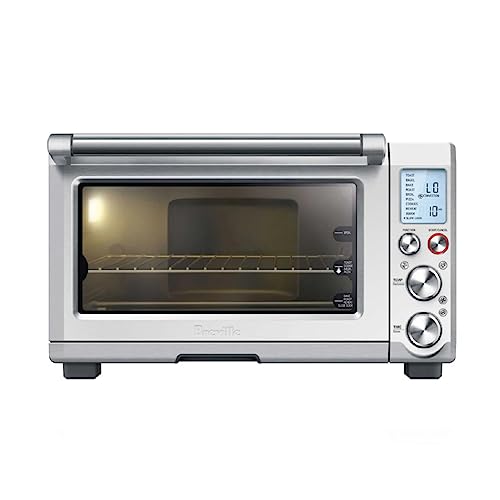
Top pickBest for a household that bakes often
1. Breville Smart Oven Pro (BOV845BSS)
A well-known convection toaster oven with a stainless finish, a digital panel and many cooking presets. It has long been a reference pick for people who want a dependable second oven.
Suits: a household that bakes often. Strengths: a roomy interior and precise settings. Weaknesses: a bigger footprint. Skip it if you have very little counter.

Best for crisp fries and toast in one unit
2. Cuisinart TOA-60 Air Fryer Toaster Oven
A stainless toaster oven with an air fry mode and a basket, plus convection baking. It combines two appliances in one body.
Suits: crisp fries and toast in one unit. Strengths: air fry and convection together. Weaknesses: it takes up solid counter space. Skip it if you only toast bread.

Best for a tight kitchen
3. Ninja Foodi Digital Air Fry Oven (SP101)
A flip-up air fry oven that tilts against the wall when not in use to free counter space. It offers multiple cooking functions.
Suits: a tight kitchen. Strengths: a flip-up design and many modes. Weaknesses: interior depth is moderate. Skip it if you prefer simple dials.
View Ninja Foodi Digital Air Fry Oven (SP101) on Amazon
Best for an everyday family oven
4. Black+Decker Toaster Oven (TO3250XSB)
A larger-style toaster oven with convection, simple dials and a stainless-style finish. It targets families who want a value choice.
Suits: an everyday family oven. Strengths: a familiar brand and simple dials. Weaknesses: fewer features than premium ovens. Skip it if you want digital presets.
View Black+Decker Toaster Oven (TO3250XSB) on Amazon
Best for a plain, budget-friendly pick
5. Hamilton Beach Convection Toaster Oven (31103DA)
A convection toaster oven with easy dials and a straightforward layout. It covers toast, bake and broil without fuss.
Suits: a plain, budget-friendly pick. Strengths: a simple layout and easy cleaning. Weaknesses: check the listing for size. Skip it if you want air fry.
View Hamilton Beach Convection Toaster Oven (31103DA) on Amazon
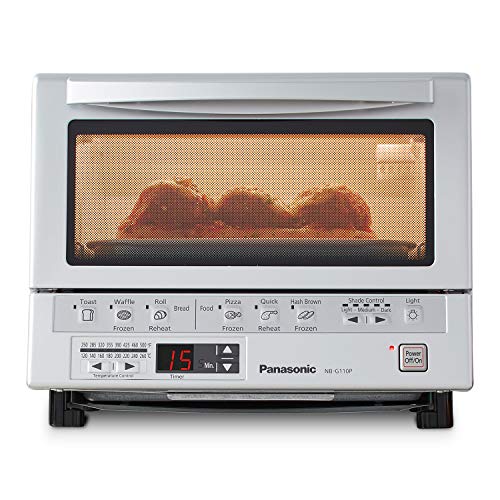
Best for a small kitchen or a dorm
6. Panasonic FlashXpress Toaster Oven (NB-G110P)
A compact toaster oven with quartz heating elements that is built for quick toasting and small bakes.
Suits: a small kitchen or a dorm. Strengths: a small footprint and quick heat. Weaknesses: limited capacity. Skip it if you cook for a big family.
View Panasonic FlashXpress Toaster Oven (NB-G110P) on Amazon
Care and Setup
- Empty the crumb tray often.
- Let the oven cool before wiping the interior.
- Keep the glass door clean to check food without opening it.
- Leave space around the oven for ventilation.
- Wash the air fry basket if one is included.
Mistakes to Avoid
- Using foil that touches the heating elements.
- Letting grease build up and smoke.
- Placing the oven under a low cabinet.
- Overfilling the pan.
- Forgetting to preheat convection mode.
Interior Space Versus Slice Counts and Pan Sizes
Manufacturers often describe toaster oven capacity in slices of bread or the size of pizza, but those numbers can mislead. A slice count tells you how much toast fits side by side, not whether your baking dish, sheet pan or casserole will go in. Use the interior width, depth and height on the listing and compare them with the pans you already own. Remember that heating elements sit close to the top and bottom, so usable height is less than the cavity measurement.
Measure your most-used pan, including handles, and check the oven door for clearance when it opens. If you often make a whole chicken, a roast or a deep casserole, a compact unit will not suit you, and a model with more height may be needed. If you mainly toast bread, reheat leftovers and bake small trays of cookies, a smaller body saves counter space and heats up faster.
Think about racks. Many ovens offer two or three rack positions, and the choice affects browning. Top positions are closer to the broiling element, while lower positions suit baking. Check that the rack slides out smoothly, and whether it locks, since reaching into a hot oven is a burn risk. A crumb tray that pulls out easily makes cleaning simpler.
Heating Elements, Convection and Evenness of Cooking
Toaster ovens heat with metal or quartz elements above and below the food. How these are arranged and how the oven controls them affects evenness. Models with more elements, or elements that cycle with a thermostat, tend to hold temperatures more steadily than basic designs. Quartz elements heat up quickly, which suits toast and small reheats, but sometimes brown the top faster than the bottom.
Convection adds a fan that moves hot air around the food. The usual effect is faster cooking and more even browning, and many recipes suggest lowering the temperature or shortening the time when convection is used, so follow the manual. Air fry modes use a fast fan and often a perforated basket to crisp food with little oil. Capacity for air frying is usually smaller than the oven interior, so check the listing for what fits in the basket.
Whatever the heating, allow the oven to preheat fully, as many cook poorly if loaded cold. Rotate trays partway through when you cook a full tray of cookies, since hot spots are common in small ovens. An oven thermometer is an inexpensive way to learn how accurate your oven’s dial is, because small ovens can run hotter or cooler than the setting. Adjust times to match what you find.
Controls, Presets and Ease of Use
Controls shape how often you reach for the oven. Dial controls are straightforward and durable, and they suit people who want to set a temperature and time and walk away. Digital controls offer exact temperatures, timers and presets for toast, bagels, pizza or reheating. They are handy if you value repeatable results, but some people find menus fiddly.
Check the toast shade settings and how they work. A good toast function lets you choose light, medium or dark and gives consistent results across several rounds. Keep in mind that the first batch may differ from later ones as the oven warms up. A bake timer with an automatic shutoff is a useful safety feature, as is a signal when the oven reaches temperature.
- Is the display easy to read from your usual position?
- Can you set a temperature in small steps?
- Does the oven have a keep-warm function?
- Are the buttons or dials easy to clean?
A large window and interior light help you check food without opening the door, which preserves heat. Check the cord length and where the outlet sits, since the unit needs space to vent heat safely.
Placement, Ventilation and Power Considerations
Toaster ovens get hot on the outside, and placement affects safety. Leave the clearance the manual specifies above, behind and at each side, since heat must escape. A low cabinet above the oven can trap heat, discolor the cabinet and in the worst case cause damage. Keep curtains, paper towels and plastic away from the unit. Place it on a stable, heat-resistant surface, not on a tablecloth or a lightweight shelf.
Electrical draw is another thing to check. Toaster ovens use a lot of power for their size, and the listing or label will give the wattage. Plugging one into a circuit that already powers a kettle, microwave or other high-draw appliance can trip the breaker. Plug it into a wall outlet rather than a power strip, and avoid extension cords unless the manual allows it.
Think about how the oven fits your routine. If you will move it often, a lighter model with a cool-touch handle helps. A flip-up or space-saving design suits small kitchens, while a larger unit might be happier living permanently on the counter. Keep the exterior clean so grease does not build up and become a smoking or fire risk.
Cleaning Habits and Cooking Tips to Get More From It
Regular cleaning keeps a toaster oven working well and prevents smoke. Empty the crumb tray often, and wipe the interior once the oven is cool. For baked-on splatters, a damp cloth with mild soap is usually enough, and a non-abrasive pad can lift tougher spots. Avoid spraying cleaner directly onto the elements or controls. Check whether the racks and pans can go in the dishwasher, and wash air fry baskets according to the instructions.
Use cookware that fits and is suitable for the oven. Metal pans, ceramic dishes and oven-safe glass are generally fine, but check temperature limits. Line trays with foil or parchment only if it does not touch the heating elements or block airflow, as that can cause hot spots or fire. Never leave plastic or paper near the elements.
A few habits improve results. Preheat for baking, give the food space so air circulates, and use the top rack for browning and the lower rack for even baking. For crisp results from frozen foods, spread them in a single layer. Use a thermometer to check meat, rather than relying on color alone. Know when to replace the oven: a door that does not close tightly, elements that no longer glow evenly, persistent smoke when clean, damaged cords or rust inside all signal trouble. For a small appliance, a worn unit is often better replaced than repaired.
Sizing a Toaster Oven to Your Counter and Your Cooking
Toaster ovens range from compact models that fit a few slices of bread to large units that hold a whole pizza or a small roasting tray. Begin with the space on your counter, including clearance above and behind the oven, since these appliances give off heat and need room to breathe. Read the manual for the minimum distance from walls and cabinets, and never place the oven under a low cupboard if the maker advises against it.
Then look at the interior. Measure the pans you already own, such as a quarter sheet pan or a pizza pan, and compare them with the stated interior size. A listing may quote the number of slices of bread or the size of pizza it fits. Use those as rough guides and check the interior dimensions for your own dishes.
Convection and Air Fry Functions Compared
| Function | What it does | Good for |
|---|---|---|
| Standard bake | Heats from top and bottom elements | Casseroles, simple baking |
| Convection | Adds a fan to move hot air | Even browning, roasting |
| Air fry | High-speed airflow with a basket or tray | Crisp fries, wings, vegetables |
| Broil | Top element at high heat | Melting cheese, browning tops |
| Toast | Even heat for bread | Bagels and slices |
Air fry modes are a convenient addition, though results vary by model. Follow the maker’s instructions for quantities and trays, and avoid overcrowding.
Controls: Dials, Buttons and Digital Displays
Dials are quick and easy to use with messy hands, and they often last long. Digital controls offer presets and precise timers but add complexity. Think about whether you want to set a temperature and time by feel or prefer one-touch settings for common tasks. A bright interior light and a window that is easy to see through help you check food without opening the door.
- Clear temperature markings and a readable timer
- A tone that signals when the cycle ends
- Rack positions that are easy to adjust
- A crumb tray that slides out cleanly
Safe Placement and Use
Toaster ovens get hot on the outside as well as the inside. Keep them on a stable, heat-resistant surface away from the edge, and keep cords from touching hot surfaces. Follow the manual for clearance, and do not cover vents. Use oven mitts when handling trays. Avoid putting materials in the oven that the maker does not approve, such as certain plastics or thin foil that touches the elements.
Plug directly into a wall outlet if the maker advises it, and do not run other high-power appliances on the same circuit at the same time. If anything about the electrical setup concerns you, consult a licensed electrician.
Cleaning and Upkeep
Empty the crumb tray regularly, wipe the interior when cool and clean spills before they bake on. Use cleaners the maker approves, and avoid abrasive pads on coated surfaces. Remove racks and trays for washing by hand or in the dishwasher if allowed. A clean oven works better, smells better and lasts longer.
Habits That Hurt Results
Overfilling the oven restricts airflow and leads to uneven results. Placing food too close to the top element can burn the surface. Ignoring the preheat can alter cooking times. And leaving the oven unattended on high heat is risky, so stay nearby. Learn the hot spots of your model, rotate trays, and adjust times as you gain experience.
Does a Toaster Oven Replace a Full Oven
For small households, a toaster oven can handle most daily baking, reheating and toasting while using less space and warming up quickly. For large roasts, big batches or multiple trays, a full oven is still useful. Many people use both, relying on the toaster oven for everyday tasks and saving the big oven for special meals.
Everyday Recipes That Suit a Toaster Oven
These ovens shine with small, quick jobs. Reheat pizza slices so the crust crisps, toast bagels evenly, roast a tray of vegetables, bake a single-serve casserole or cook a pair of chicken thighs. Frozen snacks cook well with convection or air fry modes. Cookies bake nicely in small batches, which is handy when you want a treat without heating a full oven. Always check the packaging of frozen foods and follow the food safety guidance for your ingredients.
Cookware That Fits and Is Safe to Use
Use bakeware that the oven manual approves, and check size before you buy anything new. Metal baking pans, ceramic dishes and glass bakeware that is labeled oven safe are commonly acceptable, but confirm with the maker. Keep dishes away from the heating elements. Avoid plastic and paper containers unless they are marked as suitable for oven use, and follow the instructions for any foil.
Energy and Heat in a Small Kitchen
A compact oven heats a smaller space, so it can be a sensible choice on warm days when you want to avoid heating the whole kitchen. Be mindful of ventilation, and make sure steam and heat can escape safely. Let the oven cool before wiping it down, and keep curious children and pets away from the hot exterior during use.
Choosing Countertop toaster ovens: What Actually Matters
Heating character decides results. Even, well-spread elements toast uniformly and bake without fierce hot stripes; convection, where fitted, evens things further and speeds cooking, at the cost of noise and a little drying that some bakes dislike. Maximum temperature and the broil or grill function matter for finishing and cheese, while a genuine low setting serves warming and slow tasks. Controls should be legible and honest: a timer that can be set precisely, temperature in sensible steps, and functions labeled in words a guest can understand. A toaster oven is often a household’s second oven and its first teaching oven; clarity is a feature.
Build and daily details finish the picture. A door that opens smoothly and stays where you leave it, a rack that slides without tipping, an interior light, and an exterior that does not become dangerously hot all shape daily satisfaction. Consider the footprint with the door open, the cord’s reach, and where the oven will live relative to your prep space, because it will likely become a permanent resident. Energy sense matters too: for small meals, this little oven heating in minutes beats a full-size oven’s long preheat, and that economy is one of the strongest reasons to own one.
A countertop toaster oven is a small, complete oven, so judge it the way you would judge a big one, scaled down. Interior size should be measured against your real dishes: the pizza you buy, the casserole you love, the six slices of toast on a family morning. Rack positions matter because they set the distance between food and elements, and a toaster oven with sensible positions and enough height cooks far more than toast. Check what pans it swallows, including handles, and whether the crumb tray and interior are easy to clean, because this appliance will cook everything from garlic bread to roast chicken and will collect the evidence.
How Countertop toaster ovens Fit Real Routines
Second oven duty at big meals
When the main oven is full, the countertop oven becomes the difference between a calm host and a juggling act. It roasts the vegetables while the joint rests, bakes the gratin while the turkey occupies the big cavity, warms plates and bread, and holds a pie at serving temperature. Plan its jobs in advance and assign it dishes that forgive approximate timing, sides and warmers rather than the showpiece. Two ovens at two temperatures is the professional kitchen’s secret, scaled to a counter, and holiday cooking is where owners fall permanently in love with these machines.
Small meals and cooking for one or two
For small households, the toaster oven is often the main oven in practice. A chicken breast with vegetables, a single portion of lasagna, a small loaf, a tray of roasted chickpeas for snacking: all cook properly without heating a large empty cavity. Portions reheat with their texture intact, which makes leftovers a plan rather than a penalty. The economics are real, less energy, less heat in the kitchen, faster preheats, and the psychology matters too: cooking a small meal feels proportionate, so people cook more and order in less.
Toast, breakfast, and the morning routine
Breakfast is the toaster oven’s home shift: toast and bagels, obviously, but also reheated pastries that a microwave would soften, baked eggs in ramekins, sausages and tomatoes on a small tray, and cheese on toast that a grill pan cannot match. The oven’s speed means it fits the morning’s tempo, preheating while the kettle boils. Keep the crumb tray emptied and the rack position for toast memorized, and mornings run themselves. For households whose breakfasts vary by person and by day, the little oven’s flexibility beats any single-purpose appliance.
Setup, Daily Use, and Getting the Best Results
Assemble the small kit that makes the oven versatile: the pans that fit it, measured with their handles; a rack-friendly tray for drips; mitts that suit a narrow door; and a thermometer habit for the first months while you learn whether the dial runs hot or cool. Keep the manual’s guidance on which materials and maximum temperatures it allows close at hand, since small ovens put food close to elements and rules about foil, parchment, and glass dishes matter more here than in a big oven. A page of your own notes in a drawer beats any of this in theory.
Daily rhythm is simple: crumbs out regularly, spills wiped once cool, and the door’s glass cleaned before the film builds into something you cannot see through. Because the cavity is small, grease concentrates near the elements and announces itself as smoke and off flavors quickly if ignored. A two-minute wipe after a messy cook is the whole secret to a toaster oven that stays sweet for years. Treat it as you would a good pan, cleaned as part of cooking, not as a separate household project scheduled for a free Saturday.
Place the oven on a stable, heat-resistant surface with clearance above and behind for its vents and radiant heat, and never boxed in under a low shelf that traps steam. Run it empty once as the maker directs to clear new-appliance smells. Then map its character with a toast test: slices across the rack show you its hot and cool zones in one cycle, and every toaster oven has them. Note the rack position and setting that toast your bread as you like it, because that calibration anchors your sense of the oven’s honesty for everything else.
Care, Cleaning, and Keeping It Working Well
Performance changes usually trace to cleanliness or habit. Toast browning unevenly may mean crumbs are shading an element or the rack position has crept. Baking that suddenly runs slow can be a door seal fouled by a crumb, or simply a fuller oven than usual. If elements glow patchily or the oven behaves erratically, stop and consult the maker rather than cooking on; heating appliances earn respect. With ordinary care, a toaster oven’s life is long, and most of its aging shows in cosmetics, a darkened interior, a stiffer knob, rather than in its cooking.
The crumb tray is the maintenance item owners forget and ovens remember. Empty it on a weekly rhythm, more often if you toast daily, because accumulated crumbs near elements are both a flavor and a safety issue. Wash the rack and tray in the sink, wipe the interior walls with a damp cloth and mild cleaner the maker approves, and avoid abrasive tools on nonstick interior coatings where fitted. Clean the door glass inside and out so you can judge browning without opening the door, and check that the door still closes evenly, since a good seal is temperature honesty.
Common Mistakes and How to Avoid Them
Material mistakes follow: foil draped loosely can contact elements, parchment can lift in convection air, and glass dishes moved from fridge to fierce heat can crack. Follow the manual’s rules for your model, keep liners weighed down and within their ratings, and give glass a few minutes on the counter before it meets high heat. Finally, do not store items inside the oven, and build the household habit of checking it is empty before switching on. Most toaster oven dramas are storage dramas that met a preheat.
Oversized food is the toaster oven’s classic mistake: a chicken that crowds the elements, a casserole filled to the brim, a pizza that touches the walls. Food needs clearance on every side for air and radiant heat to work, and tall food near the top element scorches while its center lags. Choose dishes by the cavity’s real measurements and lower the rack for tall items. The second mistake is treating times from a full-size oven as exact; small ovens cook faster and fiercer, so check early, rotate pans, and let a thermometer settle arguments about doneness.
How the Picks in This Guide Compare
Comparison only makes sense against your own priorities, so use this section as a decision exercise rather than a ranking. The picks above were chosen to cover different needs within countertop toaster ovens: different sizes, styles, and strengths for different kitchens. Read across them with your space measurements, your regular recipes, and your cleaning tolerance in hand, and the shortlist usually narrows itself to one or two. What follows revisits each pick in turn and frames the question you should ask of it.
Breville Smart Oven Pro (BOV845BSS) is the pick to study closely if its purpose in this guide matches the job you most need done. Read its section alongside the picks either side of it, and notice the trade-offs the guide describes: every design in this category gives something to get something. If the compromise it makes is one you would happily make too, that is a strong signal. If its strengths answer a problem you do not have, a simpler pick further down the list will probably serve you better.
With Cuisinart TOA-60 Air Fryer Toaster Oven, the decision is about fit for your household rather than rank. Its review above explains the cooking it is built for; your task is to be honest about how often that cooking happens in your kitchen. A pick used three times a week at the centre of your routine is worth more than a technically broader one used monthly. Check also the practicalities the review raises, size, handling, and care, because those are the details still shaping your satisfaction a year from now.
Ninja Foodi Digital Air Fry Oven (SP101) represents one answer to the question this guide is asking, and the other picks represent others. Compare them by the criteria that opened this article: how they fit your space, how they behave in the cooking you repeat, and how they clean and store afterwards. If you find yourself torn between this pick and another, choose by the tie-breaker of daily friction: the one that will be easier to reach for, easier to wash, and easier to live with usually wins the year, whatever wins the afternoon.
Black+Decker Toaster Oven (TO3250XSB) earns its place in this line-up for the role set out in its review above. When you weigh it against the neighbouring picks, compare what the reviews themselves say about what it does well, where its limits are, and the kind of cooking it suits. The right choice is rarely the most elaborate option; it is the one whose strengths match your weekly routine rather than your most ambitious day, and whose handling and care you will be happy with long after the novelty fades.
Hamilton Beach Convection Toaster Oven (31103DA) is the pick to study closely if its purpose in this guide matches the job you most need done. Read its section alongside the picks either side of it, and notice the trade-offs the guide describes: every design in this category gives something to get something. If the compromise it makes is one you would happily make too, that is a strong signal. If its strengths answer a problem you do not have, a simpler pick further down the list will probably serve you better.
With Panasonic FlashXpress Toaster Oven (NB-G110P), the decision is about fit for your household rather than rank. Its review above explains the cooking it is built for; your task is to be honest about how often that cooking happens in your kitchen. A pick used three times a week at the centre of your routine is worth more than a technically broader one used monthly. Check also the practicalities the review raises, size, handling, and care, because those are the details still shaping your satisfaction a year from now.
More Practical Notes on Countertop toaster ovens
Accessories should follow your actual cooking. The right small pans, a quarter sheet, a modest casserole, a skillet that fits, unlock more meals than any electronic extra. Buy them by measurement, not by hope, and prefer materials you already understand. A second rack or a specialty tray earns its place only when a weekly habit calls for it. The toaster oven’s genius is doing ordinary cooking well at small scale; equip it for your ordinary, and it will handle your occasions better than you’d expect.
Finally, teach the household the oven’s few rules and its great strengths, because it will be used by everyone. Show younger cooks the clearance rule, the empty-before-preheat check, and the mitt habit, and write the toast setting where a guest can find it. Appliances that a whole household uses confidently get cleaned, cared for, and kept. A toaster oven that becomes shared infrastructure, rather than one person’s gadget, justifies its counter space many times over.
Think of the toaster oven as the kitchen’s utility player and place it where utility happens: near the prep counter, with a landing spot for hot trays and room for its door to open without moving the kettle. Its value compounds with proximity. Owners who banish it to a distant counter use it half as much, which is another way of saying that placement is a feature you choose after purchase. Give it a good home and it will quietly become the most-used cooking appliance you own.
Read the manual once, properly, before the appliance’s first week is out. Manuals are unfashionable and irreplaceable: they hold the clearances, the cleaning products to avoid, the error signals, and the small capabilities the marketing never mentioned. Keep it, or its digital copy, where the household can find it, and note the model and serial details in the same place. When something behaves oddly in year three, the answer is usually in those pages, and the household that can find its manuals solves problems in minutes instead of weekends.
Energy and water habits around countertop toaster ovens are unglamorous and cumulative. Run appliances at their efficient loads rather than in dribs and drabs where the design allows, keep seals, filters, and vents clean so the machine does not labor against its own neglect, and switch off at the socket where the design expects it rather than leaving everything in standby forever. None of this asks for sacrifice; it asks for rhythm. The households that get the lowest bills and the longest appliance lives are rarely the most frugal, just the most consistent.
Teach the whole household the appliance’s few rules and its ordinary routine. Shared appliances fail at the boundaries between users: one person’s shortcut becomes another’s mystery fault. A short conversation, or a note on the fridge door covering what goes in, what never does, and what to do when a cycle ends, aligns everyone. Children old enough to use countertop toaster ovens are old enough to learn their care, and guests are happier with a sentence of guidance than with anxious hovering. An appliance the whole house understands is an appliance that lasts.
Keep a small log for the first season: what you cooked or processed, the settings that worked, and the one thing you would change. Appliances have personalities, and published guidance is written for an average kitchen that is not yours. Your own notes, rack positions, timings, doses, and quantities for your regular tasks, become the real manual within a dozen uses. This is the least technological advice in this guide and the most valuable: the difference between owners who love their appliances and owners who tolerate them is usually a page of notes.
Accessories should be bought in the order your frustration dictates. Live with countertop toaster ovens for a month first, and let real friction, the missing rack, the awkward jug, the pan that does not fit, tell you what to buy. Each accessory should remove a named annoyance from a task you perform weekly; anything bought for an imagined task will join the drawer of good intentions. And when you do buy, measure first and buy once, because the accessory that fits properly and is used daily is cheaper at any price than the almost-right one replaced twice.
Plan for the appliance’s whole life in your home, including its end. Keep the packaging only if storage is free and returns are plausible; register the warranty; note where spare parts and consumables for your model are sold. When performance drifts, work through the simple causes in order, cleanliness, loading, settings, placement, before assuming failure, because most appliance misery is maintenance wearing a disguise. A well-kept machine, honestly assessed, will tell you clearly when it is done; until then, steady care beats anxious replacement.
Consider how countertop toaster ovens interact with the rest of your kitchen’s cast. The best kitchens are ensembles: each appliance covers the others’ weaknesses, and tasks flow to the tool that does them best rather than the newest one. Let the appliance in this guide take the jobs it is genuinely best at, and resist forcing it to be universal. That division of labor is what makes a kitchen feel calm at the busiest hour, and it is the real destination of every comparison and criterion in this guide: the right tool, in the right place, doing its best work.
Safety around countertop toaster ovens is mostly a set of small, unbroken habits. Keep the area around the appliance clear and dry, route cords and hoses where they cannot be tripped over or pinched, and let hot parts cool before cleaning or covering. Never defeat a safety feature because it slows you down, and never leave a heating appliance in a state you would not leave a hob. Teach these habits as part of the appliance’s routine rather than as warnings, and they will be followed on the tired evenings when warnings are forgotten.
Finally, judge countertop toaster ovens by the standard of your ordinary week. The right choice is the one that makes Tuesday easier: faster to set up, calmer to use, simpler to clean, and reliable enough to be forgotten between uses. Feature lists and first impressions fade; the weekly rhythm is the product. If you choose by fit, by your real loads and recipes, and by the care you will actually give, the appliance will repay you in the only currency that matters in a kitchen, which is good food with less friction, week after week.
Toaster Oven FAQ
Can a toaster oven replace my regular oven?
For small meals, yes. For large roasts or several dishes at once, a full-size oven is still better.
Is air fry the same as convection?
Both use a fan, but air fry modes push hotter air faster, often with a basket, for crisp results.
How big should the interior be?
Pick one that fits your usual baking pan and a pizza if you make them. Check the stated interior size on the listing.
Do toaster ovens use a lot of power?
They typically use less than a full oven for small meals. Check the wattage on the listing.
How do I know if my pan will fit?
Measure the pan with its handles and compare it with the interior width, depth and height on the listing. Allow room for the door to close and the elements to clear.
Do I need to lower the temperature in convection mode?
Many recipes suggest a lower temperature or shorter time with convection. Follow the oven's manual and check food early the first few times.
Why does my toast brown unevenly?
Hot spots, a cold first batch or a crowded rack can cause this. Preheat, center the food and rotate if needed.
Can I use foil in a toaster oven?
Only if it does not touch the heating elements or block airflow. Check the manual and keep foil trimmed and secure.
Where should I place a toaster oven?
On a stable, heat-resistant surface with the clearance the manual specifies. Do not put it under a low cabinet.
Do I need an oven thermometer?
It helps. Small ovens can run hotter or cooler than the dial, and a thermometer shows you how to adjust times and settings.
How do I clean baked-on grease?
Let the oven cool, wipe with a damp cloth and mild soap, and use a non-abrasive pad for stubborn spots. Avoid spraying cleaner on the elements.
Why does food brown faster than in my regular oven?
The elements are much closer to the food, so radiant heat is more intense, especially from above. Lower the rack for tall dishes, reduce temperature slightly compared with big-oven recipes, and check earlier than the stated time. Once you recalibrate your expectations, the speed becomes an advantage rather than a surprise.
Is it safe to use foil in a toaster oven?
Only as your model’s manual allows, kept away from the elements and never draped loosely where convection air or contact could move it onto a heating element. Many makers permit foil on the rack or as a loose tent over food, and prohibit lining the oven floor or walls. The manual’s word is final for your machine, because designs differ.
What pans fit in a countertop toaster oven?
Any oven-safe pan that fits with clearance on all sides, measured including handles, and that is rated for the temperatures and broil heat you use. Quarter sheet pans, small skillets, and modest casseroles are the usual workhorses. Measure your cavity and rack before buying pans, and remember that food rises and sauces bubble, so clearance is working space, not wasted space.
How do I stop the top of food burning while the center cooks?
Move the dish to a lower rack, reduce the temperature, and if needed tent it loosely with foil as the manual permits once it has the color you want. Dense dishes also benefit from a slightly longer, gentler bake rather than a fierce short one. An oven thermometer helps confirm the dial is honest, which settles many mysteries.
Does a convection toaster oven cook differently?
Yes: the fan moves hot air across the food, so cooking is faster and often more even, and surfaces dry and crisp more readily. Reduce temperature slightly or check earlier than still-air recipes suggest, and keep loose liners secured against the moving air. For delicate bakes, a model that lets you switch the fan off offers the best of both worlds.
Can a toaster oven replace my main oven?
For many households, for most meals, yes. It handles toast, baking, roasting, and reheating at small-to-medium scale with faster preheats and less energy. Its limits are size: large turkeys, big sheet pans, and multi-tray baking still belong to a full-size oven. Many owners use the countertop oven daily and the main oven for occasions, which is a sensible division of labor.
The Short Version
For a reference pick, the Breville Smart Oven Pro. For air fry, the Cuisinart TOA-60. For a flip-up design, the Ninja Foodi. For a value family oven, the Black+Decker. For a plain pick, the Hamilton Beach. For quick toasting, the Panasonic.

