Disclosure: airfryerkitchensupply.com is reader-supported. When you buy through links on our site, we may earn an affiliate commission at no extra cost to you.
Where to Buy
All linked picks below were confirmed before writing, and each link goes to the exact model reviewed. Use these links to check price on Amazon when you are ready to buy. Because low-spatter performance depends on design details — lids, water trays, extraction fans, enclosed cooking chambers — confirm the version in the listing matches the model named in the review, since brands sometimes sell a similar open model under a similar name.
- Chefman Smokeless Indoor Electric Grill, Extra Large (Best Overall Low-Spatter) — Check on Amazon
- Techwood Indoor Smokeless Grill with Turbo Smoke Extractor, 1500W (Best Smoke Extraction) — Check on Amazon
- Hamilton Beach Electric Indoor Grill with Hot and Cold Smoke Infuser (Best Hooded Grill) — Check on Amazon
- Techwood 1500W Smokeless Electric Grill with Glass Lid (Best Budget Lidded Pick) — Check on Amazon
- Gotham Steel Smokeless Indoor Grill with Ceramic Coating (Best Compact Water-Tray Design) — Check on Amazon
- Ninja Foodi Smart XL 6-in-1 Indoor Grill & Air Fryer DG551 (Best Fully Enclosed Splatter Control) — Check on Amazon
Let’s be straight about the best countertop grills don t spatter promise before anything else: no grill that sears meat is literally spatter-free, because spatter is physics — moisture and fat hitting a hot surface will always throw some droplets. What separates the picks in this guide from a standard open grill is how much spatter escapes onto your counter, stove, and sleeves. The honest low-spatter designs attack the problem four ways. A lid or hood physically contains droplets, which is why the lidded Techwood and the hooded Hamilton Beach are here. A water tray under the grate cools dripping fat before it can smoke and spit, the classic smokeless-grill layout used by the Chefman and Gotham Steel designs. An extraction fan, as on the Techwood Turbo model, pulls smoke and airborne grease down and away instead of letting it drift across the kitchen. And a fully enclosed smart grill like the Ninja DG551 cooks behind a closed lid with managed airflow, so almost nothing reaches the counter at all. If you grill in a small apartment, cook in clothes you like, or simply hate wiping down the whole stove after burgers, this is the shortlist that respects that priority — with the trade-offs of each approach stated plainly in every review.
In this guide
Quick Picks
- Chefman Smokeless Indoor Electric Grill, Extra Large — Best Overall Low-Spatter: An extra-large water-tray smokeless grill: dripping fat lands in cool water instead of smoking and spitting, and the big surface feeds a family. — Check on Amazon
- Techwood Indoor Smokeless Grill with Turbo Smoke Extractor, 1500W — Best Smoke Extraction: A lidded Korean-BBQ-style grill with a built-in turbo smoke extractor fan, a dishwasher-safe drip tray, and a glass lid per the Amazon listing. — Check on Amazon
- Hamilton Beach Electric Indoor Grill with Hot and Cold Smoke Infuser — Best Hooded Grill: A hooded indoor grill with a vented hood and fan, a wide 150–450°F range, and a smoke infuser for adding flavor behind a closed lid. — Check on Amazon
- Techwood 1500W Smokeless Electric Grill with Glass Lid — Best Budget Lidded Pick: A compact, portable smokeless grill with a tempered glass lid, six heat levels, and dishwasher-safe parts at a budget-friendly tier. — Check on Amazon
- Gotham Steel Smokeless Indoor Grill with Ceramic Coating — Best Compact Water-Tray Design: A compact smokeless grill with a ceramic-coated removable grill/griddle plate and adjustable heating, built around the cool-drip-tray smokeless layout. — Check on Amazon
- Ninja Foodi Smart XL 6-in-1 Indoor Grill & Air Fryer DG551 — Best Fully Enclosed Splatter Control: A fully enclosed smart grill: food cooks behind a closed lid with managed airflow and a thermometer system, so spatter stays inside the machine. — Check on Amazon
One buying truth for this niche: spatter control and maximum sear pull in opposite directions. The most contained grills run slightly gentler surface heat or enclose the food, which softens the crust a little compared with a wide-open searing plate. Decide which you actually resent more — a wipe-down after dinner, or a marginally softer crust — because that answer, not any marketing claim, should pick your grill.
How These Picks Were Chosen
Candidates were verified the same way as every guide on this site: brand-plus-model searches, title matching, and a link only where the listing-confirmed the exact product. For this lens we then filtered hard on containment design. Open, lidless grills were excluded no matter how well they cook, because they cannot meet the brief. Each surviving pick had to show at least one real containment mechanism in its verified listing — a lid or hood, a water-tray smokeless layout, an extraction fan, or an enclosed cooking chamber — and we favored models whose drip management is dishwasher-friendly, since a low-spatter grill that is miserable to clean just moves the mess from the counter into the sink. We also spread the picks across tiers and formats: a family-size water-tray grill, a fan-extraction model, a hooded grill with smoke infusion, a budget lidded option, a compact ceramic water-tray design, and a premium enclosed smart grill, so the containment strategy can match your kitchen rather than the other way round.
The 6 Best Countertop Grills That Don’t Spatter

Chefman Smokeless Indoor Electric Grill, Extra Large — Best Overall Low-Spatter
The Chefman suits the family cook whose main complaint about indoor grilling is the greasy film it leaves on everything nearby. Its smokeless layout is built around the water tray: fat drips off the grate into water below, cools on contact, and never gets the chance to smoke or spatter back up — the oldest and most reliable low-mess trick in indoor grilling.
Strengths
- Water-tray design neutralizes dripping fat before it can smoke or spit
- Extra-large surface handles family batches without crowding
- Adjustable temperature lets you back off the heat for fatty cuts
Trade-offs
- Water tray must be filled before cooking and emptied after — a small ritual
- Open-top design still lets some steam and light mist escape upward
- Gentler heat than a searing grill, so crusts are good rather than aggressive
| Type | Countertop smokeless electric grill |
| Surface | Extra large grilling surface (per Amazon title) |
| Controls | Adjustable temperature control (per Amazon title) |
Judge this grill by what the kitchen looks like afterward. Counters stay clean enough to wipe once, the stove is not collateral damage, and the air clears in minutes rather than lingering until morning. The cooking itself is honest family grilling — burgers, sausages, chicken thighs, vegetables — with browning that satisfies weeknight standards. Where it asks for compromise is ritual and intensity: fill the tray, mind the water level on long cooks, and accept that the hardest sear in this guide belongs to the enclosed Ninja. For households that grill often and clean reluctantly, that is the right trade, which is why it leads this list.
A few habits make the Chefman’s system perform at its best. Fill the water tray before preheating, every time — the tray is the technology, not an accessory — and check the level during long cooks with fatty food, topping up with warm water if it drops. Keep the grate load in a single layer; the water system handles dripping fat gracefully, but a crowded, steaming pile defeats any design. After cooking, let the tray cool before carrying it, because a wide tray of hot greasy water is the one mess this grill can still make, entirely at the user’s end of the process. Handled with that small discipline, it is the most forgiving family indoor grill in this guide.
Verdict in one line: the family default for low-mess indoor grilling — fill the tray, grill generously, wipe once, done.
Best for: families who grill indoors often and want the easiest post-dinner cleanup / Not suited for: crust-obsessed cooks or anyone who will forget to fill the water tray
Check on Amazon — check price on Amazon before you decide, because countertop grill pricing and bundle contents shift often.

Techwood Indoor Smokeless Grill with Turbo Smoke Extractor, 1500W — Best Smoke Extraction
This Techwood is for the apartment dweller whose smoke alarm is the real head chef. The extraction fan actively pulls smoke and airborne grease away from the cooking surface while the glass lid contains spatter, so it attacks airborne mess and surface mess at the same time — a combination the passive designs cannot match.
Strengths
- Active fan extraction visibly reduces smoke drifting across the room
- Glass lid contains spatter while still letting you watch the food
- Dishwasher-safe drip tray keeps the cleanup side of the bargain
Trade-offs
- Fan adds noise and one more part to wipe down
- Korean-BBQ format favors thinner cuts over very thick steaks
- Extractor helps most at moderate heat; very fatty loads still produce some smoke
| Type | Countertop smokeless electric grill with extraction fan |
| Power | 1500W (per product name) |
| Lid | Glass lid (per Amazon title) |
| Cleanup | Dishwasher-safe drip tray (per Amazon title) |
Most smokeless grills are passive — they hope fat behaves. This one intervenes. The fan creates a gentle downdraft over the plate, and in practice the difference is a kitchen window that stays clear and a smoke alarm that stays silent through a round of marinated short ribs, the exact food that defeats lesser indoor grills. The round plate format shines for tabletop cooking with thin-sliced meats and vegetables shared at the table. Thick-cut steak night is better served by the Ninja below, but for smoke-sensitive homes this is the most convincing engineering answer in the guide.
The extractor’s effectiveness depends on small courtesies to physics. Cook with the lid on for fatty loads so the fan is pulling from a contained space rather than competing with the whole kitchen’s air. Keep the fan’s intake area clean — a grease-filmed intake quietly halves the system’s benefit over months — and run the fan for a minute after the food comes off, while the plate is still giving up its last smoke. Marinated meats, the usual smoke-alarm trigger, are where this model earns its place most visibly; the downdraft catches what a passive tray cannot, because the problem there is airborne from the start.
Verdict in one line: the apartment answer — when the smoke alarm is the strictest critic in your kitchen, this is the grill that silences it.
Best for: apartments, smoke-alarm peace, and tabletop Korean-BBQ-style cooking / Not suited for: thick-steak specialists or buyers who want zero fan noise
Check on Amazon — check price on Amazon before you decide, because countertop grill pricing and bundle contents shift often.

Hamilton Beach Electric Indoor Grill with Hot and Cold Smoke Infuser — Best Hooded Grill
The Hamilton Beach hooded grill suits the cook who wants containment and flavor at once. The vented hood keeps spatter inside the cooking chamber, the fan manages what escapes, and the built-in smoke infuser — hot or cold — answers the usual complaint that contained indoor grilling tastes a little too clean.
Strengths
- Closed hood is the simplest, most reliable spatter barrier there is
- Smoke infuser adds back the flavor that sealed cooking usually removes
- Wide temperature range handles both gentle warming and hard searing
Trade-offs
- Hood and infuser parts add cleaning steps after smoky cooks
- 116 sq. in. surface is a two-to-three-person grill, not a family one
- Infuser is a flavor bonus, not a substitute for real outdoor smoking
| Type | Countertop hooded electric grill |
| Temperature | 150–450°F adjustable (per Amazon title) |
| Surface | 116 sq. in. (per Amazon title) |
| Hood | Vented hood and fan (per Amazon title) |
Think of this as the indoor grill designed by someone who understood the assignment twice: first contain the mess, then fix the flavor. The hood does the containing so effectively that fatty burgers — the spatter champions of indoor cooking — become a non-event for the surrounding counter. The infuser then lets you run wood-chip smoke over ribs, cheese, or vegetables without opening the system up. Its limits are size and fuss: the chamber serves small households, and a smoke session leaves more to wash. For a couple in a small kitchen who miss smoky flavor, it is a genuinely clever middle path.
The infuser rewards a light hand. A small amount of wood material, fully engaged before the food goes in, perfumes a cook; an overloaded infuser overwhelms it, especially in a sealed chamber where smoke has nowhere to dilute. Cold-smoke mode suits cheese and nuts before a meal rather than during it, and the hood’s fan should be understood as a manager of excess, not an invitation to excess. Clean the infuser cup and hood interior after smoky sessions — the residue that flavors the next cook pleasantly in week one becomes stale by week four. Owners who treat smoke as seasoning rather than spectacle get the best from this design.
Verdict in one line: containment with a flavor budget — the hooded pick for small households that refuse to give up smoke entirely.
Best for: small households wanting contained cooking plus optional smoke flavor / Not suited for: families needing a large surface or buyers wanting the simplest possible cleanup
Check on Amazon — check price on Amazon before you decide, because countertop grill pricing and bundle contents shift often.

Techwood 1500W Smokeless Electric Grill with Glass Lid — Best Budget Lidded Pick
This is the entry ticket to low-spatter grilling: a compact Techwood with a real lid, simple level-based heat control, and parts that go in the dishwasher. It suits singles, couples, dorm-adjacent kitchens, and anyone testing whether indoor grilling fits their routine before spending premium money.
Strengths
- Glass lid contains spatter and lets you monitor without opening
- Compact and portable — stores easily, travels to a balcony or RV
- Dishwasher-safe parts keep the low-mess promise end to end
Trade-offs
- Six preset levels give less fine control than a full dial or digital panel
- Compact surface means batches for more than two or three people
- Budget tier shows in lighter build compared with the premium picks
| Type | Countertop smokeless electric grill |
| Power | 1500W (per Amazon title) |
| Lid | Tempered glass lid (per Amazon title) |
| Controls | 6-level temperature control (per Amazon title) |
Budget indoor grills usually fail the low-spatter brief because they ship open and lidless. This one’s tempered glass lid changes the category math: spatter hits glass, condenses, and wipes off in seconds, while the food stays visible the whole cook. The six-level control is blunt but honest — low for delicate fish, middle for chicken, high for burgers — and the whole unit is light enough to move off the counter when counter space is contested. It will not out-cook the Chefman for a family or out-engineer its fan-equipped sibling, but as a first low-mess grill it is the easiest recommendation in this guide to justify.
This compact Techwood’s lid is tempered glass, and it should be treated with the respect that material asks: avoid thermal shock by letting it cool before washing, and do not set it down on a cold wet surface straight from a hot cook. In daily use the glass earns its place constantly — doneness is visible, cheese melting is visible, and the urge to open and release heat mostly disappears. The six heat levels map cleanly onto real foods once learned: delicate fish low, eggs and vegetables in the middle, burgers and chops high. For a first low-spatter grill, that simplicity is a feature, because a tool understood completely gets used completely.
Verdict in one line: the lowest-cost honest route into lidded, low-spatter grilling, and the easiest first grill to outgrow happily.
Best for: singles, couples, and first-time indoor grillers on a budget / Not suited for: family-size batches or cooks wanting precise temperature control
Check on Amazon — check price on Amazon before you decide, because countertop grill pricing and bundle contents shift often.

Gotham Steel Smokeless Indoor Grill with Ceramic Coating — Best Compact Water-Tray Design
The Gotham Steel suits the buyer who wants the water-tray smokeless layout in its most compact, simple form, with a ceramic-coated plate that swaps between grill and griddle duty. It is the small-kitchen answer to the Chefman: same containment philosophy, friendlier footprint.
Strengths
- Ceramic nonstick plate releases food and wipes clean easily
- Removable plate covers both grilling and flat griddle jobs
- Compact body suits small counters and single-person households
Trade-offs
- Smallest cooking area in this guide — strictly a one-to-two-person grill
- Ceramic coatings need non-metal utensils to stay slick
- No lid, so it relies on the tray system rather than physical containment
| Type | Countertop smokeless electric grill |
| Plate | Removable grill/griddle plate, ceramic coating (per Amazon title) |
| Controls | Adjustable heating (per Amazon title) |
This grill makes its case on simplicity. There is no fan to clean, no infuser to fill, no program to learn — just the drip-cooling layout that made smokeless grills a category, a plate that lifts out for washing, and heat you set and forget. The absence of a lid means a small amount of upward mist still escapes on fatty loads, which is the honest difference between it and the lidded picks. For one or two people grilling a couple of burgers or a pair of chicken breasts, that difference rarely matters, and the tiny footprint means it can actually live where you will use it.
The Gotham Steel’s ceramic plate is its personality: food releases easily, browning is gentle and even, and cleanup is a wipe more often than a scrub. Ceramic asks for partnership — wooden or silicone utensils, no metal, no abrasive pads — and repays it with a surface that stays pleasant to cook on. The grill/griddle duality in a single removable plate suits its one-to-two-person brief precisely: a burger on the ribbed side tonight, eggs on the flat side tomorrow, in a body that stores in the space a toaster leaves. Small kitchens do not need smaller ambitions; they need tools sized to their counters, and this is one.
Verdict in one line: the minimalist smokeless grill — no fan, no fuss, just the water-tray principle in its most compact form.
Best for: one-to-two-person households wanting the simplest smokeless layout / Not suited for: family cooking or buyers who want a physical lid barrier
Check on Amazon — check price on Amazon before you decide, because countertop grill pricing and bundle contents shift often.
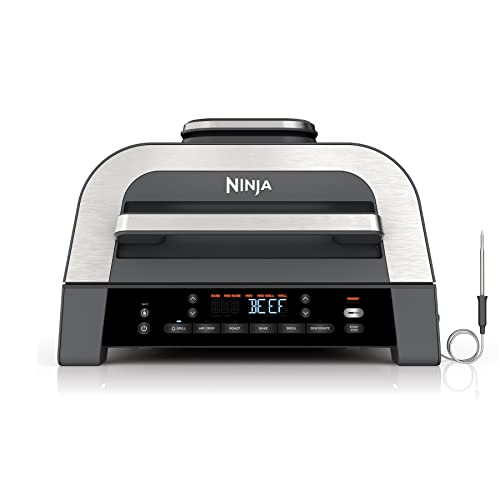
Ninja Foodi Smart XL 6-in-1 Indoor Grill & Air Fryer DG551 — Best Fully Enclosed Splatter Control
The DG551 approaches spatter the way an oven does: it simply never lets the cooking happen in the open. Food sits on the grate inside a closed, fan-managed chamber, so droplets hit interior walls that are designed to be washed. If your priority is the cleanest possible counter after a serious grilling session — thick, fatty, high-heat cooking included — this is the strongest answer here.
Strengths
- Fully enclosed chamber gives the best spatter containment in this guide
- Thermometer system cooks thick cuts precisely at high heat
- Air-fry function adds a second, also-enclosed cooking method
Trade-offs
- Premium tier and the largest footprint in this list
- Interior parts need washing after fatty cooks — the mess moves inside, by design
- Fan noise during high-heat grilling
| Type | Enclosed countertop grill and air fryer |
| Functions | 6-in-1 (per Amazon title) |
| Thermometer | Foodi Smart Thermometer (per Amazon title) |
Every other pick in this guide reduces spatter; the Ninja relocates the entire event behind a lid and a gasket. That is why it can sear harder than the water-tray models without punishing the kitchen — the heat that would carry droplets across your counter is contained and filtered by the cooking chamber itself. The thermometer system then justifies the price on the food side, landing thick steaks and chicken at chosen doneness. The cost is literal and figurative: premium tier, big footprint, and a set of interior parts to wash. For committed grillers in nice kitchens, it remains the most complete solution to the don’t-spatter brief.
Enclosure changes the cleaning equation in a way worth understanding before purchase. The spatter that other grills distribute across your counter, the Ninja collects on its interior walls, splatter shield, and grate — surfaces engineered to come out and go under the tap or into the dishwasher. The total mess is the same; its location and washability are what you are buying. Fatty cooks therefore end with a parts wash rather than a kitchen wipe-down, a trade most owners call gladly. Run the shield and grate through promptly after heavy cooks, keep the heating element area wiped as the manual directs, and the machine stays as tidy as the counter it protects.
Verdict in one line: total enclosure is total containment — the premium answer for people who grill hard and clean seriously.
Best for: frequent, high-heat indoor grilling where counter cleanliness is non-negotiable / Not suited for: tight budgets, tiny counters, or buyers wanting an open-grill experience
Check on Amazon — check price on Amazon before you decide, because countertop grill pricing and bundle contents shift often.
Comparison Table
| Pick | Badge | Key Spec | Best For |
|---|---|---|---|
| Chefman Smokeless Indoor Electric Grill, Extra Large | Best Overall Low-Spatter | Extra-large smokeless tabletop grill; adjustable temperature (per Amazon title) | families who grill indoors often and want the easiest post-dinner cleanup |
| Techwood Indoor Smokeless Grill with Turbo Smoke Extractor, 1500W | Best Smoke Extraction | Turbo smoke extractor; glass lid; dishwasher-safe drip tray (per Amazon title) | apartments, smoke-alarm peace, and tabletop Korean-BBQ-style cooking |
| Hamilton Beach Electric Indoor Grill with Hot and Cold Smoke Infuser | Best Hooded Grill | Vented hood and fan; 150–450°F; 116 sq. in. (per Amazon title) | small households wanting contained cooking plus optional smoke flavor |
| Techwood 1500W Smokeless Electric Grill with Glass Lid | Best Budget Lidded Pick | 1500W; tempered glass lid; 6-level control (per Amazon title) | singles, couples, and first-time indoor grillers on a budget |
| Gotham Steel Smokeless Indoor Grill with Ceramic Coating | Best Compact Water-Tray Design | Ceramic coating; removable grill/griddle plate (per Amazon title) | one-to-two-person households wanting the simplest smokeless layout |
| Ninja Foodi Smart XL 6-in-1 Indoor Grill & Air Fryer DG551 | Best Fully Enclosed Splatter Control | Enclosed 6-in-1 grill; Foodi Smart Thermometer (per Amazon title) | frequent, high-heat indoor grilling where counter cleanliness is non-negotiable |
Read the table by badge first and key spec second: the badge states the job each pick does best, and the key spec is drawn only from details confirmed in the verified listing. Where two picks look close, the full reviews above separate them on the trade-offs that matter in daily use.
How to Choose a Countertop Grill That Doesn’t Spatter
Choose by containment mechanism first. Lids and hoods are the most foolproof barrier — if the design physically covers the food, spatter has to work hard to escape, which is why the lidded Techwood and hooded Hamilton Beach punch above their tier here. Water-tray smokeless grills do not block droplets so much as prevent them: fat that drips into cool water cannot smoke, spit, or aerosolize, making them excellent for fatty foods cooked gently. Extraction fans handle the airborne half of the problem — smoke and grease mist — and pair best with a lid. Enclosed smart grills combine a sealed chamber with managed airflow and win on total containment while costing the most. Then sanity-check the basics: a drip tray you can reach and wash, a surface size matched to your household, and heat control you can lower for fatty cuts, because turning the temperature down slightly is the cheapest spatter reducer of all.
Why Grills Spatter — and How to Cook With Less of It
Spatter happens when water inside food flashes to steam at a hot surface and ejects tiny droplets of fat with it. Fatty meat, wet marinades, and crowded, steaming loads spatter most; dry surfaces, moderate fat, and space between pieces spatter least. You can cut spatter on any grill in this guide with technique: pat proteins dry before they go on, shake off excess marinade, bring food closer to room temperature so it spends less time steaming, and avoid pressing burgers hard, which squeezes out fat and juice directly onto the hottest surface. Choose the middle-high heat setting rather than maximum for fatty cuts — the crust difference is small and the spatter difference is large. Finally, keep the drip path clear: a full or blocked drip tray lets fat pool near the heat, which is when an otherwise tidy grill suddenly starts misbehaving.
Lids, Water Trays, and Fans Compared: Which System Fits Your Kitchen?
A lid is a wall: simple, silent, and effective, but it traps steam that can soften crusts if you cook entirely covered — many cooks sear briefly uncovered, then finish lidded. A water tray is a trap for drips: silent and effective against smoke, but it does nothing about droplets thrown upward from the food surface itself, and it asks you to fill and empty it. A fan is a vacuum for the air: excellent for smoke and lingering smells, less relevant to droplets that land within inches of the grill, and it adds noise plus a filter area to clean. Enclosed chambers stack all three ideas behind one door and win overall, at premium cost and size. Small, ventilated kitchens usually do best with a lid or an enclosed grill; open-plan spaces where smells travel favor the fan model; and anyone whose main enemy is the greasy film on nearby surfaces should prioritize the water-tray and enclosed designs.
Setting Up Your Kitchen for Low-Spatter Grilling
The grill does half the work; the station does the rest. Position any indoor grill under or near your ventilation — a range hood on, or a window with a small fan exhausting outward — because even the best-contained grill releases steam and scent when the lid opens. Keep a clear landing zone beside the grill: spatter often happens not during cooking but during transfers, when a dripping spatula crosses open counter. Lay a washable mat or a sheet of foil under the front edge of open-format grills to catch the occasional escape, and keep a lidded container ready for cooked food so it rests under cover rather than weeping across a board. Store a dedicated pair of long tongs at the station — reach keeps sleeves out of the spatter zone — and a folded heat-safe cloth for the warm wipe-down that ends every session. Arranged once, this station makes low-spatter grilling the default rather than a special effort, which is the only kind of routine that survives busy weeknights.
Low-Spatter Cooking Beyond Burgers: Fish, Vegetables, and Marinades
The don’t-spatter brief extends past red meat, and the techniques travel well. Fish is the pleasant surprise of lidded and enclosed grills: the cover contains its delicate spatter entirely, and gentle, even heat cooks fillets without the pan-sticking drama of the stove. Skin-on fillets go down skin-side first and release when the crust is ready — patience, not oil quantity, is the anti-stick and anti-spatter strategy. Vegetables spatter least when they go on dry and oiled lightly; wet marinades are the main offender across all foods, because surface liquid flashes to steam and carries fat with it. Shake marinade off thoroughly, pat the surface, and apply sauces and glazes in the final minutes, when they will set on the food instead of boiling on the plate. Cheese, added at the end under a lid, melts from residual heat with the cover containing its gentle bubbling. Cooked this way, a full mixed dinner leaves less trace on the kitchen than a single pan of stove-top bacon — which is the honest benchmark this category should be judged against.
Measuring ‘Smokeless’ Honestly: A Buyer’s Field Test
Marketing in this category uses ‘smokeless’ the way weather forecasts use ‘sunny intervals’ — directionally true, locally optimistic. A more useful standard is the three-part field test any buyer can apply in the first week. First, the counter test: after a round of fatty burgers, does the surrounding counter need a wipe or a scrub? Lidded, tray-based, and enclosed designs in this guide pass with a wipe. Second, the air test: does the kitchen smell of dinner at bedtime, and did any alarm object during the cook? Fan extraction and enclosure lead here. Third, the laundry test — the one nobody mentions: does the cook’s shirt smell like the grill afterward? That is airborne grease made personal, and it is the truest measure of containment. No model passes all three perfectly on the fattiest possible load; the picks in this guide pass them creditably on realistic loads, which is the standard that matters. Judge your own grill by these tests during its return window, with your fattiest regular meal, and you will know — rather than hope — that you bought the right level of containment.
Before You Buy: Matching Containment to Your Real Cooking
Close the decision by auditing your own habits rather than the marketing. List the three fattiest things you grill regularly — for most households that is burgers, sausages, and marinated chicken — and picture each one on your finalist: does the design give its fat a contained path from plate to tray? If your cooking leans lean — fish, vegetables, chicken breast — nearly every pick here is more containment than you need, and the simpler lidded models will serve you perfectly. If your cooking leans rich and frequent, weight the enclosed and fan-assisted designs accordingly, because containment fatigue is real: a grill that leaves a film after every use quietly trains its owner to use it less. Check the tray logistics in the listing photos — a water tray or drip tray you can lift steadily with two hands is a safety feature, not a detail. Confirm the lid or hood clears your tallest regular food, and that the unit’s footprint leaves the landing zone this guide recommends beside it. And keep the field test in reserve: buy from a listing with a workable return policy, cook your fattiest regular meal in the first week, and judge the counters, the air, and your shirt. A grill that passes your own test has earned its counter space in the only court that matters.
What About Grill Pans and Stovetop Grilling? An Honest Comparison
Every low-spatter shopper eventually asks whether a grill pan on the stove solves the problem cheaper. It does not, and the reason is geometry: a grill pan is an open, lidless, fanless surface sitting on a burner, which means every droplet and wisp it produces is delivered directly to the stove, the surrounding counters, and the room — the exact outcome this search exists to avoid. Stovetop pans also heat unevenly across their ridges and offer no drip management beyond the pan’s own shallow channels. The dedicated machines in this guide exist because containment is a system — lid, tray, fan, or chamber — and a pan has none of the components. Where a grill pan does win is price and storage: it costs little and hangs on a hook. If spatter were a minor preference, that trade might suffice. For readers who type this query, spatter is the headline requirement, and the honest recommendation is to buy the system, not the pan — starting with the lidded budget pick if cost is the obstacle, because even the simplest lid outperforms the best open pan at the one job this page is about.
How to Grill Indoors With Minimal Spatter: A Step-by-Step Routine
Start before the grill is hot. If your model uses a water tray, fill it to the marked line; if it has a lid or hood, plan to use it for the fattiest part of the cook. Preheat the grill fully, then prepare the food: pat every surface dry, season, and brush a thin coat of oil onto the food itself rather than the plate. Load the grill in a single layer with space between pieces — crowding is a spatter multiplier because trapped steam erupts through fat. Close the lid or hood for thick and fatty items, opening it only to turn the food once, decisively, with tongs rather than a fork that pierces and sprays. Keep the heat one notch below maximum for burgers, sausages, and marinated cuts. When cooking ends, let the grill cool with the lid closed so residual droplets settle inside, then empty the drip tray or water tray into a container — never pour hot fat into the sink drain — and wash the removable parts while they are still warm. Wipe the counter zone immediately; a two-minute reset now prevents the baked-on film that makes people abandon indoor grilling.
Common Buying Mistakes
- Believing any grill is truly spatter-free and skipping basic technique like drying food first
- Buying an open, lidless grill for a low-spatter brief because it was cheaper
- Forgetting to fill the water tray, then judging the smokeless design as a failure
- Cooking everything at maximum heat, which maximizes both spatter and smoke
- Pressing burgers flat and squeezing fat directly onto the hot plate
- Pouring hot drip-tray fat into the sink, where it solidifies and causes plumbing problems
A quieter mistake is ignoring your ventilation while shopping. A fan-extraction or enclosed grill can compensate for a weak range hood, but if your kitchen already vents well, a simpler lidded or water-tray model may serve you just as happily for less money. Match the machine to the room as well as to the food.
Final Recommendation
If you want one recommendation, take the Chefman Smokeless XL: its water-tray layout quietly solves the everyday spatter problem for family-size cooking. Choose the Techwood Turbo model if smoke drifting through the home is your bigger enemy, the Hamilton Beach hooded grill if you want containment plus smoke flavor, the budget Techwood if you are starting out, the Gotham Steel if your kitchen is small, and the Ninja DG551 if you grill hard and often and want the cooking fully enclosed. In every case, check price on Amazon before ordering and confirm the lid, tray, or fan features match the listing. Related guides in this cluster: Best Countertop Grills, Best Countertop Grills For Making Grill Cheese Or Cheese Burgers, Best Cuisinart Electric Grills Skillets, and Best Custom Grills if your search widens to outdoor cooking.
- Chefman Smokeless Indoor Electric Grill, Extra Large (Best Overall Low-Spatter) — Check on Amazon
- Techwood Indoor Smokeless Grill with Turbo Smoke Extractor, 1500W (Best Smoke Extraction) — Check on Amazon
- Hamilton Beach Electric Indoor Grill with Hot and Cold Smoke Infuser (Best Hooded Grill) — Check on Amazon
- Techwood 1500W Smokeless Electric Grill with Glass Lid (Best Budget Lidded Pick) — Check on Amazon
- Gotham Steel Smokeless Indoor Grill with Ceramic Coating (Best Compact Water-Tray Design) — Check on Amazon
- Ninja Foodi Smart XL 6-in-1 Indoor Grill & Air Fryer DG551 (Best Fully Enclosed Splatter Control) — Check on Amazon
Frequently Asked Questions
Is there really a countertop grill that doesn’t spatter at all?
No — any hot surface meeting moist, fatty food will throw some droplets. The grills in this guide minimize escaping spatter with lids, hoods, water trays, extraction fans, or enclosed chambers, and good technique closes most of the remaining gap.
How does a water tray stop smoke and spatter?
Fat dripping off the food lands in cool water and solidifies or cools instantly instead of vaporizing on a hot surface. That removes the main source of indoor grill smoke and stops hot fat from spitting back upward.
Should I choose a lid or a fan for a small apartment?
A lid contains droplets; a fan removes smoke and smell from the air. Small apartments usually suffer from both, which is why the fan-equipped lidded model and the enclosed Ninja score so well here. If you must pick one, pick the lid — spatter on surfaces is harder to undo than scent in the air.
Does lower heat really reduce spatter?
Yes. Maximum heat vaporizes surface moisture violently. Cooking fatty foods one notch lower still browns them well while noticeably reducing both spitting and smoke, especially combined with dry food surfaces.
Can I use these grills for fatty burgers and sausages?
They are designed for exactly that load — it is the test case for every containment system in this guide. Fill the tray, use the lid, avoid pressing the meat, and verify doneness with a thermometer.
How do I clean up fat safely after grilling?
Let the tray cool until the fat is safe to handle, pour or scrape it into a sealable container for the trash, and wash the tray in hot soapy water or the dishwasher if the model allows. Never pour liquid fat into the sink drain.


