Where to buy
Check the latest price, availability and delivery on Amazon. Orders are placed on Amazon. We may earn a commission from qualifying purchases.
- Best overall: Sleep On Latex Pure Green Natural Latex Mattress Topper, Soft, 2 Inch, Queen — Check on Amazon
- Sleep Innovations Dual Layer 4 Inch Gel Memory Foam Mattress Topper, Queen — Check on Amazon
- BedStory 3 Inch Copper and Gel Fusion Mattress Topper, Queen — Check on Amazon
- Linenspa 3 Inch Gel Swirl Memory Foam Mattress Topper, Queen — Check on Amazon
See 2 more Amazon options
- Best Price Mattress 3 Inch Ventilated Gel Memory Foam Mattress Topper, Queen — Check on Amazon
- Amazon Basics 2 Inch Cooling Gel-Infused Memory Foam Mattress Topper, Queen — Check on Amazon
Read the full guide ↓
Disclosure: As an Amazon Associate, airfryerkitchensupply.com earns from qualifying purchases. Links to Amazon on this page are affiliate links; they cost you nothing extra. Listing details such as price and availability change often, so check the current Amazon listing before you buy.
Side sleepers shop for a mattress topper with two problems at once, and the two problems pull in opposite directions. The first is pressure: lying on your side concentrates your weight on a shoulder and a hip, so you need a surface soft and deep enough to let those two points sink in while your waist stays supported. The second is heat: the deeper a topper lets you sink, the more foam wraps around your body — and wrapped foam is warm foam. Every “cooling” topper in this guide is therefore a negotiation between contouring and temperature, and this guide scores the six picks on both, in that order. A topper that sleeps cool but leaves your shoulder grinding into the mattress underneath has failed at the main job.
One honesty note before the picks, because this category needs it more than most: “cooling” on a topper box is a comfort claim, not a measurement. Gel beads, copper particles and phase-change fibers are maker technologies with maker numbers attached, and each review below prints those claims as claims, with their limits. No passive topper refrigerates a bed, and none of these products treats shoulder pain, hip pain, night sweats, hot flashes or any medical condition. A topper can make a bed’s surface more comfortable; if you wake with persistent pain, numbness or tingling in an arm or shoulder, that is a conversation for a clinician, not a checkout page. Every pick in this guide is judged in the queen size, because topper sizing climbs by size and a twin judged in a queen guide helps nobody — check the current price on Amazon for the exact size and thickness you need.
For most side sleepers we would begin with the Sleep On Latex Pure Green in soft: it is the only pick whose cooling does not depend on an additive, and its soft firmness cushions a shoulder without the slow, trapped sink of memory foam. If you are a heavier side sleeper, or your shoulder needs genuinely deep contouring, the Sleep Innovations dual layer and the Linenspa Gel Swirl will likely suit you better — both are judged honestly below, including where each one gives up on cooling to win on pressure relief. Below you will find detailed notes on each pick, a comparison table and a buying checklist for side sleepers.
A note on pricing before you start: topper pricing on Amazon is slippery in a specific way — one listing often covers four thicknesses and six sizes, and the headline price belongs to the smallest, thinnest variant. Always check the current price on Amazon for the queen size of the named thickness, with the size and thickness selectors set correctly. If a pick is showing above $200 for the queen on the day you shop, treat that as the market talking and move to the next row of the table.
In this guide
Quick Picks
Short on time, or comparing several options at once? Each row below names a side-sleeper type and the product that suits it, with a link to the listing. All picks are queen size — check the current price on Amazon.
| Buyer type | Pick | Why it stands out | Link |
|---|---|---|---|
| Best overall for side sleepers | Sleep On Latex Pure Green Natural Latex Topper, Soft, 2 Inch, Queen | Real latex airflow plus a soft, buoyant cushion — cooling that never saturates | Check on Amazon |
| Best deep contouring | Sleep Innovations Dual Layer 4 Inch Gel Memory Foam Topper, Queen | 2 inches of gel foam under a 2 inch quilted pillow-top — the deepest shoulder sink here | Check on Amazon |
| Best plush pressure relief | Linenspa 3 Inch Gel Swirl Memory Foam Topper, Queen | The softest sink in this guide, positioned at the lower end of this budget in queen | Check on Amazon |
| Best value | Best Price Mattress 3 Inch Ventilated Gel Topper, Queen | Ventilation holes plus gel, positioned at the lower end of this budget | Check on Amazon |
| Best thin topper | Amazon Basics 2 Inch Cooling Gel-Infused Topper, Queen | A light touch of cooling foam that barely changes the bed’s height | Check on Amazon |
| Only for firm-bed seekers | BedStory 3 Inch Copper and Gel Fusion Topper, Queen | Extra firm support foam — the wrong direction for most side sleepers, judged honestly below | Check on Amazon |
How These Picks Were Chosen
The first filter was the budget itself, applied to the queen size. Every product below is a real Amazon listing whose queen size sits at or under $200 in the United States — check the current price on Amazon to confirm it still sits within the budget when you shop. Anything whose queen size lives permanently above the line was left out of the picks, however good it might be: the ViscoSoft Serene Hybrid and Active Cooling lines sit above this budget for a queen on Amazon, the Tempur-Pedic cooling topper is a premium-tier product well above this budget, and the Turmerry latex topper starts above this budget in queen. Several of those are named, unlinked, in the ceiling section below, because knowing what you are not buying is part of choosing well.
The second filter was the side-sleeper test, and it re-ordered how every pick is judged. A side sleeper’s shoulder and hip carry far more weight per square inch than a back sleeper’s spread-out frame, so a topper for this guide had to do one of two things: contour deeply enough to spread that load (the memory foam picks), or cushion responsively enough that the shoulder is never grinding on the mattress core below (the latex pick). Firmness labels were read against body weight, not taken at face value: a “soft” that suits a 130-pound sleeper can bottom out completely under a 230-pound one, and the reviews say which end of the scale each pick serves. One pick — the BedStory — fails the side-sleeper test for most people and is included deliberately, with that verdict printed in its review, because its firmness is exactly what a minority of heavier side sleepers and firm-bed seekers are shopping for, and because a guide that hides the wrong pick teaches less than one that labels it.
We did not sleep on these toppers ourselves. We read the maker listings and specification pages, compared materials, thicknesses, densities and cover constructions, and cross-checked them against retailer listings and expert coverage. Cooling language is treated as maker language throughout: when a listing says its gel “captures and distributes heat,” that is the maker’s description of its own product, and this guide prints it as such. Where independent reviewers who did test a topper reported weaker cooling than the box promised, the review says that too — it happens more than once below.
One thing we weighed heavily was the cooling mechanism itself, because the mechanisms are not equal — and for side sleepers the ranking has a twist. Latex cools by structure: an open, springy cell network that air can move through all night. Gel and copper infusions cool by conduction: they pull heat out of the foam’s surface faster than plain foam would, which helps most in the first hours and fades as the foam reaches your temperature. The twist is that side sleepers sink deeper into foam than anyone, so more of their body is in contact with the slab — conduction cooling has more surface to work on, and more body heat to absorb. Ventilation holes help air move but cannot make foam into latex. The ranking in this guide follows pressure relief first and that physics second, which is why the deep-contouring memory foams are recommended by name for the sleepers they suit, even though the latex pick takes the top spot for the average build.
Listings were checked the slow way: on the maker’s own Amazon listing or storefront where one could be read, and otherwise across independent retailer and expert coverage. A product whose listing could not be verified did not get a link, and where the evidence is thinner than we would like, the sources note for this guide says so openly. One popular product failed this test outright: the Lucid 3-inch gel topper is a fine budget buy in queen, but its size-specific ASINs could not be tied to the queen listing with confidence, so it is named here without a link rather than linked on a guess.
The 6 Best Cooling Mattress Toppers for Side Sleepers Under $200
Sleep On Latex Pure Green Natural Latex Mattress Topper, Soft, 2 Inch, Queen
Who it suits: Light-to-average-build side sleepers who sleep hot and hate the slow, stuck feeling of memory foam — and anyone who wants the cooling to come from the material itself rather than an additive stirred into foam.
This is the plainest product in the guide and the most effective cooler in it: a single 2-inch slab of natural Dunlop latex, in the soft firmness (the maker rates its soft at about 20 ILD), measuring a true 80 by 60 inches in queen and weighing about 24 pounds. The latex is GOLS certified organic and fairly traded, made by Sleep On Latex from Sri Lankan rubber, and there is no gel, no copper and no phase-change anything in it — because latex does not need them. Its open-cell structure is full of interconnected air pockets, so warmth dissipates through the slab instead of collecting at the surface. Check the current price on Amazon — this pick sits inside this budget with room to spare for a product category where latex usually sits at the premium end.
Judged through the side-sleeper lens, the honest word for this pick is buoyancy. Latex pushes back: you lie on it more than in it, and your shoulder is cushioned by a springy surface rather than cradled by a deep mould. For a lighter or average side sleeper that is often the better bargain — the shoulder gets real cushioning, the waist keeps its support so the spine stays straighter, turning over takes no effort, and less of your body is wrapped in material holding heat. The same listing sells medium and firm versions if soft reads too soft. What you are paying for, versus a basic gel slab, is physics and lifespan: independent topper coverage consistently ranks natural latex as the coolest passive topper material, and latex’s durability is measured in many years rather than the two to four a budget memory foam slab typically gives before it softens and stays compressed. Note what this pick includes and what it does not: this ASIN is the bare topper without the maker’s luxury cover, and the covered versions cost more — a breathable cotton protector or your own fitted sheet is the practical finish, and the sources note flags the cover question for the publisher.
- Genuine natural latex: airflow cooling that does not saturate overnight.
- Soft firmness cushions the shoulder without the trapped, sinking feel of foam.
- GOLS certified organic, fairly traded latex; true 80 by 60 inch queen cut.
Honest limitation: Two inches of buoyant latex is a cushion, not a cradle: heavier side sleepers, and anyone whose shoulder needs deep sink to get comfortable, can bottom out through it onto the mattress below — those sleepers should start with the Sleep Innovations or Linenspa picks instead. Latex also has a faint natural rubber smell for the first days, it is a 24-pound slab that is awkward to move, and this listing is the uncovered version.
Choose it if you sleep hot, turn over often, and your build is light to average. Skip it if you are a heavier side sleeper, or you want the slow, sinking hug of memory foam around your shoulder.

Sleep Innovations Dual Layer 4 Inch Gel Memory Foam Mattress Topper, Queen
Who it suits: Side sleepers whose shoulder and hip pressure is the main problem — including heavier side sleepers — and who want the deepest contouring this budget offers in a construction that still makes a genuine effort at cooling.
Sleep Innovations builds this topper in two layers with two different jobs: 2 inches of cooling gel memory foam below, and a separate 2-inch quilted pillow-top cover filled with fluffy fiber on top. For a side sleeper, that stack is the deepest cradle in this guide: four inches of combined give means a shoulder can sink properly instead of perching on a slab, and the pressure spreads across the ribcage and hip instead of concentrating on two points. Reviewers who tested it for TechRadar found the pressure relief genuinely good. Check the current price on Amazon; it is made in the USA with a 10-year warranty — the longest warranty in this guide by years.
The layering is also the cooling story. The fiber-filled cover puts a breathable, airy layer between you and the foam — the surface your skin touches is quilted fill, not foam — while the gel infusion below spreads heat through the slab. TechRadar’s testers noted they did not feel a dramatic cooling effect from the gel itself; the cover is what most owners credit for the fresher surface feel. For a side sleeper that trade is usually worth making: contouring first, and the coolest surface construction available on a deep memory foam build second. The pillow-top cover is also removable and washable, and it holds the foam in place instead of letting it creep. Four inches is a serious change, though: it will soften a firm mattress substantially, deep-pocket sheets become necessary, and stomach sleepers in the same bed may find the sink too deep.
- Deepest contouring here: 2 inches of gel foam under a 2 inch quilted pillow-top.
- Removable, washable cover — the only fully washable surface in this guide.
- Made in the USA with a 10-year warranty — check the current price on Amazon.
Honest limitation: Independent testing found the gel’s cooling subtle rather than dramatic — the cover does most of the perceived cooling — and 4 inches of build demands deep-pocket sheets and will overwhelm an already-soft mattress.
Choose it if shoulder and hip pressure relief is the priority and your mattress is firm enough to take 4 inches of softening. Skip it if you sleep very hot above all else, or your mattress is already soft.
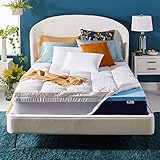
Linenspa 3 Inch Gel Swirl Memory Foam Mattress Topper, Queen
Who it suits: Side sleepers who want the plushest, softest sink in this guide for the least money — and who accept that plushness and maximum cooling pull in opposite directions.
Linenspa is one of the best-selling topper brands on Amazon, and the Gel Swirl is its signature construction: 3 inches of memory foam with cooling gel swirled visibly through it, so the gel is distributed in ribbons rather than mixed invisibly. The feel is the softest here — reviewers who tested it describe a genuinely plush, yielding surface that takes shoulders and hips in deep, which is exactly what a side sleeper on a hard mattress is shopping for. Three inches is the useful middle thickness for this sleep style: enough depth for a shoulder to sink without bottoming out for most builds, without the bed-rebuilding height of the 4-inch pick. Check the current price on Amazon; the foam is CertiPUR-US certified with a 3-year warranty. It is among the most affordable routes in this guide to a thick, soft, gel-bearing slab from a brand with a long track record, positioned at the lower end of this budget.
The trade-off must be printed plainly, because it decides whether this pick works for you: the deeper foam wraps you, the more surface area it has to hold heat with, and a plush 3-inch gel slab is the cooling compromise of this guide. The gel swirl moderates the foam’s warmth — owners and reviewers agree it sleeps cooler than the same foam without gel, while also judging the gel’s contribution more marketing than mechanism — but a very hot sleeper will still do better with the latex pick. Reviewers have also noted the foam softens further over a year or two of use; for a side sleeper that softening arrives first exactly where the shoulder lands, so treat this as a topper with a prime of roughly 18 to 24 months rather than a five-year buy. There is also no cover: the slab goes straight under your fitted sheet, which needs the depth for mattress plus 3 inches. Buy it as the pressure-relief pick with a cooling assist, not as the cooling pick, and it will not disappoint you.
- Plushest feel in this guide — deep pressure relief for shoulders and hips.
- Gel swirled through the full slab; CertiPUR-US certified foam.
- Positioned at the lower end of this budget in queen — check the current price on Amazon.
Honest limitation: Plush foam wraps the body and holds heat better than it sheds it — the gel moderates rather than solves warmth — the foam softens noticeably after roughly 18 to 24 months, and there is no cover included.
Choose it if pressure relief on a budget is the main job and moderate cooling is enough. Skip it if you sleep very hot, or you want a topper that keeps its exact feel for many years.

Best Price Mattress 3 Inch Ventilated Gel Memory Foam Mattress Topper, Queen
Who it suits: Value hunters, guest-room and dorm buyers, and side sleepers who want to test whether a contouring cooling topper helps before spending three figures on one.
Best Price Mattress takes the simplest possible approach to the cooling problem and positions it at the lower end of this budget for a queen: 3 inches of gel-infused memory foam with ventilation holes punched through the slab, so air has channels to move through instead of only foam to soak into. The two mechanisms are modest and both are real — gel to spread surface heat, perforations to let the slab breathe a little — and the foam is CertiPUR-US certified with a 3-year warranty per the maker’s listings. For a side sleeper, the 3-inch thickness is the point: it is deep enough for a shoulder and hip to sink into at a price point well below the deeper, plusher picks, and coverage of this topper consistently lands in the same place — it is the budget benchmark, the one reviewers name when the brief is “cooling topper, queen, as cheap as honestly possible.” Its lower-tier positioning also leaves room in the budget for the deep-pocket sheets a 3-inch topper requires.
What this lower price point does not buy is density and longevity. Budget foam is lighter foam, and lighter foam compresses sooner: expect this topper to feel its best in the first year or two, and to flatten gradually in exactly the hip and shoulder zones a side sleeper loads every night — the zones where you can least afford to lose depth. Heavier side sleepers will feel that flattening sooner. It also arrives as a bare slab with no cover and no straps, so it can creep on a smooth mattress — a fitted sheet with real depth, or a mattress protector over the top, is the standard fix. None of that disqualifies it. For a guest bed, a dorm, a first apartment or a trial run, a certified, ventilated gel slab at the lower end of this budget is the rational buy, and thousands of buyers have made exactly that calculation.
- Ventilation holes plus gel infusion — two honest cooling mechanisms.
- CertiPUR-US certified with a 3-year warranty, positioned at the lower end of this budget in queen.
- Three full inches of contouring depth — the same build as toppers positioned higher in the range.
Honest limitation: Lower-density budget foam softens and flattens sooner than the premium picks — first in the shoulder and hip zones — and there is no cover or anchoring, so it can migrate under the sheet.
Choose it if you want the side-sleeper cooling-topper experiment at the lowest honest price point in this guide. Skip it if this is a nightly bed for a heavier sleeper who needs a topper to last five years.

Amazon Basics 2 Inch Cooling Gel-Infused Memory Foam Mattress Topper, Queen
Who it suits: Side sleepers who mostly like their mattress already and want only a light cooling layer and a slight softening on top — the smallest change in this guide.
Amazon’s own label closes the list with the thinnest pick: 2 inches of gel-infused memory foam, CertiPUR-US certified, ventilated, and positioned at the bottom of the category in queen — check the current price on Amazon. Two inches is a deliberate choice rather than a compromise. It takes the hard edge off a firm mattress and puts a gel-bearing surface between you and a heat-holding mattress core, without changing the bed’s height enough to fight your existing sheets or turning a supportive mattress into a hammock. For a lighter side sleeper on a decent-but-warm bed, or a combination sleeper who rolls between side and back, that light touch is frequently the correct amount of topper: a little shoulder cushion, a little surface cooling, and a spine that stays where the mattress put it.
Its limitations are printed in its dimensions and depth. Amazon cuts this topper at 78 by 58 inches for a queen — an inch or two short on every side versus a true 80 by 60 queen — which some owners notice as a border of bare mattress. More importantly, 2 inches is the shallowest cradle here: an average or heavier side sleeper’s shoulder will push through most of it and land on the mattress beneath, so if pressure relief is your main reason for shopping, the 3-inch options above are the honest route. The foam is also a basic slab: no cover, no straps, and cooling that amounts to “less warm than plain foam,” as Consumer Reports’ testing of this line reflects. What it offers instead is certainty: a certified foam from a seller that is not going anywhere. If your problem is mild — a bed that runs a little warm and a little firm — a mild, lower-tier pick is the right answer.
- Only 2 inches — refreshes the surface without rebuilding the bed.
- CertiPUR-US certified, ventilated gel foam; tested by Consumer Reports.
- Positioned at the lower end of the category in queen — check the current price on Amazon.
Honest limitation: Cut small at 78 by 58 inches against a true 80 by 60 queen, the shallowest shoulder cradle in this guide, and its cooling is the mildest here — a reduction in warmth, not a transformation.
Choose it if your mattress needs a nudge, not a rescue. Skip it if shoulder or hip pressure is your main problem, or you need full edge-to-edge coverage.

BedStory 3 Inch Copper and Gel Fusion Mattress Topper, Queen
Who it suits: A narrow minority: heavier side sleepers who bottom out through soft toppers, and firm-bed seekers whose mattress is too soft as well as too warm. For most side sleepers, this is the wrong pick in this guide — and this review will say exactly why it is still here.
BedStory’s 3-inch queen is an extra firm memory foam topper whose foam is infused with four things at once: cooling gel, copper, bamboo charcoal and green tea extract — the maker’s “fusion” recipe — inside a knitted cover the listing rates at 500 GSM, with a non-slip base and CertiPUR-US certified foam. Copper is the infusion with a real physical story: it is an excellent thermal conductor, so copper particles in foam do move heat away from the contact surface faster than foam alone, which is the same reason copper appears in premium cooling lines in a higher tier. Check the current price on Amazon — this topper sits comfortably inside this budget in queen.
Now the side-sleeper verdict, printed plainly: firmness is the opposite of what a side sleeper’s shoulder needs. On an extra firm surface the shoulder cannot sink, so it takes the body’s weight on a small area while the waist sags or the spine bends upward — the exact pressure pattern the other five picks exist to relieve. If you are an average or lighter side sleeper, buy literally any other row of the table. The exceptions are real, though: a heavier side sleeper (roughly 230 pounds and up) compresses foam so much more that a firm 3-inch slab can contour adequately for them where a plush one bottoms out, and a sleeper whose bed is genuinely too soft may need firming before any cushioning makes sense. Two further honesty notes this listing particularly needs. BedStory’s own copy claims its copper infusion “can improve blood circulation” and relieve fatigue. A foam layer cannot do that, there is no evidence offered for it, and this guide does not repeat it as fact: buy this topper for conductive cooling and firm support, which are plausible and testable, not for circulation benefits, which are marketing. And the brand sells a thicket of near-identical 3-inch toppers under similar titles, so check that the listing you land on is the 3-inch queen copper and gel fusion model with the 500 GSM knitted cover before ordering, because its siblings differ in firmness and cover.
- Copper plus gel infusion — conduction cooling in a firm support foam.
- The only pick that firms a too-soft bed up instead of softening it further.
- 500 GSM knitted cover, non-slip base, CertiPUR-US certified foam.
Honest limitation: Extra firm is the wrong direction for most side sleepers — the shoulder cannot sink, so pressure concentrates instead of spreading — and the maker’s circulation and fatigue claims are unsupported marketing that should be ignored.
Choose it if you are a heavier side sleeper who bottoms out through plush toppers, or your mattress is too soft and too warm at once. Skip it if you are a light or average side sleeper with shoulder pressure — every other pick in this guide will serve you better.

Comparison Table
| Product | Material (as maker states) | Best use | Link |
|---|---|---|---|
| Sleep On Latex Pure Green Topper, Soft, 2 Inch, Queen | Natural Dunlop latex, GOLS organic | Coolest all-night sleep with a buoyant cushion — check price on Amazon | Check on Amazon |
| Sleep Innovations Dual Layer Topper, 4 Inch, Queen | Gel memory foam + quilted fiber pillow-top | Deepest shoulder contouring, washable cover — check price on Amazon | Check on Amazon |
| Linenspa Gel Swirl Topper, 3 Inch, Queen | Gel-swirled memory foam | Plushest pressure relief, at the lower end of this budget — check price on Amazon | Check on Amazon |
| Best Price Mattress Ventilated Gel Topper, 3 Inch, Queen | Gel memory foam, ventilated | Value contouring and cooling, at the lower end of this budget — check price on Amazon | Check on Amazon |
| Amazon Basics Cooling Gel Topper, 2 Inch, Queen | Gel-infused memory foam | Light-touch refresh, at the lower end of this budget — check price on Amazon | Check on Amazon |
| BedStory Copper and Gel Fusion Topper, 3 Inch, Queen | Firm memory foam, gel/copper/charcoal/green tea | Firming plus cooling for heavier sleepers, within this budget — check price on Amazon | Check on Amazon |
How to Choose a Cooling Mattress Topper for Side Sleepers Under $200
- Put pressure relief first, cooling second. A cool bed your shoulder hates is a failed purchase. Rank contouring depth and softness for your build first; then choose the coolest construction among the picks that pass that test.
- Match softness to your weight, not the label. Under roughly 130 pounds, even “medium” foams can feel firm and the soft latex or plush Linenspa will contour best. Over roughly 230 pounds, plush 2–3 inch foams bottom out — look at the 4-inch Sleep Innovations, or the firm BedStory if you also need support.
- Pick thickness by job. Two inches refreshes a surface and suits lighter sleepers; 3 inches is the side-sleeper workhorse — enough depth for a shoulder to sink; 4 inches rebuilds the bed and is the choice for serious pressure relief on a firm mattress.
- Understand the sink-versus-heat trade. The deeper you sink, the more foam wraps you and the warmer the bed sleeps. If you run very hot, latex’s on-top buoyancy or a thinner topper will serve you better than the plushest slab, however good its gel story sounds.
- Choose the cooling mechanism before the brand. Latex cools by airflow all night; gel and copper cool by conduction and fade as they warm; ventilation helps foam breathe. The picks above are ordered by that physics, not by marketing volume.
- Check the queen price on Amazon, never the headline price. Topper listings lead with the twin or the 1.5-inch variant. Always set the size and thickness selectors to the queen in the named thickness and check the current price on Amazon before comparing.
- Check the actual dimensions. A queen topper should be 80 by 60 inches. Some budget toppers are cut 1 to 2 inches short on each side; the Amazon Basics review above flags its 78 by 58 cut so you can decide with eyes open.
- Budget for deep-pocket sheets. A 3 or 4 inch topper on a modern mattress defeats standard fitted sheets. If your sheets barely fit now, the sheet purchase is part of the topper purchase.
- Re-check your pillow after adding a topper. A thicker, softer surface lets your shoulder sink lower, which changes the gap your pillow has to fill. Side sleepers often need a slightly lower or softer pillow once a plush topper goes on — judge it after the first few nights, not the first.
- Treat Q-Max and degree-drop numbers as advertising. Coolness figures on listings measure a fraction of a second of first contact under lab conditions. They tell you a surface feels cool when you first lie down, not how the bed sleeps at 3 a.m.
- Ignore health claims entirely. Copper does not improve your circulation from inside a foam slab, and no topper treats shoulder pain, night sweats or hot flashes. Buy for heat movement and feel; take symptoms to a clinician.
The Side Sleeper’s Trade-Off: Contouring Holds Heat
Every topper decision a side sleeper makes runs through one physical conflict. Pressure relief comes from sink: the shoulder and hip descend into the material, the contact area grows, and the load spreads. Cooling, in foam, comes from the opposite condition — the less of you is wrapped in material, the less heat the material can hold against you. A back sleeper can choose a thin, breezy topper and lose nothing. A side sleeper who does the same wakes with a numb arm, because their shoulder never got the depth it needed. This is why this guide refuses to rank the six picks on cooling alone, and why the “coolest” pick and the “most recommended” pick are not automatically the same product for every build.
The mechanisms handle the trade differently. Latex cheats it, partially: its open-cell network moves air even while it is compressed, and its buoyancy means you sink less deeply for the same cushioning, so a soft latex slab gives a light-to-average side sleeper real shoulder relief while staying the coolest surface here. Memory foam cannot cheat it — the gel and copper infusions conduct heat away from the contact surface, which genuinely helps in the first part of the night, but once the slab has warmed to equilibrium there is nowhere left for the heat to go, and a deeply sunk side sleeper is in contact with more warm foam than anyone. The dual-layer Sleep Innovations answers with architecture instead of chemistry: the quilted fiber cover keeps an airy, breathable layer at the skin while the foam below does the contouring, which is why it is the deep-sink pick this guide can recommend to warm sleepers with the fewest reservations.
The practical translation: decide which problem wakes you up. If it is heat, weight your choice toward latex or thinner foam and accept adequate rather than maximal contouring. If it is a sore shoulder or a numb arm at 3 a.m., weight it toward depth — the Sleep Innovations or the Linenspa — and accept moderate rather than dramatic cooling, then fix the remaining heat with the room: a fan, lighter bedding, a breathable protector. Choose by your night’s pattern, not by the size of the word “cooling” on the box.
Firmness, Body Weight and Shoulder Room
“Soft,” “medium” and “firm” are not measurements — they are promises made to an average body that may not be yours. Foam responds to load, and a side sleeper loads a topper at two narrow points, so the same slab can contour beautifully for one person and feel like a plank or a hammock to another. As a working rule: below roughly 130 pounds, you do not compress foam very far, so choose the softest constructions (the soft latex, the Linenspa) or your shoulder will ride on top of the slab instead of in it. Between roughly 130 and 230 pounds, the mainstream picks all work as labelled, and the choice turns on feel — buoyant latex versus sinking foam. Above roughly 230 pounds, depth and density matter more than softness labels: thin plush foams bottom out, leaving your shoulder on the mattress core with a warm foam frame around it, so the 4-inch Sleep Innovations or a firmer, denser slab is the honest starting point.
Shoulder width matters alongside weight. A broad-shouldered sleeper needs more sink before the neck can rest level, which pushes toward 3 to 4 inches of contouring depth; a narrow-shouldered sleeper on the same slab can end up with the head tilted down toward the mattress. Your pillow is the other half of this equation: the deeper the topper lets your shoulder sink, the less loft the pillow needs to fill the gap between shoulder and head. Changing one without checking the other is the most common reason a good topper gets returned in the first week. Give a new topper three or four nights, adjust the pillow once, and only then judge the pairing.
One more fit point: a topper cannot repair a mattress whose support has failed. If your mattress has a permanent dip, a soft topper will drape into it. Toppers change surfaces, not support structures — if the bed itself sags, the honest purchase is a mattress.
What $200 Cannot Buy
Honesty about the ceiling matters as much as the picks. The one technology that truly regulates temperature all night — active cooling, where chilled water or air circulates through a pad — does not exist anywhere near this budget: Eight Sleep’s Pod cover and ChiliSleep’s Dock Pro start well above this budget for a queen and run far higher, and they are systems with pumps and reservoirs, not toppers. Below them sits a premium passive tier this guide could not include: Tempur-Pedic’s cooling topper sits well above this budget for a queen, Saatva’s graphite topper sits in that premium tier and is sold direct rather than on Amazon, the GhostBed topper sits above this budget, ViscoSoft’s Serene Hybrid and Active Cooling Copper lines sit above this budget on Amazon, and Talalay latex toppers generally sit above this budget in queen, where the Dunlop Pure Green in this guide sits within it.
What $200 does buy, this guide argues, is every passive mechanism that matters, in constructions a side sleeper can actually use: the coolest material class (natural latex) in a full queen slab, the deepest dual-layer contouring build with a washable cover and a 10-year warranty, and certified gel slabs at the lower end of this budget for buyers whose problem is milder. The gap above the $200 line buys thicker latex, phase-change covers, brand trials and provenance — real things, worth real money to some buyers — but it does not buy a different category of cooling. The category change is active cooling, and it costs far more than this budget.
Common Buying Mistakes
- Buying the coolest topper instead of the right one — a thin, breezy slab that leaves your shoulder grinding is a failed purchase however cool it sleeps.
- Choosing firmness by the label instead of by your weight, then concluding toppers “don’t work” when a soft slab bottoms out or a firm one never lets your shoulder in.
- Believing a gel topper will feel cold all night, then returning it at dawn — conduction cooling fades as the foam warms; only airflow and active systems keep working.
- Buying 4 inches of topper for a cooling problem, when the extra foam wrapped around the body holds more heat than the gel in it removes.
- Putting a softening topper on a sagging mattress and blaming the topper when the dip comes straight through — toppers change surfaces, not support structures.
- Forgetting the pillow: adding a deep, soft topper and keeping a tall, firm pillow, which cranks the neck sideways all night.
- Trusting Q-Max scores and “sleeps 5 degrees cooler” claims as all-night measurements; they describe first contact in a lab.
- Repeating a maker’s health claims — copper circulation, pain treatment, sweat treatment — as reasons to buy. They are marketing, and no passive topper treats a medical condition.
- Forgetting the sheets: ordering a 3-inch topper for a 14-inch mattress and discovering the fitted sheet pops off at 2 a.m.
- Ordering the wrong variant in a crowded listing — BedStory and its peers sell near-identical toppers under one roof, so check firmness, thickness and size on the final page.
Final Recommendation
- Most side sleepers: Sleep On Latex Pure Green Natural Latex Mattress Topper, Soft, 2 Inch, Queen.
- Deepest pressure relief: Sleep Innovations Dual Layer 4 Inch Gel Memory Foam Mattress Topper, Queen.
- Plush relief on a budget: Linenspa 3 Inch Gel Swirl Memory Foam Mattress Topper, Queen.
- Tightest budget: Best Price Mattress 3 Inch Ventilated Gel Memory Foam Mattress Topper, Queen.
- Lightest touch: Amazon Basics 2 Inch Cooling Gel-Infused Memory Foam Mattress Topper, Queen.
- Heavier sleepers needing firming: BedStory 3 Inch Copper and Gel Fusion Mattress Topper, Queen.
Our top two are the Pure Green latex for the light-to-average side sleeper whose problem is heat as much as pressure, and the Sleep Innovations dual layer for the sleeper — at any weight — whose shoulder and hip pressure is the thing that actually wakes them, because between them they cover the two honest routes this budget offers: change the material, or build the deepest, coolest-surfaced version of the material you already like. If money is the binding constraint, the Linenspa delivers most of the contouring at a lower price point in this range — check the current price on Amazon. None of these will refrigerate a bedroom, cure a hot mattress core or treat a medical condition, and they do not try to. They are the honest $200 layer: check the queen size and thickness are selected, check the current price on Amazon, and buy the mechanism that matches how your night actually goes wrong.
Frequently Asked Questions
What thickness of topper is best for side sleepers?
Three inches is the working default: deep enough for a shoulder and hip to sink without bottoming out for most builds, without rebuilding the whole bed. Two inches suits lighter side sleepers and anyone who only needs the surface refreshed — the latex pick works at 2 inches because latex cushions responsively rather than by depth. Four inches is the choice when pressure relief is the dominant problem and the mattress underneath is firm enough to support the extra softness.
Latex or memory foam — which is better for side sleepers?
It depends on your build and your heat problem. Memory foam contours more deeply, moulding around the shoulder, which is why the deepest picks in this guide are foam; latex cushions buoyantly, lets you turn over without climbing out of a mould, and sleeps cooler all night because air moves through it. Light-to-average side sleepers who run hot usually prefer latex; heavier side sleepers, and anyone whose shoulder pain point is a hard mattress surface, usually need foam’s depth. Neither is universally “better” — the trade-off section above is the honest map.
Will a cooling topper fix my shoulder or hip pain?
A topper can change how much pressure your shoulder and hip carry, and many side sleepers find a deeper, softer surface more comfortable. That is a comfort claim, not a treatment: no topper in this guide treats shoulder pain, hip pain or any other condition, and this guide makes no such claim for any pick. Pain that persists, worsens, or comes with numbness or tingling in the arm or hand deserves a clinician’s attention before another bedding purchase.
Can a cooling topper help with night sweats or hot flashes?
A topper can make the bed surface feel less hot, which many sleepers find more comfortable, but it does not treat night sweats, hot flashes or any other condition, and this guide makes no such claim for any pick. If night sweats are heavy, new or accompanied by other symptoms, see a clinician — that conversation matters more than any bedding purchase, and a topper bought afterward will work better for being chosen on comfort alone.
Why does my gel topper feel cool at bedtime but warm by morning?
Because conduction has a finish line. Gel and copper pull heat from the surface and spread it through the slab, which feels cool while the slab is cooler than you. Once the whole slab reaches equilibrium with your body, there is nowhere for new heat to go and the topper sleeps like ordinary foam. Side sleepers feel this sooner than most, because sinking deep puts more of the body in contact with the slab. This is normal physics, not a defective product — and it is the reason this guide ranks airflow materials above infusions for all-night cooling.
How firm should a topper be for a side sleeper?
Softer than the same sleeper would choose for back sleeping — the shoulder needs somewhere to go. As a starting map: light sleepers (under ~130 lb) want genuinely soft constructions; average builds want soft-to-medium with at least 3 inches of depth; heavier sleepers (over ~230 lb) often do better with a firm-but-deep slab that cannot bottom out, which is the one case where the firm BedStory in this guide makes sense for side sleeping. If you wake with a numb arm, the surface is effectively too firm or too thin for you, whatever the label said.
Do I need special sheets with a mattress topper?
Often, yes. Add the topper’s thickness to your mattress depth and compare with your fitted sheet’s pocket depth: a 12-inch mattress plus a 3-inch topper needs pockets of 16 inches or more. The 2-inch picks in this guide fit most modern deep-pocket sheets; the 4-inch Sleep Innovations almost always requires buying sheets rated for 18 inches or deeper.
How long will a cooling topper last?
Latex is the long-distance material here, with a working life commonly measured at many years. Quality memory foam at these prices typically gives three to five years before softening; budget slabs soften sooner, and side sleepers wear a topper unevenly — the shoulder and hip zones soften first, because they carry the load every night. Rotating the topper head-to-foot every few months, using a protector, and keeping it out of direct sun all extend whichever lifespan you bought.
- Best Cooling Mattress Topper Under $200
- Best Cooling Mattress Topper Under $100
- Best Cooling Mattress Topper Under $400
- Best Cooling Pillow Under $200
- Best Bed Sheet Set Under $200
Related Guides
- Best Cooling Mattress Topper For Side Sleepers Under $30
- Best Cooling Mattress Topper For Side Sleepers Under $75
- Best Cooling Mattress Topper For Side Sleepers Under $100
- Best Cooling Mattress Topper For Side Sleepers Under $400
- Best Cooling Mattress Topper For Side Sleepers Under $700