Disclosure: airfryerkitchensupply.com is reader-supported. When you buy through links on our site, we may earn an affiliate commission at no extra cost to you.
Where to buy
All six picks in this guide were confirmed against Amazon’s catalog through our product verification pass before any link was printed, and each is sold through Amazon at the links below. Start with the FelizMax buckwheat zafu if you want the default recommendation for cool, stable sitting.
- FelizMax Zafu Buckwheat Meditation Cushion, 33cm (Zippered Cotton Cover) — Check the current price on Amazon
- renoo Organic Round Meditation Cushion (Cotton, Linen, Hemp Cover) — Check the current price on Amazon
- Hihealer Premium Crescent Meditation Cushion (Buckwheat) — Check the current price on Amazon
- Mindful & Modern Zabuton Meditation Mat (Cotton Filled) — Check the current price on Amazon
- Zafuko Foldable Cushion (Organic Kapok Filling) — Check the current price on Amazon
- renoo Round Organic Meditation Cushion Zafu, 13×7 (Adjustable Height) — Check the current price on Amazon
Introduction: why meditation cushions run hot, and what “cool” fixes
Anyone who has sat a long meditation in summer knows the problem this search names: twenty minutes in, the cushion that felt perfect has become a warm, damp nest, your legs are asleep in a new and interesting way, and the sit ends early for reasons that have nothing to do with your mind. The search for the best cool meditation pillows is a search for cushions that manage heat and moisture while doing their primary job — holding your pelvis at the height and tilt that lets your spine stack and your knees rest. “Cool” in this category is not air conditioning and it is not a gel gimmick; it is the sum of breathable fills, natural-fiber covers, and shapes that minimize contact area and let air move. Get those right and the cushion disappears from your attention, which is the highest praise any meditation tool can earn. Get them wrong and no amount of technique compensates, because the body keeps filing its complaints — heat, pressure, numbness — at exactly the moments the practice asks for stillness.
The fills divide by temperature behavior as much as by feel. Buckwheat hulls are the coolest mainstream fill: the hulls are hollow, air circulates between them, and the cushion conforms without insulating. Kapok is light and soft but warmer, trapping air in its fibers the way a duvet does. Memory foam is the warmest and the least traditional — it molds beautifully and breathes barely at all, which is why this guide treats foam cushions as a comfort choice for short sits rather than a cool-sitting recommendation. Covers matter just as much: cotton and linen breathe; polyester velour and microfiber feel plush and sit hot. Every slot below is chosen with that physics in mind.
One scope note, in this site’s standing style: meditation cushions are comfort equipment for a practice. This guide makes no medical claims for them — no promises about backs, joints, circulation, or anything else a clinician should advise on. What a good cool cushion honestly offers is a stable, breathable seat that lets you sit your chosen session length without the cushion becoming the distraction.
In this guide
Quick Picks
- Best Overall (Cool & Stable) — FelizMax Zafu Buckwheat Meditation Cushion, 33cm: the classic round zafu in the coolest mainstream fill, with a zippered cotton cover; conforms, breathes, and holds posture for long sits. — check price on Amazon
- Best for Hot Climates — renoo Organic Round Meditation Cushion (Cotton, Linen, Hemp Cover): the maximum-breathability natural-fiber cover over a buckwheat fill, for un-air-conditioned rooms and summer retreats. — check price on Amazon
- Best for Beginners — Hihealer Premium Crescent Meditation Cushion (Buckwheat): the shaped cushion that supports thighs and eases the first months of cross-legged sitting. — check price on Amazon
- Best Knee & Ankle Comfort — Mindful & Modern Zabuton Meditation Mat (Cotton Filled): the padded base layer under any zafu; not a pillow itself, but half of every cool, comfortable seat system. — check price on Amazon
- Best Lightweight / Travel — Zafuko Foldable Cushion (Organic Kapok Filling): the light, foldable cushion for retreats, parks, and sangha visits, accepting kapok’s warmth in exchange for portability. — check price on Amazon
- Best Tall Sit / Firm Support — renoo Round Organic Meditation Cushion Zafu, 13×7 (Adjustable Height): a 7-inch-loft buckwheat zafu whose height adjusts by fill, for taller sitters and tight hips who need height to keep knees below hips without stacking blankets. — check price on Amazon
How These Picks Were Chosen
The selection criteria for this guide were thermal first, ergonomic second, and everything else third — because the search asks for cool. Fills were ranked by breathability (buckwheat hulls first, kapok middle, foam last), covers by fiber (linen and cotton over synthetics), and shapes by the sitting problem they solve: the round zafu as the standard, the crescent for thigh support, the zabuton as the base layer, and the tall formats for bodies that need height. We excluded decorative floor pillows not built for sitting practice, inflatable travel cushions that feel like beach toys, and any cushion whose “cooling” claim rested on a gel layer with no breathability story behind it — gel feels cool for five minutes and then simply becomes warm gel.
On verification, plainly: this site’s rule is that purchase links are printed only for products confirmed against Amazon’s catalog, and all six picks below passed that check — the specifications quoted in each review come from the confirmed listing data. No prices and no ratings are printed anywhere in the guide; cushions are positioned by tier in words, and the buying guidance is written to hold for the category as well as for the specific cushions chosen.
The 6 Best Cool Meditation Pillows

FelizMax Zafu Buckwheat Meditation Cushion, 33cm (Zippered Cotton Cover) — Best Overall (Cool & Stable)
The FelizMax is the reference design of meditation seating in its classic form: a round zafu filled with buckwheat hulls, 33cm across (a 41cm size is also listed) and 14cm high, in a zippered cotton cover. For cool sitting the design has never been beaten. The hulls shift until they match your sitting bones, then lock into a stable mound that does not bounce, creep, or compress across a long sit. Air moves through the hull bed in a way no foam or fiber fill permits, and a cotton twill cover completes the system: durable, washable on many models via a zipper, and neutral against skin in warm rooms. If you buy one cushion from this guide, this is the one to buy.
Strengths
- Coolest mainstream fill — hollow hulls and air gaps shed heat instead of storing it.
- Conforms precisely, then holds shape; posture stays where you put it for the full session.
- Adjustable: open the zipper and add or remove hulls to tune height exactly to your hips.
Trade-offs
- Heavy — a full buckwheat zafu is the anchor of your practice corner, not a travel companion.
- Firm in a way that surprises foam-cushion owners; the first week is an adjustment, not a defect.
- Hulls settle and compact over years and eventually need topping up or replacing.
Sit on a zafu correctly and its design intent becomes obvious: you sit on the front third, not the center, so the pelvis tilts slightly forward, knees drop below hip level, and the spine stacks with minimal muscular effort. That position, on a breathable hull bed, is the coolest stable seat in this guide — the one against which every other slot is a specialization. In tier terms this is the mid-range anchor of any cushion collection: not the cheapest object here, and worth it every day of its long service life.
| Fill | Buckwheat hulls (Amazon title) |
| Size | 33cm or 41cm diameter, 14cm height (Amazon title) |
| Cover | Zippered cotton cover (Amazon title) |
Best for: most meditators, most rooms, most session lengths. / Not suited for: travel-first buyers or anyone who wants a soft, plush sit.
Check on Amazon — check the current price on Amazon, and confirm the size, color and configuration on the listing match what this review describes before ordering.

renoo Organic Round Meditation Cushion (Cotton, Linen, Hemp Cover) — Best for Hot Climates
If your practice room is a sun-facing space in a warm climate — or a retreat hall with no air conditioning and forty other warm humans — the cover becomes the front line, and linen is the coolest common cover fiber in the category. The renoo’s removable cover blends cotton, linen and hemp — the natural-fiber family that wicks moisture, dries fast, and feels cool to the touch — over a buckwheat core, at a generous 15 inches across. That combination produces the maximum-breathability seat in this guide. This is the pick for summer intensives and tropical home practice.
Strengths
- Linen cover maximizes surface breathability and moisture handling over the coolest fill.
- Dries quickly between sessions — important when the cushion is used twice daily in humid heat.
- Natural-fiber hand-feel that improves with washing rather than pilling like synthetics.
Trade-offs
- Linen wrinkles and softens unevenly; the aesthetic is rustic, not tailored.
- Usually priced above cotton-cover equivalents — you are paying for the fiber, fairly.
- Same buckwheat weight and firmness class as the FelizMax; the cover changes temperature, not support.
Choose this cushion when temperature, not posture, is the thing ending your sits. Owners in genuinely hot rooms often pair it with the cotton-filled zabuton below, keeping the whole stack breathable. A small practical note: in humid climates, store any natural-fill cushion where air circulates, and give it sun occasionally — natural materials reward the same airiness in storage that they provide in use.
| Fill | Buckwheat (Amazon title) |
| Cover | Cotton, linen, hemp blend, removable (Amazon title) |
| Size | 15 inches diameter (Amazon title) |
Best for: hot climates, summer retreats, twice-daily sitters. / Not suited for: buyers who want a crisp, formal-looking cushion.
Check on Amazon — check the current price on Amazon, and confirm the size, color and configuration on the listing match what this review describes before ordering.

Hihealer Premium Crescent Meditation Cushion (Buckwheat) — Best for Beginners
The Hihealer crescent answers the beginner’s real problem: not the sitting bones, but the thighs. Its wedge-and-wing shape supports the tops of the thighs as they angle down from the pelvis, removing the slow burn that ends new meditators’ sits at twelve minutes. It is filled with buckwheat, so it stays reasonably cool where kapok-blend crescents feel gentler at a small warmth cost. For the first year of practice, this shape keeps more people sitting than any other design sold.
Strengths
- Thigh support removes the most common beginner complaint and extends sits comfortably.
- Lower, more forgiving geometry than a tall round zafu — less intimidating to hips that are still opening.
- Works for cross-legged and some kneeling-adjacent positions as flexibility develops.
Trade-offs
- Many sitters outgrow it: as hips open, the plain zafu’s cleaner posture often wins, making this a first cushion rather than a final one.
- The shape is bulkier to store and to carry than a round zafu of similar height.
- Kapok-blend rivals sit warmer; this buckwheat build is the cool choice, at a small softness cost.
Think of the crescent as training geometry: it meets your body where it is, this month, and builds the sitting habit that is the actual foundation of practice. There is no failure in later graduating to the FelizMax — there is only the success of still sitting when graduation day arrives. In tier terms it is a modest, single-purpose purchase, and for households with two beginners it is often the cushion that gets fought over.
| Fill | Buckwheat (Amazon title) |
| Shape | Crescent / bolster form (Amazon title) |
| Role | Ergonomic floor cushion for adults (Amazon title) |
Best for: beginners, tight hips, and anyone whose thighs end their sits. / Not suited for: experienced sitters with open hips who prefer the classic zafu.
Check on Amazon — check the current price on Amazon, and confirm the size, color and configuration on the listing match what this review describes before ordering.
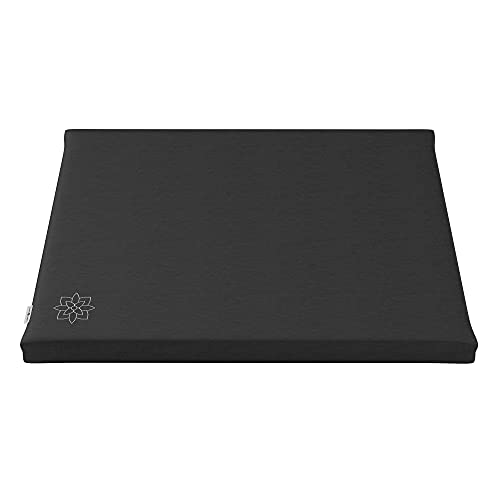
Mindful & Modern Zabuton Meditation Mat (Cotton Filled) — Best Knee & Ankle Comfort
The Mindful & Modern zabuton is the unsung half of the classic seat: a large, flat, cotton-filled mat that goes under the zafu and gives knees, shins, and ankles a cushioned surface. It is not a pillow you sit on directly for posture — it is the foundation that makes the pillow’s posture sustainable, especially on hard or cold floors. Its cotton fill is the cool-sitting choice: the mat’s job is padding, and natural fiber does it without the heat-trapping of the foam pads sold beside it.
Strengths
- Transforms hard floors: knees and ankles stop being the session’s limiting factor.
- Defines the practice space visually and physically — the mat is the boundary of the sit.
- Cotton builds stay temperature-neutral and fold or roll for storage.
Trade-offs
- An additional purchase — the zafu alone is a seat; the zabuton completes it, and budgets should plan for both.
- Bulky to wash; most owners spot-clean and air it, reserving deep cleaning for rare occasions.
- On carpeted floors its benefit shrinks; it earns its place on wood, tile, and tatami.
Size the zabuton generously — your knees should land on it with margin in your widest comfortable position, which is why this mat’s large rectangular format is the floor, not the ceiling, and larger mats suit taller sitters. Paired with any zafu in this guide, it is the difference between a cushion and a seat. If budget forces sequencing, buy the zafu first and the zabuton second; your ankles will file the request in writing within a fortnight.
| Fill | Cotton filled (Amazon title) |
| Format | Large rectangular floor mat for bench or zafu (Amazon title) |
| Role | Kneeling and sitting support pad (Amazon title) |
Best for: hard floors, bony ankles, long sits. / Not suited for: thick-carpet rooms where the floor is already padded.
Check on Amazon — check the current price on Amazon, and confirm the size, color and configuration on the listing match what this review describes before ordering.

Zafuko Foldable Cushion (Organic Kapok Filling) — Best Lightweight / Travel
Buckwheat’s great flaw is weight, and kapok is the traditional answer: a feather-light natural fiber. The Zafuko builds it into a foldable cushion — used folded for a higher, compact seat or unfolded as a flatter pad — in organic kapok filling, made to be carried to a retreat, a park, or a friend’s sangha without thinking about it. The trade is thermal — kapok insulates like the tree-down it is, so this is the warmest cushion in the guide — and structural: kapok compresses over months and needs fluffing and eventual refilling. For the traveling meditator, those are fair prices for a real cushion in the bag.
Strengths
- A fraction of a buckwheat cushion’s weight, and it folds — the easiest cushion here to pack or carry.
- Soft, forgiving sit that suits shorter travel sessions and unfamiliar floors.
- Natural fiber with a long traditional history in meditation cushions.
Trade-offs
- Warmest fill here — the wrong choice as a home cushion for a heat-sensitive sitter.
- Compresses over time; height and support drift downward across a season of heavy use.
- The folded format is compact; tall sitters should check the folded height against their geometry honestly.
The travel cushion’s real competition is the folded hotel blanket, and against that competition it wins easily: consistent height folded, a shape made for sitting, and a practice that feels the same away as at home. Retreat veterans treat it as non-negotiable kit. Buy it as a second cushion, keep the buckwheat anchor at home, and the pair covers the whole geography of a practice life.
| Fill | Organic kapok filling (Amazon title) |
| Format | Foldable — use folded or unfolded (Amazon title) |
| Character | Soft, portable cushion (Amazon title) |
Best for: retreats, travel, and outdoor sitting. / Not suited for: a primary home cushion for heat-sensitive sitters.
Check on Amazon — check the current price on Amazon, and confirm the size, color and configuration on the listing match what this review describes before ordering.

renoo Round Organic Meditation Cushion Zafu, 13×7 (Adjustable Height) — Best for Tall Sitters and Tight Hips
Posture geometry is unforgiving arithmetic: if your knees cannot rest below your hips, your lower back rounds and the sit becomes a wrestling match. Tall sitters and tight-hipped sitters solve it with height, and the renoo tall zafu is built for exactly that: a 13-inch round cushion with a full 7-inch loft — taller than the standard class — filled with buckwheat whose height adjusts by adding or removing hulls, under a GOTS-certified cotton washable cover. Sat on correctly, it restores the geometry without a teetering stack of blankets, and in buckwheat the tall cushion stays as cool as the FelizMax; the extra hulls add weight but not warmth. (A meditation bench is the legitimate alternative for sitters who kneel — different geometry, same goal.)
Strengths
- Restores knees-below-hips geometry for bodies a standard zafu leaves cramped.
- Buckwheat fill stays adjustable — remove hulls as flexibility improves and the cushion descends with you.
- Stable in a way stacked blankets and pillows never are mid-session.
Trade-offs
- The heaviest option here; this cushion lives where it sits.
- Too much height is its own error — perched sitters tip forward; tune by removing hulls gradually.
- Premium tier in most lines, reflecting the extra fill and larger cover.
The fitting method matters more than the model: sit, check that knees rest at or below hip height with feet relaxed, and adjust fill across several sessions rather than judging on day one, when every new cushion feels strange. Done right, this slot quietly removes the single most common physical excuse for a short practice — and it does so while keeping the cool, breathable character the whole guide is built around.
| Fill | Buckwheat, adjustable height (Amazon title) |
| Size | 13×7 inches (Amazon title) |
| Cover | GOTS certified cotton, washable (Amazon title) |
Best for: tall sitters, tight hips, and anyone stacking blankets today. / Not suited for: petite sitters, for whom standard height is already correct.
Check on Amazon — check the current price on Amazon, and confirm the size, color and configuration on the listing match what this review describes before ordering.
Comparison Table
| Pick | Badge | Key spec | Best for |
|---|---|---|---|
| FelizMax Zafu Buckwheat Cushion, 33cm | Best Overall | Buckwheat hulls, cotton cover, adjustable fill | Most meditators |
| renoo Organic Round Cushion (Linen Blend Cover) | Best for Hot Climates | Linen cover over buckwheat | Hot rooms, summer retreats |
| Hihealer Premium Crescent Cushion | Best for Beginners | Shaped thigh support, buckwheat or blend | Beginners, tight hips |
| Mindful & Modern Zabuton Mat | Best Knee & Ankle Comfort | Cotton-filled base mat, large rectangular | Hard floors, long sits |
| Zafuko Foldable Cushion | Best Lightweight | Organic kapok fill, foldable | Travel, retreats |
| renoo Tall Zafu, 13×7 | Best Tall Sit | Adjustable buckwheat, 7-inch loft | Tall sitters, tight hips |
How to Choose a Meditation Pillow That Stays Cool
Fill first: the temperature hierarchy
Every cool-sitting decision starts with fill. Buckwheat hulls breathe because they are shells with air between them; nothing synthetic has matched their combination of conformity, stability, and coolness. Kapok trades coolness for lightness. Cotton batting, the zabuton’s fill, is temperature-neutral and belongs under you rather than beneath your sitting bones. Memory foam and polyester fiberfill sit at the warm end — acceptable for short, comfort-first sits, wrong for the long, warm-room sessions this search is about. If a listing does not state its fill plainly, that silence is your answer.
Cover fiber: linen, cotton, then everything else
After fill, the cover decides how the cushion feels against skin and how it handles the moisture of a warm sit. Linen leads, cotton twill follows closely and wins on durability and price, and synthetic plushes and velours trail — they feel luxurious in a showroom and sit hot in August. A removable, washable cover is worth real money in warm climates, where the cover absorbs what the room provides.
Height and diameter: fit the geometry to the body
Standard zafus run roughly 13–14 inches across with a loft that compresses to a working height under your weight; the test is always knees at or below hips with a slight forward pelvic tilt. Petite sitters may prefer a lower or smaller cushion; tall sitters should start at the tall renoo rather than suffering at standard height. When in doubt, choose adjustable buckwheat — a cushion whose height you can tune by the handful of hulls is a cushion that fits you in year three as well as week one.
Shape: round, crescent, or bench
Round is the standard because it serves the widest range of postures — cross-legged, Burmese, and kneeling over the cushion turned on edge. Crescent adds thigh support for beginners and tight hips. A bench changes the posture entirely to kneeling and suits sitters whose hips or knees vote against cross-legged positions altogether. None is more “advanced” than another; the advanced choice is the one you can sit on, still, for your full session.
How to Sit on a Zafu: Setup for a Cool, Stable Session
- Place the zabuton first. Mat down, zafu centered toward its front half, on a floor away from direct sun and heat vents — the room’s coolest corner is your seat’s first feature.
- Sit on the front third of the cushion. Not the center. The front-third position tilts the pelvis gently forward and lets knees fall below hips, which is the geometry every benefit in this guide assumes.
- Arrange the legs without forcing. Cross-legged or Burmese (one foot before the other) are both correct. Knees should rest toward the mat; if they hover, add height (the tall-zafu logic of the renoo above) rather than pressing them down.
- Stack the spine from the base. Sit bones grounded, spine rising naturally, shoulders level, chin slightly tucked. If you are straining to sit straight, the cushion height is wrong — adjust the fill, not your effort.
- Dress for the room you have. Breathable, loose clothing is part of the cool-sitting system; the best cushion cannot ventilate a pair of jeans.
- End the sit by airing the cushion. Stand the zafu on edge or in moving air for a while after long warm sessions. Natural fills stay fresh in proportion to the air they get between sits.
- Review the setup monthly. Flexibility changes, seasons change, and a cushion that fit in September may sit high or low by December. A monthly two-minute check — knees below hips, pelvis tilted, no strain to sit tall — keeps the geometry honest, and with adjustable buckwheat the correction is a handful of hulls rather than a new purchase. Treat the seat as equipment under light maintenance, like the practice it serves.
Common Buying Mistakes
- Buying foam for long sits in warm rooms. Memory foam’s showroom comfort is real and so is its heat; the mismatch appears at minute twenty.
- Choosing by plushness photos. The softest-looking cushion is rarely the most sittable; stability, not sink, is what a zafu sells.
- Skipping the zabuton. Ankles and knees end more sits than backs do. The mat is half the seat.
- Ignoring adjustability. A fixed-height cushion fits you on one day of your flexibility journey; adjustable buckwheat fits the whole journey.
- Buying decorative floor pillows as meditation cushions. They are stuffed for lounging, at heights and firmness that fight posture. The categories share a shelf, not a purpose.
- Expecting “cooling gel” to stay cool. Gel absorbs heat until it matches you, then insulates. Breathability — air that moves — is the only cooling that lasts a full session.
Final Recommendation
For most meditators, start with the FelizMax: a round buckwheat zafu in a cotton cover is the cool, stable, adjustable standard, and paired with the Mindful & Modern zabuton it becomes a complete seat. If your room runs genuinely hot, upgrade the cover, not the concept — the renoo linen-blend version is the same wisdom in a cooler skin. Beginners should start with the Hihealer crescent without embarrassment and graduate when their hips say so; travelers add the Zafuko; tall and tight-hipped sitters go straight to the tall renoo and tune the fill down as they open. Every pick in this guide was chosen to keep the cushion out of your attention — cool, stable, and forgotten — which is where meditation equipment belongs.
Related reading in this series: Best Meditation Cushions, Best Floor Pillows, Best Buckwheat Pillows, Best Yoga Pillows, Best Zabuton.
Postures Compared: What Each Seat Is Really For
Full lotus and half lotus
These postures demand the most of hips and knees and reward a standard-height zafu used precisely — front-third sitting, pelvis tilted, the cushion’s stability doing the work that muscle would otherwise do. Cool-sitting matters most here, because the folded-leg position reduces airflow around the legs; buckwheat and natural covers earn their keep in exactly these long, still, warm sits. Beginners should treat lotus as a direction, not a starting point, and no cushion purchase changes that sequencing.
Burmese position
One foot before the other, both legs folded without stacking, Burmese is the workhorse posture of long retreats precisely because it distributes effort kindly. It pairs with every slot in this guide, asks slightly less height than cross-legged positions, and is where the crescent cushion’s thigh support shows its value most clearly in the first year of practice.
Kneeling (seiza) with cushion or bench
Kneeling sitters turn a zafu on edge between the legs or use a bench, taking hip rotation out of the equation entirely. The zabuton becomes even more important here — the full weight of the shins and ankles rests on it — and cool-sitting concerns shift to the cushion’s edge and the mat’s breathability rather than the seat’s airflow. If cross-legged postures have never agreed with your knees, this is not a lesser practice; it is the same practice in a sustainable shape.
Chair sitting
A final honesty: many meditators sit in chairs for reasons of body, age, or injury, and a chair sit with feet flat and spine unsupported by the backrest is a complete practice posture. A small buckwheat cushion on the chair seat can still help — leveling the pelvis, adding the slight forward tilt — and every breathability principle in this guide applies unchanged. The cushion industry will not tell you a chair is fine. This guide will: the seat serves the sit, never the reverse.
Caring for Natural-Fill Cushions: Hulls, Kapok, and Covers
Buckwheat hulls are agricultural material and age like it: across years of daily sitting they polish, compress, and slowly lose loft. The maintenance rhythm is simple — unzip and stir the hulls every few months to redistribute them, top up with fresh hulls when the working height drops, and replace the fill entirely when it feels dead and dusty rather than springy, typically after several years of real use. Never wash hulls; if they get wet, spread them thin in sun and air until fully dry. The cover, by contrast, should be washed like the working textile it is — that is what the zipper is for — and a spare cover is a legitimate purchase in warm climates, letting one dry while the other serves.
Kapok asks for fluffing: a minute of kneading and shaking before a sit restores much of its loft, and occasional sun does for kapok what it does for all natural fibers. Cotton zabutons spot-clean and air; full washing is possible for many but shrinks and lumps batting if done carelessly, so follow the maker’s guidance and prefer prevention — a washable cover or a throw layer in the dirtiest seasons. Across all fills, the storage rule is one sentence: cool, dry, and breathing. A natural cushion stored with the same airiness it provides will outlast several synthetic successors. That longevity is the quiet economic argument underneath this whole guide: the breathable, adjustable, maintainable cushion is not only the coolest seat but the cheapest one per year of practice, because it is maintained rather than replaced.
Building a Cool Practice Corner
The cushion is only one term in the temperature equation. Choose the seat’s location with the same care as its fill: the coolest corner of the room is usually away from sun-struck windows in the afternoon and away from heating vents in winter, and a spot with gentle air movement — not a fan aimed at your face, but a room position where air actually circulates — multiplies the breathability you bought in the cushion. On hard floors the zabuton insulates you from a cold slab in winter and from a sun-warmed one in summer; on tatami or wood, the stack breathes as a system. Time of day is the free variable: in hot climates, the early-morning sit is the cool sit, and generations of practitioners in warm countries organized their practice around that fact long before cushion technology entered the discussion. Dress, too, is equipment — loose natural-fiber clothing is the layer of the system closest to your skin, and no cushion can compensate for sitting in synthetic athletic wear designed to hold heat during exercise.
Retreats concentrate every variable: shared halls, fixed schedules, unfamiliar floors. The travel kit that experienced sitters pack is boring and complete — the Zafuko kapok travel cushion, a light cotton throw that serves as zabuton, shawl, and cover in one, and the knowledge of their own correct cushion height so they can rebuild it from borrowed cushions when theirs cannot come. Cool at a retreat is mostly preparation, and preparation is mostly knowing your geometry before you arrive.
Troubleshooting the Sit: Physical Distractions and Their Cushion Fixes
Problem: legs fall asleep → raise the seat, change the crossing
Pins and needles mid-sit usually mean a knee or ankle is bearing pressure it should not, or the pelvis sits too low and the legs compensate. Add height first (hulls in, or step up to Slot 6), sit on the front third faithfully, and alternate which leg crosses in front across sessions. If numbness persists in every posture, that is a question for a clinician, not a cushion catalog — this guide’s scope is comfort equipment, and it stays there.
Problem: lower back aches by minute fifteen → check the tilt
A rounded lower back is a geometry report: the pelvis is tilting backward because the seat is too low or you are sitting at its center. Move to the front third, add fill, and confirm the knees rest below the hips. The ache that survives correct geometry across weeks deserves professional advice rather than a taller cushion.
Problem: the cushion feels hotter as the sit goes on → audit the whole stack
Work from skin outward: clothing fiber, cover fiber, fill, mat, floor, room position. Any synthetic layer in that chain can be the bottleneck — the plush throw under the zafu, the foam pad instead of a cotton zabuton. Cool sitting is a system property; the fix is finding the one insulating layer, and it is rarely the zafu itself if you bought one of the buckwheat picks.
Problem: the cushion slides or the sit creeps → fix the interface
A zafu that migrates on a smooth floor needs the zabuton under it (friction is another of the mat’s quiet jobs) and a check that you are not perched so high that balance becomes effort. Creep across a long sit also signals a too-soft fill; buckwheat’s lock-in stability is the standing cure.
Budget Tiers and the Sensible Buying Sequence
Meditation cushions price in three broad tiers, and the tiers buy different things. The budget tier buys shape: a correctly shaped cushion in serviceable materials, often with synthetic-blend covers — a legitimate start, with the cover as the likely compromise on coolness. The mid tier buys the full formula this guide recommends: buckwheat fill, natural-fiber removable covers, honest stitching, and adjustability; for most practitioners this is the lifetime tier, the last cushion purchase they need to think about for years. The premium tier buys craft — organic fabrics, refined shapes, heritage makers — which is real value to those who care and invisible to the sitting itself beyond the mid tier’s standard. Heat-sensitive buyers should note the ordering inside every tier: fill decides more than cover, and cover decides more than brand. A budget buckwheat cushion in cotton will sit cooler than a premium foam cushion in linen, every session, forever.
The sequence matters as much as the selection. Buy the seat before the accessories: zafu (or crescent) first, zabuton second, travel cushion third, spare cover when the climate argues for it. Households with two sitters should resist the matching-set temptation and fit each body separately — cushion height is personal geometry, and a shared compromise cushion serves neither sitter well. The same logic extends to guest cushions and studio purchases: a small range of heights serves a population better than a row of identical cushions, and adjustable buckwheat is the practical way to hold that range without a storeroom of variants. Finally, buy once at the mid tier rather than twice at the budget tier if your practice is established; if it is not, the budget tier’s job is to find out whether the practice sticks, and it does that job honestly.
What a Cushion Cannot Do
A short section of expectations management, because cushion marketing rarely offers any. A meditation pillow cannot lengthen your sits by willpower substitution — it removes physical obstacles, and the rest is practice. It cannot cool a hot room; it can only decline to add its own heat to your side of the exchange. It cannot correct a posture your body is not ready for, which is why the beginner and tall-sit picks exist as geometry rather than as encouragement to endure. And it cannot substitute for instruction: a teacher watching your sit for five minutes will adjust things no buying guide can see. What the right cushion genuinely does — hold a breathable, stable geometry so your attention is free for the actual work — is modest, mechanical, and completely worth having. Buy it for exactly that, and it will never disappoint you.
A note on sitting through seasons
Your cushion needs change across the year even when your body does not. The seat that feels perfect in January can feel warm in July for room reasons, not cushion reasons — which is why this guide’s system (breathable fill, natural cover, airy storage, cool corner, morning sits in summer) outperforms any single “cooling” product claim. Judge your setup across a full season before replacing pieces of it; most warm-sit complaints resolve at the room and routine level, leaving the cushion — if it is one of the buckwheat picks — exactly as right as the day it arrived. The same patience applies in reverse: a cushion that feels merely adequate in a cool spring may prove to be the coolest seat you own when August tests it, which is the season this entire guide was written for.
Keep the receipt and the fill specifications of whatever cushion you buy; knowing your exact working height and fill type turns every future adjustment, refill, and replacement into a five-minute decision instead of a new research project.
Related guides
Frequently Asked Questions
Why is buckwheat considered the coolest fill?
Buckwheat hulls are hollow shells with air space between them, so air circulates through the cushion instead of being trapped in fibers or foam cells. That airflow, plus the hulls’ stability, is why buckwheat zafus feel noticeably cooler across a long sit than kapok or foam equivalents.
How high should a meditation cushion be?
High enough that, seated on its front third, your knees rest at or below your hips with your pelvis tilted slightly forward. For many adults a standard zafu compresses to the right working height; taller or tighter-hipped sitters need a high-loft cushion, and adjustable buckwheat lets you fine-tune by adding or removing hulls.
Do I really need a zabuton as well?
On hard floors, effectively yes for longer sits: the zafu positions your pelvis, but your knees, shins, and ankles rest on the floor itself, and they become the limiting factor. A cotton zabuton pads them without adding heat. On thick carpet you can postpone the purchase.
How do I keep a natural-fill cushion fresh in a humid climate?
Air it after long sessions, store it where air circulates rather than in a sealed bin, give it occasional sun, and keep the cover washed. Natural fills managed this way stay fresh for years; sealed, damp storage is what shortens their life.
Is a meditation bench better than a cushion?
Neither is better absolutely — they serve different postures. A bench suits kneeling sitters and those whose hips or knees rule out cross-legged positions; a cushion serves cross-legged and Burmese postures and adjusts more finely. Choose by the posture your body actually sustains.
How long does a buckwheat zafu last?
The cover and stitching typically outlast the fill’s prime: expect several years of daily sitting before hulls compact enough to need topping up, and longer before a full fill replacement. Because the height is adjustable, a buckwheat zafu ages gracefully — you maintain its geometry with handfuls of hulls rather than replacing the cushion — which is a large part of its lifetime value over foam, whose decline cannot be adjusted away.
Are round or crescent cushions cooler?
Fill and cover decide temperature far more than shape. A buckwheat crescent and a buckwheat round sit at nearly the same temperature; the crescent’s extra thigh contact adds a small warmth cost and a large comfort benefit for beginners. Choose shape by posture, and temperature by fill and fiber.
Can I use a regular pillow or folded blanket instead?
For a first few sits, yes — and you should, rather than not sitting. But blankets compress unevenly and slide, and bed pillows are too soft to hold pelvic geometry, so most regular sitters graduate to a purpose-built cushion quickly. The Hihealer crescent exists precisely for that transition.

