Disclosure: airfryerkitchensupply.com is reader-supported. When you buy through links on our site, we may earn an affiliate commission at no extra cost to you.
Where to buy
For anyone comparing the best composite kitchen sinks, this shortlist is the place to start: every model below was verified before its link was attached. Composite kitchen sinks are sold through Amazon, kitchen and bath dealers and home centres. Because a sink is a ten-to-twenty-year purchase fitted into a specific cabinet and counter, buy against exact model numbers and dimensions, confirm the minimum cabinet size on the listing, and arrange the counter decision — undermount or drop-in — before ordering, not after.
- KRAUS Bellucci Workstation Granite Composite Sink, 32-Inch, Metallic Gray (KGUW2-33MGR) — check price on Amazon; verify external dimensions, bowl depth and minimum cabinet size before ordering.
- KRAUS Bellucci Granite Composite Sink, 32-Inch, Metallic Black (KGUW2-33MBL) — check price on Amazon; verify external dimensions, bowl depth and minimum cabinet size before ordering.
- Karran 32-Inch Granite Composite Sink Kit, Black — check price on Amazon; verify external dimensions, bowl depth and minimum cabinet size before ordering.
- Karran Granite Composite Single Bowl Undermount Sink, Black — check price on Amazon; verify external dimensions, bowl depth and minimum cabinet size before ordering.
- Karran 33-Inch Granite Composite Double Bowl Sink, Brown — check price on Amazon; verify external dimensions, bowl depth and minimum cabinet size before ordering.
- Karran 33-Inch Granite Composite Drop-In Sink, Brown (QT670) — check price on Amazon; verify external dimensions, bowl depth and minimum cabinet size before ordering.
The case for the best composite kitchen sinks rests on a simple observation: a sink is the hardest-worked surface in the kitchen, and composite — quartz particles bound in resin, coloured all the way through — is the material that forgives that work longest. The best composite kitchen sinks resist the scratches that dull steel, the stains that haunt fireclay and cast iron enamel, and the drumming noise that makes thin metal sinks feel cheap, while offering colours steel cannot honestly wear.
This guide ranks six verified composite sinks across the formats real kitchens need: two workstation undermounts from Kraus’s Bellucci line, a complete Karran kit, a classic Karran undermount, and two Karran drop-ins including a low-divider double bowl. Every linked model was verified before linking, and the guide is plain about the material’s real costs — weight, installation demands and a care routine that rewards gentleness — because a sink chosen honestly is a sink kept happily.
In this guide
Quick Picks
- KRAUS Bellucci Workstation Granite Composite Sink, 32-Inch, Metallic Gray (KGUW2-33MGR) — Best Overall: The Bellucci is what happens when the two best modern sink ideas — granite composite material and the workstation ledge — are combined by a maker that understands both. Check price on Amazon.
- KRAUS Bellucci Granite Composite Sink, 32-Inch, Metallic Black (KGUW2-33MBL) — Best Black Workstation: Black sinks make a kitchen look deliberate, and black stainless steel breaks hearts by showing every scratch and water spot. Check price on Amazon.
- Karran 32-Inch Granite Composite Sink Kit, Black — Best Complete Kit: A sink is a system — bowl, grid, strainer, care — and the Karran kit is the pick for buyers who want that system in one box from one maker, with every component sized and finished to match. Check price on Amazon.
- Karran Granite Composite Single Bowl Undermount Sink, Black — Best Classic Undermount: Not every kitchen wants a workstation. Check price on Amazon.
- Karran 33-Inch Granite Composite Double Bowl Sink, Brown — Best Double Bowl: Double-bowl households are a loyal tribe — one side to wash, one to rinse or soak — and this Karran serves them in composite with two modern refinements: a low divider that lets long pans span both bowls, and a warm brown quartz finish that suits traditional and transitional kitchens where black and gray feel cold. Check price on Amazon.
- Karran 33-Inch Granite Composite Drop-In Sink, Brown (QT670) — Best Drop-In: The QT670 is the drop-in single bowl for buyers who want composite’s toughness without an undermount’s counter requirements: it drops into a standard cutout, sits proudly on its rim, and gives you one deep, quiet, stain-resistant bowl with the drain offset to the right to free the cabinet’s left side for storage.. Check price on Amazon.
How These Picks Were Chosen
Verification came first: every pick was confirmed against current catalogue listings, and only confirmed models carry links. The criteria were composite-specific. Material honesty came first — true quartz composite, through-coloured, from makers who specialise in it, rather than coated imitations. Format coverage came second: the shortlist had to serve undermount and drop-in installations, single and double bowls, and workstation and classic preferences, because composite buyers are usually fitting an existing kitchen, not designing from a blank page. Third was the working detail: bowl depth, drain position, divider height, included accessories and cabinet minimums — the specifications that decide whether a sink fits a life. Fourth was colour realism: each colourway was judged on how it ages in a real kitchen, not how it photographs in a showroom. No prices or ratings are printed anywhere in this guide; check price on Amazon at purchase time.
The 6 Best Composite Kitchen Sinks
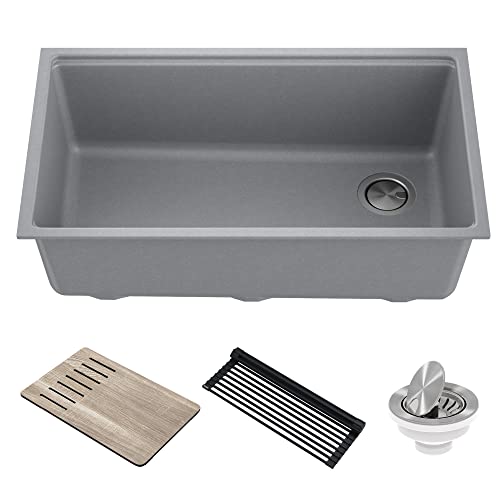
KRAUS Bellucci Workstation Granite Composite Sink, 32-Inch, Metallic Gray (KGUW2-33MGR) — Best Overall
The Bellucci is what happens when the two best modern sink ideas — granite composite material and the workstation ledge — are combined by a maker that understands both. The quartz composite shrugs off the daily abuse that scratches steel and stains fireclay, while the ledge turns the sink into a prep station with a board and rack that slide over the bowl. For most kitchens choosing composite, this is the sink to beat.
| Material | Quartz granite composite |
| Format | 32-inch undermount workstation with integrated ledge |
| Accessories | Cutting board and roll-up drying rack included (per listing) |
| Heat | Granite composite rated for high heat contact (see listing for rating) |
Strengths
- Quartz composite resists scratches, stains and heat in daily use
- Workstation ledge adds genuine prep function over the bowl
- Metallic gray is the most forgiving colour for real kitchens
Trade-offs
- Heavy; cabinet support must be planned properly
- Undermount only suits stone or solid-surface counters
- Premium position within the composite tier
Composite’s advantages compound over years. The material is coloured through, so the inevitable knife nick or dropped pan does not expose a different-coloured substrate; it resists staining from coffee, wine and turmeric in a way that makes light colours genuinely practical; and it deadens the drumming noise of a running tap and dropped cutlery without add-on pads. The Bellucci’s workstation format exploits the undermount installation properly: accessories ride on the ledge at counter height, so prep happens over the bowl and mess falls where the water is. The honest costs are weight — composite sinks are heavy and want proper cabinet support — and the undermount commitment itself, which belongs with solid-surface or stone counters, not laminate. Colour choice matters too: metallic gray hides water spots and crumbs better than any finish in this guide, which is why it takes the overall badge ahead of its black sibling.
Best for: kitchens that want best overall from a composite sink / Not suited for: installations whose counter or cabinet cannot support this format
Check on Amazon — check price on Amazon and confirm dimensions and cabinet requirements on the listing.

KRAUS Bellucci Granite Composite Sink, 32-Inch, Metallic Black (KGUW2-33MBL) — Best Black Workstation
Black sinks make a kitchen look deliberate, and black stainless steel breaks hearts by showing every scratch and water spot. Black granite composite is the way to have the look without the upkeep: the colour is the material, all the way through, and the Bellucci’s workstation ledge adds the prep function that turns a style choice into a working upgrade.
| Material | Quartz composite granite |
| Format | 32-inch undermount workstation, integrated ledge |
| Accessories | Cutting board and roll-up rack included (per listing) |
| Finish | Metallic black through-coloured composite |
Strengths
- True black look without black steel’s scratch and spot problems
- Workstation ledge adds counter space where prep happens
- Through-coloured material hides wear instead of advertising it
Trade-offs
- Hard-water scale shows on black; needs a wipe-down habit
- Heavy undermount install suits planned counter projects
- Darker bowl makes small dropped items harder to spot
The case for black composite is practical before it is aesthetic. Through-coloured quartz composite does not show the micro-scratching that ruins black-coated steel, it hides the dark staining that light sinks advertise, and its matte mineral texture suits modern and industrial kitchens where a gleaming steel box looks like an appliance that wandered in from a canteen. The workstation ledge earns its place in small and medium kitchens especially, because it manufactures counter space over the sink exactly where prep mess happens. Two honest cautions: in hard-water areas, light mineral scale shows on black more than on gray, and a quick wipe-down habit is the price of the look; and undermount installation plus composite weight means this is a sink to fit during a counter project, not a casual weekend swap. Chosen knowingly, it is the most striking pick in this guide and one of the most durable.
Best for: kitchens that want best black workstation from a composite sink / Not suited for: installations whose counter or cabinet cannot support this format
Check on Amazon — check price on Amazon and confirm dimensions and cabinet requirements on the listing.

Karran 32-Inch Granite Composite Sink Kit, Black — Best Complete Kit
A sink is a system — bowl, grid, strainer, care — and the Karran kit is the pick for buyers who want that system in one box from one maker, with every component sized and finished to match. The 32-inch quartz composite bowl is the centre, and the included bottom grid and basket strainer are the accessories owners otherwise buy later at worse prices and in mismatched finishes.
| Material | Quartz composite |
| Format | 32-inch single bowl undermount |
| Kit includes | Bottom grid, basket strainer and surface care product (per listing) |
| Cabinet | 36-inch minimum cabinet (per listing) |
Strengths
- Grid, strainer and care included and matched to the bowl
- Reversible offset drain eases cabinet and plumbing fit
- One purchase completes the sink system for a renovation
Trade-offs
- Kit value is wasted if you already own quality accessories
- 36-inch cabinet minimum excludes smaller kitchens
- Undermount format requires suitable counter material
Kits are underrated because the components are unglamorous, but live with a sink for a month and the grid becomes essential: it keeps pans off the bowl floor, lets glasses drain without pooling, and absorbs the impacts that chip and scratch. Getting the correct grid with the sink, rather than measuring and gambling later, is worth real money. The bowl itself follows Karran’s composite formula — quartz-rich, through-coloured, with a reversible offset drain that lets you position the bowl’s deep end and the plumbing to suit the cabinet. Installation is undermount with a 36-inch cabinet minimum, and the kit’s care product matters more than it sounds: composite rewards a simple care routine and punishes abrasive neglect, so starting with the maker’s own product sets the right habit. For a one-purchase renovation, this is the tidiest route into composite in the guide.
Best for: kitchens that want best complete kit from a composite sink / Not suited for: installations whose counter or cabinet cannot support this format
Check on Amazon — check price on Amazon and confirm dimensions and cabinet requirements on the listing.

Karran Granite Composite Single Bowl Undermount Sink, Black — Best Classic Undermount
Not every kitchen wants a workstation. The classic Karran undermount is composite in its purest form: one deep single bowl, an offset drain you can place left or right, no ledges or accessories competing for attention — just the material doing its quiet work of resisting stains, scratches and noise for decades.
| Material | Quartz composite |
| Format | Single bowl undermount, 9-inch deep bowl (per listing) |
| Drain | Reversible offset drain position |
| Cabinet | 36-inch minimum cabinet size (per listing) |
Strengths
- Deep single bowl fits pans and racks double bowls reject
- Offset drain can be placed to suit the cabinet
- Purest expression of composite: quiet, tough, stain-resistant
Trade-offs
- No workstation ledge or included accessories
- Single bowl means washing and rinsing share one space
- 36-inch cabinet minimum
There is a discipline to recommending the simple version: most households use a sink as a sink, and a deep, well-made single bowl serves them better than a feature platform. The 9-inch depth swallows roasting pans and stockpots; the single undivided bowl fits the sheet pans and oven racks that double bowls reject; and the offset drain frees cabinet space below for bins or a water filter on the side you choose. Composite’s through-colour and density make this the low-maintenance heart of a working kitchen, and Karran’s long focus on the material shows in the finish quality. The trade-offs are the format’s own: no workstation ledge, no second bowl for the soak-and-rinse routine, and accessories bought separately. If your cooking is pan-heavy and your taste runs to simplicity, this is the composite sink that will still be pleasing you when the kitchen around it has been remodelled twice.
Best for: kitchens that want best classic undermount from a composite sink / Not suited for: installations whose counter or cabinet cannot support this format
Check on Amazon — check price on Amazon and confirm dimensions and cabinet requirements on the listing.

Karran 33-Inch Granite Composite Double Bowl Sink, Brown — Best Double Bowl
Double-bowl households are a loyal tribe — one side to wash, one to rinse or soak — and this Karran serves them in composite with two modern refinements: a low divider that lets long pans span both bowls, and a warm brown quartz finish that suits traditional and transitional kitchens where black and gray feel cold. It is also this guide’s drop-in option, fitting existing counters the undermounts cannot.
| Material | 80% natural quartz composite (per listing) |
| Format | 33-inch top-mount 50/50 double bowl |
| Divider | Low divider (6-inch class) for pan handling |
| Depth | 9-inch deep bowls (per listing) |
Strengths
- Low divider keeps two-bowl workflow without exiling big pans
- Drop-in mount suits laminate counters and easy replacements
- Brown quartz hides staining and suits wood cabinetry
Trade-offs
- No workstation ledge
- Rimmed mount is less seamless to clean around than undermount
- Two bowls each smaller than a single bowl for the biggest items
The low divider is the detail that converts double-bowl sceptics. At full height, dividers exile every pan longer than a bowl; dropped to a lower profile, the divider keeps the two-bowl workflow for dishes while letting a roasting pan or cookie sheet lie across both bowls under the tap. The brown colourway deserves its place on merit, not novelty: quartz composite in brown hides the tea and coffee staining that plagues light sinks, warms up wood cabinetry, and does not show hard-water spotting the way black does. Top-mount installation is the practical headline — the rim sits on the counter, so the sink suits laminate counters and straightforward replacements where undermount is impossible. You give up the workstation ledge and the seamless undermount wipe-in, and in exchange you get the most flexible installation and the classic two-bowl routine in a material that will outlast steel. For traditional kitchens, that is the right trade.
Best for: kitchens that want best double bowl from a composite sink / Not suited for: installations whose counter or cabinet cannot support this format
Check on Amazon — check price on Amazon and confirm dimensions and cabinet requirements on the listing.
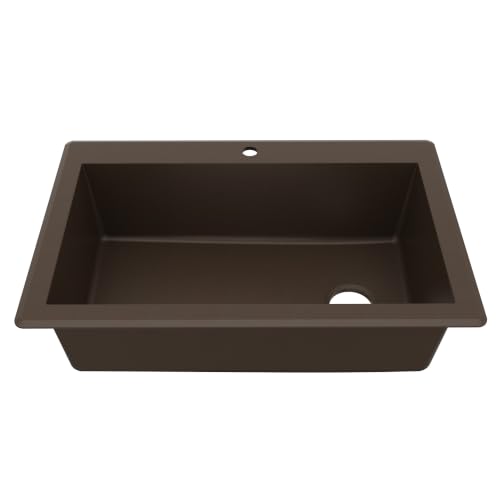
Karran 33-Inch Granite Composite Drop-In Sink, Brown (QT670) — Best Drop-In
The QT670 is the drop-in single bowl for buyers who want composite’s toughness without an undermount’s counter requirements: it drops into a standard cutout, sits proudly on its rim, and gives you one deep, quiet, stain-resistant bowl with the drain offset to the right to free the cabinet’s left side for storage.
| Material | Granite composite (quartz) |
| Format | 33-inch top-mount single bowl |
| Drain | Right-side drain position (per listing) |
| Depth | 9-inch deep bowl (per listing) |
Strengths
- Drop-in install suits existing counters and DIY renovation
- Deep single bowl with space-freeing offset drain
- Composite toughness without undermount requirements
Trade-offs
- Rim collects crumbs and needs a cleaning pass
- No workstation ledge
- Right-side drain only; confirm it suits your cabinet layout
Drop-in composite is the renovation-friendly face of the material. The installation is within reach of a competent DIYer — cutout, seal, drop, plumb — and the rim forgives counter imperfections that undermounting would expose. The single deep bowl handles the pan-and-rack reality of family cooking, and the right-side drain is a small, thoughtful asymmetry: bins and cleaning supplies live on the left, plumbing on the right, and the disposal, if fitted, sits where the drain is. Composite care is the only learning curve: avoid harsh abrasives, wipe acidic spills rather than leaving them overnight, and the surface stays rich for years. Against the undermount picks you trade the seamless counter wipe-in and the workstation option; against steel drop-ins you gain silence, stain resistance and a finish that does not scratch into dullness. For a kitchen refresh that stops short of new counters, this is the composite pick.
Best for: kitchens that want best drop-in from a composite sink / Not suited for: installations whose counter or cabinet cannot support this format
Check on Amazon — check price on Amazon and confirm dimensions and cabinet requirements on the listing.
Comparison Table
| Pick | Badge | Key spec | Best for |
|---|---|---|---|
| KRAUS Bellucci Workstation Granite Composite Sink, 32-Inch, Metallic Gray (KGUW2-33MGR) | Best Overall | Quartz granite composite | Best Overall buyers |
| KRAUS Bellucci Granite Composite Sink, 32-Inch, Metallic Black (KGUW2-33MBL) | Best Black Workstation | Quartz composite granite | Best Black Workstation buyers |
| Karran 32-Inch Granite Composite Sink Kit, Black | Best Complete Kit | Quartz composite | Best Complete Kit buyers |
| Karran Granite Composite Single Bowl Undermount Sink, Black | Best Classic Undermount | Quartz composite | Best Classic Undermount buyers |
| Karran 33-Inch Granite Composite Double Bowl Sink, Brown | Best Double Bowl | 80% natural quartz composite (per listing) | Best Double Bowl buyers |
| Karran 33-Inch Granite Composite Drop-In Sink, Brown (QT670) | Best Drop-In | Granite composite (quartz) | Best Drop-In buyers |
The pattern: Kraus’s Bellucci line owns the workstation undermount space in two colours, while Karran covers everything else — kits, classics, drop-ins and double bowls. Choose the format first and the maker decision mostly makes itself.
How to Choose a Composite Kitchen Sink
Start with the counter, because it eliminates half the catalogue. Undermount composite sinks belong under stone, quartz or solid-surface counters where the edge can be sealed and the weight supported; drop-in models suit laminate and straightforward replacements. Next, the cabinet: most 32- and 33-inch composite sinks want a 36-inch cabinet, and discovering that after delivery is the classic composite-buying disaster. Measure the cabinet interior, check the listing’s minimum, and only then fall in love with a colour.
Composite vs stainless steel vs fireclay — which material is right for you?
Steel is lighter, cheaper to install and endlessly available, but it scratches into a patina, drums under the tap and shows water spots in hard-water homes. Fireclay is beautiful, heavy and brittle at the edges, with staining that demands prompt wiping. Composite sits between them with the best forgiveness profile: quiet like fireclay, tougher than both against impact staining, and coloured through so wear does not show as damage. Choose composite when the sink is a working surface first and a jewel second — which is most kitchens, most of the time.
Single bowl, double bowl or workstation?
Single bowls fit the biggest items and suit cooks whose pans outsize their dish stacks. Double bowls serve the wash-and-rinse routine and households without dishwashers doing daily service — and a low divider removes the classic objection. Workstations convert the sink into prep space and suit smaller kitchens and keen cooks in equal measure. The dishwasher question decides more than people admit: heavy dishwasher households use the sink for pans and prep, which argues single or workstation; hand-washing households argue double.
Which colour hides real life best?
Mid-tone grays and browns are the forgiving champions: they hide water spots, crumbs and mild staining between cleans. Black is dramatic and hides dark staining but advertises light hard-water scale. White and bisque composite are far more stain-resistant than white fireclay or enamel, yet they still ask for prompt attention to turmeric, beetroot and red wine. Match the colour to your water, your light and your honest wiping habits, not only to the cabinet doors and the showroom photograph that started the conversation.
What about faucets, disposals and accessories compatibility?
Undermount and most drop-in composite sinks leave faucet mounting to the counter or a separate deck, so your faucet choice stays free — but plan the hole drilling with the counter fabricator, because composite’s hardness makes drilling a professional task with the correct bits. Garbage disposals fit composite sinks with the appropriate flange for the material’s thickness; check the listing or the maker’s guidance rather than assuming a steel-sink flange will seat correctly. For accessories, the hierarchy is simple: a correctly sized bottom grid first, because it protects the bowl and improves draining; a fitted strainer and stopper second; workstation accessories third, and only for the ledged models designed to carry them. Improvised accessories that overhang or rock on a composite rim are worse than none, because a sliding steel rack can mark any sink given time and friction.
How long does a composite sink realistically last?
Longer than the kitchen around it, in most cases. The material does not rust, peel or wear through, and its failure modes — installation damage, violent impact, abrasive abuse — are events rather than ageing. Households routinely keep composite sinks through a counter replacement, re-mounting the same bowl under new stone, which is perhaps the strongest testimony the material can earn. Budget accordingly: a composite sink is a fifteen-to-twenty-five-year decision, so the colour and format choices deserve the extra day of thought this guide keeps recommending, and the per-year cost of even the premium picks becomes modest when the lifespan is honest.
Is composite a good choice for a rental property or a resale?
For landlords and sellers, composite has a specific appeal: it photographs like stone, survives tenants better than steel or enamel, and does not date the way fashionable finishes do. A mid-tone gray or brown composite sink reads as a quality signal in a listing photograph and asks almost nothing of the occupants to keep presentable — no polishing, no special cleaners beyond the non-abrasive rule, and no rust or chipped enamel to explain at inspection. The investment logic is strongest in mid-range properties, where a composite sink lifts the kitchen’s perceived quality disproportionately to its cost, and in long-held rentals, where its twenty-year indifference to abuse outperforms two cycles of cheap steel. In short-hold flips the calculus is thinner, because the material’s value is longevity the seller will not personally use — though even there, the showroom effect of a quiet, stone-like sink under a good faucet should not be underestimated.
What does a composite sink feel like to use every day?
Daily experience is where composite quietly wins converts. The tap’s drumming disappears. A mug set down carelessly lands with a dull tap instead of a clang. Hot pans can rest in the bowl without the thermal drama of enamel or the scorch anxiety of solid-surface sinks. The surface wipes clean with a cloth rather than demanding a polish, and because the colour is uniform, the small evidence of a busy week — a coffee ring left too long, a turmeric splash — rinses or lifts without leaving the ghost marks that accumulate on steel and light fireclay. Users also notice the bowl floor over the first weeks: composite’s slight mineral texture and the grid’s presence mean glasses and boards drain instead of sitting in puddles, cutlery stops sliding toward the drain in a clattering pile, and the whole washing-up process becomes fractionally calmer in a way that adds up across thousands of repetitions. None of these pleasures photographs, which is why composite remains the connoisseur’s material rather than the showroom’s — it is chosen by people who have lived with the alternatives and kept notes.
What should you ask your counter fabricator before ordering?
Four questions prevent most composite regrets. Will the counter material and thickness support an undermount of this weight, and who supplies the support rails or cradle? Is the cutout made from the sink’s own template, and is the reveal — positive, negative or flush — agreed in writing before cutting? Who drills the faucet holes, with what tooling, and at whose risk if the stone chips? And does the installation include sealing the counter’s cut edge, which protects the counter as much as the sink? A fabricator who answers these crisply has fitted composite before; one who waves them away has not, and the sink should not be their education. Drop-in buyers escape most of this, which is precisely the drop-in format’s enduring virtue.
How does composite handle a household with children and heavy use?
It is arguably the family-optimal material. Dropped bottles and thrown cutlery meet a surface that neither chips like enamel nor dents like steel; hot pans from a distracted parent land without scorching; the inevitable science experiments of dyed, glued and painted childhood rinse off a non-porous surface that refuses to keep souvenirs. The quietness matters in open-plan homes more than brochures admit, because the sink is used from dawn to midnight and a drumming steel bowl taxes everyone in earshot. The one family rule genuinely worth posting on the fridge is the abrasive rule: scouring powders live somewhere else, and the soft sponge lives at the sink. Teach that once, and a composite sink will absorb a childhood of use and still be the sink the grown children remember as simply part of the kitchen that always worked.
How to Install and Set Up a Composite Sink Properly
Step 1: Dry-fit everything. Set the sink in the cutout or under the counter opening, confirm the drain position against the cabinet’s plumbing, and check that disposal and filter housings clear the bowl. Composite is heavy; rehearse the lift with help before sealant is involved.
Step 2: Support the weight correctly. Undermount composite sinks must be supported by the cabinet structure — rails, brackets or a cradle per the maker’s instructions — never hung from the counter by adhesive and clips alone. Drop-ins rest on their rim with a continuous sealant bead.
Step 3: Seal and plumb carefully. Use the sealant type the maker specifies, connect the strainer and disposal with the correct flange for composite thickness, and hand-check every joint dry before the first fill.
Step 4: Protect the surface from day one. Fit the bottom grid if your model includes or offers one, brief the household on the no-abrasives rule, and keep the maker’s care product under the sink where it will actually be used.
Step 5: Run the first-week routine. Wipe the bowl down after washing up, rinse away acidic and strongly coloured residues rather than leaving them overnight, and dry the surface when you can. The habit formed in week one is the finish you keep in year ten.
Common Buying Mistakes
Ordering before measuring the cabinet. Composite sinks are wide, deep and heavy, and the 36-inch cabinet minimum catches out more buyers than any other specification. Measure first, order second.
Undermounting into laminate. Exposed laminate edges and composite weight are a failed installation waiting for moisture. Match the mount to the counter honestly, or choose a drop-in pick.
Cleaning composite like steel. Abrasive pads and powders dull the surface permanently. Composite needs soft cloths, mild cleaners and the occasional mineral-oil refresh per the maker’s guidance.
Ignoring drain position. Offset and side drains are features, not trivia: they decide where the disposal sits and how much usable cabinet remains. Choose the drain for your cabinet, not by habit.
Skipping the bottom grid. The grid is cheap insurance against the dropped pan that chips any sink material. If your pick does not include one, buy the correct size with the sink.
Final Recommendation
Most kitchens should choose the KRAUS Bellucci Workstation Granite Composite Sink, 32-Inch, Metallic Gray (KGUW2-33MGR) for its combination of workstation function and forgiving colour. Black-kitchen designs belong on the KRAUS Bellucci Granite Composite Sink, 32-Inch, Metallic Black (KGUW2-33MBL), one-box renovations on the Karran 32-Inch Granite Composite Sink Kit, Black, and purists on the classic Karran undermount. Double-bowl households and drop-in projects are served by the two Karran top-mount picks, in brown quartz that suits real kitchens.
Explore the wider sink cluster: Best Copper Kitchen Sinks · Best Corner Kitchen Sinks · Best Deep Kitchen Sinks · Best Undermount Kitchen Sinks · Best Granite Composite Kitchen Sinks
What Is Granite Composite, Actually?
The name confuses buyers, so here is the material in plain terms. Granite composite — also sold as quartz composite — is made by binding a high proportion of crushed quartz or granite stone in an acrylic resin, then moulding the mixture into a sink and curing it into a single dense piece. The stone content is what you feel: the weight, the cool mineral surface, the silence when a pan lands. The resin is what you benefit from invisibly: it seals the stone into a non-porous surface that does not harbour stains or bacteria the way natural stone can, and it gives the material a slight resilience that pure stone lacks.
Two quality signals separate good composite from cheap imitations. The first is stone content: higher quartz proportions feel denser, sound quieter and resist scratching better, while resin-heavy composites feel plasticky and age like it. The second is through-colour: in a quality sink the colour is the material itself from surface to core, so a decade of micro-wear reveals the same colour beneath. Coated products — a coloured skin over a different substrate — fail this test within a few years at the drain and the bowl floor. Every pick in this guide is a through-coloured quartz composite from a maker whose main business is this material, which is precisely why the shortlist is dominated by two specialist names rather than six logos.
How Do You Live With Composite Day to Day?
Owners describe a consistent pattern. The first pleasure is acoustic: the kitchen gets quieter, because the sink stops amplifying the tap, the disposal and every dropped spoon. The second is thermal and tactile — the surface feels like stone, holds no metallic chill, and does not show the day’s water spots the way steel does in hard-water homes. The third arrives slowly: the sink looks the same in year three as in month three, because there is no finish to scratch through and no coating to dull.
The frictions are equally consistent. Composite is heavy at installation and unforgiving of being dropped or levered during fitting, so it rewards professional or careful two-person installation. Its surface prefers soft cleaning, and households addicted to scouring powder must convert. In very hard water areas, light mineral filming can build on dark colours and needs a periodic wipe with the maker’s recommended cleaner. None of these is a reason to avoid the material; all of them are reasons to choose it knowingly, which is what this guide is for.
Which Composite Pick Suits Which Kitchen?
Match by project type. A full renovation with new stone counters belongs on an undermount: the Bellucci in gray for the hardest-working family kitchens, the Bellucci in black for designed, darker schemes, the classic Karran for purists who want a bowl and nothing else. A renovation keeping its counters belongs on a drop-in: the low-divider double for hand-washing households, the QT670 for single-bowl cooks. A a one-box purchase where every accessory must simply be right belongs on the Karran kit. And a rental or interim kitchen, honestly assessed, belongs on none of these — composite is a decade-scale purchase, and its value is realised by the household that stays to enjoy it.
What Should You Know About Composite Sink Sizes and Fit?
Sink sizing confuses because three different measurements share one conversation. The headline size — 32 or 33 inches — is the external width across the counter. The bowl size is smaller by the walls and rim, and it is the bowl that decides whether your largest roasting pan fits, so check the listing’s interior dimensions against the pan you actually own, not the pan you imagine. The cabinet minimum is the third number and the least forgiving: it accounts for the bowl, the mounting hardware and the plumbing, and a cabinet below the minimum turns installation into cabinet surgery.
Depth deserves its own sentence. The 9-inch class bowls in this guide are the sweet spot for family kitchens: deep enough for stockpots and stacked dishes, shallow enough that shorter users are not reaching into a well. Deeper bowls exist and are covered in this site’s deep-sink guide; shallower ones suit bar and prep roles. Finally, template discipline: every pick ships with or publishes a cutout template, and the counter should be cut from that template — never from the headline dimensions — because composite tolerances are exact and stone does not forgive a freehand cut.
Frequently Asked Questions
Are composite kitchen sinks durable?
Yes — quartz composite is among the most durable sink materials in domestic use. It resists scratches, stains, heat and impact better than most alternatives, and because the colour runs through the material, minor wear does not show as damage. Its enemies are abrasive cleaning and unsupported installation, both avoidable.
Can composite sinks crack?
Any rigid sink can be damaged by a sufficiently violent impact or a bad installation, and composite is no exception — but in normal service, with proper cabinet support, cracking is rare. Dropping a heavy cast-iron pan from height is the realistic risk, which a bottom grid largely removes.
Do composite sinks stain?
They resist staining far better than fireclay, enamel or light steel, and most residues rinse away. Strong pigments left overnight — turmeric, beetroot, red wine — can mark light colours temporarily, so the habit of rinsing after colourful cooking keeps any composite colour looking new.
Are composite sinks heat resistant?
Granite composite tolerates hot pans and boiling water far beyond normal kitchen exposure, though makers still advise against placing a pan straight from maximum oven heat onto a cold wet surface, because thermal shock is unkind to every sink material. Use a trivet for extreme cases and the material will not trouble you.
How do you clean a composite sink?
Daily: rinse and wipe with a soft cloth and mild detergent. Weekly: a non-abrasive cleaner for water marks. Never: scouring powders, steel wool or harsh bleach soaks. A light mineral-oil wipe, where the maker recommends it, restores the surface’s depth of colour.
Composite or stainless steel — which is quieter?
Composite, by a wide margin. Its density absorbs the sound of running water, dropped cutlery and disposal vibration that make steel sinks drum. Padded premium steel narrows the gap, but a composite bowl is the quietest mainstream option in the kitchen.
Can you put a garbage disposal on a composite sink?
Yes — composite sinks accept standard disposals with the correct mounting flange for the sink’s drain thickness, and the material’s density actually quiets disposal vibration better than steel. Confirm flange compatibility on the listing or with the maker, support the bowl properly so the disposal’s weight is carried by the cabinet structure as designed, and the combination is unremarkable in the best way: quiet, solid and durable.
Do composite sinks need sealing like natural stone?
No. The resin binder makes quality composite non-porous from the factory, so there is no sealing schedule and no resealing product to buy. What the surface appreciates instead is the occasional restorative wipe recommended by the maker — often a mineral-oil based care product — which refreshes the colour’s depth where water and use have dulled it. That is maintenance of appearance, not protection of structure.


