Disclosure: airfryerkitchensupply.com is reader-supported. When you buy through links on our site, we may earn an affiliate commission at no extra cost to you.
Specifying the best commercial use toilets is a business decision disguised as a plumbing decision. The fixture you choose will be flushed by strangers, cleaned against the clock, judged by customers who equate your restroom with your standards, and serviced by whoever holds the maintenance contract — and it will do all of that for a decade or more. This guide therefore ranks toilets the way an operator does: platform durability first, cleaning minutes second, water and parts costs third, and appearance as the supporting act rather than the headline.
The list deliberately spans the platforms a commercial buyer actually chooses between. At one end sit complete wall-hung flushometer systems with sensor valves; at the other, pressure-assist and professional tank toilets for premises whose plumbing cannot support valves. Every pick is a real commercial fixture or professional line with an installed base in businesses — no residential model has been promoted into this list on the strength of a keyword. Linked models were verified by brand and model through a listing check, and listings that are bowl-only or sold less seat are flagged in their reviews so your purchase order is complete the first time.
Set one expectation before reading on: commercial use punishes novelty. The winning fixtures here are mostly long-running platforms whose valves, seats and seals are stocked by every plumbing wholesaler in the country, because the most expensive toilet in the world is the one closed for a part nobody local carries. If a pick looks conservative, that conservatism is the feature your future self is buying.
A second expectation concerns compliance. Seat heights, flush volumes and fixture counts in commercial restrooms are regulated in ways home bathrooms are not, and local codes vary. This guide flags the ADA-relevant and water-code properties of each pick, but your building’s permit set and your local inspector have the final word — treat the reviews as a shortlist to take to that conversation, not a substitute for it.
One more framing before the reviews, because it decides real purchases: think about who cleans and who repairs before you think about who sits. A restroom’s lifetime experience is written by its cleaner and its plumber far more than by its users, who each spend three minutes a day with your decision. The fixtures below were ranked with the cleaner’s mop and the plumber’s van in mind at every step — fast-clean formats, standard parts, serviceable valves — because a toilet that those two professionals approve of is a toilet your customers will never have a reason to mention.
Where to buy
Commercial fixtures are listed on Amazon through professional and marketplace sellers, where you can check the current price on Amazon, verify exactly what each listing includes — system, bowl only, or complete toilet — and confirm spud, rough-in and seat details before committing a purchase order.
- American Standard Afwall Selectronic Flowise Wall-Hung System (1.28 GPF) — Best Overall for Commercial Use: Check the current price on Amazon
- TOTO CT708UV Wall-Mounted Flushometer Bowl (1.0 GPF) — Best for High-Traffic Restrooms: Check the current price on Amazon
- Kohler Kingston Ultra Wall-Mounted Flushometer Bowl — Best Estate Standard Bowl: Check the current price on Amazon
- Mansfield Quantum Elongated Pressure-Assist Toilet (1.6 GPF, Rear Outlet, ADA) — Best for Problem Drain Lines: Check the current price on Amazon
- Kohler Wellworth Pressure Lite Elongated Toilet (1.1 GPF, Less Seat) — Best for Small Commercial Premises: Check the current price on Amazon
- American Standard Champion PRO Round Front Toilet (1.28 GPF, Chair Height) — Best Budget for Commercial Use: Check the current price on Amazon
In this guide
Quick Picks
Six fixtures for real commercial duty: a sensor wall-hung system, two flushometer bowls for high-traffic rooms, a pressure-assist problem-solver, and two tank platforms for premises that cannot run valves.
- American Standard Afwall Selectronic Flowise Wall-Hung System (1.28 GPF) — Best Overall for Commercial Use: A complete wall-hung system pairing the Afwall bowl with a Selectronic sensor valve at 1.28 GPF — touchless, floor-free and code-current in one specification. Check the current price on Amazon
- TOTO CT708UV Wall-Mounted Flushometer Bowl (1.0 GPF) — Best for High-Traffic Restrooms: TOTO’s wall-mounted flushometer bowl at a lean 1.0 GPF — the bowl high-traffic rooms choose when the valve platform is already decided. Check the current price on Amazon
- Kohler Kingston Ultra Wall-Mounted Flushometer Bowl — Best Estate Standard Bowl: The Kingston Ultra is Kohler’s refined wall-hung commercial bowl — the standardise-on-one-bowl choice for multi-site operators. Check the current price on Amazon
- Mansfield Quantum Elongated Pressure-Assist Toilet (1.6 GPF, Rear Outlet, ADA) — Best for Problem Drain Lines: A rear-outlet, ADA pressure-assist toilet — the specialist for commercial floors where the drain leaves through the wall and gravity has given up. Check the current price on Amazon
- Kohler Wellworth Pressure Lite Elongated Toilet (1.1 GPF, Less Seat) — Best for Small Commercial Premises: Pressure-assist power on ordinary tank plumbing at 1.1 GPF — the upgrade for cafés, salons, clinics and shops whose restrooms were roughed in like a house’s. Check the current price on Amazon
- American Standard Champion PRO Round Front Toilet (1.28 GPF, Chair Height) — Best Budget for Commercial Use: The professional Champion line in compact round-front form — commercial-grade clog resistance for small staff and customer restrooms on a budget. Check the current price on Amazon
How These Picks Were Chosen
Selection began with duty cycle. Manufacturers rate commercial platforms for the kind of use a home never sees, and the shortlist only admitted fixtures from lines with documented lives in restaurants, offices, schools, gyms, clinics and hospitality — the environments where a weak fixture is found out within a month. Flushometer systems and pressure-assist platforms led the list; professional gravity lines were admitted only where their installed base in small commercial premises justified them.
Verification followed the same mechanical rule as every guide in this programme: brand-and-model search, the returned listing title matched against the model under review, and a link only where the match was exact. That process matters doubly in commercial listings, where a single product family spans bowls, tanks, valves and systems that look identical in a thumbnail. Where a pick is a bowl, the review says bowl, names what else is required, and treats the system cost — not the porcelain price — as the real number.
Cleaning and service were scored as operating costs, because they are. Wall-hung formats that free the floor, glazed surfaces that release soil, sensor valves that remove the missed flush, and platforms whose rebuild kits sit in every wholesaler’s van all reduce the lifetime cost of a restroom in ways a purchase price never shows. Each pick’s trade-offs name its service personality honestly, including the two platforms that ask for specialised parts.
The final six were then mapped to six premises: the design-led business that wants touchless, the high-traffic workhorse room, the estate standardising on one bowl, the building with problem drains, the small venue on tank plumbing, and the budget-led operator. Read the badges as premises, not prizes — the right toilet is the one whose badge describes your building.
What are the 6 best commercial use toilets?

American Standard Afwall Selectronic Flowise Wall-Hung System (1.28 GPF) — Best Overall for Commercial Use
If one fixture in this guide represents where commercial restrooms have arrived, it is this system. The Afwall wall-hung bowl keeps the floor completely clear for cleaning, the Selectronic sensor valve removes the handle — and with it the missed flush and the hygiene objection — and the whole assembly delivers its flush at 1.28 gallons, current with modern water codes. Because the listing is a system, the bowl and valve arrive engineered for each other, sparing you the compatibility matrix that makes piecemeal flushometer specifications go wrong.
In operation, sensor flushing changes a restroom’s reputation. Users never find an unflushed bowl, never touch a handle, and read the room as cared-for — a judgement customers transfer to the business itself, fairly or not. For the operator, the costs are known and small: batteries on a schedule, a valve platform shared with one of the largest commercial ranges in the country, and a bowl whose EverClean-family surface thinking reduces the chemistry and minutes in every clean.
The requirements are the format’s usual ones and they are not negotiable: an in-wall carrier, a commercial supply line, and professional installation with the wall open. This is a fixture for new builds, gut renovations and businesses that plan their restrooms like assets. If that describes your project, stop shopping — this is the specification to beat, and nothing below beats it on its own ground.
Strengths
- Complete matched system — sensor valve and wall-hung bowl in one listing
- Touchless flushing ends missed flushes and handle contact
- Wall-hung format delivers the fastest, most thorough restroom cleans
Trade-offs
- Needs in-wall carrier and commercial supply — a renovation-scale install
- Sensor valve adds batteries and electronics to the maintenance rhythm
- Highest commitment on this list in both specification and installation
| Specification | Detail |
|---|---|
| Configuration | Wall-hung flushometer system |
| Flush volume | 1.28 GPF |
| Valve type | Selectronic sensor flush valve |
| Format | Wall-hung, floor-clear cleaning |
Best for: businesses building or gutting restrooms that customers judge them by / Not suited for: premises needing a like-for-like swap on existing tank plumbing
Check the current price on Amazon

TOTO CT708UV Wall-Mounted Flushometer Bowl (1.0 GPF) — Best for High-Traffic Restrooms
High-traffic restrooms — transport hubs, large offices, education, entertainment venues — live or die on two numbers: flushes survived and gallons consumed. The CT708UV is TOTO’s answer to both, a wall-mounted back-spud bowl rated at 1.0 gallon per flush, built in the heavy vitreous china the commercial range is known for. Paired with a quality 1.0-rated flushometer valve, it delivers the rapid, repeatable cycle that a queue at half-time demands, with no tank to refill and no recovery pause between users.
Understand the listing as the trade does: this is the bowl. The valve, carrier and seat are specified separately, which in high-traffic work is normal and even desirable — estates standardise valves across hundreds of rooms for spares simplicity, then fit bowls per room. TOTO’s commercial bowls hold their glaze and their geometry under cleaning regimes that would embarrass residential porcelain, and the wall-hung format keeps the floor washable end to end, a decisive advantage when the room is cleaned three times a day.
Choose this bowl when traffic is the headline and your valve platform is settled or your plumber has a house standard. First-time commercial buyers building a complete room from nothing may prefer the bundled Afwall system above; operators expanding an existing estate will recognise the CT708UV as the professional’s way of buying.
Strengths
- 1.0 GPF rating cuts water cost hardest where flush counts are highest
- Heavy commercial bowl built for continuous, back-to-back use
- Wall-hung format suits multi-clean-per-day regimes
Trade-offs
- Bowl only — valve, carrier and seat are separate specification lines
- Requires a valve genuinely rated for 1.0 GPF to deliver its rating
- Institutional appearance prioritises duty over design
| Specification | Detail |
|---|---|
| Configuration | Wall-mounted flushometer bowl only |
| Flush volume | 1.0 GPF |
| Spud | Back spud |
| Use case | High-traffic commercial restrooms |
Best for: high-traffic restrooms on an established flushometer valve platform / Not suited for: first-time buyers who need everything in one box
Check the current price on Amazon
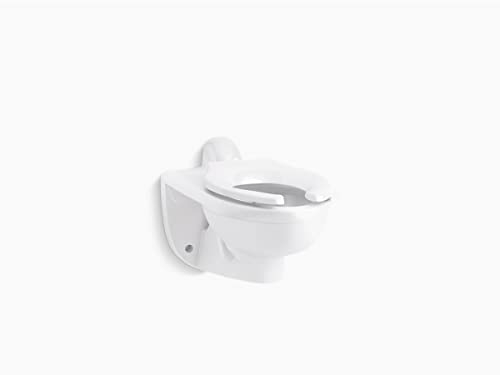
Kohler Kingston Ultra Wall-Mounted Flushometer Bowl — Best Estate Standard Bowl
Multi-site operators think in standards, and the Kingston Ultra is built to be one. As the updated member of Kohler’s long-running Kingston commercial family, it gives estates a modern wall-mounted rear-spud bowl that shares the family’s service logic while presenting a cleaner, more contemporary profile than the fixtures it replaces. Fit it across a portfolio and your maintenance teams carry one mental model, one spares shelf and one troubleshooting habit for every restroom you own.
The bowl itself does the commercial basics without theatre: elongated comfort for users, a rear-spud connection matching the dominant valve placement, and Kohler’s commercial china that tolerates aggressive cleaning chemistry. Like the TOTO above, it is sold as a bowl — an estate feature, not a flaw — letting you pair it with the manual or sensor valve your standard specifies. Water rating depends on the valve you pair, so estates chasing a portfolio-wide consumption figure should specify bowl and valve as one decision.
Pick the Kingston Ultra when the word standard appears in your brief: chains, franchises, campus estates and facilities firms who will thank themselves at every future repair that the bowl in room forty is the bowl in room four. Single-site buyers lose nothing by choosing it either — they simply gain a bowl whose support network is national.
Strengths
- Current-generation bowl from a deep, long-running commercial family
- Rear-spud elongated format matches standard commercial valve geometry
- Ideal standardisation pick — one bowl, one spares logic, every site
Trade-offs
- Bowl only — valve, carrier and seat specified separately
- Flush volume is set by the valve you pair, so specify as a system
- Commercial styling is purposeful rather than decorative
| Specification | Detail |
|---|---|
| Configuration | Wall-mounted flushometer bowl only |
| Spud | Rear spud |
| Bowl shape | Elongated |
| Line | Kohler Kingston commercial family |
Best for: multi-site operators standardising bowls across an estate / Not suited for: buyers wanting a complete, pre-matched system in one order
Check the current price on Amazon

Mansfield Quantum Elongated Pressure-Assist Toilet (1.6 GPF, Rear Outlet, ADA) — Best for Problem Drain Lines
Some commercial rooms defeat ordinary toilets twice over: the drain exits through the wall instead of the floor, and the run beyond it is long, old or nearly flat. The Mansfield Quantum was engineered for exactly that building. Its pressure-assist system drives waste with supply-line force rather than gravity’s optimism, and its rear-outlet configuration connects to wall drainage that floor-outlet toilets cannot use without reconstruction. The elongated bowl is ADA-height, making it a natural fit for the accessible stall in older premises where the plumbing is hardest.
Mansfield is a name commercial buyers know from specification sheets rather than advertisements, and the Quantum’s presence in institutional settings reflects that heritage. In service, pressure assist transforms marginal drainage: the jet scours the bowl and pushes the waste column decisively into the line, ending the double-flush and the weekly rodding that plague weak rooms. The 1.6 GPF rating is the honest cost of that force in this configuration — water is the fuel this platform spends to buy reliability.
Buy the Quantum when your building, not your preference, is talking: rear-outlet drainage, problem runs, accessible-stall duty. It is a specialist, priced and built like one, and in the premises it suits there is no substitute at any price that does not involve opening floors.
Strengths
- Rear-outlet design serves wall-drain commercial plumbing
- Pressure-assist jet powers waste through long or flat drain runs
- ADA-height elongated bowl suits accessible stalls in older buildings
Trade-offs
- 1.6 GPF — reliability is bought with water in this configuration
- Pressure-assist flush is forceful and audible
- Specialist configuration; confirm outlet geometry before ordering
| Specification | Detail |
|---|---|
| Configuration | Pressure-assist, rear outlet |
| Flush volume | 1.6 GPF |
| Height | ADA, elongated bowl |
| Flush system | Pressure-assist (QuantumOne platform) |
Best for: older commercial buildings with wall drains and weak drain runs / Not suited for: standard floor-outlet rooms, where simpler platforms do the job
Check the current price on Amazon

Kohler Wellworth Pressure Lite Elongated Toilet (1.1 GPF, Less Seat) — Best for Small Commercial Premises
A huge share of commercial restrooms are, plumbed underneath, houses: a floor flange, a half-inch stop, and a tank toilet that was never meant for Saturday-afternoon queues. The Wellworth Pressure Lite is the strongest honest answer for those rooms. Its pressure vessel hides inside a conventional tank and delivers a jet flush that clears like a valve fixture, while the installation remains a one-hour tank swap any plumber can price blindfolded. At 1.1 GPF it also undercuts the 1.28 benchmark, so the upgrade pays a small water dividend alongside the reliability one.
For a small business, the arithmetic is compelling: no wall opening, no carrier, no supply upgrade, no closed restroom for days — just a toilet that stops embarrassing the business. The elongated bowl keeps customers comfortable, and the Pressure Lite platform’s parts are a long-established service ecosystem. The listing is sold less seat, in the trade manner; order an open-front or closed commercial seat with it and the job is complete.
Respect the one personality trait: the flush is brisk and audible. In a compact café where the restroom door opens beside the tables, sample that sound mentally before committing — or embrace it, as many operators do, as the audible signature of a restroom that works. For small premises with real traffic, this is the pick that ends restroom complaints without a building project.
Strengths
- Valve-grade flush force on standard tank-toilet plumbing
- 1.1 GPF beats the efficiency benchmark while out-flushing gravity rivals
- One-hour swap installation — no walls opened, no restroom closure project
Trade-offs
- Flush is noticeably louder than a gravity toilet
- Sold less seat — add a commercial seat to the order
- Pressure vessel internals are platform-specific service parts
| Specification | Detail |
|---|---|
| Configuration | Two-piece pressure-assist tank toilet, less seat |
| Flush volume | 1.1 GPF |
| Bowl | Elongated |
| Flush system | Pressure Lite pressure-assist |
Best for: small commercial premises on residential-style plumbing / Not suited for: quiet dining rooms where the restroom adjoins the seating
Check the current price on Amazon
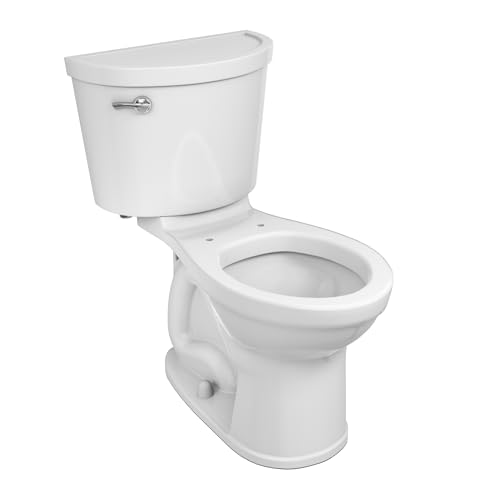
American Standard Champion PRO Round Front Toilet (1.28 GPF, Chair Height) — Best Budget for Commercial Use
Not every commercial toilet serves a crowd. Staff restrooms, small workshops, takeaways and service businesses need a fixture that survives employees, occasional customers and indifferent treatment, at a price that survives the accounts department. The Champion PRO round front is that fixture: American Standard’s professional line, with the Champion platform’s oversized flush valve and wide glazed trapway doing the anti-clog work, in a round-front bowl that fits the small rooms budget premises actually have, at a chair height adults appreciate, flushing an efficient 1.28 gallons.
The PRO designation matters more than the badge suggests. These are the models contractors buy repeatedly for commercial and rental work because their parts are universal, their china is heavy, and their warranty claims are rare enough to protect a tradesman’s reputation. In a small business, that translates to a toilet your local plumber can service from van stock on the first visit, forever — the true budget feature, since call-outs cost more than porcelain.
Know its ceiling: this is a gravity platform, and a genuinely busy public restroom will outgrow it. But for the long tail of small commercial premises — which is most commercial premises — the Champion PRO round front is the correct, honest spend, and its compact bowl will fit rooms the elongated picks cannot.
Strengths
- Champion anti-clog engineering in a professional PRO line model
- Round-front bowl fits small commercial restrooms and tight stalls
- Universal gravity parts — first-visit fixes from any plumber’s van stock
Trade-offs
- Gravity flush cannot match pressure-assist or flushometer clearing force
- Round front is less spacious for users than elongated bowls
- Intended for light-to-moderate commercial duty, not crowd venues
| Specification | Detail |
|---|---|
| Configuration | Two-piece tank toilet |
| Flush volume | 1.28 GPF |
| Bowl | Round front, chair height |
| Line | Champion PRO professional series |
Best for: staff restrooms and small businesses needing pro-grade on a budget / Not suited for: high-traffic public restrooms that need valve platforms
Check the current price on Amazon
Comparison Table
| Pick | Badge | Key spec | Best for |
|---|---|---|---|
| American Standard Afwall Selectronic Flowise Wall-Hung System (1.28 GPF) | Best Overall for Commercial Use | Wall-hung sensor system, 1.28 GPF | businesses building or gutting restrooms that customers judge them by |
| TOTO CT708UV Wall-Mounted Flushometer Bowl (1.0 GPF) | Best for High-Traffic Restrooms | Wall-mount bowl only, 1.0 GPF | high-traffic restrooms on an established flushometer valve platform |
| Kohler Kingston Ultra Wall-Mounted Flushometer Bowl | Best Estate Standard Bowl | Wall-mount bowl only, rear spud, elongated | multi-site operators standardising bowls across an estate |
| Mansfield Quantum Elongated Pressure-Assist Toilet (1.6 GPF, Rear Outlet, ADA) | Best for Problem Drain Lines | Pressure-assist rear outlet, ADA, 1.6 GPF | older commercial buildings with wall drains and weak drain runs |
| Kohler Wellworth Pressure Lite Elongated Toilet (1.1 GPF, Less Seat) | Best for Small Commercial Premises | Pressure-assist tank toilet, 1.1 GPF | small commercial premises on residential-style plumbing |
| American Standard Champion PRO Round Front Toilet (1.28 GPF, Chair Height) | Best Budget for Commercial Use | Two-piece PRO, 1.28 GPF, round front | staff restrooms and small businesses needing pro-grade on a budget |
How do these toilets perform across a year of commercial service?
Afwall Selectronic system across a year
The pattern owners report is reputational: restroom comments improve and stay improved, because the two experiences users remember — touching a handle and finding a missed flush — have been designed out. Service settles into batteries and an annual valve glance. The system’s first year usually converts the operator’s other restrooms to a renovation plan.
TOTO CT708UV across a year
Water meters make this bowl’s case quarterly. In high-traffic rooms the 1.0 rating shows up as a measurable utility trend, while the bowl itself simply endures the clean-count. Estates that pair it with a disciplined valve standard report the fewest restroom tickets per fixture in their portfolio.
Kingston Ultra across a year
Uniformity is the year’s story: one bowl everywhere means one training session, one spares shelf and one phone call for anything. Cleaners develop a single rhythm for every room. The Ultra’s value is the absence of variety, compounding quietly across every site that adopts it.
Mansfield Quantum across a year
The Quantum’s year is measured in call-outs that stop happening. Rooms that needed monthly rodding go quiet; the accessible stall stops being the problem stall. Owners forgive its water use the way they forgive a van’s fuel — it is the cost of the capability the building requires.
Wellworth Pressure Lite across a year
Small businesses describe the same arc: restroom complaints end in week one, and by month twelve nobody remembers the old toilet existed. The vessel asks for nothing in year one and the flush still clears Saturday queues. It is the upgrade that makes a small premises feel professionally run.
Champion PRO across a year
Staff restrooms fitted with the Champion PRO generate the facilities equivalent of silence. Its year is a story of universal parts and zero surprises — the occasional seat or flapper handled from van stock in minutes. For budget-led operators, that silence is the entire business case, delivered.
What a year teaches every operator
Across all six platforms, year one teaches the same lesson: the fixture was never the risk. The risks were the unlogged model, the unstocked kit, the unstandardised platform and the uninspected joint. Operators who close those four gaps in week one find that every pick in this guide — at every price — behaves like the professional equipment it is.
A note on specifying for new builds versus refits
New builds should default to the wall-hung flushometer systems: the carrier and supply costs are marginal inside a construction budget, and the operating dividends run for the building’s life. Refits should default to honesty about the existing platform — the best commercial toilet for a refit is usually the best version of what the wall already supports, upgraded in valve and bowl rather than converted at five times the cost. The picks above are ordered with both instincts in mind.
What should a business check before choosing commercial use toilets?
Begin with the unglamorous trio: plumbing, traffic and code. Establish whether each room runs flushometer supply or tank plumbing, and whether wall-hung carriers exist or would need building. Count flushes per day at peak, not on average — commercial fixtures fail reputations at peak. Then confirm your local code’s position on flush volume, accessible fixture dimensions and any backflow or valve requirements, because a fixture that delights you and fails inspection is an expensive ornament.
After the trio, think in systems. Bowl, valve, carrier and seat are one decision in the flushometer world; standardising them across your premises is worth real money in spares and training. In the tank world, the equivalent discipline is choosing one or two professional lines and staying with them. Scattered one-off fixtures are how a business ends up with six toilets, six seats and six different conversations with six suppliers.
How do cleaning and maintenance change the right answer?
Price a restroom by the year, not by the fixture. A wall-hung room that cleans in eight minutes against a floor-mount room that takes twelve is returning a cleaner’s hour every week, forever. A sensor valve that ends the unflushed-bowl complaint removes a category of customer dissatisfaction no air freshener reaches. A platform whose rebuild kit is in every wholesaler removes the closed-restroom day that costs a restaurant its lunch service. These are the numbers that separate the picks above, and they routinely outweigh the differences in purchase price within the first year.
Maintenance access deserves one specific question: can your caretaker isolate and service this fixture without a plumber? Flushometer valves and pressure vessels both allow in-place servicing with the water isolated at the fixture. Build that isolation check into the installation sign-off, and diarise the first annual inspection before the installers leave the building.
Which water volume is right for commercial use?
Current codes in most jurisdictions centre on 1.28 GPF for commercial fixtures, with 1.0 GPF platforms available where the valve and bowl are engineered as a pair, as the TOTO pick demonstrates. The saving from 1.28 to 1.0 is meaningful only where flush counts are high — run your own count before paying for the last increment of efficiency. Conversely, the Mansfield Quantum’s 1.6 GPF shows the legitimate exception: where drainage is the problem, water spent on force is water spent on reliability, and a blocked restroom consumes more of everything than a flushing one.
What about vandalism, abuse and unsupervised rooms?
Unsupervised public restrooms are a hostile environment by design brief. Answer with mass, metal and minimal exposed mechanism: heavy china, brass valve bodies, tamper-resistant seat hardware and wall-hung formats with nothing at floor level to kick, flood or pry. Every platform in this guide comes from lines built with that brief in mind, but weight your choice toward the flushometer systems if your rooms are unsupervised at night, and consider ligature-resistant fittings where a formal risk assessment requires them.
- Wall-hung flushometer formats for the fewest exposed parts
- Metal-bodied valves and tamper-resistant seat fixings
- Open-front commercial seats for hygiene and durability
- One standard platform across sites for spares and training
How long should a commercial toilet last in service?
The porcelain should be measured in decades; the working parts in service intervals. Valves are rebuilt, vessels serviced, seats replaced — the fixture is a platform, not a disposable. That is the deepest difference from residential thinking and the reason this guide favours long-running lines: a platform with a twenty-year production history will have parts at year fifteen, while a fashionable fixture may be orphaned by year five. When a supplier quotes you, ask what the same line looked like ten years ago. The answer predicts your restroom’s middle age better than any feature list.
How should a business budget a commercial restroom refit?
Budget the room, not the fixture. The honest schedule for a flushometer refit includes the fixture system, carrier work, wall making-good, valves, seats, the plumber’s setting and testing time, and the contingency every experienced operator adds for what the opened wall reveals. Tank-platform upgrades are lighter — fixture, seat, consumables, an hour or two of labour — which is why they dominate small-premises decisions. Presenting either budget as a single porcelain price is how refits stall halfway with a restroom out of service.
Then budget the decade: cleaning minutes per week multiplied by your labour rate, water by your flush count and tariff, one valve rebuild cycle, seats on a replacement rhythm, and one emergency call-out you hope not to make. Against that decade, the differences between the picks in this guide reorder themselves — the system that cleans fastest and standardises spares usually wins even when its first invoice is the largest. Operators who show their finance colleagues the decade view rarely get their specification argued with twice.
What do customers actually notice about a commercial restroom?
Research and common sense agree: cleanliness, a flush that works first time, a door that locks, and not having to touch anything unnecessary. Notice what is absent from that list — brand names, styling eras, feature novelties. Customers cannot see your flush valve’s engineering, but they experience its consequences in a room that is never found unflushed, never smells of neglect and never has a queue caused by a refilling tank. Specify for the experience list and the fixture list in this guide aligns itself: sensor valves, decisive flushes, fast-clean formats, and platforms that never take a room out of service waiting for an exotic part.
How to replace a commercial toilet with minimal downtime
Commercial replacement is a logistics exercise: the right fixture, the right parts, the right two hours. The sequence below assumes a like-for-platform replacement — the common case — and a competent plumber; platform changes belong in a planned renovation, not a Tuesday.
- Record the existing fixture completely before ordering: platform, bowl format, spud or outlet position, carrier or flange condition, supply size and seat type. Photograph everything, including the valve body markings.
- Order the fixture and every companion part as one schedule — bowl, valve or tank trim, carrier hardware if wall-hung, seat, seals — and confirm bowl-only listings are completed by the rest of the order.
- Schedule the swap in the premises’ quietest window and pre-warn customers or staff; stage the new fixture beside the room before the old one is touched.
- Isolate water at the fixture, remove the old unit, and inspect the carrier or flange with fresh eyes — this is the only cheap moment to repair what the old toilet was hiding.
- Set the new fixture, reconnect, and flush-test repeatedly under observation, checking every joint and the valve’s metering before the room returns to service.
- Log the new fixture in the asset register with model, valve, GPF and install date, and place the correct rebuild kit and a spare seat in the store room the same day.
Close the loop a week later with a five-minute inspection: joints dry, seat bolts firm, flush volume as specified, users reporting nothing. In commercial work, a week of silence from a restroom is the sound of a specification done right — and the baseline your maintenance rhythm exists to protect.
Keep the installer’s invoice, the fixture schedule and the valve documentation together in the building file. Audits, insurance questions and the next refit all start from that folder, and a business that can produce it in one minute is a business whose restrooms will never become an archaeology project.
Common Buying Mistakes
- Buying the bowl and forgetting the system. Flushometer bowls are components. A purchase order missing the valve, carrier or seat is a restroom that opens late.
- Specifying by purchase price alone. Cleaning minutes, water, call-outs and closed days are the real costs. The cheapest fixture is routinely the most expensive restroom.
- Mixing platforms across one estate. Every additional platform multiplies spares, training and troubleshooting. Standardise ruthlessly; variety is not a virtue in facilities.
- Ignoring peak traffic. Average-day thinking buys average-day fixtures. Your restroom is judged at your busiest hour — specify for it.
- Skipping the asset register entry. The person repairing this fixture in year seven needs its model and valve today. Thirty seconds of logging saves a closed restroom later.
- Choosing residential styling for unsupervised rooms. Delicate designer fixtures in hostile rooms are a recurring invoice. Commercial platforms exist because the environment demands them.
- Leaving the old seat on the new fixture to save a line item. A worn seat on a new commercial toilet makes the whole room read as tired. Seats are the cheapest visible surface in the restroom — renew them with the fixture, every time.
Final Recommendation
For a business building its restroom reputation, the Afwall Selectronic system is the complete answer: touchless, wall-hung, efficient and matched. High-traffic rooms on an existing valve platform should take the TOTO CT708UV bowl; estates standardising across sites, the Kohler Kingston Ultra. Buildings with rear drains and weak runs have exactly one honest pick here, the Mansfield Quantum, while small premises on tank plumbing should choose the Wellworth Pressure Lite for force or the Champion PRO round front for budget — and both will outperform the residential fixture they replace by a distance your customers will notice.
Whichever platform you choose, buy it as a system, log it as an asset and service it on a rhythm. Commercial toilets reward operators who treat them as infrastructure, and punish — slowly, publicly and at peak hour — those who treat them as furniture.
A closing word on timing: restrooms are cheapest to improve when the wall is already open or the old fixture has already failed, and most expensive as an emergency. If this guide has identified your platform, consider acting on the schedule your building chooses rather than the one a cracked bowl imposes — the same fixture, bought calmly with its full system on one order, is a different and better purchase in every way that matters.
- American Standard Afwall Selectronic System — Best Overall for Commercial Use: Check the current price on Amazon
- TOTO CT708UV Bowl — Best for High-Traffic Restrooms: Check the current price on Amazon
- Kohler Wellworth Pressure Lite — Best for Small Commercial Premises: Check the current price on Amazon
Keep researching within this range: Best Commercial Toilets Best Commercial Toilets For Home Best Compact American Standard Toilets Best 1.28 Gpf Toilets Best Pressure Assist Toilets
Frequently Asked Questions
What is the best toilet type for a restaurant restroom?
A wall-hung flushometer system, like the Afwall Selectronic pick, suits most restaurants: fast cleans, no missed flushes, no handles to touch. Small restaurants on tank plumbing get the closest experience from the pressure-assist Wellworth Pressure Lite.
Are sensor flush valves reliable enough for commercial use?
Yes — Selectronic-class valves are the standard in modern commercial buildings. Their maintenance is a battery schedule and periodic inspection, both simpler than the handle-and-chain failures they replace.
Do commercial toilets have to be ADA compliant?
Accessible stalls must meet accessibility requirements covering seat height, clearances and flush controls, and several picks here are ADA-height designs. Fixture choice is one part of stall compliance — confirm the whole room against your local code.
Why are so many commercial toilets sold as bowls only?
Because commercial buyers specify bowls, valves, carriers and seats as a system, often standardising each component across an estate. It is the professional way of buying — this guide flags every bowl-only listing so the full order is visible.
How many toilets does my business need?
Fixture counts are set by building and plumbing codes based on occupancy and use type, not by preference. Your architect or local code office sets the count; this guide helps you choose what those fixtures should be.
Can a pressure-assist toilet serve a busy public restroom?
For small-to-moderate premises, yes — the Wellworth Pressure Lite exists for exactly that duty. For sustained crowd traffic, flushometer platforms recover instantly between flushes and remain the correct specification.
What seat should a commercial toilet use?
Open-front seats without lids are the commercial norm for hygiene and durability, in heavy plastic or enamelled wood rated for commercial duty. Order the seat with the fixture — several listings here are sold less seat.
Should I choose the same toilet for every restroom in my business?
Where platforms allow, yes. Uniform fixtures mean uniform spares, training and user experience, and bulk leverage at purchase. The legitimate exception is the accessible stall or a problem-drain room, where a specialist like the Mansfield Quantum earns its difference.


