Disclosure: airfryerkitchensupply.com is reader-supported. When you buy through links on our site, we may earn an affiliate commission at no extra cost to you.
Where to buy
Every pick below is sold on Amazon and was verified against Amazon’s catalog data before this guide was published, so capacities and features stated here match the real listings. Compressor machines are a considered purchase, so use the links in this section to reach the verified version of each model, read the full reviews, and check the current price on Amazon there, because we do not print prices that will be stale within the month.
Whynter ICM-201SB Upright Ice Cream Maker, 2.1 Qt Compressor: Check the current price on Amazon · Cuisinart ICE-100 Compressor Ice Cream Maker, 1.5 Qt: Check the current price on Amazon · Breville Smart Scoop Ice Cream Maker BCI600XL: Check the current price on Amazon · Whynter ICM-200LS Ice Cream Maker, 2.1 Qt Compressor: Check the current price on Amazon · Whynter ICM-220SSY Ice Cream Maker and Yogurt Maker, 2 Qt: Check the current price on Amazon · Whynter ICM-128WS Ice Cream Maker with Compressor, 1.28 Qt: Check the current price on Amazon
The best commercial ice cream makers for creamy ice cream share one defining feature: a built-in compressor. Creaminess is mostly a battle against ice crystals, and crystals grow large when a base freezes slowly and unevenly, which is exactly what happens in a pre-frozen bowl that warms as it churns. A compressor machine holds a steady, deep freezing temperature from the first minute to the last, churning the base against constant cold so crystals stay microscopic and the texture stays dense and smooth. That is the commercial method scaled for a home counter, and it is why every pick in this guide is a compressor model rather than a freezer-bowl machine wearing a commercial label.
Be clear about what commercial means at this scale. These are not shop machines that produce gallons per hour; they are heavy, countertop compressor units, mostly in the one-and-a-half to two-quart class, built to run batch after batch without a day of pre-freezing between them. For serious home producers, small cafes, test kitchens and anyone developing recipes, that back-to-back ability is the real commercial trait. Six verified models are compared here, from an upright 2.1-quart workhorse to a compact 1.28-quart unit, and every capacity and feature below comes from the verified listing data.
Creaminess also lives in the recipe, and this guide does not pretend a machine can rescue a bad base. What a compressor buys you is control: consistent temperature, consistent churn time, and the ability to repeat a result exactly, which is the foundation all good ice cream is built on. The buying guide below covers the base science briefly, because choosing the machine and understanding the base together is how creamy ice cream actually happens.
In this guide
Quick Picks
All six are compressor machines. Choose by batch size and workflow: capacity for volume, paddles and programs for gelato and variety, footprint for small kitchens.
- Whynter ICM-201SB Upright Ice Cream Maker, 2.1 Qt Compressor — Best Overall: An upright 2.1-quart compressor machine with LCD display and timer, built for back-to-back batches. — Check price on Amazon
- Cuisinart ICE-100 Compressor Ice Cream Maker, 1.5 Qt — Best for Gelato and Variety: A 1.5-quart compressor machine with two paddles, one for ice cream and one for gelato, for texture range in a smaller batch. — Check price on Amazon
- Breville Smart Scoop Ice Cream Maker BCI600XL — Best Premium: Breville’s premium compressor machine, finished in brushed stainless steel, for buyers who want the most refined countertop option. — Check price on Amazon
- Whynter ICM-200LS Ice Cream Maker, 2.1 Qt Compressor — Best Value Compressor: The same 2.1-quart compressor class with LCD display and timer, in Whynter’s value-positioned automatic model. — Check price on Amazon
- Whynter ICM-220SSY Ice Cream Maker and Yogurt Maker, 2 Qt — Best for Yogurt Makers: A 2-quart compressor machine that also makes yogurt, with LCD digital display and timer. — Check price on Amazon
- Whynter ICM-128WS Ice Cream Maker with Compressor, 1.28 Qt — Best Compact Compressor: The smallest compressor machine here: 1.28 quarts, LCD display and timer, in white, for small kitchens that refuse freezer bowls. — Check price on Amazon
How These Picks Were Chosen
Every candidate was verified against Amazon’s catalog data, confirming model, capacity and compressor configuration. Only true compressor machines were eligible: models requiring a pre-frozen bowl were excluded from this guide regardless of marketing language, because the search asks for commercial-style production and creamy results, and steady freezing temperature is the mechanism that delivers both. Capacities and stated features below come only from the verified listings.
Judging criteria were freezing consistency, batch capacity, back-to-back workflow, and texture control. Freezing consistency means the machine holds its temperature through a full churn and across consecutive batches without a rest. Capacity was judged in finished quarts per batch and batches per session, the numbers a small cafe or a party actually consumes. Workflow covered pre-cooling, how the dasher and lid handle add-ins, and how the bowl removes and washes, because a machine that is miserable to clean between flavours will not be used for flavour three.
Texture control, the ability to aim at gelato density, soft serve softness or hard-scoop firmness, separated the top picks. Machines with dedicated paddles or hardness settings earned their places; simple one-program machines were judged on how well that one program does its job. Noise and footprint were recorded honestly, because compressor machines are loud enough and large enough that pretending otherwise helps nobody.
The 6 Best Commercial Ice Cream Makers for Creamy Ice Cream
Ordered by how most serious home producers should consider them. Each review covers batch workflow as much as features, because in this category the second and third consecutive batch reveal more than the first.
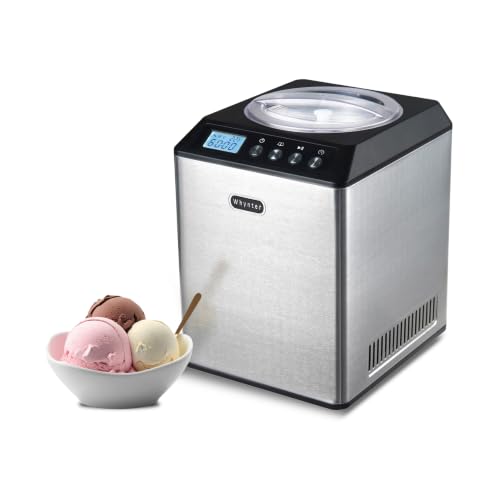
Whynter ICM-201SB Upright Ice Cream Maker, 2.1 Qt Compressor — Best Overall
The ICM-201SB is the workhorse pick: the joint-largest capacity in this guide in an upright format that uses counter depth rather than width, a compressor that needs no pre-freezing, and an LCD display with timer that makes batches repeatable. Upright matters in a working kitchen: the machine lives at the back of the counter, the bowl drops in from the top, and batch follows batch through an afternoon of production without the unit migrating around the kitchen.
Strengths
- 2.1-quart batches, the size serious production wants
- Compressor consistency for dense, fine-crystalled texture
- Upright footprint suits working counters and back bars
Trade-offs
- Heavy and tall; it claims a permanent counter home
- Compressor noise is real during the churn
- Overkill for occasional single batches
| Specification | Detail |
|---|---|
| Capacity | 2.1 quart |
| Freezing | Built-in compressor, no pre-freezing |
| Controls | LCD display and timer |
Creaminess is where this machine justifies itself. The compressor holds the bowl at a steady deep freeze while the dasher works, so a custard base sets into a dense, smooth texture with none of the iciness that creeps into the last ten minutes of a freezer-bowl churn. Run a second batch immediately and it behaves identically, which is the commercial trait home producers actually need when testing flavours side by side or producing for an event.
The timer and display sound like garnish and function as process control: dial in a churn time that produced the texture you liked, and the machine repeats it while you prep the next base. For a small cafe, a market stall or a household that has decided ice cream is a weekly production, this is the guide’s default recommendation. Check the current price on Amazon before buying; compressor pricing moves and the value case strengthens and weakens with it.
For market production, the upright format stacks workflow vertically: bases in a fridge below, machine at counter height, tubs hardening in a freezer beside it. Small producers consistently cite layout, not machinery, as their bottleneck.
Best for: Serious home producers and small cafes making multiple batches per session / Not suited for: Tiny counters, or anyone making ice cream twice a summer
Check on Amazon — check the current price on Amazon before you buy, because listings and included accessories change over time.

Cuisinart ICE-100 Compressor Ice Cream Maker, 1.5 Qt — Best for Gelato and Variety
The ICE-100 earns its place on a single thoughtful inclusion: two paddles. The gelato paddle churns more slowly and incorporates less air, producing the dense, low-overrun texture that defines gelato and that an ice cream dasher cannot imitate. Swap to the ice cream paddle for conventional churn. At 1.5 quarts with a built-in compressor, it is the variety machine: smaller batches, more styles, constant temperature.
Strengths
- Dedicated gelato paddle: genuine texture range in one machine
- Compressor consistency at a slightly smaller footprint
- Ideal batch size for recipe development
Trade-offs
- 1.5 quarts is the smaller working batch
- Two paddles means more parts to store and wash
- Volume producers will run it constantly and still want more
| Specification | Detail |
|---|---|
| Capacity | 1.5 quart |
| Freezing | Built-in compressor, no pre-freezing |
| Paddles | 2 paddles included (ice cream and gelato) |
Recipe developers should look hardest at this pick. A 1.5-quart batch is large enough to judge a recipe honestly and small enough to test three variations in an afternoon, each churned at the same temperature by the compressor, so the only variable is the recipe itself. The gelato paddle’s slower, denser result is not a marketing nuance; tasters notice it immediately, and sorbet and frozen yogurt also benefit from controlled overrun.
For a household whose ice cream life is variety rather than volume, a different flavour every week, gelato on Fridays, sorbet for the dairy-free guest, the ICE-100 is the most interesting machine in this guide. Producers feeding crowds should take the Whynter capacity instead and accept one texture done very well.
Keep a dedicated notebook page per paddle. Gelato and ice cream versions of the same flavour behave differently enough that separate, dated records for each prevent a season of confused re-testing.
Best for: Texture experimenters who make gelato as often as ice cream / Not suited for: Volume producers, who need the 2-quart class
Check on Amazon — check the current price on Amazon before you buy, because listings and included accessories change over time.

Breville Smart Scoop Ice Cream Maker BCI600XL — Best Premium
The Smart Scoop is the premium expression of the countertop compressor idea: Breville’s brushed stainless build, a design intended to live on the counter permanently, and the polish of a brand whose kitchen machines are bought as much for ownership pleasure as for output. It makes the same fundamental promise as every pick here, compressor-frozen, no pre-freezing, batch after batch, wrapped in the most finished package in the guide.
Strengths
- Premium build and finish; a display-worthy appliance
- Compressor workflow: no pre-freezing, repeat batches
- Strong brand support and accessory ecosystem
Trade-offs
- Premium pricing within this category
- Large and heavy like all compressor machines
- The ice cream itself is not automatically better than the Whynter’s
| Specification | Detail |
|---|---|
| Brand line | Smart Scoop |
| Finish | Brushed stainless steel |
| Freezing | Compressor (Smart Scoop line) |
Honesty about premium tiers matters: the Smart Scoop’s ice cream is excellent, and so is the Whynter’s. What the extra money buys is the object: finer materials, tighter fit, a control experience designed rather than assembled, and the confidence of Breville’s support network. For some buyers that is worth it every day the machine sits on the counter; for others it is money that should have bought ingredients.
Choose it if your kitchen is a place you invest in and your ice cream production is a settled habit, not an experiment. Newcomers to serious ice cream should prove the habit on a value compressor first, then upgrade with knowledge. Either way, check the current price on Amazon, because premium appliance pricing varies enough between promotions to change the calculation.
The Smart Scoop’s presentation suits open-kitchen and demonstration settings: a machine customers can watch working is marketing that runs on electricity and cream.
Best for: Buyers wanting the premium build and a machine that lives on display / Not suited for: Budget-led buyers; the value picks below produce excellent ice cream for less
Check on Amazon — check the current price on Amazon before you buy, because listings and included accessories change over time.

Whynter ICM-200LS Ice Cream Maker, 2.1 Qt Compressor — Best Value Compressor
The ICM-200LS is the value route into full-size compressor production: 2.1 quarts per batch, no pre-freezing, an LCD display and timer for repeatable churns, in Whynter’s automatic format. If the ICM-201SB is the workhorse, this is the same work at the keener position, and for many buyers the decision between them will come down to format preference and the price on the day, which is why both are here.
Strengths
- Full 2.1-quart compressor capacity at a value position
- Timer and display make batches repeatable
- Automatic operation suits unattended production
Trade-offs
- Finish and format are less refined than the upright model
- Same compressor noise and weight as the class
- Value pricing still means a serious purchase versus bowl machines
| Specification | Detail |
|---|---|
| Capacity | 2.1 quart |
| Freezing | Built-in compressor, no pre-freezing |
| Controls | LCD display and timer |
| Operation | Automatic |
In the bowl, this machine does the thing that matters: it freezes steadily and churns consistently, so custards set smooth and dense, and a second batch behaves like the first. The automatic operation suits a production rhythm, base in, program set, attention elsewhere until the timer calls. Small producers selling at markets or supplying a family that eats ice cream like a food group will find the capacity and consistency cover their needs completely.
The comparison with the upright ICM-201SB is about kitchen geometry and budget, not output. Measure your counter, decide which format lives better in it, check the current price on Amazon for both on the day, and buy accordingly. That is a boring decision process that produces a machine you will use for years.
Pair this machine with a second set of hands at events rather than a second machine: its batch rhythm means the constraint is usually base preparation and tub handling, not freezing capacity.
Best for: Producers wanting full capacity and compressor consistency at the value end / Not suited for: Buyers who prioritise the upright format of the ICM-201SB
Check on Amazon — check the current price on Amazon before you buy, because listings and included accessories change over time.

Whynter ICM-220SSY Ice Cream Maker and Yogurt Maker, 2 Qt — Best for Yogurt Makers
The ICM-220SSY adds a second craft to the compressor platform: yogurt making alongside ice cream, in a 2-quart machine with the family’s usual LCD display and timer. Dual-function appliances usually earn scepticism, but the pairing is logical here: the household that cultures yogurt weekly and churns ice cream on weekends is a real household, and one machine on the counter beats two.
Strengths
- Two genuine functions: compressor ice cream and yogurt
- 2-quart capacity serves family batches of either
- Display and timer keep both processes repeatable
Trade-offs
- Slightly smaller batch than the 2.1-quart picks
- Yogurt function is wasted money if unused
- Same size, weight and noise as the class
| Specification | Detail |
|---|---|
| Capacity | 2 quart |
| Freezing | Built-in compressor, no pre-freezing |
| Functions | Ice cream and yogurt |
| Controls | LCD digital display and timer |
The ice cream side is full Whynter compressor behaviour: steady freeze, dense texture, back-to-back batches, no pre-frozen bowl in the freezer for a day beforehand. The yogurt side turns the machine into a controlled incubation environment, and the household maths is simple: if yogurt is a weekly staple in your kitchen, this machine replaces a second appliance and earns its counter space twice.
If yogurt is a food you buy happily and never plan to make, buy the ICM-200LS or ICM-201SB instead and spend the difference on vanilla and cream. The verdict here is lifestyle arithmetic, not machine quality: for the dual-craft kitchen this is the smartest pick in the guide.
The yogurt function gives this machine a weekday job in households and small cafes alike: a fresh yogurt program through the week, ice cream for the weekend, one footprint earning daily.
Best for: Households that will genuinely use both ice cream and yogurt making / Not suited for: Single-purpose buyers paying for a function they will not touch
Check on Amazon — check the current price on Amazon before you buy, because listings and included accessories change over time.

Whynter ICM-128WS Ice Cream Maker with Compressor, 1.28 Qt — Best Compact Compressor
The ICM-128WS answers the compact question honestly: what is the smallest machine that still freezes with a real compressor? At 1.28 quarts it makes a couple’s batch, a tasting batch, a single flavour for tonight, with the same steady-temperature advantage as its bigger siblings and the same LCD and timer control. For small kitchens, compressor ice cream usually means accepting a big machine or not having it; this is the third option.
Strengths
- True compressor freezing in the smallest footprint here
- Perfect batch size for couples and recipe tests
- No pre-freezing, so spontaneous ice cream is possible
Trade-offs
- 1.28 quarts disappears fast in a family
- Cost per quart of capacity is the highest here
- White finish shows splashes and needs wiping
| Specification | Detail |
|---|---|
| Capacity | 1.28 quart |
| Freezing | Built-in compressor, no pre-freezing |
| Controls | LCD display and timer |
| Colour | White |
Small batches have a hidden virtue: freshness. A 1.28-quart batch is eaten within days, so the machine cycles often and the ice cream is always young, when texture is at its best. Recipe experimenters get the same benefit as with the ICE-100: cheap, fast iteration at honest scale. The compressor keeps each small batch’s texture at the standard the big machines set.
Buy it for a small household with a serious habit. Families should not, because a machine that needs three batches to fill a freezer tub teaches its owners to use it less. Match the batch to the table and this little compressor will be the hardest-working appliance in a small kitchen.
Small-batch machines make excellent flavour-of-the-day units alongside a bigger producer: the limited flavour runs on the little machine, the staples on the large one, and nothing is wasted.
Best for: Small kitchens and couples who want compressor quality in modest batches / Not suited for: Families or producers, who will find the batch small
Check on Amazon — check the current price on Amazon before you buy, because listings and included accessories change over time.
Comparison Table
All six freeze with compressors; the differences are batch size, texture tools and extra functions. Capacity is quoted per batch, and all six can run consecutive batches.
| Pick | Badge | Key spec | Best for |
|---|---|---|---|
| Whynter ICM-201SB Upright Ice Cream Maker, 2.1 Qt Compressor (Check price) | Best Overall | 2.1 Qt, built-in compressor, LCD display and timer | Serious home producers and small cafes making multiple batches per session |
| Cuisinart ICE-100 Compressor Ice Cream Maker, 1.5 Qt (Check price) | Best for Gelato and Variety | 1.5 Qt, built-in compressor, 2 paddles | Texture experimenters who make gelato as often as ice cream |
| Breville Smart Scoop Ice Cream Maker BCI600XL (Check price) | Best Premium | Compressor machine, brushed stainless steel finish | Buyers wanting the premium build and a machine that lives on display |
| Whynter ICM-200LS Ice Cream Maker, 2.1 Qt Compressor (Check price) | Best Value Compressor | 2.1 Qt, built-in compressor, LCD display and timer | Producers wanting full capacity and compressor consistency at the value end |
| Whynter ICM-220SSY Ice Cream Maker and Yogurt Maker, 2 Qt (Check price) | Best for Yogurt Makers | 2 Qt, built-in compressor, yogurt function, LCD display | Households that will genuinely use both ice cream and yogurt making |
| Whynter ICM-128WS Ice Cream Maker with Compressor, 1.28 Qt (Check price) | Best Compact Compressor | 1.28 Qt, built-in compressor, LCD display and timer | Small kitchens and couples who want compressor quality in modest batches |
The real divide is batch philosophy. The 2-quart-plus machines are production tools: fewer, larger batches, events and stocking a freezer. The 1.5 and 1.28-quart machines are variety tools: smaller, more frequent batches, more flavours, fresher ice cream. Neither is better; they serve different kitchens, and choosing the wrong philosophy is the expensive mistake in this category.
The second divide is texture control. The ICE-100’s gelato paddle and the premium Smart Scoop’s positioning serve buyers who think in textures; the Whynter workhorses serve buyers who think in quarts. Know which thinker you are before the price tempts you either way.
How to Choose a Commercial-Style Ice Cream Maker for Home Production
Confirm the compressor first and let everything else follow. A machine that needs its bowl frozen for a day before use is a different product with a different workflow, however commercial its styling. With a compressor, production is spontaneous and repeatable: base in, churn, next batch. Without one, production is a schedule. For creamy texture and any kind of volume, the compressor is the category.
Size by session, not by serving. Count how much ice cream your household or small business uses in a week and how many flavours you want in play. One flavour in quantity points to the 2.1-quart machines; three flavours in rotation points to the smaller, faster-cycling machines, which also keep every batch fresher. Remember that a batch is also a commitment: two quarts of a failed experiment is a lot of freezer space to apologise to.
- Volume and events: Whynter ICM-201SB or ICM-200LS, 2.1 Qt
- Variety and gelato: Cuisinart ICE-100 with two paddles
- Premium ownership: Breville Smart Scoop
- Ice cream plus yogurt: Whynter ICM-220SSY
- Small kitchen, real compressor: Whynter ICM-128WS
Finally, plan the machine’s home before it arrives. Compressor units are heavy, they vibrate gently, they need ventilation clearance around them, and they will not be carried to a cupboard between uses. Measure the counter, confirm the clearance, and accept the machine as a resident. A compressor maker that lives set up gets used weekly; one that must be fetched gets used monthly.
What Actually Makes Ice Cream Creamy
Creaminess is small ice crystals, and small ice crystals come from fast, steady freezing with constant agitation. A compressor holds the cold steady so crystals form small throughout the churn instead of growing during warm spells. The dasher’s job is to keep the freezing layer scraped off the bowl wall and folded back in, and to incorporate a controlled amount of air, the overrun. Too little air and ice cream is dense to the point of heaviness, gelato territory; too much and it is fluffy and melts to foam, the cheap commercial trick your palate already knows.
The base does the other half of the work. Fat coats the palate and softens texture; sugar and other dissolved solids depress the freezing point so the finished ice cream scoops instead of chipping; egg yolk emulsifies and adds the custard body most premium ice cream is built on. A compressor cannot fix a watery, under-sweetened base, and a great base in a warming freezer bowl will still freeze icy at the end of the churn. Machine and recipe are one system, which is why this guide pairs a compressor with the advice to weigh ingredients and chill the base thoroughly before churning.
Serving matters too. Ice cream stored hard in a deep freezer should be tempered in the fridge or on the counter briefly before scooping, so the texture you made is the texture you taste. Much ice cream accused of iciness is simply served ten degrees too cold, straight from the coldest corner of the freezer.
Running a Small Production Rhythm: Batches, Storage and Hygiene
Compressor ownership rewards a rhythm. Chill bases overnight so they enter the machine cold and churn faster and finer. Run flavours in a sensible order, lightest first, vanilla before chocolate before coffee, and many batches need only a wiped bowl between them rather than a full wash. Label every tub with flavour and date; production without labels becomes freezer archaeology within a month.
Storage containers matter more than their price suggests. Shallow, lidded tubs freeze the finished ice cream evenly and scoop kindly; press a layer of parchment or wrap onto the surface before lidding to prevent ice crystals forming on top during storage. Eat within a few weeks for best texture, because home freezers cycle temperature and slowly grow the crystals your compressor worked to keep small.
Hygiene is the commercial habit worth copying exactly. Custard bases are dairy and egg: cool them quickly, refrigerate them properly, and do not hold a base for days before churning. Wash the bowl, dasher and lid promptly after production, dry them fully, and keep the machine’s vents clear. A small producer’s reputation, even if the only customers are family, is built on this boring paragraph.
From Home Batches to Small Sales: What Changes at Commercial Intent
Some readers of this guide will sell what they make, at a market stall, a cafe counter or as a small local brand, and the step from home production to sale changes the obligations more than the technique. Food safety law, labelling and allergen disclosure apply from the first tub sold, and they vary by jurisdiction; the time to learn your local rules is before the first market, not after the first complaint. The machines in this guide are capable of sale-quality product, but capability is not compliance, and this guide flags the distinction deliberately.
Consistency becomes a commercial virtue in itself. A customer who loved last week’s vanilla expects the same vanilla this week, which is why the batch log recommended in the how-to section stops being a hobbyist’s notebook and becomes your production record: weights, churn times, temperatures, dates. Compressor machines earn their price here precisely because they remove the machine as a variable, leaving your recipe as the only thing to control.
Costing is the third change. A home producer counts ingredients loosely; a seller must know the cost per tub including base ingredients, mix-ins, packaging, energy and the stall fee, and must price for the batches that fail as well as the ones that sell. None of this diminishes the pleasure of the craft. It professionalises it, and the producers who thrive are the ones who professionalise the paperwork while keeping the making joyful.
Flavour Development on a Compressor Machine: A Method That Works
The compressor’s gift to flavour development is the controlled experiment, and a simple method turns casual batches into a personal recipe library. Change one variable per batch: the sugar level, the fat source, the steep time of a flavouring, the churn time. Record the change and the verdict in the batch log the same day, while your palate’s memory is accurate. Three batches into any flavour, you will know more about it than a shelf of recipe books can tell you, because the knowledge is calibrated to your machine, your ingredients and your taste.
Build flavours in families. A perfected vanilla base becomes the platform for a dozen variations, steeped, rippled and studded, each inheriting the base’s proven balance. A perfected chocolate base and a fruit sorbet base complete the working set most producers, home or small commercial, ever need. The smaller machines in this guide, the ICE-100 and the ICM-128WS, are the development tools: cheap, fast batches that fail inexpensively. The 2-quart machines are the production tools that scale the winners.
Taste at the right temperature or your notes will mislead you. Ice cream eaten straight from the churn is softer and tastes sweeter and less cold than the same batch hardened and tempered for serving. Judge development batches after hardening and a short temper, the state your household or customers will actually eat, and let the machine-side tasting be only a texture check.
Finally, develop for your water, your dairy and your sugar, not for an idealised ingredient list. Local cream varies, eggs vary, and the recipe that wins in your kitchen is the one tuned to them. This is the deepest reason to own the machine rather than buy the product: the tuning is yours, it compounds with every batch, and no shop, however good, is tuning for your table.
How to Use a Compressor Ice Cream Maker: First Batch to Back-to-Back Production
The workflow below applies across the picks, with paddle and program specifics noted where they differ.
- Chill the base thoroughly. Make your custard or base the day before and refrigerate it until fully cold. A cold base churns faster, freezes finer and tastes better; this step improves texture more than any machine setting.
- Pre-cool the machine. Run the compressor empty for a few minutes before adding the base, where the model allows, so the bowl is at full cold from the first contact.
- Churn with the right paddle and program. On the ICE-100, choose the gelato paddle for dense, low-air results and the ice cream paddle for standard churn. On timer models, set the time that produced your best texture last batch and repeat it.
- Add mix-ins late. Chocolate chips, nuts, ripples and fruit pieces go in during the final minutes, just long enough to distribute. Added early, they freeze rock-hard and batter the dasher.
- Judge doneness by texture, not the clock alone. Finished ice cream should be thick, smooth and holding soft peaks, firmer than soft serve, looser than a stored scoop. It hardens in the freezer; over-churning in the machine makes it grainy and buttery.
- Transfer and harden fast. Move the batch to a chilled, shallow lidded tub, press wrap onto the surface, and get it into the coldest part of the freezer promptly.
- Clean between flavour families. Wipe the bowl for similar flavours, wash fully when moving from strong flavours like coffee or mint to delicate ones, and dry everything before the next batch.
Keep a batch log, flavour, base recipe, churn time, result, for the first dozen batches. Commercial producers do this because memory lies and notebooks do not; by batch twelve you will own a personal settings chart worth more than any preset.
Common Buying Mistakes
Buying a freezer-bowl machine in commercial clothing. If the bowl must be pre-frozen for a day, it is not a compressor machine and cannot run back-to-back batches. Check the freezing method before the styling persuades you.
Churning a warm base. A warm base takes longer to freeze, grows larger crystals and comes out icy no matter how good the machine is. Chill bases overnight; there are no shortcuts that work.
Over-churning for firmness. Ice cream should leave the machine at soft, thick consistency and harden in the freezer. Churning until it looks scoop-hard in the bowl produces grainy, buttery texture.
Ignoring batch-size philosophy. A 2.1-quart machine in a two-person home makes freezer-filling batches that age badly; a 1.28-quart machine in a cafe is a bottleneck. Match batch to consumption.
Storing in deep, uncovered tubs. Surface crystals and freezer flavours ruin good batches in storage. Shallow lidded tubs with wrap pressed on the surface keep the texture you made.
Skipping the ventilation and counter plan. Compressors need airflow and a permanent home. A machine boxed in a hot corner works harder, freezes slower and lives shorter.
Final Recommendation
For most serious home producers the Whynter ICM-201SB is the recommendation: full 2.1-quart batches, upright format, steady compressor freezing, batch after batch. The ICM-200LS delivers the same class at the value position, the ICE-100 is the texture explorer’s machine with its gelato paddle, the Smart Scoop is the premium object, the ICM-220SSY serves the ice-cream-and-yogurt household, and the ICM-128WS proves a small kitchen can still freeze with a compressor.
Check the current price on Amazon for your shortlist, measure the counter the machine will live on, and chill your first base the night before it arrives. Creamy ice cream is a system, cold steady freezing, a sound base, a sensible rhythm, and every machine here can be the centre of that system for years.
A closing note on value, because compressor machines ask for real money and deserve a real justification. The comparison that matters is not machine against machine but machine against the alternative: premium ice cream bought by the tub, week after week, year after year, in the quantities a serious household consumes. Against that baseline, a compressor maker that serves for a decade pays for itself in the arithmetic of ordinary grocery shopping, and everything after the payback point, the flavour control, the ingredient control, the ability to make the exact ice cream your household loves that no shop sells, is pure gain. The payback is faster for the value Whynter picks and slower for the premium Breville, and buyers should run their own household’s numbers honestly rather than borrowing this guide’s enthusiasm. What cannot be priced as easily is the capability itself: the dinner party dessert made that morning, the child’s flavour invented and churned the same afternoon, the small business that starts as a Saturday experiment. Machines in this guide are bought for texture, for creaminess, for production, but they are kept for capability, and capability compounds. Choose the capacity and the texture tools that match your ambitions, chill your first base tonight, and the machine will begin making its case tomorrow.
And if this is your first compressor machine, give yourself the grace of a learning month. The first batches teach the machine’s timing, the second week teaches your base, and by the end of the month most owners are producing ice cream they would happily serve to their most critical friend. That trajectory, from capable to genuinely excellent, is the real product being bought here, and every pick in this guide is capable of carrying you along it.
Shortlist for quick checking: Whynter ICM-201SB Upright Ice Cream Maker, 2.1 Qt Compressor: Check on Amazon · Cuisinart ICE-100 Compressor Ice Cream Maker, 1.5 Qt: Check on Amazon · Breville Smart Scoop Ice Cream Maker BCI600XL: Check on Amazon · Whynter ICM-200LS Ice Cream Maker, 2.1 Qt Compressor: Check on Amazon · Whynter ICM-220SSY Ice Cream Maker and Yogurt Maker, 2 Qt: Check on Amazon · Whynter ICM-128WS Ice Cream Maker with Compressor, 1.28 Qt: Check on Amazon.
Keep researching within this series: Best Ice Cream Makers, Best Ice Makers, Best Clear Ice Cube Makers, Best Gelato Makers, Best Frozen Yogurt Makers.
Related guides
Frequently Asked Questions
Why does a compressor make creamier ice cream?
It holds a steady, deep freezing temperature through the whole churn, so ice crystals form small and stay small. Freezer-bowl machines warm as they churn, letting crystals grow in the final minutes, which is when iciness develops.
What batch size should I choose?
Match the batch to a week of eating. Two-quart machines suit families, events and small-scale selling. Batches of 1.5 quarts and below suit couples, variety seekers and recipe developers, and stay fresher because they are eaten sooner.
Can these machines run back-to-back batches?
Yes, that is the defining advantage of a compressor. There is no bowl to re-freeze for a day between batches, so you can churn flavour after flavour in one session, wiping or washing the bowl between flavour families.
What is the difference between the ice cream and gelato paddles?
The gelato paddle, included with the Cuisinart ICE-100, churns to incorporate less air, producing a denser, lower-overrun texture. The standard ice cream paddle incorporates more air for a lighter, more conventional scoop.
Do I still need to chill my base first?
Yes. A thoroughly chilled base freezes faster and finer in any machine. Make custard bases the day before, refrigerate until fully cold, and your texture will improve more than any other single change can achieve.
How long does homemade ice cream keep?
For best texture, eat within a few weeks, stored in a shallow lidded tub with wrap pressed onto the surface. Home freezers cycle temperature, which slowly grows ice crystals, so even perfect ice cream gradually loses its edge.
That is the standard this guide has applied throughout: steady cold, honest capacity, and texture you can repeat on demand, batch after batch, season after season, without exception.