Disclosure: airfryerkitchensupply.com is reader-supported. When you buy through links on our site, we may earn an affiliate commission at no extra cost to you.
Where to buy
Every pick in this guide to the best comfy womens slippers was cross-checked against Amazon’s own catalog data before it earned a link, so the buttons below go to the exact product described — not a look-alike listing. Prices in this category move often, so each pick simply asks you to check the current price on Amazon rather than trusting a number printed here that could be stale by the time you read it.
- UGG Women’s Coquette Slipper (Best Overall) — Check the current price on Amazon
- Dearfoams Women’s Leslie Terry Clog (Best Washable) — Check the current price on Amazon
- Acorn Women’s Moc Slipper (Best Moccasin) — Check the current price on Amazon
- RockDove Women’s Original Two-Tone Slipper (Best Value Memory Foam) — Check the current price on Amazon
- RockDove Women’s Trapper Moc (Best Warm Moccasin on a Budget) — Check the current price on Amazon
- Vionic Women’s Gemma Mule Slipper (Best Structured Support) — Check the current price on Amazon
The best comfy womens slippers share a short list of honest virtues: a closed, foot-hugging shape that stays on without toe-gripping, cushioning that supports rather than swallows the foot, a lining that warms without cooking, and a sole with enough substance for the school run to the mailbox. This guide shortlists only closed slippers — moccasins, clogs, mules and plush closed-back styles — because open sandals, slides and flip-flops are a different product wearing a slipper’s name, and ballet-style flats offer neither warmth nor cushion worth the word ‘comfy.’
Every pick below was confirmed against Amazon’s catalog data in a stated women’s size before receiving a link. The six span the real spectrum of what women actually want from a house shoe: shearling luxury, washable memory foam practicality, structured support for long standing days, and the moccasin that has quietly become the default gift of the holiday season. Comfort claims here stay exactly that — comfort claims. No pick is presented as treating any foot condition; where a design offers structured arch support, it is described as a fit preference, because that is what it honestly is.
Read the fit notes with your own feet in mind: slippers are sized in ranges, linings pack down over the first weeks, and the difference between a slipper that feels snug on day one and perfect on day twenty is the difference between shearling and foam. Each review says which break-in story you are buying.
In this guide
Quick Picks
If you only have a minute, these are the six shortlisted options for the best comfy womens slippers, each chosen for a different kind of buyer. The full reviews further down explain who each one suits and where each one compromises.
- UGG Women’s Coquette Slipper — Best Overall. The shearling benchmark: a plush sheepskin-lined mule on a proper sole, in the chestnut colourway that defined the category. — Check price on Amazon
- Dearfoams Women’s Leslie Terry Clog — Best Washable. A washable memory foam terry clog, available in wide widths — the practical pair that goes in the machine and comes back ready. — Check price on Amazon
- Acorn Women’s Moc Slipper — Best Moccasin. A ragg-wool moccasin with memory foam and an indoor-outdoor sole — the campsite-to-couch classic in dark charcoal heather. — Check price on Amazon
- RockDove Women’s Original Two-Tone Slipper — Best Value Memory Foam. The people’s memory foam slipper: two-tone slip-on, machine washable, non-slip indoor-outdoor sole — in eggplant, sized 7-8 in this listing. — Check price on Amazon
- RockDove Women’s Trapper Moc — Best Warm Moccasin on a Budget. A chestnut moccasin-style RockDove with memory foam and an indoor-outdoor sole — the warm, enclosed, washable all-rounder. — Check price on Amazon
- Vionic Women’s Gemma Mule Slipper — Best Structured Support. A flannel mule built on Vionic’s structured three-zone comfort footbed — the slipper for women who stand all day and feel it. — Check price on Amazon
How These Picks Were Chosen
Style eligibility came first, per the rule of this category: only closed slippers — moccasin, plush, shearling, memory-foam, clog and mule constructions — were considered; sandals, slides, flip-flops, ballet flats and massage shoes were excluded outright, however comfortable their listings claimed to be. Each surviving candidate then had to be a genuine women’s product, confirmed in catalog data with women’s sizing, before it could receive a link.
Comfort was judged on the mechanics that produce it: footbed material and thickness, whether the shape holds the foot without gripping, lining warmth versus breathability, and sole substance for hard floors and quick outdoor steps. Washability and durability of the upper completed the picture — a comfy slipper that cannot be cleaned or that flattens in a month is a short romance, and the reviews say so where it applies.
The 6 Best Comfy Women’s Slippers
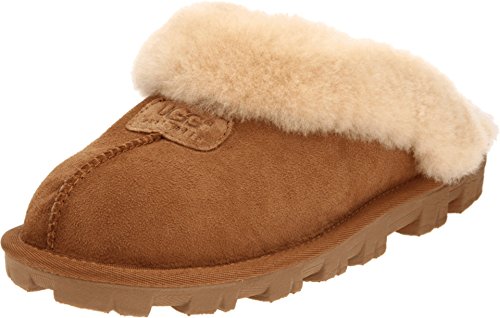
UGG Women’s Coquette Slipper — Best Overall
The Coquette is the slipper other slippers are compared to, and one wear explains it: real shearling lining that regulates temperature instead of just insulating, a moulded footbed that firms up into the shape of your foot, and a sole substantial enough for the driveway. As a backless mule it slips on in one motion — the 6 a.m. test every house shoe must pass. It suits women who wear slippers for hours daily and want one excellent pair rather than a rotation of mediocre ones. Size note from long experience with the style: shearling packs down, so a snug first fit is the right fit.
Strengths
- Genuine shearling lining — warm in winter, breathable in summer
- Moulds to the foot over the first weeks of wear
- Substantial sole handles quick outdoor steps
Trade-offs
- Premium tier position in this guide
- Shearling needs a brush and airing, not a washing machine
- Backless mule style is not for stair-dashers who want a heel grip
| Style | Closed-toe mule slipper |
| Lining | Shearling |
| Colour/size verified | Chestnut, women’s 7 |
Judge the Coquette at week three, not hour one: the shearling compresses into a personal footbed and the whole slipper becomes unmistakably yours. It is also the most giftable object in this guide — the pair that recipients wear daily for years. If your budget stretches to one premium pair, this is the pair the category is named after.
A word on colour: chestnut is not just the classic choice, it is the practical one — it hides the dust of daily house wear better than the pale colourways while showing less lint than black. And a care note that extends its life years: keep the Coquette away from radiators and direct heat when wet. Shearling dried gently at room temperature stays supple; shearling baked dry cracks. The slipper rewards the same patience it teaches.
Best for: All-day slipper wearers and gift buyers / Not suited for: Anyone needing machine-washable footwear

Dearfoams Women’s Leslie Terry Clog — Best Washable
Dearfoams’ Leslie solves the problem shearling cannot: life is messy, and slippers absorb it. This terry clog is built to be machine washed, its memory foam footbed cushions tile and hardwood kindly, and — a detail wide-footed women will appreciate — it comes in wide widths rather than asking wide feet to size up and slop around. It suits busy households, pet owners, and anyone whose slippers double as garden-door and laundry-room shoes. The clog shape stays on better than a mule while still slipping on hands-free.
Strengths
- Machine washable — the hygiene pick of the guide
- Memory foam cushioning over hard floors
- Wide widths available, not just longer sizes
Trade-offs
- Terry is cosy rather than luxurious
- Memory foam softens and flattens faster than shearling
- Clog styling is practical, not elegant
| Style | Closed clog slipper |
| Footbed | Memory foam |
| Care | Machine washable |
| Widths | Wide widths available |
The Leslie is the slipper you will actually wear most, because it asks the least of you: kick them off by the machine, wash with the towels, wear them again. For households with dogs, kids or mud seasons, that washability is worth more than any lining. Buy it as your daily driver and let fancier pairs be the treat.
The wide-width availability deserves emphasis because it is rarer than it should be: most slipper brands treat width as length, forcing wide feet into sizes that flop at the heel. A true wide clog keeps the heel seated and the toes uncramped — the difference between a slipper that is worn all day and one that is kicked off under the desk by ten. If standard slippers have always felt like a compromise, this is the pick that ends it.
Best for: Busy households, pet owners and wide feet / Not suited for: Buyers wanting a premium natural-material feel

Acorn Women’s Moc Slipper — Best Moccasin
Acorn’s moc is the slipper equivalent of a good wool sweater: a ragg wool upper that breathes and shrugs off wear, memory foam underfoot, and a sole rated for the porch, the woodpile and the campsite as well as the kitchen. The moccasin shape encloses the foot fully — warmer and more secure than a mule — and the heathered wool hides the evidence of an active life. It suits women whose slippers work indoors and out: cabin weekends, garden mornings, dog doors at dawn.
Strengths
- Ragg wool upper — durable, breathable, forgiving of wear
- Full moccasin enclosure stays on securely
- Indoor-outdoor sole for real errands to the yard
Trade-offs
- Wool warmth is too much for some in summer
- Memory foam footbed flattens over long ownership
- Rustic look will not suit every wardrobe
| Style | Moccasin slipper, closed back |
| Upper | Ragg wool |
| Sole | Indoor-outdoor |
This is the pair to leave by the door you actually use. The Acorn’s charm is that it never asks to be babied: wool and a real sole take the outdoors in stride, and the foam keeps kitchen standing comfortable. If your home life flows across the threshold all day, the moc outperforms daintier slippers by simply surviving your routine.
The ragg wool upper has a second talent: temperature honesty. Wool warms without the clamminess synthetics can produce, because it breathes and handles moisture gracefully — which is why the Acorn is the pick for women whose feet run hot in plush but cold in knit. It is the slipper equivalent of natural fibres everywhere: less dramatic on day one, more comfortable on day one hundred.
Best for: Indoor-outdoor households, cabins and campers / Not suited for: Hot sleepers wanting a cool summer slipper

RockDove Women’s Original Two-Tone Slipper — Best Value Memory Foam
RockDove’s Original is the slipper that converted a generation of foam sceptics: a proper memory foam footbed in a closed slip-on shape, a waffle-knit-style two-tone upper that breathes better than plush, and a rubber sole that grips kitchen tile and survives the mailbox run. It is machine washable, lightweight and honestly priced within its tier. It suits first-time slipper buyers, students, and anyone stocking a guest room — the pair that makes everyone who tries it understand the category.
Strengths
- Machine washable and quick to return to service
- Non-slip indoor-outdoor sole
- Breathable knit-style upper suits warmer homes
Trade-offs
- Foam comfort fades sooner than shearling or structured footbeds
- Sized in ranges — between-sizes feet must choose thoughtfully
- Knit upper offers less warmth than plush or wool
| Style | Closed slip-on |
| Footbed | Memory foam |
| Care | Machine washable |
| Colour/size verified | Eggplant, 7-8 |
Buy the RockDove as the benchmark of value: everything it promises — cushion, grip, washability — it delivers without theatre. Its foam will eventually flatten, as all foam does, and at its tier position replacing it is a shrug rather than a tragedy. For most households this is the rational default, and the fancier picks above are upgrades from a genuinely good baseline.
Guest-room duty is this slipper’s secret career: a washable, forgiving, one-size-fits-most-visitors pair that hosts can launder between guests without a thought. Households that entertain often keep a spare pair for exactly this — it is the hospitality equivalent of the good guest towel. At its tier, that is a rational purchase, not an extravagance.
Best for: Value buyers, guests rooms and first slippers / Not suited for: Buyers wanting a decade-long pair

RockDove Women’s Trapper Moc — Best Warm Moccasin on a Budget
The Trapper Moc takes RockDove’s proven foam platform and wraps it in a full moccasin: more warmth around the foot, a more secure fit for stairs and busy mornings, and the classic chestnut moc look that pairs with everything from pyjamas to jeans. It remains machine washable with a non-slip indoor-outdoor sole, which is a rare combination — most warm mocs, the Acorn included, ask for gentler care. It suits cold houses, draughty floors and anyone who wants one warm pair that can also be thrown in the wash.
Strengths
- Full moccasin warmth with machine washability
- Memory foam comfort, non-slip indoor-outdoor sole
- Secure enclosed fit for stairs and active mornings
Trade-offs
- Warmer than some feet want in mild weather
- Foam lifespan caveat applies as with all foam picks
- Range sizing again — check the chart carefully
| Style | Moccasin slipper |
| Footbed | Memory foam |
| Care | Machine washable |
| Colour/size verified | Chestnut, 6.5-7.5 |
Between the two RockDoves, choose by climate: the open-knit Original for warmer homes, the Trapper for cold floors and winter. Between the Trapper and the Acorn, choose by care: the Acorn’s wool is the finer material, the Trapper’s washability is the finer lifestyle fit. That honest fork is exactly why both are in this guide.
Stair households, note the Trapper’s fit advantage concretely: the enclosed moccasin heel means the slipper comes with your foot on every step, unlike mules that trail a half-beat behind. Add the non-slip sole and this is the pair for homes where slippers are worn actively — cooking, tidying, carrying laundry — rather than purely for sofa duty. Activity level, honestly assessed, should drive the mule-versus-moc decision more than looks.
Best for: Cold floors and wash-and-wear households / Not suited for: Warm-climate wearers — see the Original instead

Vionic Women’s Gemma Mule Slipper — Best Structured Support
Most slippers cushion; the Gemma supports. Its built-in orthotic-style insole is contoured — arch, heel cup and forefoot zones shaped rather than flat — which many women who stand on hard floors all day find transforms evening comfort. The black flannel upper keeps it looking like a shoe you meant to wear, and the mule shape keeps it a true slip-on. To be precise about claims: this is a comfort and fit design, not a medical device, and this guide recommends it to women who simply know they prefer structured support in their footwear — as many do, from their trainers to their boots.
Strengths
- Contoured three-zone footbed with real arch structure
- Flannel upper looks tidy enough for the doorbell
- Heel cup stabilises the foot instead of letting it roll
Trade-offs
- Structured feel is wrong for lovers of pillowy softness
- Premium-specialist tier position
- Mule shape — no heel retention for fast stair work
| Style | Mule slipper |
| Footbed | Three-zone comfort orthotic-style insole |
| Upper | Flannel, black (verified listing) |
The Gemma is the answer to a specific sentence: ‘my feet are tired by evening even at home.’ If your daytime shoes are supportive and your slippers are flat foam, the contrast alone can be the problem — this mule keeps the support story consistent around the clock. If you love sinking into plush, buy the Coquette and be happy; the Gemma is for the other tribe, and it serves them better than anything else here.
Expect an adjustment period if you arrive from flat foam slippers: a contoured footbed feels present — even bossy — for the first several wears, then becomes the thing your feet seek. Give it a week of evenings before judging. Women who make that adjustment rarely go back, because the Gemma effectively extends their supportive-footwear day to the front door’s inside. Women who still miss the sink-in feeling after a week have learned their tribe, and the Coquette awaits.
Best for: Women who prefer structured, supportive footwear / Not suited for: Plush-pillow slipper lovers
Comparison Table
| Pick | Badge | Key spec | Best for |
|---|---|---|---|
| UGG Women’s Coquette Slipper Check price on Amazon | Best Overall | Shearling mule, moulded footbed | All-day slipper wearers and gift buyers |
| Dearfoams Women’s Leslie Terry Clog Check price on Amazon | Best Washable | Washable terry clog, wide widths | Busy households, pet owners and wide feet |
| Acorn Women’s Moc Slipper Check price on Amazon | Best Moccasin | Ragg wool moc, indoor-outdoor sole | Indoor-outdoor households, cabins and campers |
| RockDove Women’s Original Two-Tone Slipper Check price on Amazon | Best Value Memory Foam | Washable memory foam slip-on | Value buyers, guests rooms and first slippers |
| RockDove Women’s Trapper Moc Check price on Amazon | Best Warm Moccasin on a Budget | Warm moc, washable, foam footbed | Cold floors and wash-and-wear households |
| Vionic Women’s Gemma Mule Slipper Check price on Amazon | Best Structured Support | Contoured support footbed, flannel mule | Women who prefer structured, supportive footwear |
How to Choose the Best Comfy Womens Slippers
Decide your footbed philosophy first, because it predicts satisfaction better than any upper material. Cushion people want memory foam or shearling — a surface that yields. Support people want structure — a contoured insole like the Vionic’s that holds the arch and cups the heel. Neither is healthier in the abstract; they are different definitions of comfort, and most women know their tribe from their shoe rack. If your favourite trainers are plush, buy plush slippers. If they are structured, buy the Gemma and ignore the foam entirely.
Then match the shape to your life. Mules and clogs slip on hands-free and suit constant on-off wear, but offer no heel retention. Closed-back moccasins and slip-ons stay on through stairs, ladders and lively toddlers, and keep heels warm in cold houses. Finally, the sole: a thin fabric sole is a bedroom-only shoe, while the rubber indoor-outdoor soles on most picks here handle hard floors, garages and garden paths — the difference between a slipper and a house shoe you can actually live in.
Sizing and the break-in truth
Slippers are sold in whole sizes or ranges (7-8, 9-10), so between-size feet must make a judgement call: with foam and knit uppers, size down if between — they relax. With shearling, the first fit should feel snug, because the lining packs down into your foot’s shape over two weeks; a Coquette that feels perfect in the shop doorway will feel loose by month two. Wide feet should look first at Dearfoams’ wide widths rather than sizing up into sloppiness.
Lining materials, honestly compared
Shearling is the connoisseur’s lining: warm, breathable, durable for years, and not washable. Plush synthetics are soft and cheap and flatten fastest. Terry (the Dearfoams) is the washer’s friend. Wool (the Acorn) breathes and endures but runs warm. Flannel (the Vionic) is the tidy middle. There is no best lining — there is your climate, your laundry habits and your budget, in that order.
Making Slippers Last
Rotate two pairs if you wear slippers daily — foam and shearling both recover loft when rested a day between wears. Air any pair overnight outside the bathroom’s humidity. Wash the washable ones on the schedule their makers allow, and never machine-wash shearling or wool mocs that do not ask for it. Brush shearling occasionally, shake out knit uppers weekly, and retire a pair when the footbed stays flat or the sole smooths out — a worn-smooth sole on kitchen tile is a fall waiting for a wet patch.
How to Break In and Care for New Slippers
The first fortnight decides whether a pair becomes beloved or gets returned. This routine stacks the odds.
- Wear them in short sessions first. An hour or two around the house for the first few days lets foam mould and shearling begin packing to your foot without overwhelming either material — or your feet.
- Expect the shearling squeeze. If you bought the Coquette or any shearling pair, a snug start is correct. Judge the fit at day ten, not day one; the lining will have sculpted itself by then.
- Keep them dry inside. Slippers absorb foot moisture nightly. Air them outside the steamy bathroom, and if you wear them barefoot daily, a light sprinkle of foot powder in the pair — or socks — extends freshness considerably.
- Wash only the washable. Dearfoams and RockDove pairs go in the machine on gentle, then air dry. Shearling gets a brush and fresh air; wool mocs get spot cleaning. The fastest way to kill a good slipper is a well-meant hot wash.
- Check soles monthly. Run a thumb over the tread. Smooth soles on hard floors are a safety issue, not a cosmetic one — that is the retirement signal.
Follow this and the pairs in this guide will pay back their tier positions in years of daily comfort — the only metric slippers are truly bought on.
Slippers for Hard Floors, Soft Floors and Everything Between
Floor type quietly decides slipper satisfaction. On tile, stone and hardwood — the modern home’s default — you need both cushion and grip: foam or structured footbeds over rubber soles, exactly the profile of most picks here. On carpeted homes, thinner soles and lighter uppers suffice, and the priority shifts to not overheating. On mixed floors with a garden beyond, the indoor-outdoor sole stops being a luxury and becomes the product.
Standing time matters as much as surface. A slipper for sofa evenings can be pure plush; a slipper for cooking, crafting and childcare — hours of standing — needs the footbed story told in this guide’s choosing section. Be honest about which life your slippers will actually live: most women’s slippers are workwear for the home, and they should be bought with the same seriousness as work shoes, because the hours are comparable.
The Gift-Buyer’s Guide to These Six Pairs
Slippers are among the most-given and most-worn gifts in the home category, and the six picks sort neatly by recipient. The safe luxury: the UGG Coquette, sized snug. The practical delight: the Dearfoams Leslie, especially in wide for the recipient who never finds wide. The outdoorsy daughter or cabin owner: the Acorn moc. The can’t-go-wrong value: either RockDove, chosen by climate. The standing-all-day professional — nurse, teacher, chef, retail — whose feet are her livelihood: the Vionic Gemma, with a gift receipt and the one-week adjustment note passed along kindly.
Two gift rules from hard experience. First, when between sizes, follow the material: size down for foam and knit, keep true or snug for shearling. Second, a washable pair given to a new parent is worth two luxury pairs — timing is a feature. The best slipper gift is the one still in daily service next winter, and every pick here has a recipient for whom that is exactly what happens.
Slippers Through the Seasons
A one-pair household asks its slippers to be four products a year, and the picks divide the seasons honestly. Deep winter belongs to the enclosed and the lined: the Trapper Moc, the Acorn, the Coquette with its temperature-regulating shearling. Spring and autumn — the on-off, door-open months — suit the clogs and mules: Dearfoams Leslie, Vionic Gemma, on in a second for the school run of household tasks. Summer is where most slippers fail their owners: hot feet in plush. The RockDove Original’s breathable knit upper is this guide’s warm-weather answer, and the Coquette’s shearling surprises many by regulating rather than roasting.
If your home has cold floors year-round — stone, tile, a draughty old house — ignore the calendar and buy for the floor. If your home runs warm, weight breathability over lining in every season. The calendar is a hint; your house is the fact.
When to Replace Your Slippers (and Why It Matters)
Three retirement signals, in order of importance. First, the sole: once the tread smooths, hard floors become a fall risk, and no amount of upper beauty justifies it. Second, the footbed: foam that stays compressed, or a structured insole that has cracked or flattened, no longer does the job you bought — your feet will report this as end-of-day tiredness you blame on everything else. Third, hygiene that washing cannot restore: a washable pair that still smells after a proper wash and full dry has reached the end of its materials’ story.
Replacing on signal rather than on schedule is both safer and cheaper: shearling pairs commonly serve for years, foam pairs for a year or two of daily wear, and both die honestly when their signals appear. The habit to build is the monthly sole check from the care section — ten seconds that keep the whole category safe.
Verdict by Foot and Lifestyle
The all-day home worker whose floor is her office: the Vionic Gemma if her feet ask for structure, the Coquette if they ask for cushion — and she knows which, because her trainers already told her. The busy household runner — pets, post, laundry, garden: the Dearfoams Leslie, washable and wide where it counts. The indoor-outdoor lifer: the Acorn moc, wool and a real sole, by the door she actually uses. The cold-floor dweller: the RockDove Trapper, enclosed and warm and washable. The warm-home dweller: the RockDove Original, breathable and light.
The gift buyer: Coquette for luxury, Leslie for practicality, Gemma for the professional on her feet, Acorn for the cabin soul, RockDove for the can’t-miss. The first-time slipper buyer who has somehow reached adulthood in socks: start with the RockDove Original, learn your tribe — cushion or structure, mule or moc — and upgrade with knowledge instead of guesses. Slippers are a decade-long daily relationship bought in a single click; the hour spent matching them to your feet and floors is the best-returning hour in this entire guide.
And the closing rule, which outranks every verdict above: closed, fitted, grippy and honestly cared for beats fashionable, flimsy and forgotten. Every pair here clears that bar — the rest is taste, and taste, in slippers, is allowed to be the final word.
Slippers at Work: The Home-Office and On-Your-Feet Cases
The home-working era quietly made slippers into professional equipment. Eight hours in a house shoe is a footwear decision with the same weight as a commute shoe once was, and it deserves the same logic: match the footbed to your feet (the Gemma’s structure or foam’s cushion), insist on a sole that survives the doorstep and the garden path between meetings, and keep a presentable pair — the flannel Gemma, the chestnut Coquette — for the video call that becomes a doorbell delivery. Two pairs, rotated, is the professional standard this guide recommends without irony.
For women whose work is on their feet in other people’s spaces — carers, cleaners, caterers, retail and healthcare workers who change shoes at the door — the washable picks carry the argument: a pair that can be laundered on a work rhythm is not a luxury but a hygiene system. The Dearfoams Leslie in a wide width has ended more end-of-shift foot misery than any premium pair this guide could name, precisely because it fits the life it is worn in.
A Note on Slipper Socks, Insoles and Other False Economies
Three adjacent products deserve honest treatment because buyers cross-shop them constantly. Slipper socks are fine for a carpeted evening and inadequate as footwear: no sole, no structure, no grip worth the name on hard floors. Replacement insoles can rescue a beloved pair whose uppers outlasted their footbeds — a genuinely good trick for the Acorn and Coquette class — but they cannot rescue a pair whose sole has smoothed, because the safety problem lives underneath. Gel inserts marketed with therapeutic language should be read the way this guide reads all such language: as comfort accessories, judged on feel, never as treatment.
The false economy to avoid is the ultra-cheap closed slipper that mimics these shapes with foam a quarter as dense and a sole of glued fabric. It will feel almost right in the shop and be flat, slick and misshapen by the second month — at which point its buyer has spent a third of a RockDove’s tier position to learn why the RockDove exists. In a category worn daily for years, the mid-tier is the budget option; the bottom tier is the expensive one, paid in instalments of disappointment.
Buy once at the level your floors and feet deserve, maintain the pair with the airing and rotation habits in this guide, and the cost-per-wear arithmetic becomes almost comical — pennies a day for the most-worn footwear you own. That is the real verdict underneath all six reviews: slippers are not a treat purchase, they are infrastructure, and infrastructure should be bought like it matters.
A Final Word on Colour and Wardrobe
Slippers are seen by everyone who crosses your threshold, so colour is a real decision: chestnut and charcoal — the tones dominating this guide’s picks — pair with the widest range of home clothes and hide the dust of daily wear best. Pale plush is prettier in week one and sadder by month three. Buy the colour your actual house, with its actual floors and animals, will keep honest — the same discipline this guide applies to every other feature.
One Last Habit: The Doorway Pair
Keep your daily pair at the door you use most, on a mat, soles down, aired by the room rather than stewing in a closed cupboard. It sounds like nothing; it is the habit that keeps a pair fresh, findable and ready at 6 a.m., which is when slippers earn their keep. Infrastructure works when it is where the life is — slippers included.
Common Buying Mistakes
Buying open sandals or slides as ‘slippers’. They offer neither warmth nor a secure fit, and toe-gripping your footwear across the kitchen is the opposite of comfort. This category means closed slippers for a reason.
Sizing shearling by the first try-on. A perfectly comfortable shearling fit on day one becomes a loose fit by month two as the lining packs. Snug is correct; painful is not — learn the difference in a short home trial.
Ignoring your footbed tribe. Foam lovers find structured insoles bossy; support lovers find foam sloppy. Buying against your tribe guarantees a return no brand quality can prevent.
Machine-washing everything. Washability is a per-model feature, not a category trait. The washable picks here say so; the shearling and wool picks conspicuously do not.
Wearing one pair into the ground. Daily wear without rest flattens any footbed. Two mid-tier pairs rotated will outlast and out-comfort one premium pair worn every single day.
Final Recommendation
Start with the UGG Coquette if you want the category’s benchmark and your budget allows — it is the pair the others are measured against. The Dearfoams Leslie is the practical household hero, the Acorn moc the indoor-outdoor workhorse, and the two RockDoves cover value foam in warm and breathable editions. If your feet ask for structure rather than plush, the Vionic Gemma stands alone in this guide, deliberately.
Whichever pair you choose, size it by its material’s break-in story and rest it between wears. Comfy is not a feature list; it is what is still true at month six. Related guides:
Best Slippers For Women
Best Memory Foam Slippers
Best Moccasin Slippers
Related guides
Frequently Asked Questions
What makes a slipper ‘comfy’ rather than just soft?
The combination of a footbed that matches your preference — cushioning or structure — a shape that stays on without toe-gripping, a lining suited to your home’s temperature, and a sole with real grip and substance. Softness alone lasts about a week; the other three are what month six feels like.
Are memory foam slippers a good choice?
For cushion lovers, yes — with eyes open about lifespan. Foam compresses permanently over time, faster than shearling or a structured insole. The washable foam picks here (Dearfoams, RockDove) are priced in tiers where replacement is painless, which is the honest way to buy foam.
Should slippers feel tight at first?
Shearling and plush pairs should feel snug — the lining packs down to your foot within two weeks. Foam and knit pairs relax slightly. Painful is never correct, and a pair that is already loose on day one will only get looser.
Can I wear house slippers outside?
The picks here with indoor-outdoor rubber soles — Acorn, RockDove, UGG, Dearfoams — handle porches, paths and quick errands happily. Fabric-soled bedroom slippers cannot, and wet grass will ruin most uppers regardless of sole. Match the trip to the shoe.
Which slippers are best for standing on hard floors?
For pure cushion, the thick memory foam picks; for structure, the Vionic Gemma’s contoured footbed. Many all-day standers prefer structure by evening — if your feet tire rather than chill, start with the Gemma.
How long should a good pair of slippers last?
Shearling and wool pairs, rested and aired, serve for years. Foam pairs typically give a year or two of daily wear before the footbed flattens. In every case, a smooth sole or a permanently flat footbed is the retirement signal.
Are slippers with arch support better for everyone?
No — they are better for the women who prefer structure, which is a real and sizeable tribe, and wrong for women who love a soft, unstructured footbed. This guide presents the Vionic Gemma as a fit preference, not a prescription: if your favourite shoes are structured, it will likely delight you; if they are plush, choose the Coquette or a foam pick instead.
How do I stop slippers from smelling?
Air them nightly outside the bathroom, rotate two pairs so each fully dries between wears, wear socks or use a light foot powder if you go barefoot, and wash the washable pairs on schedule. Odour is moisture plus time; every one of those habits attacks one of the two ingredients.
Can I wear slippers with socks, or is that wrong?
It is entirely practical: socks extend the life of linings, add warmth in deep winter, and let a snug pair fit a touch looser. Shearling is traditionally worn barefoot to let the fibre regulate and mould, but comfort outranks tradition — wear what your feet prefer, and air the pair either way.
What are the best slippers for plantar discomfort at home?
This guide makes no medical recommendations — for a diagnosed condition, your clinician or podiatrist leads. In pure comfort terms, women who prefer structure choose the Vionic Gemma’s contoured footbed, and women who prefer cushion choose thick memory foam; both are fit preferences, honestly labelled as such.
How should slippers fit compared with shoes?
Slightly more forgiving than a street shoe: toes should not touch the end, the heel should stay seated without gripping in closed styles, and shearling or plush pairs should start snug. If you are between sizes, follow the material rule from this guide — down for foam and knit, snug for shearling.
Can slippers be resoled or repaired?
Premium pairs sometimes can — a cobbler can often refresh a worn sole on a quality moccasin or shearling slipper, and replacement insoles extend structured pairs. Foam value pairs are designed to be replaced rather than repaired. Ask a local cobbler before retiring a beloved premium pair; the answer surprises many owners.
Are moccasin slippers warm enough for winter?
Yes — a lined moccasin is one of the warmest shapes made, because it encloses the whole foot including the heel that mules leave to the weather. The Acorn’s wool and the Trapper’s plush lining both serve cold floors properly. In a draughty house, the enclosed moc is the winter default for a reason.


