Disclosure: airfryerkitchensupply.com is reader-supported. When you buy through links on our site, we may earn an affiliate commission at no extra cost to you.
Where to buy
Every pick below was cross-checked against the Amazon catalog before it earned a link, so the buying box stays simple: while comparing the best coffee makers that turn off, start with the Ninja CE251 Programmable Brewer 12-Cup if you want the safest all-round choice, then compare the specialist picks underneath it. Prices move, so each pick links out with a prompt to check price on Amazon rather than a printed number that would be stale within weeks.
- Ninja CE251 Programmable Brewer 12-Cup — Best Overall Auto Shut-Off: Check on Amazon — check price on Amazon
- Cuisinart DCC-3200 PerfecTemp 14-Cup — Best Large Pot With Auto-Off: Check on Amazon — check price on Amazon
- Braun BrewSense 12-Cup Drip Coffee Maker KF707 — Best Programmable Classic: Check on Amazon — check price on Amazon
- BLACK+DECKER 12-Cup Thermal Programmable CM2046S — Best Thermal Auto-Off: Check on Amazon — check price on Amazon
- Mr. Coffee 12-Cup Programmable Coffeemaker — Best Budget Auto-Off: Check on Amazon — check price on Amazon
- Cuisinart 10-Cup Thermal Classic DCC-1170BKNAS — Best Compact Thermal: Check on Amazon — check price on Amazon
Looking for the best coffee makers that turn off is really looking for peace of mind: the machine should end its own shift. An automatic shut-off protects the coffee from stewing on a live plate, protects the carafe from being baked dry, trims wasted electricity, and removes the low-grade ‘did I leave the coffee maker on?’ question from every departure. The good news is that auto-off is now common — the skill is choosing the machine whose version of it matches your routine.
The six picks below span glass carafes on self-ending warming plates and thermal carafes that keep coffee hot after the machine powers down entirely. Every pick was verified against the Amazon catalog before it received a link, and each review states plainly how its shut-off behaviour works.
In this guide
Quick Picks
Ninja CE251 Programmable Brewer 12-Cup — Best Overall Auto Shut-Off. A programmable 12-cup brewer whose adjustable warming plate switches off on schedule — the balanced family pick for the auto-off brief. Check on Amazon — check price on Amazon.
Cuisinart DCC-3200 PerfecTemp 14-Cup — Best Large Pot With Auto-Off. Fourteen cups, hotter brewing and full programmability with auto shut-off — the big-pot answer for households that forget the switch. Check on Amazon — check price on Amazon.
Braun BrewSense 12-Cup Drip Coffee Maker KF707 — Best Programmable Classic. Braun’s tidy programmable classic: a 24-hour timer to start, anti-drip to serve mid-brew, and automatic shut-off to finish the job. Check on Amazon — check price on Amazon.
BLACK+DECKER 12-Cup Thermal Programmable CM2046S — Best Thermal Auto-Off. Thermal carafe plus programmability: the pot stays hot by insulation after the machine switches off, so auto-off costs you nothing in temperature. Check on Amazon — check price on Amazon.
Mr. Coffee 12-Cup Programmable Coffeemaker — Best Budget Auto-Off. The budget proof that auto-off is not a premium feature: Brew Later scheduling, auto pause for the first cup, and a machine that shuts itself down. Check on Amazon — check price on Amazon.
Cuisinart 10-Cup Thermal Classic DCC-1170BKNAS — Best Compact Thermal. A compact programmable thermal: schedules like a big machine, holds heat by insulation once it switches off, and fits smaller counters. Check on Amazon — check price on Amazon.
How These Picks Were Chosen
Eligibility required genuine automatic shut-off behaviour — a programmable keep-warm period that ends, or a thermal design where the brewer powers down after the cycle. Machines with only a manual switch, however good their coffee, were excluded from a keyword that is explicitly about turning off.
Picks were then balanced across the two legitimate philosophies of the category: plate machines that hold coffee hot until their timer expires, and thermal machines that switch off immediately and hold heat by insulation. Both appear because households divide honestly between wanting maximum plate heat and wanting zero stewing.
Capacity, programmability and tier were spread deliberately — 10 to 14 cups, budget to trusted-brand — so the shut-off feature could be bought at whatever scale a household actually needs.
The 6 Best coffee makers that turn off

Ninja CE251 Programmable Brewer 12-Cup — Best Overall Auto Shut-Off
The turn-off question sounds trivial until you picture the two failure modes: a warming plate left glowing under an empty carafe all weekend, and a pot of coffee stewing itself bitter because nobody switched the machine off. The Ninja CE251 handles the brief the sensible way — full programmability to start the brew when you want it, and an adjustable warming plate whose keep-warm period ends on the machine’s schedule rather than your memory’s.
Around that core it is simply a well-sorted family brewer: 12-cup glass carafe, classic and rich brew strengths, a small-batch function that does not waste coffee on solo mornings, and a removable reservoir that makes filling a one-handed job. For most households asking this search’s question, this is the machine that answers it without any other compromises.
Strengths
- Programmable start plus a warming plate that ends its own shift
- Small-batch function suits solo mornings in a family machine
- Removable reservoir and simple, legible controls
Trade-offs
- Glass carafe coffee still degrades if held for many hours
- No thermal-carafe option in this model
- Keep-warm duration choices may not match every routine exactly
| Spec (from verified listing) | Programmable 12-cup brewer with adjustable warming plate, 24-hour delay brew and small batch function per verified listing title |
|---|
Best for: families who want scheduled brewing and a plate that switches itself off / Not suited for: households wanting thermal holding instead of a plate
Check on Amazon — check price on Amazon.

Cuisinart DCC-3200 PerfecTemp 14-Cup — Best Large Pot With Auto-Off
Big pots are where auto shut-off stops being a nicety and becomes the point: a 14-cup carafe on a live plate is a lot of coffee to ruin and a lot of heater to leave running. The DCC-3200 pairs its capacity with the control set this search needs — programmable brewing, an adjustable warming plate, and automatic shut-off behaviour so the machine closes itself down after service instead of waiting to be remembered.
Its PerfecTemp hotter brewing, covered in our hot-coffee guide, makes it the pick for large households that care about temperature as well as automation. The standing caveat of every glass-and-plate machine applies: drink the pot within a couple of hours for best flavour, and let the auto-off protect you on the days the pot outlasts the household.
Strengths
- Full programmability with automatic shut-off for a 14-cup pot
- Adjustable plate temperature softens long-hold flavour loss
- Hotter PerfecTemp brewing alongside the automation
Trade-offs
- Large counter footprint
- Glass carafe is breakable where thermal is not
- Feature set is more than minimalists need
| Spec (from verified listing) | Programmable 14-cup maker with PerfecTemp hotter brewing and adjustable warming plate per verified listing title |
|---|
Best for: large households and offices brewing big scheduled pots / Not suited for: small kitchens and thermal-carafe loyalists
Check on Amazon — check price on Amazon.

Braun BrewSense 12-Cup Drip Coffee Maker KF707 — Best Programmable Classic
The BrewSense is the machine for people who like their automation in a clean, European accent. Its 24-hour timer handles the morning start, the anti-drip system lets you pull the carafe mid-brew without a countertop flood, and the machine switches itself off after the keep-warm period rather than idling indefinitely. Two brew styles — regular and bold — cover the household’s range without a thicket of settings.
Braun’s design language also keeps the footprint and the interface unusually tidy for a 12-cup programmable machine, which matters in kitchens where the coffee maker is permanent furniture. It will not out-feature the Ninja or out-capacity the Cuisinart, but as a balanced, forget-proof daily brewer it is very hard to fault.
Strengths
- 24-hour programmable start with automatic shut-off
- Anti-drip system for mid-brew pours
- Compact, tidy design for a full-size machine
Trade-offs
- 12-cup capacity only — no larger option
- Glass carafe holding, with the usual time limits
- Fewer brew customisations than the Ninja CE251
| Spec (from verified listing) | 12-cup drip maker with 24-hour timer, two brew styles and anti-drip system per verified listing title |
|---|
Best for: tidy kitchens wanting classic, reliable automation / Not suited for: households needing 14-cup capacity
Check on Amazon — check price on Amazon.
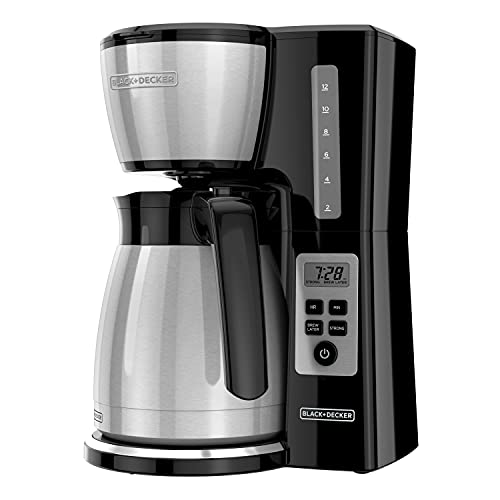
BLACK+DECKER 12-Cup Thermal Programmable CM2046S — Best Thermal Auto-Off
This BLACK+DECKER exposes the elegant truth about auto shut-off: pair it with a thermal carafe and switching off stops mattering. The machine brews on schedule — its Vortex showerhead is designed to saturate the grounds evenly — then powers down while the insulated carafe keeps the coffee serving-hot on stored heat alone. There is no plate to forget, no stewing, and no low-grade anxiety about what was left on when you left the house.
Thermal ownership has its own small disciplines: pre-warm the carafe for maximum hold, rinse it promptly, and do not expect yesterday’s coffee to be anything but a lesson. Within those, this is the most energy-sensible full-size answer to the keyword, at a tier well below the premium thermal machines.
Strengths
- Thermal carafe keeps coffee hot after the machine turns off
- Programmable scheduling with brew-strength selection
- No warming plate to forget or to stew the coffee
Trade-offs
- Carafe hold time is finite — hours, not all day
- Thermal carafe needs pre-warming for best results
- Showerhead and carafe add washing-up parts
| Spec (from verified listing) | 12-cup thermal programmable maker with brew strength selector and Vortex showerhead technology per verified listing title |
|---|
Best for: energy-conscious households that drink a pot over hours / Not suited for: anyone who wants a plate-warmed pot kept at maximum heat
Check on Amazon — check price on Amazon.

Mr. Coffee 12-Cup Programmable Coffeemaker — Best Budget Auto-Off
Mr. Coffee’s 12-cup programmable is the machine that democratised this entire keyword. Its Brew Now or Later control is the timer, its grab-a-cup auto pause handles the impatient, and when the keep-warm period ends the machine turns itself off — the complete safety-and-convenience brief at the lowest tier in this list. For a first programmable machine, a rental kitchen, or an office that cannot be trusted to switch anything off, it is the rational default.
Budget-tier ownership means plastic where others use steel and a warming plate that will stew a forgotten pot before the auto-off rescues it. Set expectations by the tier and the machine over-delivers: scheduled, hot, self-extinguishing coffee without a premium invoice. Households that fall in love with the routine can upgrade within this very list later.
Strengths
- Complete timer plus auto-off brief at the lowest tier here
- Auto pause serves the first cup mid-brew
- Simple controls anyone in the household can run
Trade-offs
- Plate holding still degrades coffee over long periods
- Materials and finish are budget grade
- No thermal or small-batch refinements
| Spec (from verified listing) | 12-cup programmable coffeemaker with Brew Now or Later and grab-a-cup auto pause per verified listing title |
|---|
Best for: budget buyers, rentals and offices that need forget-proof coffee / Not suited for: shoppers wanting premium build or thermal holding
Check on Amazon — check price on Amazon.

Cuisinart 10-Cup Thermal Classic DCC-1170BKNAS — Best Compact Thermal
The DCC-1170 takes the thermal-plus-auto-off logic of the BLACK+DECKER pick and packages it for smaller households and counters. Ten cups is the right size for a couple who drink coffee across a morning, the thermal carafe keeps it hot after the programmable brewer has switched itself off, and Cuisinart’s classic control layout keeps scheduling a ten-second job rather than a manual consultation.
Choose it over the larger thermal if your household genuinely finishes ten cups; a smaller pot brewed fresh beats a bigger pot held longer, every time. Its limits are the format’s limits — finite hold time, a carafe to rinse — plus a capacity ceiling that entertaining households will outgrow. For its intended kitchen, it is the neatest complete answer in this six.
Strengths
- Programmable brewing with thermal holding after shut-off
- 10-cup size suits couples and smaller households
- Trusted-brand build in a compact footprint
Trade-offs
- Capacity too small for gatherings
- Thermal hold is measured in hours, not a full day
- Fewer brew-style options than the Ninja
| Spec (from verified listing) | 10-cup thermal classic coffeemaker, programmable, in black with thermal carafe per verified listing title |
|---|
Best for: couples wanting scheduled, self-extinguishing, thermal-held coffee / Not suited for: households brewing for crowds
Check on Amazon — check price on Amazon.
Comparison Table
Compare these by what ‘off’ means for each: plate timers that end the warming shift, versus thermal machines that power down and let insulation take over. Then match capacity to your household. If you read one row closely, read the Braun BrewSense 12-Cup Drip Coffee Maker KF707 (Check on Amazon) — it is the pick readers most often underestimate.
| Pick | Badge | Key spec | Best for |
|---|---|---|---|
| Ninja CE251 Programmable Brewer 12-Cup (Check on Amazon) | Best Overall Auto Shut-Off | 12-cup, adjustable warming plate | families who want scheduled brewing and a plate that switches itself off |
| Cuisinart DCC-3200 PerfecTemp 14-Cup (Check on Amazon) | Best Large Pot With Auto-Off | 14-cup programmable, adjustable plate | large households and offices brewing big scheduled pots |
| Braun BrewSense 12-Cup Drip Coffee Maker KF707 (Check on Amazon) | Best Programmable Classic | 12-cup, 24-hour timer | tidy kitchens wanting classic, reliable automation |
| BLACK+DECKER 12-Cup Thermal Programmable CM2046S (Check on Amazon) | Best Thermal Auto-Off | 12-cup thermal, programmable | energy-conscious households that drink a pot over hours |
| Mr. Coffee 12-Cup Programmable Coffeemaker (Check on Amazon) | Best Budget Auto-Off | 12-cup programmable, budget tier | budget buyers, rentals and offices that need forget-proof coffee |
| Cuisinart 10-Cup Thermal Classic DCC-1170BKNAS (Check on Amazon) | Best Compact Thermal | 10-cup thermal, programmable | couples wanting scheduled, self-extinguishing, thermal-held coffee |
How to Choose a Coffee Maker That Turns Off Automatically
Decide first whether you want your coffee held hot by power or by insulation. A warming-plate machine keeps the pot at serving temperature until its auto-off expires — ideal if the household drinks within that window and likes its coffee piping. A thermal machine switches off right after brewing and holds heat passively for hours — ideal if your drinking is spread out and your priority is the machine being safely, completely off.
Then look at the details of the shut-off itself. How long is the keep-warm period, and can you adjust it? Does the machine remember your preference? Does auto-off apply after every brew or only scheduled ones? These small print items decide whether the feature quietly fits your life or quietly annoys it.
Why Auto Shut-Off Matters More Than It Sounds
The safety case is the obvious one: a heating plate forgotten under an empty or near-empty carafe is a needless household risk, and auto-off removes the human memory from that equation entirely. Offices, rentals and multi-generational homes — anywhere the person who brewed is not the person who leaves last — benefit most, which is why so many workplaces now mandate it.
The quality case is nearly as strong. Coffee on a live plate is coffee being cooked; an auto-off that ends the warming period on schedule caps the damage on the days a pot outlasts its drinkers. Add the modest energy saving of a machine that does not idle warm for hours, and auto-off earns its place as a first-order feature rather than a footnote.
Programmability and Shut-Off: the Pairing That Runs a Morning
Auto-off’s natural partner is the programmable start, and together they automate the whole arc of a morning pot: the machine wakes before you do, brews, holds the coffee hot through breakfast, and switches itself off as the house empties. When you shop, treat the two as one system — check that the timer is easy to set, that the clock survives a power flicker gracefully, and that a manual brew also ends with the same shut-off discipline.
One honest caution: automation rewards fresh preparation. Coffee grounds loaded the night before are fine; water and beans left loaded for days are not. The best routine is a two-minute evening setup — fresh water, fresh grounds, timer set — which the six machines here all support.
How to Set Up Auto Shut-Off and Timers Correctly
Five minutes of setup on day one is what turns auto-off from a spec-sheet line into a daily habit that protects your home and your coffee.
- Set the machine’s clock accurately first — every timer and shut-off calculation depends on it.
- Find the keep-warm or auto-off setting in the menu and choose a duration that matches your real drinking window, not an optimistic one.
- Run a test brew with water only and stay nearby: confirm the machine ends its warming period and switches off when promised.
- If your machine is thermal, note that it powers down right after brewing — pre-warm the carafe so the off state still means hot coffee.
- Set the programmable start for a weekday morning and verify the full arc once: brew, hold, off.
- Tell the household how it behaves. Auto-off only creates peace of mind if everyone knows the machine handles it.
Recheck the settings after any power outage — clocks and timers are usually the first casualties, and a silent reset is the most common reason a ‘broken’ auto-off is reported.
Common Buying Mistakes
Assuming every coffee maker turns itself off. Many basic machines run until switched off manually. If this feature matters — and this search says it does — verify it is present and how it behaves.
Setting the longest keep-warm by default. Hours on a plate ruins coffee long before the shut-off arrives. Match the warming window to your actual drinking pattern.
Buying a plate machine for all-day drinking. If coffee is sipped across six hours, a thermal carafe with immediate shut-off serves both flavour and safety better.
Forgetting the clock after a power cut. A reset clock means a mistimed brew and a confused shut-off. Make resetting it part of your power-outage routine.
Leaving an empty carafe on a live plate ‘just for a minute’. That minute is how carafes get baked and plates get stressed. If the pot is empty, the machine should be off — which is the entire point of this list.
Final Recommendation
For most households the Ninja CE251 is the balanced answer: programmable, family-sized, with a warming plate that ends its own shift. Big-pot homes belong with the Cuisinart DCC-3200, tidy classicists with the Braun BrewSense, and anyone who wants the machine fully off with the coffee still hot should choose between the BLACK+DECKER and Cuisinart thermal models. The Mr. Coffee proves the whole brief — timer, auto pause, auto-off — at a budget tier.
Start with the Ninja CE251 Programmable Brewer 12-Cup (Check on Amazon) if you want the safest first choice, or the Cuisinart DCC-3200 PerfecTemp 14-Cup (Check on Amazon) if its badge matches your household more closely — check price on Amazon for either.
Keep exploring the same cluster before you decide: Best Coffee Makers Timer Best Coffee Makers That Make Really Hot Coffee Best Coffee Makers That Use K Cups Best Coffee Makers That Make Hot And Iced Coffee Best Clean Edge Can Openers
The Household Safety Case for Automatic Shut-Off
It is easy to file auto shut-off under convenience, but its strongest argument is the composition of real households. The person who starts the coffee is routinely not the person who leaves the house last; teenagers, guests, cleaners and grandparents all interact with a machine nobody briefed them on. A brewer that ends its own heating cycle converts an instruction nobody can enforce — ‘remember to turn the coffee maker off’ — into a property of the appliance itself. That is the same logic as auto-off irons and ovens with timers, and it is why landlords, insurers and workplace safety policies increasingly treat the feature as standard rather than optional.
The risk it retires is modest but real: a dry or near-empty glass carafe left on a live plate can crack from thermal stress, a plate left heating an empty pot wastes energy for hours, and any unattended heating appliance is a small, unnecessary addition to a home’s background risk. Auto-off does not make coffee makers dangerous or safe in absolute terms — it simply removes the most common human failure from the system, cheaply and permanently.
There is a subtler benefit for multi-generational homes. Older relatives who have made coffee the same way for fifty years should not need a new habit layered onto a morning ritual; a machine that quietly handles its own shut-off preserves their independence and everyone else’s peace of mind at the same time. Features that protect without patronising are rare, and this is one of them.
Energy, Cost and the Arithmetic of a Forgotten Plate
A warming plate is a small heater, and small heaters left on for long hours write real numbers on a year’s electricity. The per-day figure is genuinely modest — this is not the appliance that dominates a household bill — but auto-off’s saving is not really about the plate’s rated draw. It is about the tail: the weekend away where the machine warms an empty kitchen for two days, the office brewer that runs from Friday’s pot to Monday’s arrival. Features earn their keep in the tail cases, and shut-off timers are pure tail protection.
Thermal machines change the arithmetic entirely by deleting the plate. Their energy story ends when the brew does; the carafe’s insulation does the holding for free. For a household motivated by running cost as much as safety, that is the elegant end-state: the machine that turns off soonest is the one whose coffee stays hot longest without power. This guide’s thermal picks are recommended in that spirit — auto-off not as a timer to configure, but as a design that never needed one.
The counterpoint, for completeness: a plate machine’s keep-warm is sometimes exactly what a household wants, and a cup poured at full plate heat has a quality no hour-old thermal pot quite matches. The arithmetic argues for thermal; the palate may argue back. Both arguments are represented in the six picks, deliberately.
Offices, Rentals and Shared Kitchens: Where Auto-Off Is Non-Negotiable
Shared spaces multiply every argument in this guide. In an office, the brewer’s users number in the dozens, responsibility for switching it off belongs to no one, and the machine may hold a pot from the morning meeting to the evening cleaner’s round. Auto shut-off is the difference between a policy and a hope. It is also why the budget Mr. Coffee in this list is such a common sight in workplaces: the complete timer-plus-shut-off brief, at a price a facilities budget approves without a meeting.
Rentals and holiday lets make the same case from the owner’s side. Guests cannot be briefed on every appliance, turnover days are chaotic, and a machine that manages itself protects the property and the next guests’ first morning equally. Landlords fitting out a kitchen could do worse than choose every small appliance by one question — what does it do when nobody remembers it? — and coffee makers answer that question more honestly than most.
Dorms and first flats complete the picture: new cooks, shared kitchens, irregular hours. The machines recommended there are the simple, inexpensive, self-extinguishing ones, because in a shared kitchen the best safety feature is the one nobody has to learn, enable or remember.
What Counts as Turning Off: a Buyer’s Field Guide
The phrase ‘turns off’ hides at least four different behaviours, and a careful buyer distinguishes them before money moves. Full automatic shut-off ends all heating after a set period — the behaviour this search wants. A warming-plate timer is the same promise expressed as a duration you can often adjust. A thermal brewer ‘turns off’ the moment the cycle ends, having never had a plate to switch off. And standby is the impostor: a machine that stops brewing but keeps a heater, a tank or a display’s worth of draw alive indefinitely. BUNN-style always-hot tanks are the honest version of that fourth category — declared, purposeful, and for the right household worth it — but a buyer seeking shut-off should know they are buying the opposite philosophy.
Check, too, when the shut-off applies. The best implementations end the heating cycle after every brew, scheduled or manual. Weaker ones auto-off only after a programmed brew, leaving the Saturday manual pot to stew until remembered. The product questions and the manual — both reachable from the listings linked in this guide — answer this in a sentence, and it is a sentence worth reading before purchase rather than after the first forgotten weekend.
Finally, note what restarts the clock. Most machines reset their keep-warm period when a new brew starts or the carafe is lifted and replaced; some require a button. None of this is good or bad in itself — it is fit. A household of grazers who top up across a morning wants a generous, easily-reset window. A household that brews, pours and leaves wants the shortest honest one.
Auto-Off and the Rest of the Safety System
A coffee maker’s shut-off does not work alone, and the machines in this guide pair it with the supporting habits of a safe appliance. Auto pause — the drip-stop that lets you remove the carafe mid-brew — prevents the countertop flood that sends people mopping around a live appliance. A cool-touch, well-seated carafe and a reservoir that cannot be overfilled past its mark are the unglamorous engineering that keeps hot water where it belongs. When you compare models, these details deserve the same attention as the headline timer.
Placement completes the system in a way no feature can. A brewer under a low cabinet bathes that cabinet in steam at every cycle; a brewer at a counter’s edge invites the cord-and-elbow accident. Auto-off retires the risk of the forgotten machine, but the daily risks of hot water and steam are managed by where the machine stands and whether its cord is routed out of traffic. The safest coffee maker is a decent machine, sensibly placed, that also turns itself off.
And keep the human layer honest: auto-off is a backstop, not a babysitter. Children should still learn that the machine is hot, guests should still be told the pot is fresh, and the household should still glance at the kitchen before a holiday. Features that handle forgetfulness work best in homes that treat them as insurance rather than as permission.
Choosing Your Shut-Off Style: Three Households, Three Answers
Consider the commuter household: brew at six, house empty by seven-thirty, nobody home until evening. Its correct machine is a thermal or a short-window plate model, because every minute of keep-warm after seven-thirty is waste wearing a safety costume. The Ninja and the thermal Cuisinart serve this house; a four-hour plate default would betray it daily in small, unnoticed ways.
Consider the home-working household: coffee brewed at eight, sipped until noon, machine within sight all day. Its risk is not the forgotten weekend but the stewed second half of the pot — and its answer is either a thermal carafe or an adjustable plate set to an honest two hours, with the discipline to brew a fresh half-pot rather than resurrect the morning’s. The BLACK+DECKER thermal and the adjustable-plate Cuisinart divide this household by taste.
Consider the multi-generational household: grandparents brewing at five, teenagers at nine, nobody quite sure who used it last. Here auto-off is not a setting but a philosophy — the machine must be safe under ambiguous ownership, which means the strongest default shut-off, the clearest controls and the least reliance on anyone’s memory, including the manual’s. The Braun and the budget Mr. Coffee, in their different tiers, are built for exactly this ambiguity. Name your household honestly, and the six picks sort themselves.
Reading the Fine Print: Shut-Off Claims Decoded
Listings describe shut-off in a vocabulary that rewards the same translation as every other category in this guide. ‘Auto shut-off’ without a duration is a promise without a schedule — look for the keep-warm period it refers to. ‘Programmable keep-warm’ is the adjustable version, and the one worth paying for in staggered households. ‘Thermal carafe’ is a design statement that makes the whole vocabulary moot, which is why thermal models state it so plainly. And ‘energy-saving mode’ usually refers to standby behaviour rather than to the heating cycle itself — a good thing, but a different one from the promise this search makes.
The manual, reachable from every listing linked here, settles what the marketing leaves open: whether shut-off follows manual brews as well as scheduled ones, what the default window is, and how it is changed. Two minutes with that document, before purchase, is the highest-value research available in this category — higher than any review, including this one, because it describes your exact machine rather than the category’s habits.
The Etiquette of the Shared Pot
Auto-off has a social dimension that manuals never mention: it ends arguments. The shared pot’s oldest disputes — who left it on, whose cup was stewed, whether the last person out remembered — all dissolve when the machine manages its own ending. What remains is the pleasant part of communal coffee: the person who brews is generous, the people who drink are grateful, and nobody is the pot’s supervisor. Households and offices both underestimate how much low-grade friction a self-managing appliance removes until they have lived with one.
There is a reciprocal courtesy worth adopting alongside the feature: brew for the household you have, at the time they actually drink, and let the shut-off handle the rest. The machine absolves memory; it does not absolve the person who brews fourteen cups for two people at dawn. Features and habits, in this category as in every other in this guide, are a partnership.
The Ten-Year View: Shut-Off as an Ownership Philosophy
Appliances reveal their designers’ assumptions over years, and the auto-off machine assumes something kind: that its owners are human, that mornings are rushed, that memory is a finite resource best spent on people rather than appliances. That assumption ages well. The household that buys it is not buying a timer circuit; it is buying ten years of never once standing in a doorway wondering about the coffee maker — a small, daily, compounding peace that no specification table captures.
The philosophy generalises, and households that internalise it start choosing everything the same way: the iron that lifts its own soleplate, the oven that ends its own cycle, the machine that manages its own ending. It is not laziness. It is the deliberate allocation of attention — the one household resource that never appears in any budget and constrains all of them. The coffee maker that turns itself off is simply the appliance that understood the assignment first.
So the closing recommendation of this guide is less about which of the six to buy — the badges have done that work — and more about refusing to buy the seventh kind: the machine, however brilliant its coffee, that leaves its ending to you. In a category where the self-managing version exists at every tier from budget to premium, choosing the forgetful machine is choosing the worry. Decline it.
What to Do When the Shut-Off Itself Misbehaves
Even a backstop deserves a backup plan, and auto-off faults announce themselves in recognisable ways. A machine that stays warm far beyond its window may simply have had its keep-warm reset by a carafe lift nobody registered — live with it for one observed cycle before condemning it. A machine that never warms at all after brewing may have had its keep-warm disabled in a settings menu during someone’s enthusiastic button tour; the manual’s settings page, not a repair bill, is the first destination. A machine whose display and clock reset themselves is reporting power interruptions, and its timer complaints should be investigated at the wall, not the worktop.
If a full observed cycle still ends with a live plate hours later, treat the machine as a manual one until it is serviced: switch it off at the wall as a household rule, and contact the manufacturer, because heating controls are not a user-service item. The category’s promise is peace of mind, and a machine that cannot keep that one promise should not be negotiated with — it should be repaired, replaced from this guide’s six, or retired. Fortunately, in a field this mature, it is also the rarest sentence in this entire article.
A Final Word on Habits
The best auto-off setting is the one matched to a routine the household actually keeps, and routines are discovered, not declared. Spend the first week noticing: when is the pot really finished, who pours last, how long does the carafe honestly sit? Set the window to that evidence rather than to an aspiration, and revisit it once a season as the household’s mornings drift. A feature tuned to real life disappears into it — which is, for a safety feature, the highest compliment available. The machine ends its shift; the household never has to think about it again.
One Last Check Before You Order
Before ordering, stand in your kitchen at the hour you usually leave and look at the counter. Whatever is still on — a plate glowing under an empty carafe, a display lit on a machine finished hours ago — is the argument for this purchase, made by your own household, in its own handwriting. Choose the machine whose shut-off matches the scene: thermal for the house that empties early, an adjustable plate for the house that grazes, the strongest default for the house where nobody is quite sure who brewed. Then let the next departure be the first one where the question does not need asking.
And If You Remember One Thing
Remember that the goal was never the feature — it was the unasked question. A household that no longer wonders about the coffee maker has freed that small piece of attention for everything else a morning contains. Every pick in this guide delivers that freedom at its tier; the only wrong choice left is the machine that keeps the question alive. Buy the one that lets you forget it, and then, happily, forget it.
Frequently Asked Questions
Do all programmable coffee makers turn off automatically?
Most modern programmable models include an automatic shut-off after their keep-warm period, but it is not universal and the duration varies. Check the specific model’s behaviour rather than assuming the timer implies the shut-off.
How long do coffee makers stay on before turning off?
Keep-warm periods commonly run from under an hour to several hours depending on the model and setting, and many machines let you adjust the duration. Thermal models switch off immediately after brewing and rely on insulation instead.
Is a thermal carafe better than auto shut-off?
They solve the same problem differently and pair beautifully: a thermal machine turns off at once and the carafe holds the heat. A plate machine holds heat actively until its shut-off. Choose by how spread out your drinking is.
Does auto shut-off save much electricity?
The saving per day is modest, but a warming plate left on for hours daily adds up across a year — and the safety and coffee-quality benefits matter more than the energy line item.
Can I override the auto shut-off if guests are still drinking?
On most machines, yes — starting a fresh keep-warm period or a new brew resets the cycle. Check your model’s controls; the override is usually a single button press.
Why did my coffee maker’s timer stop working?
The most common cause is a power interruption resetting the clock and schedule. Reset the time and reprogramme the brew; if the display itself has failed, that is a service issue rather than a settings one.


