Disclosure: airfryerkitchensupply.com is reader-supported. When you buy through links on our site, we may earn an affiliate commission at no extra cost to you.
Where to buy
This shortlist of the best coffee makers for serious coffee drinkers was verified model by model before a single link was placed. Serious coffee drinkers do not need more buttons; they need control over the three variables that decide a cup — water temperature stability, even saturation of the bed, and a brew ratio they can repeat. The machines below earned their places on verified listings that name those capabilities outright, including SCA certification where the listing itself states it. Every pick was matched on 2026-11-21; use the links to check price on Amazon for the exact model, because this tier renames and re-bundles models constantly.
- Technivorm Moccamaster KBGV Select 10-Cup (Best Overall): Check on Amazon
- Bonavita 8 Cup Coffee Maker BV1901TS (Best Specialty Value): Check on Amazon
- OXO Brew 8-Cup Coffee Maker (Best for Single Cups and Carafes): Check on Amazon
- Breville Precision Brewer BDC400 (Most Adjustable): Check on Amazon
- Fellow Aiden Precision Smart Drip Coffee Maker (Best Programmable Profiles): Check on Amazon
- Bonavita Enthusiast 8 Cup Coffee Brewer (Thermal Carafe) (Best Removable Reservoir): Check on Amazon
The best coffee makers for serious coffee drinkers are not the most expensive machines, and they are definitely not the ones with the longest feature lists. They are the brewers that hold water temperature steady through the whole cycle, wet the coffee bed evenly instead of channeling through its center, and let you repeat yesterday’s exact brew tomorrow. Specialty coffee lives or dies on those three things, and everything else — displays, apps, carafe styling — is garnish.
This guide is organized around specialty criteria on purpose. Where a listing states SCA certification, we say so, because that certification is a tested standard for temperature and extraction rather than a marketing adjective — and where a listing does not state it, we do not claim it, even for famous names. Bloom cycles, adjustable ratios and pre-infusion appear below only where the verified listing names them. That discipline is the difference between a buying guide and a brochure, and serious drinkers, of all readers, will notice it.
One more honesty note: no drip machine rescues stale beans or a bad grind. These brewers assume you are bringing fresh coffee and a competent burr grinder to the partnership — several picks below are pod-free designs built for exactly that user. If your grinder is the weak link, fix it first; then choose among these six with confidence, because every one of them will faithfully show you whatever your beans and grind have to say.
In this guide
Quick Picks
- Technivorm Moccamaster KBGV Select 10-Cup — Best Overall: The hand-built benchmark: a brewer whose entire reputation rests on temperature discipline and a showerhead that treats the bed evenly, in a 10-cup polished-silver machine. Check on Amazon
- Bonavita 8 Cup Coffee Maker BV1901TS — Best Specialty Value: SCA Certified specialty brewing at a mid tier: one-touch pour-over-style extraction, auto pause, and a double-wall thermal carafe. Check on Amazon
- OXO Brew 8-Cup Coffee Maker — Best for Single Cups and Carafes: An SCA Certified brewer that handles a solo mug as seriously as a full thermal carafe — the flexible specialty machine for one-or-two-drinker homes. Check on Amazon
- Breville Precision Brewer BDC400 — Most Adjustable: The control room of the group: six brewing paths including a Gold setting, Strong, Iced and Cold Brew, in a glass-carafe machine built for experimentation. Check on Amazon
- Fellow Aiden Precision Smart Drip Coffee Maker — Best Programmable Profiles: Specialty brewing as software: custom profiles, a real bloom cycle, cold brew preset and app scheduling, across a 1-to-10-cup range with a thermal carafe. Check on Amazon
- Bonavita Enthusiast 8 Cup Coffee Brewer (Thermal Carafe) — Best Removable Reservoir: Bonavita’s refined take: SCA Certified pour-over-style brewing with a removable water reservoir — the specialty machine that is easiest to live with daily. Check on Amazon
How These Picks Were Chosen
Our criteria were the specialty fundamentals. Temperature stability first: a brewer must deliver water in the proper extraction range and hold it there from first pour to last, not start hot and fade. Saturation second: showerhead design and, where offered, a bloom or pre-infusion phase that lets the bed degas before the main pour, so extraction is even rather than channeled. Ratio control third: the ability to brew a small batch at the same strength as a full one, and to adjust strength without hacks.
Certification was treated as evidence, not decoration. SCA Certified listings — the Bonavita and OXO models below carry that wording in their verified Amazon titles — were credited for it, because the standard is administered by the Specialty Coffee Association against measured performance. Models without the wording were judged on their design and named features alone, and the copy below says plainly which is which.
Verification closed the process: each machine was searched by brand and model, its returned title matched line by line, and only then was its ASIN used. Spec boxes quote only what those verified titles establish. No prices are printed anywhere in this guide — at this tier especially, check price on Amazon on the listing itself.
A final criterion was honesty of interface: does the machine tell you what it is doing? Brewers that expose their variables — a named Gold program, a selectable flow, a saved profile with its parameters visible — scored above brewers that hide everything behind a single ‘brew’ promise and a premium badge. Serious drinkers iterate, and iteration requires a machine whose settings can be known, recorded and repeated. That is also why this guide’s spec boxes are deliberately plain: they state what the verified listings establish, so your own notes start from facts.
The 6 Best Coffee Makers for Serious Coffee Drinkers

Technivorm Moccamaster KBGV Select 10-Cup — Best Overall
Every specialty conversation about drip brewers eventually arrives at the Moccamaster, and it arrives there because of restraint. The KBGV Select is a 10-cup, 40-ounce machine that concentrates on the fundamentals — a powerful heating element, a wide showerhead, and manual control over the brew basket’s flow — and wraps them in a metal body built to be serviced rather than replaced.
Strengths
- Legendary temperature discipline — the reason it anchors this category
- Select switch lets you brew a half carafe at proper strength, not a diluted compromise
- Metal, serviceable construction suits a buy-for-decades mindset
Trade-offs
- Premium tier — the most considered purchase in this guide
- Manual flow control on the basket asks for a little technique
- Glass carafe and hot plate format rather than thermal, in this configuration
| Capacity | 10 cups, 40 oz / 1.25 L (per listing) |
| Finish | Polished silver |
| Model | KBGV Select 53941 |
What separates the Moccamaster from competent brewers is not a feature; it is the heating architecture. Its element brings the full reservoir to temperature and holds the delivery there, so the last water over the bed extracts like the first — the single most common failure of ordinary drip machines, which start near boiling and sag. The KBGV’s selector addresses the other classic compromise: small batches. Brewing five cups in a machine plumbed for ten usually means a fast, under-extracted pass; the half-carafe setting slows the flow to compensate, and the basket’s manual drip-stop lets you extend contact or pull the carafe for a pour. None of this is automated, and that is the point — this is a brewer for a drinker who has opinions about contact time and wants a machine that obeys rather than decides. It will not bloom for you or profile for you. It will deliver the most honest cup of any machine here, every day, for a very long time, and for serious drinkers that trade is the entire appeal.
Best for: Purists who want temperature discipline and manual control above automation / Not suited for: Anyone who wants programmable profiles, timers or app control
Check on Amazon — check price on Amazon before you decide, because listings, bundles and included accessories change over time.

Bonavita 8 Cup Coffee Maker BV1901TS — Best Specialty Value
If the Moccamaster is the benchmark, the Bonavita BV1901TS is the argument that specialty fundamentals do not require a benchmark budget. Its verified listing states SCA Certified outright, and the machine is built around pour-over logic — a showerhead that saturates like a kettle pour, one-touch operation, and a stainless double-wall thermal carafe that keeps brewed coffee off a hot plate.
Strengths
- SCA Certified per its listing — tested temperature and extraction performance
- One-touch operation: specialty results without a morning ritual of settings
- Thermal carafe preserves the cup instead of stewing it on a plate
Trade-offs
- 8-cup capacity is a household size, not an entertaining size
- Fewer manual controls than the Moccamaster or Breville Precision
- Thermal carafe hides the coffee level from view
| Capacity | 8 cups |
| Certification | SCA Certified (per listing) |
| Carafe | Stainless steel double-wall thermal |
| Operation | One-touch, auto pause brewing |
Bonavita’s design philosophy is to automate the pour-over variables and nothing else. The heater and showerhead do the work a careful hand with a gooseneck kettle would do — deliver water at a proper, steady temperature and distribute it across the bed — and then the machine gets out of the way. That is why the one-touch interface is a feature here rather than a compromise: the variables a serious drinker cares about are handled inside, and the ones left to you are the right ones, namely the beans, the grind and the ratio you load. The thermal carafe completes the philosophy, because specialty coffee held on a hot plate degrades measurably within the hour; insulation holds temperature without continuing to cook the cup. For a drinker upgrading from a generic drip machine, this is the single most noticeable step up in the guide relative to its tier — the cup gets cleaner and sweeter in a way that is immediately obvious with fresh, well-ground beans, and the machine asks almost nothing of you in return.
Best for: Serious drinkers who want certified specialty performance without premium pricing or fuss / Not suited for: Tinkerers who want to adjust every variable themselves
Check on Amazon — check price on Amazon before you decide, because listings, bundles and included accessories change over time.

OXO Brew 8-Cup Coffee Maker — Best for Single Cups and Carafes
Most specialty brewers are carafe machines that tolerate small batches; the OXO Brew 8-Cup was designed the other way. Its listing states SCA Certified Home Brewer status, and the machine brews a single serving with the same temperature discipline as its full 8-cup thermal carafe — a combination that serves the serious drinker who often drinks alone.
Strengths
- SCA Certified per its listing, for both carafe and single-serve brewing
- Single-serve mode solves the small-batch extraction problem elegantly
- Thermal carafe keeps the full batch at its best without a hot plate
Trade-offs
- Single-serve mode uses its own basket arrangement — a small extra step to learn
- Stainless build and certification place it in the upper-mid tier
- 8-cup ceiling, like the Bonavita
| Capacity | 8 cups |
| Certification | SCA Certified Home Brewer (per listing) |
| Modes | Single-serve and full carafe |
| Carafe | Thermal, stainless steel |
The small-batch problem is the quiet scandal of drip coffee: a machine tuned for eight cups runs water through a shallow bed too fast, and the result is a thin, sour shadow of the same beans brewed full. OXO’s answer is a dedicated single-serve path that treats one mug as a first-class brew — controlled flow over a properly proportioned bed — backed by the same certified temperature performance as the carafe mode. For the serious drinker in a one-coffee household, that dual competence is worth more than any display or timer in this guide, because it means Tuesday’s solo cup and Saturday’s shared carafe are both real coffee. The build is the expected OXO formula — clean lines, sensible controls, a thermal carafe that pours well — and the interface stays admirably plain for a machine of this capability. Choose it over the Bonavita if your drinking is mostly solo with occasional company; choose the Bonavita if the carafe is your default and the mug is the exception.
Best for: Mostly-solo serious drinkers who still want a proper carafe on demand / Not suited for: Large households — the 8-cup ceiling will chafe
Check on Amazon — check price on Amazon before you decide, because listings, bundles and included accessories change over time.
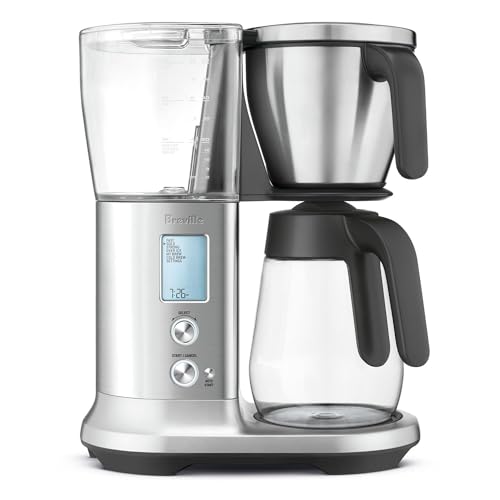
Breville Precision Brewer BDC400 — Most Adjustable
Where the Moccamaster offers obedience, the Breville Precision Brewer offers range. Its listing promises brewing six ways — Gold, Fast, Strong, Iced and Cold Brew among the named settings — in a brushed stainless machine with a glass carafe. This is the brewer for the drinker who rotates methods and beans and wants one machine that can follow.
Strengths
- Multiple brew programs let one machine serve different beans and moods
- Gold setting targets the classic specialty parameters at a touch
- Iced and Cold Brew modes extend the machine beyond hot drip entirely
Trade-offs
- Range means complexity — there are settings to learn and occasionally to get wrong
- Glass carafe format rather than thermal in this configuration
- Not the pick for someone who wants one perfect button
| Modes | 6 brew ways incl. Gold, Fast, Strong, Iced, Cold Brew (per listing) |
| Carafe | Glass |
| Finish | Brushed stainless steel |
| Model | BDC400 |
The Precision Brewer’s value to a serious drinker is experimental throughput. Dialing in a new bean on a fixed brewer means changing one variable at a time — grind, ratio, dose — while the machine’s behavior stays an unknown constant. Breville turns the machine itself into a variable: the Gold program for a standards-based baseline, Strong when a bean needs more extraction, Fast when the morning does not care, and dedicated Iced and Cold Brew paths that most drip machines simply cannot walk. That makes it the best learning machine in this guide, and the best household machine where drinkers disagree — one person’s bright light roast and another’s dark, heavy cup can both be honored without a second appliance. The discipline it demands is note-taking: with this many levers, the drinker who does not record what worked will brew a lot of interesting coffee and repeat none of it. Accept that bargain and the BDC400 is less a coffee maker than a small, very capable brew lab.
Best for: Experimenters and mixed-preference households who will use the modes / Not suited for: Set-and-forget drinkers — the Bonavita does that job better
Check on Amazon — check price on Amazon before you decide, because listings, bundles and included accessories change over time.

Fellow Aiden Precision Smart Drip Coffee Maker — Best Programmable Profiles
Fellow’s Aiden is what happens when a pour-over company builds a machine. The listing reads like a specialty checklist — custom brew profiles, a dedicated bloom cycle, a cold brew preset, app-enabled scheduling — wrapped around a 1-to-10-cup brewer with a thermal carafe. It is the most deliberately specialty-first design in this guide.
Strengths
- Bloom cycle and custom profiles automate real pour-over technique
- 1-to-10-cup range handles the solo mug and the full carafe seriously
- App scheduling means the profile you dialed in can be waiting at wake-up
Trade-offs
- App dependence will not suit drinkers who distrust connected appliances
- Premium tier, competing directly with the Moccamaster’s different philosophy
- Profiles reward the drinker who experiments — and punish autopilot
| Capacity | 1–10 cups |
| Carafe | Thermal |
| Smart features | App-enabled scheduling, custom brew profiles (per listing) |
| Presets | Cold brew preset, bloom cycle |
Aiden’s argument is that the gap between automatic drip and manual pour-over was never the water — it was the recipe. A bloom phase, a chosen ratio, a pulsed pour: these are decisions a skilled hand makes at the kettle, and Aiden encodes them as profiles you can save, share and schedule. For the serious drinker, that changes the machine’s role from appliance to instrument: dial in a light-roast profile on Sunday, and the machine reproduces it faithfully on a groggy Wednesday, which no human with a kettle honestly does. The 1-to-10-cup flexibility matters just as much, because profile brewing usually collapses at small volumes; here the solo cup gets the same recipe discipline as the carafe. The honest cautions are connectivity and cost. The app is integral to the experience, so a household that keeps appliances offline should look at the Moccamaster instead, and the tier is premium — justified if you will actually build profiles, wasted if you will press one preset forever. Used as designed, this is the most interesting brewer in the guide.
Best for: Profile builders who want pour-over recipes reproduced and scheduled automatically / Not suited for: Offline purists — the Moccamaster is your machine
Check on Amazon — check price on Amazon before you decide, because listings, bundles and included accessories change over time.

Bonavita Enthusiast 8 Cup Coffee Brewer (Thermal Carafe) — Best Removable Reservoir
The Enthusiast takes Bonavita’s proven specialty formula — SCA Certified, per its listing — and fixes the one ergonomic flaw of most brewers: the fixed water tank. Its removable reservoir lifts out to fill at the sink and to descale properly, in a stainless-paneled 8-cup machine with a thermal carafe.
Strengths
- Removable reservoir makes filling and descaling genuinely easier
- SCA Certified specialty performance in the Bonavita tradition
- Thermal carafe and stainless panel suit a permanent countertop presence
Trade-offs
- Shares the 8-cup ceiling of the other specialty mid-sizes
- Removable tank seals are one more part to keep clean
- Less manual control than the Moccamaster or Aiden
| Capacity | 8 cups |
| Certification | SCA Certified (per listing) |
| Reservoir | Removable |
| Carafe | Thermal |
It sounds mundane until you have owned the alternative: a removable reservoir changes the daily and monthly reality of a brewer. Daily, you fill at the sink with two hands and a clear view of the level, instead of ferrying a pitcher to a machine wedged under cabinets and guessing. Monthly, descaling becomes a proper soak of the tank itself, where scale actually lives, rather than a hopeful flush. Layered on that practicality is the same certified extraction as its sibling pick — the listing states SCA Certified, with the pour-over-style saturation Bonavita is known for — so nothing about the cup is sacrificed to the convenience. Why choose it over the BV1901TS? The reservoir, the refined panel, and a generally more considered daily experience. Why choose the BV1901TS over it? Simplicity and tier. Either way, Bonavita placing two machines in a six-pick specialty guide is not an accident; no brand in this category has made certified performance this accessible, this consistently.
Best for: Serious drinkers who descale faithfully and hate pitcher-filling under cabinets / Not suited for: Anyone needing more than 8 cups, or craving manual flow control
Check on Amazon — check price on Amazon before you decide, because listings, bundles and included accessories change over time.
Comparison Table
| Pick | Badge | Key spec | Best for |
|---|---|---|---|
| Technivorm Moccamaster KBGV Select 10-Cup | Best Overall | 10-cup, 40 oz / 1.25 L | Purists who want temperature discipline and manual control above automation |
| Bonavita 8 Cup Coffee Maker BV1901TS | Best Specialty Value | 8-cup, one-touch pour-over style, SCA Certified, thermal carafe | Serious drinkers who want certified specialty performance without premium pricing or fuss |
| OXO Brew 8-Cup Coffee Maker | Best for Single Cups and Carafes | 8-cup, SCA Certified, single-serve capable, thermal carafe | Mostly-solo serious drinkers who still want a proper carafe on demand |
| Breville Precision Brewer BDC400 | Most Adjustable | Brew 6 ways: Gold, Fast, Strong, Iced, Cold Brew settings | Experimenters and mixed-preference households who will use the modes |
| Fellow Aiden Precision Smart Drip Coffee Maker | Best Programmable Profiles | 1–10 cup, app-enabled scheduling, custom brew profiles, bloom cycle | Profile builders who want pour-over recipes reproduced and scheduled automatically |
| Bonavita Enthusiast 8 Cup Coffee Brewer (Thermal Carafe) | Best Removable Reservoir | 8-cup, SCA Certified, removable reservoir, thermal carafe | Serious drinkers who descale faithfully and hate pitcher-filling under cabinets |
The specialty fundamentals: temperature, saturation and ratio
Temperature first, because it gates everything else. Coffee extracts properly in a well-understood hot range; water that arrives too cool under-extracts into sourness, and a brewer whose temperature sags across the cycle brews two different coffees into the same carafe — the first cups extracted, the last merely steeped. This is why SCA certification matters where a listing states it: the standard measures exactly this discipline, and it is why the Moccamaster’s heating design has the reputation it does even without a word of marketing.
Saturation is the second gate. A showerhead that dumps water in the bed’s center carves a channel, over-extracting the middle and ignoring the edges; an even, gentle distribution — and a bloom phase that lets fresh coffee release its gas before the main pour, as the Fellow Aiden automates — lets water meet all the grounds on equal terms. When a cup tastes simultaneously bitter and sour, uneven saturation is the usual suspect, and it is a machine fault, not a bean fault.
Ratio is where the drinker takes over: the proportion of coffee to water, held consistent across batch sizes. Machines earn their specialty status partly by not sabotaging it — the Moccamaster’s half-carafe setting, the OXO’s dedicated single-serve path and Aiden’s 1-to-10-cup profiles are all, at heart, ratio-protection devices. Your part is a scale and a notebook. Weigh the dose, keep the ratio, change one variable at a time, and any machine in this guide will show you steady, satisfying progress toward your cup.
How to choose among these six specialty brewers
Start from your temperament, because these machines embody philosophies. If you believe the drinker should control the brew, the Moccamaster’s manual flow and the Breville’s program range are your two poles — obedience versus options. If you believe the machine should control the brew so you can control the beans, Bonavita’s one-touch certified machines and the OXO are the honest choices. If you believe a recipe, once perfected, should be captured and repeated by software, the Fellow Aiden stands alone.
Then check your batch pattern. Mostly solo with occasional company points to the OXO or Aiden; a daily full carafe for two serious drinkers points to the Bonavita pair or the Moccamaster; a household of experimenters points to the Breville. Capacity numbers in the spec boxes are all verified from listings — match them to your real mornings, not your aspirational brunches.
Finally, budget honestly across the whole station. A premium brewer fed by a blade grinder and stale beans loses to a mid-tier brewer with a good burr grinder and fresh coffee every single morning. If the total station budget is fixed, the Bonavita BV1901TS plus a grinder upgrade is very often the smartest allocation in this entire guide.
Getting the most from a specialty brewer
Fresh beans, ground just before brewing, are the highest-leverage habit in specialty coffee — ahead of any machine feature in this guide. Buy in quantities you will finish within a few weeks, store them sealed away from heat and light, and treat the roast date as information, not trivia. Pair that with filtered water if your tap is heavily chlorinated or very hard: the machine can only extract what the water lets it taste.
Then work the variables in order. Fix your ratio for a week. Adjust only grind for the next few brews, finer toward bitterness’s edge, coarser away from sourness. Use the machine’s strengths deliberately — bloom on the Aiden, the Gold program as a baseline on the Breville, the half-batch setting rather than a half-measure of grounds on the Moccamaster. Specialty coffee is not fussiness; it is the same care, repeated, and these six machines are the ones that reward the repetition instead of wasting it.
Water, the ingredient nobody buys on purpose
Ninety-eight percent of the cup is water, and specialty drinkers are the readers most likely to be sabotaging great machines with indifferent water. Heavily chlorinated tap water flattens delicate flavors no brewer can restore; very hard water scales heating elements — quietly destroying the temperature stability this guide prizes — and over-extracts into harshness; distilled water, at the other extreme, under-extracts because minerals are part of the extraction chemistry. The practical answer for most homes is simple: a carbon filter jug for taste, and descaling on a calendar rather than on symptoms for hardness.
This is also where the picks divide subtly. Machines with removable reservoirs, like the Bonavita Enthusiast, make the descale-and-rinse cycle thorough enough to protect their own precision. Profile machines like the Aiden assume consistent water — a profile tuned on Monday’s water drifts when the water changes, which is an argument for filtering once and holding the input constant. Treat water as an ingredient with a specification, keep that specification steady, and the expensive temperature discipline you bought will finally be the weakest variable in the chain — which is to say, not the weakest at all.
Thermal versus glass, and other ownership questions
Ownership details decide whether a specialty brewer stays specialty. Thermal carafes protect extraction quality across the drinking window but hide the level and demand a rinse discipline; glass shows everything and pairs with a warming plate that must be treated as a serving timer, not a storage device. Several picks above chose thermal deliberately, and the glass models — the Breville in this configuration, and glass variants elsewhere in these lines — suit drinkers who finish the pot promptly. Neither is a compromise; they are answers for different drinking windows, and matching the carafe to your window matters more than the badge on the brewer.
Reservoir design is the other ownership axis. Fixed tanks are filled by pitcher and descaled by faith; removable tanks — the Bonavita Enthusiast’s among them — are filled at the sink and descaled by soaking, which is why fastidious owners gravitate to them. Lid and basket geometry matter at 6 a.m. more than in the showroom: a basket that swings out cleanly, a lid that opens without clearing a cabinet, a carafe that pours to the last ounce without wrist gymnastics. The six machines here were all chosen with those unglamorous mornings in mind, because a specialty brewer is not a trophy — it is the most-used instrument in a serious drinker’s kitchen, and it should behave like one every single day.
How to Dial In a New Bag of Beans on a Specialty Brewer
A repeatable dialing-in routine turns a good brewer into a great one. Run this sequence whenever you open a new bag, whatever pick you own.
- Start at a sane baseline: a ratio around 1 part coffee to 16 parts water by weight, a medium grind resembling coarse sand, and the machine’s standard or Gold-style program if it has one.
- Brew a small batch first — using the machine’s small-batch or single-serve mode where it has one — and taste it black, at drinking temperature, before adjusting anything.
- Read the cup: sour, salty or thin means under-extraction (grind finer, or use a stronger program); bitter, dry and hollow means over-extraction (grind coarser). Change only the grind between brews.
- If your machine offers a bloom or pre-infusion phase, enable it for fresh beans — beans within two weeks of roasting degas vigorously, and blooming visibly improves evenness.
- Once the cup is balanced, write the recipe down: bean, dose, water, grind setting, program. On a profile machine like the Aiden, save it as a named profile instead.
- Re-check at the bag’s halfway point. Beans age, and a half-step finer on the grinder usually restores the cup for the bag’s second week.
Three or four small brews is the typical cost of dialing in, and the recipe you capture pays it back on every subsequent morning. The notebook — or the saved profile — is the real specialty equipment; the brewer is its instrument.
Common Buying Mistakes
Blaming the machine for the grinder’s sins. Inconsistent grind produces simultaneous over- and under-extraction that no brewer can fix. If cups taste muddy and sharp at once, upgrade the grinder before the machine — the picks here will only reveal the problem more clearly.
Claiming certifications the listing does not. When you recommend a machine to a friend — or read other guides — watch for SCA language attached to models whose listings never state it. In this guide, certification is credited only where the verified listing carries the words. Hold every source to that standard.
Brewing small batches in full-batch mode. A shallow bed in a full-size basket under-extracts almost by definition. Use the half-carafe setting, the single-serve path or the small-batch profile your machine provides — they exist precisely because the manufacturers know this failure mode.
Leaving brewed coffee on a hot plate. Specialty extraction deserves better than slow stewing. If your machine has a glass carafe and plate, decant the remainder into a thermal server; or choose a thermal-carafe pick next time and remove the temptation entirely.
Changing three variables at once. New ratio, new grind and a new program in the same brew teaches you nothing, because the improvement — or the disaster — cannot be attributed. One variable per brew is slower for a day and faster for a lifetime.
Freezing or refrigerating beans in daily use. The daily in-and-out cycle condenses moisture on the beans every time the container opens, aging them faster than a sealed counter canister would. Buy in two-to-three-week quantities, store them sealed at room temperature, and let the freezer serve only genuine long-term storage, in portions you thaw once.
Storing the machine’s settings in your head alone. A recipe that exists only as a feeling cannot be repeated after a holiday, a new bag or a borrowed grinder setting. Write the working recipe — dose, grind, program or profile — on a card kept with the beans. Serious drinkers are made by records, not by memory.
Final Recommendation
The Moccamaster KBGV Select remains the specialty benchmark — the machine for the drinker who wants control, temperature discipline and a brewer built for the long term. The Bonavita BV1901TS delivers certified specialty performance at the friendliest tier in this guide, and its Enthusiast sibling adds the removable reservoir that daily life appreciates. The OXO Brew 8-Cup is the solo drinker’s certified answer, the Breville Precision Brewer is the experimenter’s range of options, and the Fellow Aiden is the future-facing pick — specialty recipes, captured as profiles and scheduled to the minute.
None of them will rescue poor beans or a poor grind, and all of them will reward good ones. Verify the exact model on its listing, check price on Amazon there, and then invest your real effort where specialty coffee is actually decided: fresh beans, a consistent grind, and a notebook.
If you would rather start from the shortlist, the three picks most readers land on are Technivorm Moccamaster KBGV Select 10-Cup, Bonavita 8 Cup Coffee Maker BV1901TS, OXO Brew 8-Cup Coffee Maker — check price on Amazon on each listing and compare the current bundles before you commit.
Keep exploring the same shelf before you buy: Best Coffee Makers For Smarthomes Best Coffee Makers For Speed And Taste Best Coffee Makers Best Coffee Makers For Single Person Best Coffee Makers For Small Office Best Coffee Makers For Small Spaces
Frequently Asked Questions
What does SCA Certified actually mean on a coffee maker listing?
It means the brewer has been tested against standards administered by the Specialty Coffee Association, covering areas such as brew temperature, extraction and uniformity. In this guide we credit the claim only where the verified Amazon listing itself carries the words ‘SCA Certified’ — as the Bonavita and OXO listings do — and we do not attach it to any model whose listing does not state it.
Is the Moccamaster worth it over the Bonavita?
They pursue the same fundamentals by different means. The Moccamaster offers manual control, a metal serviceable build and a half-carafe setting, at a premium tier. The Bonavita automates the same temperature-and-saturation discipline behind one touch, with SCA certification stated on its listing, at a mid tier. Choose by philosophy and budget, not by cup quality alone — both brew an honest specialty cup.
What is a bloom cycle, and do I need one?
Blooming is a short pre-wetting phase: a little water saturates the fresh grounds and lets them release trapped gas before the main pour, so extraction proceeds evenly instead of bubbling around the gas. Fresh, recently roasted beans benefit most. Machines like the Fellow Aiden automate it; on other brewers, its absence is a small thing next to grind and ratio, not a deal-breaker.
Can one machine really brew a single cup and a full carafe well?
Yes, if it was designed for it — which is rarer than listings suggest. The honest solutions are a dedicated single-serve path (the OXO approach), a flow-compensating half-batch setting (the Moccamaster), or per-size profiles (the Aiden). A standard carafe machine simply run with less water and coffee will under-extract the small batch almost every time.
How much of the cup is the machine, really?
Think of it as a chain: beans and freshness set the ceiling, the grinder decides how close to even extraction you can get, water quality frames the flavor, and the brewer delivers the temperature and saturation that let the rest happen. A specialty brewer’s job is to never be the weak link. All six picks here meet that standard; beyond it, your beans and grinder decide the cup.
Glass or thermal carafe for specialty coffee?
Thermal, for taste over time: it holds temperature by insulation rather than by cooking the coffee on a plate, so the second hour’s cup resembles the first. Glass wins only on visibility and tradition. Several picks above are thermal for exactly this reason; if you choose a glass model, decant leftovers into a thermal server rather than letting them sit on the plate.
Do I need a gooseneck kettle or other gear with these machines?
No — these brewers exist precisely to internalize the kettle’s work: temperature, distribution and timing are the machine’s job. Your supporting cast is a burr grinder, a scale for dose and water, and fresh beans. Spend there before anywhere else; the machines in this guide were chosen so that no further brewing hardware is required to reach their ceiling.
How long should a specialty brewer last, and what maintenance protects it?
A well-kept specialty brewer should serve for many years; the Moccamaster’s serviceable design philosophy exists precisely because its maker expects that horizon. The maintenance that protects the investment is unglamorous: descale on a calendar matched to your water’s hardness, keep the showerhead and basket free of coffee oils with a weekly wash, and never let brewed coffee bake onto a warming plate. Temperature stability — the thing you paid for — is the first casualty of scale, so the descale schedule is not housekeeping; it is calibration.
Are these machines wasted on pre-ground coffee?
Not wasted, but capped. A specialty brewer will extract pre-ground coffee more evenly and at a better temperature than a basic machine, so the cup improves — but pre-ground coffee stales within days of opening and cannot show what these machines can do. If a grinder is genuinely not possible, buy small quantities of freshly ground coffee from a roaster who grinds to order, store it sealed, and finish it quickly. The brewer will meet you as far as the coffee allows.
What is the single best first upgrade after buying one of these brewers?
A burr grinder, if you do not already own one — it is the only accessory that changes what every one of these machines can deliver, because even particle size is what lets their temperature and saturation discipline express itself in the cup. After the grinder, a simple scale for dose and water. Everything beyond those two is refinement; those two are foundation, and a serious drinker who buys them in that order will taste the difference in the first week.


