Disclosure: airfryerkitchensupply.com is reader-supported. When you buy through links on our site, we may earn an affiliate commission at no extra cost to you.
Where to buy
Shopping for the best coffee makers for restaurants? Every recommendation below is a verified pick for exactly that brief. Every machine in this guide was verified against Amazon’s catalog data for this site before writing, and each pick links to its Amazon listing so you can check price on Amazon and confirm the exact commercial model code. Restaurant equipment punishes ambiguity: a brewer’s domestic twin can share a silhouette and none of the duty rating. Order the model named here, keep the documentation with your health-inspection paperwork, and confirm voltage and configuration on the listing before the machine is scheduled into a service.
- BUNN VP17-3 Pourover Commercial Coffee Brewer, 3 Lower Warmers — check price on Amazon
- BUNN VPR APS Commercial Pour Over Air Pot Coffee Brewer — check price on Amazon
- BUNN VPS 12-Cup Pourover Commercial Brewer, 3 Warming Stations — check price on Amazon
- Hamilton Beach Commercial 60 Cup Coffee Urn (D50065) — check price on Amazon
- West Bend 100-Cup Commercial Coffee Urn (NSF) — check price on Amazon
- BUNN VP17-1SS Pourover Coffee Brewer, 1 Warmer — check price on Amazon
The best coffee makers for restaurants are not scaled-up home machines; they are service equipment, judged on a different scoreboard entirely. A restaurant brewer is measured in pots per hour during a brunch rush, in whether the third carafe tastes like the first, in how it behaves in the hands of a new server on their second shift, and in whether it can be cleaned to a health inspector’s standard at midnight by a tired closer. This guide chose commercial machines on exactly those terms — throughput, consistency, trainability, and cleanability — and it is deliberately blunt about the line between café-and-diner duty and the banquet-and-institution volume that needs urns instead.
Two service architectures organize the picks. Decanter brewers with warmers — the classic BUNN pattern — suit table service: pots brewed continuously, carried to tables, refreshed on a rotation. Airpot and urn systems suit self-service and volume: coffee brewed into insulated servers that hold quality without a hotplate, or urns that produce dozens of cups for events where a pot brewer would need an hour of cycling. Most restaurants honestly run one of each pattern across their day — decanters for the dining room, an airpot for the patio or the waiting area, an urn in the back for the private-dining booking — and the reviews below are written to be combined, not just compared.
Every pick was verified against Amazon’s catalog data first, with commercial model codes taken from the verified listings. We excluded domestic machines dressed in stainless, excluded anything whose service model depends on proprietary pods at restaurant volume, and favored equipment whose consumables — standard filters, standard decanters — can be sourced from any restaurant supplier on a Sunday emergency run. In food service, the supply chain is part of the product.
In this guide
Quick Picks
Six commercial machines across the two restaurant architectures — decanter brewers for table service, airpots and urns for volume and self-service. Badges match the full reviews. A note before the list: most restaurants reading this guide will end up owning two of these machines, not one, because a dining room, a patio station, and a private-events program are three different coffee problems wearing one name. Read the picks as building blocks for a program — the rotation brewer, the station brewer, the volume urn — and mark the ones that match rooms you actually have. The single-machine answer exists too, and it is the first pick on the list, but the honest guide owes you the combination logic up front rather than after your first banquet exposes the gap.
- Best Overall for Restaurants — BUNN VP17-3 Pourover Commercial Coffee Brewer, 3 Lower Warmers: A commercial pourover brewer holding three pots at once — regular, decaf, and a rotating spare — with no plumbing hookup, built for dining rooms that pour coffee all service long.
- Best for Airpot and Self-Service Stations — BUNN VPR APS Commercial Pour Over Air Pot Coffee Brewer: A pourover brewer that brews directly into airpots — insulated servers that hold coffee quality for hours and travel to patios, waiting areas, and self-service stations without a warmer.
- Best for High-Volume Diner Service — BUNN VPS 12-Cup Pourover Commercial Brewer, 3 Warming Stations: A commercial pourover brewer with three warming stations arranged for continuous high-turnover service — the diner pattern: a pot on every station, a server always armed.
- Best for Banquets and Large Parties — Hamilton Beach Commercial 60 Cup Coffee Urn (D50065): A commercial 60-cup urn in polished stainless steel — one brew covers a banquet, a wedding coffee station, or a conference break, dispensed a cup at a time by the guests themselves.
- Best for Very Large Events and Institutions — West Bend 100-Cup Commercial Coffee Urn (NSF): A 100-cup commercial urn, NSF approved, in highly polished aluminum — the maximum-volume pick for institutions, large venues, and restaurants whose events run into the hundreds.
- Best Compact Commercial for Small Cafés — BUNN VP17-1SS Pourover Coffee Brewer, 1 Warmer: The single-warmer member of the same commercial family — a compact stainless pourover brewer for the small café, bakery, or bistro whose coffee volume is real but modest.
How These Picks Were Chosen
Verification came first: every machine here was confirmed against Amazon’s catalog data for this site, with commercial model codes — the numbers a supplier or inspector would recognize — taken from the verified listings. Domestic machines, pod systems, and anything without a genuine commercial duty story were excluded, however handsome their stainless cladding.
We then scored on the restaurant scoreboard: pots or cups per hour at peak, consistency across a long service, training time for a brand-new hire, cleanability to inspection standard, and the availability of standard consumables and spares from ordinary restaurant suppliers. The six survivors split deliberately across service patterns — decanter rotation, airpot stations, and urn volume — because restaurants combine patterns across a day and a building, and a guide that crowns one architecture for every room would fail every room differently.
The 6 Best Coffee Makers for Restaurants

Best Overall for Restaurants: BUNN VP17-3 Pourover Commercial Coffee Brewer, 3 Lower Warmers
The VP17-3 is the archetypal restaurant brewer for a reason: it solves the dining room’s actual problem, which is rotation. Three lower warmers mean a fresh pot can always be brewing while a regular and a decaf sit ready — the server never faces the choice between an empty pot and an old one. During a rush, that rotation is the difference between coffee as a smooth background service and coffee as a recurring apology.
Pourover operation — water poured in by hand, no water line — makes it deployable in almost any restaurant, including older buildings and leased spaces where plumbing work needs a landlord, a permit, and a prayer. BUNN’s internal tank holds water at brewing temperature, so each pot brews fast and, more importantly, identically: pot twelve of the brunch service tastes like pot one, which is the consistency guests actually judge you on.
Strengths
- Three warmers sustain a regular / decaf / fresh-pot rotation through a full service
- Commercial build and a hot-water tank deliver fast, consistent pots at rush pace
- No plumbing required — installs on any suitable counter in an afternoon
Trade-offs
- Staff must pour water for every pot — discipline is part of the system
- Decanters are glass and will break in service; spares are a standing cost
- Warmer-held coffee still ages; the rotation needs a freshness rule with teeth
| Type | Commercial pourover brewer |
| Warmers | 3 lower warmers |
| Plumbing | None — manual fill |
| Model | 13300.0013 VP17-3 |
| Service style | Decanter table service |
Trainability is this machine’s quiet superpower. A new server learns it in one demonstration — pour, brew, rotate, dump the oldest — and the failure modes are all visible and recoverable: an empty tank, a forgotten pot, a decanter left dry on a warmer. There is no menu system to misconfigure mid-rush and no proprietary anything between the restaurant and its coffee. For an industry built on staff turnover, that simplicity is a financial feature.
Size it to a dining room of small-to-mid scale doing continuous table service. A high-volume diner turning tables fast should look at the three-station VPS below; a banquet operation needs the urns. But for the classic restaurant pattern — breakfast through dinner, coffee with every check — the VP17-3 remains the machine the rest of the industry is compared against, and the one a first-time restaurateur can buy without a specialist’s advice.
Best for: Small-to-mid restaurants running continuous decanter table service / Not suited for: Banquet volume, self-service stations, or plumbed high-throughput bars
Check the current price on Amazon
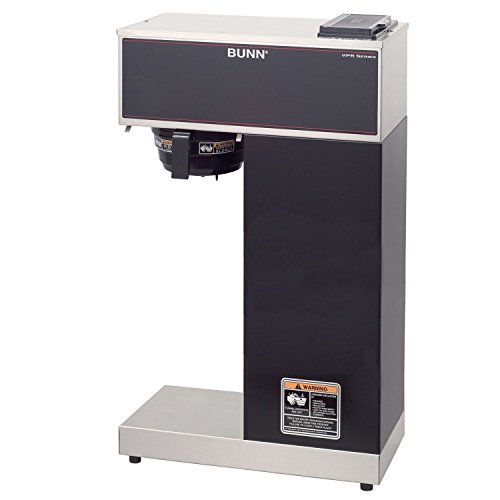
Best for Airpot and Self-Service Stations: BUNN VPR APS Commercial Pour Over Air Pot Coffee Brewer
The VPR APS changes where coffee can live in a restaurant. Instead of pots chained to warmers, it brews into airpots: pump-top insulated servers that keep coffee hot and tasting fresh for hours, then go wherever service needs them — the host stand for waiting guests, the patio, the private room, the counter of a café that serves at a till rather than at tables. For bakeries, cafés, and fast-casual formats, this is often the correct primary architecture, not a supplement.
Airpot holding also fixes the quality problem warmer plates create. Coffee on a hotplate cooks; coffee in a sealed insulated server simply stays hot, so the cup poured at hour two resembles the cup poured at minute ten far more closely. Guests notice the absence of the burnt bottom-of-pot taste even when they cannot name it.
Strengths
- Brews into airpots that hold quality for hours and serve anywhere in the building
- No hotplate cooking — held coffee stays clean-tasting through a long service
- Pourover design needs no plumbing; ideal for cafés and fast-casual counters
Trade-offs
- Airpots are an additional purchase and an additional washing discipline
- Pump tops need regular deep cleaning to stay fresh and sanitary
- Less suited to classic table service where a carried pot is part of the ritual
| Type | Commercial pourover airpot brewer |
| Servers | Airpots (insulated pump servers) |
| Plumbing | None — manual fill |
| Model | 33200.0010 VPR APS |
| Service style | Self-service / station service |
Operationally, airpots reward a labeling culture: brew time on a strip of tape, regular versus decaf unmistakable at a glance, and a dump time the staff actually honors. Restaurants that run that discipline find airpots liberating — one brew covers a station for hours, freeing staff from pot-watching entirely. Restaurants that skip the labels discover that airpots hide old coffee as efficiently as they hold fresh coffee, which is a management lesson, not an equipment flaw.
Choose the VPR APS as the primary brewer for counter-service formats and as the second brewer for table-service rooms that need a patio or events station. Either way it is the most flexible coffee a restaurant can pour, and the format guests increasingly expect from any serious café program.
Best for: Cafés, bakeries, fast-casual counters, patios, and self-service stations / Not suited for: Traditional table-service rooms built around carried decanters
Check the current price on Amazon

Best for High-Volume Diner Service: BUNN VPS 12-Cup Pourover Commercial Brewer, 3 Warming Stations
Diners and high-turnover breakfast houses run coffee like a utility: constant, unglamorous, and absolutely load-bearing — the cup that lands within a minute of seating is the product as much as the eggs are. The BUNN VPS is built for that pattern, with three warming stations keeping multiple pots in play so no server ever waits on a brew while a section fills up.
Like the rest of this BUNN family it is pourover — no plumbing project stands between the restaurant and service — and it holds brewing water at temperature so pots cycle quickly and consistently through the rush. The layout suits a pass or server station where pots are grabbed, poured, and returned in a continuous loop.
Strengths
- Three warming stations keep multiple pots live through a continuous rush
- Commercial duty cycle built for all-day, every-day diner service
- Fast, consistent pot cycling from a temperature-held tank
Trade-offs
- Demands a strict freshness rotation or three stations become three old pots
- Counter footprint is a real commitment at a server station
- Overkill — in cost and presence — for a low-turnover dining room
| Type | Commercial pourover brewer |
| Stations | 3 warming stations |
| Capacity | 12-cup decanter pots |
| Model | 04275.0031 VPS |
| Service style | High-turnover table service |
The VPS earns its keep in the economics of the refill. Diner coffee culture runs on the circulating server and the topped-up cup; every minute a pot is unavailable is a table drinking less coffee and remembering the wait. Three stations convert brewing from a bottleneck into a background rhythm — one pouring, one ready, one brewing — and that rhythm is what regulars describe, inaccurately but tellingly, as ‘the coffee is always fresh here.’
It asks for the same discipline as every multi-pot system, squared: labeled pots, a dump rule, a closer who actually rotates stock. Give it that, and it will run a breakfast house for years with the reliability of a refrigerator. Deny it, and no brewer at any price will save the program — the machine is the easy part of diner coffee; the rotation is the craft.
Best for: Diners, breakfast houses, and high-turnover rooms with constant refills / Not suited for: Low-turnover fine dining or small cafés
Check the current price on Amazon

Best for Banquets and Large Parties: Hamilton Beach Commercial 60 Cup Coffee Urn (D50065)
Banquet coffee is a different sport: two hundred guests, a twenty-minute break, and a beverage station that must simply work while staff are elsewhere. The Hamilton Beach Commercial D50065 brews sixty cups into a polished stainless urn and dispenses by tap, so guests serve themselves and the coffee program for the entire event runs on one brew cycle and one staff check-in.
The commercial designation matters here — this is the brand’s commercial line, built for the duty cycle of repeated event service rather than occasional home parties. Polished stainless presents properly at a wedding or a corporate function, and the urn format keeps coffee at serving temperature through a long reception without the stewed character of a pot held too long.
Strengths
- 60-cup single brew covers banquets and conference breaks without cycling
- Self-service tap dispensing frees staff during events
- Commercial-line build in polished stainless suits front-of-house presentation
Trade-offs
- Urn coffee is event coffee — very good at volume, not a specialty program
- Brew time for a full urn must be scheduled ahead of the event, not during it
- Storage and post-event cleaning need an owner on the events team
| Capacity | 60 cups |
| Type | Commercial coffee urn |
| Build | Polished stainless steel |
| Model | D50065 |
| Service style | Banquet / self-service events |
The D50065 also serves the main dining room as insurance. Banquet booked the same night as a full house? The urn takes the party while the decanter brewers take the floor. Private-dining room without a coffee station? The urn is the station. Equipment that flexes across the building’s formats earns its storage space in a way single-purpose gear does not.
Event discipline applies: start the brew early enough that the urn is holding, not brewing, when guests arrive; level the urn on the station; and assign the rinse-and-dry afterward to a named closer, because an urn put away damp is an urn that tastes of the last event at the next one. Managed that way, this is buy-once equipment for any restaurant with a private-dining or catering arm.
Best for: Banquets, weddings, private dining, and conference service / Not suited for: Daily table service or specialty coffee programs
Check the current price on Amazon

Best for Very Large Events and Institutions: West Bend 100-Cup Commercial Coffee Urn (NSF)
At the top of the volume ladder sits the West Bend 100-cup commercial urn. One hundred cups per brew serves the conference center, the institutional cafeteria, the festival concession, and the restaurant whose ‘private event’ means a ballroom. The NSF approval on this model matters in commercial settings — it is the certification inspectors and institutional buyers look for, and its presence here is a genuine differentiator among big urns.
The highly polished aluminum body keeps a very large vessel manageable in weight — a full 100-cup urn is heavy with coffee alone, and the material choice is a practical kindness to the staff who move it. Like all urns it dispenses by tap for self-service at scale.
Strengths
- 100-cup capacity — the largest single-brew volume in this guide
- NSF approved for commercial and institutional requirements
- Polished aluminum body keeps a huge urn movable by real staff
Trade-offs
- Far beyond any ordinary restaurant’s daily need — this is event infrastructure
- Long brew lead time for a full load must be built into event timelines
- Cleaning a vessel this size is a two-sink, two-person job done properly
| Capacity | 100 cups |
| Certification | NSF approved |
| Build | Highly polished aluminum |
| Type | Commercial coffee urn |
| Service style | Institutional / large events |
Most restaurants should not buy this — and the guide says so plainly, because the ones that should will recognize themselves instantly: venues with a real events business, institutional feeders, and caterers whose coffee contract is measured in hundreds of cups. For them, the alternative is renting or running multiple smaller urns in parallel, both of which cost more across a season than owning the right vessel.
If your events top out at sixty covers, the Hamilton Beach above is your urn and this one is a storage problem. Volume equipment obeys the same sizing law as everything else in this guide — match the machine to the service you actually run, at the peak you actually hit, and the equipment will never be the story of the night.
Best for: Large venues, institutions, and high-volume catering operations / Not suited for: Ordinary restaurant service of any normal scale
Check the current price on Amazon

Best Compact Commercial for Small Cafés: BUNN VP17-1SS Pourover Coffee Brewer, 1 Warmer
Not every restaurant needs three warmers; the small café or bistro needs one excellent pot, brewed properly, on equipment that will not embarrass the program or the budget. The VP17-1SS is the same commercial pourover pattern as its bigger siblings — temperature-held tank, fast consistent pots, no plumbing — in a single-warmer footprint that fits a small counter and a small covers count.
It is also the correct first commercial machine for a business graduating from a domestic brewer. The jump in consistency is immediate: because brewing water waits at temperature instead of heating per pot, the coffee stops varying with the machine’s mood, and the staff stops apologizing for it.
Strengths
- True commercial build and consistency in a compact single-warmer format
- No plumbing — installs anywhere, including leased and historic spaces
- Stainless construction presents well in open café counters
Trade-offs
- One warmer means one coffee at a time — decaf needs a plan B
- Manual fill for every pot, like the whole pourover family
- A growing room will outgrow it into the three-warmer models above
| Type | Commercial pourover brewer |
| Warmers | 1 warmer |
| Plumbing | None — manual fill |
| Build | Stainless steel |
| Model | 13300.0001 VP17-1SS |
For the small format, the VP17-1SS’s economics are the story: commercial reliability without commercial overbuying, standard decanters and filters from any supplier, and a service life measured in years of daily duty. It is the machine a café buys when coffee is a supporting program — excellent, dependable, and not the headline — which describes most small restaurants honestly.
Pair it with the airpot brewer above if the café adds a self-service or takeaway station, and the two-machine program covers nearly every small-format pattern there is. Start here, grow into the family, and no purchase is ever wasted — the single-warmer machine becomes the decaf or the backup when the bigger brewer arrives.
Best for: Small cafés, bistros, and bakeries with modest continuous volume / Not suited for: High-turnover rooms or simultaneous regular-plus-decaf service
Check the current price on Amazon
Comparison Table
Choose by service pattern first and volume second — and notice what the table does not contain: a single espresso machine or pod system, because at restaurant volume those architectures answer a different question than the one dining rooms ask all day. The same restaurant may legitimately own two rows of this table, one for the floor and one for events, and many of the strongest coffee programs in independent restaurants are exactly that pairing: a decanter rotation that never stops during service and an urn that appears when the private room fills.
| Pick | Badge | Key spec | Best for |
|---|---|---|---|
| BUNN VP17-3 Pourover Commercial Coffee Brewer, 3 Lower Warmers | Best Overall for Restaurants | Commercial pourover, 3 warmers, no plumbing | Small-to-mid restaurants running continuous decanter table service |
| BUNN VPR APS Commercial Pour Over Air Pot Coffee Brewer | Best for Airpot and Self-Service Stations | Brews into airpots, pourover, no plumbing | Cafés, bakeries, fast-casual counters, patios, and self-service stations |
| BUNN VPS 12-Cup Pourover Commercial Brewer, 3 Warming Stations | Best for High-Volume Diner Service | 3 warming stations, commercial pourover, diner duty | Diners, breakfast houses, and high-turnover rooms with constant refills |
| Hamilton Beach Commercial 60 Cup Coffee Urn (D50065) | Best for Banquets and Large Parties | 60-cup commercial urn, stainless, tap dispensing | Banquets, weddings, private dining, and conference service |
| West Bend 100-Cup Commercial Coffee Urn (NSF) | Best for Very Large Events and Institutions | 100-cup urn, NSF approved, aluminum | Large venues, institutions, and high-volume catering operations |
| BUNN VP17-1SS Pourover Coffee Brewer, 1 Warmer | Best Compact Commercial for Small Cafés | 1 warmer, commercial pourover, stainless, compact | Small cafés, bistros, and bakeries with modest continuous volume |
How to Choose the Best Coffee Makers for Restaurants
Begin with the service pattern, because it eliminates most of the field. Table service with carried pots points to decanter brewers with warmers. Counter service, cafés, and any station where guests pour their own points to airpots. Events point to urns, sized to the largest regular booking, not the largest imaginable one. Restaurants that skip this step buy impressive machines that fight their own floor plan every service.
Next, do peak math in pots per hour. Count the covers in your busiest hour, assume roughly a cup and a half per coffee-drinking cover plus refills in diner formats, and check the brewer’s cycle can stay ahead of it with one pot in reserve. A machine that falls behind at peak does not produce slightly late coffee; it produces a server station queue, a comped check, and a review that mentions the wait. The three-station and three-warmer picks exist because real restaurants run that math and refuse to live on the edge of it.
Plumbing: the renovation hiding in the purchase
Plumbed brewers are excellent and, in many buildings, a project: water line, filtration, drainage, permits, landlord. Every pick in this guide is pourover or urn format specifically so a restaurant can upgrade its coffee this week rather than this quarter. If your space already has a coffee-bar water line and your volume is genuinely high, plumbed equipment is a legitimate step beyond this guide — just price the installation honestly before comparing sticker prices.
Certifications and the inspector
Commercial listings and certifications — NSF marks, commercial model designations — are not paperwork vanity in food service. Inspectors, insurers, and institutional clients all read them, and a domestic machine in a commercial kitchen can become a finding. Keep the machine’s documentation with your other compliance paperwork from the day it arrives; the middle of an inspection is the wrong time to discover nobody kept it.
Coffee Quality in a Working Restaurant: Consistency Beats Brilliance
Guests judge restaurant coffee comparatively — against the last cup they had here, and against the café down the street — and consistency wins both comparisons more often than brilliance does. The equipment choices that produce consistency are unglamorous: water held at brewing temperature, standard filters, decanters that are actually clean, and a freshness rotation with a dump rule. Every brewer in this guide was chosen to make the tenth pot of the day taste like the first, because in a dining room the tenth pot is the one most guests drink.
Inputs deserve the same discipline as equipment. A house coffee chosen for how it holds — a blend that tastes good at minute forty on a warmer, not just at minute four — will outperform a delicate roast that fades by the second table. Airpot service relaxes that constraint and suits brighter coffees; warmer service rewards blends built for holding. Match the coffee to the architecture you bought, train the rotation, and the program quietly becomes a reason regulars return rather than a line item they forgive.
The Money Side: Cost per Cup, Rental Comparisons, and When to Own Two Machines
Restaurant coffee economics reward a few minutes with a pencil. A decanter program’s consumables — grounds, filters, the occasional decanter — run to a modest cost per cup, and the equipment in this guide is priced like the workhorse appliance it is rather than like a flagship espresso installation. Compare that with the two common alternatives honestly: a leased full-service program, which converts the same coffee into a perpetual per-cup fee with a contract attached, and delivered urn coffee for events, which charges banquet prices for what the Hamilton Beach and West Bend urns in this guide produce in-house after a handful of events. Ownership wins for most independent restaurants within the first season, and it wins by more every season after.
The two-machine question deserves its own paragraph because restaurants resist it superstitiously, as if a second brewer admitted the first was a mistake. In practice the second machine is bought for a different job — the airpot station, the events urn, the decaf answer — and the pair together cost less than the downtime, comps, and emergency rentals of a single machine asked to be everywhere. The correct frame is not ‘which machine’ but ‘which machines, in which rooms, on which services’ — and a restaurant that answers that question once, in writing, stops re-litigating it at every equipment failure.
Finally, protect the investment with the boring line items: spare decanters on the shelf, filters bought by the case before the case runs out, a descaling and cleaning schedule the closer actually signs off, and the supplier’s number taped inside the office door. Restaurant coffee programs rarely die of bad equipment. They die of a Tuesday when the filters ran out, the spare pot was never bought, and the machine nobody cleaned gave up mid-brunch. Every one of those deaths is preventable for less than the cost of one comped party of six.
Staffing the Coffee Program: Roles, Rotations, and the Closing Checklist
Restaurant coffee fails at shift boundaries. The opener brews, the mid-shift assumes, the closer discovers. The fix is a written micro-system, small enough to live on one card at the server station: who brews the first pot and when; the rotation order and the dump rule (a pot’s birth time written on a band or board, no exceptions); who washes what at close — decanters and brew baskets nightly with proper detergent, airpot pump tops on their own schedule, urn interiors after every event; and the weekly descale or tank check assigned to a named role, not to ‘whoever.’
None of this is bureaucracy for its own sake. It is how a restaurant makes a new hire’s second-shift coffee taste like the veteran’s, and how the program survives holidays, turnover, and the Saturday the manager is off. Equipment in this guide was chosen to make that card short — visible states, obvious controls, standard parts — because a coffee program that depends on one person’s memory is a program one resignation away from collapse.
How to Run a Restaurant Coffee Station Through a Full Service
A service-day rhythm that works with every brewer in this guide, from first brew to close.
- Before open: brew the first pots early enough that service starts with coffee ready, not brewing. Check decanters and airpots for yesterday’s residue — a sniff and a rinse now beats a complaint at noon.
- Label every vessel. Brew time and contents (regular / decaf) on each pot or airpot, in the format your house chose, every time. Memory is not a labeling system.
- Rotate on the rule, not on vibes. Oldest pot pours first; a pot that hits the house time limit is dumped and logged, even if it looks fine. The rule protects the guest who cannot see the clock.
- Mid-service: keep one pot in reserve during any rush — brewing ahead of demand is the entire game. Assign pot-watching to the station, not to a person, so breaks do not break the rotation.
- Events: start urns early enough to be holding at guest arrival, level and test the tap, and put a drip tray and a small sign where guests can help themselves without hunting for staff.
- At close: dump, wash decanters and baskets with detergent, rinse airpots and run their pump tops through the wash schedule, wipe warmers and counters, and leave the brewer ready for the opener — water, filters, and the first pot’s coffee staged.
Run that rhythm for a month and it stops being a checklist and becomes the house’s muscle memory — which is the moment the coffee program starts making money instead of apologies.
Two service-day judgment calls deserve explicit house policy, because they arise weekly and improvising them creates inconsistency guests can taste. The first is the end-of-service pot: when the last seating is an hour out, brew a half batch or shift to airpot holding rather than sending a full fresh pot to die on the warmer — the final tables of the night judge the restaurant on the same standard as the first, and a smaller fresh pot beats a larger stale one every time. The second is the complaint cup: when a guest says the coffee tastes off, the answer is never an argument and rarely a re-pour from the same pot — it is a fresh cup from a fresh pot, immediately, with the suspect pot pulled and tasted by staff at the station. Restaurants that empower servers to make that call without fetching a manager turn a potential complaint into a story about being looked after.
Close the loop monthly: taste the coffee yourself, at a table, at the worst hour — late in a long service, from the oldest vessel in rotation. That cup, not the fresh morning pot the manager drinks at the pass, is the product your guests actually review. Adjust the blend, the ratio, or the dump rule based on that cup, and the program improves on evidence instead of on hope.
Common Buying Mistakes
Restaurant coffee purchases go wrong in ways that only become visible mid-service, in front of a full room, with the ticket times already slipping. Every pattern below has been paid for by real restaurants in comps, reviews, and emergency purchases at retail prices on a Saturday morning. These are the patterns to avoid while the decision is still a calm one made at a desk.
- Buying a domestic machine for commercial duty. It will brew — briefly. Duty cycle is not a suggestion, and a home machine in a restaurant is a countdown, not a saving.
- Sizing to the average day. Restaurants live at their peaks. A brewer that cannot stay ahead of the brunch rush fails at the only moment that defines it.
- Ignoring the decaf problem. Decaf drinkers are loyal and vocal. A one-warmer plan with no decaf answer manufactures a daily disappointment at scale.
- Letting pots age without a dump rule. Warmer-held coffee has a clock. Restaurants without a written freshness rule serve the oldest pot to the unluckiest guest, daily.
- Skipping the spare decanters. Glass breaks in service, always at peak. Spares are not stock; they are the difference between a shrug and a crisis.
- Neglecting the closing wash. Old coffee oils go rancid in baskets and airpot tubes and flavor every subsequent brew. Nightly washing is the cheapest quality program in the building.
Final Recommendation
For most restaurants the answer starts with the BUNN VP17-3 for decanter rotation, adds the BUNN VPR APS wherever an airpot station would serve guests better, and brings in the Hamilton Beach Commercial 60 Cup Urn when events enter the picture. Check price on Amazon for each, confirm the model codes against your service pattern, and buy the rotation, not just the machine.
Smaller and different formats have their own guides: cafés and offices overlap at Best Coffee Makers For Coffee Shop, the general workplace picture is in Best Coffee Makers For Office, and high-volume front-of-house service is covered in Best Coffee Makers For Large Office for the corporate side. Home-scale questions belong in Best Coffee Makers For Home Use — and if the person speccing the restaurant kitchen is also surviving newborn nights at home, Best Coffee Makers For New Parents is the other essential read.
Frequently Asked Questions
What type of coffee maker do most restaurants use?
Commercial decanter brewers — most often pourover models with multiple warmers — are the industry default for table service, because they brew continuously, hold a regular/decaf rotation, and need no plumbing. Cafés and counter-service formats increasingly standardize on airpot brewers, and events run on urns; many restaurants own one of each pattern.
How many cups per hour does a restaurant coffee maker need to produce?
Work backward from your peak: covers in the busiest hour, times roughly one to one-and-a-half cups per coffee drinker, plus diner-style refills where that culture applies. The brewer must stay ahead of that number with a pot in reserve. If the math puts you near a machine’s limit on a normal Saturday, buy the next size up — peaks grow.
Is a pourover brewer good enough, or does a restaurant need a plumbed machine?
Pourover commercial brewers run a large share of the industry’s dining rooms perfectly well — their tanks hold water at temperature, so brew quality and speed are commercial-grade. Plumbed machines remove the manual filling and suit very high volumes and permanent coffee bars. The honest dividing line is volume and labor, not coffee quality.
What should a restaurant do when its only brewer fails mid-service?
Triage in this order: move any station or events machine (an airpot brewer or urn) into dining-room duty, put a simple sign and a server script in place before guests discover the problem themselves, and comp coffee generously while the backup runs — the goodwill costs less than the reviews. Then treat the failure as the purchase order it is: the replacement conversation, and the second-machine conversation, should happen that week, while the lesson is still priced in everyone’s memory.
How long can coffee sit on a warmer or in an airpot?
House rules vary, but quality falls noticeably after roughly an hour on a hotplate-style warmer and holds considerably longer in a sealed airpot. Whatever limits you choose, write them down, label pots with brew times, and dump on the rule — the guest’s cup should never be the oldest one in the building by accident.
What certifications should restaurant coffee equipment have?
Look for genuine commercial models and, where institutional or inspector scrutiny applies, NSF approval — the 100-cup urn in this guide carries it. Keep the machine’s documentation with your compliance paperwork, and buy standard-format equipment whose filters and decanters any restaurant supplier stocks.
How often should a restaurant descale and deep-clean its brewers?
Decanters, baskets, and airpot exteriors wash nightly; airpot pump assemblies need a regular deep clean on a written schedule; descaling or tank maintenance follows your water hardness and the manufacturer’s guidance — in hard-water areas, monthly attention is not excessive for a machine that cycles all day. Build all of it into the closing checklist so it survives staff changes.


