Disclosure: airfryerkitchensupply.com is reader-supported. When you buy through links on our site, we may earn an affiliate commission at no extra cost to you.
Where to buy
Shopping for best coffee makers and accessories? The fastest way to buy this shortlist is Amazon, where every verified pick below is sold with current availability shown on the product page. Prices move often, so we do not print them here — accessories such as filters are consumables that cycle through sellers quickly, so buy the maker first and stock the matching supplies from the same listing where you can. Use the Check on Amazon links throughout this guide to see the live price, delivery options and any current bundle offers for each model.
- Chemex Pour-Over Glass Coffeemaker Classic 6-Cup (Best Overall) — Check on Amazon
- Baratza Encore Conical Burr Grinder (Best Grinder Accessory) — Check on Amazon
- Hario V60 Pour Over Coffee Starter Set, Size 02 (Best Starter Kit) — Check on Amazon
- AeroPress Original Coffee Press (Best Manual Maker) — Check on Amazon
- Kalita Wave Pour Over Dripper 185, Glass (Best Dripper Upgrade) — Check on Amazon
- Melitta 52 oz Pour-Over Coffee Brewer with Glass Carafe (Best Budget Full-Size Set) — Check on Amazon
Best coffee makers and accessories
Searching for the best coffee makers and accessories together is smarter than it sounds, because a coffee maker is only ever half the purchase. The other half — the grinder, the filters, the dripper or the server it brews into — decides how the coffee actually tastes and how annoying the daily routine becomes. Buy the machine alone and you often discover a week later that the filters are a proprietary size, the carafe is fragile, or your blade grinder is quietly ruining the expensive beans you bought to celebrate.
This guide therefore pairs the two halves properly. The six picks below are a mix of complete brewing setups, makers with strong accessory ecosystems and the single most important accessory in coffee — a proper burr grinder. Each pick explains which accessories it needs, which it includes and which upgrades are worth adding later, so the total cost and the total routine are clear before you spend anything.
Everything linked here was verified against retailer data first. Where a pick needs a specific filter size or a particular supply, we say so in its review, because accessory compatibility is exactly where coffee purchases go wrong.
Consider the total cost of ownership before the picks, because accessories rewrite it. A pour-over brewer that needs a specific filter, a press that needs none, a grinder that needs a replacement burr once in many years — these are different financial shapes wearing similar price tags. This guide surfaces those shapes in every review: what is included, what you will keep buying and what you will never buy again. Judged over two years of daily coffee, the cheapest setup to run in this list costs little more than the coffee itself, and the most expensive is still trivial next to a pod habit.
Finally, a note on taste, because the best setup is the one matched to the cup you actually enjoy. Paper-filtered pour-over tastes clean and bright; press coffee tastes heavy and rich; the AeroPress sits between, leaning clean. If you do not yet know your preference, the cheapest education is a café crawl — order the same coffee as a pour-over and as a French press in two good cafés, and notice which cup you finish happily. Then buy for that cup. Equipment follows palate, never the reverse, and every pick in this guide was chosen to make one of those cups excellently.
In this guide
Quick Picks
Short on time? These are the six best coffee makers and accessories we would buy with our own money, each chosen for a different kind of coffee drinker. Every badge here matches the badge in the full review further down, so you can jump straight to the model that fits your kitchen.
- Chemex Pour-Over Glass Coffeemaker Classic 6-Cup — Best Overall: The iconic all-glass pour-over system: brewer and server in one piece, with thick bonded filters that produce an exceptionally clean cup. — Check on Amazon
- Baratza Encore Conical Burr Grinder — Best Grinder Accessory: The accessory that upgrades every coffee maker you own: a proper conical burr grinder with consistent grounds for drip, pour-over and press. — Check on Amazon
- Hario V60 Pour Over Coffee Starter Set, Size 02 — Best Starter Kit: Dripper, server and filters in one box — the complete V60 starter kit that takes a beginner from nothing to proper pour-over in one purchase. — Check on Amazon
- AeroPress Original Coffee Press — Best Manual Maker: The manual press with the deepest accessory ecosystem in coffee — metal filters, flow-control caps, stands and a world of recipes all fit it. — Check on Amazon
- Kalita Wave Pour Over Dripper 185, Glass — Best Dripper Upgrade: The flat-bottom dripper that makes pour-over easier: three small holes and a level bed give even extraction with less perfect technique. — Check on Amazon
- Melitta 52 oz Pour-Over Coffee Brewer with Glass Carafe — Best Budget Full-Size Set: A full-size manual pour-over set — cone brewer over a 52 oz glass carafe — that brews for a table of people at a budget-tier price. — Check on Amazon
How These Picks Were Chosen
We chose these six to cover the realistic ways people build a coffee setup: a complete pour-over system with its own filter ecosystem, a starter kit that bundles dripper, server and filters, a manual press with the deepest accessory shelf in coffee, a precision dripper for upgrading an existing kettle setup, a budget full-size pour-over set, and a burr grinder — included because no accessory improves a cup more, and any honest ‘makers and accessories’ guide has to say so.
For each pick we checked three accessory questions. What does it include in the box? What consumables does it lock you into, and are they easy to find? And what does the upgrade path look like — can you add a scale, a better server or a metal filter later, or is the system a dead end? Picks that failed the consumables test, however good the maker, were left out.
We also applied a snobbery filter in reverse: no pick earns its place for being fashionable. The Chemex is a museum-piece design and also a genuinely excellent brewer; the Melitta set is unfashionable and genuinely useful. Both are here on performance. Where a famous name did not survive contact with the accessory questions — odd filter sizes with patchy availability, fragile servers with no replacement path — it was left out, however photogenic.
The 6 Best Coffee Makers and Accessories

Chemex Pour-Over Glass Coffeemaker Classic 6-Cup — Best Overall
The Chemex is the rare coffee maker that is also a design object — a single piece of hourglass-shaped glass that brews and serves, finished with a wood collar and leather tie. More importantly for daily life, it is a complete system: its unusually thick bonded paper filters are the secret to its famously clean, tea-like cup, removing more sediment and oils than standard filters.
Strengths
- Brewer and serving carafe in one elegant piece of glass
- Bonded Chemex filters give an exceptionally clean, sweet cup
- No plastic anywhere in the brew path
Trade-offs
- Chemex filters are a specific supply — standard cone filters do not fit properly
- All-glass build demands careful handling and hand washing
- Manual pour-over technique takes a few brews to learn
| Type | Manual pour-over brewer and server |
| Capacity | 6-cup (Classic series) |
| Filter | Chemex bonded paper filters |
| Material | Borosilicate-style glass with wood collar |
As a maker-plus-accessory system the Chemex is beautifully resolved: the filters are engineered for the brewer, the pour is forgiving once you learn a slow spiral, and the same vessel goes from counter to table. It suits drinkers who like lighter, brighter coffee and a calm morning ritual. The accessory commitment is the filters — keep a genuine stock, because substitutes change the draw-down time and the cup.
Add a gooseneck kettle later and the system is complete. Skip the Chemex only if your household is rough on glassware or wants coffee at the press of a button.
One more ownership note: the Chemex collar is not decoration — the wood and leather tie is the handle, insulating your hand from the hot glass. Keep the tie snug and the collar dry, and the system handles as safely as it looks. Owners who treat that detail with respect report decades of service from a single brewer.
Serving tip: rinse the Chemex with hot water before brewing on cold mornings. The thick glass holds temperature swings against the brew, and a warmed vessel keeps the extraction where the recipe intends — a ten-second habit that separates Chemex owners who ‘get it’ from those still wondering.
Best for: Pour-over drinkers who want one beautiful, complete system / Not suited for: Busy households needing push-button coffee or unbreakable gear
Check the current price on Amazon

Baratza Encore Conical Burr Grinder — Best Grinder Accessory
If this guide could only recommend one accessory, it would be this grinder. Coffee ground minutes before brewing tastes dramatically better than pre-ground, and a conical burr grinder produces the even particle size that even extraction requires. The Encore is the long-standing entry point into serious grinding — simple, repairable and consistent across the brew methods most homes use.
Strengths
- Consistent conical burr grind for drip, pour-over, press and AeroPress
- Simple, durable design with replaceable parts and strong maker support
- Compact footprint for an appliance that gets used daily
Trade-offs
- It is an accessory, not a brewer — you still need a coffee maker
- Not aimed at fine espresso grinding for pump machines
- Grinding is a few decibels of morning noise, like any electric grinder
| Type | Electric conical burr grinder |
| Use with | Drip, pour-over, French press, AeroPress and moka |
| Design | Compact countertop, beginner-friendly controls |
| Role | Accessory — pairs with every maker in this guide |
Pair the Encore with any maker in this list and the cup improves more than upgrading the maker itself would achieve. Its grind range covers the whole manual and drip spectrum, the controls are a simple on/off with a grind dial a beginner cannot really get wrong, and Baratza’s parts support means a worn burr years from now is a small order, not a new appliance.
Buy it first if you currently use pre-ground coffee or a blade grinder — it is the highest-impact coffee purchase most households ever make. Buy it second, right after the maker, if you are building a setup from zero.
A word on pairing: the Encore’s hopper holds enough beans for several days, but flavour still favours grinding from a sealed bag kept nearby and topping the hopper up every few days. Treat the grinder as a dispenser of freshness, not a storage jar, and it will repay you in every cup it feeds.
The Encore also grinds happily for methods beyond this guide — moka pots, cold brew, percolators — which makes it the household’s general-purpose coffee engine. Buy it for the drip machine and it will quietly serve every brewing experiment the next five years bring.
Best for: Any coffee drinker upgrading from pre-ground or a blade grinder / Not suited for: Espresso specialists needing a dedicated fine-grind machine
Check the current price on Amazon

Hario V60 Pour Over Coffee Starter Set, Size 02 — Best Starter Kit
Starter kits exist to remove decision fatigue, and this one does it properly: a size 02 V60 dripper, a matching glass server and a starter supply of the correct paper filters. The V60 is the dripper most of the specialty coffee world learns on, famous for the control its spiral ribs and single large hole give the pourer.
Strengths
- Everything needed in one box — dripper, server and filters
- The V60 teaches real pour-over technique that transfers to any dripper
- Size 02 brews one large or two small cups, the home sweet spot
Trade-offs
- V60 technique is the least forgiving here — it rewards practice
- Filters are an ongoing V60-size supply to keep stocked
- Glass server needs the usual care
| Type | Pour-over starter set |
| Includes | V60 dripper 02, glass server, paper filters |
| Capacity | Size 02 — up to about 4 cups per server |
| Filter | Hario V60 02 paper filters |
For a gift or a first step into manual brewing, this set beats assembling parts piecemeal: everything matches, the filters fit, and the first brew can happen the day it arrives. The V60’s reputation for difficulty is overstated for home purposes — a steady pour, fresh grounds and a two-to-three minute draw-down produce a lovely cup, and the dripper’s huge recipe community means help is always one search away.
Add a gooseneck kettle when budget allows; it is the one accessory that makes V60 pouring markedly easier. Until then, pour slowly from a regular kettle with a steady hand.
Beginners often ask which part of this set to upgrade first. The answer is none of it — the set is balanced. Upgrade the inputs instead: fresher beans, then a gooseneck kettle when pouring feels clumsy, then a scale when you want Tuesday to taste like Monday. The dripper and server will not be the limiting factor for a long time.
The V60 set’s server is sized to the dripper, which sounds trivial until you have brewed into an oversized jug and watched the coffee cool while it waits. Matched components are the unglamorous reason kits like this outperform improvised assemblies at the same money.
Best for: Beginners and gift buyers who want a complete pour-over kit / Not suited for: Anyone wanting coffee without learning a simple technique
Check the current price on Amazon

AeroPress Original Coffee Press — Best Manual Maker
The AeroPress earns its place in an accessories guide because of what surrounds it. The press itself is a simple immersion-and-pressure brewer that makes a smooth single cup in about two minutes, but the ecosystem is the story: reusable metal filters, flow-control and espresso-style caps, organiser stands and travel cases all exist for this standard size, and the recipe community is enormous.
Strengths
- Huge third-party accessory and recipe ecosystem
- Fast, forgiving brews and seconds-long cleanup
- Works with paper filters or reusable metal filter accessories
Trade-offs
- Single-serving format — not a household batch brewer
- Paper micro-filters are a consumable unless you add a metal filter
- Not true espresso, despite the concentrate it produces
| Type | Manual immersion/pressure press |
| Filter | Paper micro-filters, standard size; metal filters available as accessories |
| Brew time | About 2 minutes per manufacturer listing |
| Kit | Press, scoop, stirrer and starter filters |
Buy the AeroPress as a platform. Out of the box it covers daily single cups at home, in the office or at a campsite. Over time you can shape it to your taste — a metal filter for more body and zero consumables, a flow-control cap for a more espresso-like concentrate — without replacing the brewer. Few coffee products at any price offer that kind of growth path.
It is also the easiest recommendation in this guide for a second brewer: households with a drip machine add an AeroPress for solo cups and decaf, and it complements rather than replaces the main setup.
AeroPress owners should also know the press travels better than any other pick here — it is effectively unbreakable in a bag — so it quietly doubles as a travel brewer even in its standard form. Several of our readers keep a second one permanently packed; at this size and price, that is a rational luxury.
AeroPress filter maths, for the record: a daily press drinker uses one filter a day, and packs contain hundreds. Compare that with any pod subscription and the accessory economics of this entire guide are summarised in a single sentence.
Best for: Single-cup drinkers who like to customise and experiment / Not suited for: Households needing several cups at once
Check the current price on Amazon

Kalita Wave Pour Over Dripper 185, Glass — Best Dripper Upgrade
The Kalita Wave is the thinking person’s alternative to cone drippers. Its flat-bottom bed and three small drainage holes keep the water level steady and the extraction even, which makes it noticeably more forgiving of an imperfect pour. The glass 185 size brews for one or two people and drops onto almost any mug or server you already own.
Strengths
- Flat-bottom design extracts evenly and forgives pouring errors
- Glass version lets you watch the brew level as you pour
- Works over a mug or server — minimal new kit required
Trade-offs
- Kalita Wave filters are a specific ruffled supply to keep in stock
- Glass is breakable; steel versions exist for rougher use
- A dripper is an accessory to a kettle setup, not a standalone maker
| Type | Flat-bottom pour-over dripper |
| Size | 185 — one to two servings |
| Filter | Kalita Wave 185 paper filters |
| Material | Glass |
If you already own a kettle and mugs, the Wave is the smallest purchase that delivers genuine café-quality pour-over at home. Its even extraction flatters medium roasts and forgiving drinkers, and the learning curve is days rather than weeks. Pair it with the Encore grinder above and you have a manual setup that embarrasses far more expensive machines on cup quality.
Choose the Wave over the V60 if consistency matters more than ultimate control; choose the V60 if you enjoy chasing the last few percent of clarity and do not mind the practice.
The Wave’s flat bed also makes it the most forgiving dripper for coarse, budget grinders: even extraction forgives uneven particles better than a cone does. If a quality burr grinder is a future purchase rather than a current one, the Kalita is the dripper that will flatter your coffee most in the meantime.
Kalita ownership is refreshingly boring after the purchase: the filters are the only recurring decision, and the dripper itself asks for nothing but a rinse. Boring, in coffee hardware, is the highest compliment a daily tool can earn.
Best for: Home brewers upgrading from basic cones who want consistency / Not suited for: Anyone without a kettle, or who needs push-button brewing
Check the current price on Amazon
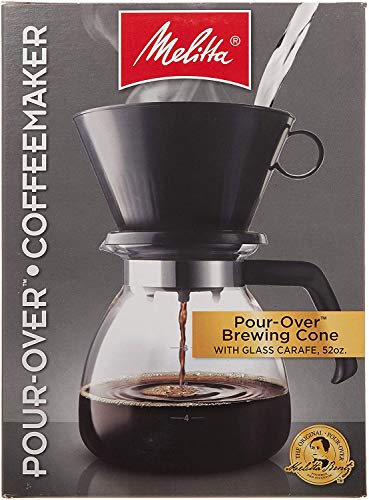
Melitta 52 oz Pour-Over Coffee Brewer with Glass Carafe — Best Budget Full-Size Set
Melitta invented the paper coffee filter, and this set is its classic home format scaled up: a pour-over cone that sits on a generous 52 oz glass carafe, brewing enough for a family breakfast or a table of guests. It is the budget anchor of this guide — a complete maker-and-carafe set that uses widely available cone filters.
Strengths
- Large 52 oz carafe brews for several people at once
- Uses standard, easy-to-find cone filters
- Complete set at a budget tier — cone and carafe included
Trade-offs
- Manual pouring for a full carafe takes a few attentive minutes
- Glass carafe has no warming plate — serve promptly or decant
- Basic build and finish compared with the premium glass systems
| Type | Manual pour-over brewer set |
| Capacity | 52 oz glass carafe |
| Filter | Standard cone paper filters |
| Includes | Pour-over cone and glass carafe |
For households that host — weekend family breakfasts, dinner-party coffee, a holiday table — this set solves a real problem cheaply: manual brewers are usually single-cup, and electric machines sized for a crowd are bulky and expensive. The Melitta set brews a genuinely large batch with the clean taste of pour-over, then goes back in the cupboard. Everyday solo drinkers should pick a smaller system; occasional hosts will wonder how they managed without it.
Because there is no hot plate, plan to serve within about half an hour or pour the batch into a thermal carafe — the one accessory worth adding to this set.
Hosts should note the set’s second talent: it is an excellent cold-brew and iced-coffee batch maker in summer, steeping grounds in cold water in the carafe overnight in the fridge. A budget set that covers winter mornings and summer afternoons earns its cupboard space twice over.
One caution for the Melitta set: the carafe’s size invites brewing for a crowd with a domestic kettle, which may need two boils for a full batch. Plan the water before the guests arrive and the set performs like equipment twice its price.
Best for: Hosts and families wanting batch pour-over on a budget / Not suited for: Solo drinkers or anyone needing keep-warm convenience
Check the current price on Amazon
Comparison Table
| Pick | Badge | Key spec | Best for |
|---|---|---|---|
| Chemex Pour-Over Glass Coffeemaker Classic 6-Cup | Best Overall | 6-cup glass brewer-server, bonded filters | Pour-over drinkers who want one beautiful, complete system |
| Baratza Encore Conical Burr Grinder | Best Grinder Accessory | Conical burr, brew-method grind range | Any coffee drinker upgrading from pre-ground or a blade grinder |
| Hario V60 Pour Over Coffee Starter Set, Size 02 | Best Starter Kit | Dripper + server + filters bundle | Beginners and gift buyers who want a complete pour-over kit |
| AeroPress Original Coffee Press | Best Manual Maker | Standard press, accessory platform | Single-cup drinkers who like to customise and experiment |
| Kalita Wave Pour Over Dripper 185, Glass | Best Dripper Upgrade | Flat-bottom 185 dripper, glass | Home brewers upgrading from basic cones who want consistency |
| Melitta 52 oz Pour-Over Coffee Brewer with Glass Carafe | Best Budget Full-Size Set | 52 oz carafe pour-over set | Hosts and families wanting batch pour-over on a budget |
Notice how each pick answers the accessory question differently: the Chemex and Melitta are complete systems, the Hario set is a bundled starting point, the AeroPress and Kalita are platforms and upgrades, and the Baratza is the universal accessory that lifts all of them. The right buy depends on what you already own — a kettle owner needs a dripper, a dripper owner needs a grinder.
Which Accessories Actually Matter for a Coffee Maker?
Ranked by impact on the cup, the list is shorter than marketing suggests. First, a burr grinder — fresh, even grounds transform any brewer. Second, the correct filters, in stock: the wrong size or a substitute changes flow and flavour, and running out stops the routine entirely. Third, a gooseneck kettle for pour-over methods, which turns pouring from a splash into a controlled stream. Fourth, a simple scale, which makes recipes repeatable instead of approximate.
Everything after that — stands, special servers, storage canisters — is about tidiness and pleasure rather than taste. Buy in impact order and a modest setup will out-brew an expensive machine fed with stale pre-ground coffee every single morning.
How to Choose a Coffee Setup Without Buying Twice
Start from your serving pattern. Solo drinkers should build around a single-cup system like the AeroPress or a dripper; couples and families around a carafe system like the Chemex or Melitta set, or a drip machine from our other guides. Then list the consumables your choice commits you to — filter type and size — and confirm they are easy to order before the maker arrives.
- One maker that matches your serving size
- The correct filters, with a spare pack in the drawer
- A burr grinder, bought first or second
- A kettle suited to the method (gooseneck for pour-over)
- A thermal carafe if coffee must wait before serving
Following that order prevents the classic mistake: an impressive machine, no filters, and a week of drinking whatever the corner shop sells while supplies ship.
Paper, Metal and Cloth Filters: What Changes?
Filters are the cheapest accessory and one of the most influential. Thick paper, like Chemex bonded filters, produces the cleanest cup by trapping oils and fine sediment. Standard paper keeps most sediment out with a little more body. Metal filters — popular AeroPress and dripper accessories — let oils and micro-fines through for a heavier, richer cup and never need replacing, at the cost of sediment in the last sip and a wash after every use.
There is no correct answer, only a preference: clarity drinkers buy paper, body drinkers buy metal, and many households keep both and switch by mood and bean. What is not optional is fit — a filter must match your brewer’s size and shape, or extraction and the morning both suffer.
The Accessory Audit: What Your Current Setup Is Missing
Before buying anything in this guide, audit what you already own against the four gaps that actually affect the cup. Gap one is grinding: if beans meet a blade or a bag of pre-ground, that is the first purchase, full stop. Gap two is pouring: pour-over owners without a gooseneck kettle are brewing with one hand tied — the kettle is the second purchase. Gap three is measurement: if you dose by eye and wonder why Tuesday’s cup differs from Monday’s, a simple scale closes the loop for very little money. Gap four is serving: coffee that waits in the brewer or on a hot plate is coffee declining — a thermal carafe rescues it.
Most households find they have exactly one or two of these gaps, not four. Fix them in order and stop; the hobby’s commercial wing would love you to believe a great cup needs a shelf of gadgets, but the brewers in this guide plus a grinder, a kettle and a scale outperform elaborate setups built on stale beans and guesswork.
How to Store Coffee Makers and Accessories So They Last
Glass servers and brewers die by impact, not by age: store them where they cannot be knocked by a cupboard door or a sliding pan, and never stack anything inside a glass carafe. Burr grinders last longest when their hoppers are emptied of stale beans weekly and the burrs brushed out monthly — coffee oils go rancid inside a grinder just as they do in a brew basket. Paper filters belong in a dry drawer away from cooking steam, which can pre-dampen and weaken them.
Finally, keep the small things together: a single drawer or box holding filters, the scoop, spare seals and the descaler sachet turns a scattered set of accessories into a system. The setups in this guide reward that small organisation every single morning, because a coffee routine fails at its fiddliest missing part, never at its biggest machine.
Building the Setup in Stages: A Sensible Buying Order
Few households should buy a whole coffee station in one order, and staging the purchases teaches you what you actually need. Stage one is the brewer matched to your serving pattern — a system from this guide. Stage two, a fortnight later, is the grinder, bought with the confidence of knowing your brewer’s character. Stage three is the method accessory your routine asks for: a gooseneck kettle if pouring feels clumsy, a thermal carafe if coffee waits, a scale if consistency wanders. Stage four — the stage many never need — is the pleasure layer: a second brewer for a different method, like an AeroPress beside a drip machine.
Staging has a hidden benefit beyond budget: each addition lands on a stable routine, so you can taste exactly what it changed. Buy everything at once and you will never know which purchase deserved the credit — or the blame. Coffee rewards the patient experimenter, in the cup and in the shopping alike.
Coffee Makers and Accessories as Gifts: Matching the Box to the Person
Coffee gear fails as a gift when it answers a question the recipient never asked. The safe matches are these. For the beginner with nothing: the Hario starter set, because it is complete and forgiving of a first month. For the pod drinker quietly tiring of pods: the AeroPress plus a bag of good ground coffee, because the first cup makes the argument no card can. For the home cook whose kitchen is already serious: the Baratza Encore, because it upgrades equipment they already own and love. For the host: the Melitta set or the Chemex, sized to their table.
Two gift rules apply across the guide. Include the consumable — filters in the right size, or beans — so the first brew happens on the day, not after a shopping trip. And never gift a system whose supplies are hard to source locally unless you also gift the first year’s supply; an elegant brewer orphaned by its filter size is a beautiful paperweight, and this guide’s accessory-first approach exists to prevent exactly that outcome.
The Two-Brewer Household: Why One Coffee Maker Is Rarely Enough
Spend time in serious coffee homes and a pattern emerges: almost none of them run a single brewer. The classic pairing is a batch brewer for the household — a drip machine or a carafe system like the Chemex or Melitta in this guide — plus a single-cup brewer for solo moments, which is the AeroPress’s natural second career. The logic is pure fit: batch brewers make small amounts badly, and single-cup brewers make gatherings tedious, so each covers the other’s weakness for less money than one mythical machine that does both perfectly.
Accessories slot into the same logic. One good grinder serves both brewers. One kettle serves the pour-over and the press. A thermal carafe rescues whichever brewer’s output must wait. When you plan a coffee corner as a small system rather than a sequence of unrelated purchases, the pieces start multiplying each other’s value — and the total spend, spread across the years these tools last, stays remarkably sane. That system thinking, more than any single product, is what this guide exists to encourage.
How to Set Up a New Coffee Maker and Its Accessories
Whatever combination you bought, this first-day routine gets a new setup brewing properly and stocked sensibly from the start.
- Unbox against the manual and confirm every included accessory is present — scoops, filter samples and servers are easy to miss in packaging.
- Wash everything that touches coffee or water with warm water and mild soap, then rinse thoroughly; new glass and plastic often carry a faint factory taste.
- Run a water-only brew through electric machines, or rinse manual brewers with hot water, to flush the system before the first real coffee.
- Fit and rinse your first filter — a hot-water rinse removes paper taste and, on pour-over systems, preheats the brewer and server.
- Weigh your first dose rather than scooping blindly; a scale turns the maker’s suggested ratio into a repeatable starting point you can adjust.
- Brew, taste, adjust one thing — grind size first, then ratio — and write down what worked; future-you at 7 a.m. will be grateful.
- Stock the consumables drawer the same day: a spare pack of the correct filters beside the maker, so the routine never breaks over a five-minute supply.
From there, the only standing chore is a weekly rinse of servers and carafes and a monthly descale for electric machines in hard-water areas — small habits that keep both maker and accessories tasting clean for years.
Common Buying Mistakes
Buying the maker and forgetting the filters. The most common setup failure in coffee. Every system in this guide names its filter — order a spare pack with the maker, not after it.
Using the wrong filter size ‘because it fits’. A cone filter folded into a flat-bottom dripper (or the reverse) changes flow and extraction. Close enough is not close enough in brewing.
Spending on the machine, skimping on the grinder. An expensive brewer fed stale pre-ground coffee loses to a budget brewer with fresh burr-ground beans. The grinder is not the optional extra.
Assuming accessories are universal. AeroPress standard and XL sizes, V60 01/02/03 sizes and Kalita 155/185 sizes are all different ecosystems. Check the size in the product name before ordering anything.
Storing beans in the pretty canister by the sunny window. Heat and light stale coffee fast. An airtight container in a cool cupboard beats a beautiful jar on the counter for anything you will not finish this week.
Final Recommendation
If you want one complete, beautiful system and drink coffee with others, the Chemex set is the centrepiece pick. Building from zero on a sensible budget, pair the Hario starter set — or the Kalita Wave if you already own a kettle — with the Baratza Encore, and you have a manual setup whose cup quality embarrasses machines costing far more. The AeroPress is the flexible second brewer every household benefits from, and the Melitta set is the quiet hero for anyone who hosts.
Whichever route you take, buy the filters with the maker and the grinder as soon as budget allows. Those two unglamorous decisions matter more than any single product badge in this guide.
Keep exploring the rest of our coffee coverage here: Best Coffee Makers Best Coffee Makers Accessories Best Coffee Makers Aeropress
Frequently Asked Questions
What is the most important coffee accessory to buy first?
A burr grinder. Freshly ground, evenly sized coffee improves every brewing method more than any other single purchase. If you already own a decent grinder, the next priority is a reliable stock of the correct filters for your brewer.
Do I need special filters for pour-over coffee makers?
Yes — each system uses its own. Chemex brewers need Chemex bonded filters, the Hario V60 takes V60-size filters, and the Kalita Wave uses its ruffled Wave filters. The Melitta set is the exception, using standard cone filters that are easy to find almost anywhere.
Can I use a metal filter instead of paper?
In systems that offer one — the AeroPress is the popular example — yes. Metal filters let more oils and fine particles through, giving a heavier cup, and they eliminate the consumable cost. Paper gives a cleaner cup. Many drinkers keep both and choose per bean.
What size Hario V60 should a beginner buy?
Size 02, as in the starter set in this guide. It brews one large or two smaller cups, which covers most home routines, and it has the widest recipe support. Size 01 is very small and 03 is aimed at larger batches.
How many cups does the Chemex 6-cup actually make?
Chemex cup sizing runs smaller than a standard mug, so the 6-cup model is best thought of as two generous mugs. If your household drinks large mugs together every morning, consider how often you will brew a second round, or look at the larger Chemex sizes.
Is a gooseneck kettle essential for pour-over?
Not essential, but it is the accessory pour-over brewers feel most. The controlled, gentle stream makes even saturation far easier, especially with the V60. Start with a regular kettle, poured slowly, and upgrade when the method has you hooked.
Do I need a scale for pour-over coffee?
Not strictly, but it is the cheapest consistency upgrade there is. Weighing coffee and water turns a good recipe into a repeatable one; without it, you are re-guessing the ratio every morning. Most home brewers who buy a scale wonder why they waited.
How often should grinder burrs be replaced?
For home use, burrs last for years — typically hundreds of kilograms of coffee — before grind consistency visibly fades. Signs are increasing fines and a cup that turns muddy or bitter at your usual setting. The Baratza in this guide is designed with replaceable burrs and available parts, which is a large part of its long-term value.
Are expensive coffee accessories worth it for beginners?
The grinder is; most others can wait. A beginner with a good grinder and a basic brewer will make better coffee than a beginner with a luxury brewer and pre-ground coffee, and will learn faster because fresh grinding removes the biggest variable. Add accessories as your routine reveals the need for them, not before.
How do I stop my pour-over tasting sour?
Sour usually means under-extraction: grind a little finer, pour a little slower to extend the contact time, and make sure the water is properly hot — just off the boil. Change one variable per brew. The Kalita Wave forgives these errors most; the V60 teaches you fastest; both arrive at a sweet cup within a few attempts.
Related guides in this series: Best Coffee Grinder Drip Coffee Makers Best Coffee Makers And Grinder Best Coffee Makers Bodum


