Disclosure: airfryerkitchensupply.com is reader-supported. When you buy through links on our site, we may earn an affiliate commission at no extra cost to you.
Where to Buy
In a hurry? These are the best chopsticks to buy across the six materials that actually matter — fiberglass, bamboo, steel, ceramic, wood, and titanium — every one with a listing we verified. Check price on Amazon for each, and read the material guide below before deciding, because with chopsticks the material is the product.
- HIWARE 10 Pairs Fiberglass Chopsticks, Black, 9.5 Inches — check price on Amazon
- Antner 5 Pairs Natural Bamboo Chopsticks, 8.8 Inches — check price on Amazon
- MUYOS Stainless Steel Chopsticks, 5 Pairs, Silver — check price on Amazon
- Ceramic Chopsticks, Blue Peony Bone China, 5 Pairs, 9.7 Inches — check price on Amazon
- GLAMFIELDS Japanese Natural Wooden Chopsticks, 5 Pairs, 8.8 Inches — check price on Amazon
- Snow Peak Titanium Chopsticks — check price on Amazon
Introduction: The Best Chopsticks to Buy Are the Ones That Match Your Table
Searching for the best chopsticks to buy sounds simple until you realise the market is really six different products wearing one name. A fiberglass family set, a bamboo beginner pair, a Korean steel set, a bone-china gift set, a hand-carved Japanese wooden pair, and a titanium travel set are all ‘chopsticks,’ yet they suit different meals, different hands, and different tolerances for upkeep. This guide is organised by that truth. We picked one verified exemplar of each material — six picks, six badges — and then built the buying guide around the questions that actually decide satisfaction: what length fits your cuisine, how much grip your skill level needs, whether your household dishwashes everything, and how much care you will honestly give a natural material. Every pick below carries an Amazon listing we confirmed through the site’s Amazon product listings, with specifications taken from those listings only. We print no static prices — check price on Amazon — and no star ratings, because neither helps you choose a material. What helps is understanding the trade-offs, so each review states plainly who a pick suits, who it does not, and what living with it is like after the novelty wears off.
In this guide
Quick Picks
One pick per material, so the shortlist doubles as a material guide. Badges are repeated at each detailed review.
- Best Overall: HIWARE 10 Pairs Fiberglass Chopsticks, Black, 9.5 Inches — the default family set: ten dishwasher-safe fiberglass pairs at the classic 9.5-inch dining length.
- Best Bamboo: Antner 5 Pairs Natural Bamboo Chopsticks, 8.8 Inches — classic Japanese-style bamboo: feather-light, warm in the hand, and kind to beginners learning grip.
- Best Metal: MUYOS Stainless Steel Chopsticks, 5 Pairs, Silver — hollow-core stainless that stays light, with non-slip tips and full dishwasher freedom.
- Best Ceramic: Ceramic Chopsticks, Blue Peony Bone China, 5 Pairs, 9.7 Inches — bone-china porcelain with a blue peony design: the beautiful, easy-clean gift set — handle with care.
- Best Wooden: GLAMFIELDS Japanese Natural Wooden Chopsticks, 5 Pairs, 8.8 Inches — hand-carved natural wood in the Japanese style: warm, light, and textured for control.
- Best Premium and Travel: Snow Peak Titanium Chopsticks — ultralight titanium at 22 grams with a carrying case — the outdoors and travel specialist.
How These Picks Were Chosen
We chose by material first and brand second. Chopsticks are a mature, simple product; the material determines weight, grip, heat behaviour, care, and lifespan far more than any brand’s marketing does. So the shortlist had to include the six materials a buyer will realistically meet — fiberglass, bamboo, stainless steel, ceramic, wood, and titanium — with one strong, verified example of each rather than six near-identical fiberglass sets. Each example then had to pass verification: we matched the product against the airfryerkitchensupply.com Amazon listing data feed and took the ASIN and specifications from the listed listing, so lengths, pair counts, and care claims in this article come from the listings themselves. We deliberately excluded categories we could not verify cleanly — no unverified ‘carbon fibre’ claims, no mystery-wood sets with no stated length. Within each material we favoured the configuration most buyers actually want: family-size pair counts for household materials, the classic dining lengths, and dishwasher-safe builds where the material allows it. The result is a shortlist where choosing is really choosing a material and a use case — which is the honest decision this purchase involves.
The 6 Best Chopsticks to Buy, by Material

HIWARE 10 Pairs Fiberglass Chopsticks, Black, 9.5 Inches — Best Overall
If you buy one set of chopsticks for a household that eats noodles, rice, and sushi several times a week, this is the sensible default. Fiberglass is the material the restaurant trade converged on for good reasons: it does not warp, stain, splinter, or absorb odours, it survives the dishwasher indefinitely, and it keeps a light, balanced feel that pure metal cannot match. The HIWARE set gives you ten pairs at 9.5 inches — the versatile middle length for dining — in plain black that matches any tableware. There is nothing precious about them, and that is the point: these are the chopsticks you will actually use daily.
Strengths
- Fiberglass construction shrugs off dishwashers, hot broth, and years of daily use without warping or fading
- Ten pairs covers a family plus guests, so a pair is always clean and ready
- 9.5-inch length is the all-round dining size for bowls, plates, and shared dishes
Trade-offs
- Fiberglass has a smooth, slightly slick feel that some traditionalists find less grippy than wood on oily noodles
- Plain black styling is functional, not decorative — look at the ceramic pick if the table setting matters
- Not the pick for high-heat cooking; use the long cooking chopsticks discussed in the guide below for wok work
| Material | Fiberglass |
| Length | 9.5 inches (per listing) |
| Quantity | 10 pairs |
| Care | Dishwasher safe (per listing) |
The reason fiberglass wins the ‘best overall’ slot is failure-mode maths. Bamboo and wood eventually split, stain, or grow rough at the tips. Metal lasts forever but conducts heat and can feel slippery and heavy. Ceramic is beautiful and fragile. Fiberglass simply accumulates the fewest problems per year of ownership, which is why it dominates commercial dining rooms where chopsticks are washed hundreds of times. HIWARE’s version is the category’s reference set: consistent moulding, tips textured enough for noodles, and a price tier (check price on Amazon — we do not print static prices) that makes a ten-pair household set an easy decision. One usage note: fiberglass chopsticks are dining tools. Their comfortable length and heat tolerance suit table use and light serving, but sustained wok frying wants the 16-inch class of cooking chopsticks covered in the how-to section. Buy this set for the table, and let it be the standard every other material in this roundup is judged against: if a prettier or more traditional material delights you enough to accept its care demands, buy that too — but own this baseline first if your household is new to chopsticks.
Best for: families and everyday dining — the first set most households should own / Not suited for: cooking at the wok, or buyers who want a natural material on principle
Check the current price on Amazon
Antner 5 Pairs Natural Bamboo Chopsticks, 8.8 Inches — Best Bamboo
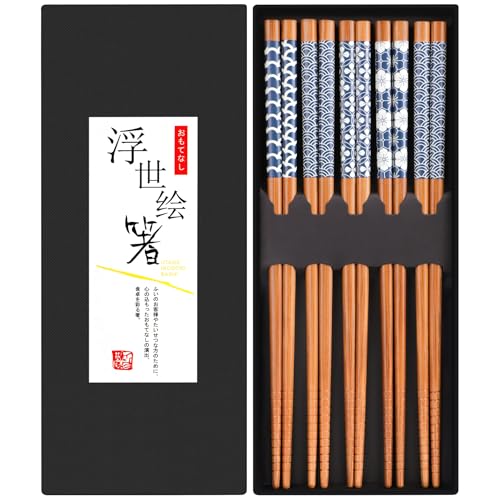
Bamboo is where most people’s chopstick story starts, and the Antner set shows why the material endures. At 8.8 inches in the Japanese style, these are short, light, and precise — the easiest configuration for a beginner to control, and a comfortable size for smaller hands and smaller bowls. Bamboo does not conduct heat from hot broth, does not scratch bowls, and has a natural fine texture that grips food more forgivingly than polished metal or fiberglass. The listing describes them as dishwasher safe, though the care section below explains why many owners still hand-wash bamboo to stretch its life.
Strengths
- Feather-light bamboo makes learning grip easy and causes the least hand fatigue
- Natural surface texture grips noodles and slippery foods more forgivingly than polished materials
- Shorter 8.8-inch Japanese length suits smaller bowls, smaller hands, and precise picking
Trade-offs
- Bamboo is a natural material with a finite life: tips eventually roughen and pairs eventually split, so treat the set as renewable, not permanent
- Porous surface can hold strong colours and odours longer than fiberglass or metal
- Shorter length is less ideal for reaching across large shared platters or into deep hotpot broth
| Material | Natural bamboo |
| Length | 8.8 inches / 22.5 cm (per listing) |
| Quantity | 5 pairs |
| Style | Japanese, per listing |
Choosing bamboo is choosing a feel. In blind use, bamboo’s warmth and slight give register immediately against the clinical coolness of steel, and for foods like tofu, flaky fish, and soft noodles, that gentle grip prevents the squeeze-and-shatter mistakes beginners make. The Antner set’s Japanese proportions matter more than they appear to: Japanese chopsticks are shorter than Chinese ones because Japanese meals centre on individual bowls and plates held close, including fish dishes where short, pointed tips help separate flesh from bone. If your table leans Japanese — miso soup, rice bowls, grilled fish — this length will feel right in a way a 10.5-inch Chinese pair never will. The honest cost is longevity. Keep bamboo out of prolonged soaking, dry it upright after washing, and retire a pair when the tip frays; a frayed tip harbours residue and ruins the precision you bought bamboo for. Viewed that way, a five-pair bamboo set is a consumable you renew every year or two, and at this tier that is a fair trade for the most pleasant learning experience of any material here.
Best for: beginners, Japanese-style meals, smaller hands, and anyone who values feel over permanence / Not suited for: buyers who want one set to last a decade untouched, or hotpot nights with deep shared broth
Check the current price on Amazon
MUYOS Stainless Steel Chopsticks, 5 Pairs, Silver — Best Metal
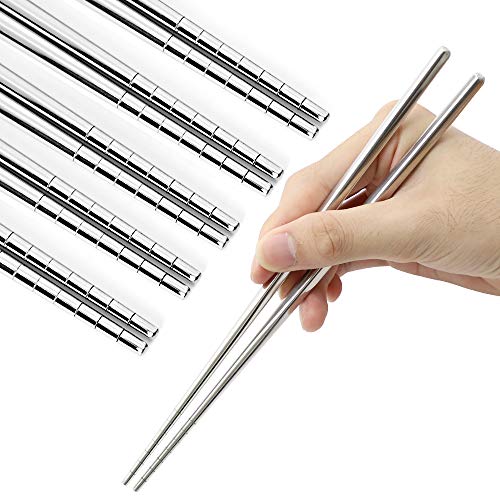
Metal chopsticks are the Korean table standard, and the MUYOS set is the version we recommend for households curious about them. The design detail that matters is in the listing: a hollow-core build. Solid steel chopsticks are fatiguing and conduct heat eagerly; hollowing the core keeps these light in the hand while retaining steel’s indestructibility. The tips are shaped for grip — essential, because polished metal on an oily noodle is the classic beginner frustration — and the whole set is dishwasher safe with nothing to warp, stain, or split, ever.
Strengths
- Stainless steel is effectively permanent: no warping, staining, splitting, or odour retention
- Hollow-core design keeps the weight down so metal does not tire the hand
- Non-slip tips address metal’s one real weakness — grip on smooth, oily foods
Trade-offs
- Metal conducts heat, so resting them in a steaming bowl or using them at a grill needs awareness
- The cooler, harder feel is an acquired taste if you learned on wood or bamboo
- Metal clicks against ceramic and glass bowls, which some households find noisy at a quiet table
| Material | Stainless steel, hollow-core (per listing) |
| Quantity | 5 pairs |
| Care | Dishwasher safe (per listing) |
| Tips | Non-slip, per listing |
Why does Korea use metal chopsticks at all? The practical answers are durability in a high-volume food culture, hygiene in restaurants, and compatibility with the metal bowls and hot dishes of Korean dining. If your household eats a lot of Korean food — barbecue, stews served bubbling, metal rice bowls — metal chopsticks are not an affectation; they are the matching tool, and they will not scorch at a grill the way bamboo can. The MUYOS set is the right ambassador for the material because it solves the two objections in advance: weight, via the hollow core, and grip, via the tip design. What it cannot solve is physics — steel conducts heat, so do not leave these resting across a hot pot rim and then grab the ends carelessly, and expect a little more table noise than wood gives you. For households that host often and hate replacing things, there is a strong case for making this the house set: five pairs that will look and perform the same in ten years, through thousands of dishwasher cycles, with zero maintenance rituals. Pair them with the bamboo pick above if you want a warmer-feeling option for guests who are still learning.
Best for: Korean-food households, heavy users, and anyone who wants a buy-once set with zero upkeep / Not suited for: beginners still mastering grip, or anyone who dislikes metal’s cool feel and table noise
Check the current price on Amazon

Ceramic Chopsticks, Blue Peony Bone China, 5 Pairs, 9.7 Inches — Best Ceramic
Ceramic chopsticks exist for the table where how things look is part of the meal. This bone-china set, decorated with a blue peony motif, is the giftable, photographable pick of the roundup — and the listing confirms the practical side too: porcelain is non-porous, easy to clean, and dishwasher safe. At 9.7 inches it sits in the comfortable dining range. What ceramic asks in return is care: it is the one material here that can chip or break if dropped on tile or knocked in a crowded sink, and we will not pretend otherwise.
Strengths
- Bone-china porcelain is completely non-porous, so no staining or odour retention from strong foods
- The blue peony design makes this a genuine gift set and a table upgrade, not just a utensil purchase
- Smooth glazed surface wipes and washes clean more easily than any natural material
Trade-offs
- Ceramic chips and breaks: one drop on a hard floor can end a pair, and sink knocks take their toll over time
- The glazed surface is the slickest here — the hardest material for beginners to grip slippery food with
- Heavier in the hand than bamboo or fiberglass, which some users notice over a long meal
| Material | Bone china porcelain (per listing) |
| Length | 9.7 inches (per listing) |
| Quantity | 5 pairs |
| Care | Dishwasher safe (per listing) |
Ceramic is the connoisseur’s trade: maximum beauty and hygiene, minimum forgiveness. The hygiene point is real and underrated — a glazed porcelain surface gives bacteria nowhere to hide and releases turmeric, chilli oil, and beetroot stains that would live in bamboo for weeks. That makes this set a thoughtful choice for households that serve strongly coloured food often, or for anyone who simply dislikes the idea of a porous utensil. The fragility point is equally real. Treat these like the wine glasses of the chopstick drawer: hand-wash if your sink is a chaotic place, store them where they cannot rattle against steel cutlery, and accept that over years you may lose a pair. Many owners solve this by using ceramic for guests and plated meals while a fiberglass or steel set does weekday duty — a two-set system this roundup quietly recommends for anyone who loves ceramic. As a gift, this is the easiest pick on the page: it arrives as a designed object with a story (bone china, a classic peony motif), at a dining length that suits most adults, and it suits recipients who already own ordinary chopsticks and would never buy themselves the beautiful version.
Best for: gifts, design-conscious tables, and households serving strongly coloured food often / Not suited for: clumsy households, young children, or beginners — the slick glaze and fragility punish learners
Check the current price on Amazon

GLAMFIELDS Japanese Natural Wooden Chopsticks, 5 Pairs, 8.8 Inches — Best Wooden
Wood is bamboo’s more refined cousin: denser, smoother-finished, and available in the hand-carved Japanese styles that make a simple utensil feel crafted. The GLAMFIELDS set gives you five pairs of natural wood at the 8.8-inch Japanese length, described on the listing as lightweight and hand-carved in a classic style. Wood’s fine grain gives a controlled, slightly warm grip that suits precise eating — separating fish, picking herbs, placing garnishes — and a good wooden pair has a balance that moulded materials rarely match.
Strengths
- Natural wood grain offers a warm, controlled grip with a crafted, hand-finished feel
- Japanese 8.8-inch proportions suit precise eating and smaller bowls
- Lightweight like bamboo but with a denser, smoother finish that feels a step up at the table
Trade-offs
- Wood needs the gentlest care here: hand-wash, dry promptly, and keep it out of long soaks and harsh dishwasher cycles to protect the finish
- Natural material means gradual wear — finishes dull and tips soften over years of use
- Not suited to cooking heat or to resting in hot broth for extended periods
| Material | Natural wood, hand-carved (per listing) |
| Length | 8.8 inches / 22.5 cm (per listing) |
| Quantity | 5 pairs |
| Style | Japanese, per listing |
The case for wood is the case for any natural tool: it feels alive in the hand in a way polymers do not, and for people who eat with chopsticks daily, that feel is not a luxury — it is the experience of every meal. Japanese wooden chopsticks in particular are made with pointed, finely tapered tips, because the cuisine demands precision: lifting a single shiso leaf, teasing flakes from grilled fish, picking a slice of ginger from a crowded plate. This GLAMFIELDS set sits in that tradition at an accessible tier. The commitment you make in return is care. Wood and dishwashers are uneasy partners — heat, detergent, and long wet cycles dull finishes and can raise the grain — so the ritual is a quick hand-wash, a towel dry, and upright storage. Many owners oil wooden chopsticks occasionally with food-safe oil, the same way they would a wooden spoon, though the listing makes no specific care claims and you should follow the seller’s instructions first. Choose wood if your meals lean Japanese, if you eat with chopsticks often enough to appreciate nuance, and if a two-minute care ritual sounds like pleasure rather than chore. Choose fiberglass or steel if it sounds like a chore — that self-knowledge is the real buying guide.
Best for: Japanese-style dining, experienced users, and anyone who enjoys natural materials and simple care rituals / Not suited for: dishwasher-only households or anyone who wants zero-maintenance utensils
Check the current price on Amazon

Snow Peak Titanium Chopsticks — Best Premium and Travel
The premium end of the chopstick market is not about decoration; it is about titanium. Snow Peak, the Japanese outdoor brand, makes this set for campers and travellers, and the listing’s numbers tell the story: 22 grams, with a carrying case included. Titanium does not rust, does not taste of anything, does not conduct heat the way steel does, and is strong enough to be made slim without flexing. At home it is a luxury; in a backpack, a work bag, or a travel kit, it is simply the best tool for the job — a personal set that replaces disposable chopsticks everywhere you go.
Strengths
- Titanium is rust-proof, taste-neutral, and exceptionally durable while weighing just 22 grams per the listing
- Carrying case included, making it a genuine everyday-carry and travel set
- Lower heat conduction than stainless steel, so it behaves better around hot food outdoors
Trade-offs
- Premium tier pricing for a single set — you are paying for material and brand engineering, not pair count
- Titanium’s slim profile and smooth finish reward an already-confident grip
- One set does not furnish a family table; this is a personal or travel purchase
| Material | Titanium (per listing) |
| Weight | 22 grams (per listing) |
| Case | Carrying case included (per listing) |
Snow Peak’s chopsticks make sense once you see the use case clearly. Disposable chopsticks are wasteful and often splintery; restaurant reusables are fine until you are eating at a trailhead, a desk, or a street stall where you would rather use your own. A 22-gram titanium set in a case disappears into a bag and lasts effectively forever, through campfires, dishwashers, and decades of lunches. Titanium’s material personality also suits eating better than its reputation suggests: it warms to a neutral feel quickly, never carries yesterday’s flavours, and its slight surface texture grips better than polished steel. At home, owners tend to adopt a set like this as ‘their’ pair — the one that lives in the cutlery drawer and gets reached for first. Is it necessary? No — the HIWARE fiberglass set at the top of this roundup feeds a family for a fraction of the commitment. Is it the best chopsticks to buy if the question is one perfect personal set, for travel and daily use, that you will still own in twenty years? Yes, and it is not close. Buy it for yourself, or as the gift for the outdoors person who already owns every gadget except a beautiful one they will use three times a day.
Best for: travellers, campers, desk-lunch regulars, and anyone buying one perfect personal set / Not suited for: furnishing a family table on a budget — buy the multi-pair sets above instead
Check the current price on Amazon
Comparison Table
| Pick | Badge | Key spec | Best for |
|---|---|---|---|
| HIWARE 10 Pairs Fiberglass Chopsticks, Black, 9.5 Inches | Best Overall | Fiberglass, 9.5 in, 10 pairs, dishwasher safe | families and everyday dining — the first set most households should own |
| Antner 5 Pairs Natural Bamboo Chopsticks, 8.8 Inches | Best Bamboo | Bamboo, 8.8 in, 5 pairs | beginners, Japanese-style meals, smaller hands, and anyone who values feel over permanence |
| MUYOS Stainless Steel Chopsticks, 5 Pairs, Silver | Best Metal | Stainless steel, hollow-core, 5 pairs | Korean-food households, heavy users, and anyone who wants a buy-once set with zero upkeep |
| Ceramic Chopsticks, Blue Peony Bone China, 5 Pairs, 9.7 Inches | Best Ceramic | Bone china porcelain, 9.7 in, 5 pairs | gifts, design-conscious tables, and households serving strongly coloured food often |
| GLAMFIELDS Japanese Natural Wooden Chopsticks, 5 Pairs, 8.8 Inches | Best Wooden | Natural wood, 8.8 in, 5 pairs, hand-carved | Japanese-style dining, experienced users, and anyone who enjoys natural materials and simple care rituals |
| Snow Peak Titanium Chopsticks | Best Premium and Travel | Titanium, 22 g, case included (per listing) | travellers, campers, desk-lunch regulars, and anyone buying one perfect personal set |
How to Choose Chopsticks: Length, Material, and Grip
Start with length, because it follows your cuisine. Chinese dining chopsticks run longest — roughly 10.5 inches — because meals centre on shared dishes and hotpot, where reach and distance from steam matter. Japanese chopsticks run shortest, around 8.5 to 9 inches, for individual bowls held close and precise work with fish. Korean chopsticks sit between, usually in metal, matched to metal bowls and grilled food. If your household eats mixed Asian cuisines, a 9.5-inch pair is the diplomatic compromise — which is why our Best Overall fiberglass pick sits exactly there. Next, grip. Beginners should prize texture: bamboo, wood, and textured-tip fiberglass forgive imperfect technique, while polished metal and glazed ceramic punish it. If you are buying for a learner, buy grip first and beauty later. Third, be honest about washing. If everything goes in the dishwasher, your materials are fiberglass, steel, titanium, and (carefully) ceramic; bamboo and wood will live shorter, duller lives under machine washing whatever the listing allows. Fourth, count your household: multi-pair sets in fiberglass or steel furnish a table economically, while premium materials like titanium make sense bought singly, as personal sets. Finally, buy cooking chopsticks separately. Dining chopsticks of any material are the wrong tool for wok frying; the 16-inch wooden cooking class exists for that, and using dining pairs at the stove is how tips get scorched and finishes ruined.
Chopstick Materials Compared: What Living With Each One Is Like
Fiberglass is the modern default: polymer-and-glass composite, moulded with textured tips, indifferent to dishwashers, hot broth, and strong detergents. Its weakness is feel — smooth and slightly clinical — and a lower heat ceiling than metal for cooking tasks. Bamboo is the lightest and warmest, with natural micro-texture that grips kindly; it is also a plant product with a lifespan, happiest hand-washed and replaced when tips fray. Wood is bamboo refined: denser hardwoods, finer tapers, finishes that reward hand-washing and occasional care; it is the material of connoisseurs and of Japanese dining tradition. Stainless steel is the permanent option, hygienic and indestructible, with heat conduction and table noise as its taxes; hollow-core designs and textured tips, like our MUYOS pick, pay down both. Ceramic is the hygienist’s and aesthete’s choice — non-porous, stain-proof, beautiful — and the only material here that breaks, so it suits careful households and guest use. Titanium is steel’s exotic sibling: lighter, rust-proof, taste-neutral, gentler with heat, and priced accordingly; it shines as a personal and travel set rather than table furnishing. Notice that no material wins everywhere. The best chopsticks to buy are the pair whose weaknesses live where you do not care — noise, care rituals, fragility, price — and whose strengths sit exactly on your table’s habits.
How to Hold Chopsticks and Build Skill (Plus Care Basics)
If you are buying your first set, ten minutes of technique beats any upgrade in material. Rest the lower chopstick on the web between thumb and index finger and on the tip of your ring finger; it stays still. Hold the upper chopstick like a pencil, between thumb, index, and middle fingertips; it does all the moving. Practise by moving dry beans, then peanuts, then noodles, from bowl to bowl; grip near the back third of the sticks for leverage, and let the tips meet precisely — misaligned tips, not weak grip, cause most dropped food. Beginners should start on the bamboo or fiberglass picks above, whose texture forgives, and graduate to steel or ceramic later if they wish. Care follows material: fiberglass, steel, and titanium go in the dishwasher without a thought. Bamboo and wood prefer a quick hand-wash, a towel dry, and upright storage so tips dry fully; never leave them soaking, which swells and splits natural fibres. Ceramic washes easily but stores best where it cannot rattle against metal. Store all chopsticks dry, tips up in a holder or flat in a drawer divider, and retire any natural pair whose tip has frayed — a frayed tip is where residue hides and precision dies.
Training Chopsticks, Kids, and Shared Family Sets
Households with children face a version of this purchase the material debate does not cover. Children learn fastest on short, light chopsticks with help: training designs add a hinge, finger rings, or a silicone guide that holds the two sticks in alignment while small hands build the motion. If your household includes a learner under eight, the pragmatic setup is a forgiving adult set — bamboo or fiberglass from this roundup — plus one or two training pairs bought separately for the child, rather than forcing small hands onto full-size adult sticks. Length matters here too: a child wrestling a 10.5-inch pair is fighting the tool, not learning the skill. For shared family sets, think in systems rather than single purchases. A ten-pair fiberglass base set covers daily meals and guests; a five-pair bamboo or wooden set covers learners and Japanese-style meals; one beautiful ceramic set covers occasions. That layered drawer costs less than most people expect across the tiers involved, and it means nobody is eating ramen with the slippery gift set or serving guests the frayed training pair. Colour-coding helps in practice: several households assign each person a colour or material, which quietly solves both hygiene preferences and the mystery of whose pair is whose in a crowded drawer.
Disposable vs. Reusable: The Honest Sustainability Picture
Disposable bamboo chopsticks — the kind bundled with takeaway orders — are a genuinely useful product for picnics, parties, and lunchboxes you might lose. They are also, multiplied across a household that eats with chopsticks daily, a steady stream of splintery, inconsistent tools and avoidable waste. The reusable sets in this roundup invert that: a fiberglass or steel set washes thousands of times, and even the natural materials last years with basic care. The sustainability maths favour reusables quickly, but the eating maths favour them immediately — consistent length, consistent tips, no splinters, no mystery warping from a damp storage cupboard. Our practical advice is a hybrid most chopstick cultures already follow: keep reusables as the house standard, keep a small pack of disposables strictly for travel, packed lunches, and the picnic basket, and keep a personal titanium or steel set — like the Snow Peak pick above — in your bag if you eat out often and prefer your own tools. That combination covers every real situation without pretending a single purchase solves all of them, and it is the setup we would recommend to any household making chopsticks a daily habit rather than an occasional novelty.
Chopstick Etiquette Basics Worth Knowing Before You Host
Buying the right chopsticks is half the purchase; using them without faux pas is the other half, and it matters most for the households buying guest sets like the ceramic pick above. A few rules travel across Chinese, Japanese, and Korean tables. Never stick chopsticks upright in a bowl of rice — the image echoes funeral incense offerings in several cultures and is the one mistake hosts genuinely notice. Do not spear food with a chopstick like a fork, do not point with them, and do not wave them over dishes while deciding; rest them on a rest, a holder, or the edge of your plate between bites. When sharing dishes, use the serving end or dedicated serving chopsticks rather than your personal pair, a hygiene habit that also explains why family sets come in colours. Do not rub disposable wooden chopsticks together theatrically — it implies you expect splinters and, by extension, a cheap establishment. And when you pass food to another person, place it on their plate rather than passing chopstick-to-chopstick, which echoes a funeral rite in Japan. None of this requires ceremony at a Tuesday noodle night; it is simply the knowledge that turns a good set of chopsticks into confident hosting, and it costs nothing to acquire alongside the purchase.
Building Your Drawer at Three Tiers
Because we do not print static prices, here is the honest tier logic instead. At the budget tier, one multi-pair fiberglass or bamboo set furnishes the whole table and survives the dishwasher or a hand-wash routine; that single purchase covers ninety percent of households completely. At the mid tier, add a second material for a second job: steel for the Korean-barbecue household, wood for the Japanese-dining household, or ceramic for the household that hosts and photographs its table. At the premium tier, add the personal set — titanium for the traveller or commuter — and keep it out of the shared drawer. Notice what never appears in this ladder: a drawer full of one material in five colours, or a single fragile set asked to do every job. Chopsticks are cheap enough, even at the premium end, that the correct strategy is coverage of use cases rather than loyalty to one product. If you are furnishing a first apartment, buy the budget tier now and the mid tier when your cooking tells you which cuisine you actually live on; your table habits, not a guide, should choose the second set.
Rests, Holders, and Storing a Set Properly
A small accessory completes any set in this roundup: the chopstick rest. Rests keep tips off the tablecloth between bites — the hygienic and polite default — and they stop round chopsticks rolling off the table, which every owner of polished steel or ceramic pairs has experienced mid-meal. Ceramic rests pair naturally with the bone-china pick; wooden or bamboo rests suit the natural sets; a simple folded napkin works in a pinch but slides. For storage, keep pairs together and dry: a drawer divider that separates chopsticks from heavier cutlery protects wooden finishes and ceramic glazes alike, and upright storage in a ventilated holder suits households that wash and reuse within the day, provided the holder drains — standing water at the tips is how natural materials stain and smell. If you buy the titanium travel set, its included case is the storage; keep it in the bag you actually carry, not the drawer, or the everyday-carry logic evaporates. These are small disciplines, but chopsticks are small tools — the difference between a set that feels considered after two years and a drawer of mismatched survivors is almost entirely storage and rests.
Common Buying Mistakes
The first mistake is buying by appearance alone: the most beautiful set in the listing photo may be glazed ceramic, the hardest material for a beginner to use. Match material to skill and household first, looks second. The second is buying one length for every job — dining pairs at the wok scorch and feel clumsy, while long cooking pairs at the table feel like oars. The third is furnishing a family from single-pair premium sets, or the reverse: expecting a bulk disposable-style pack to feel like a crafted pair. The fourth is ignoring pair count and ending up two pairs short at every family dinner. The fifth is machine-washing wooden and bamboo sets for a year and blaming the material when the finish dies; the care ritual is part of the product. The sixth is buying metal for a household of learners, whose frustration with slippery tips can put them off chopsticks entirely — start forgiving, upgrade later. Finally, beware listings with no stated length, material, or pair count: every pick in this roundup states all three, and yours should too.
Final Recommendation
Most households should start with the HIWARE fiberglass set: ten dishwasher-proof pairs at the universal dining length, the baseline against which everything else is a preference. Learners and Japanese-style tables will be happiest with the Antner bamboo or the GLAMFIELDS wooden set, heavy users and Korean-food fans with the MUYOS stainless steel, and anyone buying a gift should go straight to the blue peony bone-china set. For one perfect personal set that travels everywhere, the Snow Peak titanium stands alone. Round out your drawer with the neighbouring guides: Best Chopsticks Sterilizer, Best Fiberglass Chopsticks, Best Bamboo Chopsticks, and Best Cooking Chopsticks.
Frequently Asked Questions
What are the best chopsticks to buy for beginners?
Bamboo or textured fiberglass at around 9 to 9.5 inches. Both are light, grippy, and forgiving of imperfect technique. In this roundup, the Antner bamboo set is the gentlest starting point, and the HIWARE fiberglass set is the best choice if the same set must also survive daily dishwasher use by the whole family.
What length of chopsticks should I buy?
Match the cuisine: roughly 8.5 to 9 inches for Japanese-style individual bowls, about 9.5 inches as an all-round compromise, and around 10.5 inches for Chinese shared-dish and hotpot dining. Cooking chopsticks are a separate, longer tool — around 16 inches — and should not double as dining pairs.
Are metal chopsticks harder to use?
Slightly, at first. Metal is smoother and heavier than wood or bamboo, so slippery foods demand better technique. Hollow-core designs with textured tips, like the MUYOS set in this roundup, narrow the gap a lot, and metal rewards you with permanence: no warping, staining, or replacement cycle.
Can you put chopsticks in the dishwasher?
Fiberglass, stainless steel, and titanium handle dishwashers indefinitely, and the ceramic set here is listed as dishwasher safe too, though hand-washing protects it from knocks. Bamboo and wood live longest hand-washed and dried promptly, whatever a listing permits — heat and long wet cycles dull finishes and raise grain over time.
How many pairs of chopsticks does a household need?
Count your regular seats, add two for guests, and add one spare pair per material you own. For most families that lands on a ten-pair household set like the HIWARE fiberglass pick, optionally plus a smaller special set — ceramic for guests, bamboo for learners, or a personal titanium pair for travel.
Do chopsticks need to be replaced?
Natural materials do: retire bamboo or wood when tips fray, split, or stay stained after washing. Fiberglass should be replaced if the surface becomes rough or the tips chip. Steel, titanium, and intact ceramic effectively do not wear out, which is their long-term value argument despite higher upfront tiers.

