Disclosure: airfryerkitchensupply.com is reader-supported. When you buy through links on our site, we may earn an affiliate commission at no extra cost to you.
Where to buy
For anyone comparing the best charcoal bbq grills, this shortlist is the place to start: every model below was verified before its link was attached. Charcoal BBQ grills are sold through Amazon, home centres and barbecue specialists, frequently under both “grill” and “smoker” labels for the same hardware. Order against the exact model names in this guide, and re-check included accessories on the listing, because barrel and offset models are sold in several trims that share a name.
- Weber Original Kettle Premium Charcoal Grill, 22-Inch — check price on Amazon; confirm grate size, firebox inclusion and trim on the listing before ordering.
- Weber Original Kettle Charcoal Grill, 18-Inch — check price on Amazon; confirm grate size, firebox inclusion and trim on the listing before ordering.
- Char-Griller Smokin’ Pro Charcoal Grill and Offset Smoker — check price on Amazon; confirm grate size, firebox inclusion and trim on the listing before ordering.
- Kamado Joe Classic Joe Series II, 18-Inch — check price on Amazon; confirm grate size, firebox inclusion and trim on the listing before ordering.
- Dyna-Glo X-Large Premium Dual Chamber Charcoal Grill — check price on Amazon; confirm grate size, firebox inclusion and trim on the listing before ordering.
- Royal Gourmet CC1830S Charcoal Grill and Offset Smoker — check price on Amazon; confirm grate size, firebox inclusion and trim on the listing before ordering.
BBQ is what charcoal was born for, and the best charcoal bbq grills are the ones that respect the two halves of the craft: hot, fast grilling over glowing coals, and slow cooking in smoke with the lid down. If you are shopping for the best charcoal bbq grills, you are really choosing how much of each half you cook, and this guide is organised around that honest question rather than around feature lists.
The six picks below divide the work sensibly. Two kettles cover households large and small with the most versatile shape in grilling. A barrel-and-firebox combo and a value offset cover traditional smoking without a second mortgage. A premium ceramic kamado covers everything at once for the committed cook, and a dual-chamber barrel covers the crowd-pleasing mixed grill better than anything else here. Every linked model was verified before its link was attached, and no prices or star ratings are printed, because both change faster than any guide can be updated — check price on Amazon at the moment you buy.
In this guide
Quick Picks
- Weber Original Kettle Premium Charcoal Grill, 22-Inch — Best Overall: The Premium is the sweet spot of the kettle line for barbecue duty: the hinged grate and enclosed ash catcher of the top models, without paying for the insert system many owners never use. Check price on Amazon.
- Weber Original Kettle Charcoal Grill, 18-Inch — Best for Small Households: Not every household cooks for six. Check price on Amazon.
- Char-Griller Smokin’ Pro Charcoal Grill and Offset Smoker — Best Grill-and-Smoker Combo: The Smokin’ Pro answers the buyer who wants one machine that grills burgers directly and smokes ribs indirectly without buying two cookers. Check price on Amazon.
- Kamado Joe Classic Joe Series II, 18-Inch — Best Premium Ceramic: If the AKORN in our companion guide is the value route into kamado cooking, the Classic Joe II is the full expression of it: thick ceramic that holds heat through winter, a two-tier cooking system that doubles useful space, an air-lift hinge that makes the heavy lid feel weightless and an ash drawer that ends the kamado cleanup chore. Check price on Amazon.
- Dyna-Glo X-Large Premium Dual Chamber Charcoal Grill — Best for Two-Zone Cooking: Two-zone cooking is the core technique of charcoal BBQ, and the Dyna-Glo dual chamber builds the whole grill around it: two separate fire chambers, each with its own crank-adjustable charcoal tray, so one side can be searing while the other idles at roasting temperature — with the heat gap adjustable by winding a handle instead of moving coals with tongs.. Check price on Amazon.
- Royal Gourmet CC1830S Charcoal Grill and Offset Smoker — Best Value Offset: The CC1830S is the budget door into offset-style BBQ: a 30-inch barrel grill with a side firebox that lets you smoke with indirect heat today and grill directly tonight, at a price that leaves room in the budget for charcoal, wood chunks and the meat itself. Check price on Amazon.
How These Picks Were Chosen
Verification came first: each model was confirmed against current catalogue listings, and only confirmed models carry links. The judging criteria were BBQ-specific. Fire control came first — damper quality, lid fit and how a grill behaves when asked to hold a steady medium heat for an hour, which is where cheap charcoal grills fail. Cooking-system honesty came second: does the format do what its marketing claims, as a grill, as a smoker, or as both? Third was the working layout — grate material, shelf space, ash handling — because BBQ is a process measured in hours and small frictions compound. Fourth was ownership: parts, covers and whether the grill will still be serviceable in five years. Models that were grills in name but smokers in neither function nor fact were cut, as were offsets too flimsy to hold a fire honestly.
One deliberate omission deserves explanation: dedicated bullet and drum smokers are superb BBQ tools, but they are covered in this site’s smoker guides, and this guide is for grills that smoke rather than smokers that grill. The line matters because it decides what you reach for on a Tuesday night.
The 6 Best Charcoal BBQ Grills

Weber Original Kettle Premium Charcoal Grill, 22-Inch — Best Overall
The Premium is the sweet spot of the kettle line for barbecue duty: the hinged grate and enclosed ash catcher of the top models, without paying for the insert system many owners never use. For BBQ — ribs at midday, a chicken roasted whole, burgers when the neighbours appear — it does everything the format allows, and it does it with the least fuss per cook of any kettle Weber sells.
| Cooking surface | 22-inch hinged plated steel grate |
| Ash management | One-Touch cleaning with high-capacity enclosed ash catcher |
| Lid features | Built-in thermometer, Tuck-Away-style lid handling via hinge-side holder design on the bowl rim |
| Extras | All-weather wheels, tool hooks, heat shield handle |
Strengths
- Hinged grate makes long BBQ cooks and refuelling straightforward
- Enclosed ash catcher keeps long fires breathing properly
- Best balance of features and cost in the kettle range
Trade-offs
- Lid thermometer reads lid air, not grate temperature
- No work surface; you still need a table beside the grill
- Gourmet insert system of the Master-Touch is not included
Barbecue on a kettle is a fuel-arrangement game, and the Premium supports every arrangement well. The hinged grate lets you feed a snake or top up a banked fire without moving the food; the enclosed catcher keeps ash out of the intake path on long cooks, which is the difference between a fire that fades at hour three and one that holds. The lid thermometer is a guide rather than gospel — grate temperature runs hotter than lid temperature — but for repeatable roasting it is genuinely useful once you learn its offset against a probe. Build and support are the usual Weber story: enamel that shrugs off weather, parts everywhere, and a design so settled that accessories from a decade ago still fit. If your BBQ life is varied and frequent, start here and spend the savings on charcoal and a good thermometer.
Best for: BBQ cooks who need best overall from a charcoal grill / Not suited for: buyers whose cooking is better served by another format in this guide
Check on Amazon — check price on Amazon and confirm the exact configuration before ordering.
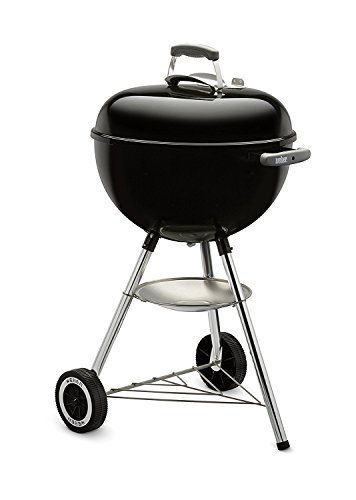
Weber Original Kettle Charcoal Grill, 18-Inch — Best for Small Households
Not every household cooks for six. The 18-inch kettle is the full kettle method — two-zone fires, lid-down roasting, real smoke flavour — in a size that suits couples, small families and small outdoor spaces, and it sips charcoal while doing it. For two to three people it is not a compromise pick; it is the correctly sized tool.
| Cooking surface | 18-inch plated steel grate |
| Construction | Porcelain-enamelled steel bowl and lid |
| Ash management | One-Touch cleaning, ash catcher pan |
| Footprint | Compact kettle suited to small patios and balconies where permitted |
Strengths
- Full kettle capability in a compact, fuel-sipping size
- Ideal cooking area for one to three people
- Light and simple to move, store and clean
Trade-offs
- Indirect zone is small for large roasts and full rib racks
- Open ash pan is messier than enclosed catchers
- Too small as the only grill for regular entertaining
Smaller bowls heat faster and use noticeably less fuel per cook, which over a season of weeknight grilling is a real saving in both money and lighting time. The trade is grate geometry: a two-zone fire on an 18-inch grate leaves a modest indirect area, so large roasts and full racks of ribs need planning — a rib rack or cutting racks in half solves most of it. Everything else is kettle business as usual: dampers that actually control the fire, enamel that lasts, parts forever. Balcony dwellers should check building rules first, since many prohibit charcoal outright; where it is allowed, this is the charcoal grill that fits the space and the household. It also travels better than its big brother for car camping and park cookouts, provided it is fully cold before it goes in the car.
Best for: BBQ cooks who need best for small households from a charcoal grill / Not suited for: buyers whose cooking is better served by another format in this guide
Check on Amazon — check price on Amazon and confirm the exact configuration before ordering.

Char-Griller Smokin’ Pro Charcoal Grill and Offset Smoker — Best Grill-and-Smoker Combo
The Smokin’ Pro answers the buyer who wants one machine that grills burgers directly and smokes ribs indirectly without buying two cookers. The barrel chamber grills over its own charcoal tray, and the side firebox turns the same unit into a genuine offset smoker — or a small second grill for sides while the main chamber is busy. As a first step into combined grilling and smoking it remains the benchmark value design.
| Format | Barrel grill with attached side firebox for offset smoking |
| Cooking area | Large combined area across main chamber and firebox (see listing) |
| Grates | Cast iron cooking grates in main chamber |
| Extras | Side firebox doubles as a small direct grill; warming rack; chimney stack with damper |
Strengths
- Grills directly and smokes offset-style in one unit
- Firebox doubles as a small auxiliary grill
- Cast iron grates and wide chamber suit batch cooking
Trade-offs
- Thin steel loses heat in cold or windy weather
- Doors typically need aftermarket gaskets to smoke efficiently
- Assembly and upkeep are more involved than a kettle
Judge it as two cookers sharing a frame. As a grill, the barrel format gives a wide grate that suits batch cooking, cast iron grates that sear properly, and an adjustable charcoal tray on many trims that changes heat distance without moving food. As a smoker, the firebox feeds heat and smoke across the chamber in the traditional offset pattern; expect to seal the doors with gasket material and to tend the fire, because that is what offset cooking is. Steel is thinner than premium smokers, so it works harder in cold wind and will not last as long as heavy-gauge rivals — but it teaches both crafts honestly at an accessible level, and the food it produces, once you learn its dampers, embarrasses far pricier gas grills. Buy it as a learning platform and a crowd feeder, not as a lifetime heirloom.
Best for: BBQ cooks who need best grill-and-smoker combo from a charcoal grill / Not suited for: buyers whose cooking is better served by another format in this guide
Check on Amazon — check price on Amazon and confirm the exact configuration before ordering.

Kamado Joe Classic Joe Series II, 18-Inch — Best Premium Ceramic
If the AKORN in our companion guide is the value route into kamado cooking, the Classic Joe II is the full expression of it: thick ceramic that holds heat through winter, a two-tier cooking system that doubles useful space, an air-lift hinge that makes the heavy lid feel weightless and an ash drawer that ends the kamado cleanup chore. For the buyer who knows kamado cooking is their endgame, this is the one to save for.
| Construction | High-fire ceramic body with air-lift hinge |
| Cooking system | Divide & Conquer two-tier flexible cooking rack |
| Ash management | Slide-out ash drawer with ash tool |
| Extras | Kontrol Tower top vent, cart with locking casters, side shelves |
Strengths
- Ceramic heat retention for steady smoking and winter cooking
- Two-tier Divide & Conquer system doubles useful cooking options
- Air-lift hinge and ash drawer fix the classic kamado annoyances
Trade-offs
- Heavy; choose its home carefully because moving it is a project
- Premium purchase and accessory pricing
- Ceramic can crack if knocked or thermally shocked
Ceramic changes the physics of a cook. Once the dome is heat-soaked, temperatures hold with a steadiness steel cannot match, fuel consumption drops to a trickle, and winter smoking stops being an act of endurance. The Divide & Conquer rack is more than a shelf: half-moon surfaces at two heights let you sear low on one side while roasting high on the other, and half-moon deflectors turn part of the grill indirect without emptying it. The air-lift hinge and ash drawer remove the two classic kamado annoyances — heavy lids and messy cleanouts. Ownership costs are the honest counterweight: the grill is heavy, it should live where it lands, ceramic demands respect during moves, and the accessory ecosystem, while excellent, is priced at the premium level the grill occupies. None of that diminishes what it cooks, which is everything, superbly.
Best for: BBQ cooks who need best premium ceramic from a charcoal grill / Not suited for: buyers whose cooking is better served by another format in this guide
Check on Amazon — check price on Amazon and confirm the exact configuration before ordering.
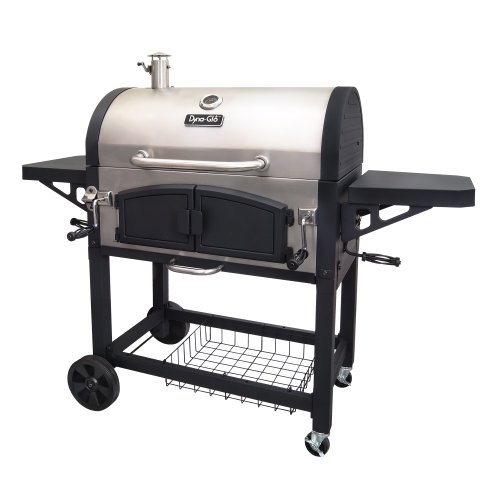
Dyna-Glo X-Large Premium Dual Chamber Charcoal Grill — Best for Two-Zone Cooking
Two-zone cooking is the core technique of charcoal BBQ, and the Dyna-Glo dual chamber builds the whole grill around it: two separate fire chambers, each with its own crank-adjustable charcoal tray, so one side can be searing while the other idles at roasting temperature — with the heat gap adjustable by winding a handle instead of moving coals with tongs.
| Format | Dual-chamber barrel with two separate charcoal trays |
| Heat control | Two crank-adjustable charcoal trays, dual chimney stacks |
| Grates | Porcelain-enameled cast iron cooking grates |
| Extras | Side shelves, bottle opener, temperature gauges in lid |
Strengths
- Independent dual chambers make two-zone cooking effortless
- Crank-adjustable trays change heat without moving coals
- Large grates suit entertaining and mixed grills
Trade-offs
- Big footprint and involved assembly
- Two chambers mean more cleaning and upkeep
- Less suited to true low-and-slow smoking than kamado or offset picks
The crank trays are the feature to understand. Raising the coals to just under the grate gives fierce direct heat for steaks and burgers; dropping them creates distance and gentler heat for chicken and sausages, all without opening the lid and losing your temperature. Running two chambers independently means a mixed grill — the cook’s hardest timing problem — becomes manageable: sausages finish on the cool side while steaks sear on the hot side, each at the right moment. The barrel format swallows platters of food, and cast iron grates mark it beautifully. The costs are size, assembly time and more moving parts to keep clean; grease and ash management across two chambers is a bigger job than a kettle’s single bowl. For hosts who cook mixed loads for a crowd, the trade is worth it every time.
Best for: BBQ cooks who need best for two-zone cooking from a charcoal grill / Not suited for: buyers whose cooking is better served by another format in this guide
Check on Amazon — check price on Amazon and confirm the exact configuration before ordering.

Royal Gourmet CC1830S Charcoal Grill and Offset Smoker — Best Value Offset
The CC1830S is the budget door into offset-style BBQ: a 30-inch barrel grill with a side firebox that lets you smoke with indirect heat today and grill directly tonight, at a price that leaves room in the budget for charcoal, wood chunks and the meat itself. It asks for the usual offset compromises and rewards them with genuinely smoky food.
| Format | 30-inch barrel grill with attached offset smoker firebox |
| Cooking area | Combined main, firebox and warming area (see listing for current figure) |
| Grates | Porcelain-coated steel cooking grates |
| Extras | Front and side shelves, cool-touch handles, bottle opener, wagon wheels |
Strengths
- Offset smoking and direct grilling in one affordable unit
- Generous combined cooking and warming space
- Shelves and layout are practical for real cooks
Trade-offs
- Light steel needs gaskets and loses heat in wind
- Paint and finish need upkeep to prevent rust
- Temperature stability lags heavy-gauge smokers
Set expectations correctly and this grill pleases. The steel is light, so it leaks heat and smoke until you add gasket tape, and its temperatures wander more than a heavy smoker’s — but the layout is right, the firebox is usable, and with a water pan in the chamber and modest fires it turns out ribs and chicken with real smoke character. As a direct grill the barrel is wide and sociable, with shelves where you need them. Longevity is the bargain you are making: kept covered, cleaned of ash and touched up where paint burns off, it gives several good seasons; left wet and full of ash, it will not. For a first offset, or a second grill dedicated to smoking while a kettle handles weeknights, it is money spent in the right order — on the craft first, the hardware second.
Best for: BBQ cooks who need best value offset from a charcoal grill / Not suited for: buyers whose cooking is better served by another format in this guide
Check on Amazon — check price on Amazon and confirm the exact configuration before ordering.
Comparison Table
| Pick | Badge | Key spec | Best for |
|---|---|---|---|
| Weber Original Kettle Premium Charcoal Grill, 22-Inch | Best Overall | 22-inch hinged plated steel grate | Best Overall buyers |
| Weber Original Kettle Charcoal Grill, 18-Inch | Best for Small Households | 18-inch plated steel grate | Best for Small Households buyers |
| Char-Griller Smokin’ Pro Charcoal Grill and Offset Smoker | Best Grill-and-Smoker Combo | Barrel grill with attached side firebox for offset smoking | Best Grill-and-Smoker Combo buyers |
| Kamado Joe Classic Joe Series II, 18-Inch | Best Premium Ceramic | High-fire ceramic body with air-lift hinge | Best Premium Ceramic buyers |
| Dyna-Glo X-Large Premium Dual Chamber Charcoal Grill | Best for Two-Zone Cooking | Dual-chamber barrel with two separate charcoal trays | Best for Two-Zone Cooking buyers |
| Royal Gourmet CC1830S Charcoal Grill and Offset Smoker | Best Value Offset | 30-inch barrel grill with attached offset smoker firebox | Best Value Offset buyers |
The pattern to notice: kettles win on versatility, the combo and offset win on smoke tradition, the kamado wins on range and steadiness, and the dual chamber wins on mixed-load control. Your cooking mix, not the table order, should make the decision.
How to Choose a Charcoal BBQ Grill for the Way You Cook
Start by counting your last ten cooks, honestly — not the cooks you plan in January, but the ones that actually happened, in the weather you actually get, for the people who actually show up. If eight were burgers, steaks, sausages and chicken pieces, buy the best kettle your budget allows and stop reading comparison charts. If half involved ribs, shoulders or whole birds cooked slowly, weight the smoking formats. If most involved feeding eight or more people a mixture of everything at once, chamber size and zone control outrank everything else. The biggest cause of charcoal disappointment is buying for imagined cooking instead of actual cooking.
Grill first or smoker first — which are you?
Grill-first households should optimise for direct heat, grate quality and fast cleanup, and treat smoking as a bonus the kettle snake method provides. Smoker-first households should optimise for sealed cooking chambers, fuel efficiency and fire access, and accept weaker weeknight grilling. Combo units genuinely split the difference, with the caveat that they are good at both jobs rather than great at either — which, for many back gardens, is exactly the right trade.
How important is temperature stability?
Stability is the product of mass, insulation and sealing. Ceramic kamados lead, insulated steel follows, kettles are honest middle performers, and light offsets trail until gasketed. Stability matters in proportion to cook length: irrelevant for burgers, decisive for a six-hour shoulder. Cold and wind amplify every difference, so northern and coastal cooks should weight this criterion double.
What about cooking for a crowd?
For crowds, think in terms of grate workflow, not headline area. A wide barrel with shelves lets you run a production line; a dual chamber lets you hold finished food warm without overcooking it; a kettle with a warming strategy — an oven indoors on low — punches above its size. The worst crowd setup is a small grill and a hungry queue, so if you entertain monthly, let that fact outrank your everyday size.
How should you split a BBQ budget between grill and gear?
New buyers routinely spend the entire budget on the grill and then cook on it with a fork and a prayer. A better split reserves a sensible share for the tools that decide results: a chimney starter, an instant-read thermometer, proper long tongs, a stiff grate brush and a fitted cover. Those items, together, cost less than the jump between grill trim levels and improve every single cook, while the trim jump usually buys a thermometer in the lid and a nicer handle. Buy the grill one level down if you absolutely must; never buy the everyday tools one level down. The same logic applies to fuel: quality briquettes or lump from reputable makers light reliably and burn cleanly, and the saving on bargain charcoal is paid back in failed fires and off flavours. Finally, budget for the second season, not just the first: a replacement grate, fresh gaskets for a smoker, or a heat deflector for a kamado are planned purchases in a well-run barbecue household, and setting a little aside for them keeps a good grill good instead of letting small wear become the excuse for a premature replacement.
Should you buy new, or consider a used grill?
Charcoal grills are among the safest used purchases in outdoor cooking, because the good designs have almost nothing to wear out invisibly. A used kettle or kamado can be assessed in two minutes: check the bowl or ceramic for cracks and chips, confirm the dampers move and seal, look at the grate honestly, and check the legs and wheels for rust at the joints. Avoid used light-steel offsets unless the price reflects their condition, because rust-through in a firebox is structural, not cosmetic. Ceramic kamados deserve extra care — hairline cracks in the firebox are common and usually harmless, but a cracked outer dome is a negotiation point, not a detail. Buying used also suits the two-grill strategy this guide keeps recommending: a new kettle for everyday cooking and a used offset or kamado for weekends is how many experienced households assembled their line-up, and it spreads money across capability rather than badges. Whichever route you take, deep-clean any used grill, replace the cooking grate if its history is unknown, and run one hot empty burn before the first food goes on.
How to Run a BBQ Session: Grill, Roast and Smoke in One Afternoon
Step 1: Light early and light once. Start the chimney forty minutes before food is due to go on. Rushing a fire is how food ends up over unlit coals and tastes of it.
Step 2: Set up two zones from the start. Bank coals to one side even for simple grilling. The cool zone is your brake pedal, your holding area and your rescue space for flare-ups.
Step 3: Sequence by tolerance. Cook in order of how forgiving each item is: sausages and chicken can wait in the cool zone; steaks and burgers cannot wait at all. Put slow items on first and fast items on last, and let the fire’s natural decline match the menu — fiercest heat early for searing, gentler heat later for roasting.
Step 4: Add smoke deliberately. For smoked flavour on a grill, add one or two hardwood chunks to the coals just before the food goes on, lid down, and resist adding more. Smoke should season the food, not announce itself from the street.
Step 5: Rest, then clean while warm. Rest grilled meat on a warm plate, loosely covered. While it rests, close the vents partway, let the grill burn clean for a few minutes, brush the grate, and empty the ash only when it is completely cold — into a metal container, never a plastic bin.
Common Buying Mistakes
Buying an offset for burgers. Offsets smoke beautifully and grill indifferently. As a household’s only grill they frustrate more owners than any other format.
Trusting headline cooking areas. Figures often include warming racks and firebox grates. Compare main-chamber grates, and remember a two-zone fire halves your direct area by design.
Skipping the cover and the chimney to save money. These two inexpensive items protect the grill and improve every cook. Cutting them to afford a bigger grill is false economy.
Expecting set-and-forget from charcoal. Even the steadiest kamado needs occasional attention. If you want true autopilot, that is a pellet grill’s job — a different guide and a different flavour.
Leaving ash in the grill between cooks. Ash plus moisture is the fastest legal way to rust out a charcoal grill. Empty it, every time, once cold.
Final Recommendation
Most BBQ households should buy the Weber Original Kettle Premium Charcoal Grill, 22-Inch and cook happily for years. Smaller households get the same method in the right size from the Weber Original Kettle Charcoal Grill, 18-Inch, and anyone torn between grilling and smoking should take the honest middle path of the Char-Griller Smokin’ Pro Charcoal Grill and Offset Smoker. The Kamado Joe Classic Joe II is the connoisseur’s single-cooker answer, the Dyna-Glo dual chamber is the entertainer’s, and the Royal Gourmet CC1830S is the budget route to real offset flavour.
Keep exploring the cluster: Best Charcoal Barbecue Grills · Best Charcoal Bbq Grills Under $200 · Best Charcoal Bbq Grills Under $500 · Best Charcoal Bbq Smokers · Best Offset Smokers
Which BBQ Techniques Should a Charcoal Cook Master First?
Equipment threads dominate barbecue talk, but results come from five techniques, and every pick in this guide supports all five. Master them in this order and your grill — whichever you buy — will outperform a premium grill in untrained hands.
Direct grilling is the foundation: food over the coals, lid used as a tool rather than a default, turning for even browning. The skill is reading heat with your hand and your eyes, and knowing that sugar-heavy sauces burn over direct heat and belong on at the end.
Two-zone cooking is the single biggest upgrade to anyone’s charcoal game. With all the coals banked to one side, you own a searing zone and a safe zone simultaneously. Thick steaks sear then finish gently; chicken crisps without flaring; sausages wait without splitting. If you learn nothing else from this guide, learn to build every fire this way.
Lid-down roasting turns a grill into an oven. A whole chicken, a tray of vegetables or a joint of pork cooks evenly in the convective heat, picking up smoke as it goes. The discipline is vent control: set the intake, leave the exhaust open, and stop lifting the lid to check — use a probe and trust it.
The snake method is kettle smoking without accessories: briquettes arranged two-by-two around the bowl’s edge, lit at one end, burning slowly around the circle for hours under a shoulder or a rack of ribs, with wood chunks placed along the first half of the snake. It is not as steady as a kamado or as characterful as an offset, but it produces honest, satisfying barbecue that surprises everyone at the table who assumed a simple kettle could not smoke at all.
Reverse searing finishes the set: cook thick cuts gently in the cool zone until they approach target temperature, then sear them hard over the coals at the end. The result — edge-to-edge evenness with a proper crust — is the technique restaurants use, and charcoal does it better than any other domestic fuel because the finishing heat is so fierce.
How Do Charcoal and Wood Choices Change BBQ Flavour?
Charcoal is not a neutral fuel, and treating it as one leaves flavour on the table. Briquettes are the metronome: consistent size, consistent burn, a mild background flavour that lets rubs and sauces lead. They are the right default for long cooks and for learning, because one variable stays fixed while you practise the others. Lump charcoal is the soloist: hotter, faster to light, cleaner-burning with a faint wood note of its own, and more variable — the right choice for searing and for kamados, where the cooker supplies the consistency the fuel lacks.
Wood is seasoning applied through smoke, and the dose makes the difference between barbecue and bonfire. Oak is the all-rounder, sturdy enough for beef and gentle enough for pork. Hickory is stronger and bacon-like, beloved with pork and easily overdone. Mesquite is the strongest of the common woods and belongs in short, hot cooks rather than long smokes. Fruitwoods — apple, cherry, peach — are the gentle end of the scale and flatter poultry, pork and fish. Use chunks rather than chips for cooks over an hour, place them on the coals rather than in a pan of water, and remember that thin blue smoke flavours food while thick white smoke — the sign of a fire starved of air — coats it in bitterness. If your barbecue tastes harsh, the fix is almost never a different wood; it is a cleaner fire.
How Should You Set Up Your Backyard BBQ Station?
The difference between a relaxed barbecue and a frantic one is usually decided by the six feet around the grill. Set the grill on level, non-combustible ground, out of the wind’s main path but never under a roof, tree canopy or awning, and far enough from the house that smoke drifts away from open windows. Charcoal needs a clear safety margin because it throws sparks when lit, because a knocked chimney can scatter live coals across a wide area in a second, and because the grill itself stays hot enough to burn skin and melt plastic for hours after the cooking ends and everyone has gone back indoors; a metal ash container with a lid lives beside the grill permanently, not as an afterthought.
Work in a triangle: grill, preparation surface, and a landing zone for cooked food, close enough that you never carry a platter across the garden with tongs in your teeth. Raw and cooked food get separate trays and separate tools — cross-contamination at a barbecue is a layout problem before it is a knowledge problem. Keep a spray-free zone around the coals: water bottles for flare-ups cause ash clouds and steam burns, and the correct and calm response to any flare is simply moving the food to the cool zone and closing the lid briefly.
Storage shapes habits. Charcoal kept indoors, dry and near the door gets used; charcoal in a damp shed at the garden’s end quietly discourages weeknight grilling and degrades every fire it eventually makes. A lidded bin beside the grill, holding fuel, chimney, lighter cubes and a brush, turns lighting the grill into a two-minute routine — and routine, more than any feature on any grill in this guide, is what makes charcoal the fuel you actually cook on rather than the fuel you admire.
What Separates Good Charcoal BBQ From Great Charcoal BBQ?
Experience compresses into a handful of habits. Great charcoal cooks light less fuel than beginners — a smaller, fully engaged fire beats a large smouldering one for control and flavour. They season boldly but sauce late, because sugar burns. They rest meat without exception and slice against the grain without thinking. They keep notes, unglamorous as that sounds: what the fire setup was, how long the cook took, what to change. And they clean the grill while it is still warm enough to make the job easy, which is why their ten-year-old kettle cooks like a new one while a neglected premium grill struggles in its third season. None of these habits can be bought, and no badge in this guide substitutes for a single one of them, but the picks collected here are the ones that reward them longest and punish their absence least.
Frequently Asked Questions
What is the difference between a charcoal grill and a charcoal BBQ smoker?
A grill cooks primarily with direct radiant heat from coals beneath the food, with smoking as a secondary technique. A smoker cooks with indirect heat and smoke over hours. Combo and kettle designs blur the line usefully, which is why this guide ranks grills by how honestly they do both jobs.
How do I keep ribs from drying out on a charcoal grill?
Cook them indirectly at a steady medium-low heat with a water pan in the grill, wrap them for part of the cook if you like tender results, and judge doneness by tenderness and bone pull-back rather than by time alone. Stable temperature matters more than any rub or sauce.
Is a kamado worth it for BBQ?
If you smoke often, cook year-round, or simply hate fighting a fire, yes — the steadiness and fuel economy are transformative. If you grill burgers twice a month, a kettle gives you the same dinners for a fraction of the commitment.
Why does my charcoal fire keep going out?
Almost always ash or air. Ash chokes the intake from below, damp charcoal smoulders instead of burning, and closed vents starve the fire. Sweep the ash system, store charcoal dry, and leave the exhaust open while cooking.
Can I cook pizza on a charcoal BBQ grill?
Yes, and charcoal does it well because it can run hotter than a domestic oven. Use a pizza stone or steel, let it heat thoroughly with the lid down, and on a kamado use the deflector setup. Keep toppings light so the base crisps before the top dries.
How long should I let coals burn before cooking?
Wait until the coals are fully engaged and edged with grey ash — typically fifteen to twenty minutes in a chimney. Cooking over black, freshly lit coals produces harsh flavours and uneven heat, and is the most common beginner mistake in charcoal BBQ.
What is the best charcoal BBQ grill for a beginner?
A 22-inch kettle. It teaches every fundamental technique, forgives mistakes with its two-zone flexibility, costs the least to run and remains useful forever as a second grill even if you later add a smoker or kamado. The Premium kettle in this guide is the beginner pick precisely because its hinged grate and enclosed ash catcher remove the two frictions that discourage new owners most.
How do I stop food sticking to the grate?
Start with a clean, hot, lightly oiled grate and dry food — moisture is glue. Then wait: food releases when it has seared properly, and prising at it early tears the crust you are trying to build. If sticking is chronic, the grate is usually dirty or the fire too cool rather than the food being at fault.


