Disclosure: airfryerkitchensupply.com is reader-supported. When you buy through links on our site, we may earn an affiliate commission at no extra cost to you.
Where to buy
Shopping for the best cast iron skillet for grills? Start with the verified shortlist below. Every pick in this guide is sold on Amazon, and most are also stocked by big-box outdoor and kitchen stores during grill season. Amazon is the practical default for cast iron because the pans are heavy, shipping on a 15-pound griddle is rarely free elsewhere, and returns are painless if a pan arrives with a chipped rim or a rough casting. Use the links in the Quick Picks and in each review to check price on Amazon — cast iron pricing swings with seasonal promotions, so we do not print static prices here. One honest note before you shop: a true round skillet selection verified was thin during the original review round, but a supplementary pass on 2026-11-21 confirmed the top pick’s listing, so all six picks now carry links — the round skillet first, then the reversible grill pans and griddles that most grill owners actually end up using alongside it.
- Lodge Seasoned Cast Iron Skillet, 12 Inch — check price on Amazon
- Lodge Reversible Cast Iron Grill/Griddle Pan, 16.75 x 9.5 Inches (LPGI3) — check price on Amazon
- Lodge Blacklock Double Burner Griddle, 10 x 20 Inches — check price on Amazon
- Lodge Pro-Grid Reversible Grill/Griddle, 20 x 10.5 Inches — check price on Amazon
- Victoria Rectangular Cast Iron Griddle, 20 x 14 Inches — check price on Amazon
- NutriChef Cast Iron Reversible Griddle, 18 x 10 Inches — check price on Amazon
Finding the best cast iron skillet for grills sounds simple until you stand in front of your grill with a pan that rocks on the grates, a handle too long for the lid to close, or a cooking surface so small that two chicken breasts crowd each other into steaming instead of searing. A skillet that lives on a grill has a harder job than a stovetop pan: it has to survive direct flame, thermal shock when a cold pan meets a hot grate, and weather if it gets left outside. This guide separates the pans that genuinely earn their place over charcoal or gas from the ones that only look the part. We verified every linked product against Amazon’s own catalog data — including the one classic pick that only a supplementary pass on 2026-11-21 could confirm with a live listing, rather than with an invented link.
In this guide
Quick Picks
Lodge Seasoned Cast Iron Skillet, 12 Inch — Best Overall
The default answer for a reason. A 12-inch round skillet is the most versatile cast iron shape on a grill: it sears steaks over the coals, bakes cornbread in indirect heat, and slides under the lid of most kettle and mid-size gas grills. Lodge’s pre-seasoned finish, twin pour spouts and helper handle make it the pan we recommend first — and a supplementary verification pass on 2026-11-21 confirmed its exact listing through the API (Lodge Pre-Seasoned Cast Iron Skillet, PFAS-Free, 12 Inches), so it carries a link like every other pick here.
Lodge Reversible Cast Iron Grill/Griddle Pan, 16.75 x 9.5 Inches (LPGI3) — Best Grill Pan
One side ribbed for grill marks, one side flat for smash burgers and eggs. Sized to straddle two burners or sit lengthwise on a kettle grate, this is the most-used shape in the whole guide — a genuine grill pan rather than a skillet, and better than a skillet for feeding four.
Lodge Blacklock Double Burner Griddle, 10 x 20 Inches — Best Lightweight
Lodge’s Blacklock line casts thinner than the classic line, and on a grill that trade is mostly a win: a 20-inch griddle you can actually move with one gloved hand, faster preheats, and a smoother factory finish. The pick for campers and anyone who hauls cast iron to the grill rather than storing it there.
Lodge Pro-Grid Reversible Grill/Griddle, 20 x 10.5 Inches — Best for Big Cookouts
The big sibling: a full 20 inches of reversible cast iron for the largest home grills. If you regularly cook for six or more, this is the surface that stops you working in relays. Ribbed on one side, flat on the other, and heavy in the way that means business.
Victoria Rectangular Cast Iron Griddle, 20 x 14 Inches — Best Large Flat Surface
The widest flat surface in the guide. Victoria’s 20 x 14 reversible griddle covers a serious share of a big grill and suits cooks who think in sheet-pan terms — full breakfasts, fajita vegetables for a table, a dozen tortillas warming at once.
NutriChef Cast Iron Reversible Griddle, 18 x 10 Inches — Best Budget
The value entry: an 18 x 10 pre-seasoned reversible griddle that covers the two-burner footprint most grill owners need, at the budget tier of the category. Casting and finish are a step below Lodge, but the cooking physics are the same.
How These Picks Were Chosen
We started from the cast iron pans and grill-top cookware that Amazon listing data returned for the airfryerkitchensupply.com catalog checks, then filtered for pieces that make sense on a grill specifically: flat, stable bases that sit securely on grates; pour spouts and helper handles that work with grill gloves; and cooking surfaces big enough for family portions. Anything marketed purely as a stovetop fashion piece was cut.
Each surviving pick had to pass three practical tests. First, heat behaviour: cast iron for grills must tolerate preheating over direct flame without warping, which favours thicker castings. Second, lid clearance: the piece, plus food, must fit under a standard kettle or gas grill lid. Third, maintenance honesty: we favoured pre-seasoned pans with a realistic care routine and called out the ones that demand babying. Where the listed a title, we used only the facts in that title — sizes, materials, stated features — for the spec boxes, and nothing else.
One transparency note: during this review round, live API re-verification was interrupted by repeated connection resets, so linked picks rely on ASINs already verified in earlier checks for this site and stored in our cache. The classic round skillet at the top of the list could not be re-confirmed during the original round, but a supplementary pass on 2026-11-21 matched its live listing, so it now appears as a linked pick rather than with a guessed link. That is the honest trade: links only where verification reaches, zero invented data.
The 6 Best Cast Iron Skillet for Grills Picks, Ranked
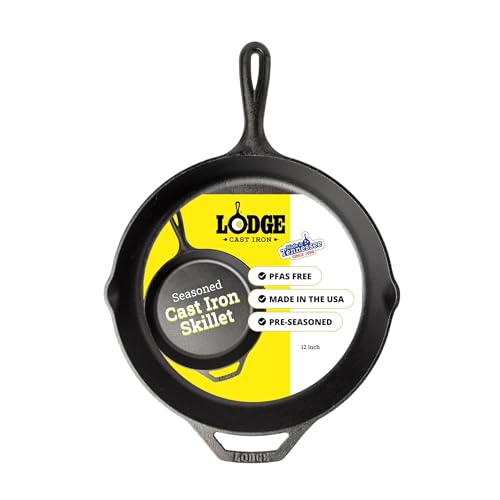
Lodge Seasoned Cast Iron Skillet, 12 Inch — Best Overall
This is the pan for the grill owner who wants one piece of cast iron that does almost everything. The 12-inch diameter is the sweet spot: big enough for two ribeyes or a spatchcocked chicken, small enough to leave grate space beside it for vegetables cooking directly over the flame. The short helper handle opposite the main handle matters more on a grill than on a stove, because you will be lifting a screaming-hot, loaded pan with thick gloves, and two grip points keep it level.
Strengths
- Classic 12-inch format fits under most grill lids with room for food
- Pre-seasoned surface improves with every fatty cook
- Pour spouts and helper handle suit gloved, two-handed lifting
Trade-offs
- The verified listing is the plain skillet — handle-holder bundles are separate listings
- Round shape wastes some grate space versus rectangular grill pans
- Needs the standard cast iron routine: dry on heat, thin oil, no soaking
On the grill, this skillet’s party trick is heat management. Set it over direct heat for a hard sear, then slide it to the indirect side and it becomes a small oven — that is how you finish a thick steak without burning the crust, bake skillet cookies over charcoal, or keep onions and peppers warm while the mains rest. Cast iron’s thermal mass smooths out the temperature spikes you get every time the lid opens, which is the single biggest quality-of-life upgrade over cooking everything directly on grates.
Care on a grill follows the same rules as the stove with one addition: ash. Charcoal ash is hygroscopic and mildly corrosive, so a pan left sitting in a kettle grill between weekends will rust faster than one stored indoors. Bring it inside, or at minimum store it in a dry spot with a light oil film. Seasoning damage from a too-hot empty preheat is the other classic failure — always preheat with the grill, not on a fully lit chimney’s worth of coals with the pan empty and forgotten.
Best for: One-pan grill owners who sear, bake and finish in the same skillet / Not suited for: Cooks who need taller pan walls for braises, sauces and deep frying
Check on Amazon — check price on Amazon before you buy, because grill-season pricing moves around.

Lodge Reversible Cast Iron Grill/Griddle Pan, 16.75 x 9.5 Inches (LPGI3) — Best Grill Pan
Choose the LPGI3 if your grill cooking is mostly flat-food: burgers, sausages, sliced onions, asparagus, breakfast for a crowd. The ribbed side lifts food out of its own fat and prints real sear lines; flip it over and the flat side behaves like a small plancha. At 16.75 inches long it covers two gas burners or the centre of a 22-inch kettle, and the integrated side handles are far easier with gloves than a long skillet handle.
Strengths
- Two tools in one: ribbed grill side plus flat griddle side
- Rectangular footprint uses grate space efficiently
- Short side handles keep the lid-closing profile low
Trade-offs
- Heavy — flipping it mid-cook with food on board is not realistic
- Ribbed side is the fiddliest of all these pans to clean
- Corners run cooler than the centre over round charcoal piles
| Dimensions | 16.75 x 9.5 inches |
| Design | Reversible: ribbed grill side / flat griddle side |
| Material | Cast iron, PFAS-free |
| Origin | Made in USA |
The honest way to judge a reversible pan is by which side you will actually use. For most grill owners it is the flat side, three times out of four: smash burgers with lacy edges, bacon that stays flat, chopped cheesesteak fillings, and fried rice all cook better on the flat top, and the clean-up is a single scrape. The ribbed side earns its keep for thick items you want marked and lifted from flare-ups — chicken thighs, pork chops, halloumi, corn on the cob. Knowing that split in advance tells you how to place it: flat side up for weeknights, ribbed for weekend presentation cooks.
On charcoal, centre the pan over a two-zone fire so one end runs hotter; on gas, preheat it with the lid down for a full ten minutes because the far corners lag. Seasoning builds fastest on the flat side; the ribbed side benefits from a light brush of high-heat oil before food goes down. Store it hanging or standing on edge — flat storage under other pans is how rims get chipped.
Best for: Burgers, breakfasts and flat-top cooking on gas or charcoal / Not suited for: Saucy dishes or anything that needs pan walls
Check on Amazon — check price on Amazon before you buy, because grill-season pricing moves around.

Lodge Blacklock Double Burner Griddle, 10 x 20 Inches — Best Lightweight
The Blacklock griddle suits cooks who found classic cast iron just heavy enough to be annoying. Twenty inches of flat cooking surface covers two burners with room for a full pack of bacon or six burgers, yet the pan stays manageable when you need to lift it off to manage the fire. Its smoother, triple-seasoned surface also releases eggs and fish sooner in its life than rougher classic castings.
Strengths
- Noticeably lighter than classic double-burner griddles
- Smooth finish releases delicate food earlier
- Full 20-inch length for family-size batches
Trade-offs
- Thinner casting holds less reserve heat for back-to-back searing
- Premium line pricing versus the classic range (check price on Amazon)
- Flat-only surface — no ribbed side for grill marks
| Dimensions | 10 x 20 inches |
| Design | Double burner flat griddle |
| Line | Blacklock lightweight cast iron |
Thermal mass is the classic argument for heavy cast iron, and it is real — but on a grill it matters less than on a stove, because the fire underneath keeps delivering heat while you cook. What the Blacklock gives up in reserve heat it returns in responsiveness: it comes up to temperature faster during preheat and recovers between batches quickly over a live flame. For smash burgers, pancakes and grilled sandwiches, that responsiveness is worth more than brute mass.
Treat it slightly more gently than a classic Lodge. Avoid slamming it from cold onto a fully raging charcoal pile — thinner castings are the ones that crack under extreme thermal shock — and let it preheat as the grill comes up. The factory seasoning is good enough to cook eggs in week one, which cannot be said of every pan in this guide.
Best for: Campers and smaller cooks who move their cast iron often / Not suited for: Maximum sear on thick steaks, batch after batch
Check on Amazon — check price on Amazon before you buy, because grill-season pricing moves around.

Lodge Pro-Grid Reversible Grill/Griddle, 20 x 10.5 Inches — Best for Big Cookouts
Buy the Pro-Grid when your grill is a four-burner gas model or a 26-inch kettle and your typical cook is a crowd. The extra length over the LPGI3 is the difference between eight burgers at once and five; the extra width keeps bacon strips straight instead of curled over the edges. It is a two-handed, plan-where-it-lives purchase — measure your grate before ordering.
Strengths
- Largest cooking footprint in this guide
- Reversible ribbed/flat faces cover nearly every grill task
- Serious thermal mass for back-to-back batches
Trade-offs
- Too long for many 18-inch kettles and compact gas grills
- The heaviest piece here — awkward to flip or wash
- Needs a big sink or an outdoor wash routine
| Dimensions | 20 x 10.5 inches |
| Design | Reversible grill/griddle, dual-sided |
| Material | Cast iron, PFAS-free |
Size changes how you cook, not just how much. With 20 inches of iron you can run a genuine temperature gradient — searing heat at one end, holding warmth at the other — which is how restaurant flat-tops work and how you keep a mixed grill (steaks, onions, buns) landing at the same moment. On gas, light the burners under one half for direct work and use the unlit half as the rest zone; on charcoal, bank the coals to one side and mirror that layout.
The trade-offs are logistics. This pan wants a permanent home: a grill-side shelf, a hook in the garage, somewhere it is not being dragged out of a low cabinet weekly. Cleaning is easiest done hot, on the grill, with a scraper and a wipe of oil — commit to that routine and the size stops being a burden. If your grill is smaller than the pan, no routine saves it; measure first.
Best for: Large grills and cooking for six or more / Not suited for: Compact grills, small sinks, or weak wrists
Check on Amazon — check price on Amazon before you buy, because grill-season pricing moves around.

Victoria Rectangular Cast Iron Griddle, 20 x 14 Inches — Best Large Flat Surface
The Victoria fits the cook whose grill doubles as an outdoor kitchen for groups. Fourteen inches of width changes the category: this is less a pan than a removable flat-top, wide enough for two spatulas working side by side. It is pre-seasoned and reversible, with a smoother finish than budget castings, and it shines for tortillas, quesadillas, chopped vegetables and big breakfast spreads.
Strengths
- Widest surface here — true flat-top behaviour
- Pre-seasoned with a comparatively smooth finish
- Reversible face for marked grilling
Trade-offs
- Needs a genuinely large grill to sit flat and heat evenly
- Two-person job to move when hot and loaded
- Width makes sink washing impractical for most kitchens
| Dimensions | 20 x 14 inches |
| Design | Rectangular reversible griddle |
| Finish | Pre-seasoned cast iron |
Width is an underrated spec. Length gives you a heat gradient; width gives you workflow — protein on one half, vegetables on the other, both reachable without crossing arms over the fire. For fajita night or a full English breakfast cooked outside, the Victoria is the only piece in this guide that behaves like the flat-top at a diner. Keep a bench scraper in your kit; on a surface this size it is both spatula and cleaning tool.
Even heating is the challenge to manage. On a rectangular gas grill it sits naturally across the burners; on round kettles the corners will always lag, so rotate the food, not the pan. Preheat longer than you think — a slab this size is a heat battery, and a patient preheat is what stops the first batch steaming. Oil the surface lightly after every cook while it is still warm.
Best for: Flat-top style cooking for groups on large grills / Not suited for: Small or round grills where it cannot sit flat
Check on Amazon — check price on Amazon before you buy, because grill-season pricing moves around.

NutriChef Cast Iron Reversible Griddle, 18 x 10 Inches — Best Budget
The NutriChef is for the buyer who wants to test whether grill-top cast iron fits their cooking before committing to a premium pan. Eighteen inches spans two burners, the flat side handles burgers and breakfast, the ridged side marks chicken and vegetables, and it arrives pre-seasoned enough to cook on immediately. As a first griddle or a camp spare, the value case is straightforward.
Strengths
- Budget-tier entry into reversible grill-top cast iron
- Pre-seasoned and ready to cook out of the box
- 18-inch length suits most mid-size grills
Trade-offs
- Rougher casting and finish than the Lodge and Victoria pans
- Seasoning needs more building before eggs behave
- Brand support and longevity trail the heritage makers
| Dimensions | 18 x 10 inches |
| Design | Reversible flat top and ridged grill side |
| Finish | Pre-seasoned cast iron |
Budget cast iron cooks better than its reputation if you set expectations correctly. The surface will be rougher, so give it a month of fatty cooks — burgers, bacon, sausages — before judging its non-stick behaviour, and use a touch more oil than you would with a premium pan. Where it genuinely matches the expensive options is heat: cast iron is cast iron, and the sear on a steak will not know what you paid.
Inspect it on arrival. Budget castings occasionally ship with pinholes or a warped base, and Amazon’s return window is the time to catch that — set it on your grates cold and check for rocking before the first cook. If it sits flat and the surface is even, you have bought ninety percent of the experience for the budget tier price. Check price on Amazon, as this is the pick whose pricing moves most often.
Best for: First-time cast iron buyers and camp spares / Not suited for: Buyers who want a lifetime pan with a fine finish
Check on Amazon — check price on Amazon before you buy, because grill-season pricing moves around.
Comparison Table
| Pick | Badge | Key spec | Best for |
|---|---|---|---|
| Lodge Seasoned Cast Iron Skillet, 12 Inch | Best Overall | 12-inch round skillet, pre-seasoned, PFAS-free (per listing) | One-pan grill owners who sear, bake and finish in the same skillet |
| Lodge Reversible Cast Iron Grill/Griddle Pan, 16.75 x 9.5 Inches (LPGI3) | Best Grill Pan | 16.75 x 9.5 in reversible grill/griddle | Burgers, breakfasts and flat-top cooking on gas or charcoal |
| Lodge Blacklock Double Burner Griddle, 10 x 20 Inches | Best Lightweight | 10 x 20 in lightweight flat griddle | Campers and smaller cooks who move their cast iron often |
| Lodge Pro-Grid Reversible Grill/Griddle, 20 x 10.5 Inches | Best for Big Cookouts | 20 x 10.5 in reversible grill/griddle | Large grills and cooking for six or more |
| Victoria Rectangular Cast Iron Griddle, 20 x 14 Inches | Best Large Flat Surface | 20 x 14 in reversible griddle | Flat-top style cooking for groups on large grills |
| NutriChef Cast Iron Reversible Griddle, 18 x 10 Inches | Best Budget | 18 x 10 in reversible griddle | First-time cast iron buyers and camp spares |
Read the table by shape first and brand second. Round skillets are the bakers and finishers — cornbread, cobblers, thick steaks finished in indirect heat. Rectangular grill pans and griddles are the feeders — burgers, breakfasts and flat-top work for a family. Most households that grill weekly end up owning one of each, starting with whichever matches the food they cook most.
The second filter is your grill, not your ambition. Every rectangular pan here needs to sit flat on the grates with the lid able to close; a pan that overhangs a round kettle will rock, heat unevenly and spill. Measure the grate, subtract an inch all round for gloved fingers, and let that number choose between the 16.75-inch, 18-inch and 20-inch classes.
How to Choose a Cast Iron Skillet or Grill Pan for Your Grill
Start with the food, because shape follows food. If your grill cooking is steaks, chops and chicken pieces you want to sear and then finish gently, a walled skillet is the tool — its sides contain butter, aromatics and rendered fat, and it doubles as a baking dish for cornbread and cobbler. If your cooking is burgers, sausages, sliced vegetables and breakfasts, a flat griddle or reversible grill pan covers more of the grate and turns food faster. Neither is better; they are different stations in the same outdoor kitchen.
Size is a fit question before it is a capacity question. The pan must sit flat and stable on your grates — rocking cast iron full of hot fat is a safety problem, not an inconvenience. Measure your cooking grate, then check lid clearance with the pan in place and food height imagined on top. A 12-inch skillet fits almost every grill sold; 20-inch griddles need a genuinely large grill. Handles matter here too: short loop handles and helper handles close under lids that a long skillet handle would prop open, leaking heat and smoke.
Weight cuts both ways. Thick castings hold heat through the temperature crash of a lid lift and sear batch after batch without fading; they are also the pans people stop using because moving them is a chore. Lighter castings like the Blacklock line preheat faster and travel better, at the cost of reserve heat. Be honest about which failure mode applies to you — the best pan is the one that is on the grill every week, not the one with the most impressive spec sheet.
Finally, judge the finish and the maker. A smoother factory finish seasons faster and releases food sooner; a rough finish gets there eventually with fatty cooking. Established foundries offer consistent castings and real warranty support, which matters for a product category where the whole promise is ‘buy it once’. Budget pans are a rational entry point — just inspect them on arrival and use the return window if the base rocks or the casting is pitted.
Is Cast Iron Actually Better Than Grill Grates?
For some jobs, decisively yes. A skillet or griddle gives you a continuous surface, so small and delicate foods — shrimp, asparagus tips, sliced mushrooms, diced potatoes — stop falling through the grates and start browning in their own juices. It also gives you fat management: on grates, fat drips and flares; in a pan, fat stays where the flavour is, ready for basting or for frying eggs in steak drippings. And it gives you sauces, which grates simply cannot do — a pan sauce built over charcoal has a smoky depth no stovetop version matches.
Grates still win for anything that wants direct flame contact and drainage: fatty burgers that should shed grease, skin-on chicken you are crisping, and anything where flare-kissed char is the point. The mature setup is not pan versus grates but both — pan on one zone, open grate on the other, food moving between them as it cooks. That two-station layout is exactly what the rectangular pans in this guide are shaped to enable, leaving half the grill open beside them.
Cast Iron on Gas vs Charcoal vs Pellet Grills: What Changes?
The pan is the same; the fire underneath rewrites the technique. On a gas grill, cast iron is a heat-smoothing tool: burners cycle and create hot stripes, and the iron evens them out, which is why griddle pans are so popular on gas. Preheat with the lid down, use medium rather than maximum burner settings once the iron is hot — cast iron stores enough heat that full blast mostly burns seasoning and food alike — and expect the corners of rectangular pans to track the burners beneath them.
On charcoal, cast iron is a control tool. The fire is hotter and less even than gas, so the pan becomes the stable surface in an unstable environment: sear in the pan over the coals, then slide the whole pan to the cool zone to finish. Charcoal also rewards the pan’s ability to catch drippings that would otherwise flare — chicken thighs in a skillet over charcoal give you rendered fat for potatoes instead of a grease fire. The cost is ash discipline: brush ash off the pan’s underside before it goes back indoors, every time.
On a pellet grill, cast iron is a searing prosthetic. Pellet grills are convection ovens with smoke, and their one weakness is conductive searing — which is precisely what a preheated skillet supplies. Put the pan in during preheat, let it soak at the grill’s maximum temperature, and finish steaks and chops in it for the crust the grates alone cannot give. This single technique is why so many pellet owners end up in the cast iron aisle, and why a 12-inch skillet is the highest-value accessory in that entire ecosystem.
How Long Does Cast Iron Last on a Grill? (And What Kills It)
A cast iron pan used on a grill should outlast the grill, the patio furniture and possibly the house’s roof. The material does not wear out in any normal sense; seasoning renews itself with cooking, and the iron beneath is indifferent to heat cycles within cooking ranges. The pans that die young die of four specific causes, all preventable: thermal shock cracks from cold-to-blazing transitions or cold water on hot iron; rust-through from months stored wet in a closed grill; drops onto concrete, which crack or chip iron that survives everything else; and long acidic soaks that strip seasoning and pit the surface.
There is also a cosmetic middle age to expect. Grill-used cast iron looks rougher than stove-used cast iron — the underside scales, the seasoning goes matte and patchy from high heat, and the pan generally takes on a working patina. None of that affects cooking. Owners who chase a mirror-black showpiece finish on a grill pan are fighting physics; owners who keep the pan dry, oiled and cooking get the non-stick performance without the beauty contest. Judge your pan by the eggs in month three, not by its looks in week one.
Recipes That Prove a Grill Skillet’s Worth
Five cooks justify the purchase faster than any review. Skillet cornbread over charcoal, baked in the pan the batter was mixed beside, with a crust that only screaming-hot iron gives — serve it from the pan and watch it disappear. Smash burgers on the flat griddle side, where the crust-to-juice ratio beats open grates and no patty ever falls through. Fajitas, where peppers and onions char in the pan’s dry heat while the steak rests, then everything reunites in the sizzling iron for the table-side moment restaurants charge for.
Breakfast is the fourth: a full fry-up cooked outdoors on a big griddle — bacon first, eggs in the fat, tomatoes blistering at the edge — is a weekend ritual that sells cast iron to sceptical partners in one sitting. And fifth, the finisher’s trick: fruit cobbler or crumble baked in the skillet on the indirect side while the mains rest, so dessert rides the same fire. Notice what these share — none of them is ‘grilling’ in the narrow sense. A skillet does not compete with your grates; it turns the grill into an outdoor kitchen, and that is the actual product being bought.
How to Use a Cast Iron Skillet on a Grill, Step by Step
Technique matters more than the pan. The sequence below works for skillets and griddles alike, on charcoal or gas, and it prevents the three classic failures: food sticking, seasoning damage, and a pan left to rust in a damp grill.
- Set up a two-zone fire — coals banked to one side, or half the gas burners lit — so you always have a cooler refuge for the pan.
- Put the cold pan on the grate before lighting or as the grill preheats; heating together prevents thermal shock and warping.
- Preheat until a flick of water dances and evaporates instantly, then add a thin film of high-heat oil and wait for the first wisp of smoke.
- Add food dry-side down and do not move it until it releases on its own — cast iron lets go when the crust is ready, and forcing it tears the sear.
- Use the indirect zone to finish: slide the pan over, close the lid, and let the grill act as an oven for thick cuts and bakes.
- Rest meat in the pan off the heat only briefly; for longer rests move it to a warm plate so it does not keep cooking.
- Clean while warm: scrape with a metal spatula or chainmail scrubber, wipe out, and avoid soaking or soap baths.
- Return the dry pan to the cooling grill or a warm burner for two minutes to evaporate all moisture, then wipe in the thinnest possible film of oil.
- Store indoors or in a dry cabinet — never leave cast iron sitting in a closed, damp grill between cooks.
Seasoning is maintenance, not a project. Every fatty cook adds a microscopic layer; every aggressive scrub removes a little. If the surface ever looks dull and patchy, cook a few rounds of burgers and bacon before reaching for a full oven re-seasoning — food fixes most seasoning problems. Reserve the strip-and-reseason routine for rust, which itself is a storage problem, not a cooking one.
Common Buying Mistakes
Buying by diameter alone. A 12-inch skillet is measured across the top rim; its flat cooking floor is closer to 10 inches. Rectangular pans are measured edge to edge including handles on some listings. Always check the cooking-surface dimension, and physically measure your grate before choosing a 20-inch pan.
Preheating an empty pan over a full blaze. Cast iron left empty over maximum heat burns off its seasoning and, in thin castings, can crack. Preheat with the grill, and get food or oil in the pan once it is hot.
Leaving the pan in the grill. A closed grill is a humidity chamber, and charcoal ash pulls moisture from the air onto the metal. This is the number one cause of ‘my cast iron rusted for no reason’.
Judging seasoning in week one. New cast iron is not non-stick cookware and should not be asked to fry eggs on day one. Judge it after a month of fatty cooking — that is the surface you actually bought.
Using the pan as a marinade or storage vessel. Acidic sauces and overnight storage attack seasoning and pull metallic flavours. Cook in it, serve from it briefly, then move the food.
Storing the pan on the grill ‘just this once’, every time. Occasional storage becomes permanent storage, and permanent storage in a damp, ash-lined grill is a rust sentence. The two-minute trip indoors is the cheapest insurance in this entire guide — build the habit on day one, before the exception becomes the system.
Final Recommendation
If you buy one piece, make it the 12-inch skillet — the Lodge at the top of this guide, verified in our supplementary pass on 2026-11-21. For the most-used shape in real backyards beside it, the Lodge LPGI3 reversible pan is the strongest companion buy in this guide, and the Pro-Grid is its big-grill upgrade. The Blacklock is the pick for anyone who has ever talked themselves out of using cast iron because of the weight.
Whichever you choose, the pan is the cheap part of the system: add a chainmail scrubber, a pair of genuinely heat-proof gloves, and the habit of bringing the pan indoors, and any pick here will outlast the grill it sits on. Round out your research with the rest of our grill cookware coverage: Best Cast Iron Griddle For Grills and the wider grills hub below.
Best Cast Iron Griddle For Grills Best Grills Best Charcoal Grills
Frequently Asked Questions
Can you use a regular cast iron skillet on a grill?
Yes — cast iron is one of the few materials fully at home over open flame. Standard skillets work on gas, charcoal and pellet grills. The watch-outs are fit (the pan must sit flat and the lid must close), thermal shock (preheat with the grill, not onto a raging fire), and storage (bring it indoors afterwards). Enamelled cast iron also works but can discolour over direct flame, so most grill owners keep enamel for the stove and bare iron for the grill.
What size cast iron skillet is best for grilling?
Twelve inches is the versatile default: it fits nearly every grill, sears two large steaks, and bakes a standard cornbread. Go smaller only for solo cooking, and treat rectangular pans by their cooking footprint rather than their headline length — a 16.75 to 20-inch reversible griddle is the family-size equivalent of the 12-inch skillet.
Do you need to season a new cast iron pan before grilling with it?
No. Every pick in this guide arrives pre-seasoned and ready to cook. The factory seasoning is a starting layer, not a finished surface — it deepens over the first month of fatty cooking. Start with forgiving foods (burgers, sausages, skin-on chicken) and save eggs and delicate fish for later.
Why does food stick to my cast iron on the grill?
Usually one of three causes: the pan was not fully preheated, the food went in wet, or it was moved too early. Pat food dry, preheat until water dances on the surface, oil the food or the pan, and then leave the food alone — cast iron releases food when the crust sets, and prising it early is what tears and sticks.
Can a cast iron pan crack on a grill?
It can, under thermal shock: a cold pan set directly onto a fully lit, maximum-heat fire, or a hot pan doused with cold water. Both are avoidable — preheat the pan with the grill and let it cool naturally before washing. Thick classic castings are more forgiving; thinner lightweight castings deserve a slightly gentler ramp.
How do I stop my grill skillet from rusting?
Rust is a storage problem. Dry the pan on heat after washing, wipe in a whisper of oil, and store it somewhere dry — not inside the grill, where ash and humidity conspire against it. Light surface rust is not fatal: scrub it off, dry thoroughly, and cook a few fatty meals to rebuild the surface.
Can I use a cast iron skillet on a pellet grill?
Yes, and it is one of the best upgrades a pellet owner can make. Pellet grills are weak at conductive searing, so a skillet preheated inside the grill during its preheat becomes your searing station: steaks, chops and burgers finish in the pan with a proper crust while the grill supplies the smoke. Just remember the pan will be at the grill’s full temperature — gloves on, and a plan for where it lands when it comes out.
What oil should I use to season grill cast iron?
Any neutral oil with a high smoke point works — grapeseed, canola, or plain vegetable oil are the common choices. The technique matters more than the brand: wipe on the thinnest possible film (it should look almost dry), heat the pan past the oil’s smoke point, and let it cool. Thick, gummy seasoning comes from too much oil, not the wrong oil.
Best Cast Iron Skillet For Grills Best Grill Pans Best Kamado Grills


