Disclosure: airfryerkitchensupply.com is reader-supported. When you buy through links on our site, we may earn an affiliate commission at no extra cost to you.
Where to buy
The market for the best cast iron single kitchen sinks is a short list from two heritage brands. All six picks below are verified against live Amazon catalog data and linked — the American Standard Delancey and Quince during preparation, and the Kohler benchmarks in a follow-up verification pass. Use the links to check price on Amazon, and still confirm the single-bowl configuration, size, and finish on the listing, because these lines include double-bowl variants and a wrong-variant order is a freight return.
Inspect any cast iron sink carefully on the day it arrives — enamel chips in transit are the known hazard of the category — photograph the basin under bright light, and keep all the packaging until installation is fully complete and the first fill test has passed.
- American Standard Delancey 30 x 19 Single Bowl Cast Iron Kitchen Sink, Brilliant White — Best Overall: check price on Amazon.
- American Standard Quince 33 x 22 Single Bowl Cast Iron Kitchen Sink, 3 Holes — Best Large Basin: check price on Amazon.
- Kohler Riverby Enameled Cast Iron Undermount Single Bowl Sink — Best Undermount: check price on Amazon.
- Kohler Whitehaven Enameled Cast Iron Apron-Front Single Bowl Sink — Best Apron Front: check price on Amazon.
- Kohler Mayfield Enameled Cast Iron Single Bowl Sink — Best Compact Classic: check price on Amazon.
- Kohler Iron/Tones Enameled Cast Iron Single Bowl Sink — Best Contemporary: check price on Amazon.
The best cast iron single kitchen sinks are where two strong trends shake hands. The first is the single bowl’s total victory in modern kitchens: one uninterrupted basin that takes sheet pans flat, swallows roasting pans whole, and ends the divider Tetris that defined the double-bowl era. The second is cast iron’s quiet persistence — enameled iron sinks that serve for decades while lighter materials cycle through the kitchen twice.
Put them together and you get a small, serious, and unusually honest category of products: a handful of models from American Standard and Kohler, in top-mount, undermount, and apron-front forms, all sharing the same material virtues — mass, silence, rigidity, and a glass-smooth enamel that cleans with nothing more than a sponge for a generation — and the same honest costs in weight, handling, and installation effort.
One more framing before the picks: ‘single’ in this category is a layout, not a size. The roundup spans compact utility bowls, the mainstream 30-inch class, and full 33-inch basins, in all three mount types. Read the picks by the job — replacement swap, farmhouse build, seamless renovation, small-kitchen discipline — rather than by brand loyalty, because in a two-brand category the configuration matters more than the badge.
A sourcing note, plainly: all six picks are now verified and linked — the American Standard pair during preparation and the Kohler benchmarks in a follow-up verification pass — with specifications taken from the verified listings and clear guidance on what to confirm before ordering. We would rather delay a link than publish a confident one we had not verified.
In this guide
Quick Picks
Six single bowls in enameled cast iron — all six verified and linked, including the four Kohler benchmarks:
- Best Overall — American Standard Delancey 30 x 19 Single Bowl Cast Iron Kitchen Sink, Brilliant White. A verified 30×19 single bowl in enameled cast iron — big enough for sheet pans, sized for standard cabinets, and backed by a brand any plumber knows.
- Best Large Basin — American Standard Quince 33 x 22 Single Bowl Cast Iron Kitchen Sink, 3 Holes. The biggest verified single bowl in cast iron: 33×22, top-mount, with a 3-hole deck. For large kitchens and like-for-like replacements.
- Best Undermount — Kohler Riverby Enameled Cast Iron Undermount Single Bowl Sink. Kohler’s undermount cast iron single bowl with a sloped basin floor. Linked to the verified 33-inch undermount listing — verify size and configuration before ordering.
- Best Apron Front — Kohler Whitehaven Enameled Cast Iron Apron-Front Single Bowl Sink. The farmhouse benchmark in single-bowl form: cast iron mass behind an exposed apron. Linked to the verified 35-1/2-inch cast iron listing — confirm the single-bowl configuration and size before ordering.
- Best Compact Classic — Kohler Mayfield Enameled Cast Iron Single Bowl Sink. Kohler’s long-running compact cast iron single bowl — the traditional top-mount for smaller kitchens, cottages, and secondary sinks. Linked to the verified 25-inch top-mount listing; verify size and hole count before ordering.
- Best Contemporary — Kohler Iron/Tones Enameled Cast Iron Single Bowl Sink. Cast iron in a contemporary key: clean geometry, flexible mounting, and Kohler’s color range. Linked to the verified 27-inch cast iron listing — confirm mount, size, and color before ordering.
How These Picks Were Chosen
We surveyed the enameled cast iron single-bowl sinks offered through major US channels and verified candidates against live catalog data where available. The American Standard Delancey (30×19) and the single-bowl Quince (33×22) confirmed cleanly and carry links. Kohler’s Riverby, Whitehaven, Mayfield, and Iron/Tones were re-verified against live catalog data in a follow-up pass and now carry links, with specifications taken from the verified listings.
We also weighed how each model treats the single bowl’s one real compromise — no second space — and favored sinks whose size, drain position, and accessory support make the basin-tub workflow easy. A single bowl is a system, and the picks below are the basins that anchor that system best.
Judging for the single-bowl brief weighted usable basin geometry first (the sheet-pan test), then enamel quality and brand support horizon, then installation reality for each mount type. Because cast iron is a decades-long commitment, we favored models and makers with the deepest support ecosystems over novelty.
- True single-bowl geometry: an uninterrupted basin that passes the sheet-pan test for its size class.
- Genuine enameled cast iron: iron core, fired enamel — the material, not a tribute to it.
- Enamel and support: finish quality plus a maker whose parts and service will exist in twenty years.
- Mount honesty: top-mount, undermount, and apron requirements stated with their real costs.
- Size discipline: footprints matched to real cabinets, from compact to 33-inch.
The 6 Best Cast Iron Single Kitchen Sinks
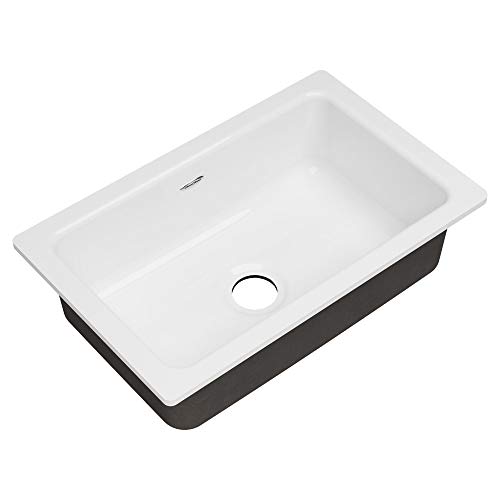
American Standard Delancey 30 x 19 Single Bowl Cast Iron Kitchen Sink, Brilliant White — Best Overall
The Delancey is where this category’s two truths meet: modern cooks want one large bowl, and cast iron buyers want a sink that lasts decades. American Standard’s 30 by 19 inch single-bowl sink in Brilliant White delivers both, in enameled cast iron, and it is verified in live catalog data — which, in this small category, is worth stating.
The 30-inch width is the quiet advantage. It fits the standard cabinets that dominate real kitchens while still taking a half-sheet pan flat and a roasting pan with room to maneuver. If you are choosing one cast iron single bowl without a cabinet renovation attached, this is the default answer.
Strengths
- Single uninterrupted basin: sheet pans lie flat, roasters soak whole, no divider Tetris.
- 30-inch footprint suits standard sink bases that exclude 33-inch models.
- Enameled cast iron surface: rigid, quiet, and the easiest white finish in the business to keep white.
Trade-offs
- One bowl means soaking and rinsing share a space; a basin tub becomes the honorary second bowl.
- Cast iron weight applies in full — crew the install and check the cabinet.
- White is the story here; colored enamel lives in the Kohler picks below.
| Material | Enameled cast iron |
| Overall size | 30 x 19 in |
| Layout | Single bowl |
| Finish | Brilliant White |
Single-bowl sizing is about the diagonal as much as the footprint. A 30×19 basin receives the pans that define weeknight cooking — sheet pans, skillets with handles, the big stockpot — at angles a divided bowl refuses. In cast iron, where the sink will serve for decades, that geometry decision outlives every appliance around it, so it deserves the thought this guide gives it.
The Delancey’s other argument is support. American Standard’s distribution means the drain, grid, and any future part are commodity items, and any plumber in the country has worked on the brand. A 25-year sink should come from a company you expect to answer the phone in year 20; this one qualifies.
Best for: most households choosing a cast iron single bowl for a standard kitchen / Not suited for: buyers who need a 33-inch basin or a colored enamel
Check the current price on Amazon

American Standard Quince 33 x 22 Single Bowl Cast Iron Kitchen Sink, 3 Holes — Best Large Basin
If the Delancey is the right size for most kitchens, the single-bowl Quince is the right size for big ones: a 33 by 22 inch enameled cast iron basin with a classic 3-hole faucet deck, top-mounted into the cutout size that generations of American kitchens were built around.
That installed base is the point. Countless kitchens have a 33×22 opening and a deck-mounted faucet; this Quince drops into that reality with the largest verified single bowl in the material. For a remodel that keeps the counter, it is close to a one-day transformation with a 25-year payoff.
Strengths
- Largest verified cast iron single bowl here — roasting pans and sheet pans disappear into it.
- Top-mount format reuses the common 33×22 cutout and existing deck faucet layout.
- Quince line’s classic styling suits traditional and transitional kitchens.
Trade-offs
- The 3-hole deck sets the faucet style; sleek single-hole plans need adaptation.
- The heaviest lift in this roundup — plan people and padding.
- Needs the cabinet width to match; measure before falling in love.
| Material | Enameled cast iron |
| Overall size | 33 x 22 in |
| Mount type | Top mount |
| Layout | Single bowl |
| Faucet deck | 3 holes |
A 33-inch single bowl changes washing-up ergonomics: two people can work at it, a day of dishes hides below the rim, and the biggest pan you own stops being a special case. In cast iron the effect is amplified, because the basin’s mass makes the whole station feel immovable — in the good way, the way a cast iron stove feels immovable.
The honest cost is the deck. A 3-hole top-mount is the traditional configuration, and kitchens designed around a counter-mounted statement faucet should look at the undermount and apron options below instead. This Quince serves the classic kitchen superbly and the minimalist one not at all — know which kitchen is yours.
Best for: large kitchens and 33×22 replacement projects wanting maximum verified basin / Not suited for: minimalist designs or cabinets under the required width
Check the current price on Amazon

Kohler Riverby Enameled Cast Iron Undermount Single Bowl Sink — Best Undermount
The Riverby is the single-bowl cast iron for the seamless-counter renovation: an enameled cast iron basin mounted below stone or quartz, designed with a basin floor that slopes toward the drain so water and crumbs travel instead of settling. The linked listing is the 33-inch undermount single-bowl in White (model 5871-5UA1-0); confirm the exact size and configuration on the live listing.
Undermount is where single-bowl logic peaks: the uninterrupted basin continues visually into the counter, prep sweeps straight in, and there is no divider and no rim between you and a clean kitchen. Combined with cast iron’s enamel, it is the easiest-cleaning sink configuration that exists.
Strengths
- Seamless wipe-in edge: the single bowl extends the counter’s working surface.
- Sloped basin floor encourages complete drainage — less standing water, less film.
- Kohler’s enamel colors and accessory support behind a long installation.
Trade-offs
- Professional installation with a real support frame; the heaviest undermount proposition in sinks.
- Solid-surface counters only — laminate is disqualified by water and weight alike.
- The 33-inch footprint demands a wide cabinet and a full renovation scope; smaller kitchens are better served by the 30-inch Delancey above.
| Model | Riverby 5871-5UA1-0 |
| Size | 33 in |
| Mount | Undermount |
| Bowl | Single bowl |
| Color | White |
The support conversation is non-negotiable with undermount cast iron: a frame or rail system inside the cabinet carries the filled basin’s weight, and the counter bond seals rather than holds. Installers who template from the physical sink and build the frame first produce the 30-year results; any shortcut shows up as a sagging seal line and a wet cabinet. Budget for the real install and the Riverby repays it daily.
Drainage slope sounds like a footnote until you live with a flat-floored basin that holds a permanent shallow puddle at the far end. The Riverby’s graded floor is one of those details that separates sink specialists from sink sellers, and in a single bowl — where everything migrates across one surface — it is felt at every rinse.
Best for: stone-counter renovations wanting the seamless cast iron single bowl / Not suited for: DIY drop-in projects, laminate counters, or unverified impulse purchases
Check the current price on Amazon

Kohler Whitehaven Enameled Cast Iron Apron-Front Single Bowl Sink — Best Apron Front
Apron-front and single-bowl are natural partners — the farmhouse tradition was always one big basin — and Kohler’s Whitehaven is the cast iron expression of that pairing: an enameled cast iron apron-front sink whose self-trimming apron design forgives small cabinet imperfections. The linked listing is the 35-1/2-inch single-bowl in White (model K-6488-0); verify the configuration and dimensions on the listing before buying.
For the farmhouse kitchen, this is the reference point: the deepest heritage material, the most recognizable silhouette, and a bowl that takes the canning pot and the roasting pan in stride. It is also the most committed install in this roundup, and the sections below price that commitment honestly.
Strengths
- The definitive farmhouse form in the most durable sink material made.
- Single deep basin matches farmhouse cooking: big pots, big pans, preserving days.
- Self-trimming apron design eases the cabinet fit that makes apron installs fussy.
Trade-offs
- Cabinet modification and professional installation are effectively mandatory.
- Premium tier before installation; the full project budget is roughly double the sink.
- The Whitehaven line also includes double-bowl Smart Divide variants — confirm the single-bowl configuration, size, and finish on the listing.
| Model | Whitehaven K-6488-0 |
| Size | 35-1/2 in |
| Material | Cast iron apron-front |
| Mount | Self-trimming undermount farmhouse |
| Bowl | Single-bowl |
| Color | White |
Ergonomics is the apron front’s hidden argument: with no cabinet face and counter edge between you and the basin, you stand closer and lean less. Across a preserving day or a holiday wash-up, that difference is felt in the lower back. The single bowl completes the logic — one deep, reachable workspace rather than two divided ones.
Choose the Whitehaven as architecture, not appliance. The cabinet is built to it, the counter is cut for it, and the enamel will outlast both. Kitchens planned that way get a sink that looks inevitable; kitchens that treat it as a swap get a project. Plan accordingly and it is the finest single bowl in this guide.
Best for: farmhouse renovations planned around the sink, professionally installed / Not suited for: standard-cabinet swaps or budget remodels
Check the current price on Amazon
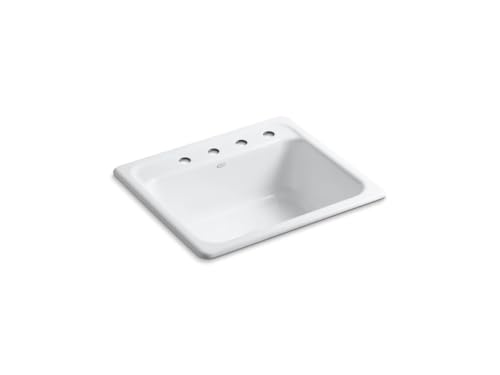
Kohler Mayfield Enameled Cast Iron Single Bowl Sink — Best Compact Classic
Not every cast iron single bowl needs to be a 33-inch statement. The Mayfield is Kohler’s compact classic: an enameled cast iron single bowl in a top-mount format sized for smaller kitchens, cottages, laundry and utility rooms, and butler’s pantries — the places where a small, indestructible sink earns its keep for decades. The linked listing is the 25-inch top-mount model (K-5964-4-0) in White; confirm dimensions on the listing.
Its appeal is proportion and permanence. A compact kitchen gets genuine cast iron — the mass, the enamel, the silence — without surrendering the counter run to a basin it cannot fill, and a utility space gets a sink that laughs at paint cans and garden tools.
Strengths
- Compact footprint brings cast iron to small kitchens and utility spaces.
- Top-mount install is the simplest route in the material.
- A long-running Kohler model with the support that implies.
Trade-offs
- Compact means compact: full sheet pans will bridge the rim rather than lie flat.
- The compact basin will not soak a full sheet pan flat — the honest trade for its footprint.
- Traditional styling; contemporary kitchens should look at Iron/Tones below.
| Model | Mayfield K-5964-4-0 |
| Size | 25 in |
| Material | Enameled cast iron |
| Mount | Top-mount |
| Bowl | 1-bowl |
| Color | White |
The secondary-sink case deserves respect: laundry, pantry, and workshop sinks live harder lives than kitchen sinks — bleach, soil, tools, paint — and they are the last fixtures anyone budgets to replace. A compact cast iron bowl is effectively a permanent answer in those rooms, which is why models like the Mayfield persist in catalogs decade after decade.
In a small primary kitchen, the Mayfield’s discipline is the feature: it reserves counter for cooking. Pair it with the basin-tub habit described in the guide and a small household loses nothing to the bigger bowls except the storage problem.
Best for: small kitchens, cottages, and utility or pantry sinks wanting permanent cast iron / Not suited for: cooks whose sheet pans must soak flat
Check the current price on Amazon

Kohler Iron/Tones Enameled Cast Iron Single Bowl Sink — Best Contemporary
Iron/Tones answers the buyer who loves everything about cast iron except the traditional styling. The line brings enameled cast iron into a cleaner, more contemporary geometry with flexible mounting and the deep color palette Kohler is known for — a single bowl that can sit in a modern kitchen as a deliberate color event. The linked listing is the 27-inch cast iron single bowl (K-5708-0) in White; check the listing for the exact configuration and color availability.
The material argument is unchanged — mass, silence, enamel longevity — but the design conversation is different: this is the sink as the room’s saturated accent, in a finish that will hold its color for the life of the kitchen.
Strengths
- Contemporary form in true enameled cast iron — no material compromise for the modern look.
- Color range turns the single bowl into the kitchen’s design anchor.
- Mounting flexibility widens the projects it can join.
Trade-offs
- A colored near-permanent fixture is a long design commitment; choose against permanent elements.
- Premium tier, with install effort set by the mount you choose.
- The linked listing is White; the line’s deeper colors are separate listings, so color-led projects must shop the range deliberately.
| Model | Iron/Tones K-5708-0 |
| Size | 27 in |
| Material | Cast iron |
| Mount | Top-mount / drop-in |
| Color | White |
Single-bowl contemporary kitchens live on uninterrupted planes — flat cabinet fronts, continuous counters — and a colored cast iron bowl punctuates that calm better than steel, which disappears, or white ceramic, which blends. The enamel’s depth of color is the effect: fired pigment has a richness that coated metals cannot imitate, and it does not fade toward the drain.
The discipline is in the choosing. Sample the color in your own light if the channel allows, judge it against floor and counter rather than accessories, and remember that the sink will outlast two rounds of decor around it. Buyers who do that homework get the most distinctive sink in this roundup.
Best for: contemporary kitchens wanting a colored cast iron single bowl as the design anchor / Not suited for: traditional kitchens, frequent redecorators, or unverified purchases
Check the current price on Amazon
Comparison Table
| Pick | Badge | Key spec | Best for |
|---|---|---|---|
| American Standard Delancey 30 x 19 Single Bowl Cast Iron Kitchen Sink, Brilliant White | Best Overall | 30 x 19 in enameled cast iron single bowl, Brilliant White | most households choosing a cast iron single bowl for a standard kitchen |
| American Standard Quince 33 x 22 Single Bowl Cast Iron Kitchen Sink, 3 Holes | Best Large Basin | 33 x 22 in enameled cast iron, top-mount single bowl, 3-hole deck | large kitchens and 33×22 replacement projects wanting maximum verified basin |
| Kohler Riverby Enameled Cast Iron Undermount Single Bowl Sink | Best Undermount | Enameled cast iron undermount single bowl, sloped basin, 33 in in White (verified listing, model 5871-5UA1-0) | stone-counter renovations wanting the seamless cast iron single bowl |
| Kohler Whitehaven Enameled Cast Iron Apron-Front Single Bowl Sink | Best Apron Front | Enameled cast iron apron-front single bowl, 35-1/2 in in White (verified listing, model K-6488-0) | farmhouse renovations planned around the sink, professionally installed |
| Kohler Mayfield Enameled Cast Iron Single Bowl Sink | Best Compact Classic | Compact enameled cast iron single bowl, top mount, 25 in in White (verified listing, model K-5964-4-0) | small kitchens, cottages, and utility or pantry sinks wanting permanent cast iron |
| Kohler Iron/Tones Enameled Cast Iron Single Bowl Sink | Best Contemporary | Enameled cast iron single bowl, contemporary design, 27 in in White (verified listing, model K-5708-0) | contemporary kitchens wanting a colored cast iron single bowl as the design anchor |
Two simple axes decide this table: size (30 vs 33 vs compact) and mount (top, under, apron). Pick the size your cabinet honestly allows and the mount your counter and budget support, then take the verified link — and still verify the listing details carefully before ordering.
How to Choose a Cast Iron Single Kitchen Sink
Start with the sheet-pan test, because it is the single bowl’s reason to exist. Take your largest sheet pan and roasting pan and measure them. A 30-inch single bowl receives standard half-sheet pans flat; a 33-inch bowl adds working room around them; a compact bowl bridges them on the rim. Match the sink to the pans you actually own — this one measurement predicts daily satisfaction better than any other.
Then choose the mount with your counter and cabinet in the room, not in a catalog. Top-mount is the forgiving classic: it covers the cut edge, tolerates laminate, and suits replacements — the Delancey and Quince route. Undermount gives the seamless wipe-in edge and demands a solid counter plus a support frame, because a filled cast iron basin is a serious hanging load. Apron-front is a cabinet project with ergonomic rewards. Each is right somewhere; each is wrong somewhere else.
Size the cabinet honestly:
- 33-inch sinks generally need a 36-inch sink base; 30-inch sinks a 33-inch base; compact models fit smaller bases — always confirm the model’s stated minimum.
- Depth: single bowls in this class run deep; deep hides dishes and soaks pans, but shorter cooks should mock up the reach before committing.
- Drain position: offset drains free up cabinet space below and let pans sit flatter; centered drains are the classic default.
- Disposal: standard openings apply across this roundup; match the flange finish to your faucet, not to the sink.
Finally, decide the second-bowl question before it decides itself. A single bowl plus a removable basin tub gives you a temporary soak side for the ten percent of tasks that want one, at zero permanent cost in basin space. Households that adopt the tub rarely miss the divider; households that soak constantly should admit it now and shop double bowls instead.
Why a Single Bowl Wins in Cast Iron Specifically
The single-versus-double debate exists in every material, but cast iron tilts it. A cast iron sink is a 25-year fixture: the layout you choose will outlive your dishwasher, your faucet, and possibly your counters. Betting that layout on the double bowl’s hand-washing workflow — in the era of the dishwasher — is betting on the past. The single bowl’s flexibility (any pan, any project, a tub when you need a second space) ages better because it assumes less about how you will cook in fifteen years.
There is also a structural elegance: one uninterrupted casting, one drain, one surface to clean, no divider ridge to trap grime or chip first. In a material whose maintenance story is ‘wipe it’, removing the divider removes the last fiddly geometry in the basin.
Sound deserves its sentence too. A single cast iron bowl is the quietest wash-up in the kitchen: no drumming from running water, no clang when a pan lands, no disposal buzz telegraphed through thin metal. In open-plan homes where the kitchen opens onto living space, that silence is a daily quality-of-life feature that never appears on a spec sheet.
The honest counter-case is the dedicated soaker: households that hand-wash delicate loads daily while the main bowl works — produce farms, big from-scratch kitchens with constant pot rotation — do use both bowls fully. If that is demonstrably your kitchen (not your aspiration), the double-bowl Quince in our general cast iron guide is your verified pick. Everyone else should take the single.
Budgeting for a Cast Iron Single Bowl: Sink, Support, and Grid
The basin is the headline cost, and cast iron single bowls sit in the mid-to-premium sink tiers. The full budget adds: a fitted bottom grid (treat as mandatory — it is the enamel’s bodyguard against pan impacts), a drain assembly and disposal flange in your faucet finish, and installation scaled to the mount — modest for a top-mount swap into an existing cutout, substantial for undermount framing or apron-front cabinet work.
Run the lifespan arithmetic before flinching: amortized over 25 years, even the premium end of this category undercuts the cost of cycling through two or three lesser sinks, each with its own install. The buyers who regret cast iron money are the ones who economized on the invisible parts — support and sealing — not the ones who paid for the sink itself.
One more line item worth its place: a quality basin tub. It is the accessory that makes a single bowl complete, standing in for the second bowl on soak days and corralling small items during cleanup. Buy it with the sink and the single-bowl system is whole from day one.
Drains, Grids, and the Accessory Decisions That Complete a Single Bowl
A single bowl concentrates every decision into one basin, so its accessories matter more than they do in a double. Start with the drain. Its position shapes the bowl’s working geometry: a rear or offset drain leaves the center of the floor free, so a roasting pan sits flat instead of teetering on the drain flange, and it frees cabinet space below for storage or a pull-out. A centered drain is the classic default and perfectly serviceable — but if a model offers the offset, take it; you will notice it weekly.
The disposal question follows. Single bowls usually host the garbage disposal, and cast iron’s mass is an unadvertised benefit here: the heavy basin absorbs disposal vibration that makes thin steel sinks buzz and drum. Fit the disposal with the flange finished to match your faucet, and confirm the mounting assembly is snug — cast iron’s rigidity rewards a firm fit and punishes a sloppy one with a slow leak at the seal.
Then the grid, which this guide has already called mandatory and will now justify once more: in a single bowl, every pan, glass, and utensil lands in the same space, so impact events concentrate exactly where the grid stands guard. Choose the fitted grid for your model over a generic mat — fitted feet land on the basin’s strong points and the grid does not skate when a heavy pot is set down.
Round out the kit with the two small tools that make a big bowl civilized: a sink-side caddy or an over-bowl rack for the items that live at the sink, and the basin tub from the budgeting section. With grid, rack, and tub in place, the single bowl stops being an absence of a divider and becomes a workspace with zones — which was the idea all along.
How to Set Up and Use a Cast Iron Single Bowl Well
A single bowl rewards a small amount of deliberate setup. This routine — grid, tub, drain care, and enamel habits — turns the big basin into a system, and it applies whichever pick in this guide you install.
- Fit the bottom grid first. Set the sink’s fitted grid in place before the first pan lands. It prevents impact chips, keeps items off the enamel, and lets water circulate under soaking cookware.
- Establish the tub zone. Keep a basin tub that nests at one end of the bowl. Soaking, produce washing, and small-item corralling happen there; the rest of the basin stays free for pans.
- Work the diagonal. Load large pans corner-to-corner — the single bowl’s diagonal is its longest dimension and the reason sheet pans fit where a divided bowl refuses them.
- Rinse toward the drain as you go. The single surface means debris migrates freely; a quick sweep with the sprayer after each session keeps the enamel’s easy-clean promise true.
- Clean with the gentle kit. Dish soap and a soft sponge daily; baking-soda paste and a melamine sponge for metal marks and stains. No scouring powders, no steel wool — the glaze’s smoothness is its protection.
- Repair chips promptly. If a chip happens, dry it and fill it with a color-matched enamel repair kit before the exposed edge can rust and stain its neighbors.
Keep a small log in the first month: note what actually soaks, what bridges the rim, and where items collect. Single-bowl ownership has a short learning curve — tub placement, rack position, grid habits — and a month of noticing turns the big basin from a novelty into the most natural workspace in the kitchen. Owners who skip the noticing keep fighting habits formed around a divider that no longer exists.
On installation, the rules from our general cast iron guide apply in full: top-mount swaps are careful DIY with a helper; undermount cast iron requires a support frame carrying the basin; apron fronts require the cabinet built to the sink with the counter templated from the physical unit. In every case the sink should be on site before any counter is cut.
Let any new sealant cure for its full stated time before the first full-bowl soak. A single bowl holds more water than any other fixture in the kitchen; it is the wrong load with which to test fresh silicone.
Common Buying Mistakes
Buying the 33 for a 30-inch cabinet
The most common single-bowl error is measuring the old sink instead of the cabinet. The sink’s number is its outside; the cabinet’s interior is the law. Measure inside width, confirm the model’s minimum cabinet size, and only then choose between the Delancey’s 30 and the Quince’s 33.
Skipping the grid to ‘see the enamel’
Owners skip the grid for the look, then meet the first skillet slide. The enamel you wanted to see is exactly what the grid protects. Modern grids are low-profile and removable for cleaning; the aesthetic cost is small and the protection is the difference between a pristine decade and a repaired one.
Expecting a single bowl to soak and serve simultaneously
One bowl is one space. The fix is the basin tub, not buyer’s remorse: soak in the tub at one end, work in the rest. Households that refuse the tub and soak constantly should have bought the double — an honest self-assessment at purchase time prevents the only real disappointment this category offers.
Ignoring bowl depth until the first backache
Deep single bowls are wonderful for soaking and hiding dishes, and genuinely awkward for shorter cooks who must reach the bottom many times a day. Depth is a body measurement, not just a spec: stand at a showroom sink of similar depth, or mock the reach with a box, before the 25-year commitment. The right depth disappears into use; the wrong one is felt every single day.
Undermounting on clips and adhesive
A filled single bowl is the heaviest hanging load in the kitchen. Without a frame or rails carrying it to the cabinet, the seal creeps open and the cabinet rots quietly. Support is structure. Any installer who waves it off should be waved off in turn.
Scrubbing the glaze dull
Enamel’s stain resistance is its glassy smoothness. Abrasive powders and pads spend that smoothness, after which the sink genuinely becomes harder to clean — a self-fulfilling decline. Gentle cleaning is not fussiness; it is the maintenance the material actually specifies.
Final Recommendation
Buy the Delancey if you want the verified, no-drama, no-regret answer for a standard kitchen: a 30×19 cast iron single bowl from a brand with a national support network, sized for the cabinets most kitchens actually have. Take the single-bowl Quince when the kitchen is bigger, the existing cutout is 33×22, and the classic deck-mount look is genuinely welcome.
The Kohler benchmarks serve the planned renovations: Riverby for the seamless undermount, Whitehaven for the farmhouse build, Mayfield for compact and utility spaces, Iron/Tones for the colored contemporary statement. All four are linked in this edition after follow-up verification — use the links to check price on Amazon, and still verify the single-bowl configuration, size, and finish on the listing before you commit.
Then set the bowl up as a system — grid in, tub nested, gentle cleaning kit stored under the sink, disposal flange matched to the faucet — and a cast iron single bowl will quietly become the most permanent-feeling and most-used fixture in your entire kitchen.
Keep researching the cluster: Best Cast Iron Kitchen Sinks Best Ceramic Kitchen Sinks Best Caulking For Kitchen Sinks Best Single Bowl Kitchen Sinks Best Farmhouse Kitchen Sinks
Related guides
Frequently Asked Questions
Is a single bowl better than a double bowl in cast iron?
For most modern kitchens, yes. The single bowl fits the pans that define current cooking, adapts with a basin tub when a second space is needed, and — decisive in cast iron — ages better across a 25-year life because it assumes less about your future workflow. Committed daily soakers who hand-wash constantly are the honest exception.
What size cast iron single bowl should I buy?
Let the cabinet decide the outside and your pans decide the rest. A 30-inch bowl (Delancey class) fits standard bases and takes half-sheet pans flat; a 33-inch bowl (Quince class) adds working room in larger kitchens; compact models serve small kitchens and utility spaces but bridge big pans on the rim. Confirm the model’s minimum cabinet size before ordering.
How do I soak dishes in a single bowl while still using the sink?
Use a basin tub nested at one end of the bowl: it becomes the soak zone while the remaining basin stays free for rinsing and pan work. It is the standard single-bowl workflow, costs almost nothing, and removes the only real compromise of the layout.
Can a cast iron single bowl be undermounted safely?
Yes, with a proper support frame or rails inside the cabinet carrying the filled basin’s weight, under a solid waterproof counter. Adhesive and clips alone are a seal, not a structure, and are not sufficient for cast iron. This is professional installation territory, and it produces the most seamless result in the category.
Will a white cast iron sink stay white?
Enamel white is fired into the surface, so it does not yellow or peel. Surface stains from tea, coffee, and hard water sit on the glaze and lift with baking-soda paste; metal marks from pans wipe off with a melamine sponge. What dulls enamel is abrasive scrubbing — clean gently and the white lasts as long as the sink.
What is the best way to protect a cast iron single bowl from chips?
A fitted bottom grid is the main defense, because most chips come from pans striking the basin floor. Add two habits: set heavy cookware down rather than dropping the last inch, and wash cast iron skillets resting on the grid rather than balanced on the rim. Small chips that do occur can be filled with a color-matched enamel repair kit before the exposed edge stains.
How were the Kohler picks verified in this guide?
Links here are only published after verification against live catalog data. The Kohler models could not be re-verified when this batch was first prepared, so they ran unlinked in the first edition; a follow-up verification pass has since matched each model to a live listing, and all four are now linked with specifications from those listings. They are included because an honest cast iron roundup cannot omit the category’s benchmarks. Confirm configuration and details on the listing before buying.


