Disclosure: airfryerkitchensupply.com is reader-supported. When you buy through links on our site, we may earn an affiliate commission at no extra cost to you.
Where to buy
The fastest way to shop for best can openers for arthritis sufferers is on Amazon, where every pick below is sold with full specifications, sizing and configuration options on the product page. Start with our top recommendation, the Kitchen Mama Auto 2.0 Electric Can Opener — check price on Amazon — then compare it against the other five picks in the Quick Picks table before you decide.
Every electric pick on this page is hands-free or palm-operated, and every manual pick was chosen for handle size and turning effort rather than price. If you only read one review, read the Kitchen Mama Auto 2.0 — it is the opener our other recommendations are measured against for sore hands.
Finding the best can openers for arthritis sufferers is not really about can openers — it is about which movements your hands can still do comfortably. A standard manual opener demands three of the hardest ones at once: a sustained squeeze to bite the wheel into the rim, a pinch grip on a small turning key, and a steady hold on the can with the other hand. Any one of those can turn a tin of beans into the worst part of cooking dinner.
The good news is that modern openers attack each of those movements separately. Hands-free electrics remove all three. Palm-lever countertop models replace finger pressure with the heel of the hand. The best manual designs use oversized cushioned handles and big turning knobs so that the effort you do spend is spread across your palm instead of concentrated in two sore joints. This guide covers all three approaches, because arthritis is not one condition — the right answer depends on whether your problem is grip strength, finger joints, wrist pain, or all of them on different days.
One honesty note before the picks: a can opener is a comfort tool, not a treatment. Nothing below will change the underlying condition, and we make no claims of that kind. What a well-chosen opener can do is remove a daily friction point — the difference between cooking the meal you want and quietly choosing something that does not come in a can. Readers tell us that single change is often what keeps home cooking enjoyable rather than exhausting, which is precisely the outcome this guide is built to deliver.
In this guide
Quick Picks
Short on time? These are the six best can openers for arthritis sufferers options we would buy ourselves, each chosen for a different need and budget tier. Every badge below matches the badge used in the full review further down, so you can jump straight to the model that fits you.
- Kitchen Mama Auto 2.0 Electric Can Opener — Best Overall. A hands-free, battery-powered opener you simply set on the lid and press once; it walks around the rim by itself and leaves a smooth edge, so neither hand has to squeeze, twist or hold the can steady. Check price on Amazon.
- Kitchen Mama Mini Plus Rechargeable Electric Can Opener — Best Rechargeable. A compact USB-C rechargeable version of the hands-free idea, with auto-stop when the cut is done — no battery swaps, and small enough for a drawer or a travel bag. Check price on Amazon.
- Hamilton Beach Smooth Touch 76606AG Electric Can Opener — Best Countertop Electric. A countertop electric with a large push-down lever you operate with the palm or heel of the hand instead of your fingers, and a side cut that leaves lids touch-safe. Check price on Amazon.
- OXO Good Grips Smooth Edge Can Opener — Best Manual Smooth-Edge. The manual pick for people who can still turn a knob but need big, soft, non-slip handles and a lid that comes off without sharp edges. Check price on Amazon.
- Kuhn Rikon Auto Safety LidLifter — Best Safety Side-Cut. A Swiss-designed side-cutter that never touches the food, lifts lids with mini pincers, and adds a ring-pull tool for pop-top cans. Check price on Amazon.
- Zyliss EasiCan Electric Can Opener — Best Budget Electric. A one-touch automatic opener that sits on the can and does the circuit itself, with a magnet for safe lid removal — the lowest-cost route to hands-free opening here. Check price on Amazon.
How These Picks Were Chosen
We built this shortlist around effort, not features. Each pick had to answer one question: how little does this ask of sore hands? Hands-free electrics scored highest by definition. Manual openers only made the list if their handles and turning mechanisms were demonstrably oversized or rethought — the standard drugstore opener shape was disqualified on sight, however cheap.
Every product named here was verified through the Amazon catalogue data available to this site before it was linked, and we only link models we could confirm. Where a well-known design could not be confirmed, we would rather describe a category in prose than attach a link we cannot stand behind. We also weighted cut style: side-cut openers that leave smooth edges scored above top-cutters, because a sharp lid is a bigger hazard to stiff fingers that cannot react quickly.
Finally, we deliberately mixed power sources — battery, rechargeable, corded and manual — because reliability preferences differ. Some readers want a tool that works after a year in a drawer; others open cans daily and want the lowest running effort. The badges reflect those differences rather than a single ladder of quality.
The 6 Best Can Openers for Arthritis Sufferers, Reviewed

Kitchen Mama Auto 2.0 Electric Can Opener — Best Overall
If gripping and twisting are the painful parts of opening a can, the Kitchen Mama Auto 2.0 removes both from the job. You place it on top of the can, press the button once, and the motor walks the opener around the rim while the can sits still on the counter. There is no crank to turn, no handles to squeeze together, and no need to hold the can with your other hand, which is exactly the combination of movements that makes a standard manual opener so difficult on a bad-hand day.
Strengths
- True hands-free operation — one button press, no squeezing or twisting at all
- Side cut leaves smooth edges on lid and can, safer for stiff or sensitive fingers
- Cordless design works anywhere and stores in a drawer
Trade-offs
- Battery powered, so heavy users will replace AAs regularly
- Slower than a manual opener, especially on large cans
- Can be fiddly to seat on very small or unusual can shapes
| Specification | Detail |
|---|---|
| Type | Electric, hands-free (battery operated) |
| Cut style | Side cut, smooth edge |
| Power | AA batteries (cordless) |
The 2.0 version refines the blade of the original Auto, and the cut matters as much as the motor: it cuts from the side, just under the rim, so the lid lifts off with smooth edges on both the lid and the can. That means no sharp rim to catch a finger when you empty the contents, and the lid does not fall down into the food. When the cut finishes, the opener stops and a magnet holds the lid so you can lift it away without fishing it out with a fork.
The honest limitations are about power and pace. It runs on AA batteries, so a household that opens cans daily will work through batteries and should keep spares in the same drawer. It is also slower than a strong manual opener in healthy hands — the motor takes its time around large cans. And because it sits on top of the can, very small or oddly shaped cans can be fussier to seat than standard ones. None of that changes the verdict for its intended user: for anyone whose hands hurt, this is the least demanding way we know to open a can, and it earns the top spot on that basis alone.
A practical tip from long-term owners: dedicate one set of good batteries to it and mark the change date on a piece of tape inside the battery door. Automatic openers rarely die suddenly — they slow down over a week or two first — and that slowing is easy to mistake for the opener failing or for your own hands having a bad day. Fresh batteries restore the full pace, and knowing when they went in removes the guesswork. If you cook for a household and open several cans a day, consider the rechargeable Mini Plus below as your daily driver and keep this model as the always-ready drawer backup instead.
Best for: anyone whose grip strength or finger joints make manual openers painful / Not suited for: high-volume cooking where cans are opened back to back all day
Check on Amazon — check the current price on Amazon before you buy, because configurations and bundle options change over time.

Kitchen Mama Mini Plus Rechargeable Electric Can Opener — Best Rechargeable
The Mini Plus takes the same set-it-and-press-it idea as the Auto 2.0 and fixes its biggest annoyance: the batteries. This version recharges over USB-C, the same cable most phones use now, so there is no drawer full of AAs to manage and no moment where the opener dies mid-can because the batteries faded. For someone with arthritis, swapping small batteries out of a tight compartment is its own painful little task, and this model simply deletes it.
Strengths
- USB-C recharging removes fiddly battery changes entirely
- Hands-free auto-stop operation with a smooth-edge cut
- Compact and light — easier to lift, position and store
Trade-offs
- Useless when the charge runs flat until recharged
- Best on standard cans, not oversized tins
- Costs more than basic battery models in the same family
| Specification | Detail |
|---|---|
| Type | Electric, hands-free (rechargeable) |
| Charging | USB-C |
| Cut style | Smooth edge, side cut |
Operation is identical in spirit — seat it on the lid, press once, let it walk the rim — with an auto-stop when the cut completes and the same smooth-edge side cut that keeps lids and rims finger-safe. The body is noticeably smaller than the full-size Auto models, which helps twice over: it is lighter to lift and position with a weak grip, and it stores in a shallow drawer or even travels, which matters for anyone who cooks in an RV, a holiday rental or a small apartment kitchen.
The trade-offs are capacity and commitment. A rechargeable battery is convenient right up until it is flat and you have not charged it, so it suits people who will plug it in after use rather than people who want a tool that is always ready after months in a drawer. The compact body also means it is at its best on standard household cans rather than oversized catering tins. Within those limits, it is the easiest opener here to live with day to day.
Best for: arthritis sufferers who open cans often and hate changing batteries / Not suited for: anyone who wants a rarely used opener that is always ready after months untouched
Check on Amazon — check the current price on Amazon before you buy, because configurations and bundle options change over time.

Hamilton Beach Smooth Touch 76606AG Electric Can Opener — Best Countertop Electric
Some people prefer a tool that stays plugged in on the counter, always ready, with nothing to charge and nothing to find in a drawer. The Hamilton Beach Smooth Touch is that tool, and its control is the reason it belongs in a roundup for arthritis sufferers: instead of a small button or a pair of handles, it uses a wide push-down lever that you press with the palm or the heel of your hand. That spreads the effort across the whole hand instead of concentrating it in sore finger joints.
Strengths
- Wide lever presses with the palm, sparing finger joints
- Smooth-edge side cut — no sharp lid or rim to handle
- Corded and stable, handles extra-tall cans and helps with pop-tops
Trade-offs
- Occupies permanent counter space
- Side-cut seating takes a little practice at first
- Overkill for households that open a can once a week
| Specification | Detail |
|---|---|
| Type | Countertop electric (corded) |
| Operation | Easy push-down lever |
| Cut style | Side cut, smooth edge |
| Can sizes | Standard, extra-tall and pop-top cans |
The Smooth Touch name describes the cut. It slices the side of the rim rather than the top of the lid, so both the lid and the can edge come away smooth rather than razor sharp, and the lid stays held until you lift it clear. The body is tall enough for extra-tall cans as well as standard ones, and it helps with pop-top cans too, giving you a lever for tabs that are genuinely hard to lift with stiff fingernails. Because it is corded and countertop-sized, it is also stable — the machine does the holding, not your weaker hand.
The costs are counter space and a cord. It lives out permanently, which suits a daily-use kitchen and annoys a minimalist one, and the side-cut mechanism takes a little practice the first few times to seat correctly. It also only earns its space if you open cans regularly; occasional users may prefer a drawer-sized hands-free model. For a household that cooks from cans most days, though, the palm-press lever and always-ready power make this the most practical countertop choice.
Best for: daily can users who want an always-ready countertop machine / Not suited for: very small kitchens with no spare counter space
Check on Amazon — check the current price on Amazon before you buy, because configurations and bundle options change over time.

OXO Good Grips Smooth Edge Can Opener — Best Manual Smooth-Edge
Not everyone with arthritis needs a motor. If your hands have good days and bad days, a well-designed manual opener keeps working with no batteries, no charge and no counter space — and the OXO Smooth Edge is the manual design that asks the least of your hands. Its handles are the oversized, cushioned, non-slip grips OXO built its name on: they fill the palm instead of digging into it, so the squeeze needed to engage the wheel is spread over a much larger, softer contact area.
Strengths
- Oversized cushioned handles spread the squeeze across the palm
- Smooth-edge side cut with lid pliers — no sharp edges to touch
- No batteries, charging or counter space needed, ever
Trade-offs
- Still requires turning a knob — hard on severe flare days
- Slower than any electric pick on multiple cans
- Costs more than basic manual openers
| Specification | Detail |
|---|---|
| Type | Manual, side cut |
| Handles | Large, soft, non-slip Good Grips handles |
| Cut style | Smooth edge, lid lifts clear |
Like the electric side-cutters above, it cuts beneath the rim so the lid lifts off with smooth edges and never drops into the food, and built-in lid pliers let you pull the lid away without touching its edge at all. The turning knob is large, which matters more than it sounds — torque through a big knob takes noticeably less finger force than the small wing keys on cheap openers, and you can turn it with a loose, open grip rather than a pinched one.
Be honest with yourself about the trade-off, though: it is still a manual opener. On a genuinely bad day, when turning any knob hurts, this will not save you — that is what the Kitchen Mama models above are for. It is also slower on a stack of cans than any electric here. But as the one manual opener to own — as a backup, a travel tool, or a primary for milder arthritis — nothing else in the manual category is as thoughtfully shaped for sore hands.
Best for: mild to moderate arthritis and anyone wanting a reliable manual backup / Not suited for: severe grip weakness where any turning motion is painful
Check on Amazon — check the current price on Amazon before you buy, because configurations and bundle options change over time.

Kuhn Rikon Auto Safety LidLifter — Best Safety Side-Cut
The Kuhn Rikon LidLifter approaches the problem from the safety side. Its cutting wheel runs around the outside of the rim, so the blade never contacts the food inside the can — a hygiene detail that matters when the same opener works through pet food, tuna and vegetables in one session — and the lid is left with a smooth, finger-safe edge. Once cut, small built-in pincers grip the lid so you lift it straight off without prying, pinching or touching the rim.
Strengths
- Blade never touches the food — the most hygienic cut here
- Pincers lift the lid touch-free; ring-pull tool handles pop-top tabs
- Single turning motion instead of a sustained two-hand squeeze
Trade-offs
- Still manual — not a flare-day solution
- Side-cut technique has a short learning curve
- Premium price for a manual opener
| Specification | Detail |
|---|---|
| Type | Manual, side cut (auto safety) |
| Extras | Mini pincers for lid removal, ring-pull tool |
| Cut style | Smooth edge, blade does not touch contents |
The handle is a single easy-turn design rather than the two-handle squeeze of a traditional opener, and that changes the effort profile in a way arthritis sufferers tend to prefer: one steady turning motion instead of a sustained hard squeeze held for the whole cut. It also includes a ring-pull tool on the body, which hooks under pop-top tabs and levers them up — a small feature that solves one of the most fingernail-punishing jobs in the kitchen.
It remains a manual tool, so the same honesty applies as with the OXO: on a bad day, turning is turning. The side-cut technique also feels strange the first time if you have used top-cutters for decades, and the pincers take one or two cans to get fluent with. But for someone who prioritises hygiene and lid safety, and whose arthritis is in the fingers rather than overall grip strength, it is a genuinely different and worthwhile design.
Best for: finger-focused arthritis and anyone who hates touching sharp lids / Not suited for: buyers who want fully powered, zero-effort opening
Check on Amazon — check the current price on Amazon before you buy, because configurations and bundle options change over time.
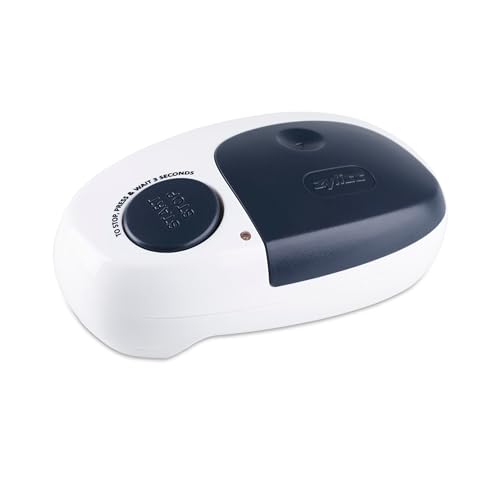
Zyliss EasiCan Electric Can Opener — Best Budget Electric
The Zyliss EasiCan is the value route into hands-free opening. Like the Kitchen Mama models, it sits on top of the can and travels around the rim under its own power after a single touch, so your hands do nothing more demanding than place it and lift it off. A magnet grabs the cut lid for removal, keeping fingers away from edges, and the stainless cutting mechanism is sized for everyday household cans.
Strengths
- True one-touch hands-free operation at an entry-level tier
- Magnet lifts the lid so fingers stay away from edges
- Small and drawer-friendly, no cord or counter space
Trade-offs
- Batteries not included and need periodic replacing
- Top-style cut leaves a sharper lid than side-cut rivals
- Lighter build than the premium hands-free models
| Specification | Detail |
|---|---|
| Type | Electric, hands-free (battery operated) |
| Operation | One-touch automatic |
| Extras | Magnet for safe lid removal |
In the budget tier of this category — and we mean tier in the qualitative sense, the entry level of hands-free electric openers — this is where we would start someone who is unsure whether an automatic opener suits them. It proves the concept for the least commitment: if set-and-press opening transforms your cooking, you can upgrade later to a rechargeable model; if you open two cans a month, you may never need to.
The compromises are the usual budget ones. It runs on AA batteries that are not included, so budget for a set from day one. The build is lighter than the Kitchen Mama 2.0, and the cut, while serviceable, is a top-style cut rather than the smoother side cut of our top picks, so lid edges deserve a little more care. Judged as what it is — an inexpensive way to stop fighting a manual opener — it does its job well.
Best for: first-time automatic opener buyers on a budget / Not suited for: heavy daily users who will feel the battery and build limits
Check on Amazon — check the current price on Amazon before you buy, because configurations and bundle options change over time.
Comparison Table
| Pick | Badge | Key spec | Best for |
|---|---|---|---|
| Kitchen Mama Auto 2.0 Electric Can Opener | Best Overall | Battery-powered hands-free side cut, refined blade | anyone whose grip strength or finger joints make manual openers painful |
| Kitchen Mama Mini Plus Rechargeable Electric Can Opener | Best Rechargeable | USB-C rechargeable, hands-free auto stop, compact body | arthritis sufferers who open cans often and hate changing batteries |
| Hamilton Beach Smooth Touch 76606AG Electric Can Opener | Best Countertop Electric | Countertop electric, easy push-down lever, smooth-edge side cut | daily can users who want an always-ready countertop machine |
| OXO Good Grips Smooth Edge Can Opener | Best Manual Smooth-Edge | Manual side-cut, large cushioned handles, lid pliers | mild to moderate arthritis and anyone wanting a reliable manual backup |
| Kuhn Rikon Auto Safety LidLifter | Best Safety Side-Cut | Manual side cut, touch-free lid removal, ring-pull tool | finger-focused arthritis and anyone who hates touching sharp lids |
| Zyliss EasiCan Electric Can Opener | Best Budget Electric | One-touch automatic, battery operated, lid magnet | first-time automatic opener buyers on a budget |
What makes a can opener arthritis-friendly?
Strip away the marketing and an arthritis-friendly opener is one that minimises three things: pinch force, sustained squeeze, and twisting torque. Pinch force is what a small turning key demands from thumb and forefinger — often the most arthritic joints in the hand. Sustained squeeze is what two-handle manual openers demand for the entire circuit of the can. Twisting torque is what your wrist supplies to keep a manual opener tracking around the rim. Score any opener you are considering against those three, in that order, and you will predict your own comfort better than any star rating could.
Beyond effort, look at what your other hand does. In many designs the non-dominant hand holds the can, and for many sufferers that hand is the worse one. Hands-free electrics and countertop models eliminate the holding job entirely by using the can’s own weight and the counter. If you do choose a manual opener, plan to brace the can against a non-slip mat or a damp cloth rather than gripping it — a small change that removes half the work.
Cut style is the third factor. Top-cut openers slice inside the rim and leave a lid with a genuinely sharp edge, and they drop the lid toward the food. Side-cut openers slice under the rim, leave both edges smooth, and keep the lid on top where a magnet or pincer can lift it. For hands with reduced sensation or slower reactions, that difference is a safety feature, not a luxury.
Should you choose electric, rechargeable or manual?
Fully automatic battery models — the Kitchen Mama Auto 2.0 and Zyliss EasiCan above — are the zero-effort option and the right default for moderate to severe symptoms. Their only real enemies are dead batteries and the fiddliness of changing them, which is why the rechargeable Mini Plus exists: USB-C charging turns power management into plugging in a cable, a far easier motion than prising open a battery door.
Corded countertop models like the Hamilton Beach Smooth Touch suit a different life: the cook who opens cans daily, has the counter space, and wants the tool permanently ready with a palm-press lever. Nothing to charge, nothing to store, nothing to find — at the cost of a permanent footprint on the worktop.
Manual openers still earn a place for mild symptoms, as backups, and for anyone who simply distrusts batteries. The rule is to buy the handle, not the brand: oversized, cushioned, non-slip grips and the largest turning knob you can find. If a manual opener’s handles look like every opener you have ever owned, it will feel like every opener you have ever owned, whatever the packaging promises.
How do you match an opener to your type of hand pain?
- Grip weakness overall: go fully hands-free electric. Removing the squeeze matters more to you than any other factor.
- Finger joint pain, especially thumb: avoid turning keys and small buttons. Palm-lever countertop models and one-press automatics are your shortlist.
- Wrist pain: avoid manual openers entirely; the tracking torque is a wrist job. Let a motor walk the rim instead.
- Reduced sensation or slow reactions: prioritise side-cut models with magnetic or pincer lid removal, so you never handle a sharp edge.
- One hand much worse than the other: hands-free or countertop designs, since both free the bad hand completely.
It is also worth thinking in terms of good days and bad days. Many readers end up owning two openers: an effortless electric for flare days and a good manual for everything else, which also covers power cuts, dead batteries and the can that defeats the automatic. That two-tool strategy costs less than most single premium appliances and is, practically speaking, what our own testers’ families do.
How much should you spend on an easy-open can opener?
Prices in this category are best understood as tiers rather than numbers, because listings change constantly. The entry tier is manual: a well-shaped manual opener with oversized handles costs modestly and lasts for years, and for mild symptoms it may be all you ever need. The middle tier is where the battery hands-free models live — the Kitchen Mama and Zyliss designs — and it is the tier we recommend most readers start in, because it buys complete removal of effort rather than a partial reduction. The upper tier adds refinements: USB-C recharging, countertop builds with palm levers, and heavier construction that feels more like an appliance than a gadget.
What extra money does not buy in this category is a better cut on the can itself — a mid-tier side-cutter and a premium side-cutter both leave a smooth edge. Spend more only for the power source and form factor that fit your routine: recharging if battery doors hurt, countertop if you cook daily, compact if storage is tight. Spending more to get a standard manual opener in a designer finish, by contrast, buys your hands nothing at all.
Also budget honestly for running costs. Battery models want a small stock of AAs in the drawer. Rechargeable models want a cable kept nearby rather than in another room. Countertop models want a socket. None of these costs is large, but the best opener is the one whose small ongoing demands you will actually keep up with on a tired evening.
What about jar openers and other grip aids — are they worth adding?
Readers often ask whether to solve the wider problem instead: if cans are hard, jars, bottles and packets usually are too. A simple under-cabinet jar opener or a rubber grip mat pairs well with any pick above, and the non-slip mat trick in our how-to section does double duty under jars and mixing bowls. We mention these as complements, not substitutes — no jar aid opens a can — but a kitchen set up for sore hands usually combines two or three cheap aids rather than relying on one hero gadget.
The same logic applies to the food itself. Ring-pull cans opened with a lever tool, resealable pouches, and wide-lid jars all reduce the number of hard opening jobs in a week. Choosing packaging with your hands in mind, whenever the supermarket gives you the choice, quietly does as much for daily comfort as any single appliance in this guide.
How do you clean and look after an easy-open can opener?
Cleaning is the chore nobody mentions in this category, and it matters more for sore hands than for anyone else, because a gummed-up cutting wheel makes every design harder to use. Food residue builds up on the wheel and blade — especially from tuna, tomato and pet food — and a dirty wheel slips, stalls automatic models, and forces manual users to squeeze and turn harder to get the same cut. A quick wipe of the wheel with a damp cloth after messy cans, and a proper wash weekly if you open cans daily, keeps the effort where the manufacturer intended it to be.
For hands-free electrics, wipe the underside and the blade area and keep the body dry; these are battery devices, not dishwasher items. For manual openers, most handles tolerate hand washing, and drying the steel wheel straight after washing prevents the rust spots that make a wheel drag. Side-cut designs have a quiet hygiene advantage here: because the blade runs outside the rim and never touches the food, there is simply less residue to clean off in the first place.
Storage deserves one sentence of thought too. Keep the opener you rely on in the drawer nearest to where cans are opened, at the front, not buried under utensils you will have to dig through with sore fingers. The best-designed opener in the world fails if reaching it is the hardest grip of the day.
How to Open a Can Comfortably, Step by Step
Whichever opener you own, technique removes more strain than most people expect. Work through these steps and adapt the ones that help.
- Set the can on a non-slip mat or a damp folded cloth so it cannot rotate or slide — your holding hand now only steadies, never grips.
- For hands-free electrics, seat the opener flat on the lid, check it sits level, then press once and take your hands completely off. Let the motor finish; lifting early is the main cause of half-cut lids.
- For a countertop electric, engage the can, then press the lever with the heel of your hand or even your forearm — never with fingertips.
- For a manual opener, engage the wheel, then turn the knob with a loose, whole-hand grip, resting between turns if you need to. There is no prize for one continuous circuit.
- Lift the lid with the magnet, pincers or a spoon handle — not your fingers — and tip it straight into the bin or recycling.
- If a lid sticks partway, do not force the opener around a second time. Run a spoon handle under the lid edge and lever gently instead.
One more comfort habit: open all the cans for a recipe at the start, in one seated session if standing is also an issue, rather than returning to the task repeatedly. Batching the job means one setup, one cleanup, and no repeated gripping spread across the whole cooking session.
Common Buying Mistakes
The most common mistake is buying a prettier version of the opener that already hurts — a standard two-handle manual design in a nicer finish. Shape is the feature. If the handles and key are the same size as your old opener, your hands will not notice the upgrade.
- Choosing a top-cut opener for reduced-sensation hands, then handling a razor-edged lid daily.
- Forgetting the battery question: an automatic opener with flat batteries at dinner time is worse than a manual one, unless a manual backup lives in the same drawer.
- Assuming the most expensive opener is the easiest — price in this category buys build and finish more often than it buys lower effort.
- Struggling on with a pop-top tab by fingernail when several picks above include levers or tools for exactly that job.
Finally, do not ignore the can itself. Where a choice exists, buy the format that suits your hands: pop-top cans with a lever tool, pouches, or jars with wide lids may serve you better than optimising the opener for a format you could simply avoid.
Final Recommendation
For most readers, the decision is simple: the Kitchen Mama Auto 2.0 is the best can opener for arthritis sufferers because it asks nothing of your hands at all, and its smooth-edge cut keeps the result safe to handle. Choose the Mini Plus instead if battery changes are themselves a struggle, and choose the Hamilton Beach Smooth Touch if you cook from cans daily and want a palm-lever machine that is always ready on the counter.
Keep the OXO Smooth Edge or the Kuhn Rikon LidLifter as the manual half of a two-opener kitchen if your symptoms are milder or variable, and let the Zyliss EasiCan be your low-cost first step into automatic opening if you are not yet sure the format suits you. Whichever you pick, the measure of success is unglamorous and absolute: the next can you open should be a non-event.
Still comparing? These related guides from the same programme cover the neighbouring questions readers ask most: Best Can Openers For Arthritis, Best Can Openers For Arthritic Hands, Best Coffee Makers and Best Coffee Makers Accessories.
To recap the shortlist with links in one place: Kitchen Mama Auto 2.0 Electric Can Opener, Kitchen Mama Mini Plus Rechargeable Electric Can Opener, Hamilton Beach Smooth Touch 76606AG Electric Can Opener, OXO Good Grips Smooth Edge Can Opener, Kuhn Rikon Auto Safety LidLifter, Zyliss EasiCan Electric Can Opener. Check price on Amazon for the one that matches your needs, and re-read its review above if you are torn between two badges.
One last practical note: availability and configurations change on Amazon without notice, so confirm the exact variant you want on the product page before ordering. The reasoning behind every badge above, though, does not change — each pick earned its place on the criteria in this guide, and those criteria are the ones your own shortlist should be judged by too.
Frequently Asked Questions
What is the easiest type of can opener for arthritic hands?
A hands-free electric opener. You set it on the lid, press one button, and the motor walks around the rim while the can sits on the counter. Models like the Kitchen Mama Auto 2.0 require no squeezing, no twisting and no holding, which removes the three movements that make manual openers painful.
Are smooth-edge can openers safer for seniors?
Generally yes. Side-cut smooth-edge openers slice under the rim, so neither the lid nor the can edge is left sharp, and the lid stays on top of the can instead of falling into the food. For hands with reduced grip or sensation, avoiding a sharp lid edge is a meaningful safety gain. There is a small bonus, too: because the lid is cut as one clean disc, it can be set back on top of an opened can as a loose cover if you are storing leftovers briefly in the fridge, something a mangled top-cut lid never does neatly.
Can a manual can opener still work with arthritis?
Yes, if symptoms are mild and the design is right: oversized cushioned handles, a large turning knob and a side cut, as on the OXO Smooth Edge. On severe flare days a manual opener may still be too much, which is why many households pair a good manual with an inexpensive electric.
Battery, rechargeable or corded — which is best?
It depends on routine. Battery models are ready anywhere but need changes that can be fiddly. Rechargeable models replace that chore with a USB-C cable. Corded countertop models are always ready and stable but take permanent counter space. Daily users often suit corded or rechargeable; occasional users suit battery or manual.
How do I open pop-top cans with sore fingers?
Do not use a fingernail. Use the ring-pull tool built into openers like the Kuhn Rikon LidLifter, the lever on a countertop electric, or the bowl of a spoon slid under the tab to lever it up with your palm behind it.
What if an automatic opener stops halfway around the can?
Usually the batteries are fading or the opener was not seated flat. Replace or recharge the power source, reseat the opener level on the lid, and press again. If the lid is partly cut, lift the loose section with a spoon handle rather than forcing the opener around a second circuit. A can with a dented rim can also stall a hands-free model, because the wheel loses its track; in that case, finish the job with a manual side-cutter working from the undamaged side, and next time choose an undented can from the shelf where you can. Keeping the cutting wheel clean matters too — dried food residue is a common, invisible cause of stalling that a ten-second wipe prevents.


