Disclosure: airfryerkitchensupply.com is reader-supported. When you buy through links on our site, we may earn an affiliate commission at no extra cost to you.
Where to Buy
All six pillows in this guide are sold on Amazon, where you can check price on Amazon for the current size, colour, and cover options. Travel and camping pillows are a category where listings bundle extras — stuff sacks, washable covers, earplugs — inconsistently between variants, so confirm what is in the box on the product page before ordering. Start with the Quick Picks for the shortlist, read the full review of any pillow that matches your kind of trip, and then use the buying guide to check the one thing photos cannot tell you: how the pillow’s packed size and support style fit the way you actually travel.
A quick orientation before the picks: this category covers two different jobs that are often confused. A camping pillow is a small sleeping pillow — it goes under your head in a tent or hammock and is judged on comfort lying down and packed size. A travel pillow is a neck pillow — it wraps or supports your neck while you sleep upright in a plane, train, or car seat. Most people who camp and fly need one of each eventually, and this guide includes both families, clearly badged, rather than pretending one pillow wins at both jobs.
Introduction: Sleeping Away From Your Own Bed
The best camping travel pillows solve a problem every traveller recognises: sleep away from home is worse in predictable ways, and the pillow is usually the weakest link. In a tent, the improvised options — a stuff sack of clothes, a rolled jacket — start acceptable and end at 3 a.m. as a lumpy negotiation. In a plane seat, your head falls forward or sideways until your neck files a formal complaint. The best camping travel pillows are the ones designed against those specific failures: camping pillows that inflate or compress to a real pillow’s shape and stay there all night, and travel neck pillows that hold your head in a neutral position instead of letting it drop.
The design space has matured into clear families. Inflatable camping pillows weigh almost nothing and pack to pocket size, trading some plushness for portability. Compressible foam camping pillows feel closer to a home pillow and pack larger. Memory foam travel pillows mould around the neck and give the most supportive upright sleep, at the cost of bulk in your carry-on. Wrap-style travel pillows use internal structure to hold the head upright with very little material. Each family appears in this guide, badged for the traveller it suits, because the right answer depends on whether your trips are measured in grams, in cabin-bag space, or in hours of upright sleep.
One honesty note: no travel pillow makes an economy seat into a bed, and no camping pillow fully replicates the pillow on your bed at home. What the good ones do — measurably, night after night — is remove the worst failure modes: the deflating valve, the sliding inflatable, the neck pillow that pushes your head forward. Judge them on that standard and they will not disappoint you.
In this guide
Quick Picks
These six picks cover the realistic spread of camping and travel pillows, from an ultralight inflatable to a structured wrap pillow. Each earned its slot for a distinct kind of trip.
- Hikenture Camping Pillow with Removable Cover — Best Overall Camping Pillow. An ultralight inflatable pillow with an ergonomic shape and a washable cover — the tent pillow most campers should start with. Check price on Amazon
- Crisonky Camping Pillow — Best Ultralight. A dual-valve inflatable travel pillow that packs to almost nothing for backpackers counting grams. Check price on Amazon
- Trtl Pillow — Best for Upright Sleep on Flights. A structured wrap pillow that holds your head upright with internal support, in a fraction of a foam pillow’s bulk. Check price on Amazon
- napfun Neck Pillow for Traveling — Best Memory Foam Travel Pillow. A pure memory foam neck pillow that moulds to your neck and compresses into its carry bag. Check price on Amazon
- BCOZZY Travel Neck Pillow — Best Chin Support. An overlapping-wrap design that supports the chin as well as the sides, for heads that fall forward. Check price on Amazon
- Everlasting Comfort Neck Pillow for Airplanes — Best for Long-Haul Flights. An upgraded memory foam travel pillow built for the longest upright sleeps. Check price on Amazon
How These Picks Were Chosen
Every product here was cross-checked against Amazon’s own catalogue data, so names, formats, and features match live listings. Picks were then chosen to cover the real design families — inflatable camping, ultralight inflatable, structured wrap, classic memory foam U-shape, and chin-support wrap — rather than six versions of the same pillow.
Judging criteria were sleep-specific. For camping pillows: inflated size versus packed size, whether the shape cradles a head instead of balloting it off a slippery dome, valve reliability, and whether the surface is quiet and covered rather than bare plastic against your ear. For travel pillows: whether the support holds the head in a neutral position (many U-shaped pillows push the head forward, which is worse than nothing), chin support for forward-fallers, compressibility for cabin bags, and whether the cover removes for washing — a pillow that lives against your face on journeys should be washable, full stop.
Excluded: full-size bed pillows marketed as “travel” by adding a bag, inflatable pillows with a history of valve complaints baked into their design, and any pillow whose support claim depended on medical promises. Comfort is the claim here, honestly stated.
One more selection principle ran through every pick: each pillow had to be the best answer to its question, not a compromise answer to all of them. The guide deliberately contains no “hybrid” that claims to be a camping pillow, a neck pillow, and a lumbar roll in one, because in practice those products are three mediocre tools in a trench coat. Travellers sleep better with one honest tool per job, which is why the six slots went to six specialists.
The 6 Best Camping Travel Pillows

Hikenture Camping Pillow with Removable Cover — Best Overall Camping Pillow
The Hikenture is the camping pillow that converts the stuff-sack sceptics. It is an ultralight inflatable pillow with two design decisions that separate it from the generic inflatable crowd: an ergonomic contoured shape that cradles your head instead of presenting a slippery balloon to slide off, and a removable, washable cover that puts fabric — not plastic — against your face and ear. It inflates in a few breaths, packs down to a fraction of a foam pillow’s bulk, and works in a tent, a hammock, or stretched across a car-camping mat.
Strengths
- Contoured shape keeps your head centred instead of rolling off
- Removable washable cover — quieter and more comfortable than bare inflatable fabric
- Packs ultralight and tiny; inflates in a few breaths
Trade-offs
- Inflatable feel is firmer and less plush than a foam pillow
- Side sleepers who like a thick pillow may find it low
- Like all inflatables, a puncture ends its trip — carry the patch habit
The inflation trick worth learning on night one: inflate it fully, lie down, then release a little air until your head settles into the contour rather than perching on top of it. An inflatable pillow at maximum pressure is a beach ball; at eighty percent it becomes a pillow. That single adjustment is the difference between the people who swear by inflatable pillows and the people who swore at them, and it applies to the Crisonky below as well.
The cover deserves its paragraph because it solves the inflatable pillow’s two sensory problems: the crinkle noise against your ear every time you move, and the clammy feel of synthetic shell fabric on a warm night. A fabric cover muffles the first and absorbs the second, and because it removes for washing, the pillow stays fresh across a season of trips instead of accumulating tent smell. For most campers — backpackers who still want comfort, car campers who want small packed size — this is the default recommendation.
Best for: Tent and hammock campers who want real comfort at minimal packed weight / Not suited for: Sleepers who need a thick, plush, home-style pillow
This pick sits in the budget-to-mid-range tier. Check the current price on Amazon for current colours.

Crisonky Camping Pillow — Best Ultralight
The Crisonky is built for the traveller who counts grams: an ultralight inflatable pillow with a dual air valve that packs down to nearly nothing and weighs about as much. Its ergonomic shaping supports neck and lumbar as well as head duties — backpackers press pillows into service as lumbar support on long sits and as leg pillows in hammocks, and this one is designed with that versatility in mind.
Strengths
- Among the lightest and smallest-packing pillows in this guide
- Dual-valve design inflates fast and adjusts firmness precisely
- Versatile shape works for head, lumbar, and leg support
Trade-offs
- Bare inflatable surface — noisier and less plush than the covered Hikenture
- Minimal cushioning; comfort comes from shape, not padding
- Ultralight materials demand reasonable care around sharp ground
The dual valve is the feature to understand. One valve handles bulk inflation; the second allows fine adjustment and fast, complete deflation when you are packing up in the rain and every second of faff is a second of wet gear. In practice the adjustment valve is what you will use nightly, bleeding pressure in small amounts until the pillow disappears beneath your head — the goal with any inflatable is to forget it exists.
Choose the Crisonky when the trip is genuinely weight-limited: thru-hikes, bikepacking, one-bag travel where the pillow doubles as your flight pillow in a pinch. Choose the Hikenture when a little more packed size buys you the cover and the plusher night. Neither choice is wrong; they are answers to different packing equations, and owning the ultralight for the trail while the covered pillow serves car camping is a combination many experienced campers end up with.
Best for: Backpackers and one-bag travellers minimising weight and bulk / Not suited for: Campers wanting a plush, covered, home-like sleep surface
This pick sits in the budget tier. Check the current price on Amazon before ordering.

Trtl Pillow — Best for Upright Sleep on Flights
The Trtl Pillow discards the U-shape entirely. It is a structured wrap — a fleece scarf-like band with an internal support that holds your head upright and slightly to one side, the position heads naturally settle into when they sleep against something. The result is upright support with a fraction of the bulk of a foam neck pillow: it packs flat, hangs off a bag handle, and does not turn your carry-on into a pillow transport system.
Strengths
- Internal structure genuinely holds the head upright instead of cushioning its fall
- Packs nearly flat — the smallest travel footprint in this guide
- Machine washable fleece wrap
Trade-offs
- Supports the head to one side; committed centre-sleepers may not adapt
- Fleece wrap can feel warm in hot cabins
- Takes a flight or two of adjustment to find your fit
The honest explanation of why the Trtl works where fat U-pillows fail: most upright sleep failure is lateral — your head tips sideways until neck strain wakes you. A cushion can soften that tip; a structure can prevent it. The Trtl’s internal support acts like a discreet brace inside the wrap, holding the angle your head would otherwise fall past. Side-leaning sleepers tend to convert immediately; travellers who sleep with their chin on their chest should look at the BCOZZY instead, because forward fall is a different problem with a different solution.
Practical notes: the wrap fastens and adjusts, so experiment with tension before the flight rather than at cruising altitude, and try both sides — most people have a preferred lean direction they have never consciously noticed. The fleece is cosy in air-conditioned cabins and can be warm in summer ground transport; in a hot train carriage, loosen the wrap and use the support more loosely. None of this is complicated, but the Trtl rewards five minutes of fitting more than any other pick here.
Best for: Frequent flyers who sleep leaning to one side and travel light / Not suited for: Forward-falling sleepers, or anyone who dislikes anything wrapped at the neck
This pick sits in the mid-range tier. Check the current price on Amazon for the current colour range.
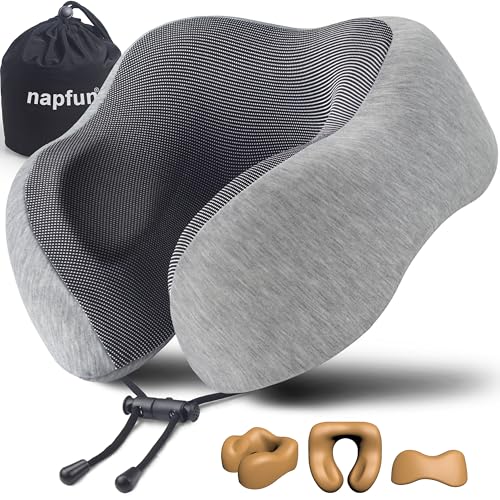
napfun Neck Pillow for Traveling — Best Memory Foam Travel Pillow
The napfun is the classic done properly: a travel neck pillow in pure memory foam that moulds to the individual shape of your neck and jaw, with a washable cover and a carry bag that compresses it for packing. If your mental image of a travel pillow is a U of foam, this is the best-executed version of that idea in this guide — supportive without the forward-push that ruins cheaper U-pillows.
Strengths
- Pure memory foam moulds to your neck for even, personalised support
- Shaped to support without shoving the head forward
- Compresses into its carry bag; cover removes for washing
Trade-offs
- Bulkier in the bag than the Trtl or inflatable picks
- Memory foam feels warm against the neck in hot cabins
- Firmness is fixed — no adjustment beyond positioning
The forward-push problem deserves emphasis because it is the category’s original sin. A U-pillow with a thick back section wedges foam between your neck and the headrest, tipping your head forward into the exact posture that guarantees a stiff arrival. The napfun’s shaping keeps the back section slim and puts the support at the sides, where your head actually falls. When you test any foam pillow, that is the check: sit against a headrest, and if your chin is being nudged toward your chest, reject the pillow regardless of foam quality.
Memory foam also rewards a packing habit: compress it into its bag only for travel, and store it uncompressed at home so the foam keeps its recovery. Treated that way, a foam pillow’s support stays consistent for years of trips. For travellers who fly several times a year and have the cabin-bag space, this is the dependable, no-learning-curve choice — it works the way you expect, the first time, with no fitting ritual.
Best for: Regular flyers wanting classic, moulding neck support / Not suited for: Ultralight packers, or travellers in very hot climates
This pick sits in the budget-to-mid-range tier. Check the current price on Amazon for current colours and sizes.

BCOZZY Travel Neck Pillow — Best Chin Support
The BCOZZY is engineered around the failure mode the other pillows treat secondarily: the forward fall. Its overlapping wrap design crosses support under the chin, so when your head nods forward in sleep it lands on the pillow instead of your chest. For the large population of travellers whose in-flight sleep is a series of head-nod wake-ups, that single design focus is the difference between arriving rested and arriving wrecked.
Strengths
- Overlapping front design genuinely supports the chin against forward fall
- Wraps and adjusts to different neck sizes, including a large size
- Works in cars and trains as well as planes
Trade-offs
- Full-wrap coverage feels enclosing for travellers who dislike neck contact
- Bulk sits between the foam U-pillows and the Trtl
- Side-support is good rather than class-leading
Fit is the whole story with a wrap design, so take the sizing seriously: the pillow must overlap and fasten snugly enough that the chin ledge is actually under your chin, and BCOZZY’s size range exists because a wrap that is too large simply becomes a scarf. Measure against the size guidance on the listing, and if you are between sizes for a wrap style, the snugger fit usually performs better in sleep.
Beyond flights, the BCOZZY has a second life its rivals envy: the passenger seat of long car journeys and the upright nap in an office chair during a break. Anywhere your head wants to fall forward in a seated doze, the chin ledge applies. Travellers whose sleep problem is lateral should still choose the Trtl; travellers whose problem is the nod will find this the most targeted tool in the guide.
Best for: Forward-falling sleepers on planes, trains, and long car rides / Not suited for: Travellers who dislike full neck coverage, or pure side-leaners
This pick sits in the mid-range tier. Check the current price on Amazon and choose your size carefully.

Everlasting Comfort Neck Pillow for Airplanes — Best for Long-Haul Flights
The Everlasting Comfort pillow is the memory foam formula upgraded for duration: an ergonomically raised-lobe design that cradles the head through a full long-haul sleep cycle, in a travel set built for the realities of ten-plus hours in a seat. Where the napfun is the dependable classic, this is the pillow aimed at the traveller whose flight is long enough that pillow quality stops being a comfort detail and becomes the trip’s hinge point.
Strengths
- Raised-lobe ergonomic shape supports the head through position changes
- Memory foam comfort sustained across long-haul durations
- Travel-set format designed around cabin use
Trade-offs
- The largest cabin footprint of the travel picks
- Premium touches put it above the classic foam pillows in tier
- Overkill for short hops — the napfun or Trtl serve better
Long-haul sleep differs from a two-hour nap in one crucial way: you will change position many times, including positions you did not plan. A pillow that only supports one posture gets abandoned by hour six, usually onto the tray table. The raised-lobe shaping is designed to keep the head corralled through those shifts — support at the sides for the lean, a slim back that respects the headrest, and enough structure under the jaw to soften the nod. It is the most complete upright-sleep system here, with the size to match.
The buying logic is frequency times distance. One long-haul trip a year justifies it if you sleep badly on planes; monthly long-hauls justify it immediately. Short-haul travellers should save the cabin space and choose the Trtl or napfun. And a packing note: clip the pillow outside the cabin bag rather than inside it — every frequent flyer in this category eventually adopts the carabiner habit, because cabin-bag volume is worth more than the pillow’s dignity. On arrival, give the foam a few minutes to recover its shape after hours compressed in the bag; it will, and the first night’s sleep in the hotel is better for the pause.
Best for: Long-haul flyers and anyone whose trip depends on sleeping in the seat / Not suited for: Short flights, ultralight packers
This pick sits in the mid-range tier. Check the current price on Amazon for the current travel set configuration.
Comparison Table
| Pick | Badge | Key Spec | Best For |
|---|---|---|---|
| Hikenture Camping Pillow | Best Overall Camping | Inflatable, contoured, removable washable cover | Tent and hammock sleeping |
| Crisonky Camping Pillow | Best Ultralight | Inflatable, dual valve, minimal packed size | Backpacking and one-bag travel |
| Trtl Pillow | Best for Upright Sleep | Structured wrap, internal head support, packs flat | Side-leaning flight sleepers |
| napfun Neck Pillow | Best Memory Foam Travel | Pure memory foam, slim back profile, carry bag | Classic moulding neck support |
| BCOZZY Travel Neck Pillow | Best Chin Support | Overlapping wrap, chin ledge, size options | Forward-falling sleepers |
| Everlasting Comfort Neck Pillow | Best for Long-Haul | Raised-lobe memory foam, travel set | Ten-hour-plus flights |
Read the table by job first and model second: the two inflatables are ground pillows, the four remaining picks are seat pillows, and no row substitutes for a row in the other family. Within each family, the differences are the ones the reviews detail — cover versus bare shell, structure versus foam, chin support versus side support. If you are torn between two rows, the tiebreaker is the trip you take most often, not the trip you take most ambitiously.
How to Choose the Best Camping Travel Pillow for Your Trips
Start by naming your failure mode, because every pillow in this guide is a targeted answer to one. In a tent, failure is a pillow that deflates, slides, or crinkles you awake. In a seat, failure is a head that falls — sideways or forward. Buy against your actual failure and the category becomes simple.
Camping Pillows: Inflatable vs Compressible
Inflatables like the Hikenture and Crisonky win on packed size and weight by an order of magnitude, and modern contoured shapes have closed most of the comfort gap. Their remaining weaknesses are feel — firmer, less plush — and puncture risk. Compressible foam pillows feel like home and pack like a loaf of bread. The deciding question is transport: if the pillow travels in a backpack, inflatable; if it travels in a car boot and never walks anywhere, foam is a legitimate luxury. Most mixed-use travellers land on a covered inflatable as the compromise that travels everywhere.
Travel Pillows: Identify Your Fall Direction
Watch yourself, or ask your travel companion: when you doze upright, does your head tip sideways, drop forward, or both? Sideways tippers need lateral structure — the Trtl’s brace or a foam pillow’s side lobes. Forward droppers need a chin ledge — the BCOZZY’s whole reason to exist. Both-direction sleepers on long flights are the Everlasting Comfort’s audience. Buying a pillow for the wrong direction is the category’s most common wasted purchase, and it is entirely avoidable with one honest observation.
The Headrest Test for Foam Pillows
Any foam U-pillow must pass one check before its first flight: sit in a chair with a headrest, put the pillow on, and lean back. If the foam behind your neck pushes your head forward off the headrest, the pillow will fight you for the entire flight. Slim-back designs like the napfun exist because this test eliminates most of the cheap end of the market. Do the test at home, where returning the pillow is easy.
Covers, Washing, and Hygiene
A pillow that presses against your face in airports, tents, and train seats collects the journey. Removable washable covers — on the Hikenture, the napfun, and the Trtl’s washable wrap — are not a luxury feature; they are the difference between a pillow you keep for years and one you quietly retire after a season. If a pillow cannot be washed, it should at least be used with a pillowcase or buff as a barrier layer.
Budget Tiers, Honestly Divided
The budget tier — the Crisonky and napfun in this guide — buys genuinely effective pillows; this category’s budget end is unusually competent because the designs are simple and mature. The mid-range tier buys refinement targeted at your specific problem: the Trtl’s structure for side-leaners, the BCOZZY’s chin geometry for nodders, the Everlasting Comfort’s long-haul shaping, the Hikenture’s covered comfort for campers. Spend by problem, not by tier: a traveller whose head falls forward gains nothing from a premium side-support pillow, and a backpacker gains nothing from premium foam that will not fit the pack. The most expensive mistake in this category is a well-made pillow aimed at somebody else’s sleep.
How to Use These Pillows Well: Setup Tips for Tents and Seats
- Inflate to eighty percent. For both inflatable camping picks, full pressure is a beach ball. Inflate fully, lie down, and bleed air until your head settles into the pillow’s contour and your neck stays level with your spine.
- Anchor the camping pillow. An inflatable on a slick sleeping pad migrates at night. Put it inside your sleeping bag’s hood, under the pad’s head straps if it has them, or inside a pillowcase tethered to the pad — any friction defeats the midnight slide.
- Match pillow height to your sleep position. Side sleepers need more loft to fill the shoulder gap; back sleepers need less. Inflatable users adjust with air; foam users adjust with pillow choice, which is why trying your travel pillow in your actual tent setup before a big trip is worth the ten minutes.
- Fit the travel pillow before departure. Adjust the Trtl’s wrap tension and side, the BCOZZY’s overlap, and the foam pillows’ orientation at home. Discovering your fit at 35,000 feet, in the dark, in a middle seat, is the hard mode nobody needs.
- Use the seat’s own headrest wings. Most modern airline headrests bend at the sides. Bend them. Combined with a pillow that passes the headrest test, they form the closest thing economy offers to a cradle.
Common Buying Mistakes
Buying a camping pillow for flights, or the reverse. A tent pillow under your head does nothing for a falling neck in a seat, and a neck pillow in a tent is a donut where a pillow should be. They are different tools; this guide badges them separately for a reason.
Judging an inflatable at full pressure. The most common reason inflatable pillows get returned after one night. Eighty percent inflation is the product; the extra twenty percent is the complaint department.
Ignoring your fall direction. A chin-support pillow bought by a side-leaner, or a side brace bought by a nodder, will be abandoned by the second trip. Observe first, buy second.
Packing a foam pillow loose in the cabin bag. Memory foam compresses — use the carry bag or a compression strap, or clip the pillow outside the bag. Travellers who do neither conclude the pillow is “too bulky” when the packing was the problem.
Skipping the washability check. A face-contact travel product you cannot wash has a short, increasingly unpleasant career. Covers and washable wraps are in this guide’s criteria for a reason.
Care, Field Repair, and Getting Years From a Small Pillow
Inflatable pillows die of two causes: punctures and valve neglect. Prevent the first by keeping the pillow off bare ground — it lives on a pad, in a tent, or in its stuff sack, never as a seat cushion on gravel. Prevent the second by closing the valve before packing and keeping grit out of the seal; a grain of sand in a valve is a slow leak that masquerades as a faulty pillow. If a leak does develop on a trip, the field diagnosis is water: inflate the pillow, submerge sections in a stream or sink, and watch for the bubble stream. Mark the spot, dry it, and apply a small adhesive patch — the repair kits sold for sleeping pads work on pillow fabrics — then let it cure before the night’s inflation. A patched inflatable typically serves for seasons afterward.
Foam pillows ask for different care. Store them uncompressed so the foam keeps its recovery; a memory foam pillow left crushed in a travel bag for six months will remember the bag, not your neck. Air foam pillows after trips before storing them, because cabin and tent moisture absorbed into foam is what produces the stale smell travellers blame on the material. Covers should be washed after every few trips — they are the hygiene layer, and they are designed to take the washing so the core does not have to.
The wrap pillow’s care is simplest: the Trtl’s fleece wrap is machine washable, and the internal support should be kept dry and unbent beyond its designed flex. Treat the support like the frame it is — no sitting on it in the bag, no forcing it flat under heavy luggage — and it will hold heads up for years of flights.
A final longevity note that applies to every pick: pillows are personal gear in a way tents are not. The traveller who finds their pillow — the one whose fall direction, sleep position, and packing style it matches — tends to keep it for a decade. That is the real argument for buying by fit rather than by price tier in this category: the right budget pillow outlasts the wrong premium one, because the wrong one gets left at home.
Final Recommendation
Match the pillow to the trip. For tents and hammocks, start with the Hikenture — its covered, contoured design is the best all-round camping sleep here — and step to the Crisonky when grams genuinely rule. For flights, identify your fall: side-leaners should choose the Trtl, forward-nodders the BCOZZY, classic-foam loyalists the napfun, and long-haul travellers the Everlasting Comfort. Many regular travellers end up owning exactly two pillows from this list — one inflatable for the ground, one structured or foam pillow for the seat — and that pairing covers essentially every night away from home.
If you travel both ways — ground and air — and can only buy one pillow today, buy for the trip type you take most, then add the second when you can: the Hikenture for campers, the Trtl or napfun for flyers. Forward-nodders should not compromise — the BCOZZY exists for you — and ultralight backpackers should not either, because the Crisonky gives up almost nothing but weight. Long-haul travellers facing a serious flight should treat the Everlasting Comfort as trip insurance: the cheapest upgrade to a long flight is the sleep you manage to get on it.
Keep exploring the travel sleep cluster: Best Travel Pillows · Best Camping Pillows · Best Neck Pillows For Travel · Best Sleeping Bags · Best Camping Gear For Beginners
The Right Pillow for Each Kind of Trip
The backpacking trip. Weight and volume rule everything, which makes this a two-horse race: the Crisonky if every gram is spoken for, the Hikenture if you can spare a little packed size for the cover’s comfort. Both inflate in breaths at the end of a long day, both disappear into a pack corner in the morning, and both beat the clothes-stuff-sack they replace by a margin you will feel most at altitude, on the third night, when sleep quality decides whether the trip is a pleasure or an endurance event.
The car-camping weekend. Packed size stops mattering and comfort takes over. The Hikenture remains the recommendation — car campers underestimate how much a covered, quiet pillow improves tent sleep — but this is also the trip where the pillow you already own for flights can moonlight as a spare for the kids’ tent. If your household camps by car more than it flies, spend on the camping side of this guide first.
The long-haul flight. This is the Everlasting Comfort’s home turf, with the BCOZZY as the pick for confirmed forward-nodders. On flights long enough to cross an ocean, also think in systems: pillow plus the seat’s winged headrest plus an eye mask is a combination worth more than any single component, and the pillow is the component you control completely.
The business trip. One bag, fast packing, arrive presentable. The Trtl was seemingly designed for this brief — it packs flat against a laptop bag, looks like a scarf rather than camping gear, and supports the head through the short, precious sleep of a red-eye before a working day. The napfun is the alternative for travellers whose bag has room and whose preference is foam.
The road trip. Passengers sleep at angles airline passengers never meet, against windows and door pillars. The BCOZZY’s wrap keeps a head supported through curves and braking; the Crisonky, deflated to nothing in the glovebox, covers the driver’s rest-stop nap and doubles as lumbar support on the long driving shifts. Road trips reward versatility, and those two picks have the most of it.
Materials and Construction, Explained
Memory foam softens with body heat and moulds to the neck’s exact shape, distributing pressure evenly. Its costs are bulk, warmth, and a firmness that changes with cabin temperature — foam boards stiff in a cold cargo hold and soften again in use. The napfun and Everlasting Comfort picks show the material at its best, in shapes designed around the headrest problem rather than copied from it.
Inflatable cores in modern camping pillows are TPU-laminated fabrics that hold air reliably at a few ounces of weight. Construction details that matter: welded seams over glued ones, a valve that can be operated with cold fingers, and a shell texture that grips a sleeping pad. Both camping picks here use contoured internal shaping — the pillow’s chambers are designed so inflation produces a cradle rather than a sphere.
Structured supports, the Trtl’s approach, trade cushioning for geometry: a shaped internal frame holds the head at a sleeping angle the way a brace holds a joint. The feel is unfamiliar for one flight and indispensable by the third, which is why this design inspires the strongest loyalty in the category among frequent flyers who have adapted to it.
Covers are the unsung component. A removable, washable, soft-touch cover decides how a pillow feels against skin at hour nine and whether it smells like your travels by trip three. When two pillows otherwise tie, choose the one whose cover comes off — in this guide, that consideration is already baked into the picks.
Frequently Asked Questions
Can I use a camping pillow as a flight pillow?
An inflatable camping pillow can prop your head against a window or serve as lumbar support in a seat, and ultralight travellers do exactly that. But it will not stop your head falling sideways or forward the way a dedicated travel pillow does — for upright sleep, use the tool designed for it.
Why does my inflatable camping pillow feel hard?
Because it is overinflated. Bleed air until your head settles into the pillow rather than balancing on it — around eighty percent of full pressure suits most sleepers. The contour can only cradle your head once the pressure lets it.
How do I stop a camping pillow sliding around the tent?
Add friction: tuck it into your sleeping bag hood, place it inside a pillowcase, or run it under your sleeping pad’s straps. A bare inflatable on a bare pad is two slippery surfaces negotiating all night.
Memory foam or structured wrap for flights — which is better?
Neither universally. Memory foam moulds and comforts, and suits travellers who sleep fairly still. Structured wraps like the Trtl actively hold the head and pack far smaller. Your fall direction and your cabin-bag space decide it.
How should I clean a travel pillow?
Remove and wash the cover per its label — most covers in this guide are machine washable. Foam cores should be spot-cleaned and aired, never soaked. Inflatable pillows wipe down and air dry; wash the removable cover separately.
Is a travel pillow worth it for a short flight?
For a flight under two hours where you do not plan to sleep, usually not — the weight and space buy little. For any flight where you hope to doze, even a short one, a compact option like the Trtl earns its place, because twenty minutes of supported sleep beats an hour of head-nodding. Judge by whether you intend to sleep, not by the distance on the ticket.
Should I buy one pillow for both camping and flying to save money?
You can, and the ultralight inflatables make the best dual-purpose compromise — a Hikenture or Crisonky works under your head in the tent and behind your neck or against the window in a seat, adequately at both and brilliantly at the first. But if you travel often in both modes, the dedicated pair — one camping pillow, one travel pillow matched to your fall direction — will outperform any compromise within a few trips, and the combined cost of two budget specialists is usually less than one premium generalist that does neither job as well.
Can children use these travel pillows?
Older children can use smaller-sized travel pillows — the BCOZZY’s size range is the obvious starting point — fitted so the support sits under the chin and jaw without covering the mouth or nose, and used under adult supervision on journeys. Camping inflatables suit children well since their firmness adjusts with air. For young children, follow the manufacturer’s age guidance on the listing and common sense about anything wrapped at the neck.
What pillow height do side sleepers need when camping?
Enough to keep the neck level with the spine when lying on your side — which usually means more loft than back sleepers need. Inflatable users add air; if you consistently max out a low inflatable, choose a higher-loft model or stack the pillow on folded clothing inside the tent as a base.

