Disclosure: airfryerkitchensupply.com is reader-supported. When you buy through links on our site, we may earn an affiliate commission at no extra cost to you.
Where to buy
If you are shopping for the best bull grills, the six models below are the current Bull lineup worth your attention — every one was confirmed against a live Amazon listing, from the flagship Brahma down to the compact Steer cart grill.
Bull Outdoor Products builds its reputation on outdoor kitchens: stainless grill heads designed to drop into islands, backed by one of the deepest component ecosystems in the business — doors, drawers, refrigerators, liners and replacement parts all from the same catalogue. This guide covers the five heads that anchor that system plus Bull’s freestanding Steer cart grill, and it is frank about where each model sits: the Brahma is the flagship, the Angus the entertainer, the Outlaw and Lonestar the value heads, the Bison the charcoal outlier, and the Steer the no-island option.
- Bull Brahma Grill Head, Liquid Propane (57568) — Best Overall: check price on Amazon
- Bull Angus Grill Head, Liquid Propane — Best for Entertaining: check price on Amazon
- Bull Outlaw Drop-In Grill Head, Liquid Propane — Best Budget Bull: check price on Amazon
- Bull Lonestar Drop-In Grill Head, Natural Gas — Best for Natural Gas: check price on Amazon
- Bull Bison Premium Built-In Charcoal Grill, 30-Inch (BG-88787) — Best Charcoal Bull: check price on Amazon
- Bull Steer Premium 24-Inch Grill on Cart (BG-69101) — Best Freestanding Bull: check price on Amazon
The best bull grills share a design philosophy that has kept the brand at the centre of the outdoor-kitchen trade for decades: heavy stainless construction, straightforward burner systems, enormous headline output, and an ecosystem of matching island components that lets a builder finish a whole kitchen from one catalogue. Bull does not chase novelty features; it sells permanence, serviceability and heat.
It also means Bull grills tend to be bought by people who have done their homework — builders, serious hosts, and owners on their second or third outdoor kitchen who know exactly which compromises they refuse to repeat. This guide is written for that reader: light on adjectives, heavy on the distinctions that actually separate one Bull from another.
That philosophy means the differences inside the lineup are honest and legible. Output climbs from 60,000 BTU in the Outlaw and Lonestar heads to 75,000 in the Angus and 90,000 in the flagship Brahma, per the manufacturer listings. Fuel is a version choice — most heads are sold in distinct liquid propane and natural gas variants, and this guide names the fuel of every pick exactly as listed, because ordering the wrong one is the most common Bull-buying mistake there is. And one pick, the Bison, burns charcoal instead of gas, because Bull’s built-in range has always kept a place for fire purists.
All six picks were verified against live Amazon listings. BTU figures are the manufacturer’s listing figures and are labelled as such; no prices or ratings are printed, because both change with dealer promotions — use the listing links to check the current price on Amazon.
In this guide
Quick Picks
The Brahma is the flagship and the default recommendation for a serious island. The Angus is the sweet spot for entertainers who do not need the flagship’s full output. The Outlaw is how you get a genuine Bull head on a controlled budget — and the Bison is there for the cook who reads “gas grill” and reaches for charcoal anyway.
- Bull Brahma Grill Head, Liquid Propane (57568) — Best Overall. Bull’s flagship head: 90,000 BTU of listing-quoted output in the 38-inch class — the grill Bull itself points to when the brief is “the best one you make”. — Check on Amazon
- Bull Angus Grill Head, Liquid Propane — Best for Entertaining. The long-running heart of the Bull range: a 30-inch-class built-in head with 75,000 BTU of listing output — the model outdoor-kitchen builders have framed into islands for years. — Check on Amazon
- Bull Outlaw Drop-In Grill Head, Liquid Propane — Best Budget Bull. The entry point to a genuine Bull island: a stainless drop-in head with 60,000 BTU of listing output and the brand’s build, without the flagship tiers’ pricing gravity. — Check on Amazon
- Bull Lonestar Drop-In Grill Head, Natural Gas — Best for Natural Gas. The Lonestar in its natural-gas listing: a 60,000 BTU stainless drop-in head for plumbed islands that never want to think about a tank again. — Check on Amazon
- Bull Bison Premium Built-In Charcoal Grill, 30-Inch (BG-88787) — Best Charcoal Bull. Bull’s built-in charcoal head: a 30-inch premium charcoal grill designed to drop into the same islands as its gas brothers — for owners who want the Bull kitchen and a real fire. — Check on Amazon
- Bull Steer Premium 24-Inch Grill on Cart (BG-69101) — Best Freestanding Bull. Bull without the island: the Steer Premium puts a 24-inch Bull grill head on a cart — the brand’s build and badge for patios that are not getting a masonry kitchen. — Check on Amazon
How These Picks Were Chosen
This is a single-brand guide, so the filter worked differently: instead of comparing brands, we mapped Bull’s own range and selected the six models that cover the real buying decisions inside it. Every pick had to be a current Bull grill with a live, verifiable Amazon listing — verified — and had to represent a distinct brief: flagship, entertainer, budget head, natural-gas head, charcoal head and freestanding cart. Accessory listings (covers, griddles, rotisserie kits) were used as supporting evidence of the ecosystem, never as picks.
Within each brief we judged the listing-verified facts: total output as listed, fuel version, format and size class, and the model’s place in Bull’s component system. Where the listing is brief — Bull’s older, trade-focused listings often are — the review says what is known, judges the grill on its established design and role, and invents nothing. That discipline matters more in a brand guide than anywhere, because brand loyalists read these pages to confirm details, and a fabricated specification would be spotted and would deserve to be.
One scope note: Bull sells its heads in fuel-specific versions. Where this guide reviews the propane version of a head, a natural-gas counterpart generally exists in the range (and vice versa) — the Lonestar appears here in its natural-gas listing, and the Brahma in propane. Always order by the exact model and fuel your island uses.
The 6 Best Bull Grills, Reviewed

Bull Brahma Grill Head, Liquid Propane (57568) — Best Overall
The Brahma is the head for the outdoor kitchen that intends to impress and endure in equal measure. Its 90,000 BTU listing figure is the highest in the Bull range, spread across the flagship 38-inch format, which makes it the natural anchor for big islands and serious entertaining: multiple zones at genuinely different temperatures, room for a crowd’s worth of food, and the output to recover heat fast when the lid opens for a tray of cold steaks. It suits committed hosts building a permanent kitchen. It is more grill than a modest island or a small household will ever use, and its tier prices it accordingly.
Check the current price on Amazon
Strengths
- 90,000 BTU total output per the listing — the most powerful head in Bull’s range
- Flagship 38-inch class format for crowd-scale cooking and wide zoning
- Sits at the top of Bull’s component ecosystem — every door, drawer and liner matches
Trade-offs
- Flagship pricing, before the island around it is even budgeted
- Propane as listed — natural-gas buyers need the Brahma’s NG version (57569)
- Output this large is wasted on small households; the Angus or Outlaw will serve them better
| Type | Built-in grill head, 38-inch class |
| Output (listing) | 90,000 BTU |
| Fuel (as listed) | Liquid propane |
| Model | 57568 |
Flagships earn their position in the details of recovery. Any grill can be hot when it is empty and closed; the Brahma’s output shows when twenty burgers land at once, or when the lid opens repeatedly for a rotisserie check, and the temperature simply refuses to sag. For the host cooking in waves for a garden full of people, that composure is the entire difference between a performance and a panic.
The Brahma also makes the most sense of Bull’s ecosystem argument. A flagship island is a composition — grill head, doors, drawers, refrigeration, perhaps a side burner — and building it inside one brand’s catalogue means one finish, one fit standard and one parts channel for the life of the kitchen. Owners who have mixed brands in an island know the alternative: five manuals, five suppliers, five shades of “stainless”.
Buy it if the kitchen is a centrepiece and the entertaining is real. The cooks who regret a Brahma are the ones who built a flagship island for four barbecues a year; the cooks who love it host monthly and would not trade down for anything.
Best for: Serious entertainers building a flagship Bull outdoor kitchen / Not suited for: Small islands, small households, or natural-gas setups (order the 57569 NG version)

Bull Angus Grill Head, Liquid Propane — Best for Entertaining
The Angus is the Bull most people should buy. Its 30-inch class is the island size that fits real gardens and real families, and 75,000 BTU is abundant output for that footprint — searing heat when you want it, gentle zones when you do not. It is the head with the longest track record in this guide: builders know its cut-out by heart, parts are stocked everywhere Bull is sold, and its behaviour across a decade of ownership is a documented fact rather than a promise. It suits propane islands and hosts who cook for six to ten. Only true crowd caterers need to step up to the Brahma.
Check the current price on Amazon
Strengths
- 75,000 BTU per the listing — hot, fast and generous for its size class
- The proven platform: installers and service techs across the trade know this head
- Full access to Bull’s doors, drawers, liners and components in matching finish
Trade-offs
- Classic feature set — Bull spends on build and output, not lighting packages
- Propane as listed; the fuel versions are separate models, so order carefully
- Less total area than the Brahma for very large gatherings
| Type | Built-in grill head, 30-inch class |
| Output (listing) | 75,000 BTU |
| Fuel (as listed) | Liquid propane |
| Line | Bull Angus |
There is a reason the Angus became the default specification in so many builder brochures: it is the balanced point of the range. Enough output that heat management is about choice rather than limitation, a size that anchors a proper island without demanding a terrace, and a price tier that leaves budget for the components that make a kitchen — storage, refrigeration, a side burner — rather than consuming it all in the head.
Cooking on it rewards the two-zone habit. Run the full width and it is a party grill; light half and it is a weeknight family grill that happens to have a reserve of power. Owners upgrading from mass-market cart grills notice the lid first — heavy, sealed, holding heat like an oven — and the burners second, because steaks stop steaming and start searing.
If your island plan is still a sketch, the Angus is the head to sketch around. Its class is the most standard in the trade, which keeps every future decision — components today, a replacement head in fifteen years — as open as this category allows.
Best for: Propane islands in the classic 30-inch class and hosts cooking for up to ten / Not suited for: Flagship-scale entertaining or natural-gas islands (choose the NG version)

Bull Outlaw Drop-In Grill Head, Liquid Propane — Best Budget Bull
The Outlaw exists for the builder who wants the island more than the badge hierarchy. It is a proper Bull head — stainless, drop-in, 60,000 BTU — at the accessible end of the range, which frees budget for the stone, doors and refrigeration that make an outdoor kitchen a kitchen. It suits family cooking completely: burgers, chicken, steaks and vegetables in normal rotation. It does not chase the Brahma’s crowd capacity or the Angus’s output reserve, and feature hunters will find Bull’s premium lines and other brands more gadget-rich. As a core appliance from a serious brand, it is exactly right.
Check the current price on Amazon
Strengths
- 60,000 BTU of listing output — honest family-scale power
- Genuine Bull construction and full ecosystem access at the range’s entry tier
- Leaves island budget for components and finishes
Trade-offs
- Less output headroom than Angus and Brahma for big, fast cooks
- Feature set is deliberately basic — the core appliance, done properly
- Propane as listed; match the version to your supply
| Type | Drop-in grill head |
| Output (listing) | 60,000 BTU |
| Fuel (as listed) | Liquid propane |
| Construction | Stainless steel |
The Outlaw is the rationalist’s pick, and outdoor kitchens need more rationalism. The total project — island, utilities, components — dwarfs any single line item, and the head is the easiest place to overspend for capacity a household never uses. An Outlaw island with great counters and a refrigerator will host better parties than a Brahma island with nowhere to put a tray.
Nor is 60,000 BTU a consolation prize. Across a family-size head, that output preheats quickly, sears properly and runs multiple zones without apology. The difference from the Angus appears at the extremes — maximum load, maximum recovery speed — which is to say, at parties the Outlaw owner can still host, with a touch more batching.
And the badge is not vanity: it is the parts channel, the builder familiarity and the resale story. A Bull head in an island tells the next buyer and the next service tech exactly what they are dealing with. That legibility is worth money, and the Outlaw is its cheapest legitimate form.
Best for: First Bull islands and family cooks balancing the total project budget / Not suited for: Crowd caterers or feature-first buyers
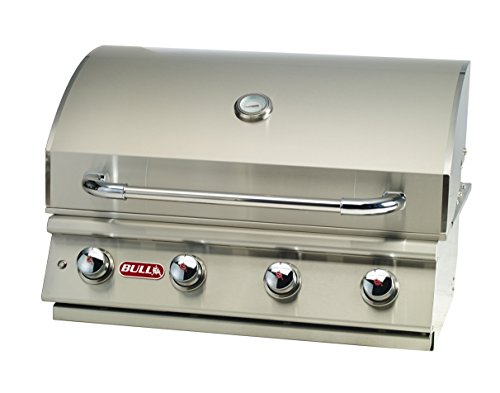
Bull Lonestar Drop-In Grill Head, Natural Gas — Best for Natural Gas
The Lonestar’s brief is fuel. Plumbed natural gas changes outdoor cooking behaviour — no tank to empty mid-party, no refill runs, a grill that is always ready — and the Lonestar is Bull’s accessible route into that life, with the same 60,000 BTU class output as the Outlaw in a natural-gas version. It suits settled households building a permanent island on a gas line. It is obviously wrong for propane setups as listed — Bull sells the Lonestar in a propane version too — and modest in features beside the Angus, which is the correct trade for its tier.
Check the current price on Amazon
Strengths
- Natural gas as listed — unlimited fuel for plumbed islands
- 60,000 BTU class output in a stainless drop-in head
- Same Bull ecosystem and builder familiarity as the rest of the range
Trade-offs
- Natural-gas version only as listed — useless on a propane island without its sibling version
- Requires the gas line investment that makes NG worthwhile
- Core feature set, like the Outlaw — spend is on build and fuel, not extras
| Type | Drop-in grill head |
| Output (listing) | 60,000 BTU |
| Fuel (as listed) | Natural gas |
| Construction | Stainless steel |
Owners who convert to plumbed gas rarely go back, and the reason is behavioural: a grill that is always fuelled gets used on weeknights, for two sausages, for the quick char on vegetables — the small cooks that a tank gauge discourages. The Lonestar NG is priced and built for exactly that household: permanent, settled, cooking often.
As a head, it mirrors the Outlaw’s honest proposition — Bull build, family output, ecosystem access — with the fuel decision made in the other direction. Choosing between them is not a quality judgement; it is a question about your yard’s infrastructure, and it should be made with your gas fitter, not your grill retailer.
One administrative note that saves real grief: natural-gas installations typically require permitted, inspected work by a licensed fitter. Budget and schedule for it, and the Lonestar’s first cook will be the start of the easiest grilling decade you have owned.
Best for: Plumbed natural-gas islands wanting Bull build at an accessible tier / Not suited for: Propane islands (order the Lonestar LP version) or feature hunters

Bull Bison Premium Built-In Charcoal Grill, 30-Inch (BG-88787) — Best Charcoal Bull
The Bison answers a question every outdoor-kitchen designer hears: can the island cook over charcoal? Bull’s answer is a purpose-built 30-inch charcoal head that installs in the island like a gas unit, giving the fire cook the full kitchen — counters, storage, refrigeration — without surrendering smoke and sear to a burner. It suits committed charcoal cooks building a permanent kitchen. It asks what charcoal always asks: fire management, ash handling, and an island design that respects a solid-fuel appliance. Gas cooks wanting push-button evenings should stay with the heads above.
Check the current price on Amazon
Strengths
- True charcoal cooking integrated into a Bull outdoor kitchen
- 30-inch format matches the classic island class of the Angus
- Premium positioning within Bull’s range — a serious head, not a novelty insert
Trade-offs
- Charcoal labour: lighting, fire management and ash are part of every cook
- Island must be designed for a solid-fuel appliance — discuss with your builder early
- No gas convenience: no instant start, no dial-a-temperature
| Type | Built-in charcoal grill head |
| Size class | 30-inch |
| Fuel | Charcoal |
| Model | BG-88787 |
The Bison’s existence says something about Bull’s read of its customers: a meaningful share of serious outdoor cooks want charcoal’s flavour with a kitchen’s infrastructure, and they were compromising with a kettle parked beside a beautiful island. A built-in charcoal head ends the compromise — the fire gets a designed home with proper clearances, and the cook gets counters and cold storage at elbow distance.
Cooking on it is the charcoal craft at full scale: a 30-inch fire gives room for a two-zone arrangement — coals banked for searing, open space for finishing — plus whole chickens, rib racks and the other large formats that small portables batch. If your entertaining style is built around fire flavour, this is the head that scales it.
Design the island around it honestly: clearances and materials for solid fuel, a metal ash routine, and ventilation that treats smoke as a feature to direct rather than a problem to discover. Builders experienced with Bull kitchens know the Bison; bring it into the conversation at sketch stage, not as a late substitution for a gas cut-out.
Best for: Charcoal devotees building a permanent Bull outdoor kitchen / Not suited for: Push-button cooks, or islands designed only around a gas head

Bull Steer Premium 24-Inch Grill on Cart (BG-69101) — Best Freestanding Bull
Not every Bull buyer is building an island, and the Steer Premium is the brand’s answer for them: a 24-inch propane grill on a cart, with the head built to the same family standard as the drop-ins. It suits smaller patios, households that may move, and anyone who wants Bull quality without construction. The 24-inch format cooks for a family in sensible batches. It does not offer the island experience — no counters, no storage wall, no permanence — and large-scale entertainers will outgrow its grate; within its brief it is the most Bull you can buy on wheels.
Check the current price on Amazon
Strengths
- Bull build quality in a freestanding cart — no island required
- 24-inch format suits smaller patios and smaller households
- Moves with you: rentals, first homes and patio reshuffles all accommodated
Trade-offs
- Smaller cooking area than the built-in heads — batching at parties
- Cart format lacks the island’s workspace and storage
- Propane as listed — a natural-gas cart version exists in the range for plumbed patios
| Type | Grill on cart, freestanding |
| Size class | 24-inch |
| Fuel (as listed) | Propane |
| Model | BG-69101 |
The Steer is best understood as the island heads’ sibling rather than their poor relation. The grill itself is a Bull — stainless, solid, built for service — and the cart simply trades the permanence of masonry for the freedom of wheels. For the large share of households whose outdoor space is a patio rather than a project, that trade is not a compromise at all; it is the correct product.
It is also the natural first Bull. Owners who start with a Steer learn the brand’s cooking manners — its heat, its zones, its upkeep — and a good number of them specify Bull again when the island eventually gets built, with the Steer retiring to a second home or a grateful relative. Brands earn that kind of continuity by building the small products properly.
Size it honestly: 24 inches is a family grill, not an event grill. Four to six burgers with room to work, a chicken in pieces, steaks for four — that is its happy repertoire, and it performs it with the composure of its bigger brothers.
Best for: Patios without islands, smaller households and first-time Bull buyers / Not suited for: Island builders or entertainers cooking for crowds
Comparison Table
| Pick | Badge | Key spec | Best for |
|---|---|---|---|
| Bull Brahma Grill Head, Liquid Propane (57568) | Best Overall | 38 in class head, 90,000 BTU (listing), propane | Serious entertainers building a flagship Bull outdoor kitchen |
| Bull Angus Grill Head, Liquid Propane | Best for Entertaining | 30 in class head, 75,000 BTU (listing), propane | Propane islands in the classic 30-inch class and hosts cooking for up to ten |
| Bull Outlaw Drop-In Grill Head, Liquid Propane | Best Budget Bull | Drop-in head, 60,000 BTU (listing), propane, stainless | First Bull islands and family cooks balancing the total project budget |
| Bull Lonestar Drop-In Grill Head, Natural Gas | Best for Natural Gas | Drop-in head, 60,000 BTU (listing), natural gas, stainless | Plumbed natural-gas islands wanting Bull build at an accessible tier |
| Bull Bison Premium Built-In Charcoal Grill, 30-Inch (BG-88787) | Best Charcoal Bull | 30 in built-in charcoal head, BG-88787 | Charcoal devotees building a permanent Bull outdoor kitchen |
| Bull Steer Premium 24-Inch Grill on Cart (BG-69101) | Best Freestanding Bull | 24 in grill on cart, propane, BG-69101 | Patios without islands, smaller households and first-time Bull buyers |
The table is really a map of two decisions. First, fuel and fire: propane heads, a natural-gas head, a charcoal head and a propane cart. Second, ambition: the Brahma and Angus for hosts, the Outlaw and Lonestar for balanced budgets, the Steer for no-build patios. Bull’s range is unusually legible — pick your row by those two decisions and you have picked your grill.
How to Choose the Best Bull Grills for Your Setup
Choosing inside one brand is a different exercise from choosing between brands: the build philosophy is settled, so the decision reduces to format, fuel and tier. Work through these in order.
Built-in head or cart: the first Bull decision
Five of the six picks here are island heads; one, the Steer, is a cart. The head decision is really a housing decision: a built-in Bull becomes part of a permanent outdoor kitchen, with all the workspace, storage and property-value logic that implies, and it commits you to a cut-out class and a fuel line. The cart commits you to nothing but a patio corner and can be cooking the evening it arrives. Households that know they are staying and entertaining outdoors choose heads; everyone else should honestly consider the Steer and spend the difference on furniture and shade.
If you do build, choose the head before the island is designed — Bull publishes cut-out dimensions for every head, and the island must be built to the chart of the exact model and fuel version you ordered.
Propane, natural gas or charcoal within the Bull range
Bull sells fuel as versions, not settings. The Brahma in this guide is the propane model 57568; its natural-gas counterpart is the 57569. The Lonestar appears here as the natural-gas listing, with a propane sibling in the range. Decide fuel from your infrastructure: a plumbed line makes natural gas the set-and-forget choice; a tank makes propane the flexible one; and no line at all is required for the Bison, whose charcoal makes it the off-grid member of the family.
The one unforgivable error is assuming a head can be casually converted with generic parts. Orifice size and regulator behaviour are fuel-specific engineering; buy the right version or the manufacturer’s kit, full stop.
Reading Bull’s tiers: Outlaw and Lonestar, Angus, Brahma
Bull’s gas heads form a clean ladder. The 60,000 BTU tier (Outlaw, Lonestar) covers family cooking completely and exists so the island around it can be funded properly. The Angus at 75,000 BTU adds output reserve and the classic 30-inch entertainer’s format. The Brahma at 90,000 BTU is the flagship: the widest format and the composure to cook for a crowd without temperature sag. All figures are the manufacturer’s listing totals — useful for comparing within the range, less meaningful against other brands’ accounting.
The honest way to choose a tier is by your largest regular cook, not your largest imaginable one. A head bought for the annual party of thirty will be oversized for the other fifty weekends; a head bought for the family can still host the party with batching and a side dish from the kitchen.
The ecosystem is the point: components, liners and parts
Bull’s deepest advantage is everything around the grill. Access doors and drawers in matching finish, insulating liners sized to the heads, side burners, refrigeration, and a parts channel that stocks burners and igniters for heads sold years ago — this is what “outdoor kitchen brand” actually means, and it is why builders specify Bull for whole projects. When you price a Bull head, price the system it unlocks.
Two practical corollaries. First, if your island framing is combustible, the liner for your exact head is a mandatory line item, not an accessory. Second, register your purchase and keep the model number with the house paperwork: a decade from now, that number is the difference between a one-click burner replacement and an archaeological dig.
Are Bull Grills Worth It? An Honest Assessment
Bull occupies the professional middle of the outdoor market: above the mass-market cart brands in build and price, below the ultra-luxury badges in ornament and cost. What the money buys is specific — stainless construction meant for permanent installation, burner output at the top of the mainstream, an ecosystem that finishes whole kitchens, and a trade network that can service the product in ten years. What it does not buy is novelty: app integrations, exotic materials and design statements belong to other brands’ brochures.
That makes Bull easy to recommend to the right buyer and easy to steer the wrong buyer away from. If your project is a permanent outdoor kitchen and your values are durability, heat and coherence, Bull is close to the default answer, and the Angus in particular may be the most-specified head in the industry for a reason. If your project is a season of patio grilling before a house move, the Steer is the honest Bull — and if even that is more commitment than the summer needs, a mass-market cart will serve you without pretending otherwise.
Bull Grill Ownership: Care, Covers and Keeping the Heat
A Bull head asks for the standard stainless discipline and rewards it like the permanent appliance it is. Burn off residue after cooking while the grates are hot, brush them clean, and empty the drip tray before it becomes a flare-up with a schedule. The exterior wants a soft cloth and, in coastal air, an occasional freshwater wipe to keep the stainless bright. A fitted cover — Bull sells them sized to each head, including the Brahma and Steer — keeps the worst of the weather and all of the pollen off between cooks.
Once a season, do the burner check: lift the grates, look along the burner tubes for blocked ports or rust-through, confirm the igniter clicks strongly, and check the gas connections with soapy water at the first cook of spring. Burners and igniters are the wear parts of any gas grill; on a Bull they are orderable by model number for years, which is precisely the ownership experience the brand’s price promises. Keep the paperwork, and the grill will keep the heat.
Bull vs. the Premium Badges: Where the Brand Sits
Shoppers cross-shopping Bull against the premium outdoor brands usually arrive with a shortlist and a confusion: the specifications look similar, so why do the prices differ? The honest answer is that the premium tier spends on refinement — hood assists, lighting design, grate metallurgy, sealed burner systems — while Bull spends on mass, output and the component catalogue around the grill. Neither spend is imaginary; they are different definitions of quality, and the right one depends on whether your kitchen is a design statement or a working tool.
In cooking terms, a Bull Brahma and a premium-badge 38-inch head will both sear a steak superbly and roast a chicken without complaint. The differences appear in the tenth year and at the margins: how the hood feels, how the knobs read at midnight, how a replacement burner is sourced. Bull’s bet — that most outdoor cooks value heat, capacity and serviceability over ceremony — has kept it at the centre of the builder trade for decades, and the six grills in this guide are that bet, expressed at every tier.
The practical advice: if your shortlist is Bull versus a premium badge, decide by the island, not the head. The brand whose components, liner and local dealer support fit your project best is the brand whose grill you will be happiest with in year eight.
How to Install a Bull Grill Head in an Island
Bull heads are installed by builders every day, and the sequence below is the standard one — use it to brief your contractor and to recognise a careful job. The manufacturer’s manual and local code govern the details for your exact model.
- Confirm the exact model and fuel version on the delivery box against your order — a propane head on a natural-gas island is the classic Bull mix-up, and it is free to catch now.
- Verify the island cut-out against Bull’s published chart for that model: width, depth, height and flange support, before the head leaves its packaging.
- Install the insulating liner sized to the head if any island framing is combustible. This step is not optional and not negotiable.
- Check island ventilation — low openings near the gas supply, high openings for heat and any leaked gas — per the manual’s specification.
- Have the licensed gas fitter run the supply with an accessible shut-off, pressure-test the line, and only then set the head into the opening with two people.
- Connect the fuel exactly as specified for the version you bought, leak-test every joint with soapy water, and fit the drip tray, grates and any rotisserie components.
- Run a supervised first burn-off on all burners: confirm even ignition and flame pattern across the full width before the first food is committed.
File the manual, the cut-out chart and a photograph of the model plate in the island’s paperwork folder. Every future service visit, parts order and eventual replacement starts with those three items.
Common Buying Mistakes
Ordering the wrong fuel version. Bull heads are fuel-specific models — the Brahma propane is the 57568, the natural-gas is the 57569. Check the model number against your island supply twice; it is the most common and most avoidable Bull mistake.
Building the island before choosing the head. Cut-outs are model-specific across the range. Choose the Bull first, then hand its chart to the builder.
Skipping the liner on combustible framing. A Bull head in a wood-framed island needs its insulating jacket. Omitting it risks fire inside the cabinetry — no saving justifies it.
Buying the Brahma for a four-person household. Flagship output and area are wasted on small cooks and cost fuel and cleaning time every week. The Angus or Outlaw exists precisely for you.
Ignoring the component ecosystem. A Bull head with mismatched doors and drawers from three other brands forfeits the brand’s main advantage. Finish the kitchen inside the catalogue where you can.
Letting the drip tray and burners go unserviced. Bull parts are orderable for years — use that. A seasonal burner check and a tray that never overflows keep a decade-old head cooking like a new one.
Final Recommendation
The Bull decision in one paragraph: build a flagship kitchen, take the Brahma. Build the classic entertainer’s island, take the Angus — it is the range’s centre of gravity for a reason. Balance the budget across the whole project with the Outlaw, or the Lonestar if your island is plumbed for natural gas. Insist on charcoal and take the Bison. Skip the island entirely and take the Steer, the Bull that asks nothing of your patio but a corner.
Whichever model you choose, order the fuel version by its exact model number, design the island around its chart, and finish the kitchen inside the ecosystem. That is how a Bull stays a Bull for fifteen years.
And if you are still deciding whether the island itself is worth building: the Steer is the honest trial. Cook a season on Bull’s cart grill, count how many evenings ended outdoors, and let that number — not a brochure — decide whether the masonry gets ordered next spring.
Compare the finalists side by side on their live listings: Bull Brahma Grill Head, Liquid Propane (57568), Bull Angus Grill Head, Liquid Propane, Bull Outlaw Drop-In Grill Head, Liquid Propane.
Keep researching with these guides from our grills program: Best Builtin Grills, Best Builtin Outdoor Grills, Best Built Grills Stainless.
Frequently Asked Questions
What is the difference between the Bull Angus and the Brahma?
Tier and scale. The Angus is the 30-inch-class entertainer’s head with a 75,000 BTU listing figure; the Brahma is the flagship 38-inch-class head at 90,000 BTU. Both are built to the same Bull standard — the Brahma buys capacity and heat recovery for larger crowds, not a different quality level.
Are Bull grills propane or natural gas?
Both — as separate, fuel-specific models. The Brahma propane is model 57568 and its natural-gas counterpart is the 57569; the Lonestar in this guide is listed in natural gas, with a propane version also in the range. Order the exact version your island uses.
Can a Bull grill head be used without an island?
The drop-in heads are designed for island installation and need proper support, ventilation and clearances — they are not freestanding appliances. If you want Bull without construction, the Steer Premium cart grill in this guide is the product built for that.
Does Bull make a charcoal grill?
Yes — the Bison Premium is a 30-inch built-in charcoal head designed to install in an outdoor kitchen island like the gas models. It is the pick in this guide for cooks who want Bull’s kitchen system around a real charcoal fire.
How long do Bull grills last?
A Bull head is built as a permanent island appliance: with seasonal burner checks, tray discipline and a cover, owners measure service in well over a decade, replacing burners and igniters as wear parts along the way. The brand’s parts availability is a core part of that longevity story — a grill that can be repaired in place is a grill that does not get replaced, which is the entire economic argument for buying at this level.
What size Bull grill do I need?
For most households, the 30-inch-class Angus is the sweet spot. Step up to the 38-inch-class Brahma if you regularly cook for crowds, down to the Outlaw or Lonestar tier if the budget should favour the island itself, and to the 24-inch Steer if there is no island at all.
Related reading: Best 32 Inch Propane Gas Grills For Outdoor Kitchens, Best 4 Burner Gas Grills, Best 36 Inch Gas Grills.


