Disclosure: airfryerkitchensupply.com is reader-supported. When you buy through links on our site, we may earn an affiliate commission at no extra cost to you.
Where to buy
Every pick in this guide to the best blenders for smoothies and food is sold through Amazon, and blender model names repeat across generations, so use the links in this guide to confirm the exact model in the listing title before you order. Check the current price on Amazon for each pick rather than relying on any price you have seen quoted elsewhere, because blender pricing moves constantly. The verified picks in this guide are: Ninja Kitchen System Pro BL770, 1500W, 72 oz + 8-cup processor; Cuisinart Smart Power Duet Blender & Food Processor BFP-703BCP1, 500W, 48 oz glass jar, 3-cup processor; Ninja Compact Kitchen System AMZ493BRN, 1200W, 72 oz pitcher, 40 oz processor bowl; KitchenAid K400 with Tamper KSB4028, Contour Silver; Vitamix Propel Series 750, 64 oz, Black; Hamilton Beach Blender and Food Processor Combo 58163, 700W peak, 40 oz glass jar, 3-cup chopper, travel cup. If a listing title does not match the model named here, you are looking at a different variant of the same blender family.
If you are shopping for the best blenders for smoothies and food, start with the job rather than the spec sheet. This guide is built around kitchens where the blender also has to help cook — sauces, soups, salsas, batters and everyday food prep, and every recommendation below was chosen for that specific work. Most blenders are bought for smoothies and then quietly asked to do much more: tomato soup, pancake batter, salsa, pesto, breadcrumbs and baby food. Some of that work a blender does brilliantly, and some of it — chopping onions evenly, kneading dough — it does badly by design. This guide separates the two honestly. Where a system pick adds a genuine food processor bowl, it earns its place; where a blender-only pick appears, it is because its jar work covers the food jobs blenders actually do well.
Below you will find six picks with clear badges so you can match a machine to your kitchen quickly, a full review of each one with its strengths and trade-offs stated plainly, a comparison table, a buying guide that explains the criteria that actually matter for this job, a practical how-to section, the mistakes that waste the most money, and answers to the questions buyers ask most. Where a pick has a verified Amazon listing, you can check price on Amazon from the links throughout the article; every product named here was cross-checked against the Amazon catalogue data for this site before it earned a link.
In this guide
Quick Picks
Best Overall System — Ninja Kitchen System Pro BL770, 1500W, 72 oz + 8-cup processor. The Ninja Kitchen System Pro BL770 is the system pick: a 1500W base driving a 72 oz pitcher and an 8-cup food processor bowl. Check the current price on Amazon.
Best Glass Jar Duet — Cuisinart Smart Power Duet Blender & Food Processor BFP-703BCP1, 500W, 48 oz glass jar, 3-cup processor. The Cuisinart Smart Power Duet BFP-703BCP1 combines a 48 oz glass blender jar with a 3-cup food processor on a 500W, 7-speed base. Check the current price on Amazon.
Best Compact System — Ninja Compact Kitchen System AMZ493BRN, 1200W, 72 oz pitcher, 40 oz processor bowl. The Ninja Compact Kitchen System AMZ493BRN scales the system idea down: 1200W, a 72 oz pitcher and a 40 oz processor bowl with Auto-iQ across three functions. Check the current price on Amazon.
Best Blender-First Pick — KitchenAid K400 with Tamper KSB4028, Contour Silver. The KitchenAid K400 builds its reputation on preset recipe programs — Ice Crush, Icy Drinks and Smoothie — across five speeds, and it ships with a tamper. Check the current price on Amazon.
Best Premium All-Rounder — Vitamix Propel Series 750, 64 oz, Black. The Propel 750 is the full-size Propel, with a 64 oz container and four programs including a self-cleaning cycle. Check the current price on Amazon.
Best Budget Combo — Hamilton Beach Blender and Food Processor Combo 58163, 700W peak, 40 oz glass jar, 3-cup chopper, travel cup. The Hamilton Beach Blender and Food Processor Combo 58163 puts a 40 oz glass blender jar, a 3-cup electric chopper and a travel cup on one 700W peak base. Check the current price on Amazon.
How These Picks Were Chosen
Selection started with the job this search describes: kitchens where the blender also has to help cook — sauces, soups, salsas, batters and everyday food prep. Candidate machines were screened on the factors that decide success at that job — sustained blending performance under the relevant load, jar or bowl geometry, blade design, control style, and the everyday practicalities of size, washing and storage. Headline wattage was treated as a rough class marker only, because brands measure and report power differently and a well-shaped jar on a modest motor regularly outperforms a poorly shaped jar on a stronger one.
Every product that carries a purchase link in this article was verified against Amazon catalogue data through this site’s product research system: the model was searched by brand and model name, the returned listing title was matched against the product we intended to recommend, and only then was its Amazon identifier used for links. That process matters because blender ranges are full of near-identical model names separated by a single letter or digit, and linking the wrong variant helps nobody. Products are described using only specifications that appear in their verified listing titles, so if a detail is not in the title, this article does not invent it.
Badges were assigned after the reviews were written, not before. The Best Overall badge goes to the pick we would recommend to the widest range of readers for this exact job; the other badges name the specific situation where each remaining pick is the smarter buy. Prices are deliberately not printed anywhere in this guide. Blender prices change too often for a printed figure to stay honest, so each pick simply invites you to check price on Amazon at the moment you are actually shopping.
The 6 Best Options for Blenders for smoothies and food

Ninja Kitchen System Pro BL770, 1500W, 72 oz + 8-cup processor — Best Overall System
The Ninja Kitchen System Pro BL770 is the system pick: a 1500W base driving a 72 oz pitcher and an 8-cup food processor bowl. Its own listing says it plainly — it blends smoothies and processes salsa and dough — which is exactly the dual life many kitchens need.
For this guide’s job — kitchens where the blender also has to help cook — sauces, soups, salsas, batters and everyday food prep — the Ninja Kitchen System Pro BL770, 1500W, 72 oz + 8-cup processor earns its badge honestly, and its review below states both sides of that case.
Strengths
- Blends smoothies and processes salsa and dough on one base
- 8-cup processor bowl handles chopping jobs a blender does badly
- 1500W class power across both functions
Trade-offs
- Two large vessels to store
- Processor bowl has its own blades and parts to wash
- Jack-of-all-trades texture trails a dedicated flagship blender
Key specs (from the verified listing): Power: 1500W (from Amazon title); Container: 72 oz pitcher plus 8-cup processor bowl; Format: Blender and food processor system.
In daily use, the pattern that emerges with the Ninja Kitchen System Pro BL770, 1500W, 72 oz + 8-cup processor is consistency: the tenth blend behaves like the first, which is what separates a machine you keep from one you replace. Think about how it fits your counter, your cupboards and your washing-up habits as carefully as its blending, because those frictions decide whether any blender gets used daily or gathers dust. Judged purely on the work this guide is about, it holds its place against the other five picks without needing excuses.
Put into practice for this guide’s work, the Ninja Kitchen System Pro BL770, 1500W, 72 oz + 8-cup processor shows its character in the first week. Its headline specification — power: 1500W (from Amazon title) — shapes how it behaves with real ingredients rather than demo loads, and the badge it carries (Best Overall System) is a summary of that behaviour, not a slogan. Readers whose routine matches the badge description tend to stop thinking about the machine within a fortnight, which is the genuine test of any countertop appliance: it becomes part of the kitchen’s furniture of habits, reached for without a decision. Readers outside that description usually notice the trade-offs listed above within the same fortnight, which is exactly why they are printed.
Best for: One appliance for smoothies plus real food processing / Not suited for: Buyers who already own a good food processor.
Check the current price on Amazon for the Ninja Kitchen System Pro BL770, 1500W, 72 oz + 8-cup processor.

Cuisinart Smart Power Duet Blender & Food Processor BFP-703BCP1, 500W, 48 oz glass jar, 3-cup processor — Best Glass Jar Duet
The Cuisinart Smart Power Duet BFP-703BCP1 combines a 48 oz glass blender jar with a 3-cup food processor on a 500W, 7-speed base. It is a modest-power, high-practicality design for kitchens where the blender also has to mince garlic and chop nuts.
For this guide’s job — kitchens where the blender also has to help cook — sauces, soups, salsas, batters and everyday food prep — the Cuisinart Smart Power Duet Blender & Food Processor BFP-703BCP1, 500W, 48 oz glass jar, 3-cup processor earns its badge honestly, and its review below states both sides of that case.
Strengths
- Genuine glass jar plus a real 3-cup processor bowl
- 7-speed control with dedicated ice crush
- Trusted mainstream brand support and parts
Trade-offs
- 500W is the lowest power here — frozen loads need patience
- Processor bowl is small for batch cooking
- Dated control styling
Key specs (from the verified listing): Power: 500W (from Amazon title); Container: 48 oz glass jar plus 3-cup processor; Controls: 7 speeds with ice crush.
In daily use, the pattern that emerges with the Cuisinart Smart Power Duet Blender & Food Processor BFP-703BCP1, 500W, 48 oz glass jar, 3-cup processor is consistency: the tenth blend behaves like the first, which is what separates a machine you keep from one you replace. Think about how it fits your counter, your cupboards and your washing-up habits as carefully as its blending, because those frictions decide whether any blender gets used daily or gathers dust. Judged purely on the work this guide is about, it holds its place against the other five picks without needing excuses.
Consider the Cuisinart Smart Power Duet Blender & Food Processor BFP-703BCP1, 500W, 48 oz glass jar, 3-cup processor in the specific terms of this job — kitchens where the blender also has to help cook — sauces, soups, salsas, batters and everyday food prep. Specifications only matter as they show up in the jar, and here the relevant one is power: 500W (from Amazon title). Around that core, the ownership details decide satisfaction: how the jar pours, how the lid seals after hundreds of cycles, and whether the controls make sense to a half-awake user at breakfast. On those everyday measures this pick is a coherent, honestly positioned machine — strong where its badge says it is strong, and unapologetic about the compromises its price and format require.
Best for: Light-duty blending plus small-batch processing / Not suited for: Daily frozen smoothie drinkers needing crushing power.
Check the current price on Amazon for the Cuisinart Smart Power Duet Blender & Food Processor BFP-703BCP1, 500W, 48 oz glass jar, 3-cup processor.

Ninja Compact Kitchen System AMZ493BRN, 1200W, 72 oz pitcher, 40 oz processor bowl — Best Compact System
The Ninja Compact Kitchen System AMZ493BRN scales the system idea down: 1200W, a 72 oz pitcher and a 40 oz processor bowl with Auto-iQ across three functions. For smaller kitchens that still cook, it is the space-aware version of the blender-processor combo.
For this guide’s job — kitchens where the blender also has to help cook — sauces, soups, salsas, batters and everyday food prep — the Ninja Compact Kitchen System AMZ493BRN, 1200W, 72 oz pitcher, 40 oz processor bowl earns its badge honestly, and its review below states both sides of that case.
Strengths
- Compact system footprint for a blender-processor combo
- 40 oz processor bowl is sized for everyday chopping
- Auto-iQ programs cover smoothies, dough and frozen drinks
Trade-offs
- Processor bowl is smaller than the BL770 8-cup bowl
- Mid-tier power for very dense doughs
- Multiple vessels and blades to organise
Key specs (from the verified listing): Power: 1200W (from Amazon title); Container: 72 oz pitcher plus 40 oz processor bowl; Programs: Auto-iQ, 3 functions.
In daily use, the pattern that emerges with the Ninja Compact Kitchen System AMZ493BRN, 1200W, 72 oz pitcher, 40 oz processor bowl is consistency: the tenth blend behaves like the first, which is what separates a machine you keep from one you replace. Think about how it fits your counter, your cupboards and your washing-up habits as carefully as its blending, because those frictions decide whether any blender gets used daily or gathers dust. Judged purely on the work this guide is about, it holds its place against the other five picks without needing excuses.
There is also a learning curve worth naming with the Ninja Compact Kitchen System AMZ493BRN, 1200W, 72 oz pitcher, 40 oz processor bowl: the first few blends teach you its preferred load size, its sound when the mixture is moving properly, and the point at which an extra splash of liquid helps rather than thins. That familiarity is worth more than any single specification, and it is why this guide recommends choosing one pick and learning it deeply instead of chasing the newest model each season. For the job described here, this machine rewards that familiarity — its results become more consistent the longer you own it, because your technique converges with its design.
Best for: Small kitchens that still want processing capability / Not suited for: Large families needing the biggest processor bowl.
Check the current price on Amazon for the Ninja Compact Kitchen System AMZ493BRN, 1200W, 72 oz pitcher, 40 oz processor bowl.

KitchenAid K400 with Tamper KSB4028, Contour Silver — Best Blender-First Pick
The KitchenAid K400 builds its reputation on preset recipe programs — Ice Crush, Icy Drinks and Smoothie — across five speeds, and it ships with a tamper. That combination makes it unusually forgiving for beginners while still handling frozen fruit credibly.
For this guide’s job — kitchens where the blender also has to help cook — sauces, soups, salsas, batters and everyday food prep — the KitchenAid K400 with Tamper KSB4028, Contour Silver earns its badge honestly, and its review below states both sides of that case.
Strengths
- Dedicated Smoothie preset takes the guesswork out of daily blends
- Asymmetric blade folds ingredients back down for even results
- Tamper included for thick mixtures that form air pockets
Trade-offs
- 56 oz jar sits between personal and family sizes
- Glass-look jar styling will not suit every kitchen
- Preset reliance means less fine manual control than a dial machine
Key specs (from the verified listing): Container: 56 oz; Programs: Ice Crush, Icy Drinks and Smoothie presets; Controls: 5 speeds with preset recipe programs; Includes: Tamper.
In daily use, the pattern that emerges with the KitchenAid K400 with Tamper KSB4028, Contour Silver is consistency: the tenth blend behaves like the first, which is what separates a machine you keep from one you replace. Think about how it fits your counter, your cupboards and your washing-up habits as carefully as its blending, because those frictions decide whether any blender gets used daily or gathers dust. Judged purely on the work this guide is about, it holds its place against the other five picks without needing excuses.
Put into practice for this guide’s work, the KitchenAid K400 with Tamper KSB4028, Contour Silver shows its character in the first week. Its headline specification — container: 56 oz — shapes how it behaves with real ingredients rather than demo loads, and the badge it carries (Best Blender-First Pick) is a summary of that behaviour, not a slogan. Readers whose routine matches the badge description tend to stop thinking about the machine within a fortnight, which is the genuine test of any countertop appliance: it becomes part of the kitchen’s furniture of habits, reached for without a decision. Readers outside that description usually notice the trade-offs listed above within the same fortnight, which is exactly why they are printed.
Best for: Beginners who want a smoothie button that simply works / Not suited for: Purists who want full manual dial control.
Check the current price on Amazon for the KitchenAid K400 with Tamper KSB4028, Contour Silver.

Vitamix Propel Series 750, 64 oz, Black — Best Premium All-Rounder
The Propel 750 is the full-size Propel, with a 64 oz container and four programs including a self-cleaning cycle. The extra program over the 510 and the larger container make it the better fit when thick, spoonable blends are part of the routine.
For this guide’s job — kitchens where the blender also has to help cook — sauces, soups, salsas, batters and everyday food prep — the Vitamix Propel Series 750, 64 oz, Black earns its badge honestly, and its review below states both sides of that case.
Strengths
- Four programs cover smoothies, frozen desserts and self-cleaning
- Full 64 oz container handles thick blends without stalling
- Pulse and variable speed remain available for manual control
Trade-offs
- Large footprint and height for a countertop appliance
- More programs than a smoothie-only buyer needs
- Premium tier pricing
Key specs (from the verified listing): Container: 64 oz; Programs: 4 programs including self-cleaning; Controls: Programs plus pulse and variable speed.
In daily use, the pattern that emerges with the Vitamix Propel Series 750, 64 oz, Black is consistency: the tenth blend behaves like the first, which is what separates a machine you keep from one you replace. Think about how it fits your counter, your cupboards and your washing-up habits as carefully as its blending, because those frictions decide whether any blender gets used daily or gathers dust. Judged purely on the work this guide is about, it holds its place against the other five picks without needing excuses.
Consider the Vitamix Propel Series 750, 64 oz, Black in the specific terms of this job — kitchens where the blender also has to help cook — sauces, soups, salsas, batters and everyday food prep. Specifications only matter as they show up in the jar, and here the relevant one is container: 64 oz. Around that core, the ownership details decide satisfaction: how the jar pours, how the lid seals after hundreds of cycles, and whether the controls make sense to a half-awake user at breakfast. On those everyday measures this pick is a coherent, honestly positioned machine — strong where its badge says it is strong, and unapologetic about the compromises its price and format require.
Best for: Households blending thick or large batches several times a week / Not suited for: Minimalists who want the smallest possible appliance.
Check the current price on Amazon for the Vitamix Propel Series 750, 64 oz, Black.
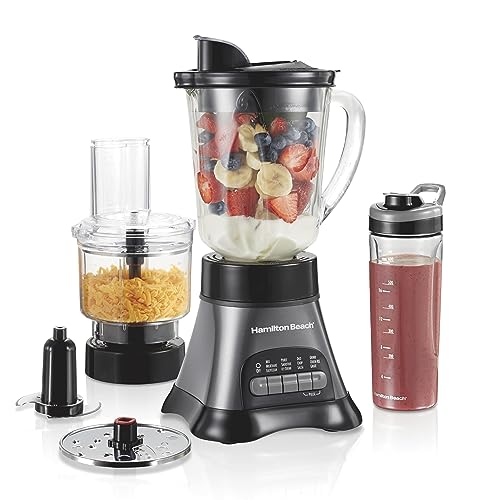
Hamilton Beach Blender and Food Processor Combo 58163, 700W peak, 40 oz glass jar, 3-cup chopper, travel cup — Best Budget Combo
The Hamilton Beach Blender and Food Processor Combo 58163 puts a 40 oz glass blender jar, a 3-cup electric chopper and a travel cup on one 700W peak base. It is the budget system pick for kitchens that chop onions as often as they blend smoothies.
For this guide’s job — kitchens where the blender also has to help cook — sauces, soups, salsas, batters and everyday food prep — the Hamilton Beach Blender and Food Processor Combo 58163, 700W peak, 40 oz glass jar, 3-cup chopper, travel cup earns its badge honestly, and its review below states both sides of that case.
Strengths
- Blender plus electric chopper covers smoothies and prep
- Travel cup adds a personal-blending option
- Accessible tier for a two-function system
Trade-offs
- 700W peak class limits dense frozen blending
- Chopper is small at 3 cups
- Two appliances worth of parts in one box
Key specs (from the verified listing): Power: 700W peak (from Amazon title); Container: 40 oz glass jar plus 3-cup chopper; Extras: Travel cup included.
In daily use, the pattern that emerges with the Hamilton Beach Blender and Food Processor Combo 58163, 700W peak, 40 oz glass jar, 3-cup chopper, travel cup is consistency: the tenth blend behaves like the first, which is what separates a machine you keep from one you replace. Think about how it fits your counter, your cupboards and your washing-up habits as carefully as its blending, because those frictions decide whether any blender gets used daily or gathers dust. Judged purely on the work this guide is about, it holds its place against the other five picks without needing excuses.
There is also a learning curve worth naming with the Hamilton Beach Blender and Food Processor Combo 58163, 700W peak, 40 oz glass jar, 3-cup chopper, travel cup: the first few blends teach you its preferred load size, its sound when the mixture is moving properly, and the point at which an extra splash of liquid helps rather than thins. That familiarity is worth more than any single specification, and it is why this guide recommends choosing one pick and learning it deeply instead of chasing the newest model each season. For the job described here, this machine rewards that familiarity — its results become more consistent the longer you own it, because your technique converges with its design.
Best for: Budget buyers who need light processing too / Not suited for: Power users blending frozen loads daily.
Check the current price on Amazon for the Hamilton Beach Blender and Food Processor Combo 58163, 700W peak, 40 oz glass jar, 3-cup chopper, travel cup.
Comparison Table
| Pick | Badge | Key spec | Best for |
|---|---|---|---|
| Ninja Kitchen System Pro BL770, 1500W, 72 oz + 8-cup processor | Best Overall System | Power: 1500W (from Amazon title) | One appliance for smoothies plus real food processing |
| Cuisinart Smart Power Duet Blender & Food Processor BFP-703BCP1, 500W, 48 oz glass jar, 3-cup processor | Best Glass Jar Duet | Power: 500W (from Amazon title) | Light-duty blending plus small-batch processing |
| Ninja Compact Kitchen System AMZ493BRN, 1200W, 72 oz pitcher, 40 oz processor bowl | Best Compact System | Power: 1200W (from Amazon title) | Small kitchens that still want processing capability |
| KitchenAid K400 with Tamper KSB4028, Contour Silver | Best Blender-First Pick | Container: 56 oz | Beginners who want a smoothie button that simply works |
| Vitamix Propel Series 750, 64 oz, Black | Best Premium All-Rounder | Container: 64 oz | Households blending thick or large batches several times a week |
| Hamilton Beach Blender and Food Processor Combo 58163, 700W peak, 40 oz glass jar, 3-cup chopper, travel cup | Best Budget Combo | Power: 700W peak (from Amazon title) | Budget buyers who need light processing too |
The table compresses the reviews into one view, but the badge column is the part to trust most: it records the situation each machine was chosen for, and buying the badge that matches your kitchen matters more than buying the longest spec list. If two picks share your situation, prefer the one whose trade-offs you mind least — every machine here has three, stated plainly in its review.
How to Choose: Best blenders for smoothies and food
Start with frequency. A blender used twice a day lives a different life from one used twice a month, and frequency is the honest justification for moving up a tier: daily users feel jar quality, program convenience and cleaning design every single day, while occasional users mostly feel the purchase itself. Match the tier to the habit you realistically have or are genuinely building, not to the most ambitious version of your kitchen routine.
Next, judge the vessel before the motor. Jar shape, bowl shape and blade layout decide what a blender can actually do with your ingredients, and they are the specifications manufacturers advertise least clearly. For the work in this guide, re-read the deep-dive section below before you buy, because it explains the mechanism your ingredients will meet — and a mechanism that suits your food matters more than a wattage figure measured under conditions your kitchen will never reproduce.
Controls deserve a decision too. Preset programs buy repeatability and free you from watching the jar; manual dials buy precision and simplicity; smart cycles buy automation at the cost of handing over judgement. None is universally best. Pick the style that matches how you cook: if you blend while making coffee and packing bags, programs earn their place; if you blend as the main event, a dial keeps you in charge.
Finally, plan for ownership. Measure the space under your cabinets before ordering a tall jar. Count the parts you will wash and decide where they will live. Check that the exact model in front of you matches the listing title you verified, because blender families reuse names across variants. And when you compare value, compare it at the moment of purchase on Amazon, where the current price reflects the market that day — not against a figure printed in any article, including this one.
What a Blender Does Well in Cooking — and What It Does Not
Blenders excel at anything that ends as a liquid or puree: soups, sauces, smoothies, dressings, marinades, batters and nut-based drinks. The vortex that makes smoothies smooth also makes soup silky and emulsifies dressings properly. Hot soup deserves one caution — blend in batches with the lid vented and a towel over the top, because steam pressure in a sealed jar is a real hazard that manuals warn about for good reason.
Blenders are poor at dry, discrete chopping. Without liquid to circulate the load, the bottom layer purees while the top layer rides untouched, which is why blender salsa so often ends as salsa soup. A food processor bowl, with its wide shape and low blade, chops evenly because pieces fall sideways onto the blade instead of needing a vortex. That is why the system picks in this guide carry real processor bowls rather than pretending the jar does everything.
Dough sits in between. Heavy doughs belong in a processor with a dough blade or a stand mixer; thin batters belong in the blender jar, where they pour beautifully. The system picks here cover both ends of that range, and the blender-only picks are honest about stopping at batter.
How to Use Your Blender for Everyday Food Jobs
Four core techniques cover most of the food work readers ask a blender to do.
- For soup: cool slightly, fill the jar no more than half, vent the lid, cover with a towel, and start on the lowest speed before rising.
- For salsa in a processor bowl: pulse in short bursts and scrape once, stopping while pieces are still distinct.
- For batter: add liquids first, then dry ingredients, and blend only until combined — over-blending toughens pancakes.
- For sauces and pesto: blend the base smooth first, then pulse in herbs or cheese at the end to keep texture and colour.
- For breadcrumbs: use dry bread in small batches and pulse; a processor bowl gives the most even crumb.
- Clean between jobs when flavours clash — a thirty-second water blend prevents garlic smoothies.
Two habits tie all of these steps together. First, listen to the machine: a healthy blend settles into a steady sound, while rattling, surging or a rising hot smell are instructions to pause and adjust the load. Second, clean immediately. Blenders are uniquely easy to clean when rinsed at once — warm water, a drop of washing-up liquid and a short blend or the self-cleaning program where fitted — and uniquely annoying once residue dries. Build the rinse into the routine and the machine stays pleasant to use for years.
Common Buying Mistakes
Mistake: Filling a jar with hot soup to the top and sealing the lid, inviting a steam blow-off.
Mistake: Trying to chop onions in a blender jar and serving onion puree instead.
Mistake: Kneading heavy dough in a blender, which strains the motor and tears rather than develops the dough.
Mistake: Blending batter until completely lump-free and long past combined, which makes pancakes tough.
Mistake: Assuming a system’s processor bowl and blender jar wash the same way — check blade handling for each.
One more mistake sits behind most of the others: buying for the neighbour’s kitchen instead of your own. The right pick in this guide is the one whose badge matches your ingredients, your household size and your patience for washing up. A flagship that intimidates you into not blending is worse value than a modest machine you use every morning.
Budget Tiers and Value, Explained Honestly
Blender pricing falls into three broad tiers, and this guide contains picks from each. The entry tier buys competence: real blending for soft and moderate loads, simpler controls, and jars and parts built to a price. The mid tier buys headroom — stronger performance under frozen or thick loads, preset programs, and systems that add cups or processor bowls. The premium tier buys refinement: the finest finished textures, the strongest build, programmed automation and machines designed to be used hard every day for years. None of these tiers is the correct one in the abstract. The correct tier is the one matched to your frequency of use and the difficulty of your typical load, which is why this guide badges picks by situation instead of simply ranking them by tier.
Value also hides in what is included. A system that adds a processor bowl or personal cups replaces purchases you might otherwise make separately; a blender-only pick at the same moment in the market may still be better value if you would never use the extras. Judge the box against your actual kitchen, count the parts you will store, and remember that the cheapest blender is the one you buy once — a too-weak machine replaced within a year costs more than the mid-tier pick bought first.
Care, Cleaning and Staying Safe
Daily care is the rinse-and-blend routine described in the how-to section: warm water, a drop of washing-up liquid, thirty seconds of blending or the self-cleaning program where fitted, then air-drying with the lid off so seals do not trap moisture. Weekly, wash the jar, lid and any cups or bowls properly, paying attention to the gasket and the area under the blade assembly where protein and fruit film collect. Blades demand respect in the sink — wash them as the sharp objects they are, never buried under soapy water where a reaching hand can find them by surprise.
Safety habits are simple and worth stating plainly. Never run the machine with the lid unsecured; never reach into a jar connected to a powered base; keep cords away from hot hobs; and give hot liquids the vented, half-full treatment described earlier in this guide. Motors that smell hot or surge repeatedly are telling you the load is wrong — stop, adjust the load, and let the machine rest rather than forcing a result. Looked after this way, every pick in this guide should give years of service, and the difference between tiers shows up as refinement rather than survival.
Final Recommendation
If you only read one line, make it this one: for most readers, the Ninja Kitchen System Pro BL770, 1500W, 72 oz + 8-cup processor is the safest buy for this job, because it balances performance, control and everyday practicality without asking you to excuse a weakness. Readers with a specific situation should follow the badges instead — each of the other five picks leads this guide for a defined kitchen, and the reviews state plainly who each one is not for.
Whichever pick you choose, buy the exact model you verified, run the how-to routine in this guide for your first blends, and judge the machine on your own ingredients rather than on anyone else’s demo. For the wider cluster around this topic, see also Best Blenders, Best Blenders For Smoothies And Food Processing, Best Blenders And Food Processors, Best Blenders For Smoothies, Best Blenders For Smoothie Bowls.
Questions to Ask Yourself Before You Buy
Before you order any pick in this guide, run through five honest questions. First, what will I blend most weeks, in real life rather than in aspiration? The answer should match a badge in this guide, and if it matches none of them, you are reading the wrong guide in the cluster — the internal links at the end of this article lead to the sibling guides written for neighbouring jobs. Second, how many servings is a normal blend? Jar and bowl sizes in these reviews are stated from the verified listings precisely so you can match capacity to your household instead of discovering a mismatch at breakfast. Third, where will it live? A blender stored in a deep cupboard gets used a fraction as often as one with a permanent counter home, so measure the space, including the height under wall cabinets, before the box arrives.
Fourth, who else will use it? Programs and smart cycles help households where several people blend with different confidence levels; a simple dial suits a single confident user. Fifth, what will I do when something wears? Lids, gaskets, jars and blade assemblies are the parts that age, and mainstream ranges with wide ownership tend to keep those parts available longest — one more reason this guide favours established models over novelty. Answer those five questions honestly and the choice among these six picks usually makes itself: one badge will describe your kitchen so exactly that the remaining decision is simply when to order.
A Note on Noise, Size and Counter Reality
Two practical realities deserve a paragraph of their own because they decide more returns than blending performance ever does. The first is noise: every full-power blender is loud, and the differences between picks are differences of degree and duration rather than of kind. Shorter, more effective blends are the real noise strategy — a machine that finishes in fifty seconds disturbs a household less than a quieter-rated machine that needs three minutes — and blending at a considerate hour remains the oldest solution of all. The second reality is size. These machines earn their counter space only if they are used, and a pick that fits your under-cabinet height and your cupboard for its accessories will be used several times more often than one that must be fetched and assembled. Measure first, order second: the dimensions that matter are in the verified listing for the exact model you chose.
Long-Term Ownership: Living With Your Blender
Three months in, the questions that matter are no longer about power. They are about the gasket that needs a proper dry before it goes back on the jar, the lid that lives in the same drawer every time so it is never missing at breakfast, and the descaling or deep-clean rhythm that keeps flavours neutral. Blenders reward small systems: store the tamper or cups with the base, keep the manual’s blade-handling warnings in mind every single wash, and run the self-cleaning habit described in the how-to section rather than letting residue bake on. Readers who build those habits report the same machine serving them for years, while identical machines in chaotic kitchens get replaced early — ownership, more than specification, is what the second year of blending is made of.
It is also worth knowing when a result is the recipe rather than the machine. If a blend disappoints, change one variable at a time: liquid amount first, then loading order, then blend time, and only then question the equipment. The picks in this guide were chosen so that, with those variables managed, the equipment stops being the limiting factor for the job described — which is the most any buying guide can honestly promise.
Frequently Asked Questions
Can a blender replace a food processor entirely?
For purees, soups and sauces, yes. For even chopping, slicing and dough, no — which is why half of this guide is system picks with genuine processor bowls.
Is it safe to blend hot soup?
Yes, with the standard precautions: half-fill at most, vent the lid, cover with a towel and start slow. Several picks here are also marketed for soup making in their listings.
Which pick is best for a small kitchen that cooks?
The compact system pick covers blending and processing in the smallest footprint. Blender-only picks suit kitchens that already own a processor.
Can these machines make nut butter?
The strongest full-size picks can, in small batches with patience and scraping. It is hard, hot work for any blender; a processor is often the better tool.
What about baby food?
Steamed vegetables and fruit puree beautifully in any pick here. Blend in batches and freeze in trays; the jar’s smoothie skills transfer directly.
Do I need the processor bowl if I mostly make smoothies?
No. If smoothies are ninety percent of your blending, a blender-only pick with a great smoothie program is the simpler, cheaper-to-store choice.


