Disclosure: airfryerkitchensupply.com is reader-supported. When you buy through links on our site, we may earn an affiliate commission at no extra cost to you.
Where to buy
Choosing the best blenders for juicing and smoothies starts with knowing which drink you actually want. One honest point before the links: a blender does not juice the way a juicer juices. A juicer separates liquid from pulp and hands you a clear drink; a blender pulverizes everything, fiber included, and hands you a thicker whole-food drink. Both are legitimate — they are different drinks. The picks below are verified through Amazon listing and cover the full honest range: two machines that genuinely do both jobs, three blenders that make excellent whole-food juices and smoothies, and one dedicated juicer for readers who discover, reading this, that clear juice is what they actually wanted. Check price on Amazon and confirm the configuration on the listing before ordering.
- Breville 3X Bluicer Pro BJB815BSS, Brushed Stainless Steel (Best True Juice + Smoothie Combo) — check price on Amazon
- Hamilton Beach Juice & Blend 2-in-1, 67970, 800W (Best Budget 2-in-1) — check price on Amazon
- Vitamix 5200 Professional-Grade Blender, 64 oz, Black (Best Whole-Food Juice Blender) — check price on Amazon
- nutribullet Full-Size Blender Combo NBF50500, 1200W (Best for Mixed Households) — check price on Amazon
- Ninja Professional Plus DUO BN751, 1400 Peak Watts (Best Pitcher + Single-Serve Power) — check price on Amazon
- nutribullet Juicer NBJ50100, 800W (Best Dedicated Juicer Reality Check) — check price on Amazon
Search for the best blenders for juicing and smoothies and you will find two different appliances hiding behind one phrase. Half the searchers want a blender that can turn whole fruits and vegetables into a drinkable, juice-like blend — fiber, body, and all. The other half want actual juice: thin, clear, pulp-separated, the kind you cannot get from a blender at any wattage. This guide serves both groups honestly, because buying the wrong one is an expensive way to learn the difference.
Here is the physics in one paragraph. A juicer pushes produce against a screen or auger and separates liquid from fiber, so a pound of carrots becomes a glass of carrot juice and a puck of dry pulp. A blender has no screen and no separation: everything you put in comes out in the glass, liquefied but complete. Blended ‘juice’ is therefore thicker, more filling, and better suited to soft produce; it also means a blender handles bananas, avocados, nut butters, and frozen fruit that no juicer can touch. Most households that buy one machine for ‘juicing and smoothies’ are happiest with either a true 2-in-1 or a strong blender — and this guide ranks both paths.
The six picks below start with the two genuine hybrids — a Breville blender-juicer and a Hamilton Beach 2-in-1 — then move to the blenders that make the best whole-food juices (a Vitamix and two combo systems), and finish with a dedicated centrifugal juicer as the reality-check option. The buying guide explains when each path wins, and the how-to section covers both techniques: making clear juice on the hybrids, and making smooth whole-food juice in a plain blender, including the nut-milk-bag trick for readers who want it thinner.
In this guide
Quick Picks
Two real hybrids, three blenders that fake juice convincingly by keeping the fiber, and one true juicer — pick your drink first, then your machine.
- Best True Juice + Smoothie Combo: Breville 3X Bluicer Pro BJB815BSS, Brushed Stainless Steel — the only pick that is literally both machines — a centrifugal juicer and a blender sharing one premium base, so juice days and smoothie days need one footprint. Check the current price on Amazon.
- Best Budget 2-in-1: Hamilton Beach Juice & Blend 2-in-1, 67970, 800W — a centrifugal juicer with a big 3-inch chute plus a 20 oz blender on the same 800W base, at budget-tier positioning. Check the current price on Amazon.
- Best Whole-Food Juice Blender: Vitamix 5200 Professional-Grade Blender, 64 oz, Black — the classic high-performance blender for whole-food juices — it liquefies produce completely, fiber and all, with variable speed control and a self-cleaning cycle. Check the current price on Amazon.
- Best for Mixed Households: nutribullet Full-Size Blender Combo NBF50500, 1200W — a 1200W full-size blender with a 64 oz pitcher for family smoothies and a 24 oz tumbler for one person’s whole-food juice in the morning. Check the current price on Amazon.
- Best Pitcher + Single-Serve Power: Ninja Professional Plus DUO BN751, 1400 Peak Watts — 1400 peak watts, a 72 oz pitcher, and two 24 oz cups — the most raw blending force here for whole-food juices and frozen smoothies alike. Check the current price on Amazon.
- Best Dedicated Juicer Reality Check: nutribullet Juicer NBJ50100, 800W — not a blender at all — an 800W centrifugal juicer with a 3-inch chute and 27 oz pitcher, included because some readers of this search actually want clear juice. Check the current price on Amazon.
How These Picks Were Chosen
The selection started with a definition problem: ‘juicing’ means separated juice to some readers and whole-food blending to others, so the shortlist was built to cover both meanings honestly rather than pretend one machine erases the difference. Every pick was verified through Amazon listing, and each was then classified by what it physically does — separate pulp, liquefy everything, or both — and ranked within that truth. No blender on this page is described as making clear juice, because none does.
Balance was the second filter. A page with six premium blenders would fail the budget reader; a page with six cheap hybrids would fail everyone by month two. The final six span two true hybrids at opposite tiers, three blenders at descending prices that make the best whole-food juice, and one dedicated juicer included as a deliberate reality check. If a well-known model is missing, it is because it duplicated a pick’s role at a worse tier or could not be verified — not because it was overlooked.
The 6 Best Blenders for Juicing and Smoothies

Breville 3X Bluicer Pro BJB815BSS, Brushed Stainless Steel — Best True Juice + Smoothie Combo
The Breville 3X Bluicer Pro is the honest answer for households genuinely split between clear juice and smoothies. It combines a centrifugal juicer with a full blender on a single base, so carrots and celery become real separated juice in the morning, and the same base blends a frozen-fruit smoothie in the afternoon. It is a premium machine and priced like one in positioning, but it replaces two appliances completely rather than compromising either job.
Strengths
- A true juicer and a true blender in one footprint — no technique workarounds
- Premium Breville build and controls across both functions
- Handles hard produce for juice and frozen produce for smoothies properly
Trade-offs
- Premium tier positioning — the most committed purchase on this page
- Two machines’ worth of parts to wash across a full day of use
- Overkill if you lean 90% toward one drink or the other
| Format | Blender and juicer combo (per Amazon listing) |
| Finish | Brushed stainless steel |
| Model | BJB815BSS |
| Functions | Juicing (centrifugal) and blending on one base |
The Bluicer Pro makes sense when the split in your house is real: one person juices vegetables every morning and wants pulp separated, another blends smoothies, and counter space allows one base. In that scenario every alternative is a compromise someone resents daily. The juicer side handles hard vegetables the way a dedicated centrifugal machine does, and the blender side is a proper Breville blender rather than a token attachment. The cost of the versatility is parts: a juicing session and a blending session in one day means two sets of components through the sink. Households that juice on weekends and blend on weekdays will not feel that burden; households doing both daily should walk in with eyes open.
Whole-food juicing in a blender has one governing rule: the jar needs liquid and motion before it needs power. Add water, coconut water, or citrus juice first, then produce in small pieces, and start on a lower speed to establish the vortex before going full speed. A dry jar of carrot chunks will rattle heroically and blend badly at any wattage; the same carrots with a cup of liquid become juice in under a minute.
Best for: households truly split between clear juice and smoothies, with counter space for one base only / Not suited for: anyone who mostly makes one drink and is buying the other function ‘just in case’
Check on Amazon — check the current price on Amazon before you decide, since listings and included accessories change over time.
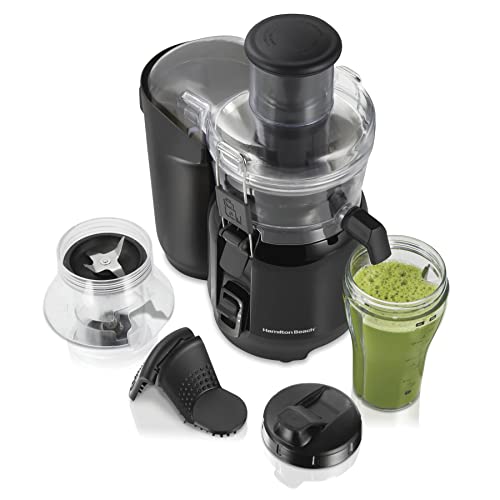
Hamilton Beach Juice & Blend 2-in-1, 67970, 800W — Best Budget 2-in-1
The Hamilton Beach Juice & Blend brings the hybrid concept down to a budget tier: a centrifugal juicer with a Big Mouth 3-inch feed chute — wide enough for many whole fruits — and a 20-ounce blender that mounts on the same 800W base for smoothies. Neither side pretends to be a premium appliance, and that honesty at this price positioning is exactly its appeal for first-time hybrid buyers.
Strengths
- Both functions included at budget positioning — the cheapest honest route to juice and smoothies
- 3-inch feed chute reduces prep on the juicing side
- 20 oz blender covers a personal smoothie without a second machine
Trade-offs
- 800W blender side is modest — frozen-fruit smoothies need small loads and patience
- Budget build and parts feel a tier below the Breville and Vitamix picks
- Juicer is centrifugal only; no slow-press option for leafy greens specialists
| Motor | 800W |
| Juicer | Centrifugal, Big Mouth 3-inch feed chute |
| Blender | 20 oz blending jar (per Amazon listing) |
| Model | 67970 |
Buy the Juice & Blend as a discovery tool. If you are unsure whether your household is a juicing household or a smoothie household, this machine lets you live both lives for a season at budget cost, and whichever side wears out its welcome tells you what to buy properly next. The juicer side is the stronger half: the wide chute and centrifugal design handle apples, carrots, and celery with little prep. The blender side is a personal-size smoothie maker, fine for fresh fruit and yogurt, limited with frozen loads. Readers who already know they blend daily and juice occasionally should invert the purchase — a strong blender below plus this as the juice answer is backwards; get the blender first and juice in it whole-food style until a dedicated juicer earns its place.
Order produce by hardness, hardest last in a pitcher but first under the blades in a personal cup. In practice: liquids, soft fruit, leafy greens, then hard vegetables and frozen items. The soft layer becomes the fluid that carries the hard layer down. Ginger and turmeric roots — common in juice recipes — should be sliced thin; a thumb-sized knob dropped in whole can survive a blend surprisingly intact.
Best for: first-time buyers unsure which drink their household will actually live on / Not suited for: daily frozen-smoothie makers who need real blending power
Check on Amazon — check the current price on Amazon before you decide, since listings and included accessories change over time.

Vitamix 5200 Professional-Grade Blender, 64 oz, Black — Best Whole-Food Juice Blender
If your definition of juicing is ‘a glass of liquefied produce,’ the Vitamix 5200 is the benchmark blender for it. Its high-speed motor and variable control do not separate anything — they pulverize skins, seeds, and fiber so completely that a carrot-apple-ginger blend pours like a thick juice rather than eating like a sauce. Generations of owners have used exactly this machine as their juicer substitute, and for soft-to-medium produce it earns the role.
Strengths
- Pulverizes whole produce finely enough for genuinely drinkable whole-food juice
- Variable speed dial gives full control from chunky to completely smooth
- 64 oz container handles family-size juice and smoothie batches; self-cleaning program helps with both
Trade-offs
- No pulp separation — readers wanting clear, thin juice need a juicer or the straining step in the how-to
- Premium tier positioning
- Whole-food juice from hard vegetables is thicker than pressed juice, full stop
| Container | 64 oz |
| Controls | Variable speed with high-speed switch |
| Blades | Stainless steel (per Amazon listing) |
| Cleaning | Self-cleaning (per Amazon listing) |
The 5200’s case rests on texture. Lesser blenders leave whole-food juice grainy — fine particles of skin and fiber that read as ‘smoothie that failed.’ The Vitamix runs long and fast enough to take that grain down to a uniform pour, especially if you use the technique in the how-to below: liquid first, hard produce in small pieces, a full-speed run longer than feels necessary. Add a nut-milk bag strain for guests who expect clear juice and you are within sight of the real thing. What it will never do is make juice from a pile of carrots with no added liquid as effortlessly as a juicer — whole-food juicing needs some liquid in the jar, and that dilutes intensity slightly. For smoothie-first households that also want vegetable drinks, it remains the single best one-machine answer on this page.
If you want blender juice thinner, strain it — but strain smart. A nut-milk bag over a jug, one pour, one squeeze: thirty seconds of work that removes most pulp while keeping far more body than a juicer leaves. Many whole-food juicers settle into a personal rule — unstrained on weekdays, strained for guests — which gets the fiber benefit most of the time without turning breakfast into a project.
Best for: smoothie-first households that also want produce drinks, fiber included / Not suited for: clear-juice purists who will strain every batch and resent it
Check on Amazon — check the current price on Amazon before you decide, since listings and included accessories change over time.

nutribullet Full-Size Blender Combo NBF50500, 1200W — Best for Mixed Households
The nutribullet Full-Size Blender Combo splits the difference for households whose drinks differ by person and by day. The 64-ounce pitcher handles family smoothies and big whole-food juice batches; the 24-ounce tumbler handles one person’s morning green drink without dirtying the pitcher. At 1200W it has the muscle for fibrous produce and frozen fruit alike, at a mid-tier positioning below the Vitamix and Breville picks.
Strengths
- Pitcher plus personal tumbler covers family batches and single servings
- 1200W is strong enough for fibrous vegetables and frozen fruit
- Simpler controls than program-heavy rivals — easy for the whole household
Trade-offs
- Whole-food juice only — no separation, like every pure blender here
- Extraction texture is very good rather than Vitamix-class on the toughest produce
- Two vessels to store, though both earn their space in mixed households
| Motor | 1200W |
| Vessels | 64 oz pitcher and 24 oz tumbler cup |
| Model | NBF50500 |
| Cleaning | Dishwasher-safe parts (per Amazon listing) |
This is the pragmatic family pick. A parent making a pitcher of berry smoothie for kids and a tumbler of celery-apple-cucumber for themselves is exactly the use pattern the Combo was designed around, and it performs both jobs without the ceremony of a premium machine. For whole-food juicing, the tumbler is the surprise star: small batches blend more violently relative to their volume, so a personal green juice comes out smoother in the tumbler than the same ingredients would in a half-empty pitcher. Keep frozen loads reasonable and add liquid generously for vegetable drinks, and the Combo covers the brief. It gives up the last word in refinement to the Vitamix — on a beet-heavy juice, you will taste the difference — at a meaningfully friendlier tier.
On the hybrid machines, juice first and blend second when you are doing both. Juice is the messier, more perishable product: make it, rinse the juicer parts immediately (dried pulp in a mesh screen is the worst cleaning job in this entire category), then blend the smoothie in the clean second act. Reversing the order means smoothie residue flavoring the juice and a longer, sadder wash-up overall.
Best for: families mixing pitcher smoothies with individual whole-food juices / Not suited for: single users, who would be better served by a personal blender or the Vitamix
Check on Amazon — check the current price on Amazon before you decide, since listings and included accessories change over time.

Ninja Professional Plus DUO BN751, 1400 Peak Watts — Best Pitcher + Single-Serve Power
The Ninja DUO BN751 is the power-forward option: 1400 peak watts driving a 72-ounce Total Crushing pitcher and two 24-ounce single-serve cups, with Auto-iQ programs for both. For whole-food juicing, that power shows up as speed — hard produce and ice break down fast — and the stacked blade design pulls ingredients through the pitcher more aggressively than a bottom-blade design at the same wattage.
Strengths
- Highest peak power here; excellent with ice and frozen fruit
- 72 oz pitcher plus two 24 oz cups covers every batch size
- Auto-iQ programs simplify both smoothies and frozen drinks
Trade-offs
- Whole-food juice texture can run slightly less fine than the Vitamix on fibrous produce
- Large footprint and a tall pitcher to store
- Power is peak-rated; technique still matters for silky results
| Motor | 1400 peak watts |
| Vessels | 72 oz pitcher and (2) 24 oz cups |
| Programs | 3 Auto-iQ programs (per Amazon listing) |
| Technology | Total Crushing and extractor blades (per Amazon listing) |
Choose the BN751 when frozen performance is non-negotiable — frozen smoothie bowls, icy drinks, and whole-food juices built on frozen fruit all play to its strengths — and when the household swings between one-person and full-pitcher batches. For vegetable juicing in the blender sense, run the pitcher at least half full so the stacked blades can establish their pull, add liquid first, and let the Auto-iQ smoothie program’s pulses do the initial breakdown before a continuous finish. The single-serve cups make a convincing morning green juice with less washing than the pitcher. Against the Vitamix, the trade is refinement for force and versatility: the Ninja is faster and more flexible; the Vitamix finishes fibrous drinks a touch silkier. Both statements can be true, and your produce basket decides which matters.
Temperature changes perception. Whole-food juice tastes noticeably better cold, and because a blender adds friction heat on long runs, starting with cold produce and adding a few ice cubes keeps the result fresh-tasting rather than flat. Juicer output benefits from the same trick — chill the produce, not just the glass. Warm green juice is where good intentions go to be abandoned.
Best for: households wanting maximum blending force across pitcher and personal sizes / Not suited for: texture perfectionists making daily fibrous vegetable juices
Check on Amazon — check the current price on Amazon before you decide, since listings and included accessories change over time.

nutribullet Juicer NBJ50100, 800W — Best Dedicated Juicer Reality Check
This pick breaks the page’s premise on purpose. The nutribullet Juicer is a dedicated centrifugal juicer — 800W, a 3-inch feed chute for whole fruits and vegetables, dual speeds, a 27-ounce juice pitcher and a pulp container. It makes no smoothies and never will. It is here because a meaningful share of people searching for blenders for juicing discover, once the difference is explained, that separated juice is the drink they wanted all along — and they deserve a verified, sensibly positioned option rather than a blender and a straining bag.
Strengths
- Real separated juice — thin, clear, pulp-free — which no blender can produce
- 3-inch chute takes many whole fruits, cutting prep time
- Dual speeds suit soft and hard produce; parts are BPA-free per the listing
Trade-offs
- Juices only: no smoothies, no frozen fruit, no nut butters, ever
- Centrifugal juicers are less efficient with leafy greens than slow juicers
- More parts to wash than any blender on this page
| Motor | 800W |
| Feed chute | 3-inch, for whole fruits and vegetables |
| Juice pitcher | 27 oz; pulp container 0.5L (per Amazon listing) |
| Speeds | Dual speeds |
If you choose this route, choose it with commitment: a juicer is a single-purpose appliance that earns its shelf by being used several times a week. The nutribullet Juicer is a sensible entry — wide chute, straightforward assembly, juice quality that satisfies anyone coming from bottled juice. Pair it mentally with the rest of this page rather than against it: many two-appliance kitchens run a juicer like this for morning vegetable juice and a personal blender for smoothies, which is a perfectly rational end state. What you should not do is buy it hoping it will ‘also blend a bit.’ It will not, and the disappointment is predictable enough to prevent right here.
Yield honesty helps planning. A blender keeps everything, so a jar of produce becomes roughly the same volume of drink, minus air. A centrifugal juicer returns noticeably less volume from the same produce — the pulp holds the rest — which is why juice-bar drinks cost what they do. Budget your produce for the machine you own, and compost the pulp either way: from a juicer it is nearly dry, and from straining it makes an excellent addition to muffins and soups.
Best for: readers who realize clear, separated juice is their actual goal / Not suited for: anyone who wants smoothies — this machine cannot make one
Check on Amazon — check the current price on Amazon before you decide, since listings and included accessories change over time.
Comparison Table
| Pick | Badge | Key spec | Best for |
|---|---|---|---|
| Breville 3X Bluicer Pro BJB815BSS, Brushed Stainless Steel | Best True Juice + Smoothie Combo | Blender + centrifugal juicer, one base | Genuine both-drinks households |
| Hamilton Beach Juice & Blend 2-in-1, 67970, 800W | Best Budget 2-in-1 | 800W; 3 in chute juicer + 20 oz blender | Budget route to both drinks |
| Vitamix 5200 Professional-Grade Blender, 64 oz, Black | Best Whole-Food Juice Blender | 64 oz; variable speed; self-cleaning | Whole-food juices and smoothies in one machine |
| nutribullet Full-Size Blender Combo NBF50500, 1200W | Best for Mixed Households | 1200W; 64 oz pitcher + 24 oz tumbler | Family smoothies plus personal green drinks |
| Ninja Professional Plus DUO BN751, 1400 Peak Watts | Best Pitcher + Single-Serve Power | 1400 peak W; 72 oz + (2) 24 oz; Auto-iQ | Frozen smoothies and power whole-food juicing |
| nutribullet Juicer NBJ50100, 800W | Best Dedicated Juicer Reality Check | 800W centrifugal juicer; 3 in chute; 27 oz pitcher | Clear juice only |
The comparison that matters is not row against row but drink against drink. If the glass you picture is clear and thin, only the Bluicer Pro’s juicer side and the nutribullet Juicer truly make it. If the glass you picture is thick, cold, and filling, every blender here makes it, and the choice narrows to batch sizes and budget. Naming your drink honestly is ninety percent of this purchase.
How to Choose Between a Blender, a Juicer, and a Hybrid
Ask what happens to the fiber. Keep it, and you get a more filling drink, slower sugar absorption from the same produce, and a machine that also makes smoothies, soups, and nut butters — that is the blender path, and it is the right default for most households. Remove it, and you get a lighter drink you can consume in larger produce quantities, at the cost of a single-purpose machine and more washing — the juicer path, right for committed juice drinkers. Refuse to choose, and the hybrids exist, at the cost of money (the Breville) or refinement (the Hamilton Beach).
Then ask what produce dominates. Leafy greens are the dividing line: blenders liquefy them completely with enough liquid, centrifugal juicers extract them poorly, and slow juicers — a category beyond this page’s picks — extract them best. Hard roots and crisp fruit (carrots, beets, apples, celery) juice beautifully by any method. Soft produce (banana, avocado, mango, berries) belongs in a blender, full stop — a juicer mostly moves it into the pulp bin. Your shopping basket, read honestly, picks the machine more reliably than any feature list.
Centrifugal, Slow, and Whole-Food: the Three Juice Styles
Centrifugal juicers — both hybrids’ juicer sides and the nutribullet Juicer here — spin produce against a mesh at high speed. They are fast, relatively affordable, and excellent with hard produce, and they ask you to drink the juice reasonably soon and accept modest yields from greens. Slow (masticating) juicers crush produce at low RPM: better green yields, drier pulp, slower sessions, higher prices, and no ability to blend. Whole-food blending skips separation entirely. None of the three is ‘the healthy one’ in any simple sense — they trade fiber, yield, speed, and versatility differently, and the best choice is the one whose trade-offs match your produce and patience.
Oxidation and storage follow from the method. Any juice is best fresh; centrifugal juice, whipped with more air, dulls fastest, while whole-food blends keep a day in a filled, sealed jar in the fridge with only modest decline. If your routine is batching Sunday produce for weekday mornings, that storage reality quietly favors the blender path — one more reason the smoothie-first household usually lands there.
Budget Tiers for the Juice-and-Smoothie Brief
At the budget tier, the Hamilton Beach 2-in-1 is the only honest both-drinks option, and it buys discovery rather than mastery. The mid tier is where strong blenders live — the nutribullet Combo and Ninja DUO — and for most households this tier is the destination: excellent smoothies, convincing whole-food juices, no second machine. The premium tier buys either refinement (the Vitamix’s texture) or true duality (the Breville Bluicer). Spending premium money on a blender while secretly wanting clear juice is the expensive mistake this page exists to prevent — the dedicated juicer at a mid positioning will make you happier than any blender at any price.
A word on produce economics, because the machine is the smaller cost of this habit. Juicing separates, so a juicer household buys produce in juicing quantities — several pounds a week for a daily glass — and should shop accordingly: carrots, celery, apples, and citrus in bulk, greens in rotation, and a standing relationship with the market’s discount rack, where slightly tired produce that blends and juices perfectly sells for a fraction of display-perfect stock. Blender households spend less per glass because nothing is discarded, but should protect the investment differently: frozen fruit bought on special is the smoothie equivalent of the discount rack, and it keeps indefinitely.
How to Make Juice and Smoothies with One Setup
Two techniques cover every machine on this page: whole-food juicing in a blender, and separated juicing on a hybrid or juicer. Learn the one your machine does; skim the other so you know what you traded.
- For whole-food juice in a blender: add 1 to 1.5 cups of liquid (water, coconut water, or citrus juice) to the jar first.
- Add soft produce and leafy greens, then hard produce cut into 1-inch pieces — small pieces are what let a blender act like a juicer.
- Blend on high for 45 to 90 seconds, longer than a smoothie, until no flecks or grain remain when you stop and look.
- Taste and adjust: a squeeze of lemon or lime brightens vegetable juices dramatically; a small apple sweetens without a recipe rewrite.
- Optional: pour through a nut-milk bag or fine strainer and squeeze for a thinner drink. Skip it when you want the fiber — most days, keep the fiber.
- For separated juice on a hybrid or juicer: prep produce to chute size, feed steadily without forcing the pusher, and alternate hard and soft items so the machine clears itself.
- For a smoothie on any blender here: liquid, soft ingredients, greens, frozen last — then blend until the surface swirls evenly with no chunks riding it.
- Whichever you made: rinse parts immediately. Juice screens and blender jars both punish delay, and a two-minute rinse now replaces a twenty-minute scrub tonight.
A good starter whole-food juice that flatters any blender here: two oranges’ worth of juice or a cup of water, one apple, one carrot, a handful of spinach, a thin slice of ginger, and ice. It is balanced, not too sweet, and it teaches you your machine’s texture ceiling in one glass. On the juicer side, the same produce (minus added water) shows you the other drink — thinner, brighter, hungrier an hour later. Trying both in the first week settles the blender-versus-juicer question with evidence instead of opinions.
Cleaning chemistry deserves thirty seconds of honesty. Both juicers and blenders punish soap-and-water procrastination, but the juicer’s mesh screen is the one part in either system that genuinely degrades if neglected — pulp dries into the mesh and each session extracts a little less. A stiff brush under running water, immediately, every time, is the whole secret; the screen that gets it lasts for years, and the one that does not becomes the reason a good machine seems to fade. The hybrids inherit this duty on their juicer side, which is worth knowing before you fall in love with the concept.
One Machine, Two Drinks: Setting Up a Home Routine
Households that succeed with both drinks usually give each a time slot rather than choosing daily. A common pattern: vegetable juice (pressed or whole-food) on weekday mornings when the produce is fresh and the appetite is virtuous, smoothies on weekends and after training when the drink is a meal. The pattern matters for purchasing because it tells you the duty split — a household juicing five mornings a week should weight the juicing side of a hybrid or buy the dedicated juicer sooner, while a household juicing twice a month should let the blender be the machine and borrow the straining trick for juice days.
Storage and prep are the routine’s invisible half. Washed, cut produce in sealed boxes turns a juice or smoothie from a project into a five-minute assembly; a freezer stocked with portioned fruit does the same for smoothies. Whichever machine you buy from this page, spend the first month building the prep habit around it — the appliance is the smaller half of the system, and the households still juicing and blending in month six are the ones whose fridges, not just their counters, were set up for it.
Common Buying Mistakes
Mistake one: buying a blender for clear juice. No wattage, blade, or program changes the absence of a separation screen. If clear juice is the goal, buy a juicer or a hybrid — this page lists both precisely so the mistake is avoidable.
Mistake two: buying a juicer for smoothies. The mirror error, and just as common in gift purchases. A juicer cannot blend, cannot take frozen fruit or bananas, and will not make anything resembling a smoothie no matter how it is fed.
Mistake three: juicing soft produce in a centrifugal machine and blaming the machine. Bananas, avocados, and ripe mangoes belong in the blender; in a juicer they mostly become pulp-bin filler. Feed each machine its own produce list and both perform better.
Mistake four: ignoring the wash-up math. A juicer has a screen, a pulp bin, a chute, and a pitcher; a blender has a jar. Used daily, that difference compounds into the real cost of ownership. The best machine is the one whose cleaning you will still tolerate in month three.
Mistake five: letting pulp guilt or fiber guilt make the decision. Juice drinkers are told they are wasting fiber; blender drinkers are told their drink is not real juice. Both drinks are legitimate, both deliver produce you would otherwise not eat, and the pulp from a juicer can go to compost, stock, or baking rather than the bin. Choose by taste, texture, and the washing-up — the drink you make happily three times a week outperforms the theoretically superior drink you make twice and abandon.
Final Recommendation
If one machine must do everything and the budget allows, the Breville Bluicer Pro is the only pick that truly does both jobs without technique or apology. If the budget is the constraint, the Hamilton Beach Juice & Blend discovers the same territory honestly at the other end of the market. Between those poles, most households should buy the blender: the Vitamix 5200 for whole-food juice refinement, the Ninja DUO for power and flexibility, or the nutribullet Combo for family practicality.
And if this guide talked you out of a blender entirely — if the drink you want is clear, cold, and separated — the nutribullet Juicer is the verified, sensible way to get it. Every pick was checked against Amazon listing; check price on Amazon, confirm the configuration, and buy for the drink you actually pictured when you searched.
A closing suggestion for the undecided: borrow the decision from your shopping basket. Next time you shop, look at what is actually in the trolley. Mostly soft fruit, bananas, yogurt, and frozen berries — you are a blender household, and the Vitamix, Ninja, or nutribullet Combo will serve you for years. Mostly carrots, celery, beets, apples, and greens in juicing quantities — the juicer side deserves its machine, whether that is the Bluicer’s second half or the dedicated nutribullet Juicer. The basket does not lie, and it is a better consultant than any feature table.
One more consideration for households on the fence between the hybrid and the pair of separate machines: counter geography. A hybrid occupies one footprint and one outlet, which in a small kitchen can be the entire argument. Separate machines occupy two footprints but can live in two places — the juicer in a cupboard between juice days, the blender on the counter for daily duty. Measure your counter and your cupboards before you decide, because the best system is the one that fits the kitchen’s real estate without a daily reshuffle, and no amount of blending quality compensates for a machine that has nowhere to live.
The true both-jobs answer is the Breville 3X Bluicer Pro — one base, real juice, real smoothies.
For the strongest blender-only route, the Vitamix 5200 makes whole-food juices with the finest texture here.
On a budget, the Hamilton Beach Juice & Blend covers both drinks at an entry positioning.
Keep exploring the shortlist: Best Blenders For Juicing Vegetables Best Blenders For Leafy Green Smoothies Best Blenders And Juicers Best Blenders For Individual Smoothies Best Blenders For Green Drinks And Smoothies.
Frequently Asked Questions
Can a blender really make juice?
It makes whole-food juice: produce liquefied completely, fiber included. The texture is thicker than pressed juice and the drink is more filling, but for soft and medium produce a strong blender gets genuinely close to juice-like. What a blender cannot do is separate pulp — for clear juice you need a juicer or a hybrid with a juicer side, or a strain through a nut-milk bag after blending.
Is juicing healthier than blending?
They are different rather than ranked. Blending keeps the fiber, which slows sugar absorption and keeps you fuller; juicing removes fiber but lets you consume the produce of several vegetables in one glass. This guide deliberately makes no medical claims — the practical answer is that the healthier method is the one you will actually use consistently with produce you enjoy.
Why does my whole-food juice taste dull compared to juice-bar juice?
Usually dilution and temperature. Blender juice needs added liquid, which softens intensity — compensate with citrus, ginger, or a concentrated base like carrot and apple. Serve it properly cold, ideally blended with a few ice cubes. A pinch of salt sounds odd and works: it sharpens vegetable flavors the way it does in cooking.
Can I juice leafy greens in a centrifugal juicer?
Poorly. Centrifugal machines fling light leaves through before extracting much from them. The workarounds are to roll greens into tight bundles and sandwich them between hard produce, or to accept the yield loss. If greens are your main juice, a slow juicer (outside this page’s picks) or whole-food blending — where greens liquefy completely — serves you better.
How long does homemade juice keep?
Drink centrifugal juice the same day, ideally within hours, as it oxidizes fastest. Whole-food blends keep about a day in a completely filled, sealed container in the refrigerator with modest quality loss. Freezing in portions is a workable batching strategy for both, with a small texture cost on thawing for the blended version.
Do I need to peel produce before juicing or blending?
For juicers, follow the chute: peel citrus (the rind is bitter and hard on machines), remove large stones, and wash everything. For blenders, skins of apples, carrots, and cucumbers can stay — they blend in and carry fiber — while citrus peel and large pits still come out. Ginger needs only washing and thin slicing. When in doubt: if you would not eat it whole, do not blend it whole.


