Disclosure: airfryerkitchensupply.com is reader-supported. When you buy through links on our site, we may earn an affiliate commission at no extra cost to you.
Where to buy
Our shortlist of the best blenders for hot sauce is below — every pick verified against the manufacturer’s listed specifications, with full reviews further down the page.
Hot sauce making is blending at its most hostile: cooked chillies and vinegar at near-boiling temperatures, acid that attacks materials, pigments that stain everything, and capsaicin that turns the blender’s exhaust into pepper spray if you run it carelessly. The machines below are hot-rated blenders whose jars — steel, glass and hot-rated copolyester — stand up to acid and heat, with the power to make sauce silky rather than seedy. All verified against Amazon’s catalogue; check price on Amazon through the links.
- Waring Blade Blender BB300S (Stainless Jar) (Best Overall for Hot Sauce): Check price on Amazon
- Vitamix 5200 Professional-Grade Blender (Best for Silky Texture): Check price on Amazon
- Oster Pro 1200 Blender with Glass Jar (Best Glass Jar for Hot Sauce): Check price on Amazon
- KitchenAid K400 Variable Speed Blender with Tamper (Best for Thick Pepper Mashes): Check price on Amazon
- Ninja Professional Plus DUO BN751 (Best for Raw and Fresh Sauces): Check price on Amazon
- Blendtec Classic 575 (Best Big-Batch Sauce Machine): Check price on Amazon
The best blenders for hot sauce have to survive a job that combines every stress in this entire blender cluster. The ingredients go in hot, often straight off a simmer. They are acidic — vinegar is the preservative backbone of most sauces. They are pigmented enough to dye a plastic jar orange for a year. And they contain seeds and skins that only sustained high speed will truly break down, because a hot sauce with gritty seed fragments is a failed hot sauce. Add the fact that blending hot chillies aerosolises capsaicin, and you have a task where the machine’s venting, materials and power all matter at once. This guide is written by that checklist.
Two sauce styles divide the field. Fermented and cooked sauces that get blended hot need the full hot-rated treatment this guide is built on. Fresh, raw sauces — a quick salsa macha style blend or a raw pepper mash — are gentler on equipment but harder on blades, because raw skins and seeds resist. Most serious home sauce makers do both, so the picks favour machines that handle the hot, cooked end properly and have the power for the raw end too.
A word on scale: hot sauce is usually made in modest batches — a litre or two at a time — which means mid-size jars are not a compromise here. They are the correct size, and several picks reflect that.
In this guide
Quick Picks
Six hot-rated machines for sauce work, ranked by acid and heat tolerance, seed-breaking power and how kindly they treat the cook’s eyes and lungs.
- Best Overall for Hot Sauce: Waring Blade Blender BB300S (Stainless Jar) — A 1.5 HP commercial motor with a 48 oz stainless jar — steel ignores vinegar, heat and chilli pigment completely, and 48 oz is exactly hot-sauce batch size. — Check price on Amazon
- Best for Silky Texture: Vitamix 5200 Professional-Grade Blender — The texture king for sauce: sustained maximum speed turns seeds and skins into a glossy, unified sauce, with a vented lid and dial control for the hot start. — Check price on Amazon
- Best Glass Jar for Hot Sauce: Oster Pro 1200 Blender with Glass Jar — A glass jar with 7 speeds and a dual-direction blade — glass shrugs off vinegar and pigment, and the reversing blade keeps chunky pepper mashes moving at the start. — Check price on Amazon
- Best for Thick Pepper Mashes: KitchenAid K400 Variable Speed Blender with Tamper — A 5-speed dial, Intelli-Speed control and a tamper — the tamper is the hot-sauce tool for thick, low-liquid mashes that stall lesser blenders. — Check price on Amazon
- Best for Raw and Fresh Sauces: Ninja Professional Plus DUO BN751 — 1400 peak watts of Total Crushing power with a 72 oz pitcher and two cups — the raw-sauce specialist: fresh pepper mashes, salsas and raw chilli blends, with a clear hot-liquid boundary stated below. — Check price on Amazon
- Best Big-Batch Sauce Machine: Blendtec Classic 575 — A big WildSide+ jar and hard-running cycles for the sauce maker who processes a harvest — gallons of peppers become sauce in a few large, consistent batches. — Check price on Amazon
How These Picks Were Chosen
All models were verified against Amazon’s catalogue data through the site’s verification system. The hot-sauce filter then asked four questions most blender reviews never raise: is the machine hot-rated for cooked sauce straight off the simmer; does the jar material resist vinegar, pigment and capsaicin carryover; can the motor sustain the long runs that seed breakdown requires; and does the batch size match how sauce is actually made. The Ninja BN751 is included with its hot boundary stated openly because its fresh-sauce performance is the best in class — hiding either fact would mislead sauce makers.
We weighted jar material unusually heavily, because sauce makers live with its consequences longest. Steel and glass return to neutral after every wash; plastic gradually becomes a sauce jar whether you planned it or not. Neither answer is wrong — dedicating a plastic-jar machine to sauce is a legitimate strategy — but the choice should be conscious, and the reviews frame it that way.
Every pick below earned its place against those filters. The shortlist of the best blenders for hot sauce opens with the Waring Blade Blender BB300S (Stainless Jar) and continues through five more machines, each matched to a specific need rather than ranked by a single score.
The 6 Best blenders for hot sauce

Waring Blade Blender BB300S (Stainless Jar) — Best Overall for Hot Sauce
For hot sauce specifically, stainless steel is the professional answer, and this Waring is its cleanest home expression. Acid, heat, pigment and capsaicin oils all wash off steel completely. It suits committed sauce makers. It does not suit cooks who need to watch seeds disappear — you blend by time and sound, then check.
Strengths
- Steel jar is immune to acid, staining and flavour carryover
- 48 oz matches real sauce batch sizes — full jar, no splitting
- Commercial motor sustains the long runs seed breakdown needs
Trade-offs
- Opaque jar — doneness judged by time, sound and sampling
- Two speeds only
- Commercial styling is plain and the footprint is serious
| Spec | Detail |
|---|---|
| Motor | 1.5 HP |
| Jar | 48 oz stainless steel |
| Controls | 2-speed toggle + pulse |
| Certification | NSF certified |
Seed breakdown is the technical heart of hot sauce. Chilli seeds and skin fragments need sustained high-speed time to shatter into smoothness, and that means runs of a minute or more with a hot, acidic load — precisely the duty that ages domestic machines. A commercial 1.5 HP motor treats it as a normal Tuesday. The result is sauce that pours silk-smooth without straining, keeping all the body that straining would remove.
The flavour-carryover point deserves emphasis for sauce makers who also blend family food. Capsaicin oils bond to scratched plastic and can ghost a child’s smoothie days later. Steel ends that problem categorically: hot soapy water returns it to neutral. If your blender is shared between sauce day and family duty, this jar material is not a luxury — it is the responsible choice.
Best for: committed hot sauce makers blending hot, acidic batches regularly / Not suited for: cooks who judge blends visually
Check the current price on Amazon

Vitamix 5200 Professional-Grade Blender — Best for Silky Texture
If your standard is a sauce with zero grit — the kind that coats a spoon like paint — the 5200’s sustained top speed is the tool. It suits texture perfectionists making cooked sauces. It does not suit makers who want to avoid any plastic near acid; its container is hot-rated copolyester, excellent but not steel.
Strengths
- Finest seed and skin breakdown of any pick here
- Dial control masters the hot, steamy start
- Vented lid manages chilli steam properly
Trade-offs
- Copolyester jar will eventually hold a hint of pigment and capsaicin
- 64 oz is more jar than a one-litre sauce batch needs
- Premium tier
| Spec | Detail |
|---|---|
| Container | 64 oz, hot-rated |
| Lid | Vented plug |
| Controls | Variable speed dial + high-speed switch |
Run a cooked chilli mash in the 5200 for a full minute at maximum and the transformation is complete: skins vanish, seeds shatter, and the sauce takes on the emulsified gloss that separates homemade from professional. The dial matters at the start — hot chilli liquid foams eagerly, and a graduated ramp keeps the vent ahead of the steam — and at the end, where dropping to low speed for the final seconds lets the biggest bubbles clear for a cleaner bottle fill.
Manage the capsaicin aerosol seriously with this or any machine: blend hot sauce in a ventilated kitchen, keep your face out of the steam path when opening, and let the jar rest before lifting the lid. The vented plug releases steam in a controlled direction; respect it. Sauce makers who follow that routine find the 5200’s texture ceiling worth the plastic-jar compromise.
Best for: silk-smooth cooked sauces and texture perfectionists / Not suited for: makers wanting zero plastic contact with acidic sauces
Check the current price on Amazon
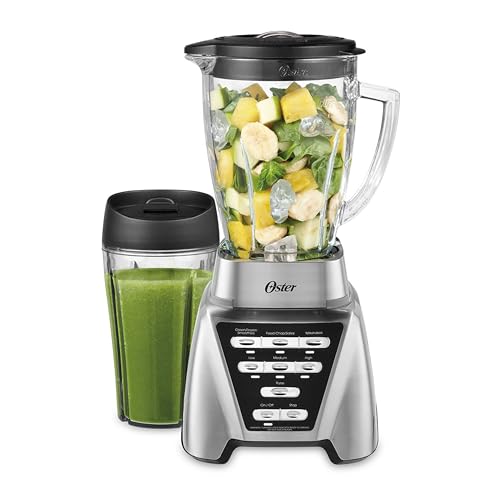
Oster Pro 1200 Blender with Glass Jar — Best Glass Jar for Hot Sauce
The Oster Pro 1200 is the glass route into serious sauce making at a mid tier. Glass is acid-proof and pigment-proof, and the dual-direction blade helps a thick mash start moving. It suits mid-budget sauce makers. It does not suit maximum seed destruction — its ceiling is a good rustic-smooth rather than paint-silk.
Strengths
- Glass jar: no staining, no acid worries, no flavour memory
- Dual-direction blade un-jams thick mashes automatically
- Mid-tier pricing for a genuinely sauce-capable machine
Trade-offs
- Seed breakdown is good, not elite
- Glass needs thermal-shock care with hot loads
- Smoothie cup is a cold extra — irrelevant to sauce work
| Spec | Detail |
|---|---|
| Jar | Glass |
| Controls | 7 speeds, Smart Settings |
| Blade | Dual-direction |
| Included | 24 oz smoothie cup |
The dual-direction feature is quietly perfect for sauce. A cooked pepper mash is thick and reluctant at the start; a blade that reverses rocks the load loose instead of drilling an air hole through it. Once moving, seven speeds give you a workable ramp for the hot start and enough top end for a respectable smoothness, especially if you blend a touch longer.
Glass discipline applies: warm the jar with hot tap water before a near-boiling load in a cold kitchen, and let it cool gradually before washing. Do that, and glass will out-serve plastic for sauce work, because the two things sauce does to jars — stain them and scent them — simply do not happen. For makers whose sauces range from mild to incendiary in the same jar, that neutrality is worth real money.
Best for: mid-budget sauce makers wanting a stain-proof glass jar / Not suited for: absolute-smoothness chasers
Check the current price on Amazon

KitchenAid K400 Variable Speed Blender with Tamper — Best for Thick Pepper Mashes
Some sauces start as a mash too thick to vortex — roasted peppers, minimal vinegar, big flavour. The K400’s tamper lets you work that mass into the blades without watering it down. It suits thick-mash makers. It does not suit huge batches; the jar is mid-size, which for sauce is usually right.
Strengths
- Tamper moves thick mashes without extra liquid
- Intelli-Speed holds pace as the mash thins
- Dial suits the careful hot start
Trade-offs
- Seed shattering is strong but below the top two picks
- Jar is plastic — pigment discipline required
- Presets are drink-oriented, not sauce-oriented
| Spec | Detail |
|---|---|
| Controls | 5-speed variable dial |
| Motor control | Intelli-Speed |
| Included | Tamper |
| Jar | 56 oz class |
Recipe ratios are sacred in sauce making: a mash that needs another splash of vinegar just to blend is a different, thinner sauce. The tamper removes that compromise — you physically fold the mass down and the blades take it from there, at the recipe’s own consistency. For roasted-pepper and chipotle-style sauces, that is the difference between following the recipe and negotiating with it.
Intelli-Speed earns its mention because a mash changes character mid-blend: stiff at the start, suddenly fluid once the peppers break. Motors that bog then surge produce uneven results; the K400 holds its speed through the transition, so the sauce’s texture is uniform from first bottle to last. Wash the jar promptly after sauce — hot water and soap immediately is what keeps a plastic jar honest in a sauce kitchen.
Best for: thick, low-liquid pepper mashes and roasted sauces / Not suited for: very large batches or steel-jar purists
Check the current price on Amazon

Ninja Professional Plus DUO BN751 — Best for Raw and Fresh Sauces
Fresh and raw sauces are where the BN751 shines: raw peppers, onion and garlic reduced fast and evenly, in big or small batches. One boundary, stated plainly: its pitcher is not the tool for near-boiling cooked sauce — blend cooked sauces after they cool somewhat, or choose a hot-rated pick above. Within that honesty, it is a superb fresh-sauce machine.
Strengths
- Stacked blades demolish raw pepper and onion evenly
- Cups suit small experimental sauce batches
- Auto-iQ keeps fresh salsa textures consistent
Trade-offs
- Not rated for near-boiling cooked sauces — cool them first
- Plastic pitcher will hold capsaicin and pigment over time
- Raw blends are coarser than cooked-blend silkiness
| Spec | Detail |
|---|---|
| Power | 1400 peak watts |
| Containers | 72 oz pitcher, two 24 oz cups |
| Programs | 3 Auto-iQ |
Raw sauce work is a chopping problem at blender scale, and stacked blades are a chopping answer: the column engages the whole pitcher height, so raw pepper pieces are cut repeatedly instead of bouncing. For fresh salsas, raw pepper relishes and uncooked sauce bases that will be cooked after blending, the texture is fast and even, and the cups let you prototype a new recipe in a 24 oz trial instead of committing a pitcher.
The hot boundary is not a flaw to hide but a workflow to plan: many sauce makers blend cooked sauces warm rather than boiling for flavour reasons anyway, and this machine handles warm work within its guidance. If your signature sauce goes from a rolling simmer straight into the jar, buy the Waring or the Vitamix. If your craft is fresh-first, this is your machine — just dedicate its pitcher to sauce duty, because capsaicin will move in permanently.
Best for: fresh and raw sauces, salsas and recipe prototyping / Not suited for: blending sauces straight off a rolling boil
Check the current price on Amazon

Blendtec Classic 575 — Best Big-Batch Sauce Machine
When the garden or the market delivers chillies by the crate, batch size becomes the whole game. The Classic 575’s big jar and blunt, undullable blade process sauce at harvest scale. It suits volume makers. It does not suit small test batches, which rattle around its jar.
Strengths
- Harvest-scale batches in a jar built for volume
- Blunt blade never dulls on seeds and skins
- Self-cleaning cycle is invaluable after pigmented sauce
Trade-offs
- Too much jar for a one-litre batch
- Loud during long sauce runs
- Plastic jar will take a permanent warm tint from heavy sauce use
| Spec | Detail |
|---|---|
| Jar | WildSide+ jar (90 oz total volume class) |
| Programs | Four preprogrammed cycles |
| Controls | 5 speeds |
| Cleaning | Self-cleaning |
Volume sauce making is a rhythm: simmer, blend, bottle, repeat, all afternoon. The 575 fits that rhythm — big loads, decisive cycles, a self-clean rinse between batches that keeps pigment from building. The blunt blade’s immunity to dulling matters across a season of seed-heavy blends; a sharp blade in September is not the blade you started with in July, but this one is.
Accept the jar’s fate honestly: a season of serious sauce will tint a plastic jar, permanently and harmlessly. Many harvest makers treat this machine as the dedicated sauce blender for exactly that reason, keeping a second, prettier machine for family smoothies. As a dedicated tool bought at a mid-premium tier, it earns its place every autumn.
Best for: harvest-scale and big-batch sauce making / Not suited for: small experimental batches
Check the current price on Amazon
Comparison Table
| Pick | Badge | Key spec | Best for |
|---|---|---|---|
| Waring Blade Blender BB300S (Stainless Jar) | Best Overall for Hot Sauce | 1.5 HP, 48 oz stainless steel jar, NSF certified | committed hot sauce makers blending hot, acidic batches regularly |
| Vitamix 5200 Professional-Grade Blender | Best for Silky Texture | 64 oz hot-rated container, vented lid, variable dial | silk-smooth cooked sauces and texture perfectionists |
| Oster Pro 1200 Blender with Glass Jar | Best Glass Jar for Hot Sauce | Glass jar, 7 speeds, dual-direction blade | mid-budget sauce makers wanting a stain-proof glass jar |
| KitchenAid K400 Variable Speed Blender with Tamper | Best for Thick Pepper Mashes | 5-speed dial, Intelli-Speed, tamper included | thick, low-liquid pepper mashes and roasted sauces |
| Ninja Professional Plus DUO BN751 | Best for Raw and Fresh Sauces | 1400 peak watts, 72 oz pitcher + (2) 24 oz cups, Auto-iQ | fresh and raw sauces, salsas and recipe prototyping |
| Blendtec Classic 575 | Best Big-Batch Sauce Machine | WildSide+ jar, 4 preprogrammed cycles, 5 speeds | harvest-scale and big-batch sauce making |
For cooked sauce off the boil: Waring steel first, Vitamix for ultimate smoothness, Oster glass for stain-proof value. For thick mashes: the K400’s tamper. For fresh and raw: the Ninja, with its hot limit respected. For harvest volume: the Blendtec.
How to Choose the Best Blenders for Hot Sauce
Start with your sauce style, because it dictates the machine. Cooked sauces blended hot require a hot-rated machine with a vented lid — non-negotiable. Thick mashes require a tamper or a reversing blade. Fresh and raw sauces require chopping power and forgive almost everything else. Most makers do at least two styles; buy for the most demanding one you do regularly, which is almost always the hot cooked sauce.
Jar material is the second decision, and for sauce it is close to a first. If the blender is shared with family food, steel or glass protects everyone from capsaicin ghosting. If the machine will live a sauce-only life, a hot-rated plastic jar is fine and lighter — just accept the tint as a badge of use. Batch size comes third: sauce batches are usually one to two litres, so mid-size jars are correctly sized, and giant jars are for harvest days only.
Seeds, Skins and the Pursuit of Smooth
A gritty sauce is almost always an under-blended sauce. Chilli seeds are hard and skins are elastic; both need sustained time at full speed, not a thirty-second burst. Plan on runs of a minute or more for cooked sauces, with the load hot — heat softens skins and helps them shatter rather than smear. If your machine’s texture plateaus above your standard, the remaining route is a fine strainer, at the cost of body and yield.
Order matters too: blend the sauce fully before any final seasoning adjustments, because texture changes perception of heat and salt. And if you add anything fresh and delicate at the end — a handful of herbs, a squeeze of lime — fold it in after blending, off the machine, so the blender’s heat and violence do not dull it.
Capsaicin Safety: Blending Chillies Without Gassing the Kitchen
Blending hot chillies, especially hot and cooked ones, puts capsaicin into the air. Work in a ventilated kitchen — window open, extractor on — and keep your face out of the direct steam path when the lid comes off. Let the jar rest for a minute after blending before opening; the worst of the aerosol settles quickly. These are small habits that separate a pleasant sauce day from an afternoon of coughing.
Skin and surface discipline completes the picture: gloves when handling the mash and the wash-up, and a dedicated scrub for the jar if it will return to family duty — or better, a jar material like steel or glass that releases capsaicin completely with hot soapy water. Label bottled sauce with heat level honestly; your future self, reaching into the fridge at midnight, will thank you.
How to Blend a Cooked Hot Sauce Smooth and Safe
The standard workflow for a cooked, blended hot sauce, tuned to the machines in this guide.
- Cook the mash fully first. Peppers, aromatics and liquid simmered until everything is soft — the blender finishes texture, but cooking creates the flavour and softens skins for shattering.
- Ventilate before you blend. Extractor on, window open. Capsaicin aerosol is the one genuinely unpleasant part of sauce making; arrange the kitchen so it leaves.
- Fill to the hot line. Hot sauce foams and expands like any hot liquid — two-thirds of the jar at most, less for frothy mashes. Blend in two batches rather than crowding.
- Start low, then commit. Ten seconds at low speed to let the steam surge vent, then straight to maximum for a full minute. Seed breakdown is a sustained-speed job.
- Rest, then open away from your face. A minute’s rest settles the aerosol and foam. Open the vent plug first, lid tilted away.
- Check texture on a cold spoon. Hot sauce looks thinner than it will be. A chilled spoon shows the true body — blend another thirty seconds if seeds still speckle it.
- Bottle hot, clean immediately. Fill bottles while the sauce is hot, then wash the jar at once in hot soapy water — capsaicin and pigment are easy now and stubborn tomorrow.
Keep a sauce log: pepper varieties and ratios, cook time, blend time, and your heat verdict a week later. Sauces mellow and marry in the bottle, so judging on blending day alone misleads. Two or three logged batches will teach you more about your peppers — and your blender’s true blend times — than any recipe written for someone else’s equipment.
Fermented vs Cooked vs Fresh: Three Sauces, Three Demands
Fermented sauces — peppers aged in brine, then blended — arrive at the blender cool or room temperature but saturated with acid and loaded with skins. Their demand is material tolerance and sustained blending: the acid argues for steel or glass, and the skins argue for the longest, fastest runs in home sauce making. Cooked sauces arrive hot, which adds the full hot-rated requirement — venting, fill discipline, graduated starts — on top of the same material and power demands. Fresh sauces arrive easy on temperature and hard on structure: raw skins and seeds that only serious chopping power handles evenly.
Most makers rotate through all three across a season, which is why this guide’s top picks are the machines strong at the demanding end — hot, acidic, sustained — since a machine that masters cooked and fermented work handles fresh work in its stride, while the reverse is not true. The Ninja’s inclusion for fresh work is the deliberate exception, badged and bounded, for makers whose craft genuinely lives at the raw end.
Bottling Day: From Blender Jar to Shelf
The blend is the midpoint of sauce making, not the end. Bottling hot sauce while it is still hot, into clean warm bottles, is the traditional home method for a good seal and a stable sauce; it is also the moment when jar choice pays out — a steel or glass jar pours predictably, and a jar with a proper lip does not dribble capsaicin down the bottle necks and onto your hands. Work over a tray, fill with a funnel, and cap promptly.
Then label like you mean it: pepper varieties, ratios, date, and a heat grade in your own honest scale. Sauces change in the bottle — heat integrates, sharp vinegar edges round off over the first weeks — so the verdict that matters is the one you record a month later, in the log this guide keeps recommending. The makers whose second season is dramatically better than their first are, without exception, the ones who wrote things down.
Troubleshooting Sauce Texture: Gritty, Thin, Separated
Gritty sauce is under-blended sauce, in nine cases out of ten: extend the full-speed run in thirty-second increments and re-check on a chilled spoon before reaching for the strainer. If grit persists at your machine’s ceiling, the load may be too dry — a spoonful of the cooking liquid or brine gives the blades a medium to work in and often unlocks the final smoothness. Thin sauce is a ratio problem, not a blending problem: more pepper solids per liquid, or a longer cook before blending, fixes what no blender can.
Separation in the bottle — a clear layer rising over days — means the emulsion was never fully built: blend longer, and blend hot, since heat helps the pepper solids and liquid unify. A sauce blended from a fully cooked, hot mash and given its full minute rarely separates. Each fault, notice, is diagnosed at the blender but cured in the process — which is why this guide treats technique as half the product, and why the strongest machine still rewards the maker who learns its behaviour.
Growing the Batch: From Hobby Jars to Case Quantities
Success creates its own problem: friends want bottles, then friends of friends. Scaling hot sauce is mostly a discipline of repetition — the same recipe in sequential batches rather than one heroic batch that overflows the jar’s hot line. The big-jar Blendtec in this guide exists for makers at that threshold, and the commercial Waring format is the next step beyond it, where batch rhythm becomes a small production line: simmer, blend, bottle, clean, repeat.
At every scale, the constraints in this guide still rule: hot fills stay conservative, venting stays respected, and the log stays written, because batch four must match batch one or the case is not a case. Makers who respect those constraints find the equipment in this guide scales gracefully from first jar to first case. Makers who chase volume past their jar’s honest limits meet the physics this whole cluster of guides is written about — usually on bottling day, at the worst possible moment.
Pepper Selection and What It Means for the Blend
Peppers decide the sauce; the blender reveals it. Thin-walled fresh peppers blend fast and need little cooking, but give a sauce with less body. Thick-walled peppers bring body and sweetness and demand longer cooking before the blend. Dried peppers, rehydrated, bring depth and a leathery skin that is the single hardest test of a blender’s sustained power — this is where the commercial and high-performance picks in this guide separate themselves from ordinary machines.
Seeds are a choice, not a fate: leaving them in adds bitterness some styles prize and demands more of the blend; removing them before cooking lightens the blender’s work and the sauce’s edge. Heat, contrary to folklore, lives mostly in the placental tissue rather than the seeds themselves — but for equipment purposes the point stands: a seeded batch blends noticeably easier. Choose per recipe, and let the log record what the machine was asked to do, so next season’s equipment judgements are based on your peppers, not generic ones.
Small-Batch Experimentation: Prototyping Without Waste
Sauce making advances by experiments, and experiments should be small. A new pepper ratio cooked down and blended in a two-cup batch teaches the same lessons as a full jar at a fifth of the cost in peppers and bottles. The cup-format machines and the mid-size jars in this guide suit that prototyping rhythm; even owners of the big harvest machines benefit from a small-batch tool for recipe development, because a failed experiment should cost a handful of peppers, not a crate.
Prototype with discipline: change one variable, blend it the same way, taste it after a rest, write it down. The sauces that become household signatures are rarely first attempts — they are third attempts with good notes. Your blender’s consistency is what makes the notes meaningful, which is another quiet argument for the well-built machines in this guide: a machine whose blend varies randomly makes experimentation impossible to read.
Heat Management in the Sauce Itself: Blending and Flavour
Blending changes a sauce’s perceived heat in ways worth understanding. A fully emulsified sauce coats the mouth evenly, so its heat arrives as a wave rather than as hot spots — the same peppers taste more powerful and more pleasant at once. Under-blended sauce, by contrast, delivers its capsaicin in bursts from unbroken tissue. This is why two batches from one recipe, blended differently, can seem like different sauces, and why your log should record blend time alongside the pepper list.
Heat also blooms over the first days in the bottle as flavours marry, then settles. Judge a new sauce twice — once on blending day for texture and salt, once a week later for its true character — and adjust the next batch on the second verdict. The blender’s consistency is what makes those verdicts comparable, which closes the loop on this guide’s core argument: in sauce making, the machine’s repeatability is a flavour ingredient.
Storing and Gifting: Jars, Bottles and Honest Labels
Hot sauce keeps well when it is bottled hot into clean bottles, sealed promptly and stored cool and dark — the acid that defines the style is also its preservative, and the blender’s job was to make that acid phase uniform throughout. Refrigeration after opening is the standing rule for home sauces, and a sauce that separates slightly in the fridge is cured by a shake, not by concern.
Gifting raises the labelling stakes: variety, date and an honest heat grade protect your friends and your reputation. Include the serving suggestion that flatters the sauce — the dish it was built for — because a great sauce used wrong tastes like a mediocre one. Makers who label well find their bottles requested by name, which is the moment a hobby becomes a small tradition, and the moment the equipment in this guide starts looking like the bargain of the kitchen.
Sauce Styles of the World, Mapped to This Guide’s Picks
Louisiana-style sauces — fermented or cooked peppers strained to a thin, bright pour — reward the machines that blend longest and smoothest, because straining after a thorough blend loses almost nothing: the Vitamix and the Waring lead here. Mexican salsas machas and cooked red and green sauces sit mid-texture, where the Oster’s glass neutrality and the KitchenAid’s tamper earn their badges. Caribbean pepper sauces, often built on raw or lightly cooked fruit-and-pepper bases, are the Ninja’s fresh territory, with its hot boundary respected by blending the cooked components warm rather than boiling.
Harissa-style pastes and thick chilli crisp bases are mash work — low liquid, high resistance — which is tamper and reversing-blade country. Asian chilli oils ask for coarse, controlled crushing rather than pureeing, the one job where you deliberately under-use these machines’ power. Reading a style and knowing which machine behaviour it wants is the sauce maker’s core skill; this guide’s badges are essentially that mapping, done once, in advance, for the styles home makers actually cook.
Your First Batch: A Confidence-Building Plan
Start your sauce making with a forgiving recipe: a cooked red sauce from roasted peppers, moderate heat, generous liquid. It exercises every skill in this guide — the hot fill, the graduated start, the full-minute blend, the rested opening — at stakes low enough to learn from. Taste it the next day, log the blend time and the result, and only then reach for the incendiary peppers and the fermentation jars.
By the third batch, the routine will feel ordinary, which is precisely when makers start skipping steps. Do not. Sauce making rewards the cook who treats batch thirty with the same respect as batch one, because the peppers do not know which batch it is. The machines in this guide will meet you at that standard for years; the plan above is how you meet them there.
Common Buying Mistakes
Blending cooked sauce in a cold-only pitcher. Hot, acidic, pressurised — the worst combination for a jar that was never rated for heat. Use a hot-rated machine or cool the sauce properly first.
Thirty-second blends and gritty sauce. Seeds and skins need sustained full-speed time. If your sauce is speckled, the answer is usually another minute, not a different recipe.
Opening the lid straight into your face. The steam above a fresh chilli blend is effectively pepper spray. Rest the jar, vent first, face away.
Sharing a scratched plastic jar between sauce and smoothies. Capsaicin ghosts into plastic and will ambush a mild smoothie later. Dedicate the jar, or choose steel or glass.
Adding vinegar to taste before blending is finished. Texture changes how heat and acid read. Finish the blend, rest the sauce, then season — ideally the next day.
Final Recommendation
For most serious sauce makers, the Waring BB300S is the right answer: steel, commercial power and a batch size that matches the craft. Texture perfectionists should choose the Vitamix 5200; glass-jar value hunters the Oster Pro 1200; thick-mash specialists the tamper-equipped KitchenAid K400; fresh-sauce makers the Ninja BN751 within its stated limits; and harvest-scale makers the Blendtec 575.
The hot cluster’s other guides: Best Blenders For Hot Liquids for the liquid-handling fundamentals, Best Blenders For Hot Soup for the soup end of hot blending, Best Blenders For Hot for the general hot category, and Best Blenders For Hot And Cold if your sauce machine must also crush ice for drinks.
Start with the Waring Blade Blender BB300S (Stainless Jar) if you want one machine that covers the brief without second-guessing. Its steel jar and commercial motor are precisely the tools this hostile, delicious job demands.
The closest alternative is the Vitamix 5200 Professional-Grade Blender: The texture king for sauce: sustained maximum speed turns seeds and skins into a glossy, unified sauce, with a vented lid and dial control for the hot start.
Frequently Asked Questions
Do I need a special blender for hot sauce, or will any strong one do?
Hot sauce combines heat, acid, pigment and long blend times, so the machine needs to be hot-rated with a jar that tolerates vinegar and a motor that sustains full-speed runs. A strong cold-only blender risks its jar and lid on the hot end and will absorb capsaicin flavour permanently. Any pick in this guide qualifies; a generic smoothie blender, however powerful, is a gamble.
How long should I blend hot sauce to get it smooth?
For cooked sauce, plan on a full minute at maximum speed as a starting point, and check on a chilled spoon. Seeds and skins are the last things to break down, and they need sustained speed rather than pulses. If texture plateaus with visible seed speckle after extended blending, a fine strainer is the remaining option — at some cost to body and yield.
Will hot sauce ruin my blender jar?
It will mark a plastic one: pigment tints it and capsaicin oils settle into scratches, flavouring later blends. That is cosmetic and flavour carryover, not structural ruin — many makers dedicate a plastic jar to sauce happily. Steel and glass jars wash back to completely neutral, which is why they lead this guide for shared machines.
Can I blend hot sauce while it is still boiling hot?
In a hot-rated machine, yes — with the standard hot discipline: fill to two-thirds at most, vent working, start low for the first seconds, then commit to full speed. Let a violent rolling boil settle for a minute first if the sauce is foaming heavily. In a cold-only machine, cool the sauce thoroughly before blending, without exception.
Why does my kitchen fill with chilli fumes when I blend?
Blending aerosolises capsaicin, and hot sauce makes it worse because steam carries it. Ventilate the kitchen, rest the jar for a minute after blending so the aerosol settles, and open the lid away from your face, vent plug first. It is the same compound as pepper spray at kitchen concentration — respect it and it is merely a sneeze; ignore it and sauce day becomes memorable for the wrong reason.
Should I strain hot sauce after blending?
Only if your texture target demands it and your blender has reached its ceiling. A powerful machine run long enough produces a smooth sauce with the seeds fully shattered, keeping the body and yield that straining removes. Try the extra minute of blending first — most sauces that seem to need straining simply need time.


