Disclosure: airfryerkitchensupply.com is reader-supported. When you buy through links on our site, we may earn an affiliate commission at no extra cost to you.
Where to buy
Shopping for the best blenders for eggs and cooking comes down to verified models and honest trade-offs. For cooking use, the exact configuration matters — jar material, tamper inclusion and program sets differ between look-alike models. Every linked pick below was verified. Use the links in this section, Quick Picks and each review to check price on Amazon before ordering.
- KitchenAid K400 Variable Speed Blender with Tamper, KSB4028 — check price on Amazon
- Breville Fresh & Furious BBL620, Silver — check price on Amazon
- Vitamix Propel Series 510, 48 oz, Black — check price on Amazon
- Oster Pro 1200, Glass Jar, 7 Speeds, Dual Direction Blade — check price on Amazon
- Hamilton Beach Wave Crusher 54221, 700W, 40 oz Glass Jar — check price on Amazon
- Ninja Professional Plus Blender BN701, 1400W peak, 72 oz — check price on Amazon
The best blenders for eggs and cooking are chosen for a broader job than smoothies: they are prep machines. Eggs are the entry point — blender omelettes, frittata bases, scrambled-egg mixtures with cheese and herbs folded in, pancake and waffle batters, Yorkshire pudding and popover batters that benefit from a rest after a thorough blend — but the same machine that handles eggs well is the one that emulsifies hollandaise and mayonnaise, purees soups, whips batters and turns a pan of roasted vegetables into a sauce. This guide ranks blenders as cooking tools, with eggs as the test that reveals control.
Eggs expose a specific weakness in blender design: too much power, applied carelessly, is a fault. Over-blended eggs foam, and foamy eggs cook up tough and spongy; batters over-worked develop gluten and turn pancakes chewy. The cook’s blender therefore needs low-speed finesse and pulse control as much as top-end power — the ability to combine in three pulses what a whisk does in thirty strokes, and to stop there. Every pick below was chosen for that range, from a gentle pulse to a full puree.
Honesty about scope: a blender does not cook eggs — it prepares them, faster and more evenly than hand whisking, and in quantities a whisk cannot match. Where a blender genuinely cooks is in friction-heated soups on the high-performance models, and that capability is noted where it exists. Everything else is prep, judged on how much better and easier it makes the cooking that follows.
In this guide
Quick Picks
Six verified machines ranked as cooking tools: control at low speed, emulsifying ability, batter handling and soup work. Badges match the full reviews.
- KitchenAid K400 Variable Speed Blender with Tamper, KSB4028 — Best Overall for Cooking: a dial-controlled cook’s blender — gentle pulses for eggs, real power for soups, and a tamper for thick mixtures. — Check on Amazon
- Breville Fresh & Furious BBL620, Silver — Best for Batters and Everyday Cooking: an even-blending, easy-cleaning everyday machine whose smooth results suit batters and egg mixtures. — Check on Amazon
- Vitamix Propel Series 510, 48 oz, Black — Best for Soups and Egg-Based Sauces: full Vitamix range in a 48 oz jar — from a gentle egg pulse to a steaming blended soup. — Check on Amazon
- Oster Pro 1200, Glass Jar, 7 Speeds, Dual Direction Blade — Best Glass Jar for Cooking: a glass-jar machine with a reversing blade — hot soups, batters and eggs without plastic-jar worries. — Check on Amazon
- Hamilton Beach Wave Crusher 54221, 700W, 40 oz Glass Jar — Best Budget for Cooking: a glass-jar budget workhorse whose Wave Action keeps egg mixtures and batters moving evenly. — Check on Amazon
- Ninja Professional Plus Blender BN701, 1400W peak, 72 oz — Best for Big Brunch Batches: a 72 oz stacked-blade pitcher for the cook feeding a crowd — frittatas, batters and smoothies at scale. — Check on Amazon
How These Picks Were Chosen
Picks were chosen for cooking range: precise low speeds and pulse for eggs and batters, sustained power for soups and purees, jar designs that emulsify reliably, and features cooks actually use — tampers, soup programs, glass jars where heat is involved. Every model was verified; only confirmed models carry buy links.
We weighted control over spectacle. A machine that can only run fast is a smoothie machine; a cooking blender must also fold, pulse and drizzle. Models were also assessed on the unglamorous cooking realities: whether the lid allows adding oil or eggs mid-blend, whether the jar pours batter cleanly, and whether cleaning after egg and cheese mixtures is a rinse or a project.
Egg-specific testing logic ran through the selection: omelette mixtures should emerge combined but not foamy, batter should pour lump-free, and emulsions should hold. Picks that foam everything they touch were excluded however powerful they were.
The 6 Best Blenders for Eggs and Cooking

1. KitchenAid K400 Variable Speed Blender with Tamper, KSB4028 — Best Overall for Cooking
The K400 is the most cook-minded machine in this guide. Its dial gives you the low, controlled speeds eggs and batters want, its Intelli-Speed control holds that speed steady as ingredients change the load, and the tamper handles the thick end of cooking — hummus, nut-based sauces, stiff batters — without stopping. It is a blender designed by people who appear to cook, and it shows in the details.
Key specs
- Controls: 5-speed variable dial, Intelli-Speed motor control (Amazon title)
- Programs: Ice Crush, Icy Drinks, Smoothie (Amazon title)
- Extras: Tamper included (Amazon title)
Strengths
- True low-speed control protects eggs and batters from foaming
- Tamper extends it to thick cooking mixtures
- Steady motor control keeps emulsions consistent
Trade-offs
- Drink-focused presets add little for cooking
- Less ultimate power than the flagship Vitamix models for soup volume
- Jar suits household cooking rather than catering batches
For eggs, the routine is three or four short pulses at the lowest speed: yolks and whites fully combined, cheese and herbs distributed, and no foam to ruin the set. Pancake and Yorkshire batters get ten seconds at low speed and a rest, emerging lump-free with the gluten barely woken. Hollandaise is where the K400 quietly shines — the steady low speed lets you drizzle butter into yolks at the pace emulsions demand, through a lid that accommodates the pour. Add soup capability that is entirely respectable and this is the cooking all-rounder to beat.
Best for: home cooks who blend as part of cooking, several times a week / Not suited for: anyone who only ever makes smoothies
Check the current price on Amazon
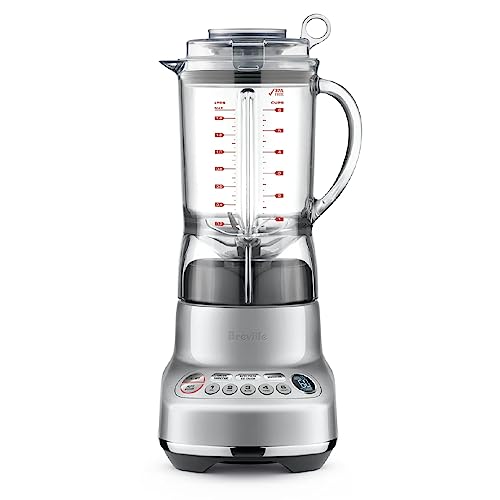
2. Breville Fresh & Furious BBL620, Silver — Best for Batters and Everyday Cooking
Breville’s Fresh & Furious earns its cooking place on evenness: its blade and jar design are tuned to pull ingredients through the cutting zone uniformly, which is exactly what batters and egg mixtures need — no pocket of unmixed flour at the bottom, no streak of white in the omelette. The auto-clean function then handles the aftermath of egg and cheese, the residues cooks least enjoy scrubbing.
Key specs
- Motor: High-torque (Amazon title)
- Controls: Multiple speed settings (Amazon title)
- Extras: Auto-clean function (Amazon title)
Strengths
- Even blending leaves no unmixed pockets in batters
- Auto-clean makes egg and cheese clean-up painless
- Balanced everyday size for family cooking
Trade-offs
- Less low-speed granularity than the KitchenAid dial
- Not a friction-heating soup machine
- Premium-mid tier pricing
Weekend cooking is this machine’s showcase: waffle batter without lumps, omelette mixtures for a full pan in one load, smoothie bowls and sauces in between. Its results are consistently described by owners as smooth in the specific way cooking wants — homogeneous rather than aerated — and that distinction is the whole game for eggs. If your blending is 70 percent cooking prep and 30 percent drinks, the Fresh & Furious proportions are right.
Best for: family cooks blending batters and eggs weekly / Not suited for: soup-focused buyers wanting friction heating
Check the current price on Amazon

3. Vitamix Propel Series 510, 48 oz, Black — Best for Soups and Egg-Based Sauces
The Propel 510 is the pick when cooking ambitions include the blender’s one genuine cooking trick: soups heated by friction alone, steaming in the jar. Its variable speed covers the egg end of the repertoire with the same authority — a low pulse for omelettes, a controlled ramp for hollandaise — and its 48 oz size is the practical sweet spot for sauces and family soups alike.
Key specs
- Container: 48 oz (Amazon title)
- Programs: 3 programs (Amazon title)
- Controls: Variable speed, pulse, self-cleaning (Amazon title)
Strengths
- Friction-heated soups: a real cooking function, not prep
- Full manual range from pulse to maximum
- Self-cleaning program suits egg and cheese residues
Trade-offs
- Power demands respect — one careless high-speed second foams eggs
- Premium tier
- Programs are drink-and-soup oriented; egg work stays manual
The cooking case for the 510 is range without compromise. Custard-based sauces, pureed soups, baby food, batters and eggs all live comfortably in the same jar, and the self-cleaning cycle means the machine is ready for the next job in a minute. Discipline is the only ask: learn the low end of the dial for eggs, because the top end is formidable. Cooks who master that range rarely want a second machine.
Best for: cooks wanting soups, sauces and eggs from one premium machine / Not suited for: set-and-forget users who dislike manual control
Check the current price on Amazon
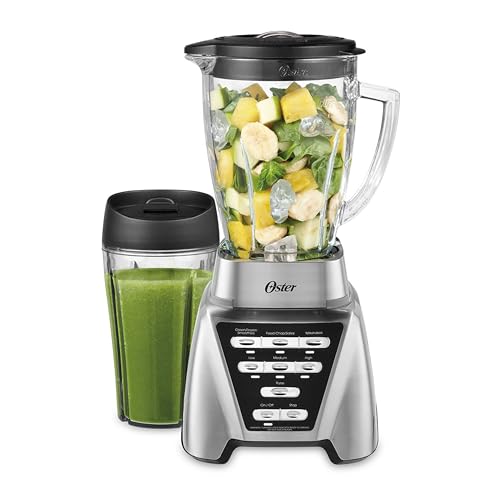
4. Oster Pro 1200, Glass Jar, 7 Speeds, Dual Direction Blade — Best Glass Jar for Cooking
Many cooks prefer glass for cooking work — hot soups, tomato sauces that stain, mixtures they want to watch — and the Oster Pro 1200 is the strongest glass-jar option here. Its dual-direction blade reverses to pull ingredients down, a genuinely useful trick for batters and egg mixtures that ride up the sides, and its seven speeds include the low settings eggs require.
Key specs
- Jar: Glass jar (Amazon title)
- Controls: 7 speeds, Smart Settings (Amazon title)
- Blade: Dual direction blade (Amazon title)
- Extras: 24 oz smoothie cup (Amazon title)
Strengths
- Glass jar suits hot and staining cooking loads
- Reversing blade keeps batters and eggs circulating evenly
- Includes a personal cup for small jobs and drinks
Trade-offs
- Glass is heavier and breakable — care in busy kitchens
- Not a friction-heating machine; soups are blended hot, not cooked
- Mid-range power ceiling on the thickest mixtures
The Pro 1200’s cooking rhythm is reassuringly traditional: low speeds that are truly low, a pulse that responds instantly, and a jar you can put hot soup into without a second thought. Egg mixtures come out even, batters pour cleanly from the glass lip, and the reversing action rescues loads that would need a spatula in other mid-range machines. For cooks whose blender lives beside the stove rather than the fruit bowl, this is the natural pick.
Best for: cooks who prefer glass and blend hot foods often / Not suited for: anyone wanting friction-heated soup or maximum power
Check the current price on Amazon

5. Hamilton Beach Wave Crusher 54221, 700W, 40 oz Glass Jar — Best Budget for Cooking
The Wave Crusher is the budget cooking pick, and its Wave Action system — designed to force ingredients down into the blades — happens to be exactly what egg mixtures and thin batters need at this tier. The 40 oz glass jar is the right size for a family omelette mixture or a batch of pancake batter, and the 14 functions include the gentle end of the range, not just smoothie violence.
Key specs
- Jar: 40 oz glass jar (Amazon title)
- Functions: 14 functions (Amazon title)
- Power: 700W (Amazon title)
- Blades: Ice Sabre blades (Amazon title)
Strengths
- Wave Action keeps light mixtures circulating evenly
- Glass jar at a budget tier is genuinely uncommon
- Right-sized for family egg and batter batches
Trade-offs
- 700W sets a ceiling: thick mixtures need help and patience
- No tamper for the stiffest jobs
- Plastic-era build feel compared with premium picks
Within its limits the Wave Crusher is a pleasure: scrambled-egg mixtures for four, crepe batter without a single lump, dressings and marinades, and smoothies on the side. Its limits are thick and frozen loads, where it asks for liquid and time. A cook whose blending is eggs, batters and sauces — precisely this article’s subject — may never meet those limits, which makes the Wave Crusher the smartest budget in this guide rather than merely the cheapest.
Best for: budget cooks whose blending is eggs, batters and sauces / Not suited for: thick-mixture or heavy frozen work
Check the current price on Amazon

6. Ninja Professional Plus Blender BN701, 1400W peak, 72 oz — Best for Big Brunch Batches
When the cooking job is volume — a frittata mixture for eight, waffle batter for a houseful, a pitcher of smoothies after — the BN701’s 72 oz stacked-blade pitcher is the tool. The stacked blades engage a full pitcher evenly, which is the big-batch problem most blenders fail: ingredients at the top that never meet a bottom blade. Used on pulse, it combines eggs for a crowd without turning them to foam.
Key specs
- Pitcher: 72 oz (Amazon title)
- Power: 1400 peak watts (Amazon title)
- Programs: 3 Auto-iQ presets (Amazon title)
Strengths
- Even blending at full-pitcher scale
- Auto-iQ convenience for drinks and frozen work
- Capacity suits brunch and batch cooking
Trade-offs
- Small egg batches are lost in the big pitcher
- Auto-iQ programs are too aggressive for eggs — use manual pulse
- Stacked blades need careful washing
The BN701 cooking method is pulse discipline: short bursts, check, one more if needed. Follow it and the big pitcher becomes a batch-prep asset — a week of smoothie packs, a double batter, soup for freezing. Ignore it and the same power foams eggs and overworks batter, which is why this pick is recommended to confident cooks rather than beginners. In the right hands it is the most productive machine here per pound spent.
Best for: big households and brunch-scale batch cooking / Not suited for: solo cooks making two-egg omelettes
Check the current price on Amazon
Comparison Table
| Pick | Badge | Key spec | Best for |
|---|---|---|---|
| KitchenAid K400 Variable Speed Blender with Tamper, KSB4028 | Best Overall for Cooking | Variable dial, tamper, Intelli-Speed | home cooks who blend as part of cooking, several times a week |
| Breville Fresh & Furious BBL620, Silver | Best for Batters and Everyday Cooking | High-torque motor, auto-clean | family cooks blending batters and eggs weekly |
| Vitamix Propel Series 510, 48 oz, Black | Best for Soups and Egg-Based Sauces | 48 oz, 3 programs, variable speed | cooks wanting soups, sauces and eggs from one premium machine |
| Oster Pro 1200, Glass Jar, 7 Speeds, Dual Direction Blade | Best Glass Jar for Cooking | Glass jar, 7 speeds, dual-direction blade | cooks who prefer glass and blend hot foods often |
| Hamilton Beach Wave Crusher 54221, 700W, 40 oz Glass Jar | Best Budget for Cooking | 40 oz glass, 700W, 14 functions | budget cooks whose blending is eggs, batters and sauces |
| Ninja Professional Plus Blender BN701, 1400W peak, 72 oz | Best for Big Brunch Batches | 72 oz, 1400 peak W, Auto-iQ | big households and brunch-scale batch cooking |
How to Choose a Blender for Eggs and Cooking
Low speed is the cooking specification
Smoothie guides worship maximum speed; cooking guides should worship minimum speed. Eggs, batters and emulsions are made at the gentle end of the dial, and a machine whose lowest setting is already violent will foam and toughen them. Look for true variable control or a responsive pulse, and treat them as the primary cooking features — power is the secondary one, needed for soups and purees.
Jar material: glass versus high-performance plastic
- Glass suits hot soups, tomato sauces and cooks who like to watch the mixture; it is heavier and breakable
- Modern blender jars on premium machines handle hot liquids well and survive drops; they can retain strong odours if neglected
- For eggs and batters specifically, either works — choose by your soup and sauce habits
- Whatever the material, a lid that lets you add ingredients mid-blend is essential for emulsions
The emulsion test
Hollandaise and mayonnaise reveal a cooking blender completely: the machine must hold a slow, steady speed while you drizzle fat through the lid in a thin stream. Dial-controlled and Intelli-Speed machines excel; program-only machines frustrate. If emulsions are on your menu, they should decide your pick.
Size for your real cooking
A 40–48 oz jar covers family cooking without wasting small loads; a 64–72 oz pitcher earns its place only if you genuinely batch-cook. Egg mixtures for two in a giant pitcher are the classic mismatch — the blades barely engage and the result is streaky. Honest sizing beats maximum sizing in a cooking blender every time.
How to Blend Eggs and Batters Without Ruining Them
The blender is faster than a whisk, which means its mistakes happen faster too. This method keeps eggs and batters on the right side of its power.
- For omelettes and scrambled eggs: add eggs, a splash of milk or water, and seasonings; pulse 3–4 times at the lowest speed — combined, not foamy
- Add cheese, herbs or cooked fillings after blending, and fold them in by hand so they keep their texture
- For pancake and waffle batter: blend wet ingredients first, add dry, then pulse just until no dry pockets remain — usually under 10 seconds
- Rest batters 10–30 minutes before cooking; the blend incorporates air and hydrates flour, and the rest repays you in texture
- For Yorkshire pudding and popover batter: blend thoroughly, rest at least 30 minutes, and give one gentle pulse before pouring into hot tins
- For hollandaise: blend yolks and lemon at low speed, then drizzle in warm butter in the thinnest stream the lid opening allows
- Clean promptly — egg residue left to dry is the hardest common film a blender jar ever grows
The governing principle is minimum effective blending. Every second beyond ‘just combined’ adds air to eggs and gluten development to batters, and neither can be taken back out.
What Else Does a Cooking Blender Actually Cook?
Beyond eggs, the cooking blender’s repertoire is wide: pureed soups (friction-heated on the Vitamix-class picks, blended hot on the rest), sauces from pesto to romesco, dressings and marinades, hummus and bean dips, breadcrumbs and crumb coatings, baby food, nut butters on the stronger machines, and frozen desserts from soft fruit. The picks in this guide were chosen to span that repertoire with control, because a blender bought for eggs will inevitably be asked for everything else — and a machine that foams an omelette mixture probably emulsifies a dressing badly too. Control is the transferable skill.
Care After Cooking: Eggs, Cheese and Heat
Cooking loads leave cooking residues. Egg and cheese films harden if left, tomato stains linger in plastic, and hot loads should never be sealed and stored in the jar. The routine that keeps a cooking blender pleasant is brief: rinse immediately, run the self-clean or a warm-water blend cycle where fitted, wash the lid’s underside and gasket — the forgotten zone where egg residue hides — and dry with the lid ajar. Glass-jar owners should avoid thermal shock: let a jar that held boiling soup warm down before it meets cold water. Two minutes of routine per use is the entire maintenance budget of every pick here.
Egg Dishes, One by One: What the Blender Does for Each
Omelettes and scrambled eggs
The blender’s gift to the omelette is uniformity: yolks and whites combined so completely that the finished eggs set in one even curd, with cheese and herbs distributed rather than pocketed. The discipline is brevity — pulses, not a cycle — and a minute’s rest for foam to settle if any formed. Scrambled eggs for a crowd are the same mixture scaled, and the blender is the only sane way to combine eighteen eggs identically. Add a spoon of water per two eggs for steam and softness; add nothing at all if you prefer a denser, French-style set.
Frittatas, quiches and strata
Here the blender becomes a bowl you can pour from. Frittata bases — eggs, dairy, cheese, seasoning — blend in seconds and pour over the fillings already in the pan, which keeps fillings where you placed them instead of stirring them into a stew. Quiche custards gain the same evenness, and a strata’s soaking mixture distributes itself through bread far more uniformly from a blender jug than from a whisked bowl. These are the dishes where a cooking blender quietly upgrades a cook’s whole brunch reputation.
Batters: pancakes, Yorkshire puddings, crepes
Blender batters share one rule — blend, rest, cook — and differ only in proportions. Pancake batter wants the least blending and a short rest. Yorkshire and popover batters want thorough blending and a long rest, ideally an hour, because their rise is steam and structure rather than raising agent. Crepe batter wants to be thin, lump-free and rested until the bubbles leave it. All three pour from the jug with a precision a mixing bowl cannot match, which is why cooks who start blending batters rarely return to the bowl for them.
Emulsions Masterclass: Hollandaise, Mayonnaise and Dressings
The blender emulsion is a small ceremony with strict physics. The yolks (or the egg, for mayonnaise) and the acid go in first and blend at low speed until pale. The fat then enters in a stream no thicker than thread — through the lid’s opening, at a pace that feels absurdly slow for the first third, when the emulsion is forming, and may quicken slightly once the mixture visibly thickens and turns glossy. Temperature is the silent variable: ingredients at room temperature emulsify willingly, while a fridge-cold egg and hot butter argue. If a hollandaise thickens too far, a teaspoon of warm water blended in restores it; if a mayonnaise splits, a fresh yolk in a clean jar, with the split mixture drizzled in as the ‘oil’, rescues it completely — a trick every blender owner should know before they need it.
Salad dressings are the everyday version of the same skill: a spoon of mustard as the emulsifying anchor, acid and seasonings next, oil drizzled last, and the result keeps for days without separating — a small weekly luxury that alone justifies counter space for the dial-controlled picks in this guide. Vinaigrettes shaken in jars separate by dinner; dressings emulsified in a blender are still unified on Friday. That difference, multiplied across a year of salads, is the cooking blender’s quietest and most persistent argument.
Cleaning and Storing a Blender That Cooks
Cooking blenders live harder lives than smoothie machines: they meet heat, fat, egg and cheese, and their maintenance should be equally grown-up. Beyond the immediate rinse this guide has already insisted on, give a cooking blender a weekly deep clean — hot water, a drop of soap, a full cycle, then a hand wash of the lid, gasket and pouring lip where films accumulate. Tomato and turmeric stains respond to an hour with a bicarbonate paste; protein films respond to an enzyme washing-up soak; smells — garlic dressings are the usual culprit — respond to a blend of water with a slice of lemon. Store the jar on the base with the lid ajar so seals dry and odours leave, and inspect the gasket monthly: it is the cheapest part on the machine and the one whose failure — a leak mid-soup — teaches owners to check it. None of this takes five minutes a week, and it is the entire difference between a cooking blender that stays pleasant for years and one that develops the faint, sad smell of old meals.
The Cooking Blender at Breakfast, Lunch and Dinner
Follow a cooking blender through one ordinary day and its value stops being abstract. Breakfast: pancake batter blended and rested while the pan heats, or an omelette mixture combined in four pulses for a pan that serves two identically. Lunch: yesterday’s roasted vegetables and stock become a soup — friction-heated on the premium pick, blended hot on the others — smoother than any the household has made by hand, with a dressing emulsified for the salad beside it. Dinner: a romesco or pesto from the jar, a marinade, a crumb coating, a hollandaise on a Saturday. None of these jobs is dramatic; together they are the difference between a kitchen where sauces come from jars and one where they come from ingredients, and that difference compounds across a year of eating more noticeably than any single showpiece recipe. This is why this guide ranks control above power: the cooking day is made of small, precise jobs, and the machine that does small jobs precisely is the one still on the counter in December.
Teaching a Household to Cook With the Blender
A cooking blender multiplies its value when more than one person can use it well, and the skills are few enough to teach in an afternoon. Teach the pulse before the program: three pulses for eggs, ten seconds for batter, stop and look — the habit of looking is the entire curriculum. Teach the drizzle for emulsions, slowly, with water and oil as a practice mayonnaise nobody has to eat. Teach the hot rules once, properly: modest batches, lid held, lowest speed first. And teach the rinse as part of every recipe, spoken in the same breath as the ingredients, so the machine is never the reason a cook avoids a sauce. Households that share these four skills find the blender stops being one person’s gadget and becomes kitchen infrastructure, like the good knife — used by everyone, respected by everyone, and missed immediately on the rare day it is out of service. That is the end state this guide is really recommending, and every pick in it can support it.
Sauces of the World, One Jar at a Time
The cooking blender’s passport is stamped in sauces. Romesco from roasted peppers, almonds and oil, blended to a rust-red roughness no shop jar imitates. Pesto in ninety seconds, with the basil kept bright by the machine’s speed rather than bruised by a knife’s patience. Chimichurri left deliberately coarse on pulses. Thai curry pastes — with the caveat that fibrous lemongrass tests every machine here and rewards the strongest — ground fine enough to fry properly. Mole’s long ingredient list homogenised into silk. Salsa verde, harissa, muhammara, aïoli: the list is a world tour, and every stop asks the same two things of the machine — the power to break down nuts, chillies and herbs, and the control to stop at the texture the sauce wants rather than the texture the motor prefers. That pair of demands is exactly the selection logic of this guide, and it is why the dial-led picks lead it: sauces are where cooking blenders stop being convenient and start being how a kitchen expresses itself.
Small Batches and Singles: Cooking for One With a Blender
Cooking for one has a reputation for sadness that the blender quietly refutes. A single omelette mixture is honestly a whisk’s job — this guide has said so — but the solo cook’s blender earns its place around that omelette: a soup from one carrot, one potato and stock, blended in the smallest pick’s jar and eaten from a mug; a sauce for one made from the end of a pepper and a handful of herbs that would otherwise have been binned; a pancake batter for one, blended, rested and poured without a bowl to wash. The format that serves this life is the mid-size jar — the K400’s class, the Oster’s glass, the Wave Crusher’s 40 ounces — big enough for a real soup, small enough that a single portion circulates. Solo households should resist both the giant pitcher, where single portions vanish, and the tiniest cups, where soup is impossible. Buy the middle, cook the repertoire in miniature, and the blender becomes the single cook’s sous-chef — silent, instant and entirely without opinions about portion size.
Buying Day Checklist for Cooking Blenders
The cooking checklist is a tour of your own menu. First, list the five things you will actually blend for cooking in the next month — if eggs and batters dominate, the dial-led picks lead; if soups dominate, weigh the friction-heating and glass-jar options; if crowds dominate, the big Ninja earns its pitcher. Second, test your hand’s preference: some cooks think in programs, most cooks think in dials and pulses, and the machine whose control matches your thinking will be used at its best rather than endured. Third, check the lid — can ingredients be added mid-blend, for the emulsion you will eventually attempt? Fourth, confirm the exact verified model, because tampers, jars and program sets vary between siblings with nearly identical names.
In the first week, run the three calibration jobs this guide has quietly been organised around. Eggs: one omelette mixture, pulsed, judged on the absence of foam. Batter: one pancake batch, judged on lumps and on the cook’s restraint. Emulsion: one mayonnaise or hollandaise, judged on whether the drizzle felt controlled. Those three jobs, passed, mean the machine fits your cooking; failed, they tell you exactly which technique to adjust before blaming the purchase — usually less speed, less time, more patience with the drizzle. Write the settings that worked on the recipe cards themselves. Future you, mid-recipe with wet hands, will be grateful.
Set the machine’s home beside the stove if cooking is truly its job, with its tamper, lid and jar together, and let it live there rather than touring the cupboards. Cooking tools are used in the middle of other tasks, with pans on heat and timers running; a blender that needs fetching is a blender that gets skipped, and the sauce comes from a jar that week. Proximity is a specification, and in a cooking kitchen it outranks several printed ones.
Finally, keep the standard this guide set at the start: minimum effective blending, every time. The cooking blender’s art is stopping — at combined, at glossy, at just smooth — and every pick here gives you the control to stop well. Buy the control that matches your hand, calibrate it on eggs, batter and an emulsion, park it by the stove, and it will repay you at the rate of several small rescues a week, which is how the best kitchen tools have always earned their keep.
A Note on Noise, Heat and Kitchen Reality
Cooking blenders work in the middle of cooking, which imposes two realities product pages omit. The first is noise at the wrong moment: a blender at full speed silences conversation, timers and the sound of a pan that needs attention, so the cook’s habit is to blend in the gaps — while the oven heats, while the batter rests, before the guests arrive — and to favour the picks whose low speeds are genuinely quiet, since most cooking blending happens at the gentle end where conversation survives. The second is heat in both directions: jars that have held hot soup should not be plunged into cold water, and cold jars should not receive boiling liquid without the manufacturer’s blessing and a vented lid. Glass tolerates the cook’s life best here, premium jars are rated for it explicitly, and every pick in this guide handles hot work within its stated guidance. Respect those two realities and the cooking blender integrates into the kitchen’s flow; ignore them and even the best machine becomes the appliance everyone works around. Integration, in the end, is the whole brief for a cooking tool — and it is achievable with any pick here, given a cook who blends in the gaps and minds the steam.
Common Buying Mistakes
Cooking-blender failures are almost always control failures, and they repeat in predictable ways.
- Blending eggs at full speed. You get foam, and foam cooks into sponges. Low pulses only — eggs need combining, not whipping, unless a recipe specifically says otherwise.
- Over-blending batter ‘to be safe’. Safety lies the other way: stop at just-combined and rest the batter. Extra seconds only toughen the result.
- Sealing a jar of hot soup with a tight lid and no vent. Steam pressure is real. Follow the manufacturer’s hot-liquid guidance, vent the lid, and never fill beyond the hot maximum line.
- Adding oil in a glug for mayonnaise. Emulsions need a drizzle. A glug breaks them, and no amount of further blending fully rescues a split mayo — start the drizzle again with a fresh yolk.
- Leaving egg mixture to dry in the jar. Dried egg film is the worst residue in this category. Rinse now; the machine’s self-clean cycle exists for exactly this.
- Using smoothie programs for cooking jobs. Programs are tuned for drinks. Cooking control is manual: dial, pulse, eyes on the mixture.
Master the low end of the dial and the rest habit, and a cooking blender becomes the prep tool you reach for daily — which is the entire point of buying one.
Final Recommendation
The KitchenAid K400 is the cooking recommendation for most households: control, tamper and steadiness in one dial-operated machine. The Fresh & Furious is the batter-and-family alternative, the Propel 510 adds friction-heated soups, the Oster Pro 1200 serves glass-jar cooks, the Wave Crusher proves eggs and batters do not require a premium budget, and the Ninja BN701 owns brunch at scale.
Choose by the cooking you actually do — eggs and batters weekly, soups monthly, crowds occasionally — and use the low end of the machine you buy. That is where cooking blenders earn their keep.
Ready to buy? Start with our top three: KitchenAid K400 Variable Speed Blender with Tamper, KSB4028, Breville Fresh & Furious BBL620, Silver, Vitamix Propel Series 510, 48 oz, Black — each link goes to the verified Amazon listing so you can check the current price and confirm the exact model.
Keep exploring the cluster: Best Blenders For Smoothies Best Blenders For Soups Best Blenders For Everyday Use Best Blenders For Crushing Nuts And Seeds Best Blenders For Dark Greens
Frequently Asked Questions
Is a blender better than a whisk for eggs?
For quantity and evenness, yes: a blender combines a dozen eggs uniformly in seconds and distributes cheese and herbs without streaks. For two eggs, a whisk is honestly faster including washing up. The blender’s advantage grows with batch size and with mixtures — frittatas, batters, quiches — beyond plain eggs.
Why did my blender omelette turn out spongy?
Foam. The eggs were blended too fast or too long, incorporating air that set into a sponge. Pulse briefly at the lowest speed until just combined, let any foam settle for a minute, and the texture returns to normal.
Can I make hollandaise in a blender?
Yes — it is one of the classic blender techniques. Blend yolks, lemon and seasoning at low speed, then drizzle warm melted butter in a thin stream through the lid. Steady low speed is the requirement, which is why dial-controlled picks lead this guide.
Can a blender cook soup, or only blend it?
High-performance models such as the Vitamix pick here genuinely heat soup by blade friction over several minutes, arriving steaming. Other blenders blend soup that you heat on the stove — and their jars, glass especially, handle the hot liquid well when you follow the hot-fill guidance.
Should pancake batter be blended or hand-mixed?
Either works if you respect the same rule: mix only until combined, then rest. A blender is faster and lump-free, but gives you mere seconds of margin — pulse, check, stop. Hand-mixing is more forgiving for beginners; the blender rewards a light touch.
How do I stop tomato sauce staining the jar?
Rinse immediately, wash with warm soapy water, and for established stains a paste of bicarbonate of soda left for an hour lifts most discolouration. Glass jars, like the Oster and Hamilton Beach picks, resist staining best of all.


