Disclosure: airfryerkitchensupply.com is reader-supported. When you buy through links on our site, we may earn an affiliate commission at no extra cost to you.
Where to buy
If you are shopping for the best blenders for company use, you are buying for an office kitchen or breakroom — a place where the machine must please everyone, survive everyone, and clean up easily enough that it never becomes a facilities complaint. Every pick below was verified against this site’s Amazon catalog data, and each links to its live listing so you can check price on Amazon and confirm the jars, cups and accessories in the box.
- KitchenAid Pure Power Blender KSB2078 (Best Overall for Offices) — Check the current price on Amazon
- Ninja Kitchen System Pro+ BR601AMZ (Best Versatile System) — Check the current price on Amazon
- Breville Fresh & Furious Blender BBL620 (Best Easy-Clean Pick) — Check the current price on Amazon
- Vitamix Propel Series 510 (Best Premium Compact) — Check the current price on Amazon
- Oster Extreme Mix Blender (Best for Office Gatherings) — Check the current price on Amazon
- Hamilton Beach Wave Crusher Blender 54221 (Best Budget for Breakrooms) — Check the current price on Amazon
The best blenders for company use live a strange double life. They are workplace equipment — bought by an office manager or a generous founder, installed in a breakroom, and used by everyone from the smoothie-devoted analyst to the colleague who will absolutely blend fish soup in it unless norms are established early. Company blenders need to be capable enough for real smoothies and frozen drinks, simple enough that nobody needs a manual or a training session, robust enough to survive cheerful misuse, and — the criterion that decides their fate — easy enough to clean that the office rule of ‘wash what you use’ actually holds.
This roundup is therefore not a smaller version of the commercial guide. A cafe blender optimizes for throughput; a company blender optimizes for harmony. The picks below favor intuitive controls, dishwasher-friendly parts, personal-cup options that keep individual mess individual, and price tiers an office can approve without a committee. There is a versatile system pick for the office that cooks together, a premium compact pick for the design-conscious workplace, an easy-clean pick for the office that fears the sink, and budget picks for the breakroom that just needs smoothies to happen.
One management note before the products: every successful office blender has a one-page norm taped near it — blend, wash or load immediately, no fish, no exceptions — and every failed one is a science experiment next to the microwave. The machines below were chosen to support the norm: nothing here requires disassembly gymnastics, specialist detergents or a designated blender officer to keep it civilized.
In this guide
Quick Picks
Six breakroom answers: a versatile pitcher-plus-cups system for offices that gather, a premium compact for small kitchens, an auto-clean specialist for cleanup-averse teams, a strong gathering-sized pick, and two budget-friendly workhorses.
KitchenAid Pure Power Blender KSB2078 — Best Overall for Offices. A 68 oz jar for the team smoothie round plus two 16 oz personal jars for individual use, on a 1700W peak platform with a simple precision knob. One machine covers both office modes: communal and personal, without a control panel anyone needs training on. Check price on Amazon.
Ninja Kitchen System Pro+ BR601AMZ — Best Versatile System. A 1200W system with a 72 oz pitcher, an 8-cup processor bowl and two 18 oz cups. For the office that does lunch clubs, soup days and salsa competitions alongside smoothies, this is the most kitchen-capable option here. Check price on Amazon.
Breville Fresh & Furious Blender BBL620 — Best Easy-Clean Pick. A high-torque blender with multiple speeds and an auto-clean function. In an office, auto-clean is not a luxury feature — it is the difference between a machine that gets cleaned and a machine that gets avoided, which is to say, between a perk and a problem. Check price on Amazon.
Vitamix Propel Series 510 — Best Premium Compact. A 48 oz professional-grade blender with three programs and self-cleaning, in a footprint smaller offices can spare. The programs make it foolproof for any employee, and the build quality suits a buy-it-for-years company purchase. Check price on Amazon.
Oster Extreme Mix Blender — Best for Office Gatherings. A 1500W blender with a 64 oz Tritan jar, a 10-point blade and auto programs with anti-jam technology. For the office party, the team celebration and the big smoothie morning, capacity and ice power are the whole brief — and this delivers both at a mid tier. Check price on Amazon.
Hamilton Beach Wave Crusher Blender 54221 — Best Budget for Breakrooms. A 700W, 40 oz glass-jar blender at a budget tier — the classic breakroom purchase. It makes perfectly good smoothies and shakes for a small team, the glass jar will not absorb the office’s collective smoothie history, and the price needs no one’s approval chain. Check price on Amazon.
How These Picks Were Chosen
Every pick was verified against this site’s Amazon catalog data, confirming jar and cup configurations, included accessories and control types against real listings. Company-specific criteria then reshaped the ranking: intuitiveness for untrained users, cleaning effort as a first-class feature, formats that separate personal mess from communal equipment, durability under cheerful misuse, and price tiers that fit office approval realities rather than household ones.
The distinction from the commercial guide was maintained deliberately. Company use is workplace use — breakrooms and office kitchens — not venue service, so duty-cycle heroics scored lower here and harmony features scored higher: auto-clean and self-clean functions, personal jars, simple knobs and programs, and jars that do not absorb a company’s worth of odors. A buyer who actually needs venue throughput should read the commercial guide instead; this list would underserve them and says so.
No workplace claims were invented: there are no productivity statistics, no wellness promises and no satisfaction figures in this guide, because none are verifiable and a blender is a perk, not a program. What experience supports — that easy cleaning decides whether shared appliances survive — is presented as reasoning, not as data.
The 6 Best blenders for company use — Reviewed in Detail

1. KitchenAid Pure Power Blender KSB2078 — Best Overall for Offices
The KitchenAid Pure Power leads the company list because its configuration matches office life exactly. The 68 oz jar handles the communal jobs — a round of smoothies for a team breakfast, frozen drinks for a Friday celebration — while the two included 16 oz personal jars let individuals blend their own without dirtying the big jar. The precision speed knob is the right interface for a shared machine: obvious, forgiving, and impossible to mis-program.
Strengths
- Pitcher plus personal jars cover communal and solo office blending
- Simple knob control needs zero training for any employee
- Strong motor handles ice and frozen fruit for group drinks
Trade-offs
- Premium-mid tier; an office purchase to approve, not an impulse
- Personal jars are two, not ten — heavy solo users may want their own
- Like all office machines, it depends on the wash-what-you-use norm
Key specs
- Motor: 1700 watts peak power as listed
- Jar: 68 oz blending jar
- Extras: (2) 16 oz personal blending jars
- Programs: Smoothie cycle, precision speed control knob
The dual-format logic is what makes this a company pick rather than a home pick wearing a badge. Most office blending is actually solo — one person’s morning smoothie — punctuated by occasional group events. Machines that only do the group format force every solo user to wash a big jar, which is how office blenders get abandoned. Personal jars keep the daily traffic light, and the pitcher stays clean and ready for the events that justify it.
Durability and manners suit the setting: the build feels appliance-grade rather than gadget-grade, the smoothie cycle gives a one-touch answer for the least technical user in the building, and the whole thing presents well in a kitchen clients might see. For the office that wants one purchase to settle the blender question for years, this is the complete answer in this roundup.
Best for: offices wanting one machine for team events and daily solo smoothies / Not suited for: tiny breakrooms with no counter for a full-size base
Check the current price on Amazon for the KitchenAid Pure Power Blender KSB2078.

2. Ninja Kitchen System Pro+ BR601AMZ — Best Versatile System
The Ninja Kitchen System Pro+ is the maximalist company pick: blender, processor and personal cups on one 1200W base. Offices with a real food culture — a lunch club that makes soup, a team that does taco days, a wellness program that runs smoothie mornings — will use the processor bowl as happily as the pitcher. The two 18 oz cups cover the solo smoothie traffic, making this the single most complete kitchen system in the roundup.
Strengths
- Pitcher, processor bowl and cups cover nearly every office food event
- 1200W base handles ice, doughs and chopping credibly
- Two cups keep daily solo blending off the big vessels
Trade-offs
- Many parts to store, track and keep together in a shared kitchen
- System complexity can intimidate the least kitchen-confident staff
- Replacement discipline matters: one lost lid degrades the whole system
Key specs
- Motor: 1200 watts
- Pitcher: 72 oz blending pitcher
- Processor bowl: 8-cup food processor bowl
- Extras: (2) 18 oz to-go cups
The processor bowl is the differentiator that justifies this pick for the right office. Salsa for a team lunch, dough for an office bake-off, chopped salads for a wellness week — these are the events that make a workplace kitchen a culture asset rather than a microwave queue. A blender-only machine watches those events from the counter; this system runs them. Offices that recognize their own social calendar in that sentence should shortlist it immediately.
The management cost is parts discipline: a shared system needs one storage home, a norm that everything returns to it, and an owner — an office manager or a rotating volunteer — who notices when a cup goes missing. Offices willing to run that light system get the most capable machine here; offices that know they will not should buy simpler and be happier.
Best for: offices with an active food culture and group cooking events / Not suited for: low-engagement breakrooms wanting a single simple appliance
Check the current price on Amazon for the Ninja Kitchen System Pro+ BR601AMZ.
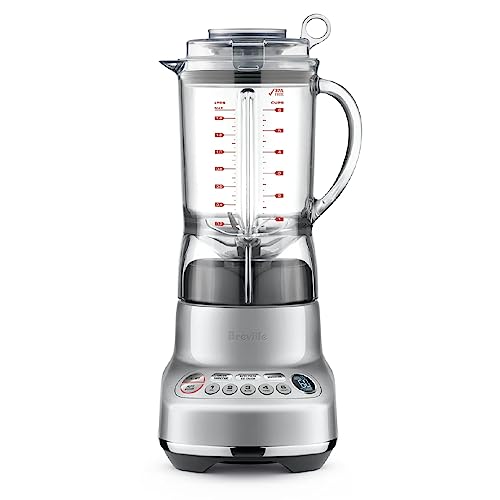
3. Breville Fresh & Furious Blender BBL620 — Best Easy-Clean Pick
The Breville Fresh & Furious earns its company badge on a single insight: the office blender’s true enemy is not weak blending, it is the unwashed jar. Its auto-clean function attacks that enemy directly — water, a drop of soap, a cycle, and the jar is credibly clean in under a minute, which is a routine even the busiest (or laziest) colleague can complete. Combined with a high-torque motor and straightforward speed settings, it is the most office-realistic machine in this roundup.
Strengths
- Auto-clean makes the wash-what-you-use norm genuinely achievable
- High-torque motor handles frozen fruit and ice for office smoothies
- Simple speed settings suit every confidence level
Trade-offs
- Mid-size format; not the pick for big office party batches
- Fewer included vessels than the system picks
- Premium-mid tier pricing among generalist blenders
Key specs
- Motor: High-torque motor
- Speeds: Multiple speed settings
- Cleaning: Auto-clean function
Consider the psychology this machine is designed around. An employee with four minutes between meetings will use a blender whose cleanup is a one-minute button press; the same employee will skip, indefinitely, a blender whose cleanup is a disassembly project. Multiply that decision across a company and a year, and auto-clean is not a convenience — it is the usage rate, the hygiene standard and the perk’s survival, all in one feature. The Fresh & Furious also blends properly, which matters, but its cleanability is why it is here.
Offices that have already killed one blender through neglect should start with this pick. Offices with a strong kitchen culture can trade up to the system or premium picks. Either way, the lesson generalizes beyond this model: in company buying, rank cleaning effort alongside blending power, because the office will experience the cleaning daily and the power occasionally.
Best for: offices where cleanup compliance decides whether a blender survives / Not suited for: large offices needing party-scale batches
Check the current price on Amazon for the Breville Fresh & Furious Blender BBL620.

4. Vitamix Propel Series 510 — Best Premium Compact
The Vitamix Propel 510 is the premium compact answer for company use: a 48 oz container that fits smaller breakroom counters and under-cabinet heights better than the big pitchers, three preset programs that make correct operation a single button for any employee, and self-cleaning that keeps the office norm easy to keep. It is the pick for the company that buys equipment the way it buys furniture — once, properly, for years.
Strengths
- 48 oz format fits small office kitchens and lower cabinets
- Three programs make staff-proof smoothies and frozen drinks
- Self-cleaning supports the office hygiene norm
Trade-offs
- Premium tier; the most expensive logic in this roundup per ounce
- 48 oz caps team batches at modest rounds
- No personal cups included for solo users
Key specs
- Container: 48 oz
- Programs: 3 preset programs plus pulse
- Speed control: Variable speed
- Cleaning: Self-cleaning program
The programs are the office feature hiding in plain sight. In a home, presets are a convenience; in a company, they are standardization — the smoothie tastes the same whether the intern or the CFO makes it, and nobody has to develop blender technique as a workplace skill. The variable speed remains for the office kitchen enthusiast, but the programs carry the daily traffic, which is exactly the right division of labor for shared equipment.
Choose this when the office is small, the counter is tight, the budget allows quality, and the expectation is a decade of service. It will not serve a fifty-person party in one batch and does not pretend to; it will make a small company’s daily smoothies beautifully and without drama, which is the actual job description of a company blender in most workplaces.
Best for: small offices wanting premium quality in a compact footprint / Not suited for: large offices blending for big groups
Check the current price on Amazon for the Vitamix Propel Series 510.

5. Oster Extreme Mix Blender — Best for Office Gatherings
The Oster Extreme Mix is the gatherings pick: when the office blends, it blends for a crowd, and this machine’s 64 oz jar, 1500W motor and ice-oriented design are built for rounds rather than servings. The iBlend auto programs simplify operation for whoever drew drink duty, and the anti-jam technology addresses the classic party failure of an overloaded jar stalling in front of an audience.
Strengths
- 64 oz jar and 1500W suit team-sized smoothie and frozen-drink rounds
- Auto programs simplify operation for rotating drink-duty staff
- Tritan jar is tough for busy, social kitchen use
Trade-offs
- Full-size footprint needs a real breakroom counter
- Overkill for an office whose blending is purely solo
- Gathering machines still live or die by the cleanup norm
Key specs
- Motor: 1500 watts
- Jar: 64 oz Tritan jar
- Blade: 10-point blade
- Programs: iBlend auto programs with anti-jam technology
Office gatherings have a specific blending rhythm: a big batch before people arrive, a second batch when the first vanishes, and a cleanup that somebody must own. This machine’s capacity shortens the production phase, its programs keep the second batch identical to the first, and its jar material tolerates the enthusiastic handling of a social kitchen. Assign the cleanup to the event organizer in advance — the machine does its part; the rota must do the rest.
For offices whose blender use is 80 percent events and 20 percent daily smoothies, this is a more honest fit than the personal-format picks. For the reverse ratio, it is a lot of machine standing idle. The ratio question, asked honestly, is the fastest route to the right company blender, and this pick owns the events end of it.
Best for: offices whose blending centers on team events and celebrations / Not suited for: solo-dominant breakrooms or minimal counters
Check the current price on Amazon for the Oster Extreme Mix Blender.

6. Hamilton Beach Wave Crusher Blender 54221 — Best Budget for Breakrooms
The Hamilton Beach Wave Crusher closes the list as the budget breakroom standard. Not every company needs a system or a premium compact; many just need smoothies to be possible in the kitchen, at a price an office manager can approve from petty discretion. The 700W motor and 40 oz glass jar cover fresh and lightly frozen smoothies, shakes and sauces for small teams, and the fourteen functions are simple enough for universal operation.
Strengths
- Budget tier fits an office manager’s no-approval purchase
- Glass jar resists stains and odors from varied users
- Simple functions; anyone in the company can operate it
Trade-offs
- 700W is modest; heavy frozen loads need smaller batches and patience
- Glass breakage is a real risk in a busy shared kitchen
- No personal cups; every use is a jar wash
Key specs
- Motor: 700 watts
- Jar: 40 oz glass jar
- Functions: 14 blending functions
- Blades: Ice Sabre blades
The glass jar deserves its office-specific praise: in a machine used by dozens of people for dozens of recipes, plastic records everything — the turmeric smoothie, the garlic dressing, the berry stain that never quite leaves. Glass starts each user at neutral, which in a shared appliance is a genuine hygiene and morale feature. The Wave Action system helps the modest motor keep everyday loads circulating, provided users add enough liquid and resist heroic ice loads.
Set the expectations on the one-page norm — reasonable loads, wash immediately, report chips or cracks — and this humble machine will serve a small company for years. Offices that outgrow it have learned their blending ratio from real use and can upgrade with data, which makes the budget pick a rational first purchase even for companies that could afford more.
Best for: small companies and first breakroom blender purchases / Not suited for: frozen-drink-heavy offices or large teams
Check the current price on Amazon for the Hamilton Beach Wave Crusher Blender 54221.
Comparison Table
For company use, compare the ownership experience first: who washes what, how big a group it serves, and how much training a new employee needs (ideally none). The key spec shown is each machine’s defining workplace asset.
| Pick | Badge | Key spec | Best for |
|---|---|---|---|
| KitchenAid Pure Power Blender KSB2078 | Best Overall for Offices | 1700 watts peak power as listed | offices wanting one machine for team events and daily solo smoothies |
| Ninja Kitchen System Pro+ BR601AMZ | Best Versatile System | 1200 watts | offices with an active food culture and group cooking events |
| Breville Fresh & Furious Blender BBL620 | Best Easy-Clean Pick | High-torque motor | offices where cleanup compliance decides whether a blender survives |
| Vitamix Propel Series 510 | Best Premium Compact | 48 oz | small offices wanting premium quality in a compact footprint |
| Oster Extreme Mix Blender | Best for Office Gatherings | 1500 watts | offices whose blending centers on team events and celebrations |
| Hamilton Beach Wave Crusher Blender 54221 | Best Budget for Breakrooms | 700 watts | small companies and first breakroom blender purchases |
How to Choose the Best Blenders for Company Use That People Actually Use
Start with your office’s blending ratio: mostly solo smoothies, mostly team events, or a real food culture that cooks. Solo-dominant offices should weight personal jars and easy cleaning; event-dominant offices should weight jar capacity and ice power; food-culture offices should consider the system pick with its processor bowl. The ratio is observable in a week of paying attention to your own kitchen, and it predicts satisfaction better than any review, including this one.
Then apply the harmony filters. Controls: could a brand-new employee make a smoothie correctly without asking anyone? Cleaning: is the full wash a one-minute routine or a five-minute project? Footprint: does the machine fit the breakroom you have, under the cabinets you have? Approval: does the tier fit the budget authority of whoever is buying? A blender that passes all four filters becomes infrastructure; one that fails the cleaning filter becomes a complaint with a power cord.
- Measure your solo-versus-group blending ratio before choosing a format
- Rank cleaning effort alongside power for any shared machine
- Prefer controls a new hire can use without instruction
- Fit the footprint to the real breakroom, cabinets included
- Keep the tier within the buyer’s actual approval authority
Office Kitchen vs Commercial Kitchen: Why the Buying Rules Differ
A commercial kitchen blends for customers, on a schedule, with trained staff and a revenue line attached to every cycle. A company kitchen blends for colleagues, opportunistically, with no training and no revenue — the currency is goodwill. That is why this guide rewards different virtues: not duty cycle and throughput, but forgiveness. Forgiving controls, forgiving cleaning, forgiving price when something breaks. A commercial flagship in a breakroom is not wrong exactly, but its strengths go unused while its complexity taxes every casual user.
The failure modes differ too. Commercial blenders die by wear; company blenders die by neglect — the unwashed jar, the lost lid, the mystery smell that makes the whole office quietly stop using it. Buying for a company means buying against neglect: fewer parts, easier washes, glass or self-cleaning where possible, and a one-page norm that the machine’s design makes easy to follow. Judge every candidate by asking not ‘how well does it blend?’ but ‘what will it look like in six months?’ — that second question is the company question.
What Are Fair Rules for a Shared Office Blender?
Four rules cover a healthy office blender culture. Blend what you like, within reason: smoothies, shakes, soups that are not fish-based, and nothing whose smell will colonize the floor — the fish rule sounds funny until the day it is needed. Wash or load what you used, immediately, every time, no ‘soaking’ fiction. Report damage the day it happens; a chipped jar replaced quietly is a small cost, while one discovered during someone’s smoothie is a small betrayal. And the machine’s spare parts — lids, cups, seals — live in one labeled drawer, not in the archaeology of the shared cupboard.
Enforcement should be social and light: a friendly one-page sign, a mention in the office onboarding, and good humor about the occasional lapse. The goal is a perk that feels like a perk. Companies that get this right find the blender becomes a small daily pleasure and an accidental culture asset — the smoothie round is where the team actually talks — which is worth more than the machine cost by an order of magnitude.
What Do Employees Actually Blend at Work? An Honest Inventory
Morning smoothies dominate, and they are the reason the machine exists in most offices: frozen fruit, yogurt, milk or a plant alternative, sometimes greens, sometimes protein powder, made in the ten minutes between arriving and the first meeting. Lunch adds the second wave — blended soups in cooler months (cooked elsewhere, blended smooth, reheated gently), dressings and sauces for the salad crowd, and the occasional hummus or dip for a team lunch. The afternoon belongs to iced coffee blends and the Friday frozen drink, which in many offices is the machine’s most beloved and least official function. A company blender that covers those three waves covers the real office menu, and any capability beyond them is surplus.
The wellness angle deserves a straight treatment, because it is often used to justify the purchase and just as often overstated. A breakroom blender does make it easier for employees to choose a smoothie over a pastry, and offices with smoothie cultures do report — anecdotally, cheerfully — that the machine gets people into the kitchen talking. What this guide will not claim is measurable health or productivity outcomes, because a blender is a perk, not a program, and perks justify themselves by being used and enjoyed. Buy it because people will like it; let any wellness benefit be a pleasant externality rather than a promised return.
There is also a hospitality function that offices discover by accident: the blender serves guests. A client who gets a proper smoothie or an iced coffee blend in your kitchen remembers the office as a place that does things well. Interview candidates notice the same signal. Small, well-kept perks communicate operational care in a way that mission statements cannot, which is a real if unquantifiable return on a modest purchase — provided, always, that the machine is clean when the guest sees it. The entire case collapses if it is not, which returns us, as every company-blender question does, to the wash.
How Do You Handle the Office Blender’s Inevitable Problems?
The smell event: somebody blends something ambitious — a garlic-heavy dressing, a protein experiment, once in every office’s history, fish — and the jar carries it for days. The recovery is procedural: immediate hot soapy wash, a baking-soda soak for the jar, the self-clean or auto-clean cycle where fitted, and a day of strong coffee-adjacent blending to re-season the machine’s reputation. The prevention is the one-page norm’s most important line, written before the event rather than after it, because a rule invented in response to a culprit feels like punishment and a rule that predates everyone feels like culture.
The disappearance problem: lids, cups and seals wander in shared kitchens with a reliability that suggests intent. The labeled drawer and named owner from the setup section are the systemic fix; the tactical fix is buying spares of the small parts at purchase time, when they are cheap and available, rather than discovering a discontinued lid’s price during a crisis. Companies should treat small parts the way IT treats charging cables: a known consumable, stocked without debate, replaced without a post-mortem.
The end-of-life question: eventually the machine dulls, leaks or simply dates, and an unowned decision becomes an unmade one, with the office blending around a zombie appliance for a year. The named owner’s monthly check exists to catch this moment, and the replacement decision should be informed by the office’s actual blending ratio learned from the first machine — most companies discover they blend more, and more communally, than they predicted, and buy one size up with confidence. That is the happy ending of the company blender story: a perk that proved itself, replaced without drama, in a kitchen that never once smelled of fish.
How Do You Get Buy-In to Buy a Blender for the Office?
Somebody has to propose the purchase, and proposals succeed when they are framed in the office’s own language. The weakest case is ‘a blender would be nice’; the strongest case is a short note that names the cost tier, the expected use — morning smoothies, team events, client hospitality — the placement, the cleaning system and the named owner, all in five lines. Decision-makers approve purchases whose risks have visibly been thought about, and an office blender’s risks are never the blending; they are the mess, the noise and the orphaned appliance in six months. A proposal that answers those three in advance, with the auto-clean or personal-jar logic from this roundup and a one-page norm attached, is a proposal that gets a yes while vaguer requests for nicer things are still circulating.
The funding route matters too. Some offices buy from a facilities or kitchen budget as standard equipment, which is the cleanest path and the one this guide’s mid-tier picks are sized for. Some use a wellness or culture budget, where the honest framing is enjoyment and kitchen culture rather than promised health outcomes. Some split the cost among the team members who will actually use it — the founders’-office and small-startup pattern — which has the side benefit of instant buy-in: people who paid for the blender wash the blender. Each route has a natural tier in this roundup, from the petty-cash budget pick to the premium compact, and matching the tier to the route is most of the politics.
After the yes, the launch is a small event worth doing properly: the machine installed with its norm taped up, a first smoothie round made for the team by the proposer, and the parts drawer labeled before the box hits recycling. Launches create the usage norm in a single afternoon — everyone sees the machine used correctly and cleaned immediately, by the person who championed it, and that image becomes the office’s template. Perks launched carelessly start life as clutter; perks launched deliberately start life as culture. The blender does not know the difference, but the office will, for years.
Office Blender vs Office Coffee Machine: What Does Each Do for a Workplace?
Offices often fund one ‘kitchen perk’ at a time, and the blender-versus-coffee question is worth answering plainly because the two machines do different cultural work. The coffee machine serves a habit that already exists: it is fuel infrastructure, used in private moments, judged on reliability and speed. The blender creates a habit that did not exist: it gathers people, it is used in small social groups as often as alone, and it is judged on the experience — the smoothie round, the Friday frozen drink, the team lunch it enables. A company choosing between them is really choosing between supporting the workforce’s existing rhythm and adding a new, more social one, and the right answer depends on which of those the office currently lacks.
In practice, the machines complement rather than compete, and the offices happiest with both sequence them sensibly: coffee first if no coffee provision exists, because caffeine is load-bearing in a way smoothies are not; blender next, when the kitchen graduates from fuel station to social space. The blender’s case strengthens with every sign that the kitchen is becoming a gathering place — team lunches, celebrations, clients hosted on site — and weakens in offices where the kitchen is a corridor with a microwave. Read your own office honestly on that spectrum and the purchase order writes itself.
There is a budget asymmetry worth noting in the blender’s favor: its running costs are the users’ ingredients, not the company’s consumables, and its maintenance is a wash rather than a service contract. As perks go, it is close to a one-time purchase with a permanent half-life of goodwill — provided, for the last time in this guide, that somebody owns the one-page norm and the machine stays clean. A clean blender beside a good coffee machine is a small kitchen that punches far above its square footage, and employees can tell the difference within a week.
How to Set Up an Office Blender Station That Stays Civilized
Fifteen minutes of setup at installation decides whether the company blender is a perk or a problem by the end of the quarter.
- Choose the spot with the sink in mind: Place the blender near the sink and the dishwasher, not across the kitchen. Every step between blending and washing is a probability that washing does not happen.
- Tape up the one-page norm: Blend freely, wash or load immediately, no fish, report damage. Signed by nobody, owned by everybody, written with humor so people actually read it.
- Label the parts drawer: One drawer or box, labeled, holding spare lids, cups and the manual. Shared appliances lose parts to entropy; a labeled home is the countermeasure.
- Stock the starter kit: A bottle brush, dish soap and a small towel live at the station permanently. Cleaning tools that must be fetched are cleaning that will be skipped.
- Name an owner: One person — office manager or rotating volunteer — checks the machine monthly, orders the replacement seal, and retires the chipped jar. Ownership is what separates maintained equipment from archaeology.
- Review after one quarter: Ask around: is it used, is it clean, is it big or small enough? Adjust the norms or the machine while the perk is still young enough to save.
The setup is deliberately boring, because boring is what working perks look like. A company blender that nobody has to think about — because it is clean, complete and obvious to use — is the entire goal.
Common Buying Mistakes
Buying a commercial machine for a breakroom. Venue equipment in an office is complexity without payoff: louder, fussier and harder to clean than the harmony-optimized machines a company actually needs. Match the machine class to the setting.
No written norm, ever. Unwritten office rules are enforced by resentment, which is the worst enforcement mechanism available. One page, taped up, with humor — that is the whole policy, and it works.
Ignoring the cleaning reality. If the wash routine is a project, the office will not do it, and the blender will die by grime within a quarter. Auto-clean, self-clean and dishwasher-safe parts are survival features here.
Losing parts to the shared cupboard. A missing lid quietly disables a shared machine for everyone. A labeled parts drawer and a named owner keep the system complete.
Buying party capacity for a solo office. A giant jar in an office of solo smoothie drinkers means every user washes a giant jar. Match capacity to the real ratio of solo to group blending.
Final Recommendation
For most companies, the KitchenAid Pure Power settles it: one machine, both formats, no training, years of service. Offices with a food culture should take the Ninja system; offices with a cleanup problem should take the Breville; small premium offices should take the Vitamix 510. If your need is actually venue service rather than workplace perks, step over to Best Blenders For Commercial Use — and for the specialty thick-blend case, Best Blenders For Commercial Acai Bowls.
Finish the picture with Best Blenders For College Living for the shared-kitchen lessons that transfer directly, Best Blenders For Couples for the two-person version of the same harmony problem, and Best Blenders For Coffee Beans for the breakroom’s other great debate. Buy for harmony, write the one-page norm, and the blender will be the easiest perk your company ever bought.
If you want the short version, start with these three:
- KitchenAid Pure Power Blender KSB2078 — check price on Amazon
- Ninja Kitchen System Pro+ BR601AMZ — check price on Amazon
- Breville Fresh & Furious Blender BBL620 — check price on Amazon
Frequently Asked Questions
What is the difference between a company blender and a commercial blender?
Setting and purpose. A commercial blender serves customers in a venue, with trained staff and revenue attached to its uptime, so it optimizes for duty cycle and throughput. A company blender serves colleagues in a workplace kitchen, with no training and goodwill as the currency, so it should optimize for simplicity, easy cleaning and forgiveness. Buying one class for the other’s job disappoints in both directions.
How powerful does an office blender need to be?
Powerful enough for the office’s real drinks: frozen-fruit smoothies and ice for celebrations cover most workplaces, which mid-to-strong household-class machines handle well. Offices blending only shakes and fresh smoothies can buy down. The binding constraint is rarely power — it is whether people keep the machine clean enough to keep using.
How do we stop the office blender from becoming disgusting?
Design and norms together: choose a machine with auto-clean, self-clean or dishwasher-safe parts; place it beside the sink; tape up a one-page wash-immediately norm; keep a brush and soap at the station; and name an owner who checks it monthly. Shared appliances fail through deferred cleaning, so every element aims at removing the deferral.
Should the company buy personal cups or one big jar?
Both formats serve different traffic. Daily solo smoothies are cleaner and kinder in personal jars, while team events need a pitcher. Machines that include both — or an office that pairs a pitcher blender with a few personal cups — match real office life best. Solo-only offices can skip the big jar; event-heavy offices cannot.
Who should own and maintain the office blender?
Name one person — typically the office manager, or a rotating volunteer — to check it monthly, keep spare lids and seals in a labeled drawer, and retire damaged jars. Unowned shared equipment decays by default; a light ownership touch is the entire maintenance strategy most office blenders need.
What should an office blender cost?
Whatever tier fits the buyer’s approval authority and the office’s blending ratio — there is no virtue in a committee-approved flagship for a breakroom that blends twice a week, and no economy in a fragile budget machine for an office that blends daily. This roundup spans budget to premium-compact so the purchase can match the workplace honestly.


