Disclosure: airfryerkitchensupply.com is reader-supported. When you buy through links on our site, we may earn an affiliate commission at no extra cost to you.
Where to buy
Here is where to buy the best blenders for chopping ice recommended in this guide. Every blender below is sold on Amazon, and each linked model was matched against Amazon’s catalog data before inclusion. Chopping ice is a pulse-and-control job, so confirm the exact controls, jar and any ice-specific features in the listing before ordering, and check price on Amazon when you buy. If your ice is destined for cocktails and snow cones, start with the KitchenAid K400 and the Margaritaville; if it is for smoothies, any pick here will serve.
- KitchenAid K400 Variable Speed Blender with Tamper — Best Overall. Check the current price on Amazon before you order, because blender pricing and bundle contents change often.
- Margaritaville Bahamas Frozen Concoction Maker DM0500, 36 oz — Best for Shaved-Ice Drinks. Check the current price on Amazon before you order, because blender pricing and bundle contents change often.
- Ninja Professional Blender 2.0 BR201AMZ, 1200W — Best Auto-iQ Convenience. Check the current price on Amazon before you order, because blender pricing and bundle contents change often.
- Vitamix 5200 Professional-Grade Blender, 64 oz — Best Manual Control. Check the current price on Amazon before you order, because blender pricing and bundle contents change often.
- Oster Classic Series 8-Speed Blender, 700W — Best Budget. Check the current price on Amazon before you order, because blender pricing and bundle contents change often.
- BLACK+DECKER Countertop Blender BL2010BG, 6-Cup Glass Jar — Best Basic Glass Jar. Check the current price on Amazon before you order, because blender pricing and bundle contents change often.
If you are comparing the best blenders for chopping ice, you are after a different result from the frozen-drink crowd: distinct, even ice fragments — the coarse, crunchy bed under a julep, the shaved mound in a snow cone, the cracked ice in a swizzle — rather than ice blended invisibly into a drink. The best blenders for chopping ice are chosen for control: a pulse that fractures without pulverizing, speeds low enough to stop at fragments, and jars that tumble cubes so every piece meets the blades before any piece turns to slush.
The failure mode of ordinary blenders at this job is a layered mess: powder at the bottom, whole cubes at the top, and a watery melt beginning before you even serve. It happens because a continuous high-speed cycle over-works the ice nearest the blades while the rest rides untouched. Chopping is therefore a technique category as much as a power category, and this guide weights pulse quality, speed range and jar tumbling as heavily as motor strength.
We verified every pick against Amazon’s catalog data, and the list deliberately includes one genuine specialist — a frozen concoction maker that shaves ice by design — alongside countertop blenders whose controls suit the chopping method. Our companion guide covers blending ice into drinks; this one is about ice that stays ice, in pieces, on purpose. We print no prices and no fixed ratings, because both change too often to trust; check price on Amazon when you are ready.
In this guide
Quick Picks
The short list: the KitchenAid K400 leads with its dedicated Ice Crush preset and tamper. The Margaritaville Bahamas is the shaved-ice specialist for drinks, the Ninja BR201AMZ brings Auto-iQ convenience, the Vitamix 5200 gives manual masters total control, the Oster Classic is the budget pulse classic, and the BLACK+DECKER is the basic glass-jar option.
- Best Overall — KitchenAid K400 Variable Speed Blender with Tamper: A variable-speed blender whose preset programs include a dedicated Ice Crush setting, with a tamper in the box. The preset’s pulse-and-ramp pattern is essentially the chopping method automated, producing even fragments instead of the usual powder-and-cubes layering.
- Best for Shaved-Ice Drinks — Margaritaville Bahamas Frozen Concoction Maker DM0500, 36 oz: A dedicated frozen drink machine with a 36 oz jar that shaves ice from a reservoir and blends it to a programmed consistency. It does one category of job — shaved-ice drinks — with a consistency no general blender quite matches.
- Best Auto-iQ Convenience — Ninja Professional Blender 2.0 BR201AMZ, 1200W: A 1200W blender with a 72 oz pitcher, Total Crushing blades and Auto-iQ programs. Its programmed cycles and stacked blades produce fast, even crushed ice for big drink batches, and the pitcher size suits households that chop for a crowd.
- Best Manual Control — Vitamix 5200 Professional-Grade Blender, 64 oz: The classic Vitamix with a 64 oz container, a full variable-speed dial and a high-speed switch. For chopping, that dial is the instrument: low-speed bursts fracture cubes coarsely, and your hand — not a program — decides the exact fragment size.
- Best Budget — Oster Classic Series 8-Speed Blender, 700W: A 700W, 8-speed blender with a 6-cup jar, a Crush Pro 4 blade and an all-metal drive. Generations of home bartenders have chopped ice on exactly this class of machine: pulse, look, pulse again — simple controls that suit the job’s stop-and-check rhythm.
- Best Basic Glass Jar — BLACK+DECKER Countertop Blender BL2010BG, 6-Cup Glass Jar: A countertop blender with a 6-cup glass jar and ten speed settings. For buyers who want glass and simple, granular speed choices for pulse-chopping — without paying for programs they will never use — this is the straightforward option.
How These Picks Were Chosen
Every pick was verified against Amazon’s catalog: searched by brand and model, matched against the returned listing title, and only then linked. Specifications in the spec boxes — jar sizes, program names, drive materials — come from those verified listings, and figures a listing did not state were not invented.
Selection criteria were specific to chopping rather than blending. We weighted pulse and speed control first, because fragment size is decided by stopping, not by power. Jar tumbling and anti-layering design came second — presets with pauses, stacked blades, tampers and vortex geometry all fight the powder-and-cubes problem differently. Drive durability under impact came third, which is why an all-metal drive earns a budget pick its place.
We included one dedicated shaver because for frozen drinks it is honestly the best tool, while stating clearly that it cannot do coarse textures or general blending. We print no prices and no fixed ratings in this guide, because both change too often to trust; check price on Amazon when you are ready to buy.
The 6 Best Blenders for Chopping Ice, Reviewed
Badges match the Quick Picks. Each review names the texture that machine produces best — shaved, crushed or cracked — because in this category the texture is the purchase.

KitchenAid K400 Variable Speed Blender with Tamper — Best Overall
The K400 leads this list because chopping ice is a control problem, and this is the control machine. Its verified Ice Crush preset runs the exact pattern an experienced hand would pulse manually — bursts that fracture, pauses that let fragments redistribute, ramps that finish evenly — so the jar comes out as uniform crushed ice rather than a geology lesson. The included tamper handles the one failure the preset cannot: a corner of cubes bridged above the blades.
It is also a genuinely good everyday blender with a variable-speed dial, so the purchase does not live or die on ice alone. For the home bartender whose crushed ice underpins juleps, cobblers and tiki drinks, this is the most repeatable route to the texture those drinks demand.
Strengths
- Dedicated Ice Crush preset automates the fracture-pause pattern
- Tamper collapses bridged cubes without stopping the cycle
- Variable speed covers everything from coarse chop to full snow
Trade-offs
- Mid-size capacity; party volumes take several cycles
- Preset texture is a house style — perfectionists may still hand-pulse
- Premium-mid pricing above the basic choppers
| Programs | Preset recipe programs including Ice Crush (verified in Amazon title) |
| Accessories | Tamper included (model KSB4028) |
| Controls | Variable speed dial plus presets |
| Finish | Contour Silver |
The preset’s pauses deserve explanation, because they are the whole trick. When a burst ends, fragments fall and cubes roll into new positions; the next burst therefore fractures fresh surfaces instead of grinding the same bottom layer into powder. That redistribution is what ‘even’ means in crushed ice, and it is why the K400’s output suits drinks served over the ice itself, where inconsistency is visible and tasted.
For snow-cone fineness, run past the preset on the dial and the same machine obliges; for the coarsest cracked ice, stop the preset early. One caution from the category’s physics: work in batches you can serve promptly, because chopped ice begins welding itself back into clumps as it melts and refreezes at the edges. The machine gives you texture; the clock is yours to beat.
Best for: home bartenders who want repeatable, even crushed ice without manual fuss / Not suited for: huge party volumes in a single cycle
Check on Amazon — check price on Amazon for the current bundle and jar options.
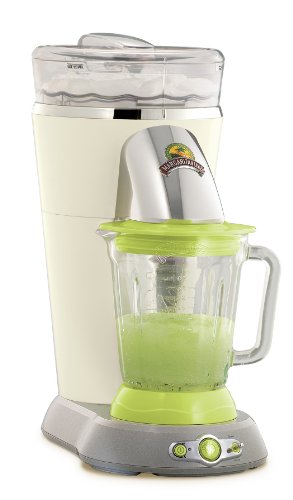
Margaritaville Bahamas Frozen Concoction Maker DM0500, 36 oz — Best for Shaved-Ice Drinks
The Margaritaville Bahamas is not really a blender that chops ice; it is an ice shaver with a blender attached, and for frozen drinks that distinction is everything. Ice goes into the reservoir as cubes and is shaved — planed into fine, snow-like flakes — before it ever meets the liquid, which is why its margaritas and daiquiris have that smooth, restaurant texture with no surprise chunks and no powdery bottom layer.
Choose it if your ice chopping exists to serve frozen drinks at home, especially for guests, where its programmed consistency turns the host into a bartender who can repeat a drink exactly. It will not help your smoothies, soups or sauces, and it does not pretend to; it is a specialist, proudly.
Strengths
- Shaves ice before blending for the smoothest frozen-drink texture here
- Programmed consistency repeats drinks exactly for guests
- Purpose-built reservoir workflow is fast at parties
Trade-offs
- Single-purpose: frozen drinks only, no general blending
- Shaved texture only — it cannot give you coarse cracked ice for juleps
- 36 oz jar and a novelty footprint to store
| Jar | 36 oz (verified in Amazon title) |
| Model | DM0500 Bahamas |
| Format | Frozen concoction maker with ice-shaving reservoir |
The shaving mechanism reframes the whole problem: instead of fracturing cubes inside a chaotic jar, it planes them in a controlled feed, so every flake is born the same size. Blending then becomes mere mixing. The result is the most uniform frozen-drink texture in this guide, and the most forgiving for beginners, because there is no pulse technique to learn and no layered failure to avoid.
Its limits are the honest price of specialization. Coarse textures are beyond it, dry snow-cone work is not its design, and it earns counter space only in homes where frozen drinks are a real ritual. In those homes — the pool deck, the tiki shelf, the Friday margarita tradition — nothing else here makes the drink as effortlessly, and we recommend it to exactly those readers without hedging.
Best for: frozen-drink households and hosts who value repeatable party texture / Not suited for: general blending, coarse crushed ice or small kitchens
Check on Amazon — check price on Amazon for the current bundle and jar options.

Ninja Professional Blender 2.0 BR201AMZ, 1200W — Best Auto-iQ Convenience
The BR201AMZ brings Ninja’s stacked-blade approach to the chopping job with more power and capacity than the classic BL610: 1200W, a 72 oz pitcher, and Auto-iQ programs that pulse and pause intelligently. The blade column engages cubes at several heights, which fights the layering problem mechanically, and the programs fight it temporally — together they produce crushed ice even enough for drinks at family scale.
This is the pick for the household that chops ice as part of general drink production — smoothies with real body, frozen lemonades, big pitchers for the table — and wants the machine to manage the cycle while they handle the glasses.
Strengths
- Stacked blades engage ice throughout the pitcher height
- Auto-iQ programs automate pulse timing for even results
- 72 oz pitcher handles crowd-size batches
Trade-offs
- Programs aim at drink textures; the coarsest cracked ice still wants manual pulsing and an early stop
- Stacked blades are sharp in the wash
- Plastic pitcher only
| Motor | 1200W (verified in Amazon title) |
| Pitcher | 72 oz |
| Blades | Total Crushing blade column |
| Programs | Auto-iQ |
Scale is where this machine justifies itself. Chopping for two is anyone’s game; chopping evenly for eight drinks is where small jars layer and stall. The BR201AMZ’s column keeps a big load engaged, and its programs keep the cycle honest when the operator is busy salting rims. The output skews toward the finer, drink-ready end of crushed — ideal for blended and shaken drinks, a touch fine for the chunkiest julep unless you stop the cycle early, which the controls happily allow.
Treat the Auto-iQ as a talented assistant rather than an autopilot: run it once, look at the texture, and learn your household’s early-stop point for coarse work. Two sessions of that calibration and the machine will feel custom-tuned to your bar.
Best for: families and hosts chopping ice for drinks at batch scale / Not suited for: coarse-texture purists or glass-jar loyalists
Check on Amazon — check price on Amazon for the current bundle and jar options.

Vitamix 5200 Professional-Grade Blender, 64 oz — Best Manual Control
Some bartenders trust no preset, and the Vitamix 5200 is their machine. Chopping ice here is a manual craft: cubes and a splash of water in the 64 oz container, the dial walked up from low in short bursts, the vortex keeping the load turning over while you watch the fragments reach exactly the size your drink wants. No other pick gives this granularity of control, because no other control here is this continuous.
It is, of course, also the finest general blender in this guide, with the hot-liquid and longevity credentials our other guides lean on. Buy it if ice chopping is one movement in a larger blending repertoire and you want a single master tool; the ice work will be superb, and so will everything else.
Strengths
- Continuous variable speed gives exact fragment-size control
- Strong vortex keeps dry-ish loads turning over while chopping
- A lifetime-class general blender beyond the ice job
Trade-offs
- Premium tier pricing for what is, to some, a simple job
- Manual method has a learning curve of a few sessions
- No preset to delegate the job to a novice
| Container | 64 oz (verified in Amazon title) |
| Controls | Variable speed dial with high-speed switch |
| Blades | Stainless steel (verified in Amazon title) |
The technique worth learning: add cubes with just a spoonful or two of water — not enough to make a drink, enough to help fragments circulate — then pulse at low-to-mid speed, watching through the lid. The moment the rattling changes pitch and the load moves as gravel rather than rocks, stop. That sound-based judgment becomes automatic by the third session, and it produces cracked ice tailored to the glass in a way no fixed program can know.
The 5200’s vortex is the enabler: weaker jars leave a still center where cubes hide, but the tall container keeps the whole load in slow circulation even at chopping speeds. If your household’s blending ambitions extend past the bar — and for most Vitamix buyers they do — this is the control pick and the forever pick in one.
Best for: manual-control bartenders and households wanting one master blender / Not suited for: preset lovers or budget-first buyers
Check on Amazon — check price on Amazon for the current bundle and jar options.

Oster Classic Series 8-Speed Blender, 700W — Best Budget
The Oster Classic is the budget elder of ice chopping: eight speeds, a proper pulse, a stainless Crush Pro 4 blade and an all-metal drive — a detail that matters, because ice impact is what strips plastic drive gears in cheap machines. Its 6-cup jar handles a round of drinks’ worth of ice, and its simplicity is a feature for a stop-start job: there is nothing between you and the pulse button to learn.
Expect honest budget physics: work in modest batches, expect a little more melt and a little less uniformity than the premium picks, and you will be pleased. This is the machine for a first home bar, a cabin, or a household whose ice chopping is a weekend pleasure rather than a daily production.
Strengths
- All-metal drive survives ice impact that kills cheap gear drives
- Simple 8-speed plus pulse controls suit stop-and-check chopping
- Budget tier with a long-running, proven design
Trade-offs
- 700W means smaller batches and a touch more melt during the work
- Uniformity trails the preset and premium picks
- Basic feature set — this is a tool, not a showcase
| Motor | 700W (verified in Amazon title) |
| Jar | 6-cup jar |
| Blade | Crush Pro 4 blade |
| Drive | All-metal drive |
The all-metal drive is the sentence in this listing that should decide budget buyers. Ice chopping is impact work, and impact finds the weakest component, which in bargain blenders is a plastic drive coupling that rounds off within a season. Oster’s metal drive and the model’s long production run are why this design keeps appearing in garages and cabins decades later, still pulsing ice for drinks.
Technique carries the rest: half-jar loads, three pulses, a look, two more. The result is honest crushed ice — a little wetter, a little less uniform than the K400’s — that serves a julep or a cobbler perfectly well. Budget picks earn their place by fitting the job’s real frequency, and for most households this one fits.
Best for: budget buyers, first home bars and cabins / Not suited for: perfectionist texture or large party volume
Check on Amazon — check price on Amazon for the current bundle and jar options.

BLACK+DECKER Countertop Blender BL2010BG, 6-Cup Glass Jar — Best Basic Glass Jar
The BL2010BG is the minimalist’s glass answer: a 6-cup glass jar, ten speeds to walk through as you chop, and no program layer between you and the ice. Ten discrete speeds give finer manual steps than the usual low-medium-high, which suits chopping’s incremental nature — start at the bottom, climb one setting at a time, stop when the fragments look right.
Glass brings its usual virtues — no staining from drink syrups, no odor memory — and its usual care rules around drops and thermal shock, though cold work is gentle on glass. As a basic, honest chopper for a small household, it covers the job without theatre.
Strengths
- Glass jar at a basic tier
- Ten speeds give fine manual steps for controlled chopping
- Simple controls with nothing to learn
Trade-offs
- Entry-class power; small batches and patience required
- No presets or tamper to help with bridged loads
- Uniformity depends on your pulse discipline
| Jar | 6-cup glass jar (verified in Amazon title) |
| Controls | 10-speed settings |
| Model | BL2010BG, black |
Chopping on this machine is a craft exercise: pulse at low speeds, shake the jar gently by hand if a corner lodges — machine off, always — and climb the speeds only as the fragments shrink. Done patiently, a 6-cup jar of cubes becomes serviceable crushed ice for two or three drinks, with the glass pouring clean and rinsing cleaner.
It will not match the K400’s evenness or the Ninja’s batch ease, and it should not be asked to. Its buyers want glass, simplicity and a low commitment, and for a couple of drinks on a Friday it delivers exactly that. Households that find themselves chopping weekly for a crowd have simply discovered they are Ninja households, and the upgrade path is clear.
Best for: small households wanting glass and simple manual control on a budget / Not suited for: crowds, coarse-ice perfectionists or the impatient
Check on Amazon — check price on Amazon for the current bundle and jar options.
Comparison Table
The six picks compressed: badge, the specification that drives chopping performance, and the texture each does best.
| Pick | Badge | Key spec | Best for |
|---|---|---|---|
| KitchenAid K400 Variable Speed Blender with Tamper | Best Overall | Ice Crush preset, variable speed, tamper included | Even crushed ice, automated |
| Margaritaville Bahamas Frozen Concoction Maker DM0500, 36 oz | Best for Shaved-Ice Drinks | 36 oz jar, ice-shaving reservoir, programmed drinks | Shaved-ice frozen drinks |
| Ninja Professional Blender 2.0 BR201AMZ, 1200W | Best Auto-iQ Convenience | 1200W, 72 oz pitcher, stacked blades, Auto-iQ | Batch ice for drinks |
| Vitamix 5200 Professional-Grade Blender, 64 oz | Best Manual Control | 64 oz container, full variable speed, stainless blades | Precision manual chopping |
| Oster Classic Series 8-Speed Blender, 700W | Best Budget | 700W, 6-cup jar, Crush Pro 4 blade, all-metal drive | Budget pulse chopping |
| BLACK+DECKER Countertop Blender BL2010BG, 6-Cup Glass Jar | Best Basic Glass Jar | 6-cup glass jar, 10 speeds | Basic glass-jar chopping |
Sort by texture first — shaved for frozen drinks, crushed for cocktails over ice, cracked for the chunkiest presentations — then by how much control you want to exercise personally. The table is built so that those two sorts land on a single row for most readers.
How to Choose a Blender for Chopping Ice
Chopping ice rewards control over power, which inverts most blender advice. The four decisions below — target texture, control style, jar behavior and drive durability — will place you correctly among our six picks.
Name your texture: shaved, crushed or cracked
Shaved ice is flakes — snow cones and frozen drinks — and is produced best by an actual shaver or by sustained fine blending. Crushed ice is small, even fragments for cocktails served over ice, and is the preset machines’ home ground. Cracked ice is the coarsest form, big irregular pieces for drinks that want slow dilution and crunch, and it is made by stopping early — which means it is made by control, not by a special feature. Buyers who know their texture can ignore half this guide’s specs; buyers who do not should buy the versatile middle, the K400, whose range covers all three respectably.
Control style: preset, program or your own hand
Presets with pauses automate the fracture-redistribute rhythm and suit most people. Auto-iQ-style programs suit batch drink production where the operator is busy. Full manual control — a continuous dial or honest pulse buttons — suits bartenders with a house texture in mind and the patience to learn a machine’s sounds. None is superior in the abstract; the question is who is running your bar on a Friday night and how much attention they want to spend on ice. Choose the control style that person will actually enjoy using.
Jar behavior and the layering problem
Layering — powder below, cubes above — is chopping’s defining failure, and every good pick here has an answer: pauses that let fragments settle, stacked blades that engage the full height, a tamper that collapses bridges, a vortex that keeps the load circulating at low speed. When comparing any machine beyond this list, ask what its answer is. A jar with no answer will layer no matter how strong its motor, and you will end up stopping, shaking and stirring your way to an inferior, meltier result.
Drive durability: ice finds the weak part
Impact loads punish couplings and gears. All-metal drives, commercial-style construction and long-running designs are the durability signals that matter for a machine asked to chop weekly. This is also why we counsel modest batches in budget machines: the same total ice in two calm loads costs the drive a fraction of one heroic load. Buy the strongest drive your tier allows, treat it with batch discipline, and check price on Amazon for the exact model — drive construction sometimes differs between variants of the same blender line.
How to Chop Ice Evenly Without Making Slush
This is the manual method that works in any pick here, and the method the presets are imitating. Master it and you can judge any machine’s program against your own hands.
- Start with cold, dry cubes straight from the freezer. Ice that has begun to melt welds into clumps and chops unevenly, so work quickly from freezer to jar.
- Fill the jar no more than half full. A chopping load needs room to tumble; a packed jar guarantees layering.
- Add no liquid for crushed or cracked textures. A spoonful of water is a snow technique, not a chopping one, and it melts your fragments at the edges.
- Pulse in short bursts — three to five to start — then stop and look. Chopping is a stop-and-check craft; the looking is not optional.
- If cubes have bridged above the blades, use the tamper if you have one, or stop the machine fully and settle the load with a utensil. Never reach into a jar on a live base.
- Continue pulsing, climbing speed slightly as fragments shrink, and stop the moment the texture matches your drink — every extra burst is melt and powder you cannot undo.
- For cracked ice, stop very early, while pieces are still large and distinct. For snow-cone fineness, switch from pulsing to a sustained run at the end.
- Serve immediately, or spread the chopped ice on a tray in the freezer for a few minutes to firm up. A mound left in a warm jar welds itself back into a single lump.
- Rinse and dry the jar after use. Meltwater left sitting in a jar refreezes around blade assemblies in cold storage and dulls the next session’s start.
If your results layer despite the method, the jar is the limit, not your hands — that is the honest signal to move to a pick with pauses, stacked blades or a tamper. If your results are uniformly good but too fine, you are simply stopping late; cracked and crushed textures are made by restraint. Either way, two practice jars of ice will teach you more than any specification sheet, and ice is the cheapest practice ingredient in the kitchen.
Chopped Ice in Drinks: A Short Texture Guide
The texture you choose changes the drink in your hand. Cracked ice, the coarsest form, dilutes slowly and suits spirit-forward drinks served over ice where the cube should still exist at the last sip. Crushed ice chills fast and dilutes eagerly, which is why juleps, cobblers and swizzles are built on it — the drink is designed around that melt. Shaved ice is nearly a ingredient itself, packing into cones and frozen drinks where it must disappear on the tongue. Even smoothies have a texture politics: ice chopped into the blend gives body, while ice left in fragments gives crunch some drinkers love and others call a flaw. Matching the chop to the glass is the whole craft, and it is why this guide refuses to rank one texture above another.
Setting Up a Home Bar Ice Program
Two textures cover almost everything
A home bar does not need five ice programs; it needs two textures made well. Keep your freezer’s standard cubes for shaking and serving over, and master one chopped texture — a uniform crush — for the julep-and-cobbler family. Add the shaved texture only if frozen drinks are a genuine household ritual, because that is the texture that justifies either a specialist machine or real practice with a strong blender. Bars that master two textures serve better drinks than bars that attempt five, for the same reason kitchens with two sharp knives outperform drawers of gadgets.
Batch rhythm for a small gathering
Chop to the round, not to the evening: one jar of crushed ice serves roughly three to four drinks depending on style, takes under two minutes to produce with the method in this guide, and holds its texture for about that round’s drinking time on a chilled tray. The host who chops per round serves every drink at its best and never faces the welded lump that an hour-old batch becomes. Build the pause into the evening — it reads as theater, not delay, when the drinks arriving are visibly better for it.
Chopped ice that must wait a few minutes should wait cold and dry: spread it on a chilled metal tray or a frozen plate in the freezer rather than piling it in the blending jar, where body heat from the motor housing and meltwater pooling at the bottom start the welding process. A slotted scoop or a quick drain through a strainer rescues a batch that has begun to weep — thirty seconds of draining restores a surprising amount of texture dignity. What cannot be rescued is a batch left at room temperature through a long conversation; that batch is now an ingredient for the next blend, not a garnish for the next drink, and the honest host chops a fresh jar instead of serving the archaeology.
A closing note on cube choice, because it quietly decides more results than any machine setting: bagged ice that has partially melted and refrozen into a solid mass must be broken apart before it enters the jar, or the blender meets a single iceberg and the session starts with a stall. A few firm taps of the bag on the counter restores individual cubes. Tray ice popped fresh and dry is the ideal load. Ice from a dispenser sits between the two. Match your pulse count to what actually went into the jar, and the texture will follow with a consistency that feels like the machine improved — it did not; the input did.
One more drink deserves its own sentence: the humble glass of ice water at a summer table is genuinely better over chopped ice than over cubes, because the fragments chill faster and the glass sweats with a frost that cubes never produce. Hosts who chop a jar for the water pitcher as well as the cocktails discover guests commenting on the water. It is the cheapest luxury in this entire guide — no ingredient but ice and thirty seconds of pulsing — and a fine way to practice your machine’s coarse texture with zero stakes before the evening’s real drinks depend on it.
If you entertain often, consider dedicating one inexpensive pick from this list to the bar permanently rather than borrowing the kitchen’s main blender. A resident chopping machine — the Oster Classic is the natural candidate — keeps drink production out of the dinner cook’s way, lives where the ice lives, and removes the nightly negotiation over a single jar. Kitchens with a dedicated bar blender report the same effect as kitchens with a second sink: a small duplication that feels, in daily use, like a large luxury.
It is a fitting place for this guide to end: ice, the cheapest ingredient in the kitchen, rewards attention out of all proportion to its cost, and the machine you choose is simply how you choose to pay that attention.
Common Buying Mistakes
Running a continuous cycle and calling it chopping
A full-speed continuous run makes powder at the bottom and leaves cubes at the top — blending’s failure mode, not chopping. Chopping is pulses, pauses and looking. Buyers who skip the pauses blame the machine for a method problem.
Overfilling the jar
A packed jar cannot tumble, and an untumbled load cannot chop evenly. Half fills, always, and two batches for a crowd. The extra thirty seconds is cheaper than a jar of layered slush.
Adding water to help it along
Water is for snow and for blending drinks. In chopping it melts fragment edges, welds pieces together and starts the dilution clock before the drink exists. Dry cubes, dry jar, patience.
Chopping far ahead of serving
Chopped ice welds and melts from the moment it is made. Chop to order, or spread it on a freezer tray to hold briefly. A bowl of crushed ice made an hour early is a bowl of ice water with ambition.
Ignoring the drive when buying cheap
Ice impact destroys weak couplings. A budget machine with a metal drive will outlive a prettier machine with plastic gearing at this specific job. At the budget tier, the drive is the specification that matters most.
Final Recommendation
For most readers, the KitchenAid K400 is the buy: its Ice Crush preset performs the chopping method automatically, its tamper solves the one problem presets cannot, and it remains a fine everyday blender when the bar is closed. Frozen-drink households should seriously consider the Margaritaville’s shaved perfection, and batch producers the Ninja BR201AMZ’s pitcher and programs.
Manual craftspeople will find their machine in the Vitamix 5200, and budget buyers in the Oster Classic’s metal drive or the BLACK+DECKER’s glass simplicity. Whichever you choose, learn the method in this guide — half fills, dry cubes, pulses with pauses, serve at once — because in this category the hands matter as much as the machine, and yours are trainable in two jars of ice.
Our top three, again for convenience: KitchenAid K400 Variable Speed Blender with Tamper (Best Overall), Margaritaville Bahamas Frozen Concoction Maker DM0500, 36 oz (Best for Shaved-Ice Drinks), Ninja Professional Blender 2.0 BR201AMZ, 1200W (Best Auto-iQ Convenience). Check price on Amazon for each before you decide, and confirm the exact jar or cup configuration in the listing.
Keep exploring the blender guides on this site: Best Blenders For Blending Ice Best Blenders For Crushing Ice Cubes Best Blenders For Banana Ice Cream Best Blenders And Ice Crushers Best Blenders For Crushing Ice
Frequently Asked Questions
What is the difference between chopping ice and crushing ice?
In practice the terms overlap, and both mean reducing cubes to fragments rather than blending them into a drink. Chopping tends to imply the coarser, more distinct end of the range — cracked and crushed pieces for serving over drinks — while crushing can extend toward finer textures. What matters is not the word but the control: any machine here can stop at your texture if it has honest pulse and speed control.
Why does my ice come out as powder at the bottom and cubes at the top?
That layering is the classic chopping failure: the bottom layer is over-worked while the top never reaches the blades. Fix it with method first — half fills, short pulses, pauses that let fragments settle and redistribute — and with hardware second: tampers, stacked blades, pause-programmed presets and vortex jars all exist to fight exactly this. If method alone never fixes it in your machine, the jar design is the limit.
Can I chop ice in a regular blender without an ice setting?
Yes, with pulse discipline. Use dry cubes, a half-full jar, and short bursts with stops to inspect, climbing speed gradually and stopping the moment your texture arrives. The Oster and BLACK+DECKER picks in this guide are essentially that method in machine form. What a regular blender cannot forgive is a full jar run continuously — that produces slush and layering in any machine without a chopping design.
How do I make coarse cracked ice instead of fine crushed ice?
Stop early — much earlier than feels natural. A few low-speed pulses fracture cubes into large, distinct pieces; everything after that makes them smaller. Work in small batches so the fracture is even, and serve cracked ice promptly, because its large surfaces still melt at the edges and weld together if it sits in a warm bowl.
Is a dedicated ice shaver better than a blender for snow cones?
For pure shaved texture, yes: a shaver planes ice into uniform flakes, which is why our Margaritaville pick owns the frozen-drink category. Strong blenders can reach a good snow with sustained fine blending, and they remain useful for everything else in the kitchen. If snow cones and frozen drinks are a weekly ritual, the specialist earns its space; if they are a monthly treat, a capable blender’s snow is close enough and far more versatile.
Will chopping ice damage my blender?
It stresses weak drives, which is why this guide weights drive construction — all-metal couplings and proven designs — so heavily. With a suitable machine, batch discipline protects it further: half fills, dry standard cubes rather than oversized craft ice, and pulses instead of sustained shock. Chopping ice weekly in a machine built for it is normal service, not abuse.

