Disclosure: airfryerkitchensupply.com is reader-supported. When you buy through links on our site, we may earn an affiliate commission at no extra cost to you.
Where to buy
Here is where to buy the best blenders for canning recommended in this guide. Every blender below is sold on Amazon, and each linked model was matched against Amazon’s catalog data before inclusion. Canning work means hot purees and big batches, so confirm the jar material, capacity and hot-liquid guidance in the exact listing before ordering, and check price on Amazon when you buy. If you preserve one food more than any other, read that pick’s review closely — salsa, sauce and soup each reward a different machine.
- Vitamix 5200 Professional-Grade Blender, 64 oz — Best Overall. Check the current price on Amazon before you order, because blender pricing and bundle contents change often.
- KitchenAid K400 Variable Speed Blender KSB4027, 56 oz — Best for Sauces. Check the current price on Amazon before you order, because blender pricing and bundle contents change often.
- Oster Pro 1200 Blender with Glass Jar — Best Glass Jar. Check the current price on Amazon before you order, because blender pricing and bundle contents change often.
- Hamilton Beach Power Elite Blender 58148AG, 700W — Best Budget Glass. Check the current price on Amazon before you order, because blender pricing and bundle contents change often.
- KitchenAid Variable Speed Corded Hand Blender KHBV53 — Best In-Pot Pureeing. Check the current price on Amazon before you order, because blender pricing and bundle contents change often.
- Ninja Kitchen System Pro BL770, 1500W — Best for Salsa Prep. Check the current price on Amazon before you order, because blender pricing and bundle contents change often.
If you are looking for the best blenders for canning, you are looking for the machine that turns a harvest into jars: tomato sauce without seeds and skins, pepper sauce with a silky body, fruit butter, soup bases and salsa that pours cleanly into the funnel. The best blenders for canning share three traits ordinary smoothie machines often lack — the capacity to work in real batches, a jar and lid arrangement that tolerates hot purees safely, and the sustained blending power to make a puree smooth enough that you are not pushing everything through a food mill afterward.
One boundary must be stated before any product names, because it protects your family: a blender prepares food for canning, but it does not make food safe to can. Safe preservation still means tested recipes, correct acidity, correct processing — water bath or pressure canning as the recipe directs — and modern guidance from sources like the USDA and the National Center for Home Food Preservation. No blender, however powerful, substitutes for any of that, and this guide will not pretend otherwise. What a great blender does is make the preparation stage faster, smoother and far less tedious.
We verified every pick against Amazon’s catalog data and chose for the canner’s actual workflow: glass jars for those who prefer them, a vented high-performance machine for hot sauces, an immersion blender for pureeing directly in the pot, and a high-capacity system with a processor bowl for the chop work that precedes salsa. Read the technique section before your next session — hot blending has rules, and they are the difference between a smooth sauce and a kitchen ceiling repainted in tomato.
In this guide
Quick Picks
The short list: the Vitamix 5200 leads for hot, smooth purees at batch scale. The KitchenAid K400 and Oster Pro 1200 serve glass-jar loyalists, the Hamilton Beach Power Elite is the budget glass option, the KitchenAid hand blender purees in the pot, and the Ninja BL770 pairs a big pitcher with a processor bowl for salsa prep.
- Best Overall — Vitamix 5200 Professional-Grade Blender, 64 oz: The canner’s benchmark: a 64 oz container with a vented lid, variable speed for gentle starts on hot loads, and the vortex to turn cooked tomatoes, peppers and fruit into purees smooth enough to skip the food mill most days.
- Best for Sauces — KitchenAid K400 Variable Speed Blender KSB4027, 56 oz: A variable-speed blender in Passion Red with a 56 oz jar and preset programs including Ice Crush. For canning, its value is the controlled, even puree: cooked sauces come out uniform from top to bottom, and the dial gives the gentle starts hot loads require.
- Best Glass Jar — Oster Pro 1200 Blender with Glass Jar: A glass-jar blender with seven speeds, Smart Settings and a dual-direction blade, plus a 24 oz smoothie cup. For canners who will not put hot purees in plastic, it is the strongest glass answer here — with the thermal-shock care glass demands.
- Best Budget Glass — Hamilton Beach Power Elite Blender 58148AG, 700W: A 700W blender with a 40 oz glass jar, twelve functions and a Wave Action system. It is the entry point for canners who want glass and gentle purees without premium pricing — suited to small batches of sauce, jam prep and soup bases.
- Best In-Pot Pureeing — KitchenAid Variable Speed Corded Hand Blender KHBV53: A variable-speed hand blender with a removable 8-inch arm and its own blending jar. It purees soup and sauce directly in the cooking pot — no transferring steaming liquid to a countertop jar — which is the safest and laziest method in this entire guide.
- Best for Salsa Prep — Ninja Kitchen System Pro BL770, 1500W: A 1500W system with a 72 oz pitcher and an 8-cup food processor bowl. Salsa canning is chop work before it is blend work, and the processor bowl handles the onions, peppers and tomatoes at salsa texture while the pitcher covers the smooth sauces.
How These Picks Were Chosen
Every pick was verified against Amazon’s catalog: searched by brand and model, matched against the returned listing title, and only then linked. Specifications in the spec boxes come from those verified listings; where a listing stayed silent on a figure, we did not invent one.
Selection criteria were specific to preservation prep. Hot-liquid handling came first: vented lids, variable speeds for gentle starts, glass options for those who avoid plastic with hot acidic food, and an immersion option that avoids hot transfers entirely. Batch capacity came second, because canning is batch work. Texture range came third — from salsa chunks to pepper-sauce silk — which is why a processor-equipped system sits alongside the puree specialists.
We excluded machines whose jars or lids made hot work an improvisation, and we state plainly throughout that blenders prepare food for canning while tested recipes and correct processing make it safe. We print no prices and no fixed ratings in this guide, because both change too often to trust; check price on Amazon when you are ready to buy.
The 6 Best Blenders for Canning Prep, Reviewed
Badges match the Quick Picks. Note the word ‘prep’ in the heading: these machines prepare food beautifully for the jars, while your tested recipe and processing method do the preserving.

Vitamix 5200 Professional-Grade Blender, 64 oz — Best Overall
For canning preparation, the Vitamix 5200’s virtues align exactly with the work. The vented lid lets steam escape as hot purees blend — the single most important safety feature in this category. Variable speed lets you start a steaming load at a crawl, so the first seconds do not surge, then ramp to the sustained high speed that reduces tomato skins and pepper seeds to near-invisibility. The 64 oz container processes a meaningful batch per cycle, which matters when the counter holds thirty pounds of tomatoes.
This is the pick for the serious preserver: sauce weekends, pepper sauce, fruit butters and soup bases, season after season. Its long track record with hot liquids is precisely the résumé canning asks for, and the same machine covers the household’s ordinary blending the rest of the year.
Strengths
- Vented lid and variable speed make hot purees safe and controlled
- Purees smooth enough to skip the food mill for most sauces
- 64 oz batches respect the scale of a real harvest
Trade-offs
- Premium tier pricing
- Plastic container — glass loyalists should read the Oster and KitchenAid reviews
- Tall jar needs storage clearance
| Container | 64 oz (verified in Amazon title) |
| Controls | Variable speed dial with high-speed switch |
| Blades | Stainless steel (verified in Amazon title) |
| Extras | Self-cleaning with warm water and a drop of soap |
The practical test is tomato sauce. Cooked tomatoes blended in the 5200 come out with skins and seeds reduced to the point where most home canners jar the sauce as it pours — a claim no budget machine survives. Pepper sauces reach that fermented-smooth, bottled consistency, and fruit butters blend evenly without the scorched-bottom stirring that stovetop reduction alone demands, though the final cook-down still belongs on the stove.
Hot technique is built into the design rather than improvised: fill no more than half for steaming loads, vent the lid, start low. Follow those rules and the machine is calm; the rules exist because hot liquid expands and surges, and the 5200’s controls are how you manage that physics. For canners processing serious volume every season, this is the recommendation we make without hesitation.
Best for: serious preservers making hot sauces, purees and soup bases in batches / Not suited for: glass-only buyers or very occasional small-batch canners
Check on Amazon — check price on Amazon for the current bundle and jar options.

KitchenAid K400 Variable Speed Blender KSB4027, 56 oz — Best for Sauces
The K400 earns its canning place on consistency. Its jar and blade design are built to pull the load down evenly, which in sauce work means no pale, under-blended layer floating on a dark, over-blended base — the flaw that makes home sauces look marbled in the jar. The variable-speed dial handles hot-load etiquette properly: start slow, let the steam and the surge settle, then climb to a finishing speed.
The 56 oz jar is a sensible middle capacity for the canner who works in stove-pot batches rather than harvest-day mountains, and the Passion Red finish of this verified listing will not be the worst-looking thing on a canning-day counter. Presets aimed at drinks are a bonus for the other 51 weeks.
Strengths
- Even, uniform purees without stratification
- Variable speed supports safe hot-load starts
- Mid-size 56 oz jar suits pot-by-pot workflow
Trade-offs
- Smaller batches than the Vitamix or Ninja for harvest-scale days
- No tamper with this configuration, so very thick butters need a stir-down pause
- Premium-mid pricing
| Jar | 56 oz (verified in Amazon title) |
| Model | KSB4027, Passion Red |
| Controls | Variable speed with preset programs |
Sauce canners will appreciate what even blending does downstream: a uniform puree cooks down at a predictable rate, seasons evenly, and fills jars that look identical on the shelf — the quiet pride of the whole hobby. The K400’s controlled vortex is genuinely good at this, and its dial encourages the unhurried starts that hot work demands.
Where it cedes ground is raw scale and very thick loads. A fruit butter at full thickness will need a pause and a spatula, where the Vitamix’s tamper-style workflow and stronger vortex push through. For the canner whose season is sauces and soups in reasonable batches, that trade is mild and the K400’s consistency is the better daily virtue.
Best for: sauce and soup canners who prize uniform purees in pot-size batches / Not suited for: harvest-scale processors or very thick fruit butter specialists
Check on Amazon — check price on Amazon for the current bundle and jar options.
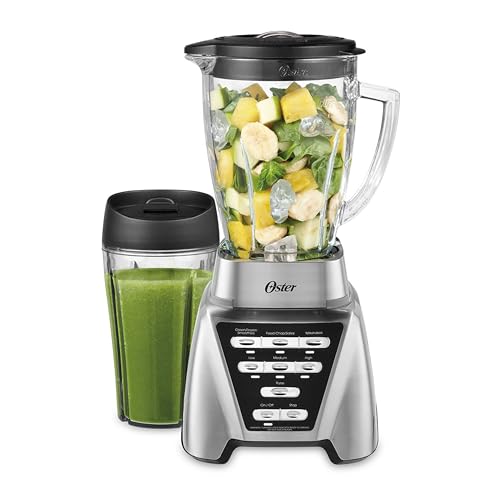
Oster Pro 1200 Blender with Glass Jar — Best Glass Jar
Many canners distrust plastic for hot, acidic foods, and the Oster Pro 1200 is their pick: a proper glass jar, a blade that reverses direction to keep thick purees moving, and seven speeds with programmed settings for controlled starts. Tomato and pepper purees come out smooth and even, and the glass will never carry last season’s garlic or pepper stain into this season’s peaches.
Glass and heat require one honest caution: thermal shock is real. Warm the jar with hot tap water before a steaming load, never set a hot jar on a cold stone counter, and the glass will serve for decades. Canners already live by temperature discipline — processing times, headspace, hot jars — so this caution fits the hobby’s existing habits naturally.
Strengths
- Glass jar for hot, acidic purees without staining or odor carryover
- Dual-direction blade keeps thick loads circulating
- Seven speeds allow gentle starts on hot loads
Trade-offs
- Glass demands thermal-shock care and is breakable on a busy canning counter
- Mid-range power works longer on the thickest purees
- Jar is heavy when full of sauce
| Jar | Glass jar (verified in Amazon title) |
| Controls | 7 speeds with Smart Settings programs |
| Blade | Dual-direction blade technology |
| Extras | 24 oz smoothie cup included |
The reversing blade earns special mention in puree work. Thick sauces bridge and tunnel in ordinary jars — the blades carve a cavity and the rest of the load sits above it, unblended. Reversal collapses that cavity mechanically, restarting circulation without opening the lid on a steaming load, which is both a quality and a safety virtue. Combined with the warm-the-jar habit, the Oster delivers glass-jar canning without the usual compromises.
Capacity sits in the comfortable middle: big enough for a pot of sauce, small enough to lift when full of something hot — a balance harvest-scale machines lose. For the glass-committed canner working in sane batches, this is the most natural recommendation in the guide.
Best for: glass-jar loyalists canning sauces and purees in moderate batches / Not suited for: clumsy counters, thermal-shock skeptics or harvest-scale volume
Check on Amazon — check price on Amazon for the current bundle and jar options.

Hamilton Beach Power Elite Blender 58148AG, 700W — Best Budget Glass
Not every canner faces a harvest mountain. For the gardener preserving a weekly basket — a few jars of sauce, a small run of jam, a soup base for the freezer — the Power Elite’s 40 oz glass jar and honest 700W motor cover the preparation work at a budget tier. The Wave Action jar keeps the load folding into the blades, and twelve functions include the low, gentle settings cooked purees appreciate.
Expectations should match the tier: skins and seeds reduce well in cooked, liquid loads, but the finest pepper-sauce silk belongs to the premium picks, and big batches mean several cycles. As the first blender of a new canning hobby, it is a sensible, glass-jarred place to start.
Strengths
- Glass jar at a budget tier
- Wave Action keeps purees circulating
- Gentle low functions suit cooked, delicate loads
Trade-offs
- 40 oz capacity means multiple cycles on sauce day
- 700W leaves a little more texture in skins and seeds than premium picks
- Not the tool for harvest-scale or very thick loads
| Motor | 700W (verified in Amazon title) |
| Jar | 40 oz glass |
| Functions | 12 functions |
| System | Wave Action continuous blending |
In its lane, the Power Elite performs respectably: a pot of cooked tomatoes becomes a smooth, jar-ready sauce with perhaps one extra cycle compared with the premium machines, and soft-fruit jam prep is well within its comfort. The glass jar is the headline at this price — canners who care about hot acidic food in glass usually must pay far more for the privilege.
The buying logic is seasonal honesty. If canning is a new or small-scale pleasure, this machine’s limits will rarely appear, and the savings buy a lot of jars and lids. If your garden produces like it is angry at you, buy the Vitamix first and skip the upgrade step entirely.
Best for: small-batch and beginner canners who want a glass jar on a budget / Not suited for: large gardens, thick butters or silk-fine pepper sauces
Check on Amazon — check price on Amazon for the current bundle and jar options.

KitchenAid Variable Speed Corded Hand Blender KHBV53 — Best In-Pot Pureeing
Every countertop hot blend involves moving steaming liquid from pot to jar and back. The immersion blender deletes that step: the KHBV53 goes into the pot, and the soup or sauce becomes smooth where it cooked. For canning prep, that means a pot of tomato or squash puree is jar-ready without a single dangerous pour, and the arm rinses clean while countertop jars are still being scrubbed.
Variable speed matters here more than raw power: a gentle start in a full pot avoids the surge and splash that a fixed-speed stick provokes. The included blending jar handles small, controlled batches — a test jar of pepper sauce before committing the pot — with the same tool.
Strengths
- Purees in the pot: no hot transfers, minimal washing
- Variable speed prevents surge and splashing in full pots
- Included jar suits small test batches
Trade-offs
- Texture is very good rather than mill-free perfect on skins and seeds
- Large pots take methodical moving of the arm to catch every corner
- One pot at a time; no batch capacity beyond the pot itself
| Arm | Removable 8-inch blending arm (verified in Amazon title) |
| Controls | Variable speed |
| Extras | Blending jar with lid included |
| Finish | Matte Black |
The in-pot method changes canning day ergonomics completely. Soup bases and sauces that would have meant three jar loads and two hot transfers become a five-minute pass with the arm, tilting the pot slightly and sweeping slowly so the bell draws the whole volume through. Skins soften enough in cooking that the result jars beautifully for most recipes; perfectionists chasing a seedless tomato sauce can still run the puree through a mill quickly, because the immersion pass has done ninety percent of the work.
For canners whose output is soups and sauces rather than silky pepper elixirs, this might honestly be the only blender the hobby needs. It is also the safest recommendation in the guide for older canners or anyone wary of lifting heavy, steaming jars — a consideration we are glad to weight properly.
Best for: soup and sauce canners who value safety and minimal washing over ultimate silkiness / Not suited for: seedless-sauce perfectionists or fruit butter specialists
Check on Amazon — check price on Amazon for the current bundle and jar options.

Ninja Kitchen System Pro BL770, 1500W — Best for Salsa Prep
Salsa exposes a gap in most blender guides: a blender alone makes salsa soup, because salsa wants controlled chunks, not a puree. The BL770 system closes the gap with its 8-cup processor bowl, which chops the vegetables to a genuine salsa texture, while the 72 oz pitcher stands ready for the smooth half of canning day — sauces, purees and soup bases — driven by the same 1500W base.
For the canner whose signature jar is salsa, with sauce as the supporting act, this two-vessel system is the most practical single purchase in the guide. It also happens to be a strong general kitchen system for the rest of the year.
Strengths
- Processor bowl makes true salsa texture a blender cannot
- 72 oz pitcher covers smooth sauces at batch scale
- 1500W base drives both vessels with authority
Trade-offs
- Two vessels to wash on a full canning day
- Pitcher purees are powerful rather than silky-fine
- Stacked blades need careful handling in the wash
| Motor | 1500W (verified in Amazon title) |
| Pitcher | 72 oz |
| Processor | 8-cup food processor bowl included |
The workflow is the argument. Peppers, onions and herbs pulse in the processor to the chunk your recipe wants; tomatoes can be processed briefly or crushed by hand for body; the batch seasons evenly because nothing was liquefied against its will. Then the same base, pitcher attached, turns the day’s smooth sauce without a second appliance coming out of the cupboard. Canning days are logistics exercises, and one base with two vessels is good logistics.
Be clear about the pitcher’s ceiling: it makes a fine sauce, but the Vitamix makes a finer one, and seed-and-skin perfectionists will notice. If your jars are mostly salsa and your sauces are rustic, the BL770 is the right tool. If your jars are mostly silk, buy the silk machine.
Best for: salsa canners who also make sauces and want one system for both textures / Not suited for: silk-puree specialists or minimalists who hate washing attachments
Check on Amazon — check price on Amazon for the current bundle and jar options.
Comparison Table
The six picks compressed: badge, the specification that matters for preservation prep, and the canning job each does best.
| Pick | Badge | Key spec | Best for |
|---|---|---|---|
| Vitamix 5200 Professional-Grade Blender, 64 oz | Best Overall | 64 oz vented container, variable speed, stainless blades | Hot purees at batch scale |
| KitchenAid K400 Variable Speed Blender KSB4027, 56 oz | Best for Sauces | 56 oz jar, variable speed, KSB4027 Passion Red | Uniform sauces and soups |
| Oster Pro 1200 Blender with Glass Jar | Best Glass Jar | Glass jar, 7 speeds, dual-direction blade | Glass-jar canning prep |
| Hamilton Beach Power Elite Blender 58148AG, 700W | Best Budget Glass | 700W, 40 oz glass jar, Wave Action | Budget small-batch prep |
| KitchenAid Variable Speed Corded Hand Blender KHBV53 | Best In-Pot Pureeing | Variable speed immersion, 8-inch arm, jar included | In-pot pureeing |
| Ninja Kitchen System Pro BL770, 1500W | Best for Salsa Prep | 1500W, 72 oz pitcher, 8-cup processor bowl | Salsa and mixed-texture prep |
Match by your signature jar. Silk sauces point to the top rows, salsa to the Ninja, soups and safety to the immersion pick, and glass loyalty to the middle rows. Most canners will find their season described in exactly one row — buy that one.
How to Choose a Blender for Canning
Canning prep is hot, batch-scale and texture-specific, which makes it a different purchase from everyday blending. The four decisions below — your signature preserve, hot-liquid strategy, capacity rhythm and texture range — will sort the six picks quickly.
Start with your signature preserve
Name the jar you make most. Tomato and pepper sauces reward the finest puree and point to the Vitamix or KitchenAid. Salsa rewards controlled chopping and points to the Ninja system. Soups and soup bases reward the immersion blender’s in-pot ease. Fruit butters reward sustained power and circulation in thick loads. Jams and jellies, being mostly cooked fruit and sugar, are the forgiving case almost any pick handles. Buying for your signature jar and letting the other preserves adapt is the fastest route to the right machine.
Choose your hot-liquid strategy
There are three safe strategies, and our picks embody all of them. A vented countertop jar with variable speed is the classic: half fills, gentle starts, steam managed by the lid. Glass adds a material preference and a thermal-shock discipline: warm the jar, avoid cold counters. The immersion strategy avoids the question by pureeing in the pot. What is not a strategy is a sealed or unvented jar of steaming puree, or a full jar of anything hot — expansion and surge are physics, not malfunctions. Choose the strategy that matches your caution level as honestly as your budget.
Capacity and the rhythm of canning day
Canning day moves in pot rhythms: a pot cooks down, a batch blends, jars fill, the next pot goes on. A blender whose capacity matches your pot keeps that rhythm smooth; an undersized jar doubles the blending stops, and an oversized one tempts dangerous overfilling with hot loads. Most home canners work in the 40 to 72 oz world our picks span. Also weigh the wash between batches — a jar that rinses and self-cleans quickly keeps the line moving when the counter is full of produce.
Texture range: from chunks to silk
Preservation textures span salsa chunks, rustic sauce body, and pepper-sauce silk, and no single vessel is best at all three. Processors chop, pitchers puree, immersion blenders do a bit of both with a rustic accent. Decide where your jars cluster on that spectrum and buy the machine whose home texture matches, accepting competent-rather-than-best performance at the far end. And remember the mill option: a blender that does ninety percent of a seedless sauce, followed by a quick pass through a food mill, beats a mediocre blender doing all of it — several of our picks make that combination genuinely fast.
How to Blend Hot Purees Safely for Canning
Hot blending is the one genuinely hazardous routine in this guide, and it is completely manageable with method. Follow these steps for any countertop pick, and use the immersion variation noted where it applies.
- Cook the food first. Blenders for canning prep work on cooked produce — tomatoes simmered down, peppers roasted or boiled, fruit softened — because cooking is what releases skins, seeds and flavor for a smooth puree.
- Let a violent boil settle to a steaming simmer before blending. Rolling-boil loads surge the most; a two-minute rest makes the blend calmer without costing your process any meaningful heat.
- Fill the jar no more than half full for hot loads — less if the puree is thick. Headspace is where expansion goes, and it is the cheapest safety in the kitchen.
- For glass jars, warm the jar first with hot tap water, and set it on a towel or wooden board afterward, never on cold stone. Thermal shock cracks jars that temperature courtesy would have saved.
- Secure the lid and confirm the vent is open or the lid cap is loosened per the manufacturer’s hot-liquid guidance, so steam has somewhere to go.
- Start on the lowest speed for fifteen to twenty seconds, then ramp gradually. The gentle start is what prevents the surge that blows lids and paints ceilings.
- Blend at the finishing speed until the puree is uniform, then stop and let it settle before opening the lid away from your face.
- Work batch by batch with the rhythm of the pots, rinsing the jar between flavors so yesterday’s pepper does not haunt today’s peaches. For immersion blending, keep the bell submerged, move slowly through the pot, and tilt the pot slightly to gather the last unblended corner.
- Fill your prepared jars promptly while the puree is hot, following your tested recipe’s headspace and processing instructions exactly — the recipe, not the blender, is your safety authority from this point on.
If a puree is not smooth enough, the fixes in order are: cook longer before blending, blend longer at finishing speed, or pass it through a food mill for the final polish. What never fixes texture is overfilling the jar or sealing steam in — the two shortcuts that cause every hot-blending accident. Canning rewards patience everywhere else in the process; the blender deserves the same courtesy.
Blender, Food Mill or Immersion: Dividing the Prep Work
Experienced canners rarely ask one tool to do everything. The food mill remains the champion of the truly seedless tomato sauce, because it separates rather than pulverizes — but it is slow, physical work over a full harvest. The modern division of labor is to let the blender do the bulk: cook, blend smooth, and then decide per recipe whether the result jars as-is (most sauces, all soups) or takes a quick mill pass (the showcase seedless sauce). The immersion blender owns the soup pot and the rustic sauce. The processor owns salsa. Thinking of the blender as the powerful first stage rather than the whole factory makes every tool in the kitchen better at its job — and makes canning day shorter, which is the improvement preservers actually feel.
A Canning Day, Timed: Where the Blender Earns Its Keep
The tomato day, hour by hour
A realistic tomato day starts with washing and coring, moves to the first pot simmering down, and reaches the blender within the first hour. From there the rhythm settles: while one pot reduces, the previous batch blends in two or three half-jar cycles of a minute or two each, fills its jars, and the jar washer — often the same person, wearing a different hat — keeps pace. Across a full day, the blender itself runs perhaps forty minutes total, yet it removes the two slowest traditional stages: the mill work for skins and seeds, and the long straining that used to decide whether sauce day was pleasant. That is the honest size of the improvement — not magic, just the two worst jobs deleted.
Pepper sauce and fruit days
Pepper sauce day is shorter and fiercer: cooked or fermented peppers blend to silk in the premium picks, strain only if you insist, and bottle quickly — the blender’s finesse is the whole show, which is why pepper specialists should weight our top pick heavily. Fruit days are gentler: butters and jam bases blend warm and forgiving, and the immersion pick shines because the pot never moves. Matching the machine to your dominant day, as our buying guide insists, is what these three rhythms look like in practice — one machine will meet all three, but it will meet one of them brilliantly, and that one should be yours.
Not every canning decision deserves a full batch. A new pepper variety, an experimental spice blend, a fruit butter at a new sweetness — these deserve a test jar first, and the blender makes test jars cheap: a cup of cooked produce, one short cycle, a spoon, a verdict. The immersion pick’s included jar and the personal-cup formats elsewhere exist for exactly this scale of curiosity. Canners who test small waste less, learn their produce faster, and arrive at harvest day with recipes already proven rather than hopeful. Keep notes on the jar with a grease pencil — variety, ratio, verdict — and by the second season your blender will have quietly become your recipe development lab as well as your production line.
One more economy worth naming: a good blender reduces waste across the whole preserving season. The tomatoes too soft for slicing, the peppers too odd-shaped for the gift basket, the fruit at the edge of overripe — all of these are puree-grade produce, and a blender that handles them confidently turns the garden’s second quality into first-quality jars of sauce, butter and base. Canners routinely report that the machine pays for itself in rescued produce before it pays in convenience, which is a pleasant order for the accounting to run in.
Finally, a word about records. Serious canners keep a season log — produce in, jars out, recipes used — and the blender belongs in that log more than most tools do. Note which machine settings produced the texture you loved in August when you are trying to repeat it the following September, because puree texture is the variable memory serves worst. A line per batch is enough: date, produce, machine, setting, verdict. Your future self, facing the next harvest with last year’s jars gleaming on the shelf, will be grateful for the precision.
Common Buying Mistakes
Believing a smooth puree makes food shelf-safe
The most consequential mistake in this category. Blending is preparation; safety comes from tested recipes, correct acidity and correct processing. A silky sauce canned by guesswork is still guesswork in a jar. Follow current USDA-aligned guidance for every recipe, every time.
Filling the jar with steaming puree
Hot liquids expand and surge. A full jar of steaming sauce is the setup for a blown lid and a burn. Half fills for hot work, always, and a gentle low-speed start — the two habits that prevent essentially every hot-blending accident.
Putting a cold glass jar under a boiling load
Thermal shock cracks glass. Warm the jar with hot water first and rest it on wood or cloth, not cold stone. Canners already manage jar temperature for processing; extend the same respect to the blender jar.
Asking a blender to make salsa
A blender purees; salsa is chopped. The result of blending salsa ingredients is a thin sauce wearing salsa’s name. Use a processor bowl, pulse with restraint, or chop by hand — and save the blender for the jars it is actually good at.
Buying capacity for the biggest day of the year
One harvest weekend does not justify a machine that frustrates fifty ordinary weeks. Buy for your typical pot rhythm and rent the big day with extra cycles; the exception is the genuinely high-volume preserver, who should buy the Vitamix first and skip the mid-step.
Final Recommendation
For most serious canners, the Vitamix 5200 is the answer: vented, controlled, and smooth enough to retire the food mill on most sauce days. Sauce-focused canners in pot-size batches will love the KitchenAid K400’s even purees, and glass loyalists have two honest routes — the Oster Pro 1200 for capability, the Hamilton Beach Power Elite for budget.
If your canning is soups and rustic sauces, the KitchenAid hand blender’s in-pot method may be the only tool you need, and if your signature jar is salsa, the Ninja BL770 system is the one purchase that covers both textures of canning day. Whichever you choose, keep the guide’s hierarchy straight: the blender makes it smooth, the recipe makes it safe, and your process makes it keep.
Our top three, again for convenience: Vitamix 5200 Professional-Grade Blender, 64 oz (Best Overall), KitchenAid K400 Variable Speed Blender KSB4027, 56 oz (Best for Sauces), Oster Pro 1200 Blender with Glass Jar (Best Glass Jar). Check price on Amazon for each before you decide, and confirm the exact jar or cup configuration in the listing.
Keep exploring the blender guides on this site: Best Blenders For Cooking Best Blenders For Baby Puree Best Blenders For Beans And Vegetable Best Blenders For Hot Soup Best Blenders
Frequently Asked Questions
Do I still need a food mill if I buy a powerful blender?
For most sauces, a top blender makes the mill optional: skins and seeds reduce to near-invisibility and the sauce jars beautifully as blended. For a truly seedless showcase tomato sauce, the mill still wins because it separates seeds rather than pulverizing them into the sauce. The efficient routine is blender first for bulk smoothness, mill second only for the recipes that demand perfection — which turns an hour of milling into ten minutes.
Is it safe to blend hot liquids in a blender?
Yes, with the method in this guide: a vented lid, a jar filled no more than half, a gentle low-speed start, and care with glass and thermal shock. The accidents in this category come from sealed lids, full jars and instant full speed. An immersion blender removes most of the risk entirely by pureeing in the pot, which is why it is our recommendation for the most cautious canners.
Can a blender replace a pressure canner or water bath?
Never. A blender prepares food; it does not preserve it. Shelf safety comes entirely from tested recipes, correct acidity, and correct processing — water bath for high-acid foods, pressure canning where the recipe requires it — following current USDA-aligned guidance. Any source suggesting a kitchen appliance substitutes for processing should be distrusted on everything else too.
What is the best blender texture for salsa canning?
Salsa wants controlled chunks, which is a food processor’s job, not a blender’s — blending liquefies the vegetables into sauce. That is why our salsa pick is a system with a processor bowl. If you only own a blender, pulse very briefly with restraint and accept a rustic, saucier salsa, or chop the firm vegetables by hand and blend only a portion of the tomatoes for body.
Glass or plastic jar for canning prep?
Both work, with different disciplines. Glass suits canners who avoid plastic for hot acidic food and never stains or holds odors, but demands thermal-shock care and is breakable. Modern blender containers handle hot purees well and shrug off drops, but can stain with tomato and hold pepper heat. Choose by your material preference and your counter’s chaos level; the technique rules for hot loads apply equally to both.
How smooth does tomato sauce need to be before canning?
As smooth as your recipe and household prefer — texture is a quality choice, not a safety variable. Safety lives in the recipe’s acidity, headspace and processing, which must be followed exactly regardless of texture. Many canners jar a rustic sauce happily; those wanting a smooth sauce should cook the tomatoes thoroughly before blending, since well-cooked skins and seeds reduce far more completely than briefly heated ones.


