Why the Target Blender Aisle Rewards a Plan
This guide may earn an affiliate commission when readers buy through qualifying links, at no extra cost to them, and that support helps keep our kitchen buying guides independent and practical.
Buying a blender at Target looks simple from the aisle. A row of boxes promises crushed ice, silky smoothies, hot soup, nut butter and effortless cleanup, often in language so similar that every machine sounds equally capable. In practice, the best blenders at Target succeed for very different reasons. One is a high-powered workhorse built for daily green smoothies and frozen fruit. Another is a compact personal blender that earns its counter space by being quick to rinse and easy to store. A third is a classic glass-jar machine that feels familiar, pours cleanly and suits households that blend sauces and shakes more often than they tackle thick frozen mixtures.
Shopping at Target also changes the decision compared with ordering blind from a warehouse listing. You can often see a display model, judge whether the jar feels awkward to lift, compare the footprint against the space under your cabinets, and choose same-day pickup when a store nearby has the exact configuration in stock. If the machine disappoints, returns are handled at a service counter rather than through a shipping label and a wait. Those conveniences matter, but they should not distract from the central question: which blender matches the food you actually make, week after week?
Target’s assortment usually spans three broad families. Personal blenders from brands such as NutriBullet are built around single-serve cups and fast weekday routines. Mid-sized countertop models from Ninja, Oster, KitchenAid and Hamilton Beach cover most family blending, with larger jars, preset programs and enough power for ice and frozen fruit. Premium high-performance machines, represented here by the Vitamix 5200, use stronger motors, tougher jars and manual speed control to handle thick mixtures with less stopping and scraping. The right choice is rarely the one with the longest feature list. It is the one whose jar size, controls, noise level and cleaning routine fit your kitchen habits.
This roundup focuses on six widely stocked choices: the Ninja Professional Plus, NutriBullet Pro, Vitamix 5200, KitchenAid K400, Oster Pro 1200 and Hamilton Beach Power Elite. Each pick below explains what it does well, where it compromises and who should buy it. Because store assortments rotate by location and season, treat the model family and configuration as the decision, not a promise that every Target shelf carries every variant on every day. If you shop in store, open the box contents list in your mind before you pay: jar, lid, tamper if included, personal cups if included, and any to-go lids or extra blades. Small included accessories often separate a satisfying purchase from a second trip.
In this guide
What to Look for in a Blender at Target
Start with the jobs you repeat most
Write down the three blends you make most often before you compare motors. A household that makes a single protein shake each morning needs speed, a sealed travel cup and painless rinsing. A family that blends pancake batter, salsa, milkshakes and occasional frozen drinks needs a larger jar, a stable base and a lid that does not leak when the jar is full. Someone who makes green smoothies with kale stems, frozen mango and ginger needs power, a jar shape that keeps ingredients moving and, ideally, a tamper. Nut butters and hummus are the most demanding common jobs because the mixture is thick, dry and reluctant to circulate; they reward high-performance machines and punish weak motors quickly.
Be honest about frequency. A blender used twice a day should be easy to leave out, quick to clean and pleasant to hear. A blender used twice a month can live in a cabinet and be a little more awkward. The most common buying mistake is paying for maximum power while ignoring the daily friction of a heavy jar, a fiddly lid or controls that require a manual every time. The second most common mistake is the opposite: buying a small personal blender for a family that immediately outgrows it, then running four cycles to make breakfast for everyone.
Read power claims with a skeptical eye
Power matters, but headline numbers are only the beginning of the story. A blender crushes ice well when motor strength, blade geometry, jar shape and speed control work together. Some jars create a strong vortex that pulls frozen fruit down into the blades. Others leave chunks riding above the action until you stop, shake and restart. Peak power figures describe a momentary maximum, not how calmly a machine sustains work on a thick mixture. In the store, you cannot run a true test, so use design clues: a sturdy base that does not feel hollow, a jar with a shaped interior rather than a plain cylinder, a lid that locks firmly and, for thick blends, a tamper that lets you push ingredients down safely while the motor runs.
For smoothies with ice and frozen fruit, most full-size countertop blenders in this roundup are capable when the liquid level is right. For nut butter, raw soup blends and very thick frozen desserts, the Vitamix class of machine separates itself because it sustains circulation instead of merely chopping. If your routine is mostly shakes and sauces, that extra capability may never repay its larger footprint and higher tier. If your routine includes daily whole-food smoothies, it probably will.
Glass jars versus plastic jars
Jar material is one of the clearest divides in this group. Glass feels substantial, resists scratching, does not hold odors as readily and pours with a reassuring weight. It suits cooks who blend tomato sauces, curry pastes and other foods that can stain or perfume a plastic jar. The trade-offs are weight and fragility. A full glass jar of soup is heavy to lift with one hand, and a dropped glass jar is usually a finished jar. Glass models also tend to top out at moderate power designs rather than the highest-performance category.
Modern blender plastic is lighter, tougher and safer for busy households, especially when kids help in the kitchen or the jar travels between counter and sink many times a day. Large plastic jars make family batches easier to handle and are standard on high-powered machines because they tolerate stress and reduce overall weight. The compromises are cosmetic and sensory: plastic can cloud over years of dishwasher cycles, can pick up turmeric or tomato tones, and can retain garlic or onion smells if it sits unwashed. Neither material is automatically better. Choose glass for feel, clarity and odor resistance; choose plastic for capacity, durability and easier lifting.
Capacity is about headroom, not just volume
A jar’s stated capacity is the brim, not the comfortable working amount. Hot liquids expand and need headroom. Thick smoothies need space to fold over. Personal cups need room for liquid to move or the result is a layered blend with powder at the top and ice at the bottom. For one person, a personal blender cup that goes straight to a gym bag or car holder can be the entire point of the purchase. For families, a full-size jar avoids repeat cycles, but only if the base is stable when the jar is genuinely full. At Target, pick up the display jar if one is available. A handle that fits your hand and a spout that looks controlled matter more than a few ounces of nominal capacity.
Controls should match your patience
Preset programs are helpful when they match real habits: smoothie, ice crush, pulse and clean cycles can make a machine approachable for several household members. Manual dials reward cooks who like to start slow, ramp up and listen to the blend. Buttons are easy to wipe but can feel vague with wet hands. Touch controls look clean and can be annoying when fingers are damp. Pulse control deserves special attention because it is the tool you use to rescue a stuck blend, chop salsa without liquefying it and knock ingredients down from the jar walls. A blender without a responsive pulse is harder to live with than its spec sheet suggests.
Noise, vibration and the morning test
Every blender capable of crushing ice is loud. The differences are in pitch, vibration and how long the noise lasts. A machine that finishes a frozen smoothie quickly may disturb a household less than a weaker machine that strains for twice as long. Heavy bases tend to walk less on the counter. Rubber feet help. If you blend before others wake, a personal blender used in short bursts or a powerful machine that finishes fast may be kinder than a budget model that needs repeated cycles. In store, press down on the display base gently; a base that rocks or feels light for its size is telling you something about how it will behave under load.
Cleaning decides whether you keep using it
Most modern blenders clean well with warm water, a drop of soap and a short blend cycle, provided you rinse immediately. Trouble starts when mixtures dry under the blade assembly or around the lid gasket. Removable blade bases can make deep cleaning easier but add parts to lose and seals to wear. Fixed-blade high-performance jars avoid disassembly and usually rinse clean fast, though you must reach carefully around the blades with a brush. Dishwasher-safe claims vary by part; lids, cups and jars may have different instructions. If hand washing is a deal-breaker in your home, read the care guidance for the exact model rather than assuming the whole machine can go on the top rack.
Counter space, storage and cord reality
Measure the vertical clearance under your cabinets before falling for a tall jar on a tall base. Some full-size combinations fit neatly; others must be stored with the jar beside the base or moved to a pantry shelf, which quietly reduces how often they get used. Check cord length too. A short cord limits placement near outlets and can pull a machine toward the counter edge when the jar is full. If your kitchen has one good prep zone, the best blender is the one that can live there without blocking the coffee maker, the knife block and the space where you actually chop.
Support, parts and the second-year test
A blender reveals its ownership cost in year two, not week two. Seals flatten, lids get dropped, jars cloud or crack, and the difference between brands becomes the difference between ordering a replacement part and replacing the whole machine. Before you commit, think about which components your routine will wear: the gasket on a personal blender’s blade base, the lid on a family jar used daily, the drive coupling on a machine that crushes ice every weekend. Brands with long retail histories tend to keep jars and lids available, and Target’s shelf presence makes common replacements easier to source than parts for obscure labels. None of this is glamorous, but a blender that can be repaired with a fresh gasket is a better purchase than a marginally stronger one that becomes landfill when a small part fails.
Warranty language deserves the same calm reading as power claims. What matters is not the length printed largest but what is actually covered: motor and base, jar, blades and electronics rarely share identical terms, and coverage for home use assumes the kind of loads described in the manual. If your routine is demanding — daily frozen blends, thick mixtures, near-constant use — choose the machine whose design brief matches that routine rather than relying on a warranty to rescue an overmatched motor. The most reliable blender is the one that never needs its paperwork.
Target stock, bundles and model variants
Large retailers often sell brand families in several configurations that share a name but not a box contents list. One version may include personal cups; another may include a food-processing bowl or an extra jar. The base can be identical while the value changes completely. When you compare a Target box with anything else, compare included parts line by line. Also expect seasonal rotation: back-to-school periods favor personal blenders for dorms and apartments, while holiday periods bring out larger giftable sets. If your chosen model is out of stock locally, pickup at a nearby store or delivery may still be simpler than settling for a machine that does not fit your routine.
Quick Comparison
The table below summarizes the six picks in plain language. It is a starting point for the detailed reviews, not a substitute for them, because the right choice depends on batch size, jar preference and the thickness of what you blend.
| Pick | Best for | Jar style | Standout quality | Main watch-out |
|---|---|---|---|---|
| Ninja Professional Plus | Family smoothies and frozen drinks | Large plastic jar | Strong ice crushing and helpful presets | Sharp stacked blades need careful washing |
| NutriBullet Pro | Single-serve shakes and smoothies | Personal cups | Fast routine with minimal cleanup | Not built for big batches or hot liquids |
| Vitamix 5200 | Thick blends and daily whole-food smoothies | Full-size 64 oz high-performance jar | Manual control, tamper and durability | Premium tier and louder under load |
| KitchenAid K400 | Households wanting balance and style | Full-size jar | Smooth results with intuitive dial | Less raw force than the strongest rivals |
| Oster Pro 1200 | Glass-jar traditionalists | Glass jar | Familiar controls and versatile programs | Heavier jar and more parts to wash |
| Hamilton Beach Power Elite | Budget-minded everyday blending | Glass jar | Simple, approachable and easy to own | Struggles sooner with thick frozen loads |
Two internal guides can help you narrow the field further before you buy: how to match accessories to your air fryer size and best afforadble personal blenders.
The Six Best Blenders at Target, Reviewed

Ninja Professional Plus
The Ninja Professional Plus is the crowd-pleaser of the Target blender aisle: a large plastic jar, a powerful motor and a set of presets that make frozen drinks feel almost automatic. Its stacked blade assembly attacks ice from several heights at once, which is why it produces snow-like crushed ice and smooth frozen margaritas with less of the stop-and-shake routine that weaker blenders demand. For families that blend pitchers of smoothies on weekends and frozen drinks for guests, it hits a sweet spot of capacity, speed and approachability.
Strengths: Ice crushing is the headline talent, and it is genuine. Frozen strawberries, ice cubes and fibrous greens break down quickly when there is enough liquid to keep the vortex moving. The preset programs are useful rather than decorative: a smoothie cycle that pulses before it commits, a crush cycle that attacks ice in bursts, and a max-blend style setting for thicker mixtures. The jar is light for its size, the lid locks with confidence and the base feels planted during hard cycles. Because the jar is plastic, a full batch is easier to carry to the table than a comparable glass jar, and younger helpers are less likely to struggle with it at the sink.
Trade-offs: The stacked blade tower is the part you must respect. It is sharp, it comes out for washing on many configurations, and it deserves a brush and attention rather than a casual hand inside the jar. Very thick mixtures without enough liquid can still ride above the blades, and the machine does not include the kind of tamper workflow that high-performance blenders use to keep dense blends moving. It is also a tall, assertive appliance; measure under-cabinet clearance before assuming it will live on the counter. Finally, the results on nut butter and very dry mixtures are acceptable for occasional use but not its natural home.
Who it suits: Choose the Ninja Professional Plus if your household blends for several people at once, loves frozen drinks and wants presets that reduce guesswork. It is an especially good fit for buyers who want strong ice performance without stepping into the premium tier, and for kitchens where a lighter plastic jar will be lifted many times a day. If your signature recipe is a single morning shake, it is more machine than you need; if your signature recipe is a pitcher of frozen lemonade for six people, it feels made for you. For current availability in the configuration you want, check price on Amazon.

NutriBullet Pro
The NutriBullet Pro succeeds by shrinking the distance between deciding to make a smoothie and drinking it. There is no dial to learn and no pitcher to wash. You fill a cup, twist on the blade base, press it onto the motor unit, blend, swap the blade for a lid or drink straight from the cup. That simplicity is why personal blenders dominate dorm rooms, small apartments, office kitchens and gym-bag routines. The Pro version adds enough power to handle frozen fruit and ice in single servings far more convincingly than the smallest personal models.
Strengths: Speed of routine is the real strength. A shake comes together in well under a minute of blending, and cleanup is a rinse of the cup and blade base if you do it right away. The cups double as travel containers, which removes the transfer step that makes people skip smoothies on busy mornings. For protein shakes, soft fruit smoothies, salad dressings and small batches of sauce, the results are consistently smooth. The footprint is tiny compared with every full-size machine here, so it can live in a corner that would never fit a pitcher blender, and it stores easily in a cabinet or dorm wardrobe.
Trade-offs: Capacity is the obvious limit. This is a one-serving, occasionally two-serving, machine. Making smoothies for a family means repeated cycles and repeated rinsing. Hot liquids are off the menu because sealed personal cups are not designed for steam pressure, so soup makers should look elsewhere. Thick mixtures need enough liquid and sometimes a shake midway; overfilling past the max line invites leaks and uneven results. The blade base gasket needs regular inspection and cleaning, because residue hides there more easily than in an open pitcher. And while frozen fruit works well in sensible portions, a cup packed solid with ice will strain any personal blender.
Who it suits: The NutriBullet Pro is the right buy for single users, couples with different smoothie schedules, students and anyone whose main goal is a daily shake with almost no cleanup. It is also a sensible second blender for a household that owns a big machine but avoids using it for small jobs. If you regularly cook for a crowd, blend soup or want one appliance for every task, choose a full-size pick instead. To see which bundle and cup sizes are in stock right now, check price on Amazon.

Vitamix 5200
The Vitamix 5200 is the classic high-performance blender that built the brand’s reputation, and its presence at Target makes it easier to buy, return or exchange through a familiar local retailer. It pairs a full-size 64-ounce container with the brand’s characteristic variable speed dial, pulse switch and tamper. Where preset-driven machines ask you to trust a program, the 5200 asks you to participate: start slow, increase speed, watch the mixture fold, and use the tamper to press corners down into the stainless-steel blades. That involvement is exactly why its results on thick and fibrous blends are so consistent.
Strengths: Whole-food smoothies are its home ground. Kale, frozen mango, ginger, nuts and seeds break down into a genuinely smooth drink without the gritty finish weaker machines leave behind. The tamper changes what is possible: hummus, thick smoothie bowls, nut butters and frozen desserts keep moving instead of forming an air pocket above the blades. Run it long enough and blade friction heats soups and sauces right in the container, a trick no preset machine here can match. The variable speed dial gives control that presets cannot, from gentle folding to full-power finishing, and the build quality feels deliberately over-engineered, with a container and base designed for years of daily use. Its full-size jar suits family batches, and the self-cleaning routine — warm water, a drop of soap, a short run at high speed — keeps cleanup honest.
Trade-offs: The 5200 sits in the premium tier of this roundup, and it asks for counter space and tolerance for noise; high-performance blending is not quiet, especially on ice. The tall 64-ounce container is generous for family batches but can feel like a lot of machine for a single small smoothie, and the assembled height deserves a tape measure before you assume it slides under your cabinets. There are no one-touch programs, so new users face a short learning curve: correct speed ramping and tamper use matter. The container is not a candidate for careless dishwasher habits either; the self-cleaning cycle is easy, but it is still a routine you must actually do. Finally, buyers who mainly make thin shakes will not use the capability they are paying for.
Who it suits: Choose the 5200 if blending is a daily cooking method rather than an occasional treat: green smoothies, soups, sauces, dips and thick bowls, in medium-to-large batches, with an expectation of owning the machine for a long time. It suits cooks who prefer control over automation and who will use the tamper instead of leaving it in a drawer. For the latest listing details on the 5200 package, check price on Amazon.

KitchenAid K400
The KitchenAid K400 aims for the middle of the market and hits it gracefully: a full-size jar, a powerful enough motor for daily smoothies and ice, an intuitive speed dial and styling that looks at home in a designed kitchen. KitchenAid’s approach emphasizes how the blend moves. The jar geometry and blade are intended to pull ingredients into a steady vortex, and in everyday use that translates to smoothies that finish evenly without constant pulsing, plus sauces and soups that come together with little drama.
Strengths: The dial is a pleasure to use, with a tactile ramp from low to high and presets for common jobs such as ice crush and smoothies. Results on mixed loads — part frozen fruit, part greens, part liquid — are reliably smooth, and the machine handles ice for drinks without the violent shuddering of lighter bases. The jar strikes a practical balance: large enough for family batches, not so large that a two-person smoothie feels lost. KitchenAid’s color range matters more than spec sheets admit, because a blender that looks right on the counter is a blender that stays on the counter and gets used. Cleanup is straightforward, and the overall noise character is firm rather than harsh.
Trade-offs: The K400 is not the strongest machine here for extreme jobs. Thick nut butters and very dry mixtures require patience, added liquid and scraping in a way the Vitamix avoids with its tamper. Buyers who measure value purely by crushing force may find the Ninja more convincing for frozen drinks at a similar tier. The lid and jar, while well made, still demand the usual care around seals, and the machine’s refined styling can tempt buyers to pay for appearance when their actual routine is a basic protein shake that a personal blender would handle faster.
Who it suits: The K400 suits households that blend several times a week across a mix of smoothies, soups, sauces and frozen drinks, and that value control, appearance and even results over maximum force. It is a strong choice for couples and small families upgrading from a tired basic blender and wanting one machine that feels like a long-term kitchen fixture. Colour choices and configurations change often on this model, so check price on Amazon.
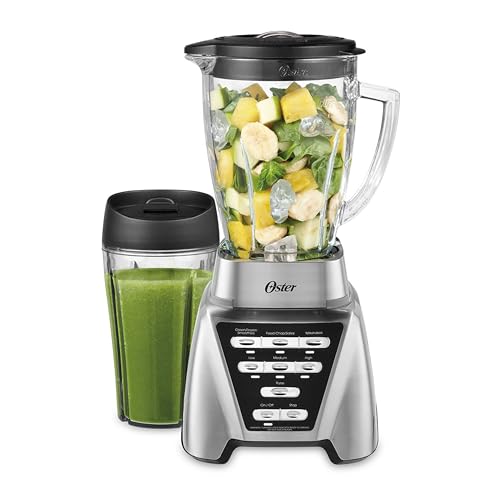
Oster Pro 1200
The Oster Pro 1200 represents the classic American countertop blender in modern form: a substantial glass jar, a metal drive system reputation, straightforward controls and pre-programmed settings for smoothies and food chop tasks. For cooks raised on glass-jar blenders, it feels immediately familiar. It also answers a preference many buyers still hold strongly: they simply like glass. It is heavier in the hand, resists staining from tomato and turmeric, and does not pick up last week’s garlic the way an aging plastic jar can.
Strengths: Versatility is the draw. The Pro 1200 handles milkshakes, salsas, batters, smoothies and crushed ice with the competence of a machine designed for general kitchen duty rather than a single trend. Dual-direction blade movement on relevant settings helps pull ingredients down and reduces the dead spots that plague simple jars. The glass jar pours neatly and feels stable on the base, and the control layout is easy for guests and teenagers to understand without coaching. Oster’s long history in blenders also means replacement jars and parts are a familiar concept for this brand family, which matters to buyers who keep appliances for years.
Trade-offs: A full glass jar is heavy, and that weight is the daily tax you pay for its virtues. Lifting it one-handed when full of soup is not for everyone, and glass always carries breakage risk in a crowded sink. The multi-part jar and blade assembly take a little longer to wash and dry than a fixed-blade jar, and gaskets need attention to stay fresh. On the thickest frozen mixtures, it works best with sensible liquid ratios and pulsing; it is a capable generalist, not a high-performance specialist. Its traditional styling may also read as plain next to the more designed machines in this group.
Who it suits: Choose the Oster Pro 1200 if you want a glass jar, cook a wide range of foods and prefer proven, understandable controls to apps, dials with learning curves or ultra-powerful motors. It fits households that blend soups and sauces often enough to appreciate glass, and buyers replacing an older Oster-style machine who want the same habits with better performance. To confirm the current glass-jar configuration on offer, check price on Amazon.

Hamilton Beach Power Elite
The Hamilton Beach Power Elite is the honest budget pick of the group: a glass-jar countertop blender with simple push-button controls, a no-fuss design and enough ability for the everyday jobs most households actually do. It will not out-blend the premium machines, and it does not pretend otherwise once you read past the box. What it offers is accessibility — a real, full-size blender for shakes, smoothies with modest frozen content, batters, dressings and party drinks, in a form that anyone can operate.
Strengths: Simplicity is a genuine feature. The buttons are self-explanatory, the jar is glass and easy to read, and the machine is light enough to move in and out of a cabinet without a sigh. For soft fruit smoothies, protein shakes, milkshakes, pancake batter and salsa, it performs perfectly respectable work. The pour spout design aims to reduce countertop drips, and the parts are easy to rinse. As a first blender for a new apartment, a dorm-adjacent kitchen or a vacation home, it covers the basics without demanding counter space, budget commitment or a learning curve.
Trade-offs: Power is the limit, and it shows with hard jobs. Large amounts of ice, dense frozen fruit and fibrous greens need smaller batches, more liquid and more patience, and the results can stay slightly textured where stronger machines finish silky. Thick mixtures are occasional projects rather than daily fare. The build feels lighter than the other full-size picks, with more vibration under strain, and long-term heavy daily use is not its design brief. Buyers who blend green smoothies every morning will outgrow it; that is not a flaw so much as a boundary worth respecting before purchase.
Who it suits: The Power Elite suits budget-minded buyers, occasional blenders and small households whose menu is shakes, soft smoothies, batters and sauces rather than frozen bricks and nut butter. It is also a sensible spare or starter machine while you learn what your blending habits really are, before committing to a higher tier. For today’s availability on this entry-level model, check price on Amazon.
Shopping at Target: Pickup, Display Models and Returns
Target’s biggest advantage in a blender purchase is not any single model; it is the ability to combine research with physical judgment. Online listings flatten every machine into the same rectangle of photographs. In a store, you can stand in front of the shelf and learn things a listing cannot tell you. Does the jar handle fit your grip when you mime lifting it full? Does the lid feel like it seals with a positive action or a vague press? Does the base look stable, or tall and tippy? Is the control panel readable at counter height, in ordinary kitchen light, with slightly wet hands? These small ergonomic truths predict satisfaction better than another decimal of advertised power.
Same-day pickup changes the risk calculation as well. Ordering for pickup lets you reserve a specific configuration instead of gambling on whatever happens to be on the shelf, and it gets the machine into your kitchen the day you decide, which is genuinely useful when an old blender dies mid-week or you are setting up a new apartment. Before you drive, confirm the box contents on the product page and again on the physical box: model family names repeat across bundles, and the difference between two similar boxes is often an included cup, a tamper or a second jar. If the exact configuration matters to you, it is worth a minute of checking in the aisle rather than a return trip later.
Returns are the other practical comfort. A blender is one of the few appliances whose real performance only reveals itself with your ingredients, your ice and your recipes. If a machine leaves your green smoothie gritty or walks across the counter under load, returning it to a service counter is simpler than repacking it for a carrier. Keep the box and inserts until you have run the machine through your three most common jobs. Test the hardest realistic job early, while the return decision is still easy, rather than discovering the limit months later. That advice applies to every pick in this guide: the first week should include your thickest smoothie, your largest batch and your most frequent quick blend.
A word about display models and open shelves: treat them as fit-and-finish checks, not performance evidence. A display unit can show you jar weight, lid action and footprint, but it cannot tell you how the motor handles frozen mango. Conversely, do not let a dusty display put you off a model whose sealed box is right beside it. And if your store’s shelf is thin, remember that Target’s assortment is wider online than in any single location; pickup from a nearby store often bridges the gap between the shelf you can touch and the model you actually want.
Which Blender Should You Choose?
If your household blends pitchers for several people and frozen drinks are a regular event, the Ninja Professional Plus is the natural center of this list. Its combination of capacity, ice performance and presets removes the most friction from family blending, and its plastic jar keeps big batches manageable. Choose it when the blender’s main job is volume with a frozen accent.
If your blending life is a daily shake for one, the NutriBullet Pro is the pick that respects your time. It is the machine most likely to be used every single day, because the routine around it is so short. Choose it when speed and cleanup matter more than batch size, and accept that soups and crowds belong to a different appliance.
If you blend as a cooking method — whole-food smoothies, soups, dips, nut butters and thick bowls — the Vitamix 5200 is the one that will not make you compromise. Its manual control and tamper turn difficult mixtures into repeatable recipes. Choose it when performance and longevity lead the decision and your batches run medium to large.
If you want one balanced machine that looks good, feels good and handles a varied week of smoothies, sauces and soups, the KitchenAid K400 is the comfortable middle. Choose it when even results and an intuitive dial matter more than maximum crushing force. If you specifically want glass, the Oster Pro 1200 is the traditionalist’s answer, with familiar controls and the odor resistance that sauce and soup cooks appreciate. Choose it when jar material and versatility lead. And if the budget leads, the Hamilton Beach Power Elite covers the everyday basics honestly; choose it for shakes, batters and soft smoothies, with clear eyes about its limits on hard frozen work.
Still torn between two? Decide by cleanup and counter space, the two factors you will feel daily. The machine that is easier to rinse and can live where you cook is the machine that gets used, and a blender that gets used is always better value than a theoretically stronger one that migrates to a high shelf.
Getting Better Results From Any Blender
Technique closes much of the gap between machines. Load order matters: liquids first, then soft ingredients, then powders and greens, with frozen items and ice last, so the vortex forms early and pulls the hard pieces down. Give the blend enough liquid to move; a smoothie that cannot circulate will not become smooth no matter how long the motor runs, and it will strain the machine in the process. Start at a lower speed to gather the load, then increase; this is gentler on the motor and produces fewer air pockets than an instant full-power start.
For thick mixtures, patience and the right tool beat force. Stop and scrape once rather than running three extra cycles. Use a tamper only if your machine is designed for one, and never substitute a spoon or spatula into a running jar. For ice, smaller cubes and a pulse-first approach break pieces down more evenly than a single long blast. For hot liquids, respect the fill line, vent the lid as the manufacturer directs and hold the lid down with a folded towel; steam expansion is the one blending hazard that surprises experienced cooks.
Finally, rinse immediately. Thirty seconds of warm water and a short blend with a drop of soap, done while the mixture is fresh, prevents the dried residue that makes people dread their blender. Most dissatisfaction blamed on a machine is actually dissatisfaction with a cleaning routine that starts too late.
Ingredient preparation helps more than most owners expect. Cut large frozen fruit into smaller pieces before it goes into the jar, let rock-hard frozen blocks sit on the counter for a few minutes so the blades meet resistance they can bite into, and break up powders with the liquid before blending so they hydrate instead of clumping against the glass. Small courtesies like these make mid-range machines feel stronger and keep strong machines working well inside their comfort zone.
Care Habits That Make a Blender Last
Blenders rarely die from one dramatic event; they wear out through heat, moisture and neglect. Avoid running very thick mixtures for long continuous stretches without a pause, especially on mid-range and budget machines. Keep the base dry, wipe spills before they reach the vents and never immerse the motor unit. Inspect gaskets and blade bases when you deep-clean, because a tired seal explains most mysterious leaks. Store jars with lids ajar if odors linger, and run an occasional cleaning blend with warm water and a little baking soda for plastic jars that have picked up color or smell. Treat the cord kindly — no tight wrapping around a warm base — and your machine will repay the care with years of unremarkable, reliable service.
Match the Blender to Your Household
The weekday smoothie loyalist
If a smoothie or shake is part of your morning on most days, your blender is closer to a coffee maker than to a special-occasion appliance, and it should be chosen with the same emphasis on routine. You need a machine that starts without ceremony, blends a predictable recipe evenly and rinses clean in under a minute. For single servings, that points to the NutriBullet Pro, whose cup-to-commute workflow removes every spare step. For two servings or a preference for dial control, the KitchenAid K400 earns its place by being pleasant to use half asleep. What this household should avoid is the giant jar bought for hypothetical parties: oversized jars blend small amounts poorly, splash ingredients up the walls and add washing-up that quietly erodes the habit the purchase was meant to support.
The family weekend blender
Some households blend rarely on weekdays and constantly on weekends: pancakes for a crowd, frozen drinks for the patio, milkshakes for children, salsa for game day. Volume and forgiveness matter more than ultimate smoothness here. The Ninja Professional Plus fits this pattern because its large jar and presets absorb big, varied loads without coaching, while the Oster Pro 1200 suits families who cook broadly and want glass for sauces and batters. The test for this household is a full jar, not a small one. Any blender can make a single smoothie; the family machine must stay stable, sealed and effective when the jar is genuinely loaded and the kitchen is busy.
The serious home cook
Cooks who make soups from roasted vegetables, grind spices, prepare nut butters, emulsify dressings and blend frozen desserts are asking a blender to behave like a food processor, a mill and an ice crusher in one body. This is the household the Vitamix 5200 was designed for. The tamper and variable speed turn technique into results: a soup that pours silk-smooth, a pesto that stays textured because you chose a low speed, a smoothie bowl thick enough to hold toppings. If this sounds like your cooking, do not let a preset panel or a pretty finish talk you into a mid-range machine; the gap shows up precisely in the recipes you care about most.
The small-space starter kitchen
First apartments, dorm-adjacent setups and compact kitchens punish appliances that demand permanent counter residence. Measure before you buy, and favor machines that store gracefully: a personal blender that fits in a cabinet, or a mid-size model whose jar nests beside its base. The Hamilton Beach Power Elite suits this stage of life honestly, covering shakes, batters and soft smoothies without consuming the budget or the counter, and the NutriBullet Pro suits it even better when servings are single. The mistake to avoid is buying the largest machine on the shelf as a symbol of a future kitchen; buy for the counter you have, and upgrade when the kitchen, not the aspiration, changes.
Mistakes to Avoid in the Blender Aisle
The first mistake is buying by headline power alone. Big numbers sell blenders, but jar design, blade shape and load order decide what happens to your actual ingredients. A well-designed mid-power machine with a good vortex will outperform a stronger motor trapped in a jar that cannot circulate, and it will do so more quietly and with less walking across the counter. Use power as a filter, not as the decision.
The second mistake is forgetting to measure height. Tall bases with tall jars are the silhouette of modern high-capacity blenders, and many kitchens cannot slide them under upper cabinets. A blender that must be pulled out, assembled and put away for every use is a blender that gets used less each month. Measure the space, then check the assembled height of the exact model, jar included, before the box reaches the checkout.
The third mistake is assuming every box with the same name holds the same machine. Retail bundles vary: cups, tampers, second jars and food-processing attachments come and go between configurations. Read the contents panel on the physical box in your hand, not the memory of a listing you saw last week. If an accessory is central to your plan — a tamper for thick blends, a travel cup for the gym — confirm it is inside this box, not a sibling box.
The fourth mistake is overfilling, especially with personal cups. A sealed cup filled past its line cannot form a vortex, so the top stays chunky while the bottom over-processes, and pressure makes leaks more likely. Respect the max line, add liquid generously and shake once midway if a blend stalls. The same principle applies to full-size jars with hot liquids, where headroom is a safety feature rather than a suggestion.
The fifth mistake is saving the hardest test for later. Many buyers make one easy smoothie, feel satisfied and discard the box — then discover two months later that the machine cannot handle their frozen-fruit routine. Test thick, large and frequent jobs in the first week, while an exchange at the counter is still painless. The sixth and final mistake is choosing for guests instead of for Tuesdays. Buy the blender your ordinary week will use, and let the occasional party borrow a second batch cycle; the machine that serves your routine will still be earning its counter space long after the party is forgotten.
Frequently Asked Questions
Is it better to buy a blender at Target or online?
It depends on what you value. Target gives you display models to handle, same-day pickup at many locations and counter returns if the machine disappoints with your recipes. Online listings may show wider configuration choices. Many buyers combine both: research online, handle the finalists in store, then buy the exact box they inspected. Either way, compare included accessories carefully, because bundles under the same model name can differ.
Can a personal blender like the NutriBullet Pro replace a full-size blender?
For one person’s shakes and smoothies, yes, and it may serve that person better than a pitcher machine. It cannot replace a full-size blender for family batches, hot soups, large amounts of ice or thick mixtures that need a tamper. Households often end up happiest with one format chosen honestly for the dominant routine, rather than a compromise that does both jobs poorly.
Glass or plastic jar: which should I choose?
Choose glass if you blend staining or strongly flavored foods often, prefer a jar that resists odors and scratches, and do not mind the weight. Choose plastic if you make large batches, want easier lifting, or have a busy household where durability matters more than feel. Both materials produce equally smooth results; the difference is in daily handling, not blend quality.
How much power do I actually need for smoothies with ice?
Enough to sustain a vortex with your typical load, which is a system question rather than a single number. Every full-size pick in this guide can handle smoothies with ice and frozen fruit when loaded sensibly with adequate liquid. The differences appear at the extremes: very thick mixtures, nut butters and large volumes of hard ice, where high-performance designs and tampers pull ahead. Buy for your hardest regular job, not your hardest imaginable one.
What should I test during the first week with a new blender?
Run your three most common recipes, including the thickest and the largest. Check smoothness, noise, vibration, lid sealing, pouring and cleanup while the return decision is still simple. If the machine struggles with a job you make weekly, exchange it for a stronger or larger pick rather than adapting your routine around it for years. A blender should fit your habits, not retrain them.
Whichever of these six earns a place on your counter, load it in the right order, give it enough liquid to move, rinse it the moment you finish, and it will turn Target’s crowded blender aisle into years of smoothies, soups and sauces that feel easy every single time.


