Disclosure: airfryerkitchensupply.com is reader-supported. When you buy through links on our site, we may earn an affiliate commission at no extra cost to you.
Where to buy
Every pick in this guide is sold through Amazon, and combos are the most bundle-sensitive products in the kitchen — the same name can ship with different cups and bowls — so use the links below to confirm the exact model and every included vessel in the listing title before you order. In this category you are buying the box contents just as much as the base itself. The verified picks in this guide are: Cuisinart Velocity Ultra Blender Food Processor BFP-650P1; Ninja Kitchen System Pro+ BR601AMZ, 1200W; Ninja Kitchen System Pro BL770, 1500W; Cuisinart Smart Power Duet BFP-703BCP1, 48 oz Glass Jar + 3-Cup Processor; Hamilton Beach Blender and Food Processor Combo 58163; Ninja Compact Kitchen System AMZ493BRN, 1200W. When you are ready, check the current price on Amazon from any of these links rather than trusting a price quoted elsewhere, because listings in this category are repriced constantly.
The best blenders and food processors combo products promise the most economical sentence in kitchen retail: one box, one base, both jobs. The promise is real — the picks in this guide genuinely blend and process from a shared motor — but the category also contains its share of theatre, where a blender grows a token chopper cup and rebrands itself a combo. This guide exists to separate the two, using the only test that matters: whether both functions, as configured in the verified listing, can do a household’s real work.
Every pick below was verified, with the combo configuration — pitcher, processor or chopper, and cups — confirmed in the listed title. The lineup spans the category’s honest range: a heritage 1 HP combo with travel cups, two full Ninja family systems, a compact programmed system, a glass-jar small-kitchen combo, and a budget combo that keeps the pattern intact at an entry tier. Between them, every household size and every serious budget has a defensible answer.
One framing note before the picks: combo is a pattern, not a compromise category. A well-chosen combo does not ask a household to accept a worse blender and a worse processor; it asks it to accept one base, used in sequence, in exchange for one footprint, one cord, and one purchase. Households that cook in sequence — which is most households, most nights — lose almost nothing and gain a kitchen that works. The reviews grade each pick on how completely it honours that exchange.
This guide is the combo-focused companion to this site’s wider blenders and food processors guide, and the two divide the labour deliberately: the general guide maps every format including immersion systems, while this one interrogates the single-box bundle itself — what is included, what it replaces, and how it lives. Readers deciding between formats should start there; readers who have already decided on a combo will find everything they need here, including the bundle-checking discipline that this category, more than any other, demands.
In this guide
Quick Picks
Short on time? These six verified combos range from a 1 HP heritage machine to a budget glass-jar set. The detailed reviews below test each one on both of its jobs, because a combo is only ever as good as its weaker function.
- Cuisinart Velocity Ultra Blender Food Processor BFP-650P1 — Best Overall Combo: The complete combo statement: a 1 HP blender and food processor in one, with two 16 oz travel cups covering the single-serve pattern most combos forget. — Check on Amazon
- Ninja Kitchen System Pro+ BR601AMZ, 1200W — Best Family Combo: The family-scale combo: a 1200W base with a 72 oz pitcher, an 8-cup processor bowl, and two 18 oz cups for smoothies, frozen drinks, salsa, and dough. — Check on Amazon
- Ninja Kitchen System Pro BL770, 1500W — Best Proven Combo: The proven combo: the long-running 1500W system with a 72 oz pitcher, an 8-cup processor bowl, and two 16 oz cups — the configuration that defined the category. — Check on Amazon
- Cuisinart Smart Power Duet BFP-703BCP1, 48 oz Glass Jar + 3-Cup Processor — Best Combo for Small Kitchens: The compact heritage combo: a 500-watt base pairing a 48 oz glass blender jar with a 3-cup food processor, seven speeds, and ice crush, in brushed chrome. — Check on Amazon
- Hamilton Beach Blender and Food Processor Combo 58163 — Best Budget Combo: The budget combo that keeps the pattern honest: 700 watts peak, a 40 oz glass jar, a 3-cup electric chopper attachment, and a travel cup included. — Check on Amazon
- Ninja Compact Kitchen System AMZ493BRN, 1200W — Best Auto-iQ Combo: The programmed compact combo: 1200W with Auto-iQ running three functions — smoothies, dough, and frozen drinks — across a 72 oz pitcher, a 40 oz processor bowl, and an 18 oz cup. — Check on Amazon
How These Picks Were Chosen
Picks were chosen by verifying each model: search by brand and model, match the listed title, and take the ASIN from the listing response. Only listing-confirmed models carry Amazon links. For combos, verification centred on the bundle — which vessels, which sizes, which cups — because two listings under one combo name can differ by exactly the attachment that decides the purchase.
The selection test was a two-job audit. As blenders, picks had to run family or household smoothies and frozen drinks credibly, or — for the small combos — the full two-person rotation without strain. As processors, they had to chop at real scale, with dough capability credited where a full bowl provides it and small-core competence accepted where a 3-cup attachment is honestly sized for a small kitchen. Combos whose second job existed only in the product name were excluded, however famous the badge.
Specifications in the review boxes come only from the listed titles, which is why some boxes look leaner than retailer pages for the same machines. Retailer copy for combos is the least reliable in the kitchen category — bundles blur, generations merge, and yesterday’s configuration haunts today’s listing. A smaller box of verified facts serves the buyer better than a rich box of inherited claims, and where a title is silent, the review says what the machine does in words rather than borrowing a figure.
The 6 Best Blenders and Food Processors Combo Picks: Full Reviews

Cuisinart Velocity Ultra Blender Food Processor BFP-650P1 — Best Overall Combo
The Cuisinart Velocity Ultra is the purest expression of the combo idea in this best blenders and food processors combo guide: one 1 HP base engineered from the start as both a blender and a food processor, with two 16 oz travel cups completing the pattern. That last detail is what elevates it from a two-in-one to a three-pattern machine — family and batch work in the main vessels, weekday singles in the cups — and it reflects a brand that has been building this exact product type longer than most rivals have existed. The listing’s own job list is the combo brief in miniature: smoothies, protein shakes, ice crushing, and chopping.
Who it suits: households that want the combo concept executed by a heritage kitchen brand, commuters who live on travel-cup smoothies, and cooks whose processing centres on chopping and mid-size prep rather than production dough. One horsepower is a serious working rating in this class — the honest, old-fashioned unit the industry used before wattage marketing — and it drives both functions with the authority that separates a combo from a blender with a toy attached.
The trade-offs are scale at both ends. The main pitcher and processor serve household batches rather than the 72 oz family scale of the Ninja systems, so very large households will blend in rounds; and Cuisinart’s combo ergonomics — swap the vessel, change the job — reward a cook working alone in sequence rather than two cooks in parallel. Neither point dents the central verdict: as a single-box answer to the whole blending-and-processing question for a typical household, the Velocity Ultra is the most complete combo in this guide.
A word on the 1 HP rating, because it confuses shoppers raised on wattage. Horsepower is the older, more conservative measure of motor work, and a genuine 1 HP combo base sits in the same working class as the four-figure wattage claims elsewhere in this guide — the numbers are not directly comparable across brands, which is why the reviews here judge each machine on its job list and configuration rather than staging a numbers contest the marketing departments have already rigged. What matters is that the Velocity Ultra crushes, chops, and blends at household scale without strain, and on that evidence it earns its badge.
Strengths
- True combo engineering at 1 HP, from the brand that defined the category
- Two 16 oz travel cups cover the weekday single-serve pattern
- Blends, crushes ice, and chops with authority across both functions
Trade-offs
- Household batch scale rather than the 72 oz family scale of Ninja systems
- Sequential single-base use, like every combo
- Mid-size processor suits chopping and prep over production dough work
| Spec | Detail (verified) |
|---|---|
| Motor | 1 HP |
| Format | Blender and food processor combo |
| Cups | Two 16 oz travel cups |
| Jobs | Smoothies, protein shakes, ice crushing, chopping |
Best for: households wanting the complete combo pattern from a heritage brand / Not suited for: very large households needing maximum pitcher and bowl scale
Check on Amazon — check the current price on Amazon for the exact model named here.

Ninja Kitchen System Pro+ BR601AMZ, 1200W — Best Family Combo
The Ninja Pro+ BR601AMZ is the combo scaled for families: 1200W driving a 72 oz pitcher for smoothies and frozen drinks, an 8-cup processor bowl for salsa and dough, and two 18 oz cups so two people can blend-and-go on the same morning. In a best blenders and food processors combo lineup it holds the family slot because it is the configuration that covers a household of four or five without a pattern gap — big batch, real processing, and personal cups, all present, all full-sized.
Who it suits: families whose blending splits between weekend batch drinks and weekday individual smoothies, and meal-preppers who use a processor bowl at genuine 8-cup scale. The two-cup provision is a small specification with large domestic consequences: households with two commuters or two school runs do not queue for the cup, wash it between blends, or quietly revert to buying smoothies. Combo value is measured in exactly these unglamorous repetitions.
Against the BL770 — its famous sibling, also in this guide — the Pro+ trades a measure of headline wattage for a newer configuration and larger cups; households choosing between them should decide on cups and current listing rather than on any imagined capability gap. Against the wider field, the standard combo caveats apply: extremes of silky blending belong to dedicated premium blenders, and the attachment set needs its storage plan. As the family combo, though, this is the most complete box in the guide.
Strengths
- Full family scale: 72 oz pitcher plus 8-cup processor bowl
- Two 18 oz cups serve two people’s weekday blending without queueing
- 1200W covers frozen drinks, salsa, and dough in one system
Trade-offs
- Slightly lower headline power than the 1500W BL770 sibling
- Attachment set requires planned storage
- Silkiest extreme blends still belong to dedicated premium blenders
| Spec | Detail (verified) |
|---|---|
| Power | 1200W |
| Pitcher | 72 oz |
| Processor | 8-cup processor bowl |
| Cups | (2) 18 oz cups |
| Jobs | Smoothies, frozen drinks, salsa, dough |
Best for: families of four or five wanting one combo for every pattern / Not suited for: solo households, for whom the scale is more than the need
Check on Amazon — check the current price on Amazon for the exact model named here.

Ninja Kitchen System Pro BL770, 1500W — Best Proven Combo
If the combo category has a founding document, it is the Ninja BL770. Its configuration — 1500W, 72 oz pitcher, 8-cup processor bowl, two 16 oz cups — has been the reference against which every later best blenders and food processors combo is described, usually in the language of catching up. It remains in this guide on present merit, not nostalgia: the processor bowl still handles salsa and dough credibly, the pitcher still runs family frozen drinks, and the enormous ownership base means pitchers, bowls, and blades circulate as orderable parts years after purchase.
Who it suits: buyers who weight track record over model-year freshness, households that want the maximum headline power in the Ninja combo line, and anyone equipping a kitchen in one decisive purchase. There is a particular confidence in buying the configuration a decade of households has already debugged: the recipes assume it, the replacement parts assume it, and the failure modes — few, known, and mostly about attachment storage — are documented by experience rather than discovered by you.
Its compromises are generational rather than conceptual. The cups are 16 oz where the Pro+ offers 18 oz, the design language is the older Ninja school, and the same system ceiling applies to extreme silky blending. Buyers choosing between this and the Pro+ are choosing between proven depth and newer breadth, and this guide declines to fake a wrong answer: if parts pipelines and production history reassure you, the BL770 is your combo; if cup size and freshness lead, take the Pro+. Both verdicts are correct, which is why both machines are here.
Strengths
- The category-defining combo configuration with a decade of ownership behind it
- 1500W is the strongest headline power in this combo guide
- Deep parts and accessory ecosystem from a vast installed base
Trade-offs
- 16 oz cups are smaller than the Pro+’s 18 oz pair
- Older design language than the current Ninja generation
- Same two-in-one ceiling on extreme silky blends as any system
| Spec | Detail (verified) |
|---|---|
| Power | 1500W |
| Pitcher | 72 oz |
| Processor | 8-cup processor bowl |
| Cups | (2) 16 oz cups |
| Jobs | Smoothies, salsa, dough |
Best for: buyers who value a proven platform and maximum system power / Not suited for: buyers who want the newest configuration and largest cups
Check on Amazon — check the current price on Amazon for the exact model named here.

Cuisinart Smart Power Duet BFP-703BCP1, 48 oz Glass Jar + 3-Cup Processor — Best Combo for Small Kitchens
The Cuisinart Smart Power Duet is the combo for kitchens where the big systems simply do not fit — spatially or culinarily. A 500-watt base drives a 48 oz glass blender jar and a 3-cup food processor, with seven speeds and ice crush, in a brushed chrome footprint that belongs in a small kitchen rather than dominating it. Its design premise is proportionality: most small households process in cups, not quarts, and blend in smoothies-for-two, not party batches, and a combo sized to that reality gets used daily instead of admired monthly.
Who it suits: couples, small apartments, and glass-jar households whose processing is the daily small core — pesto, salsa for two, chopped nuts, dressings, crumbs. The glass jar is the differentiator in this lineup: it resists the stains and odours that age plastic, handles the smoothie-and-soup rotation with a traditionalist’s confidence, and washes up looking new. The 3-cup processor, honestly sized, comes out for ten minutes and rinses in the sink, where an 8-cup bowl would still be waiting for a dishwasher cycle.
The limits are the small-combo limits and they are stated without apology: no dough production, no family frozen-drink scale, and sequential use on one base. Buyers whose prep grows will outgrow it, as they should — it is a combo for a stage and size of kitchen, executed properly by a brand that understands both. In a guide full of maximums, the Duet is the necessary minimum done right.
Strengths
- Glass jar plus 3-cup processor, proportionally sized for small households
- Heritage brand and brushed chrome finish suit compact kitchens
- Seven speeds with ice crush cover the daily blending core
Trade-offs
- No dough capability and no family-batch scale
- 500W is a moderate rating for hard frozen loads
- One base means blending and processing happen in sequence
| Spec | Detail (verified) |
|---|---|
| Power | 500-watt motor |
| Jar | 48 oz glass jar |
| Processor | 3-cup processor |
| Controls | 7-speed, ice crush |
| Blades | Stainless steel blades |
Best for: couples and small kitchens with small-batch processing patterns / Not suited for: families or dough makers needing full system scale
Check on Amazon — check the current price on Amazon for the exact model named here.
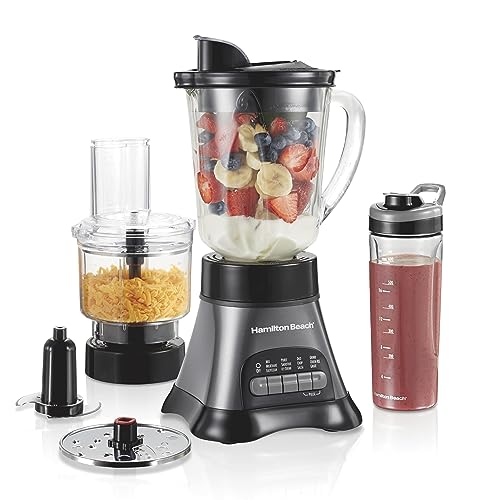
Hamilton Beach Blender and Food Processor Combo 58163 — Best Budget Combo
Every combo guide needs its budget floor, and the Hamilton Beach 58163 sets it higher than expected: a 40 oz glass blender jar — glass at a tier where rivals default to plastic — a 3-cup electric food chopper, and a travel cup, on 700 watts of peak power. The pattern is the full combo pattern in miniature, and for a first kitchen or a small household it covers the honest essentials: smoothies and shakes in the jar or the cup, and the daily chopping core in the attachment.
Who it suits: budget buyers, students in first apartments, and small households testing the combo pattern before investing in a system. There is real wisdom in that test purchase when it is this competent: a season of cooking with the 58163 teaches a household exactly which function it uses, at what volume, and the eventual upgrade — if one is even needed — is bought with evidence instead of advertising. Many households discover the miniature pattern was the destination, not the trial.
The tier’s limits apply in full. Peak wattage is a flattering measure; sustained hard frozen loads blend slower and coarser than in the Ninja systems. The jar is a two-round family batch, and the chopper chops — it does not slice, shred, or knead. But nothing in the box pretends otherwise, and the inclusion of glass and a travel cup at this tier shows a manufacturer spending its budget where owners feel it. As the budget combo, it is the easiest recommendation in this guide to defend.
Strengths
- Glass jar and travel cup included at a budget tier
- Complete miniature combo pattern: blend, chop, and go
- Identifiable brand with a long record at exactly this tier
Trade-offs
- 700W peak rating blends hard frozen loads more slowly
- 40 oz jar means family batches take two rounds
- Chopper cannot slice, shred, or knead dough
| Spec | Detail (verified) |
|---|---|
| Power | 700 watts peak power |
| Jar | 40 oz glass jar |
| Processor | 3-cup electric food chopper attachment |
| Extra | Blender travel cup |
| Finish | Gray and black (58163) |
Best for: budget buyers and small households entering the combo category / Not suited for: families needing batch scale or dough capability
Check on Amazon — check the current price on Amazon for the exact model named here.

Ninja Compact Kitchen System AMZ493BRN, 1200W — Best Auto-iQ Combo
The Ninja Compact Kitchen System is the combo for households that want the system pattern with training wheels and a smaller shadow. Auto-iQ provides three programmed functions — smoothies, dough, and frozen drinks — across a full 72 oz pitcher, a 40 oz processor bowl, and an 18 oz cup, on a 1200W base. The programming is the point of difference in this best blenders and food processors combo field: where the other Ninja systems hand the cook manual control, this one runs timed, considered cycles, which suits households where the machine is shared and nobody wants to become its specialist.
Who it suits: apartment households, newer cooks, and families who value repeatability — the same smoothie from any family member, the same dough cycle every pizza night. The 40 oz processor bowl is the considered compromise at the heart of the design: large enough for family salsa and a dough, small enough to store and wash without resentment, in a footprint that respects a compact kitchen. The pitcher, notably, does not compromise at all — family drink batches stay at full 72 oz scale.
The costs of compactness appear on volume days. Meal-preppers running processor batches back-to-back will feel the 40 oz ceiling where the 8-cup systems breathe easily, and 1200 watts, while ample, is a class below the BL770 on the hardest frozen pitcher loads. Auto-iQ also means trusting the program; cooks who blend by eye may find the cycles occasionally longer than their judgement. For the household that wants a combo to simply work, repeatably, in a modest footprint, those are the right trades — and this is the right machine.
There is a household-composition argument for this pick that deserves stating: in homes where cooking confidence varies — a confident cook, a tentative partner, teenagers beginning to make their own smoothies and doughs — programmed cycles are a leveller. The machine carries the technique, so the least experienced user gets the same result as the most, and the combo actually gets used by the whole household instead of belonging to one person. Utilisation is the hidden variable in every appliance purchase, and Auto-iQ is, at heart, a utilisation feature.
Strengths
- Auto-iQ programs make smoothies, dough, and frozen drinks repeatable for any user
- Compact footprint with an uncompromised 72 oz pitcher
- 40 oz processor bowl balances real capacity against storage and washing
Trade-offs
- Processor bowl ceiling shows on volume meal-prep days
- 1200W is a class below the strongest system on hardest frozen loads
- Programmed cycles ask the cook to trust the timing
| Spec | Detail (verified) |
|---|---|
| Power | 1200W |
| Pitcher | 72 oz |
| Processor | 40 oz processor bowl |
| Cup | 18 oz cup |
| Programs | Auto-iQ, 3 functions for smoothies, dough, frozen drinks |
Best for: smaller households that want programmed, repeatable combo performance / Not suited for: volume meal-preppers or manual-control cooks
Check on Amazon — check the current price on Amazon for the exact model named here.
Comparison Table
Combo comparison is bundle comparison. This table lists each pick’s verified configuration — power, pitcher, processor, and cups — because in this category the accessories are not extras at all; they are fully half the product you are buying.
| Pick | Badge | Key spec | Best for |
|---|---|---|---|
| Cuisinart Velocity Ultra Blender Food Processor BFP-650P1 | Best Overall Combo | 1 HP, blender + food processor combo, (2) 16 oz travel cups | households wanting the complete combo pattern from a heritage brand |
| Ninja Kitchen System Pro+ BR601AMZ, 1200W | Best Family Combo | 1200W, 72 oz pitcher, 8-cup processor bowl, (2) 18 oz cups | families of four or five wanting one combo for every pattern |
| Ninja Kitchen System Pro BL770, 1500W | Best Proven Combo | 1500W, 72 oz pitcher, 8-cup processor bowl, (2) 16 oz cups | buyers who value a proven platform and maximum system power |
| Cuisinart Smart Power Duet BFP-703BCP1, 48 oz Glass Jar + 3-Cup Processor | Best Combo for Small Kitchens | 500W, 48 oz glass jar, 3-cup processor, 7 speeds | couples and small kitchens with small-batch processing patterns |
| Hamilton Beach Blender and Food Processor Combo 58163 | Best Budget Combo | 700W peak, 40 oz glass jar, 3-cup chopper, travel cup | budget buyers and small households entering the combo category |
| Ninja Compact Kitchen System AMZ493BRN, 1200W | Best Auto-iQ Combo | 1200W, Auto-iQ, 72 oz pitcher, 40 oz processor bowl, 18 oz cup | smaller households that want programmed, repeatable combo performance |
How to Choose the Best Blenders and Food Processors Combo
Audit your two jobs separately before you shop, because a combo must pass both. Write down your blending week — how many smoothies, what batch size, whether frozen drinks feature — and your processing week — chopping volume, salsa frequency, whether dough is a real event or an aspiration. Then match configurations: family blending plus dough points to the 8-cup Ninja systems; household blending plus chopping points to the Cuisinart Velocity Ultra; small-space blending plus small-core processing points to the Duet; programmed repeatability points to the compact Auto-iQ system; and an entry budget points to the Hamilton Beach, which keeps the whole pattern in miniature.
Cups deserve more respect than buyers give them. The weekday single-serve pattern is where combos quietly win or lose their households: a combo whose owner blends Monday’s smoothie in a 72 oz pitcher will be a combo gathering dust by spring, while included travel cups — offered by the Velocity Ultra, both family Ninjas, the compact system, and even the budget Hamilton Beach — keep the daily pattern inside the system. Count the cups against the people who will use them on a weekday morning; two-cup households should buy two-cup combos.
- Audit blending and processing separately; the combo must pass both tests.
- Match processor scale to reality: 8-cup bowls for dough and volume, 3-cup attachments for the small daily core.
- Count included cups against weekday users — the single-serve pattern decides daily use.
- Choose programmed Auto-iQ if several people share the machine and none wants to learn it.
- Verify the exact bundle in the listing title; combo names hide configuration differences.
Finally, decide what the combo replaces. Priced and sized against a separate blender plus a separate processor, a good combo is the economical and spatial winner for most kitchens. Priced against a blender alone, it looks like an upsell — which is why households that never process should not buy one, and households that process weekly should not settle for less.
One more decision hides inside the configuration: motor class. Combo bases in this guide run from a budget 700-watt-peak unit to a 1500W system, and the right class follows the frozen and dough load, not the badge. Households whose blending is fresh smoothies and whose processing is chopping can live happily at the modest end; households blending frozen fruit daily and kneading weekly should buy the strong end once. Motors are the one component that cannot be upgraded later — vessels can be added, cups replaced, but the base you buy is the base that decides every future job’s ease.
Combo vs Separate Appliances: The Honest Ledger
The case for separates is real and this guide states it fairly: a dedicated premium blender out-blends any combo on the silkiest extremes, a dedicated large processor out-processes any combo bowl on volume, and two bases let two cooks work simultaneously. Households living at those extremes — daily nut butters, catering-scale prep, parallel cooking — should buy separates and ignore this entire category with this guide’s blessing.
The case for the combo is the rest of domestic life. One footprint instead of two, one motor to maintain, one purchase instead of two, and — the underrated point — one learning curve: the household masters one base, one control logic, one set of locking and cleaning habits, and applies them to every prep job. Kitchens are used by tired people at 7 p.m., and the system that gets used because it is singular and familiar beats the theoretically superior pair that requires a decision before every task. That is why the combo category keeps growing, and why its best products, like the six here, are engineered as systems rather than bundled as promotions.
How to Set Up and Use a Combo System
Setup decides whether a combo feels like one appliance or a box of parts. On arrival, wash every vessel, then assign the storage architecture before the first cook: bowls nested with blades stored safely inside or in a tray, cups and lids together, and the base resident where it will be used. Run one water blend and one pulse of the processor empty of ingredients — a dry run that teaches the locking, the sounds, and the control logic without a recipe clock running. Households that invest this twenty minutes describe their combo as intuitive; households that skip it describe the same product as fiddly.
In daily use, sequence like a professional kitchen: process the dry and aromatic jobs first, blend the wet jobs second, and let one rinse serve between them. Pulse the processor for chopping control rather than running it continuously. Load the pitcher liquids-first for a clean vortex, keep hot liquids below two-thirds, and use the travel cups for the weekday pattern they exist for instead of dirtying the pitcher out of habit. Prompt rinsing after each function — thirty seconds, immediately — is what keeps a multi-vessel system feeling like a single, willing tool.
Combo Ownership: Parts, Bundles, and Buying the Second Vessel
Combo ownership has one economic trap worth naming: the bundle is the product, so a missing or broken vessel is a missing function. Before buying, confirm that the specific pitcher, bowl, and cups for your model are sold as replacements — the Ninja and Cuisinart ecosystems in this guide pass that test comfortably — and photograph the box contents on arrival against the listing, because bundle discrepancies are a known quirk of marketplace fulfilment and are easiest to resolve in the first week.
The same logic runs in the buyer’s favour over time. A combo base that accepts additional vessels lets a kitchen grow — an extra cup for a second commuter, a replacement bowl after years of service — without replacing the motor, which is the expensive heart of the system. Treat the base as the appliance and the vessels as its wardrobe, maintain the base’s vents and coupling with a damp cloth, and a good combo will serve longer than the two budget separates it replaced would have served together.
One Meal, Both Functions: How Combo Cooking Actually Flows
The combo’s value becomes concrete at the level of a single meal. Take a weeknight taco dinner in a system household: the processor bowl pulses the salsa and shreds the cabbage, a thirty-second rinse follows, the pitcher blends a frozen drink or a crema, and the cups stand ready for tomorrow’s smoothies. Two appliances’ worth of work flowed through one base in one counter position, with one wash-up philosophy. A separates household cooked the same meal with the same quality — and used two footprints, two cords, and two learning curves to do it. Neither meal was better; one kitchen was simpler, and simplicity compounds across hundreds of dinners.
Meal-prep Sundays show the same flow at scale. The bowl works through onions, peppers, and a double dough while the pitcher rotates through a soup, a sauce, and a week of smoothie bases, the cook moving between them in the dry-to-wet sequence this guide recommends. The single base is briefly the bottleneck and mostly the rhythm: while dough rests, the pitcher blends; while soup cools, the bowl shreds. Owners who plan the sequence stop noticing the shared motor within a fortnight, which is the empirical answer to the combo sceptic’s favourite objection. The objection imagines two cooks frozen mid-recipe; the reality is one cook, flowing, in a kitchen with room to move.
Common Buying Mistakes
Mistake 1: Buying a blender with a token chopper and calling it a combo. If the processing element cannot handle a family salsa or the full small-prep core, it is an accessory, not a function. Check processor or chopper capacity in the listing title, as verified for every pick here.
Mistake 2: Ignoring the cup count. Weekday single-serve blending is the daily pattern. A combo without cups forces the big pitcher into daily service and teaches the household to stop blending altogether. Match cups to weekday users.
Mistake 3: Assuming the bundle in the photo is the bundle in the box. Combo names cover multiple configurations. Verify every vessel and size in the listing title, and check the delivered box against it on arrival day.
Mistake 4: Judging a combo against a blender alone on price. The honest comparison is combo versus blender plus processor — in money, space, and cords. Judged against one appliance, every combo looks expensive; judged against two, the good ones look almost inevitable.
Mistake 5: Skipping the storage plan. Bowls, blades, pitchers, and cups without a defined home become clutter that hides the system’s value. Assign the storage architecture before the first cook, not after the first month of frustration.
Mistake 6: Running both jobs dirty to save one wash. Sequencing dry-to-wet with a single rinse between jobs is faster and cleaner than blending after processing without rinsing. The thirty-second rinse is the combo owner’s core skill, and skipping it flavours smoothies with onion.
Final Recommendation
If you want one recommendation: take the Cuisinart Velocity Ultra for the complete combo pattern in a typical household — 1 HP, both jobs done properly, and travel cups included — or the Ninja Pro+ system if your household is family-scale and needs the 72 oz pitcher and 8-cup bowl to match. Between those two answers, most kitchens are covered honestly.
The BL770 remains the proven alternative to the Pro+, the compact Auto-iQ system serves programmed households in smaller footprints, the Cuisinart Duet serves small kitchens in glass, and the Hamilton Beach keeps the entire pattern alive at a budget tier. A combo is a promise that one base can run a kitchen’s prep — these six are the configurations that keep it.
Related guides in this series: Best Blenders And Food Processors; Best Blenders; Best 8 Cup Food Processors; Best 1000 Watt Blenders.
Frequently Asked Questions
What is the difference between a combo and a kitchen system?
In practice, very little — both describe one base driving blender and processor vessels, and the Ninja products here are sold as systems while the Cuisinart and Hamilton Beach products are sold as combos. Judge the configuration, not the label: pitcher size, processor or chopper size, and included cups, all verified in the listing title, tell you what the product actually is.
Are combo blenders as good as separate blenders and processors?
For the domestic middle — smoothies, frozen drinks, soups, salsa, chopping, home dough — yes, the genuine combos in this guide match separates job for job. Separates pull ahead only at the extremes: silkiest nut butters, catering volumes, and two cooks working at once. Most households never live at those extremes, and gain space, money, and simplicity from the combo.
Which combo is best for a family?
The family picks here are the Ninja Pro+ and the BL770: 72 oz pitchers for batch drinks, 8-cup processor bowls for salsa and dough, and two single-serve cups each. Choose between them on cup size — 18 oz versus 16 oz — and whether you weight a newer configuration or a longer track record. The compact Auto-iQ system serves smaller families that value programmed cycles and a smaller footprint.
Can a combo knead bread dough?
Combos with full processor bowls can: the Ninja Pro+, the BL770, and the compact system’s dough function handle pizza and bread doughs at home scale. The 3-cup chopper attachments on the Cuisinart Duet and Hamilton Beach combo cannot knead dough — they are chopping tools. If dough matters, it is a bowl-size decision, so verify the processor configuration before buying.
Do I need the travel cups, or are they a gimmick?
They are the difference between a combo that gets used daily and one that gets used weekly. Weekday blending is mostly single servings, and blending one smoothie in a family pitcher — then washing the family pitcher — is friction that quietly ends habits. Every pick in this guide except the small-kitchen Duet includes at least one cup, and two-cup households should choose a two-cup configuration. Treat the cups as core equipment when you compare bundles, not as a bonus to be shrugged at, because they carry the pattern you will repeat most often.
What should I check when my combo arrives?
Check the delivered vessels against the listing title’s configuration — pitcher, bowl or chopper, blades, and cups — because bundle mix-ups are the category’s known quirk and are simplest to resolve immediately. Then run a water blend and an empty processor pulse to learn the locks and sounds, assign the storage architecture, and the system starts life as one appliance instead of a box of parts.


