Disclosure: airfryerkitchensupply.com is reader-supported. When you buy through links on our site, we may earn an affiliate commission at no extra cost to you.
Where to buy
Every blanket below is sold through Amazon, and every linked pick was verified against the live Amazon catalog before this guide was published, so the name and construction described here match the listing you will land on. If a size or colorway shows as unavailable, choose the same model in the nearest size rather than substituting an unverified lookalike, because weave and fill are what matter for this category.
Bedsure Cotton Waffle Blanket · Utopia Bedding Cotton Waffle Blanket · Madison Park Windom Blanket · Bedsure Cotton Herringbone Blanket · PHF Cotton Waffle Blanket · Bamboo Viscose Comforter/Blanket
Finding the best blankets for asthma starts with a simple truth: a blanket cannot treat asthma, and no bedding purchase replaces the plan you follow with your own clinician. What a blanket can do is be easy to wash often, be woven tightly enough that it does not shed lint and loose fibers into the bed, and dry completely so it never becomes a damp, musty layer. Those three practical qualities are what this guide actually ranks.
The market splits into two camps. The first is tightly woven cotton — waffle weaves and herringbone weaves that trap very little dust inside the fabric itself and tolerate frequent hot washing. The second is smooth synthetic or bamboo-viscose layers with sealed, quilted construction that gives dust fewer places to settle. Loose, fuzzy fleece and fluffy throws sit at the other end: cozy, but they hold onto lint and are the hardest to keep genuinely clean.
All six picks below are machine washable, and each one earned its place for a different sleeper: hot sleepers, cold sleepers, people who wash weekly, and people who want one blanket that works as the only layer in summer and a middle layer in winter.
Every pick below was also checked for honest sizing, because a blanket that barely reaches the mattress edges fails this category no matter how good its weave is.
In this guide
Quick Picks
- Bedsure 100% Cotton Waffle Weave Blanket (Queen, White) — Best Overall. A 100% cotton waffle weave in a true 90×90 inch queen cut that breathes in summer, layers in winter, and goes through the wash without shedding or pilling drama. Check the current price on Amazon.
- Utopia Bedding 100% Cotton Waffle Blanket (Queen, White) — Best Budget. The value pick of the cotton waffle group: same all-cotton, easy-wash logic as the leader, in a slightly denser hand feel that suits cooler rooms. Check the current price on Amazon.
- Madison Park Windom Down Alternative Blanket (White) — Best Smooth-Finish Pick. A smooth, satin-trimmed down-alternative blanket with a moisture-wicking treatment and OEKO-TEX certification — the pick for people who dislike textured weaves. Check the current price on Amazon.
- Bedsure 100% Cotton Herringbone Blanket (Queen, Linen Beige) — Best for Cold Sleepers. A denser herringbone cotton weave that traps more warmth than a waffle while staying all-cotton, fully washable, and lint-light — the winter-leaning cotton pick. Check the current price on Amazon.
- PHF Lightweight 100% Cotton Waffle Blanket (Queen, Light Taupe) — Best Pre-Washed Softness. A pre-washed cotton waffle that arrives soft instead of crisp, in a goes-with-everything light taupe — the gentlest first impression of the cotton group. Check the current price on Amazon.
- Bamboo Viscose All Season Comforter/Blanket (Queen) — Best Cooling Pick. A silky bamboo-viscose hybrid that sleeps noticeably cool and smooth — the pick for hot sleepers who find even cotton waffle too warm. Check the current price on Amazon.
How These Picks Were Chosen
Picks were chosen on washability first. Every blanket here is machine washable as a single piece, because a blanket that needs dry cleaning or spot care will not get washed often enough to stay low-dust, no matter how good its materials look on paper. Construction came second: woven cotton and smooth sealed surfaces were favored over fuzzy, high-pile fabrics that trap lint.
Nothing in this guide is a medical product, and nothing here should be read as a claim that a blanket improves any health condition. The ranking logic is purely practical: how clean can you keep this layer, how little does it shed, and how comfortably will you actually sleep under it every night.
- Machine washable as one piece — no dry-clean-only or spot-clean picks
- Tight weave or smooth surface that sheds little lint
- No down or feather fill anywhere in the list
- Sizing verified from the Amazon listing title, not assumed
- Breathability weighed alongside warmth so hot sleepers are not an afterthought
The 6 Best Blankets for Asthma

Bedsure 100% Cotton Waffle Weave Blanket (Queen, White) — Best Overall
The waffle weave is the whole story here. The recessed pockets of the weave create air channels, so the blanket insulates without sealing heat against your body the way a flat fleece does, and because it is 100% cotton there are no synthetic fibers to break down into lint over time. For a bedroom where the goal is bedding that stays clean and stays smooth, that combination is hard to beat at this tier.
The queen size is a genuine 90 by 90 inches, which means real drape on both sides of a queen mattress instead of the skimpy coverage many ‘queen’ blankets deliver. The white colorway is also a practical choice for this category: it tolerates hot washing and the occasional oxygen-based brightener without fading, and it shows you at a glance whether the blanket is actually clean.
Strengths
- 100% cotton waffle weave breathes and sheds very little lint
- True 90×90 inch queen sizing with generous side drape
- White colorway tolerates hot, frequent washing without fading
Trade-offs
- Waffle texture can catch on jewelry and rough skin
- Cotton takes longer to dry than synthetic blankets
- Single-layer warmth is not enough alone for cold winter rooms
| Material | 100% cotton waffle weave |
| Size | Queen, 90 x 90 inches |
| Care | Machine washable |
| Colorway verified | White |
In daily use the blanket behaves like two products. Alone over a sheet it is a summer cover that keeps air conditioning chill off without cooking you. Under a duvet or comforter in winter it becomes the washable workhorse layer that sits closest to the sleeper and takes the weekly wash cycle, sparing the bulkier top layer from constant laundering. That rotation matters for anyone trying to keep the bed’s dust load down without washing a heavy comforter every week.
After repeated washing the waffle structure relaxes slightly and the hand feel gets softer, which most owners experience as an improvement rather than wear. The edges hold their shape because the weave is structural rather than printed, and the blanket does not develop the thin, shiny patches that fleece blankets show after a season of hot cycles.
One more practical detail: because the blanket is a single woven layer with no fill, it folds flat and stores in half the shelf space of a comforter. Households running the two-blanket rotation can keep the spare in a pillowcase on the linen shelf rather than dedicating a storage bin to it, and the blanket that goes back on the bed after washing is never the one that sat compressed for months.
Best for: most asthma-conscious shoppers who want one washable, breathable cotton blanket / Not suited for: sleepers who want a plush, fuzzy throw feel
Check on Amazon — check price on Amazon before you decide, since sizes and colorways change availability often.

Utopia Bedding 100% Cotton Waffle Blanket (Queen, White) — Best Budget
Utopia Bedding built its name on no-frills hotel-style basics, and this waffle blanket follows that formula: 100% cotton, a tight thermal weave, and a 90×90 inch queen cut with no decorative extras inflating the cost. For a two-blanket rotation — one on the bed, one in the wash — this is the blanket that makes the math painless.
The weave reads a touch denser than the Bedsure waffle, which makes it feel marginally warmer at the same weight. Hot sleepers in air-conditioned rooms will not notice the difference, but cold sleepers who run a single blanket deep into autumn usually prefer this one. The white finish is bright and stays bright through repeated washing.
Strengths
- Lowest-cost route into genuine 100% cotton waffle construction
- Dense weave feels warmer than rival waffles at similar weight
- Bright white finish survives repeated hot washes
Trade-offs
- Slightly less airflow than looser waffle weaves
- Plain styling with no decorative border
- Can shrink a little on the first hot dry if over-dried
| Material | 100% cotton waffle weave |
| Size | Queen, 90 x 90 inches |
| Care | Machine washable |
| Colorway verified | White |
The smart way to own this blanket is in a pair. Weekly washing is the single most effective bedding habit for keeping dust and pollen from building up in the layer closest to your face, and a pair means the habit never breaks because the spare is always ready. At this blanket’s tier, two of them typically cost less than one premium branded alternative.
Construction quality is honest rather than luxurious: the stitching is even, the selvedges are clean, and the cotton has the slightly crisp hand of new hotel bedding that softens over the first few washes. It is not the softest blanket in this guide on day one, but by week three the gap largely disappears.
It is also the blanket to buy for a second bed. Guest rooms and kids’ rooms benefit from exactly the same weekly-wash logic, and outfitting two beds with a rotation pair each is only realistic at this tier. The plain white finish matches any room, and if one blanket eventually thins after years of hot cycles, it retires to car-and-picnic duty rather than the trash.
Best for: buyers building a wash-and-rotate pair on a budget / Not suited for: anyone wanting instant plush softness out of the package
Check on Amazon — check price on Amazon before you decide, since sizes and colorways change availability often.

Madison Park Windom Down Alternative Blanket (White) — Best Smooth-Finish Pick
Not everyone likes sleeping under a textured waffle. The Windom answers with a smooth microfiber shell over a light down-alternative fill, finished with a satin trim that gives it a more dressed, made-bed look. The shell carries a 3M Scotchgard moisture-wicking treatment, which helps the blanket release perspiration instead of holding it in the fill.
The listing carries OEKO-TEX certification, which means the finished textile has been tested for harmful substances — a meaningful detail for shoppers who are as careful about what touches their skin as about what they breathe. The fill is fully synthetic, so there is no down or feather content at all, which matters to anyone whose sensitivities include feather bedding.
Strengths
- Smooth shell gives dust fewer textured pockets to settle in
- OEKO-TEX certified materials with moisture-wicking treatment
- Completely feather-free down-alternative fill
Trade-offs
- Microfiber shell is less breathable than open cotton weaves
- Satin trim is decorative and can snag if washed with zippers
- Warmth is light — a summer and shoulder-season blanket
| Shell | Microfiber with 3M Scotchgard moisture-wicking treatment |
| Fill | Down alternative (synthetic) |
| Certification | OEKO-TEX |
| Trim | Satin |
The Windom works best as the top blanket in a made bed rather than the layer against your skin. Its smooth face wipes down easily between washes, and because the whole blanket is one quilted piece it goes through a standard machine without bunching the way loose-fill comforters can. Dry it fully on a long cycle; synthetic fills can feel dry on the surface while the core still holds moisture.
Sizing runs in the line’s combined full/queen format, so on a deep queen mattress the drape is adequate rather than generous. If you share the bed with a blanket-stealing partner, consider treating this as the neat top layer and pairing it with a cotton waffle underneath for personal coverage.
The satin trim deserves one caution and one compliment. The caution: wash it in a mesh-free load without zippers or hooks, because satin edges are the first place any blanket shows snags. The compliment: that trim is why this blanket reads as ‘finished bedding’ rather than ‘utility layer,’ and for a primary bedroom that gets seen by guests, the Windom is the only pick here that pulls that off without a duvet cover over it.
Best for: sleepers who want a smooth, feather-free, certified blanket with a dressed look / Not suited for: hot sleepers who need maximum airflow
Check on Amazon — check price on Amazon before you decide, since sizes and colorways change availability often.

Bedsure 100% Cotton Herringbone Blanket (Queen, Linen Beige) — Best for Cold Sleepers
Herringbone is the classic blanket weave for a reason: the broken twill pattern packs yarns more densely than a waffle, so the finished blanket feels substantial and warm while remaining a single woven cotton layer rather than a filled quilt. For cold sleepers who find waffle blankets too airy in January, this is the cotton answer.
The linen beige colorway hides the visual dust and lint that show instantly on white, which makes it the pragmatic choice for a blanket that lives on the bed daily and gets washed weekly. The listing itself flags the blanket as not pet-friendly, an honest note: clawed pets can pull loops in any woven cotton, and households with bed-sharing dogs should read the trade-offs before choosing it.
Strengths
- Denser herringbone weave delivers real winter warmth in pure cotton
- Beige colorway hides everyday dust between washes
- Same 90×90 inch queen cut and easy machine care
Trade-offs
- Heavier and slower to dry than the waffle picks
- Listing notes it is not pet-friendly — claws can pull the weave
- Less airflow, so hot sleepers will overheat in summer
| Material | 100% cotton herringbone weave |
| Size | Queen, 90 x 90 inches |
| Care | Machine washable |
| Colorway verified | Linen Beige |
Think of this as the winter half of a two-blanket system: herringbone from roughly October through April, waffle for the warm months, both cotton, both washed on the same weekly rhythm. Because the two weaves share care requirements, the rotation adds no laundry complexity — it only changes the warmth level on the bed.
The herringbone surface also drapes differently. Where waffle blankets feel springy, this one lies flat and heavy, which many restless sleepers prefer because the blanket stays where it was placed instead of migrating off the bed overnight. That stay-put weight is comfort, not fill — there is nothing inside this blanket to clump or shift in the wash.
Weight is worth quantifying in feel rather than numbers: draped over a sleeper it registers as a reassuring, stay-put layer, closer to a light weighted feel than to a cloud. Sleepers who toss and turn often report — in general terms across woven cotton blankets — that a heavier single layer migrates less than a puffy comforter, and the herringbone’s flat drape is the extreme of that behavior in this lineup.
Best for: cold sleepers who want winter warmth without a filled comforter / Not suited for: hot sleepers, or homes where pets sleep on the bed
Check on Amazon — check price on Amazon before you decide, since sizes and colorways change availability often.
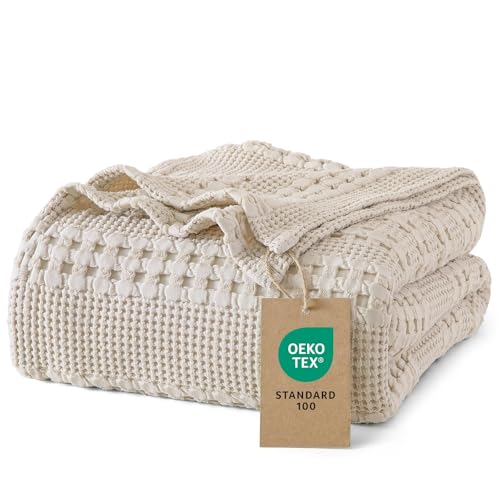
PHF Lightweight 100% Cotton Waffle Blanket (Queen, Light Taupe) — Best Pre-Washed Softness
Most cotton blankets need three or four washes before they lose their showroom crispness. PHF pre-washes this waffle blanket, so it comes out of the package already relaxed and soft, with the slight dimensional settling that new cotton does already done at the factory rather than in your dryer.
The light taupe colorway is the decorator’s choice of the group: warm enough to hide everyday lint between washes, neutral enough to sit over white sheets or under a patterned duvet without arguing with either. The weave is a classic waffle, so airflow is excellent and the blanket works from late spring through early autumn as the only cover for most sleepers.
Strengths
- Pre-washed for immediate softness and settled sizing
- Neutral taupe hides lint visually between wash days
- Classic waffle airflow for warm-weather sleeping
Trade-offs
- Softness-first finishing is slightly less crisp and structured
- Lightweight warmth only — needs a partner layer in winter
- Taupe shows hot-wash fading sooner than pure white
| Material | 100% cotton waffle weave, pre-washed |
| Size | Queen |
| Care | Machine washable |
| Colorway verified | Light Taupe |
Pre-washing has a second, quieter benefit for this category: the heavy lint release that new cotton produces happens before the blanket reaches your bed. The first loads of a new untreated cotton blanket can shed noticeably; a pre-washed blanket starts its life already past that stage, which is exactly what a dust-conscious bedroom wants.
As a layering piece it disappears gracefully — thin enough to sit between sheet and duvet without adding bulk at the foot of the bed, textured enough to stay in place instead of sliding. If you buy one blanket from this guide purely for guest-room duty, this is the one guests will describe as ‘the soft one.’
Taupe also makes this the easiest pick to coordinate with the rest of the guide’s system: white sheets below it read crisp, a white waffle above it in winter reads intentional, and the color hides the faint shadow of everyday lint that would send a white blanket to the wash a day early. Small efficiencies like that are what keep a weekly routine sustainable for years.
Best for: shoppers who want softness on night one and a neutral, lint-forgiving color / Not suited for: anyone needing standalone winter warmth
Check on Amazon — check price on Amazon before you decide, since sizes and colorways change availability often.

Bamboo Viscose All Season Comforter/Blanket (Queen) — Best Cooling Pick
Bamboo viscose has a cool, smooth hand that cotton cannot match, and this queen-size hybrid uses it in a medium-weight comforter-blanket format: more substantial than a woven blanket, lighter than a true duvet insert. The smooth surface is the point for this category — there is no nap, no fleece fuzz, and very little for dust to cling to between washes.
The 90 by 90 inch cut matches the cotton picks, so it drops into the same bed-making routine. Bamboo viscose also releases moisture quickly, which keeps the sleep surface feeling dry on humid nights when cotton can start to feel clammy by 3 a.m.
Strengths
- Coolest, smoothest sleep surface in this guide
- Smooth finish gives dust and lint little to grip
- Medium weight works across more seasons than a thin waffle
Trade-offs
- Bamboo viscose needs gentler wash cycles than rugged cotton
- Silky surface can slide under a duvet cover less grippy fabrics
- Not the choice for shoppers who want 100% natural-fiber purity (viscose is regenerated fiber)
| Material | Bamboo viscose |
| Size | Queen, 90 x 90 inches |
| Weight | Medium, all-season |
| Care | Machine washable, gentle cycle |
Care is the honest compromise here. Where the cotton picks tolerate aggressive hot washing indefinitely, bamboo viscose lasts longest with warm water and a gentler cycle — so if your household routine depends on very hot washes for every layer, keep this as the top layer and let a cotton waffle do the high-heat work underneath.
As a standalone summer cover it is the most comfortable pick in this guide for genuinely hot sleepers: cool to the first touch, breathable through the night, and heavy enough to feel like a real blanket rather than a sheet. That combination is why it earns the cooling slot despite the gentler care routine.
A note on feel for shoppers switching from cotton: bamboo viscose drapes rather than puffs. It follows the body’s contours closely, which some sleepers love and others find less cozy than a lofty layer. If you are unsure, use it first as the top layer over a thin cotton blanket; the combination gives you the cool surface with a little more loft underneath, and both layers stay fully washable.
Best for: hot sleepers who want a cool, smooth, low-lint sleep surface / Not suited for: households that hot-wash every layer aggressively
Check on Amazon — check price on Amazon before you decide, since sizes and colorways change availability often.
Comparison Table
| Pick | Badge | Key spec | Best for |
|---|---|---|---|
| Bedsure Cotton Waffle Blanket | Best Overall | 100% cotton waffle weave | most asthma-conscious shoppers who want one washable, breathable cotton blanket |
| Utopia Bedding Cotton Waffle Blanket | Best Budget | 100% cotton waffle weave | buyers building a wash-and-rotate pair on a budget |
| Madison Park Windom Blanket | Best Smooth-Finish Pick | Microfiber with 3M Scotchgard moisture-wicking treatment | sleepers who want a smooth, feather-free, certified blanket with a dressed look |
| Bedsure Cotton Herringbone Blanket | Best for Cold Sleepers | 100% cotton herringbone weave | cold sleepers who want winter warmth without a filled comforter |
| PHF Cotton Waffle Blanket | Best Pre-Washed Softness | 100% cotton waffle weave, pre-washed | shoppers who want softness on night one and a neutral, lint-forgiving color |
| Bamboo Viscose Comforter/Blanket | Best Cooling Pick | Bamboo viscose | hot sleepers who want a cool, smooth, low-lint sleep surface |
How to Choose a Blanket When Asthma Is Part of the Picture
Start with the wash, not the warmth. The most useful blanket for a dust-conscious bedroom is the one that can go through your machine weekly without shrinking, shedding, or taking two days to dry. Woven cotton wins this test most often, which is why four of the six picks here are cotton: it tolerates hot water, releases soil easily, and its fibers do not break into the fine lint that plush synthetics produce.
Weave density matters more than marketing words
Terms like ‘hypoallergenic’ are not regulated on bedding, so read the construction instead. A tight waffle or herringbone weave leaves few loose fibers at the surface. A brushed fleece or sherpa finish is engineered fuzz — comfortable, but it holds onto everything that lands on it and releases some of it back into the air every time the blanket is shaken out. If you love a fuzzy layer, keep it on the sofa, not on the bed.
Build a two-layer system instead of one hero blanket
A washable cotton blanket as the skin-side layer plus a heavier top layer you wash less often beats a single expensive comforter. The light layer takes the weekly wash; the top layer stays cleaner because it never touches the sleeper directly. In summer the light layer works alone. This system is also cheaper to replace piece by piece when one layer wears out.
Mind the fill — or choose no fill at all
Filled blankets and comforters add two complications: fill can clump after repeated washing, and feather fills are a category many sensitive sleepers avoid entirely. Every pick in this guide is either a single woven layer or uses synthetic down-alternative fill, so nothing here depends on down or feathers. If you already own a filled comforter you love, a washable cotton blanket between you and it solves most of the hygiene problem.
Size for drape, not just mattress dimensions
A queen bed wants a blanket around 90 by 90 inches to give both sleepers coverage with overhang. Skimpy blankets get pulled, bunched, and kicked half off the bed, and bunched bedding traps warm, humid air. Measure your current blanket before ordering; if it is narrower than 86 inches, you will feel the upgrade immediately.
Read care labels like spec sheets
Before any blanket earns a place on your shortlist, read its care label the way you would read a spec sheet. ‘Machine wash warm, tumble dry low’ describes a blanket you can maintain weekly for years. ‘Dry clean recommended’ describes a blanket that will be cleaned a handful of times in its life. Manufacturers write these labels conservatively, but treat them as the ceiling of what the blanket tolerates, not a challenge. Also note fiber percentages: a blanket marketed as ‘cotton’ that is actually a cotton-polyester blend will behave like the synthetic it mostly is — cooler washes, more static, faster surface wear. The picks in this guide were screened on the full fiber content in their listings, not the headline word.
How to Wash and Rotate Blankets So They Stay Low-Dust
The routine below is the one that makes any blanket in this guide perform at its best. It assumes a standard home washer and dryer and takes about ten active minutes per load.
- Wash the skin-side blanket weekly. The layer that touches the sleeper collects the most skin cells and dust; a weekly rhythm keeps buildup from ever establishing.
- Use hot water for cotton picks when the care label allows it. Cotton waffle and herringbone tolerate heat that synthetics cannot; check each label once and then keep the routine consistent.
- Skip fabric softener and scented dryer sheets. They coat fibers with residue that reduces breathability and adds fragrance to the sleep surface — the opposite of what this category is for. A plain, fragrance-free detergent is the right default.
- Dry completely, then a few minutes more. A blanket that feels surface-dry can still hold moisture in its core. Damp bedding stored in a dark closet is how musty smells start; full drying is non-negotiable.
- Rotate two blankets. While one is in the wash, the other is on the bed. Rotation also halves the wear on each blanket, so both last longer.
- Shake and air the blanket outdoors when you change sheets. A minute of fresh air and sunlight between washes keeps the layer fresher without another full cycle.
- Store off-season blankets clean, in breathable cotton bags. Never store a blanket unwashed; sealed plastic traps humidity, so breathable storage is the safer choice.
If your washer is small, wash the blanket alone rather than forcing it in with sheets. An overloaded machine rinses poorly, and detergent residue left in the weave is itself an irritant to sleep under. Most laundromat-style large-capacity machines handle a queen cotton blanket comfortably, which is another reason the woven picks outrank bulky filled comforters for this category.
Two seasonal adjustments keep the routine working year-round. In humid summers, add a short extra dry cycle and store nothing until it is fully cool and dry, because warm folded cotton in a closed closet can pick up a musty note within days. In dry winters, static becomes the nuisance instead: a lower dryer heat for the final minutes and removing the blanket promptly reduces the cling that attracts lint back onto a clean weave.
Cotton vs. Synthetic vs. Bamboo: An Honest Material Comparison
Cotton’s case is durability under real laundry conditions. It tolerates hot water, strong agitation, and full dryer heat for years, and its failure mode is gradual thinning rather than sudden surface breakdown. Its weaknesses are slower drying and a crisper hand when new. For a layer that will be washed fifty times a year, no other fiber in this guide matches that record.
Synthetic microfiber’s case is surface smoothness and low cost. A smooth shell gives dust little texture to grip, and down-alternative fills avoid feathers entirely. The weaknesses show up in the laundry room: synthetics prefer cooler washes, hold odors more readily over time, and can develop a static charge in dry winter air that attracts the very lint you are trying to avoid. The Windom earns its place because its certification and wicking treatment offset much of that, but it is still the gentler-care pick.
Bamboo viscose’s case is temperature and touch. It is the coolest-feeling fiber here and the smoothest against skin, and it releases moisture quickly. Its weakness is toughness: aggressive hot washing shortens its life, so it works best as a top layer in a system where cotton handles the harshest cycles. None of the three is ‘best’ in the abstract — the right answer depends on which layer of your bed system the blanket will be.
One material deliberately absent from this guide is wool. Wool blankets are durable and temperature-regulating, but most are not machine washable on a weekly rhythm, and that single fact disqualifies them from a list built around washing frequency. If your routine is monthly rather than weekly washing, wool re-enters the conversation; for the system this guide recommends, it does not.
Setting Up the Rest of the Bed Around Your Blanket
A blanket does not work alone, and the layers around it can either support the same low-dust logic or quietly undo it. Start with the mattress: a zippered encasement under your fitted sheet keeps the mattress itself — the one layer you cannot wash — from becoming the reservoir everything else sits on. The blanket picks in this guide assume that foundation exists; without it, even a perfectly washed blanket is laid over an unwashed base every night.
Pillows deserve the same thinking. Pillow protectors that zip closed and wash alongside the blanket load add almost no effort to the routine and cover the item closest to your face. Wash them on the same weekly cycle as the skin-side blanket so the whole sleep surface resets at once rather than in staggered pieces.
Finally, look at the floor and the air path. A blanket shaken out over the bed each morning redistributes whatever it collected; shake it at an open window or outdoors instead. Keep the bedroom floor hard or low-pile where you can, vacuum with the bed already made so settled dust is captured rather than transferred, and let the room air out while bedding is in the wash. None of this requires new equipment — it is the same cleaning effort, sequenced so the blanket you just washed is not immediately reloaded.
The point of the system is sustainability. A routine that takes an extra ten minutes a week and survives busy seasons will outperform an elaborate deep-clean performed twice a year. Choose the blanket you will actually wash, on the schedule you will actually keep, and the rest of the bed will follow.
One Blanket or Two? Planning the Rotation by Season
The most common question this category raises is whether one good blanket is enough. For warmth, often yes. For the washing system this guide recommends, one blanket creates a recurring problem: every wash day leaves the bed bare for hours, and the temptation is to stretch the interval ‘just this once’ until the weekly rhythm quietly becomes monthly. Two blankets remove the friction entirely, and friction — not knowledge — is what breaks laundry routines.
A practical pairing strategy is to buy across weaves rather than duplicating one blanket. A waffle and a herringbone in the same size give you a summer weight and a winter weight that share identical care, so the rotation doubles as a seasonal system. The Bedsure pair in this guide is the obvious example, but any waffle-plus-herringbone combination from the list works the same way.
Budget the pairing honestly. Two mid-tier cotton blankets that get washed weekly will outperform one luxury blanket washed monthly on every measure this guide uses — cleanliness, shedding, and lifespan per dollar. If funds force a sequence, buy the waffle first (it covers more of the year), add the second blanket before the next season change, and let the system build itself.
Label the rotation if your household shares laundry duty. A small tag or a designated shelf order — front blanket is the clean spare — prevents the freshly washed blanket from being put back into storage while the dirty one returns to the bed. It sounds trivial until the first time it happens, which in most households is the first month.
Common Buying Mistakes
Buying the fuzziest blanket in the store. Plush and sherpa finishes feel luxurious in a two-minute store test and then spend years shedding fibers and holding dust. For a bedroom where air quality is the priority, smooth and woven beats fuzzy every time.
Washing bedding ‘when it looks dirty’. Dust and skin-cell buildup are invisible long before they are visible. A calendar-based weekly wash for the skin-side layer works; a looks-based schedule does not.
Using heavy fragrance to make bedding smell clean. Scent is not cleanliness. Fragranced detergents and softeners leave residues in the weave that sit inches from your face all night. Fragrance-free products plus a genuinely hot wash and full dry produce a bed that smells like nothing — which is the goal.
Buying a dry-clean-only ‘premium’ blanket. It will be washed a fraction as often as a machine-washable one, and within months it will be the dirtiest layer on the bed regardless of its price. Care requirements are a performance spec in this category.
Ignoring the dryer. Pulling a thick blanket out while the core is still damp and folding it into a closet undoes the entire wash. Budget the full drying time, especially for the denser herringbone weave.
Final Recommendation
If you buy one blanket from this guide, make it the Bedsure Cotton Waffle: it is the best balance of breathability, washability, and true queen sizing, and it anchors the two-layer system described above. Cold sleepers should start with the Bedsure Herringbone instead and add a waffle later for summer. Hot sleepers who run warm even under cotton should go straight to the Bamboo Viscose pick.
On a budget, buy two Utopia Bedding waffle blankets and rotate them — the rotation habit matters more than any single product upgrade. Whatever you choose, commit to the weekly wash rhythm; the blanket is only half the system.
A last word on expectations: you will not feel a new blanket ‘work’ the way you feel a new pillow change your sleep position. What you will notice, a month into the routine, is a bed that smells neutral, a blanket that still looks bright after a dozen washes, and a laundry habit that no longer feels like a project. That quiet consistency is the entire point of this category, and every pick above was chosen to make it easy to keep.
Keep researching within this cluster: Best Blankets For Queen Bed Best Blankets For Guests Best Blankets Ever Best Blankets That Don’t Shed On Sheets
Frequently Asked Questions
What blanket material is easiest to keep low-dust?
Tightly woven cotton. Waffle and herringbone weaves have very little loose surface fiber, tolerate hot frequent washing, and dry fully in a home dryer. Smooth bamboo viscose is a close second for hot sleepers, with gentler washing.
How often should I wash my blanket?
The layer against your skin deserves a weekly wash. Top layers that never touch the sleeper can go two to four weeks. A two-blanket rotation makes the weekly rhythm easy to keep.
Are down blankets a problem for sensitive sleepers?
Many sensitive sleepers avoid feather and down fills entirely, and every pick in this guide is either a single woven layer or uses synthetic down-alternative fill, so nothing here depends on down.
Does a ‘hypoallergenic’ label guarantee anything?
No — the term is not regulated for bedding. Read the construction instead: fiber type, weave density, fill content, and care requirements tell you far more than the label claim.
Should I use fabric softener on my blankets?
It is better skipped. Softener coats fibers, reduces breathability, and leaves fragrance residue on the sleep surface. Cotton blankets soften naturally over the first several washes without it.
Can a blanket help with asthma?
A blanket is not a medical device and cannot treat any condition. What the right blanket can do is stay easy to wash, shed very little, and dry completely — practical qualities that help you keep the sleep environment clean. For anything beyond that, follow your own clinician’s guidance.
What about electric blankets and weighted blankets?
Both complicate the washing system. Most electric blankets allow only infrequent gentle washing because of their wiring, and most weighted blankets exceed home washer capacity or require special care. If you rely on either, put a washable cotton blanket from this guide between it and your skin, and wash that layer weekly — the barrier layer does the hygiene work the specialty blanket cannot.


