Disclosure: airfryerkitchensupply.com is reader-supported. When you buy through links on our site, we may earn an affiliate commission at no extra cost to you.
Where to buy
The best big cube ice makers come from two very different product families, and this guide covers both honestly: countertop clear-ice machines that freeze large cubes or spheres on a timer, and directional-freezing trays and molds that work in your freezer for a fraction of the cost. Every pick below was verified against Amazon’s catalogue data at research time. Use the links to check the current price on Amazon, and read the format notes in each review — a 2-inch cube and a 2.4-inch sphere behave similarly in the glass but come from very different routines.
- EUHOMY 2-Inch Clear Ice Cube Maker Countertop — Check on Amazon
- Klaris Clear Ice Maker — Check on Amazon
- True Cubes Crystal Clear Ice Cube Maker — Check on Amazon
- ClearlyFrozen Clear Ice Tray — Check on Amazon
- EUHOMY 2.4-Inch Clear Ice Ball Maker Countertop — Check on Amazon
- TINANA 2 Inch Clear Ice Cube Tray — Check on Amazon
Searching for the best big cube ice makers teaches you something quickly: this category is not really about ice machines at all. A standard ice maker — countertop or commercial — makes small cubes, bullets or nuggets. Big cubes, the dense 2-inch blocks that anchor a proper old fashioned, are made either by insulated directional-freezing trays in a home freezer or by a small new class of countertop clear-ice machines. Anyone who tries to sell you a conventional ice maker for this job is solving the wrong problem.
Why does size matter so much? Dilution control. A large cube has far less surface area relative to its volume than a handful of small cubes, so it chills a drink while melting slowly and predictably. Your whiskey stays cold and stays itself. Clarity matters for the same reason it looks good: clear ice is dense ice, frozen directionally so air and impurities are pushed out instead of being trapped as the white, crumbly centre that melts fast and can carry freezer flavours.
The six picks below split between freezer trays — cheap, silent, superb quality, but limited to a handful of cubes per day — and countertop clear-ice machines that produce big cubes or spheres continuously at a much higher buy-in. Which family is right depends on whether big cubes are an occasional pleasure or a nightly, multi-guest ritual.
In this guide
Quick Picks
The shortlist: two countertop machines for volume, one premium directional system, and three tray options at friendlier prices.
- EUHOMY 2-Inch Clear Ice Cube Maker Countertop — Best Overall Machine: A countertop machine making two 2-inch clear cubes per short cycle, rated up to 110 cubes a day — big-cube volume no freezer tray can touch. — Check on Amazon
- Klaris Clear Ice Maker — Best for Whiskey Purists: A compact directional-freezing system producing two crystal-clear 2-inch cubes per batch — the connoisseur’s freezer-based route. — Check on Amazon
- True Cubes Crystal Clear Ice Cube Maker — Best Budget Clear Ice: Four proper 2-inch clear cubes per freeze from an insulated silicone system at a gift-friendly price — the sensible first step into clear ice. — Check on Amazon
- ClearlyFrozen Clear Ice Tray — Best Tray Capacity: Ten 2-inch clear cubes per freeze — the largest directional tray batch here, for households that stockpile ahead of the weekend. — Check on Amazon
- EUHOMY 2.4-Inch Clear Ice Ball Maker Countertop — Best Sphere Machine: Prefer spheres? This countertop machine turns out two 2.4-inch clear ice balls per hour-long cycle, up to 48 a day. — Check on Amazon
- TINANA 2 Inch Clear Ice Cube Tray — Best Value Tray: Eight large 2-inch cubes per tray at the friendliest price here — the value route to a freezer full of big cubes. — Check on Amazon
How These Picks Were Chosen
Candidates were verified through the site’s Amazon catalogue connection, matching each listing title to the product reviewed — important here because the big-cube shelf is crowded with ordinary silicone trays wearing ‘clear ice’ language they cannot deliver. A tray only makes genuinely clear ice if it uses directional freezing: insulation on five sides so the water freezes from the top down, pushing air and impurities into a bottom layer you discard or trim. Plain open trays make big cubes, but cloudy ones, and we have labelled the difference honestly rather than repeating marketing copy.
Picks were then judged on cube size and clarity, output per day, freezer or counter footprint, release and handling, and how much daily routine the format demands. A tray that makes ten perfect cubes overnight suits a household that plans ahead; a machine that turns out spheres through the evening suits a party. Both are legitimate — the reviews say which is which.
The 6 Best Big Cube Ice Makers, Reviewed in Depth

EUHOMY 2-Inch Clear Ice Cube Maker Countertop — Best Overall Machine
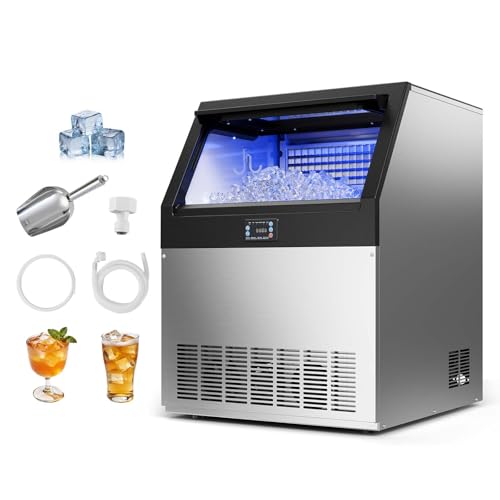
This EUHOMY is the answer for hosts who burn through big cubes faster than any tray can replace them. It produces two 2-inch clear square cubes per cycle — the listing rates a cycle at under half an hour and daily output in three figures — so a Friday of old fashioneds for eight people stops being a logistics problem. App control, a 24-hour timer and self-cleaning round out a machine clearly designed for entertaining.
Strengths
- Continuous production — big cubes on demand, not one tray a day
- True 2-inch square format for rocks glasses
- Timer lets you pre-produce before guests arrive
Trade-offs
- Premium-tier buy-in compared with any tray
- Countertop footprint and compressor hum in the room
- Output figures are rated figures; cube clarity depends on your water
Key specs: 2-inch clear cubes, 2 per cycle, rated up to 110 pcs/day, app control, 24H timer, self-cleaning (per verified listing title)
The honest comparison is against your freezer, not against other machines. Trays make better ice per cube for almost no money, but they make it in batches of four to ten, once a day, if you remembered. This machine trades a little of that artisanal perfection for abundance: cubes keep coming, the bin fills ahead of the party, and nobody’s second drink gets demoted to small ice. For households that entertain weekly, that trade is usually worth it.
Ownership follows the countertop ice machine pattern: keep the water fresh, run the self-clean cycle on schedule, and use filtered water if your tap supply is hard or chlorinated — clarity starts with the water, whatever the machine. Expect it to earn its counter space only if big cubes are a habit; occasional users should save the money and the space and buy the Klaris or a good tray below.
Best for: frequent hosts serving multiple big-cube drinks per night / Not suited for: occasional whiskey drinkers, who are better served by a tray
Check on Amazon — check the current price on Amazon before ordering, and confirm the configuration matches what is described here.
Klaris Clear Ice Maker — Best for Whiskey Purists
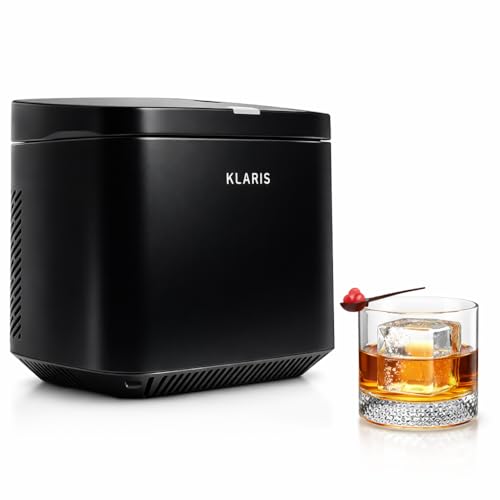
The Klaris takes the opposite approach to the EUHOMY machine: no compressor, no counter space, just a well-executed insulated directional-freezing system that yields two genuinely crystal-clear 2-inch cubes in roughly eight to ten hours. It is built for the drinker who makes one or two serious drinks an evening and wants those cubes flawless.
Strengths
- Truly clear, dense cubes — the best-looking ice in this guide
- Compact freezer footprint, silent, nothing to plug in
- Slow-melting cubes that respect an expensive pour
Trade-offs
- Only two cubes per batch — planning is mandatory
- Eight-to-ten-hour freeze means no spontaneous big cubes
- Cost per cube is high if you entertain at volume
Key specs: 2 large 2-inch clear cubes per batch, approx. 8–10 hour freeze, directional freezing (per verified listing title)
Clarity is not vanity. The white centre of a cloudy cube is trapped air and concentrated impurities; it melts faster, fractures in the glass and can carry the flavour of whatever else lives in your freezer. A directional system freezes top-down so that material ends up in a sacrificial layer, leaving a cube that is dense all the way through. In the glass the difference is visible and, over a long drink, tasteable.
The routine is the price: fill, freeze, harvest, repeat, and keep a small stockpile in a freezer bag so a spontaneous guest does not catch you out. Two cubes a batch sounds tiny until you realise most solo drinkers need exactly two cubes an evening. Buy the Klaris for ritual quality; buy the machine above for crowds.
Best for: solo or two-person whiskey and cocktail rituals / Not suited for: parties, or anyone who forgets to start tomorrow’s ice today
Check on Amazon — check the current price on Amazon before ordering, and confirm the configuration matches what is described here.

True Cubes Crystal Clear Ice Cube Maker — Best Budget Clear Ice
True Cubes is where most people should start with clear ice: an insulated mold system that makes four full 2x2x2-inch clear cubes per freeze, at a price that makes it an easy experiment and a reliable gift. Four cubes covers a couple’s evening or a small tasting flight, and the silicone format releases cleanly once you learn the timing.
Strengths
- Four full-size clear cubes per batch — double the Klaris count
- Accessible price for genuine directional freezing
- Silicone mold releases cubes without cracking them
Trade-offs
- Still a plan-ahead format — one batch per freeze cycle
- Takes a meaningful block of freezer space
- Clarity depends on technique: fill level and freeze time matter
Key specs: 4 large 2x2x2-inch clear cubes per batch, silicone mold, directional freezing (per verified listing title)
The four-cube batch is the sweet spot for most households: enough for two drinks each for a couple, or a proper round for a small group, without dedicating half a freezer shelf to ice production. Run it on a rhythm — harvest in the morning, refill, harvest before dinner — and a stockpile builds quickly in a freezer bag, which is how bars handle format ice too.
Technique notes from everyone who uses these systems: use filtered or previously boiled water if your tap water is very hard, do not overfill, and let the mold sit a few minutes at room temperature before release rather than forcing it. None of that is difficult, and the payoff — glass-clear cubes that make a home pour look and drink like a bar pour — is out of proportion to the money involved.
Best for: couples and small households starting with clear ice / Not suited for: high-volume entertaining, where a countertop machine wins
Check on Amazon — check the current price on Amazon before ordering, and confirm the configuration matches what is described here.

ClearlyFrozen Clear Ice Tray — Best Tray Capacity
ClearlyFrozen’s pitch is capacity: ten 2-inch clear cubes in a single freeze, the biggest directional-tray batch in this guide. If your pattern is a weekly batch-and-bank routine — make ten on Thursday, bag them, serve all weekend — this is the tray format that fits it, and the brand has built its reputation specifically on clear ice rather than selling it as a sideline.
Strengths
- Ten cubes per batch — the stockpiler’s choice
- Specialist clear-ice design rather than a generic tray
- Batch size suits weekend entertaining without a machine
Trade-offs
- The insulated system is bulky in a crowded freezer
- A failed batch wastes more water and time than a small tray
- Release and trimming routine has a learning curve
Key specs: 10 clear 2-inch cubes per batch, directional freezing tray system (per verified listing title)
Think of this as the batch-production option. Ten cubes is a real inventory: a full evening for four serious drinkers, produced in one overnight freeze. The economics are unbeatable — after the purchase, your cost per cube is water and freezer space — and the quality ceiling of a well-run directional tray matches or beats any countertop machine in this guide.
The discipline required is freezer management. The insulated box needs level space, the harvest needs a few unhurried minutes, and the cloudy bottom layer needs trimming or discarding as directed. Households with a second freezer or a garage freezer will find this trivially easy; households with one small freezer drawer should look at the four-cube True Cubes instead and be honest about the space they actually have.
Best for: stockpilers and weekend hosts with freezer space to spare / Not suited for: small or crowded freezers, where the compact systems fit better
Check on Amazon — check the current price on Amazon before ordering, and confirm the configuration matches what is described here.
EUHOMY 2.4-Inch Clear Ice Ball Maker Countertop — Best Sphere Machine
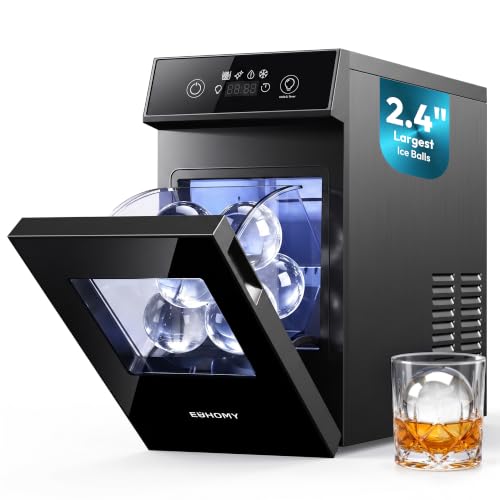
Some drinkers prefer a sphere: it presents beautifully in a wide rocks glass, rolls as you drink, and has the lowest surface-area-to-volume ratio of any format — the slowest melt of all. This EUHOMY brings sphere production to the countertop, making two 2.4-inch clear balls per cycle at a rated pace of dozens per day, with a timer and self-cleaning.
Strengths
- Spheres melt slowest of any format — maximum dilution control
- Continuous machine production for sphere drinkers
- 2.4-inch size suits wide rocks and bourbon glasses
Trade-offs
- Slower cycle than the square-cube machine — two balls per hour
- Spheres need the right glassware to shine
- Premium buy-in for a single-format machine
Key specs: 2.4-inch clear spheres, 2 per cycle, rated 48 pcs/day, timer, self-cleaning (per verified listing title)
The sphere-versus-cube debate is mostly aesthetic, with one real functional edge: the sphere’s minimal surface area does melt measurably slower, which matters over a long, slow pour. Against that, spheres are fussier about glassware — in a narrow glass a sphere can seal against the sides — and this machine’s hourly cycle is slower than its square-cube sibling, so heavy parties need the timer working ahead of time.
If your drinking life is bourbon and single malts served to a handful of people, this is a delightful machine to own. If your drinks are mixed, shaken or served in varied glassware, the square format is more versatile and the cube machine above is the better buy. Format loyalty is personal; just buy the format you actually drink.
Best for: bourbon and whiskey drinkers who love the sphere format / Not suited for: mixed-drink households needing versatile square cubes
Check on Amazon — check the current price on Amazon before ordering, and confirm the configuration matches what is described here.

TINANA 2 Inch Clear Ice Cube Tray — Best Value Tray
The TINANA tray makes eight large 2-inch square cubes per freeze and costs the least per cube of anything in this guide. A note of honesty: at this price, treat ‘crystal clear’ as an aspiration rather than a guarantee — results depend heavily on your water and technique, and many owners find these trays produce their best cubes with filtered water and a slow, undisturbed freeze. What you reliably get is properly big, slow-melting cubes.
Strengths
- Eight big cubes per freeze at a low buy-in
- Simple tray format — no insulation box to store
- Easy way to test whether big cubes suit your drinking
Trade-offs
- Clarity is technique-dependent at this tier
- Trays flex; careful handling avoids cracked cubes
- No insulation means faster, less directional freezing
Key specs: 8 large 2-inch square cubes per tray (per verified listing title)
There is a sensible ladder in this category, and the TINANA is its first rung. Spend a little, live with big cubes for a month, and learn whether you care about the difference between very good big ice and perfect clear ice. Many drinkers discover the big slow melt was the part they actually wanted, and stop here happily. Others catch the clarity bug and graduate to a directional system with no regrets, because the tray still serves for parties and punches.
To get the best from it: fill with filtered water, freeze on a level surface away from the freezer door’s temperature swings, and let cubes rest a minute before release. For the money, the improvement over standard freezer cubes in a whiskey glass is dramatic — this is the highest-value upgrade in the whole guide.
Best for: budget buyers and big-cube beginners / Not suited for: clarity perfectionists, who should buy a directional system
Check on Amazon — check the current price on Amazon before ordering, and confirm the configuration matches what is described here.
Comparison Table
Machines buy you volume; trays buy you quality per dollar. The table makes the trade explicit.
| Pick | Badge | Key spec | Best for |
|---|---|---|---|
| EUHOMY 2-Inch Clear Ice Cube Maker Countertop | Best Overall Machine | Machine, 2-inch cubes, high daily output | frequent hosts serving multiple big-cube drinks per night |
| Klaris Clear Ice Maker | Best for Whiskey Purists | Directional tray system, 2 cubes/batch | solo or two-person whiskey and cocktail rituals |
| True Cubes Crystal Clear Ice Cube Maker | Best Budget Clear Ice | Tray system, 4 clear cubes/batch | couples and small households starting with clear ice |
| ClearlyFrozen Clear Ice Tray | Best Tray Capacity | Tray system, 10 clear cubes/batch | stockpilers and weekend hosts with freezer space to spare |
| EUHOMY 2.4-Inch Clear Ice Ball Maker Countertop | Best Sphere Machine | Machine, 2.4-inch spheres | bourbon and whiskey drinkers who love the sphere format |
| TINANA 2 Inch Clear Ice Cube Tray | Best Value Tray | Tray, 8 large cubes/batch | budget buyers and big-cube beginners |
How to Choose Between a Big Cube Machine and a Tray
Count your real consumption first. One or two big-cube drinks an evening, a few nights a week, is tray territory: even the two-cube Klaris keeps up if you run it daily, and the four- and ten-cube systems build a surplus. Regular entertaining — six or more big-cube drinks in a night, weekly — is where countertop machines earn their price, because no freezer routine survives contact with a busy social life.
Then be honest about space. Machines take counter space permanently and trays take freezer space temporarily, and in most kitchens one of those is clearly scarcer. Finally, consider the ritual itself: many drinkers enjoy the tray routine as part of the hobby, the way they enjoy sharpening a knife. Others want ice to be invisible infrastructure. Neither is wrong; buy for the person you are, not the person the advertisement imagines.
Why Clear Ice Melts Slower: The Directional Freezing Idea
Ordinary ice freezes from all sides at once, trapping air bubbles and dissolved minerals in the centre as a white, weak core. That core melts and fractures first, which is why cloudy cubes seem to vanish and crack. Directional freezing insulates every side of the container except the top, so freezing proceeds in one direction and pushes air and impurities ahead of the freeze front into a final layer that never becomes part of your cube. The result is uniformly dense ice: slower melting, no crumbling, and no trapped freezer flavours.
Water still matters. Very hard tap water can cloud even a directional system slightly, and the standard fixes are filtered water or water that has been boiled and cooled, which drives off some dissolved gas. Perfect clarity also rewards patience — an undisturbed freezer and a full freeze time — which is why tray owners talk about their routine the way bakers talk about sourdough.
Sizes and Formats: 2-Inch Cubes, Spheres and Everything Between
The 2-inch cube became the standard for a practical reason: it is the largest format that fits comfortably in a standard rocks glass with room for liquid to move around it, and molds, trays and machines have standardised on it, which makes stockpiling and glassware pairing predictable. Smaller large cubes — the inch-and-a-half class found in some novelty trays — melt noticeably faster and rarely justify themselves; they are a compromise that satisfies neither the small-ice nor the big-ice purpose. Larger cubes exist for punch bowls and decanter-style serves, where a single oversized block is theatre as much as refrigeration, but they demand oversized glassware and freezer gymnastics that most households will not sustain.
Spheres occupy their own niche: the 2.4-inch class in this guide suits wide bourbon glasses and presents beautifully, and the melt advantage, while real, is modest in practice — a few extra minutes of low dilution across a long drink. Collins spears and other elongated formats serve tall drinks and look striking doing it, but they are a second format to add once the cube programme runs itself, not a starting point. The sensible first purchase is the format that matches the drinks you make weekly, in the standard size your glassware already fits — and for the overwhelming majority of home drinkers, that is the 2-inch cube.
A final sizing note concerns the glass you already own. Before buying any system, take your favourite rocks glass, measure its interior width at the base, and confirm the format fits with clearance. It is a thirty-second check that has saved more returns than any review paragraph ever written, and it is the difference between ice that serves the drink and ice that fights it.
How to Make Perfect Big Cubes at Home, Step by Step
Whether you use a directional system or a simple tray, the same routine produces the best cubes. For machine owners, steps one and five still apply — clarity starts with water.
- Start with filtered water; if your tap water is very hard, boil it, let it cool, and use that for your clearest cubes.
- Fill the mold or system exactly to its line — overfilling bonds cubes together, underfilling makes fragile tops.
- Place it level in the coldest, least-disturbed part of the freezer, away from the door.
- Freeze for the full directed time — directional systems typically need most of a day; do not rush the harvest.
- Rest the mold at room temperature for a few minutes before release, and ease cubes out rather than twisting hard.
- Store harvested cubes in a sealed freezer bag, which prevents flavour pickup and sublimation shrinkage.
- Serve with tongs, and temper a cube in the glass for twenty seconds before pouring if you want to avoid thermal-shock cracks.
Machine owners: run the self-clean cycle on schedule and keep the reservoir water fresh. A clear-ice machine fed stale water makes clear ice that tastes of the reservoir — clarity you can see is not the same as ice you want in a good drink.
Common Buying Mistakes
Expecting a normal ice maker to make big cubes. Standard countertop and commercial machines make small formats by design. Big cubes come from trays, directional systems or dedicated clear-ice machines.
Believing every ‘clear ice’ tray claim. Without directional freezing — insulation and a sacrificial layer — a tray makes big cloudy cubes. Fine ice, but not clear ice.
Underestimating the routine. Trays need a daily rhythm and freezer space. If you will not run the routine, a countertop machine is the honest purchase.
Using stale or unfiltered water. Ice is mostly water; everything in the water ends up in the drink as the cube melts. Start clean.
Cracking cubes with thermal shock. A freezer-hard cube hit with room-temperature spirit can crack. A brief temper in the empty glass prevents most splits.
Cubes vs Spheres vs Small Ice: A Melt-Rate Field Guide
Surface area is destiny. For the same total weight of ice, many small cubes expose far more surface to the drink than one big cube, so they chill faster and dilute faster. That is why shaking and blended drinks want small ice — speed is the point — and why a neat spirit wants the opposite. A sphere minimises surface area for its volume and melts slowest of all; a 2-inch cube is close behind and stacks, stores and fits glasses more predictably.
The practical upshot: big cubes are not ‘better ice’ in the abstract, they are the right ice for slow drinks. Keep small ice for shaking, big cubes for sipping, and you have covered the whole home bar with two formats — which is exactly what professional bars do with considerably more expensive equipment.
Running a Tray Programme: The Freezer Workflow That Actually Works
The difference between tray owners who love their system and those whose mold gathers dust is a workflow, not a product. The working pattern looks like this: harvest in the morning while the kettle boils, refill immediately, and let the day do the freezing. Harvested cubes go into a sealed bag in a dedicated corner of the freezer — a small, flat ‘ice library’ that never shares space with frozen peas or last month’s fish. Two minutes a day, attached to an existing habit, and the stockpile maintains itself.
Batch planning scales the same way. Know your household’s weekly big-cube consumption the way you know its coffee consumption. A couple drinking two rocks drinks on Friday and Saturday needs eight to ten cubes a week — one ClearlyFrozen batch, or two True Cubes batches, or a daily Klaris rhythm with a small surplus. A household hosting monthly tastings for six needs a stockpile strategy: produce daily for two weeks beforehand, bag everything, and arrive at the event with forty cubes in reserve and no stress.
Freezer space is the honest constraint, and it deserves an honest audit before purchase. Directional systems are insulated boxes; they need a level footprint roughly the size of a shoebox or larger, plus room to manoeuvre the harvest. Measure the shelf, check the door bins and the ice-maker housing of your own freezer compartment, and if the big system does not fit, buy the compact one and run it more often. A smaller system used daily beats a larger one that never fits and never freezes.
Big Cubes Beyond Whiskey: Where Large Format Ice Earns Its Place
Whiskey gets the headlines, but big cubes quietly improve a whole shelf of drinks. An aperitif served over one large cube stays cold through a long conversation without turning watery. Iced coffee over a big cube keeps its strength to the last sip instead of diluting into brown water by halfway. A big cube in a tall glass of sparkling water or a homemade soda slows the melt enough that the drink finishes as itself, and batch cocktails served from a pitcher stay cold in the glass without needing the pitcher iced at all.
There are also jobs where big cubes are simply the wrong tool, and knowing them saves disappointment. Shaking requires small, hard ice that fractures and chills violently; a big cube in a shaker is a paperweight. Blended drinks need crushed or nugget ice. Delicate long drinks built in the glass often want plenty of ordinary cubes for maximum chill. The mature home bar does not ask one format to do everything — it keeps big cubes for slow drinks, standard cubes for building and shaking, and that division of labour is exactly what the machines and trays in this guide are for.
One more use deserves mention: presentation for guests who do not drink spirits at all. A glass of sparkling water, tonic or a zero-proof serve over a single crystal cube looks and feels like an occasion. Good ice is hospitality in solid form, and it costs almost nothing once the routine exists — which is, in the end, the strongest argument for whichever pick in this guide fits your freezer or your counter.
The Honest Cost-per-Cube Ledger
It is worth doing the unfashionable arithmetic. A directional tray system costs, after purchase, essentially the price of water and a slice of freezer electricity: a household making ten cubes a week spends a trivial amount per year, and the cubes are as good as ice gets. A countertop clear-ice machine costs hundreds of times more to buy, consumes counter space and electricity continuously, and needs cleaning consumables — and in exchange it removes the planning constraint entirely. Neither ledger is foolish; they price different scarcities. Tray owners are spending attention, machine owners are spending money to buy attention back.
The break-even question is therefore personal rather than mathematical. If you entertain monthly, a machine may produce a few hundred cubes a year and each one carries a noticeable share of the purchase price. If you entertain weekly for eight people, the machine’s cost per cube collapses and the tray owner’s nightly routine starts to look like the expensive option — paid in the only currency that does not refill. Count your drinks honestly for a month before deciding which scarcity is yours.
Resale and longevity tilt the ledger slightly back toward machines and quality trays alike: a well-kept clear-ice machine from a known brand holds value, and a good directional tray is nearly indestructible. The false economy in this category is the very cheap mold bought repeatedly as it splits and clouds — buy once, at the tier your routine justifies, and the ledger balances itself.
Glassware, Garnish and Serving: Getting the Most from a Big Cube
A big cube deserves a glass that shows it. The classic pairing is a heavy-bottomed rocks glass wide enough for the cube to sit with clearance on all sides; too narrow and the cube wedges, seals and refuses to chill the drink evenly, too wide and it swims and looks lost. Double old fashioned glasses exist precisely for this format. If spheres are your format, the same width logic applies with even less forgiveness, which is why sphere drinkers tend to standardise on one favourite glass.
Serving technique is minimal but real. Take the cube from the bag with tongs, give it a few seconds in the empty glass if it has come straight from a very cold freezer, then build the drink over it rather than dropping the cube into liquid, which splashes and can crack the cube. For stirred drinks served up, the big cube stays in the mixing glass’s supporting cast — you stir with ordinary ice and strain over the big cube, which then has only one job: keeping the drink cold without changing it.
Finally, protect the stockpile’s neutrality. Big cubes live in freezers alongside everything a household freezes, and ice is an eager absorber of odours. Sealed bags, a dedicated corner, and a rule that the ice bag is never left open are the whole secret. A crystal cube that tastes faintly of frozen curry undoes every dollar and every hour spent making it clear — a small, sad, entirely preventable tragedy.
Troubleshooting Cloudy, Cracked and Stuck Cubes
Cloudy cubes from a directional system almost always trace back to one of four causes: the water, the freeze, the fill or the harvest. Very hard water carries enough dissolved mineral to cloud even a well-directed freeze, and the fix is filtration or boiled-and-cooled water. A freezer that is opened constantly, or a system placed in the door’s temperature swings, freezes unevenly and traps the very air the design tries to expel; move the system to the coldest stable shelf. Overfilling bonds the cubes into a single slab and traps a cloudy seam between them, while harvesting too early — before the sacrificial layer has fully formed — releases cubes whose bases are still the impurity layer wearing a clear disguise.
Cracked cubes are a thermal story. Ice taken from a deep-cold freezer into room-temperature spirit experiences a shock that dense, clear ice tolerates better than cloudy ice but does not always survive; the tempering habit — a few seconds in the empty glass, or a splash of the drink’s mixer first — prevents most splits. Stuck cubes are a patience story: silicone releases cleanly after a short rest at room temperature, and forcing a frozen mold twists micro-fractures into cubes that then fail in the glass. None of these problems require new equipment. They require the small disciplines this guide keeps returning to, because in this category the product is only ever half the result — the routine is the other half.
A Word on Water: The Ingredient Nobody Lists
Every cube in this guide is, by weight, almost entirely water, and yet water is the variable buyers think about least. Municipal supplies vary enormously: soft, clean water makes clear, neutral ice in almost any system, while hard water scales machines, clouds trays and leaves a mineral finish on the tongue as the cube melts into a delicate spirit. If your kettle furs up, your water is telling you something your ice has been repeating. A simple inline or jug filter is the cheapest quality upgrade available to any pick in this guide, and for machine owners it doubles as insurance, because scale is the leading cause of premature clear-ice machine failure. Treat the water first and even the budget tray in this guide will reward you; ignore it and even the premium machine will quietly underperform. That is the least glamorous sentence in this article, and possibly the most valuable one.
One Last Practical Note: Labelling and Rotation
Stockpiled ice has a quiet enemy — time. Even bagged, cubes slowly lose mass and pick up character from their neighbours, so treat the bag like any other freezer stock: newest cubes at the back, oldest at the front, and a rough monthly rhythm that keeps nothing in reserve long enough to taste of the freezer itself. Households that entertain seasonally should build the stockpile in the fortnight before the event rather than the season before it. Fresh big ice, like fresh everything else in a good drink, is a habit of rotation rather than a feat of production.
Final Recommendation
If big cubes are a nightly ritual for one or two drinkers, the Klaris or True Cubes systems deliver the finest ice in this guide for the least ongoing fuss, and the ClearlyFrozen tray is the batch producer for weekend stockpiles. If big cubes disappear by the dozen at your house, the EUHOMY cube machine — or its sphere sibling, if that is your format — turns an evening-long chore into a non-event.
On a budget, start with the TINANA tray and filtered water; you may find, as many drinkers do, that you have already arrived. Whatever you choose, remember the category’s one real rule: no ordinary ice maker makes big cubes, so buy the tool that was actually designed for the job.
The three routes most readers end up choosing between are the machine, the purist system and the starter system: EUHOMY 2-Inch Clear Ice Cube Maker, Klaris Clear Ice Maker, True Cubes Crystal Clear Ice Cube Maker.
Keep exploring the same cluster before you decide: Best Bar Ice Makers Best Choice Ice Makers Best Built Ice Makers Best Affordable Ice Makers
Frequently Asked Questions
Do big cubes really make a difference?
Yes, measurably. A single 2-inch cube melts far more slowly than the equivalent weight of small cubes, so a spirit-forward drink stays cold with much less dilution over twenty minutes. For fast drinks the difference hardly matters; for slow drinks it is the whole game.
Why is my ice cloudy even with a clear ice tray?
Usually water or disturbance. Use filtered or boiled-and-cooled water, keep the tray level and undisturbed, and allow the full freeze time. Very hard water may never go perfectly clear without treatment.
How many big cubes do I need per drink?
One 2-inch cube or sphere per rocks drink is standard. For a party of six drinking two rounds each, plan on twelve cubes plus a few spares — which is why hosts either stockpile trays all week or buy a machine.
Can a countertop clear ice machine replace trays entirely?
For volume, yes. For absolute clarity and zero running cost, a well-run directional tray still edges it. Many enthusiasts own both: the machine for parties, the tray for the special bottle.
How should I store big cubes?
In a sealed freezer bag or lidded container, away from strong-smelling foods. Ice absorbs odours and slowly shrinks by sublimation in open trays; bagged cubes keep well for a couple of weeks.
Are ice spheres better than cubes?
Spheres melt slightly slower and look striking, but need suitable wide glassware and can be awkward to store. Cubes are more versatile. Choose the format that matches your glasses and your drinks.