Disclosure: airfryerkitchensupply.com is reader-supported. When you buy through links on our site, we may earn an affiliate commission at no extra cost to you.
Where to buy
Every linked pick in this guide to the best beginner smoker grills was confirmed against Amazon’s catalogue data for this site before publication, and the fastest way to buy is through Amazon, where bundle configurations and seasonal stock change often. Use the links below to check the current price on Amazon for each model rather than relying on any number printed elsewhere, because smoker pricing moves with sales events and retailer promotions throughout the year.
- Masterbuilt 30-Inch Digital Electric Smoker MB20071117 — Check on Amazon
- Weber Smokey Mountain Cooker 18-Inch — Check on Amazon
- Traeger Pro 22 Wood Pellet Grill and Smoker — Check on Amazon
- Z GRILLS ZPG-7002B Pellet Smoker Grill — Check on Amazon
- Pit Boss 850 Navigator Series Wood Pellet Grill and Smoker — Check on Amazon
- Masterbuilt 30-Inch Analog Electric Smoker MB20070210 — Check on Amazon
If your first choice is out of stock, the picks are ordered so that the next model down is a genuine alternative rather than a compromise: the two Masterbuilt electrics cover the set-and-forget end, the Weber covers traditional charcoal smoking, and the three pellet grills cover the middle ground where automation meets real wood smoke.
The best beginner smoker grills share one quality that matters more than any feature list: they forgive mistakes. Your first brisket will run long. Your first ribs will go on late, come off early, or sit in a temperature dip you did not notice for an hour. A beginner-friendly smoker is the one whose temperature holds steady while you learn, whose fuel system does not demand constant attention, and whose capacity matches the way a new cook actually cooks — a rack or two of ribs, one pork shoulder, a couple of chickens — rather than the way a competition pitmaster cooks for a crowd. This guide is built around that reality. It ranks six smokers that a first-time buyer can run successfully on the first weekend, explains honestly what each fuel type asks of you, and walks through the first cooks step by step so the learning curve is measured in one or two sessions instead of a frustrating season.
Fuel choice is the first real decision, and it shapes everything else. Electric smokers are the gentlest on-ramp: you set a temperature, add wood chips through a side loader, and the element does the rest, which is why two of the six picks here are electric. Pellet grills automate the fire itself, feeding wood pellets with an auger and holding temperature with a controller, and they produce genuine wood smoke with almost no fire management. Charcoal bullet smokers like the Weber Smokey Mountain ask more of you — lighting, vent adjustment, the occasional top-up — but reward you with the deepest traditional smoke flavour and a skill set that transfers to every other live-fire cooker you will ever own. None of these paths is wrong. The right one is the one that matches how much process you want to learn versus how much you want the machine to handle while you learn the food side of smoking: rubs, wrapping, resting, slicing, and judging doneness by feel rather than by the clock.
A word on size before the picks. Beginners routinely buy too big, imagining holiday crowds, and then discover that a huge smoker burns more fuel, heats more slowly, and feels wasteful for a Tuesday chicken. Every pick here sits in the sensible middle: enough room for a full packer brisket or two pork shoulders, small enough to preheat quickly and store under a cover on a normal patio. If you later outgrow one of these, you will do so knowing exactly which dimension — capacity, fuel, or automation — you actually need more of, and that knowledge is worth more than any single purchase.
In this guide
Quick Picks
Short on time? These are the six best beginner smoker grills, each matched to the job it does best. The full reviews below explain the reasoning, the trade-offs, and the ownership details behind each line.
- Masterbuilt 30-Inch Digital Electric Smoker MB20071117 — Best Overall for Beginners: set the temperature digitally, load chips from the side without opening the door, and smoke on four chrome racks across 710 square inches. Check on Amazon
- Weber Smokey Mountain Cooker 18-Inch — Best Charcoal Smoker for Beginners: the classic bullet smoker with dual cooking grates and temperature control dampers that teaches real fire management gently. Check on Amazon
- Traeger Pro 22 Wood Pellet Grill and Smoker — Best Pellet Upgrade: 572 square inches, a meat probe, an 18 lb hopper and 6-in-1 versatility for cooks who want wood smoke without tending a fire. Check on Amazon
- Z GRILLS ZPG-7002B Pellet Smoker Grill — Best Value Pellet Smoker: PID temperature control and 700 square inches of cooking area in a pellet grill that includes a rain cover. Check on Amazon
- Pit Boss 850 Navigator Series Wood Pellet Grill and Smoker — Best for Bigger Batches: 932 square inches, WiFi and Bluetooth control, a flame broiler for finishing, and a 30 lb hopper for long cooks. Check on Amazon
- Masterbuilt 30-Inch Analog Electric Smoker MB20070210 — Best Budget Simplicity: a simple analog dial, 535 square inches and the same side wood chip loader, with nothing digital to learn. Check on Amazon
How These Picks Were Chosen
We chose these smokers the way a patient friend would choose one for you: by asking what a first season of smoking actually involves, then matching machines to those realities instead of to spec-sheet bragging. Where a specification appears in a mini spec box, it comes from the verified catalogue title for that product, not from a review roundup or a retailer’s marketing copy.
Four criteria did most of the work. First, temperature stability: a beginner cannot yet tell whether a stall is the meat or the machine, so every pick here either automates temperature (electric elements, pellet controllers) or has a long track record of holding a steady smoking temperature once its vents are set (the Weber bullet). Second, fuel forgiveness: side-loading chip trays, large hoppers, and water pans all appear in these picks because each one removes a moment where a new cook would otherwise open the door, dump heat, and extend the cook. Third, honest capacity: we favoured the 500-to-950 square inch band, which covers family smoking without the fuel waste of oversized pits. Fourth, cleanup and ownership: removable racks, accessible ash and grease management, and widely available replacement parts matter more in month six than any launch-day feature, so complex one-off designs were passed over in favour of established models with deep parts support.
We also deliberately spanned the three mainstream fuel types, because “beginner” describes experience, not preference. Some new cooks want the ritual of charcoal; others want to press a button and learn the food first. A guide that only listed pellet grills would fail the first group, and a guide that only listed charcoal would fail the second. What we excluded matters too: offset smokers, which demand constant fire tending and are the single most common cause of abandoned first-year smoking hobbies, and unbranded cabinet smokers with no verifiable model identity, which could not be confirmed in catalogue data and so could not be honestly recommended.
The 6 Best Beginner Smoker Grills

Masterbuilt 30-Inch Digital Electric Smoker MB20071117 — Best Overall for Beginners
If you want your first year of smoking to be about the food — rubs, wood choice, timing, resting — and not about fire management, this is the smoker to start on. The Masterbuilt 30-inch digital electric pairs a digital temperature control with a side wood chip loader, and that loader is the detail that matters most in practice: you replenish smoke without opening the door, so the chamber temperature you set is the temperature the meat actually experiences. It suits new cooks, busy parents, apartment-adjacent patio cooks where an open fire is a problem, and anyone whose smoking will happen on weeknights as often as weekends. It does not suit purists who want charcoal flavour as the headline, or cooks planning to smoke for twenty people at once.
Strengths
- Side wood chip loader adds smoke without opening the door and dumping heat
- Digital control holds a set temperature without vent fiddling or fire checks
- Four chrome racks across 710 square inches handle a brisket, two shoulders, or several rib racks
Trade-offs
- Electric heat produces a cleaner, milder smoke profile than charcoal or pellets
- Needs an outdoor outlet within cord reach, which shapes where it can live
- Chrome racks need prompt cleaning to stay easy to maintain over seasons
| Mini spec box — verified from catalogue title | |
|---|---|
| Size | 30-inch digital electric vertical smoker |
| Cooking area | 710 cooking square inches |
| Racks | Chrome smoking racks |
| Chip loading | Side wood chip loader |
| Model | MB20071117 |
The cooking experience is calm in a way that builds confidence fast. You season the cabinet once, load the water pan, set your temperature, and add a small handful of chips every hour or so through the side loader. Pork shoulder — the most forgiving first cook in barbecue — comes out tender without a single anxious adjustment, and because the temperature never wandered, you learn what the meat itself did during the cook: when it stalled, how the bark set, how the rest changed the slice. That cause-and-effect clarity is exactly what a beginner needs, and it is why this model tops the list. Ribs and chicken follow the same pattern, and the 710 square inches are honestly sized: a full packer brisket fits on one rack with room to spare, and two racks of ribs plus a shoulder is a comfortable weekend load rather than a squeeze.
Ownership is equally undemanding. The element and controller are the only real wear items, the racks wash in a sink, and the cabinet wipes down inside with a damp cloth once cool. Keep it covered, keep the chip tray ash emptied, and it asks for almost nothing. When you are ready to check the current price on Amazon, remember that this model is frequently bundled with covers and chip assortments by third-party sellers — the listing linked here is the verified base model, so compare bundles against it.
Best for: first-time smokers who want set-and-forget temperature control and real smoke flavour without fire management. / Not suited for: charcoal purists or cooks who regularly smoke for very large crowds. Check on Amazon
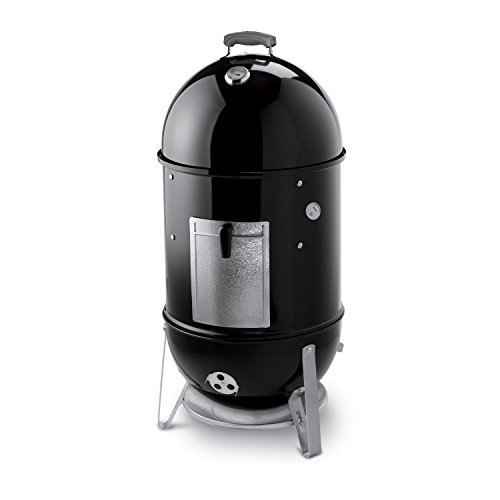
Weber Smokey Mountain Cooker 18-Inch — Best Charcoal Smoker for Beginners
The Smokey Mountain is the smoker that has taught more people to smoke than any other design, and it earns its place here because its lessons are gentle. The bullet shape, the water pan, and the porcelain-enameled kettle construction produce a naturally stable cooking environment: light a chimney of charcoal using the minion method — unlit coals with a few lit ones on top — set the bottom dampers, and the cooker settles into the smoking range and stays there for hours with only small adjustments. It suits beginners who genuinely want to learn live-fire cooking, flavour-first cooks, and anyone who suspects smoking will become a long-term hobby worth building skills for. It does not suit cooks who want to press a button and walk away for eight unattended hours.
Strengths
- Dual cooking grates give two levels of capacity in a compact footprint
- Temperature control dampers make adjustments predictable and repeatable
- Porcelain-enameled construction resists rust and cleans up easily
Trade-offs
- Charcoal smoking always asks more attention than electric or pellet cooking
- Adding fuel mid-cook means lifting the body or working through the door
- 18-inch grates fit most briskets, but the largest packers may need trimming
| Mini spec box — verified from catalogue title | |
|---|---|
| Size | 18-inch charcoal smoker |
| Grates | Dual cooking grates |
| Construction | Porcelain-enameled kettle |
| Control | Temperature control dampers |
What you get for the extra effort is flavour and understanding. Charcoal plus wood chunks produces the deepest, most traditional smoke profile in this guide, and running this cooker teaches you vent logic, fuel behaviour, and weather effects — wind and cold genuinely matter — in a design forgiving enough that your mistakes cost you thirty minutes, not a ruined dinner. The water pan is the secret: it buffers temperature swings and keeps the cooking environment humid, which is why a first brisket on a Smokey Mountain so often turns out better than a first brisket on a temperamental offset. The 18-inch size is the sweet spot for learning households; the 22-inch sibling exists for bigger crowds, but it burns more charcoal for the same Tuesday chicken, so start here unless your typical cook is genuinely large.
Practical ownership notes: use a chimney starter rather than lighter fluid, keep a dedicated ash can, and expect the inside to season into a dark, protective coating you should not scrub away. The cooker breaks into sections for transport, which makes it the one pick here that travels happily to campsites and tailgates. Check the current price on Amazon before buying, and note that the linked listing is the verified 18-inch model — the 14-inch and 22-inch versions share the same product family name, so confirm the size on the page.
Best for: beginners who want to learn real charcoal smoking on the most forgiving live-fire design available. / Not suited for: cooks who want fully unattended, push-button smoking. Check on Amazon

Traeger Pro 22 Wood Pellet Grill and Smoker — Best Pellet Upgrade
The Traeger Pro 22 is where beginners who know they will stick with smoking tend to land, because it removes the fire from fire management while keeping real wood in the equation. An auger feeds pellets to a fire pot, a controller holds your set temperature, and the included meat probe lets you cook to internal temperature instead of guessing — the single habit that improves beginner results fastest. Its 6-in-1 versatility means the same machine smokes low and slow, roasts, bakes, and grills up to its 450°F maximum, so it can serve as a household’s second oven as well as its smoker. It suits new smokers who also grill weekly, cooks who value consistency, and anyone cooking for a family of four to six. It does not suit charcoal-flavour purists or buyers who want the absolute lowest entry cost.
Strengths
- Pellet automation holds temperature without tending a fire
- Included meat probe builds good cook-to-temperature habits from day one
- 18 lb hopper covers long low-and-slow cooks between refills
Trade-offs
- Pellet smoke flavour is milder than charcoal smoke at the same temperature
- Moving parts — auger, fan, igniter — mean more long-term maintenance than a kettle
- Needs outdoor power and dry pellet storage to stay reliable
| Mini spec box — verified from catalogue title | |
|---|---|
| Cooking area | 572 sq in |
| Versatility | 6-in-1 BBQ versatility |
| Probe | Meat probe included |
| Maximum temperature | 450°F max |
| Hopper | 18 lb hopper |
On the grate, the Pro 22 behaves like a wood-fired convection oven with a smoke habit, and that predictability is its gift to beginners. Brisket flats come out evenly cooked edge to edge, ribs follow a timetable you can actually plan a dinner party around, and the learning shifts to the rewarding parts: which pellet wood pairs with which meat, when to wrap, how bark forms. The 572 square inches handle a brisket or a couple of pork shoulders comfortably, and the porcelain-coated grates clean without drama. Pellet consumption is modest at smoking temperatures and rises when you grill at the top of the range, so keep a spare bag stored dry indoors; damp pellets are the number one cause of pellet grill misbehaviour, and they are entirely preventable.
Ownership involves a vacuum: ash accumulates in the fire pot and body, and a quick shop-vac clean every few cooks keeps ignition reliable. That small chore, plus keeping the grease management path clear, is the whole maintenance contract. Check the current price on Amazon — Traeger models are frequent sale items, and the price on the page is the only one that counts.
Best for: beginners who want real wood smoke with oven-like consistency and a grill that doubles as an everyday cooker. / Not suited for: buyers chasing the deepest charcoal flavour or the lowest possible entry price. Check on Amazon

Z GRILLS ZPG-7002B Pellet Smoker Grill — Best Value Pellet Smoker
The ZPG-7002B makes the pellet case on capacity and control rather than brand heritage: a PID controller — the more precise class of temperature controller — and 700 square inches of cooking area, with a rain cover included in the box. For a beginner, PID control is not a spec-sheet luxury; it is the difference between a cooker that swings around your set point and one that parks on it, and steadier temperature means the timelines in recipes actually work. It suits value-focused buyers, larger families who need the extra grate space, and new smokers who plan to cook ribs by the rack and shoulders by the pair. It does not suit buyers who prioritise the largest dealer network or app ecosystems.
Strengths
- PID control holds smoking temperatures with small swings
- 700 sq. in cooking area fits family-scale batches on two levels
- Rain cover included, which protects the electronics from day one
Trade-offs
- Brand support network is thinner than the biggest pellet names
- No connected app control in this configuration — you monitor at the grill
- Like all pellet grills, it needs power, dry pellets, and regular ash vacuuming
| Mini spec box — verified from catalogue title | |
|---|---|
| Controller | PID control |
| Cooking area | 700 sq. in cooking area |
| Included | Rain cover |
| Colour | Black |
In use, the 7002B feels like the sensible spreadsheet answer that also cooks well. The extra area over entry pellet grills is genuinely usable — a full load is four racks of ribs laid flat, or two shoulders with room for a pan of beans beneath — and the controller’s steadiness shows up as bark that forms evenly instead of in patches. Beginners benefit from that evenness more than from any smart feature: when the machine is consistent, your notes from one cook apply to the next, and improvement comes quickly. Start with hickory or a competition-blend pellet, keep the hopper topped up before long cooks, and vacuum the fire pot on the same schedule you would any pellet grill.
One honest note on expectations: at this tier you are buying cooking performance rather than premium fit and finish, so panel gaps and paint will not match flagship grills — and none of that affects the food. Check the current price on Amazon, where this model frequently undercuts better-known names with similar cooking area; the value case only makes sense against the live price, so verify it on the page.
Best for: value-focused beginners who want precise pellet control and family-size capacity. / Not suited for: buyers who want app control and the deepest brand support network. Check on Amazon

Pit Boss 850 Navigator Series Wood Pellet Grill and Smoker — Best for Bigger Batches
Some beginners know from the first cook that they will be feeding a crowd — extended family Sundays, team parties, holiday hams for the street — and for them the Pit Boss 850 Navigator is the right kind of big. Its 932 square inches of cook space is the largest in this guide, the 30 lb hopper is sized for genuinely long cooks, and the flame broiler adds a direct-flame finishing option that most pellet grills lack, useful when smoked chicken skin or a reverse-seared steak needs a final blast. WiFi and Bluetooth control with an LCD digital controller means the long cooks this grill is built for can be monitored from the sofa. It suits big households, entertainers, and beginners whose typical cook is two briskets rather than one. It does not suit small patios or solo cooks, who will burn pellets heating space they never use.
Strengths
- 932 sq. in. cook space handles crowd-scale batches in one load
- Flame broiler allows direct-flame finishing and searing
- WiFi and Bluetooth control with meat probe for monitored long cooks
Trade-offs
- Large footprint and pellet appetite are wasted on small weekly cooks
- More grill to clean, with more grate area and a bigger grease path
- Temperature range tops out where dedicated high-heat grills begin
| Mini spec box — verified from catalogue title | |
|---|---|
| Cook space | 932-sq. in. cook space |
| Temperature range | 180°F to 500°F temp range |
| Connectivity | WiFi and Bluetooth |
| Feature | Flame broiler and LCD digital controller |
| Probe | Meat probe |
| Hopper | 30 lb. hopper |
The Navigator’s beginner-friendliness is easy to miss because of its size, but the automation is the same set-and-monitor pattern as the smaller pellet picks, and the app alerts actually matter more on the twelve-hour cooks this grill invites. Load it with a brisket and a shoulder at night, and the combination of a big hopper and remote monitoring turns an intimidating cook into a supervised one. The flame broiler deserves a specific mention for beginners: smoked wings and chicken thighs often emerge with soft skin, and thirty seconds over the open flame fixes the texture in a way that teaches you what finishing heat does — a lesson that transfers to every cooker.
Plan for the footprint honestly: measure your patio, allow clearance behind for the hopper and chimney, and budget storage for pellets in quantity, because a grill this size makes buying one small bag at a time impractical. Keep the flame broiler plate scraped and the grease bucket emptied and ownership stays simple. Check the current price on Amazon before deciding; big pellet grills see deep seasonal discounts, and the live price determines whether the Navigator or the smaller Traeger is the smarter buy for your household.
Best for: beginners cooking for crowds who want maximum pellet capacity and remote monitoring. / Not suited for: small patios, small households, or cooks who mostly smoke one item at a time. Check on Amazon
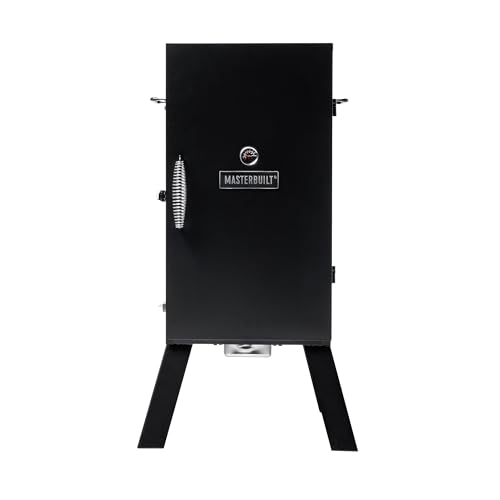
Masterbuilt 30-Inch Analog Electric Smoker MB20070210 — Best Budget Simplicity
The analog Masterbuilt strips the beginner electric formula to its essentials: a simple analog temperature dial, the same side wood chip loader as its digital sibling, and 535 square inches of smoking space in the same 30-inch cabinet format. There is no display to learn, no app to pair, and nothing to update — you turn a dial, add chips from the side, and smoke. It suits first-time buyers on a tight budget, minimalists who prefer mechanical controls, and cooks whose typical load is one shoulder, one chicken, or a couple of rib racks. It does not suit cooks who want precise digital set points or the larger capacity of the digital model.
Strengths
- Analog dial control is as simple as smoking gets
- Side wood chip loader preserves chamber heat like the digital model
- Compact 30-inch cabinet stores easily on small patios
Trade-offs
- Analog control means wider temperature swings than the digital version
- 535 square inches is the smallest capacity in this guide
- No built-in probe or display — an instant-read thermometer is essential
| Mini spec box — verified from catalogue title | |
|---|---|
| Size | 30-inch electric vertical smoker |
| Control | Analog temperature control |
| Racks | Chrome smoking racks |
| Cooking area | 535 cooking square inches |
| Model | MB20070210 |
Do not mistake the simpler control for worse food. At smoking temperatures, meat is forgiving of modest swings, and generations of good barbecue have come off dial-controlled electric cabinets. What the analog model asks in return is one good habit: verify with a thermometer. An inexpensive instant-read probe — and ideally a leave-in probe for long cooks — turns the dial from a guess into a setting, and learning to trust internal temperature over time is the core beginner skill anyway. The 535 square inches still fit a trimmed brisket or two chickens, and for the household that smokes twice a month rather than twice a week, the smaller cabinet heats faster and wastes less.
Choose between the two Masterbuilts on control preference and capacity, not on flavour — the smoke system is the same. If your budget stretches, the digital model is the easier teacher; if it does not, this analog version teaches the same lessons with one extra thermometer. Check the current price on Amazon for both before deciding, since the gap between them narrows during sales.
Best for: budget-conscious beginners who want the simplest possible electric smoker. / Not suited for: cooks who want digital precision or maximum cabinet capacity. Check on Amazon
Comparison Table
| Pick | Badge | Key spec | Best for |
|---|---|---|---|
| Masterbuilt 30-Inch Digital Electric MB20071117 | Best Overall for Beginners | 710 sq in, side chip loader, digital control | Set-and-forget first smoker |
| Weber Smokey Mountain Cooker 18-Inch | Best Charcoal for Beginners | Dual grates, dampers, porcelain-enameled | Learning real charcoal smoking |
| Traeger Pro 22 | Best Pellet Upgrade | 572 sq in, 18 lb hopper, meat probe | Wood smoke with oven consistency |
| Z GRILLS ZPG-7002B | Best Value Pellet | PID control, 700 sq in, rain cover | Family capacity on a budget |
| Pit Boss 850 Navigator | Best for Bigger Batches | 932 sq in, 30 lb hopper, flame broiler | Crowd cooks and long smokes |
| Masterbuilt 30-Inch Analog MB20070210 | Best Budget Simplicity | 535 sq in, analog dial, side chip loader | Lowest-fuss entry to smoking |
How to Choose the Right Beginner Smoker Grill
Start with fuel, because fuel decides your Saturdays. If the honest answer is that you will smoke more when the process is easy, choose electric or pellet and do not let anyone shame you out of it — the best smoker is the one that gets used twenty times a year, not the one that impresses twice. If the process itself is the attraction — fire, charcoal, adjustments — choose the Weber bullet and enjoy learning it. Decide by picturing a real cook in February rain, not a perfect June afternoon.
Next, size for your typical cook, not your maximum cook. Count the mouths you feed most often and the proteins you actually buy: a household that smokes one shoulder and a rack of ribs needs 500 to 700 square inches; a household that hosts needs 900. Oversizing costs fuel and heat-up time on every single cook, while undersizing only hurts on the two biggest days of the year — and on those days, cooking in two batches or borrowing a neighbour’s grate is a fine solution.
Then weigh control style. Digital and PID controllers narrow temperature swings and make recipe timelines reliable; analog dials and charcoal dampers widen the swings slightly but teach judgement. Pair any smoker with a decent thermometer strategy from day one — a leave-in probe for the meat and, ideally, one for the chamber — because internal temperature, not elapsed time, is how smoking is actually judged. Finally, plan the ownership details before purchase: where the smoker lives, whether an outdoor outlet is within reach for electric and pellet models, where pellets or chips will be stored dry, and how ash and grease will be handled. Beginners who solve those logistics in advance keep smoking; beginners who improvise them weekly quietly stop.
What Actually Makes Smoking Hard (and Easy) for Beginners
New smokers usually blame their equipment for three problems that are actually technique problems, and knowing them in advance flattens the learning curve. The first is the stall: large cuts like brisket and pork shoulder plateau in internal temperature for hours as moisture evaporates from the surface. It is normal, it ends, and wrapping the meat in butcher paper or foil — the classic crutch — pushes through it. The second is dirty smoke: thick white billowing smoke from a fresh, smouldering fire tastes bitter, while the thin, almost blue smoke of a clean fire tastes sweet. Electric and pellet picks largely automate this away; on the charcoal pick, let new coals settle before the meat goes on. The third is slicing and resting: a brisket cut too early or against the grain will seem tough even if it was cooked perfectly. Rest large cuts at least an hour, and slice across the grain.
The easy wins are equally predictable. Pork shoulder is the most forgiving first cook in all of barbecue — heavily marbled, tolerant of temperature swings, and obviously done when it pulls apart. Chicken rewards a slightly hotter smoke and teaches skin management. Ribs teach the bend test: pick them up with tongs and look for the bark cracking as they flex. Keep a simple notebook — fuel, wood, weather, times, results — and three cooks in, patterns appear that no video can teach you, because they are patterns about your smoker, your meat supplier, and your climate.
How to Run Your First Smoke, Step by Step
Your first cook should be a pork shoulder on whichever pick you bought, because it forgives everything you are about to do imperfectly. The night before, trim any hard fat, apply a simple salt-and-pepper-forward rub, and refrigerate uncovered so the surface dries — a dry surface builds better bark. An hour before cooking, take the shoulder out, set up the smoker, and stabilise it in the classic low-and-slow range before any meat goes on; loading meat into a still-climbing cooker is the most common first-cook error.
On an electric pick, fill the water pan, load the chip tray, set the temperature, and add the meat once the first thin smoke appears. On a pellet pick, prime the auger if the manual requires it, set the temperature, and let the grill settle for fifteen minutes with the lid closed. On the Weber, light a small chimney of coals, pour them over unlit coals in the ring, assemble the cooker with the water pan filled, and adjust the bottom dampers until the temperature parks in range. In all three cases, the next instruction is the same and the hardest to follow: leave the lid closed. Every look costs heat and time.
Monitor the meat’s internal temperature with a probe rather than the clock. Expect the stall midway and either wait it out or wrap the shoulder in foil with a splash of apple juice once the bark looks set and dark. The shoulder is done when it probes tender in several spots — the probe sliding in with almost no resistance matters more than any single number. Rest it wrapped for at least an hour, then pull it by hand, discarding hard fat as you go. Taste, note what you would change, and write it down. That notebook entry, not the sandwich, is the real product of your first smoke.
A Note on Wood Choice for Your First Cooks
Wood is the seasoning that defines smoked food, and beginners do best by starting milder than they expect. Fruitwoods — apple and cherry — are gentle, slightly sweet, and almost impossible to overdo, which makes them ideal for chicken, ribs, and your first pork shoulder. Hickory is the classic barbecue wood: stronger, bacon-like, and excellent on pork, but heavy-handed use on poultry can dominate. Oak is the reliable middle — the backbone of much Texas barbecue — and suits brisket and beef ribs where the meat itself is strongly flavoured. Mesquite is the strongest common smoking wood and the easiest to misuse; save it for short, hot cooks and beef, in small amounts, until you know your palate.
Format matters as much as species. Electric smokers use chips, which smoulder quickly and suit their side loaders. Pellet grills take their wood as pellets, so your choice is the blend in the bag — a competition blend of oak, hickory, and cherry is the most versatile first purchase. Charcoal smokers pair lump charcoal or briquettes with chunks, fist-sized pieces that burn slowly and steadily; avoid soaking chunks, because wet wood steams and smoulders dirty before it smokes clean. Whatever the format, buy smaller quantities of two or three woods rather than a bulk sack of one, keep them dry, and note in your cook log which wood you used. Three cooks in, you will have a house preference, and it will be based on your food rather than on packaging.
Common Buying Mistakes
The most common beginner mistake is buying an offset smoker first because it looks like the ones on television. Offsets demand constant small-fire management, leak heat and smoke at every seam in the budget tier, and are responsible for more abandoned smoking hobbies than any other design; they are wonderful second smokers and punishing first ones. The second mistake is buying by maximum capacity — the holiday crowd argument — and spending the year heating empty space. The third is ignoring fuel logistics: pellets stored in a damp garage, charcoal bought one tiny bag at a time, or an electric smoker placed where no outlet reaches.
Fourth, beginners under-budget for the essentials that make any smoker work: a reliable instant-read thermometer, heat-proof gloves, a chimney starter for charcoal models, a cover, and a first supply of wood. Fifth, they chase smoke flavour with volume — more chips, more chunks, constant white smoke — and learn the bitter lesson that smoke is a seasoning, not the main ingredient. Finally, many beginners judge their first cooks against restaurant barbecue made on equipment that has been seasoned for years by people who cook daily. Judge your third cook against your first instead; the improvement curve is steep, and it is the honest comparison.
Final Recommendation
For most first-time buyers, start with the Masterbuilt 30-Inch Digital Electric MB20071117: it teaches the food side of smoking with the least friction, and its side chip loader and digital control make early successes likely. If you want to learn live fire properly, the Weber Smokey Mountain Cooker 18-Inch is the teacher generations of pitmasters started on. If you want wood smoke with oven-like consistency, choose between the Traeger Pro 22 for all-round quality, the Z GRILLS ZPG-7002B for value and PID control, and the Pit Boss 850 Navigator when your batches are genuinely big. On the tightest budget, the analog Masterbuilt MB20070210 teaches the same lessons with a dial instead of a display. Whichever you choose, cook a pork shoulder first, keep notes, and give yourself three cooks before judging anything.
Keep learning within the cluster: Best Smoker Grills · Best Electric Smoker Grills · Best Pellet Smoker Grills · Best Charcoal Smoker Grills · Best Offset Smoker Grills
Frequently Asked Questions
What is the easiest type of smoker for a complete beginner?
Electric smokers are the easiest starting point because temperature is set with a control rather than managed with fire, and side-loading models add wood chips without opening the door. Pellet grills are a close second and add real wood flavour with the same hands-off pattern. Charcoal smokers like the Weber Smokey Mountain ask more of you but teach the most.
How much capacity does a beginner actually need?
For most households, 500 to 700 square inches covers a brisket, two pork shoulders, or several racks of ribs — the cooks beginners actually make. Buy toward 900 square inches only if you regularly cook for groups, because oversized smokers use more fuel and heat more slowly on every small cook.
What should my first cook be?
A pork shoulder. It is marbled, forgiving of temperature swings, inexpensive if the cook goes sideways, and obviously done when it pulls apart easily. It teaches temperature management, the stall, wrapping, resting, and pulling in a single session, and it produces a generous amount of food for the lesson.
Do I need a thermometer, or can I cook by time?
You need a thermometer. Smoking is judged by internal temperature and probe tenderness, not by the clock, because meat size, weather, and fuel all shift timelines by hours. A leave-in probe for long cooks plus an instant-read for checking are the two most valuable accessories a beginner can own.
Why did my smoked meat taste bitter?
Usually dirty smoke: thick white smoke from a smouldering, oxygen-starved fire deposits harsh compounds on meat. Aim for thin, pale-blue smoke, let fresh fuel settle before adding food, and resist adding chips or chunks constantly — steady, light smoke over hours beats heavy smoke in bursts.
Can I use these smokers in winter or rain?
Yes, with adjustments. Cold and wind increase fuel use and heat loss, especially on charcoal models, so allow longer preheats and keep the lid closed. Electric and pellet models should be sheltered from direct rain around their controls and power connections, and pellets must be stored dry year-round.


