Disclosure: airfryerkitchensupply.com is reader-supported. When you buy through links on our site, we may earn an affiliate commission at no extra cost to you.
Where to buy
Every grill below is a propane portable verified against Amazon’s catalogue before earning a link, so you can check the current price on Amazon from each listing. Two practical checks before a trip: confirm which propane the grill uses — small 1 lb camping cylinders, a standard 20 lb tank, or an adapter hose between them — and confirm the packed dimensions against your vehicle, because a portable grill that does not fit the car is a patio grill with ambitions. If you are buying for a trip that is already booked, order with the packing rehearsal in mind: the grill, its fuel and its first adapter hose should all be tested in the driveway before they are trusted at a beach an hour from the nearest shop.
- Weber Traveler Portable Gas Grill (Best Overall Beach and Camping Grill) — check price on Amazon
- Weber Traveler Compact Portable Gas Grill (Best for Small Cars) — check price on Amazon
- Weber Q 1200N Portable Propane Gas Grill (Best Tabletop for Two) — check price on Amazon
- Weber Q 2800N+ Portable Grill (Best Tabletop Performance) — check price on Amazon
- Coleman RoadTrip 285 Portable Propane Grill (Best Stand-Up Value) — check price on Amazon
- Royal Gourmet GT1001 Stainless Portable Propane Gas Grill (Best Budget Tabletop) — check price on Amazon
The best beach and camping propane grills are chosen by a different scorecard from backyard grills, because their working life is measured in car boots, picnic tables, sand and wind. Propane is the right fuel for this world — instant on, instant off, no ash to dispose of at a campsite and no coals to cool before the drive home — but the format splits into tribes: folding cart grills that stand on their own legs, tabletop grills that need a surface, and compact travellers that pack like luggage. This guide reviews the six verified portables we would actually pack, explains the beach-specific and campsite-specific traps (wind, sand, salt air, fuel logistics), and gives you the packing and cooking routine that makes a small grill feed a happy crowd far from any kitchen. Read the travel-format comparison before the reviews if you are torn between a tabletop and a stand-up model; it is the decision that shapes every trip the grill will ever take, and it is much easier to get right here than at a beach car park with a hungry family watching.
In this guide
Quick Picks
Six verified propane portables, organised by how they travel: two folding travellers, two Q-series tabletops, a stand-up road-trip grill and a stainless budget traveller. Whichever tribe you choose, the verdict line under each full review tells you in one breath who the grill serves and who should keep scrolling.
Weber Traveler Portable Gas Grill — Best Overall Beach and Camping Grill. The folding cart grill that sets up in seconds, stands on its own wheels, and cooks for a crowd — the listing notes it fits 15 burgers — without needing a table. — check price on Amazon
Weber Traveler Compact Portable Gas Grill — Best for Small Cars. The Traveler idea distilled: the same folding, wheeled, easy-open design in a compact body that leaves room in the boot for the rest of the holiday. — check price on Amazon
Weber Q 1200N Portable Propane Gas Grill — Best Tabletop for Two. The classic Q formula in its newest form: a 10,000 BTU single-burner tabletop with cast-iron grates and electronic ignition, in Midnight Black. — check price on Amazon
Weber Q 2800N+ Portable Grill — Best Tabletop Performance. The Q grown up: a stated 250–700°F temperature range with a burner arrangement that sears at steakhouse heat and roasts low — the enthusiast’s portable. — check price on Amazon
Coleman RoadTrip 285 Portable Propane Grill — Best Stand-Up Value. Three burners and 20,000 BTU on a collapsible stand-up frame with Instastart ignition — the most backyard-like cooking you can fold into a car. — check price on Amazon
Royal Gourmet GT1001 Stainless Portable Propane Gas Grill — Best Budget Tabletop. A stainless tabletop with folding legs, a lockable lid and 285 square inches at 10,000 BTU — the sensible spend for occasional campers. — check price on Amazon
How These Picks Were Chosen
Every pick had to satisfy the beach-and-camping brief in the manufacturer’s own terms — designed for travel, camping or tailgating, running on propane — and be verified against Amazon’s catalogue data for this site before earning a link. Backyard grills with removable legs and indoor electrics were excluded; portability claimed by marketing but contradicted by the design did not survive the filter.
We then organised the field by how a grill travels, because that is the decision buyers actually face. Folding cart grills (the two Weber Travelers) stand alone and suit groups; stand-up folders (the Coleman) maximise cooking at the cost of bulk; tabletops (both Q models and the Royal Gourmet) minimise bulk and assume a surface at the site. The badges name the travel style and the job, so you can shop by itinerary rather than by spec sheet.
Finally, we weighted the unglamorous travel virtues: ignition that works with cold hands, lids that lock or grates that stay put in a moving car, grease systems that do not redecorate the boot, and burners with enough reserve to cook in a sea breeze. A portable grill is judged at the worst moment of the trip, not the best, and the picks above were chosen at exactly that standard.
We also cooked the shortlist down by a simple thought experiment: it is the last evening of the trip, the light is going, the group is hungry and the wind is up. Which of these grills still lights first time, holds its temperature and feeds everyone without drama? Any design whose answer depended on perfect conditions — a dead-calm evening, a brand-new igniter battery, a perfectly level table that the site does not have — was marked down, however well it photographs on a still day in a studio. Travel equipment earns trust in bad moments, and the six picks above are the ones we would trust with the last evening.
The 6 Best Beach and Camping Propane Grills, Reviewed

Pick 1: Weber Traveler Portable Gas Grill — Best Overall Beach and Camping Grill
Check the current price on Amazon
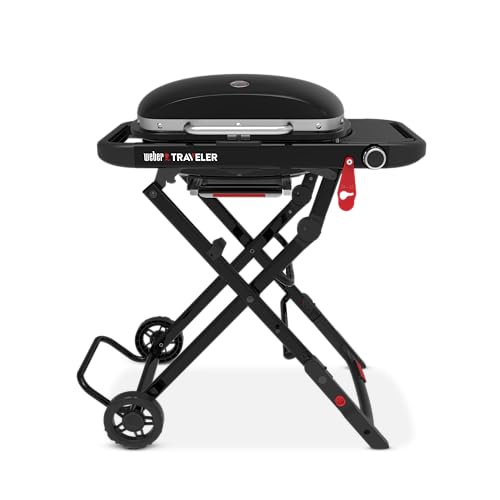
The Weber Traveler is the portable that behaves most like a real grill: a folding cart design on wheels that opens into a stable, full-height cooking station, with a grate the listing notes fits 15 burgers. It suits campers and beach parties who cook for groups and hate improvising a cooking surface. It does not suit minimalist packers or small cars — folded, it is still a substantial piece of luggage.
Strengths
- Folding cart with wheels — no picnic table required, stable on grass and sand
- Family-size grate handles group cooking in one batch
- One-handed fold design makes setup and pack-down genuinely quick
Trade-offs
- Largest packed size in this roundup — measure your boot
- Heavier than the tabletops; you will feel it on a long carry from car to beach
- Runs on small cylinders as standard, so long cooks need spares or an adapter hose
| Format | Folding cart, wheeled |
| Capacity | Fits 15 burgers (per listing) |
| Fuel | Propane |
| Use | Camping, tailgating, travel |
The Traveler’s genius is ergonomic. Beach and campsite cooking fails at the margins — no table, uneven ground, a grill balanced on a cooler — and a self-standing cart removes all of it. You cook standing up, at a sensible height, with the grill planted on its own legs and wheels, and when the meal is done it folds and rolls back to the car like luggage. The cooking itself is proper Weber: even heat, a grate with real mass for its class, and enough area that a family’s burgers happen in one round instead of three.
Fuel planning is the Traveler discipline. Small camping cylinders are convenient and finite; a weekend of group cooking will eat several, so pack spares or use an adapter hose to a 20 lb tank at basecamp-style sites. On sand, park the wheels on a board or mat if the beach is soft, and cook out of the wind where you can — the cart’s height makes it a sail in a genuine gale. Treated as the group grill it is, nothing else in this roundup touches it.
Best for: Families and groups cooking at beaches and campsites / Not suited for: Solo minimalists and very small cars
Pick 2: Weber Traveler Compact Portable Gas Grill — Best for Small Cars
Check the current price on Amazon
The Traveler Compact takes the folding-cart concept and shrinks it for smaller vehicles and smaller groups, keeping the wheeled stand and the easy open-and-close action. It suits couples and small families whose camping kit must share a modest boot with tents and luggage. It does not suit big-group cooking — the grate is the compromise that buys the size.
Strengths
- Compact folded size fits ordinary car boots alongside camping gear
- Self-standing wheeled cart — no table needed, like its big sibling
- Easy one-motion open and close suits frequent pack-and-go trips
Trade-offs
- Smaller grate means batch cooking for groups
- Still a cart grill — bulkier than a pure tabletop for ultralight trips
- Small-cylinder fuel planning applies, as with the full-size Traveler
| Format | Folding cart, wheeled, compact |
| Fuel | Propane |
| Use | Camping, tailgating, travel |
Portable grill buying is mostly boot Tetris, and the Compact is Weber’s answer to losing that game. It keeps the two features that make the Traveler line special — it stands up by itself and it folds without a wrestling match — and trades grate area to win the space war. For a couple cooking steaks, corn and a skillet of peppers, the trade is invisible; the grill feels full-size at the picnic site and half-size in the car park, which is exactly the right way round.
The Compact also suits a second life its bigger sibling cannot claim: balcony and small-patio duty at home, where its folded footprint tucks into a corner between trips. If your camping is mostly two people with occasional guests, and your car is not an SUV, this is the honest pick of the two Travelers — buy the size that matches the boot and the table, not the one that matches your ambitions for a party you host once a year.
Best for: Couples and small families with limited vehicle space / Not suited for: Regular group cooking

Pick 3: Weber Q 1200N Portable Propane Gas Grill — Best Tabletop for Two
Check the current price on Amazon
The Weber Q 1200N is the tabletop benchmark: one burner at 10,000 BTU, porcelain-enameled cast-iron grates and electronic ignition in a cast body built for travel and camping. It suits couples and solo campers who cook properly — steaks, chops, vegetables — on a picnic table. It does not suit anyone cooking for five at once, or anyone without a stable surface to put it on.
Strengths
- Cast-iron grates give real searing from a tabletop format
- Electronic ignition and a single simple burner — little to go wrong
- Cast body shrugs off the knocks of travel better than thin steel rivals
Trade-offs
- Single burner means no two-zone cooking — manage heat by position and timing
- Needs a table or stand; it is not self-standing
- 10,000 BTU is modest in wind — shelter it at exposed beaches
| Burners | 1 |
| Output | 10,000 BTU |
| Grate material | Porcelain-enameled cast iron |
| Ignition | Electronic |
| Format | Tabletop portable |
| Colour | Midnight Black |
The Q’s reputation rests on a simple fact: it cooks like a small grill, not like a camping accessory. The cast-iron grate is the reason — it stores enough heat to sear a steak properly, which most tabletops cannot do — and the domed cast body manages heat evenly around roasts and whole fish. A single burner sounds like a limitation and mostly is not: for two people, one well-controlled heat zone plus a lid is a complete kitchen, and the absence of complexity is why Q grills survive years of being thrown in car boots.
Beach notes for the Q: sand is its enemy at the grease-management level, so keep the drip tray habit strict and the grill on the table, never on the ground. Wind is the other tax — position the body so the wind hits its back, cook with the lid down, and allow extra minutes on exposed days. Fed a sensible supply of small cylinders (or an adapter hose at a long-stay pitch), the Q 1200N is the tabletop we would hand to someone who asked for one grill to camp with for a decade.
Best for: Couples and solo campers who cook seriously / Not suited for: Groups, or cooking without a table

Pick 4: Weber Q 2800N+ Portable Grill — Best Tabletop Performance
Check the current price on Amazon
The Weber Q 2800N+ is the performance tabletop: a portable propane grill with a stated temperature range of 250–700°F, including a burner for searing and the control for low-temperature roasting. It suits camping cooks who refuse to lower their standards outdoors — thick steaks, slow roasts, the full repertoire. It does not suit bargain hunters or the weight-averse; capability has a carrying cost.
Strengths
- 250–700°F range covers low roasting through genuine searing in one portable
- Dedicated searing capability is rare in the tabletop class
- Larger stage than the Q 1200N for small-group cooking
Trade-offs
- Heavier and bulkier than the smaller Q — pack space is the price
- Premium positioning among portables
- Still a tabletop: bring a stand or a solid picnic table
| Temperature range | 250–700°F (per listing) |
| Searing | Dedicated burner for searing |
| Format | Tabletop portable |
| Fuel | Propane |
| Colour | Midnight Black |
Most portables have one party trick — adequate heat — and the Q 2800N+ has a range. The low end matters more than campers expect: a beach-day chicken or a campsite pork shoulder cooked slowly, lid down, at the gentle end of the dial is a different meal from the usual burnt offerings, and the high end then finishes skin and steaks with real authority. That breadth turns the grill from a burger machine into the campsite’s actual cooker, capable of a whole weekend’s menu without repetition or apology.
Choose this Q when cooking is part of the holiday rather than a utility during it. It pairs naturally with a folding stand for sites without tables, and with an adapter hose for longer stays. In wind, its extra output is a genuine advantage — where the smaller Q asks for shelter and patience, the 2800N+ simply has more fire to spend. For the camper who reads recipes on the drive to the site, this is the portable that keeps up.
Best for: Enthusiast camping cooks wanting full temperature range / Not suited for: Ultralight packing or tight budgets
Pick 5: Coleman RoadTrip 285 Portable Propane Grill — Best Stand-Up Value
Check the current price on Amazon
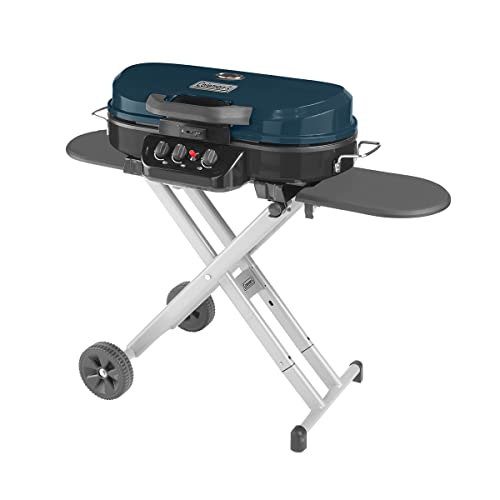
The Coleman RoadTrip 285 is the stand-up value pick: three adjustable burners, 20,000 BTU and push-button Instastart ignition on a frame that folds down for transport and stands at working height at the site. It suits families and tailgate-style beach days where several foods cook at once. It does not suit hikers or anyone carrying gear far from the car — it is a drive-to grill.
Strengths
- Three burners allow real zone cooking — unique at this portability
- 20,000 BTU is strong output for the portable class
- Stand-up frame with quick fold suits drive-to beaches and campsites
Trade-offs
- Bulky and heavy compared with tabletops — a car-based grill
- More parts and panels to clean after sandy or greasy cooks
- Three burners on small cylinders means planning fuel for long sessions
| Burners | 3 |
| Output | 20,000 BTU |
| Ignition | Instastart |
| Format | Portable stand-up, folding |
| Colour | Blue |
The RoadTrip 285’s three burners change what a portable menu can be. Burgers over the hot burner, corn steaming over the low one, buns warming at the edge — that is backyard choreography, executed at a beach car park. Coleman’s decades in camping show in the details: ignition that does not ask for a lighter, a frame that folds without trapping fingers, and surfaces designed to be wiped down at a campsite. It is the grill for the family that cooks a full meal outdoors and considers that the point of the trip.
Its honest limits are size and appetite. Folded, it wants a decent share of the boot; lit, three burners drink from small cylinders at a pace that surprises first-time owners, so an adapter hose to a larger tank is the seasoned owner’s first accessory for long stays. Keep the grease management current — a stand-up grill at a windy beach with a full tray is a mess looking for a gust — and the RoadTrip will run a family’s outdoor kitchen for years.
Best for: Families cooking full meals at drive-to beaches and campsites / Not suited for: Carrying any distance from the car

Pick 6: Royal Gourmet GT1001 Stainless Portable Propane Gas Grill — Best Budget Tabletop
Check the current price on Amazon
The Royal Gourmet GT1001 is the budget tabletop done sensibly: a stainless steel body, folding legs, a lockable lid for transport, 285 square inches of cooking area and a 10,000 BTU burner. It suits occasional campers, festival weekends and as a second grill for overflow duty. It does not suit daily expedition use — the value tier shows in the details over time.
Strengths
- Lockable lid and folding legs make transport genuinely tidy
- 285 sq in is generous cooking area for a budget tabletop
- Stainless body wipes clean and resists campsite grime
Trade-offs
- Single burner, modest output — no zone cooking, slower in wind
- Value-tier fittings reward gentle handling and dry storage
- Grate mass is lighter than the Weber Q — searing is good, not great
| Output | 10,000 BTU |
| Cooking area | 285 sq in |
| Body | Stainless steel |
| Legs | Folding |
| Lid | Lockable |
| Format | Tabletop portable |
The GT1001 understands the assignment of a budget portable: arrive intact, light easily, cook dinner, pack flat. The lockable lid is the detail veterans appreciate — a grill whose lid rattles open in the boot, shedding a greasy grate across the luggage, is a grill that gets left at home next time. Cooking is straightforward single-zone work: burgers, sausages, skewers and vegetables all behave, and the stainless body cleans up at the site with a wipe rather than a ceremony.
Set expectations at the level the price implies and this grill exceeds them; expect Weber Q refinement and it will feel thin. Dry it before storage, keep the burner covered from sand and grit, and it will serve occasional campers faithfully for seasons. As a first portable — or as the spare that lives in the car for spontaneous evenings — it is the rational end of this roundup, and there is no shame in rational.
Best for: Occasional campers and budget-conscious first-time buyers / Not suited for: Heavy expedition use or searing perfectionists
Comparison Table
| Pick | Badge | Key spec | Best for |
|---|---|---|---|
| Weber Traveler Portable Gas Grill | Best Overall Beach and Camping Grill | Folding wheeled cart, fits 15 burgers, propane | Families and groups cooking at beaches and campsites |
| Weber Traveler Compact Portable Gas Grill | Best for Small Cars | Compact folding wheeled cart, propane | Couples and small families with limited vehicle space |
| Weber Q 1200N Portable Propane Gas Grill | Best Tabletop for Two | Tabletop, 1 burner, 10,000 BTU, cast-iron grates | Couples and solo campers who cook seriously |
| Weber Q 2800N+ Portable Grill | Best Tabletop Performance | Tabletop, 250–700°F range, searing burner | Enthusiast camping cooks wanting full temperature range |
| Coleman RoadTrip 285 Portable Propane Grill | Best Stand-Up Value | Stand-up folding, 3 burners, 20,000 BTU | Families cooking full meals at drive-to beaches and campsites |
| Royal Gourmet GT1001 Stainless Portable Propane Gas Grill | Best Budget Tabletop | Tabletop, 285 sq in, 10,000 BTU, lockable lid | Occasional campers and budget-conscious first-time buyers |
How to Choose a Propane Grill for the Beach and Camping
Decide the travel format first, because it constrains everything else. If your sites have picnic tables and your groups are small, a tabletop is the lightest, cheapest route to good food. If you cook for groups or your sites are bare sand and grass, a self-standing folding grill earns its boot space every single trip. Measure the folded grill against your actual vehicle — not the brochure’s optimism — before falling in love.
Fuel logistics: the decision nobody makes until the beach
Small 1 lb cylinders are the portable standard: light, available everywhere, and finite. A single-burner tabletop sips them; a three-burner stand-up grill drinks them. For weekends and groups, an adapter hose to a standard 20 lb tank transforms the economics and the anxiety — where site rules and transport allow. Always pack one more cylinder than the menu seems to need; the spare is the cheapest insurance in camping, and an uncooked dinner is the most expensive saving.
Wind, sand and salt: the beach tax
Beach cooking is wind cooking. Choose a grill with a lid you can cook under, enough burner reserve to hold temperature in a breeze, and a body shape that can be sheltered behind a windbreak or the car. Sand infiltrates grease trays and burner tubes, so prefer designs that pack closed or lock, and never set a grill directly on sand. Salt air corrodes; a wipe-down after beach days and dry storage at home are the difference between a three-season grill and a ten-season one.
Tabletop vs. Stand-Up: An Honest Comparison
Tabletops win on weight, price and simplicity, and lose on independence: they need a surface, they cook at table height, and their grates serve two to four people honestly. Stand-up portables win on capacity and ergonomics — real zones, real batches, a cook who stands comfortably — and lose on bulk, weight and fuel appetite. Neither is better; they are answers to different trips. The mistake is buying one for the other’s itinerary: the family that crowds a tabletop at every beach day, or the couple wrestling a stand-up grill out of a hatchback for two sausages.
If your trips genuinely split between both lives, the folding compact cart is the designed compromise — self-standing like the big grills, boot-friendly like a tabletop — which is why the Traveler Compact holds its badge in this guide.
The Beach and Campsite Cooking Routine
Portable cooking runs on routine. Arrive and set the grill up first, before the tent or the towels: level ground or a solid table, sheltered side to the wind, drip tray in place. Preheat with the lid down while you organise food, and cook in a deliberate order — items that hold well (sausages, corn) first, the fast and fragile (fish, burgers, steaks) last, so everything meets at the table within minutes. Keep a lidded container for cooked food; beaches have gulls, and gulls have informants everywhere.
Pack-down is where propane proves its worth over charcoal: burners off, a minute of high heat to burn off residue once the food is safe, lid closed to cool while you eat, and a cold, closed grill in the car for the drive home — no ash, no ember anxiety, no site warden conversations. Wipe the grease tray before it travels, every time; the one time you skip it will be the time the boot liner remembers forever.
Rules, Safety and Being a Good Guest Outdoors
Many beaches and some campsites restrict open flame or require grills to be raised off the ground and used in designated areas — check the rules of your specific site before the trip, not at the gate. Propane portables are accepted in far more places than charcoal, which is one of their quiet advantages, but a rule is a rule and the fine is not worth the sausages. Keep the grill attended while lit, keep children briefed on the hot zone, and keep a bottle of water for hands and spills — not for the grill.
Leave the site cleaner than the pitch you were given: cooled grease and food scraps go in the bin or home with you, never into the sand or the bushes. The portable grill community’s access to beaches and campsites depends on exactly this behaviour, and the cook who masters the routine in the previous section will find this one costs nothing at all.
A word about water and washing up, because portable grills live where plumbing does not. Bring a small basin, biodegradable soap and a brush, and wash the grates and tools at the site or the campsite tap rather than letting grease harden for the drive home. Grease left to bake through a hot car journey becomes the kind of residue that needs soaking and swearing, and it perfumes the vehicle in ways that linger for weeks. The cooks who love their portables are, without exception, the cooks who clean them while the cleaning is easy — which is to say, within the hour, with the sea still audible.
Accessories Worth Their Space in the Car
Portable grilling attracts gadgets, but boot space is the scarcest resource on any trip, so every accessory must earn its volume. The adapter hose to a 20 lb tank earns it on any stay beyond a night. A folding stand earns it if your tabletops visit table-less sites. A rigid carry bag earns it by keeping grease where it belongs. Long tongs and a wide spatula earn it nightly; a thermometer earns it the first time it saves a steak.
What does not earn space: duplicate tools, novelty gadgets, and the giant utensil set in the roll-up case. The discipline of portable cooking is the discipline of the whole hobby in miniature — a few good tools, a routine that works, and food that makes the beach jealous. Pack like it.
Menus That Work on a Small Grill Far From Home
Portable menus succeed on foods that forgive timing and travel well. Sausages, burgers and chicken thighs are the backbone — robust, quick, happy in a warm holding corner. Skewers are the traveller’s secret weapon: they cook fast, portion themselves, and let vegetables and protein share one stick and one timing. Corn in its husk steams itself on the grate’s edge while the centre does the serious work, and a foil packet of potatoes with butter and salt, started early and ignored, rounds out almost any beach dinner.
Dessert deserves a line in the plan, because a grilled finish is what people remember. Firm fruit — pineapple rings, halved peaches, bananas in their skins — caramelises beautifully over the last of the heat, and a packet of s’mores ingredients near (never on) the grill handles the rest. The pattern across all of it is the portable cook’s creed: few ingredients, forgiving timings, and food that tastes of the place you cooked it. A small propane grill, honestly menu-planned, outperforms a big backyard grill fed with panic.
Breakfast: the portable grill’s finest hour
Campsite breakfast is where a portable propane grill quietly becomes beloved. A skillet or the grill’s own grate handles bacon and sausages while the kettle boils; eggs in a pan over the gentlest burner setting, toast directly on the grate in the final minute, and coffee as the sun comes up. Propane’s instant, controllable heat — no fire to build, no coals to wait for — is worth more at 7 a.m. than at any other hour of the trip, and it is the moment when charcoal campers look at your setup with genuine envy.
Caring for a Portable Grill Between Trips
Portables die in storage, not in service. The routine that saves them starts at pack-down — burn-off, cool, wipe the grease tray — and finishes at home: a proper brush of the grates, a check that burner ports are clear of sand and grit, and storage somewhere dry with the lid closed and the cylinder disconnected. Once a season, run the full inspection: ignition spark, flame colour across the burner, hose and connector condition, and the state of hinges, latches and legs that take the travel knocks.
Salt air deserves its own sentence, because beach grills live in it. After beach trips, wipe exterior surfaces with a damp cloth to lift salt residue before it starts its slow work, and dry the grill before it goes away. Stainless and cast bodies reward this with years; neglected, even good portables freckle and stiffen. Ten minutes at home per trip is the entire price of a portable that still lights first time on the hundredth morning of its life.
How to Set Up and Cook on a Portable Propane Grill
The same routine works for every pick in this guide, from tabletop to folding cart.
- Choose the spot first: level, stable, sheltered from the worst of the wind, away from tent fabric, dry grass and the evening’s foot traffic. Set the grill up — cart unfolded and locked, or tabletop on a solid surface — before connecting any fuel.
- Connect the cylinder or hose hand-tight, then check the joint the campsite way: listen and smell for leaks, and if anything seems wrong, disconnect and refit. Never test with a flame.
- Open the lid, light the burner with the grill’s ignition, and confirm a clean, mostly-blue flame. Close the lid and preheat fully — portable grills have small fireboxes and preheat fast, but the grate needs its minutes to store searing heat.
- Cook with the lid down as much as the food allows; on a breezy beach the lid is half the grill. Manage flare with position, not water — move food to a cooler patch rather than spraying.
- When cooking is done, run the burners on high briefly to burn off residue, then shut everything down: burners off, cylinder valve closed, and the grill left closed to cool while you eat.
- Once cool, empty or wipe the grease tray, lock the lid if the design allows, fold or pack the grill, and store cylinders upright and outside any hot, sealed vehicle space for the drive.
Cooking for a crowd on a small grill
Small grills feed crowds by choreography, not by area. Cook in waves of food that hold well — sausages and corn first, held warm at the grate’s edge or in a lidded pan — then run the heroes (burgers, steaks, fish) through in fast batches straight to the table. Announce waves like courses and nobody experiences it as waiting; they experience it as a tasting menu with sand between their toes.
Common Buying Mistakes
Buying the grill before measuring the car
Folded dimensions are the first specification of a portable grill. A wonderful grill that costs you the tent’s space is a wonderful grill you will stop bringing.
Running out of propane mid-cook
The most common portable failure and the most preventable: pack a spare cylinder, or step up to an adapter hose and a real tank for group trips.
Setting the grill on sand or grass
Sand blocks vents and invades everything; grass near a hot grill is a fire risk and a mess. Table, stand or mat — always a proper surface.
Ignoring site rules about flames
Beaches and campsites vary, and “propane is fine” is not universal. Check the specific site’s rules before the trip and save the fine money for better food.
Packing a hot or greasy grill for the drive
Burn-off, cool-down and a wiped grease tray take ten minutes. Skipping them redecorates the car and shortens the grill’s life in one gesture.
Final Recommendation
If one grill must do everything, take the Weber Traveler: it stands by itself, cooks for a crowd and folds away like luggage. Small cars and couples should take its Compact sibling, or the Q 1200N if a picnic table is always part of the plan.
Cooks who refuse to compromise outdoors should step up to the Q 2800N+ and its full temperature range; families who cook whole meals at the site will love the Coleman RoadTrip 285’s three burners; and occasional campers get honest service from the Royal Gourmet GT1001 at the budget end. Every pick is verified, so check the current price on Amazon on the one that matches your boot and your beach.
Before you order, compare the neighbouring portable and general grill guides in this series — the right portable is the one that fits your trips, and a few minutes with the alternatives is how you confirm it.
One last packing thought, offered by every experienced beach cook in some form: the best portable grill is the one that is actually in the car. Choose the size you will genuinely bring, keep it clean and fuelled between trips so leaving is easy, and the grill will pay you back in evenings that no restaurant near any beach can sell you at any price.
Best Beach Grills Best Beginner Propane Grills Best Bbq Grills Under 650.00 Best Bbq Grills With Rotisserie Best Bbq Island Grills
Frequently Asked Questions
Can I use a propane grill on the beach?
On many beaches, yes — propane grills are commonly permitted where charcoal is not, because there is no ash or ember risk — but rules are set site by site and some beaches prohibit all grills. Check your specific beach’s regulations before the trip, use the grill on a proper surface, and never leave it unattended. Between trips, most of these grills also earn their keep on balconies and small patios at home — the folding and tabletop designs especially — provided your building and local rules allow propane grills there, which is another rule to check rather than assume. Keep the maker’s stated clearances from walls and railings, never store spare cylinders indoors, and a travel grill doubles as a perfectly good small-space home grill all year round.
How many 1 lb propane cylinders do I need for a camping weekend?
It depends on burner count and cooking time: a single-burner tabletop cooking two dinners typically uses far less than a three-burner grill cooking for a family all weekend. The safe habit is to pack one more cylinder than your estimate and to switch to an adapter hose and a larger tank for group basecamp cooking.
Is a tabletop grill big enough for a family?
For a family of four cooking in sensible batches, a larger tabletop like the Q models handles dinner well; for five or more, or for single-batch cooking, a folding cart or stand-up grill is the honest answer. The comparison section above lays out the trade plainly.
How do I stop sand ruining my grill?
Keep the grill on a table or stand, never on the sand; keep the lid closed when not actively cooking; choose a design that packs shut or locks; and wipe the grease tray and exterior before packing. At home, a soft brush clears burner ports of any grit that made the trip.
Can portable propane grills sear a steak properly?
The better ones can — the Q models’ cast-iron grates and the Q 2800N+’s high-temperature range exist for exactly this. The keys are a full preheat, a dry steak surface and small batches so the grate stays hot. Expect excellent results, not steakhouse-theatre, and you will not be disappointed.
What is the safest way to transport propane cylinders?
Upright, secured so they cannot roll, in a ventilated part of the vehicle — never loose in a hot, sealed boot for hours, and never in the passenger cabin’s footwell among feet and heaters. Disconnect cylinders from the grill for transport and replace their caps.


