Disclosure: airfryerkitchensupply.com is reader-supported. When you buy through links on our site, we may earn an affiliate commission at no extra cost to you.
Where to buy
If you are shopping for the best bbq grills natural gas can offer, you have already made the decision that defines the category: your grill will be plumbed to your home’s gas line, never refilled, never run dry mid-cook, and ready the moment you turn a knob. Every pick below is a true natural gas model — built and jetted for natural gas at the factory — and each was confirmed against a live Amazon listing before earning its place.
Two rules before the shortlist. First, natural gas and propane grills are not interchangeable: buy the fuel your house supplies, and never connect a grill to the wrong gas. Second, the gas line itself is a job for a licensed plumber or gas fitter in most jurisdictions — budget for the hookup when you budget for the grill. Open a listing to confirm the connection type and hose inclusion, and check the current price on Amazon before you order.
- Weber Spirit E-325 Natural Gas Grill (Best Overall Natural Gas) — Check the current price on Amazon
- Weber Spirit E-435 Natural Gas Grill (Best for Bigger Households) — Check the current price on Amazon
- Dyna-Glo Premier 3-Burner Natural Gas Grill DGP397CNN-D (Best Budget Natural Gas) — Check the current price on Amazon
- Monument Grills M415BZNG 4+1 Burner Natural Gas Grill (Best Mid-Range With Hose Included) — Check the current price on Amazon
- Monument Grills Denali 605 6-Burner Convertible Smart Grill (Best Large Smart Grill) — Check the current price on Amazon
- Nexgrill Deluxe 6-Burner Natural Gas Grill with Griddle Insert (Best for Entertaining With a Griddle Twist) — Check the current price on Amazon
The Plumbed Life: What Natural Gas Changes About Grilling
A natural gas grill is a different ownership experience from the first evening. There is no tank to exchange on a Sunday night, no gauge to watch during a long cook, no mid-brisket fuel emergency. The best bbq grills natural gas buyers choose are effectively outdoor appliances: fixed in place, connected like a stove, and limited only by how often you feel like cooking. For households that grill several times a week, that permanence is not a luxury — it is the entire point.
The trade-offs are equally clear, and this guide states them up front. A plumbed grill stays where the line is: repositioning it means moving pipe, not pushing a cart. Installation costs real money beyond the grill — a licensed gas fitter, a quick-disconnect outlet, a hose — and the work must meet local code. Natural gas also delivers less energy per cubic foot than propane, so natural gas models are jetted differently at the factory; that is engineering, not deficiency, and it is why fuel conversions belong to manufacturer kits and professionals, never to improvisation.
The six picks below span the natural gas market honestly: two Weber Spirit models at the quality core, a budget Dyna-Glo that makes the plumbed life accessible, two Monuments covering the mid-range and the smart large-format end, and a six-burner Nexgrill with a griddle insert for entertainers. After the reviews, the buying guide covers hookup planning, sizing and the conversion question in the detail a permanent appliance deserves.
If you are converting a patio from propane to plumbed gas, expect one behavioral change nobody warns you about: you will grill more. The friction of the tank — checking it, sparing it, exchanging it — silently rationed your cooking. Remove the ration and weeknight grilling becomes the default rather than the event, which is why the households in this category tend to become the households that cook outdoors all year.
In this guide
Quick Picks: The Best bbq grills natural gas at a Glance
Six factory-built natural gas grills, from the budget doorway into plumbed grilling to a six-burner entertainment station. Match the badge to your household; the plumbing advice later in the guide applies to all of them. Every pick below is factory-jetted for natural gas — that phrase is the whole ballgame in this category, and it is verified for each model from its live listing rather than assumed from the product family.
- Weber Spirit E-325 Natural Gas Grill — Best Overall Natural Gas. The plumbed household standard: three burners, a boosted sear zone and cast-iron grates in Weber’s most sensible size. Check price on Amazon
- Weber Spirit E-435 Natural Gas Grill — Best for Bigger Households. The four-burner Spirit: more grate, a boosted sear zone and a side burner for sauces and sides, all on the gas line. Check price on Amazon
- Dyna-Glo Premier 3-Burner Natural Gas Grill DGP397CNN-D — Best Budget Natural Gas. The accessible doorway: a three-burner Premier-series grill factory-built for natural gas at an entry tier. Check price on Amazon
- Monument Grills M415BZNG 4+1 Burner Natural Gas Grill — Best Mid-Range With Hose Included. The complete mid-range package: 4+1 burners, a broil zone and — rare at any tier — the natural gas hose in the box. Check price on Amazon
- Monument Grills Denali 605 6-Burner Convertible Smart Grill — Best Large Smart Grill. The big stainless statement: six burners, smart monitoring and a conversion kit that keeps your fuel options open. Check price on Amazon
- Nexgrill Deluxe 6-Burner Natural Gas Grill with Griddle Insert — Best for Entertaining With a Griddle Twist. Six burners, 775 square inches and a griddle insert in the box: the entertainment station that also does plancha breakfasts. Check price on Amazon
How These Picks Were Chosen
The first filter was fuel authenticity: every pick is manufactured and jetted for natural gas — no propane models with a “conversion possible” shrug. Listings were verified connection, and the specifications in the boxes below (burner counts, BTU figures where listed, cooking areas, included hoses) are quoted from those live listings.
The second filter was permanence-worthiness. A plumbed grill is a ten-year decision in a way a cart grill is not, so build quality, grate material and maker support weighed heavier here than in any sibling guide. A cheap grill on a gas line is a false economy: you will pay a fitter to install it and pay again to replace it.
Within those gates, picks were spread across the real decision axes: household size (three burners versus four versus six), budget tier, and special abilities — a sear zone for steak nights, a conversion kit for households whose fuel future is uncertain, a griddle insert for the breakfast crowd. The badges name those axes plainly so the shortlist reads as a decision tree rather than a ranking.
What was excluded matters too: built-in heads meant for masonry islands (a different project with different codes), dual-fuel curiosities, and any model whose natural gas configuration could not be verified from its listing. Six clean, factory natural gas grills remained — the ones below.
The 6 Best Natural Gas Grills, Reviewed

Weber Spirit E-325 Natural Gas Grill — Best Overall Natural Gas
The Spirit E-325 in natural gas trim is the grill this guide would install for most households. Three burners with a dedicated Sear Zone and Boost burners, porcelain-enameled cast-iron grates, and Weber Works rails for prep organization — the full modern Spirit formula, plumbed. It suits families of three to six who grill weekly and want a permanent appliance that sears like a restaurant and idles like an oven.
Strengths
- Sear Zone with Boost delivers the hard crust natural gas skeptics doubt
- Cast-iron grates hold heat and define the cooking
- Weber’s parts network suits a grill you will keep for a decade
Trade-offs
- Three burners cap the crowd size — big parties cook in waves
- No side burner on this configuration
- Installation by a gas fitter adds to the true first-year cost
| Fuel | Natural gas (factory jetted) |
| Burners | 3, with Sear Zone and Boost |
| Grates | Porcelain-enameled cast iron |
| Extras (listing) | Weber Works rails |
The sear zone answers the standard objection to natural gas — that it cannot get fierce — with engineering rather than argument. Concentrated boost heat under cast iron produces the crust steaks demand, while the remaining burners hold the gentle zones for finishing. In a plumbed grill that will cook thousands of meals, that two-speed character is the difference between an appliance you use for everything and one you supplement.
The Spirit platform’s virtues compound in a permanent installation. Ignition that works every time matters more when the grill is your outdoor stove; a grease system that routes to a tray matters more when the grill lives in one spot for years; available grates, burners and igniters matter most of all. This is the natural gas grill as infrastructure, and the E-325 is sized at the point where most households’ needs and most patios’ space agree.
Plan the installation with the same care as the purchase: a quick-disconnect gas outlet within hose reach of the grill’s home, positioned so the hose never crosses a walkway under tension, installed and pressure-tested by a licensed fitter. Do that once, and the E-325 disappears into your routine — turn, light, cook, close the valve, done — for years.
Winter deserves a sentence in this grill’s favor. Plumbed gas does not care about the calendar: no tank pressure sagging in the cold, no exchange run in the rain. The E-325 lights on a January evening with the same indifference as in July, and four-season households consistently rank that reliability among the reasons they never go back to tanks.
Best for: Most households committing to plumbed grilling / Not suited for: Renters or anyone whose patio layout is temporary
Check the current price on Amazon

Weber Spirit E-435 Natural Gas Grill — Best for Bigger Households
The E-435 is the E-325’s answer to a bigger table: four burners, the same Sear Zone with Boost, a side burner for the pot work, and cast-iron grates across a wider field. It suits households of five to eight, regular entertainers, and cooks whose menus routinely include a sauce, a pot of corn or a pan of beans that would otherwise occupy grate space and the kitchen stove simultaneously.
Strengths
- Four burners create a true temperature gradient for mixed grills
- Side burner keeps sauces and sides outdoors where the meal is
- Same Weber build and support as the Best Overall pick, scaled up
Trade-offs
- Wider footprint needs a wider permanent home on the patio
- More burners to clean and maintain over the years
- Side burner is wasted money if your menu never uses it
| Fuel | Natural gas (factory jetted) |
| Burners | 4, with Sear Zone and Boost, plus side burner |
| Grates | Porcelain-enameled cast iron |
| Extras (listing) | Weber Works rails |
Width transforms mixed grilling. On four burners you can sear steaks at the boosted end, hold chicken at a gentle middle, warm bread at the far edge and keep a sauce alive on the side burner — one cook, one station, everything converging. Hosts feel this as calm: the dinner stops being a sequence of batches and becomes a single performance with a gradient for a stage.
The side burner deserves its honest assessment. For households that make pan sauces, boil corn, fry onions in a skillet or keep beans at a simmer during long cooks, it earns its place weekly. For burger-and-dogs households it will sit unused for years, and those buyers should take the E-325 and the savings. The guide’s job is to make that call visible, not to sell the bigger box.
As a permanent installation, the E-435 asks for a proper home: level paving, the gas outlet placed for its wider body, and clearance for the lid and the side burner’s pot. Give it that, and it is the natural gas equivalent of a range upgrade — the appliance a serious outdoor kitchen grows around.
A hosting detail the spec box cannot show: the E-435’s width lets you keep a finished zone. Ribs resting at the cool edge under foil, corn holding at the middle, steaks searing at the boost end — the grill becomes a pass-through kitchen rather than a single-temperature event, and the cook stops sprinting between grill and oven.
Best for: Bigger families and entertainers who use a side burner / Not suited for: Small households or side-burner skeptics
Check the current price on Amazon

Dyna-Glo Premier 3-Burner Natural Gas Grill DGP397CNN-D — Best Budget Natural Gas
The Dyna-Glo Premier is how a budget meets the plumbed life. It is a three-burner grill built and jetted for natural gas from the factory — model DGP397CNN-D — in Dyna-Glo’s Premier line, at an entry tier that leaves room in the budget for the gas fitter every natural gas buyer must hire anyway. It suits first-time natural gas owners, smaller households, and buyers whose total project budget — grill plus hookup — is the real constraint.
Strengths
- Factory natural gas configuration at a budget tier
- Three burners give a workable hot-and-calm layout
- Leaves budget room for professional installation, where money matters most
Trade-offs
- Materials and finish are a step below the Weber picks
- Fewer premium touches — no boosted sear zone at this tier
- Long-term parts support is thinner than the premium brands
| Fuel | Natural gas (factory jetted) |
| Burners | 3 |
| Series | Dyna-Glo Premier |
| Model (listing) | DGP397CNN-D |
The smartest thing about this pick is what it does to the total budget. Natural gas ownership has two costs — the grill and the hookup — and skimping on the hookup is not an option. A household that buys the Premier and hires a proper fitter has made a wiser total decision than one that buys a premium grill and is tempted to cut corners on the gas work. This guide will always recommend the safe allocation.
Cooking is honest three-burner work: preheat fully, use the left-to-right gradient, keep the lid down for chicken and thicker cuts. The Premier grills the weeknight canon — burgers, chicken pieces, vegetables, sausages — without drama, and its natural gas supply means the tenth cook of the month costs the household nothing in errands. For many families, that frictionless frequency is the entire value of the plumbed life, delivered here at the lowest entry point in the guide.
Set the longevity expectation at the tier: with a cover, a clean grease tray and burners kept clear, the Premier serves for years; it is not the decade-plus appliance the Webers are built to be. As a first natural gas grill — or the grill for a house you may sell in five years — that is a rational trade, honestly labeled.
For landlords of their own future plans, the Premier has one more virtue: it is the right grill for a first house. Install it, learn the plumbed life on it, and let it convey with the property someday as a working appliance while your next patio gets the premium build. Not every grill needs to be the forever grill to be the right grill.
Best for: Budget-conscious households entering plumbed grilling safely / Not suited for: Buyers seeking a decade-plus heirloom appliance
Check the current price on Amazon

Monument Grills M415BZNG 4+1 Burner Natural Gas Grill — Best Mid-Range With Hose Included
Monument’s M415BZNG attacks the natural gas buyer’s checklist directly: 4+1 burners totaling 50,000 BTU, a dedicated broil zone for high-heat finishing, knob lights for evening cooking — and the natural gas hose included, a detail most makers leave as an extra purchase. It suits mid-range shoppers who want four-burner capacity and a sear feature without stepping to premium pricing, and anyone who appreciates a box that contains the whole job.
Strengths
- Natural gas hose included — one less part to source
- Broil zone adds a high-heat finishing gear
- 4+1 burner layout with strong total output for the class
Trade-offs
- Brand support network is smaller than Weber’s
- Knob lights are a nicety that adds a battery/electrical upkeep item
- Mid-tier materials: good, not heirloom
| Fuel | Natural gas (factory jetted) |
| Burners | 4+1 |
| Output (listing) | 50,000 BTU |
| Included (listing) | Natural gas hose; broil zone; knob lights |
The included hose is worth dwelling on, because it signals how Monument thinks about this buyer. A natural gas purchase stalls easily in the gap between “grill arrived” and “fitter booked, hose sourced, fittings matched.” Shipping the correct hose with the grill removes one full errand from that gap, and the fitter’s job becomes simpler and therefore cheaper. Small logistics, real money.
The broil zone plays the sear role in this design: a concentrated high-heat area for finishing steaks, crisping chicken skin and charring peppers, while the main field runs at cooking temperatures. Combined with the +1 burner arrangement, the M415BZNG gives a mid-range buyer the two-temperature cooking that this guide treats as the mark of a serious grill.
Evening cooks will quietly love the knob lights more than they expect — a plumbed grill gets used on winter weeknights, in the dark, and knowing burner states at a glance is a genuine usability win. Judge the package whole: this is the mid-range natural gas grill assembled by people who listed the annoyances first.
Monument’s cleanup claims deserve a fair translation: the grease management routes drips to a tray that actually comes out without a fight, which on a plumbed grill — where the unit rarely moves — matters more than on any portable. Permanent grills live or die by whether their routine cleaning is a minute or a project.
Best for: Mid-range buyers who want capacity, sear and a complete box / Not suited for: Brand-loyal buyers who prize the largest parts network
Check the current price on Amazon

Monument Grills Denali 605 6-Burner Convertible Smart Grill — Best Large Smart Grill
The Denali 605 is the maximalist pick: a six-burner stainless grill in Monument’s Denali series, configured for natural gas with a conversion kit in the package, and smart features for monitoring the cook. It suits entertainers with a permanent patio installation, large households, and buyers who want the option — rare and valuable — of a manufacturer-supported path between fuels if they move house or change supply.
Strengths
- Six burners give the widest cooking field in this guide
- Conversion kit included: manufacturer-supported fuel flexibility
- Smart monitoring suits long cooks and hosting multitaskers
Trade-offs
- Six burners is far more grill than a small household will ever light
- Largest footprint and the most installation presence
- Smart features add components that simple grills never have to maintain
| Fuel | Natural gas, convertible with included kit |
| Burners | 6 |
| Series | Denali 605 |
| Body (listing) | Stainless steel |
The conversion kit is the headline for a subtle reason: it is the only legitimate way fuel flexibility should ever be sold. A manufacturer kit changes jets and components as a designed system, installed per instructions — the opposite of the improvised conversions this guide warns against elsewhere. For a buyer whose next house might have propane, or whose current supply might change, that designed flexibility protects a large purchase.
Six burners, honestly assessed, is a hosting appliance. The field cooks for a crowd in one wave with zones to spare — a sear end, a chicken middle, a warming edge — and the stainless cabinet format gives a permanent installation the finished look a plumbed grill deserves. Smart monitoring earns its keep on long cooks, where walking away from the grill is the entire point.
The discipline this pick demands is self-knowledge. If your ordinary dinner is four portions, five of these burners will be furniture. Buy the Denali because your calendar is full of gatherings and your patio is a venue — in that life, it is not oversized at all. It is the first grill that finally fits.
The Denali’s stainless presence cuts both ways aesthetically: it anchors a patio like a piece of outdoor furniture, which is exactly right for designed spaces and slightly overwhelming on a small deck. Measure the visual footprint as honestly as the physical one — a permanent grill is part of the view for a decade.
Best for: Entertainers and large households with permanent patios / Not suited for: Small households — most of it would never light
Check the current price on Amazon
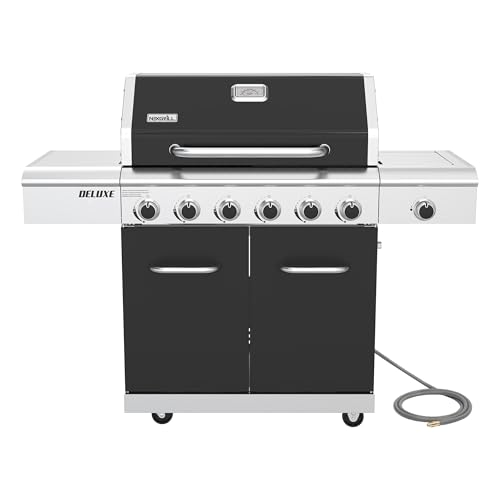
Nexgrill Deluxe 6-Burner Natural Gas Grill with Griddle Insert — Best for Entertaining With a Griddle Twist
The Nexgrill Deluxe takes the big-grill formula and adds the entertainer’s favorite accessory as standard: a griddle insert alongside six burners, 75,000 BTU of total output, 775 square inches of cooking space, a side burner and electronic ignition. It suits hosts whose gatherings run from morning to night — griddle breakfasts for the houseful, grilled dinners for the crowd — on a permanent natural gas connection.
Strengths
- Griddle insert included: plancha cooking without a second appliance
- Largest verified cooking area in this guide at 775 sq in
- Side burner plus six main burners cover any menu a party invents
Trade-offs
- Value-tier giant: more grill than most households, at a build tier below Weber
- Griddle insert covers part of the grate — it is a mode, not an addition of space
- Big footprint and big presence for a permanent spot
| Fuel | Natural gas (factory jetted) |
| Burners | 6 plus side burner |
| Output (listing) | 75,000 BTU |
| Cooking space (listing) | 775 sq in, griddle insert included |
The griddle insert is the idea that sells this grill, and it is a good one. Swap it over a section of burners and the entertainment station gains a plancha: smash burgers at lunch, fajita vegetables beside the steaks at dinner, a full breakfast the next morning for the guests who stayed. Hosts do not need a second appliance; they need their one appliance to change costumes, and the insert is exactly that.
Scale is the second argument. 775 square inches with six burners is a genuine crowd field — the whole party’s chicken in one wave, with zones for the vegetarians’ skewers and the kids’ dogs at the calm edge. The side burner keeps the sauce pot out of the traffic. For the two or three big gatherings a year that define a hosting household, this capacity is the difference between cooking and catering logistics.
The tier honesty applies as with the Dyna-Glo: Nexgrill builds to a value price, and a grill this size at this tier asks for covering, cleaning and reasonable expectations about decade-scale durability. For the host whose priority is capability per purchase — maximum field, maximum modes, plumbed convenience — it is the rational giant of the guide.
Breakfast is the sleeper argument for this Nexgrill. A houseful of guests, a griddle insert over two burners, eggs and pancakes flowing while the coffee brews — hosts report the insert earning its place on weekend mornings more than on the big annual barbecue it was bought for.
Best for: Hosts who entertain big and often, breakfast through dinner / Not suited for: Quiet households of two
Check the current price on Amazon
Comparison Table
The natural gas decision is mostly about scale and permanence: three burners for the household core, four for the gradient cooks, six for the venue patios — with the Dyna-Glo and Nexgrill marking the value ends of their size classes.
| Pick | Badge | Key spec | Best for |
|---|---|---|---|
| Weber Spirit E-325 Natural Gas Grill | Best Overall Natural Gas | 3 burners, Sear Zone with Boost, porcelain-enameled cast-iron grates, Weber Works rails | Most households committing to plumbed grilling |
| Weber Spirit E-435 Natural Gas Grill | Best for Bigger Households | 4 burners, Sear Zone with Boost, side burner, cast-iron grates | Bigger families and entertainers who use a side burner |
| Dyna-Glo Premier 3-Burner Natural Gas Grill DGP397CNN-D | Best Budget Natural Gas | 3 burners, natural gas, Premier series, model DGP397CNN-D | Budget-conscious households entering plumbed grilling safely |
| Monument Grills M415BZNG 4+1 Burner Natural Gas Grill | Best Mid-Range With Hose Included | 4+1 burners, 50,000 BTU, natural gas hose included, broil zone, knob lights | Mid-range buyers who want capacity, sear and a complete box |
| Monument Grills Denali 605 6-Burner Convertible Smart Grill | Best Large Smart Grill | 6 burners, convertible natural gas with conversion kit, smart features, stainless | Entertainers and large households with permanent patios |
| Nexgrill Deluxe 6-Burner Natural Gas Grill with Griddle Insert | Best for Entertaining With a Griddle Twist | 6 burners, 75,000 BTU, 775 sq in, side burner and griddle insert, electronic ignition | Hosts who entertain big and often, breakfast through dinner |
How to Choose the Best BBQ Grills Natural Gas: The Hookup Comes First
Plan the gas work before the grill arrives. A natural gas installation typically means a licensed plumber or gas fitter running a line to the patio, terminating in a shutoff valve and ideally a quick-disconnect outlet, pressure-tested and permitted where your jurisdiction requires it. Costs vary widely with distance from the house supply and local rules, which is why this guide treats installation as a first-class budget item rather than a footnote. Get the quote before you fall in love with a six-burner.
Position is permanent, so think like it. The grill’s home should be level, sheltered from the worst wind, clear of siding and overhangs per the manufacturer’s clearances, and placed so the hose reaches the outlet without crossing a walkway under tension. Quick-disconnects earn their small premium every time you want the grill three feet to the left for a party or pulled out for its annual deep clean.
One more planning item: the shutoff. Know where your grill’s gas shutoff valve is, keep it accessible, and close it for long absences. A plumbed grill is an appliance, and it deserves appliance habits — the same respect you give the stove indoors, applied outdoors.
Natural Gas vs Propane: The Honest Differences
Energy content is the technical heart of it: propane carries more energy per cubic foot than natural gas, so a natural gas grill is jetted with larger orifices to deliver comparable heat. Factory natural gas grills — every pick in this guide — are engineered around that, and good ones sear perfectly well. What you must never do is connect a grill to the other fuel without a manufacturer conversion kit installed per its instructions; the wrong jetting makes flames lazy, sooty or dangerous.
Convenience runs the other way. Natural gas never runs out, never needs a tank exchange, and its per-cook fuel cost is typically the lowest of any grill fuel — paid quietly on the utility bill. Propane wins on freedom: the grill can live anywhere, move houses easily, and travel. That is why this guide’s propane sibling exists for cart people, and this guide exists for settled people.
Performance in cold weather slightly favors the plumbed life as well: no tank pressure sag on a freezing evening, no frost line creeping up a cylinder mid-cook. For four-season grillers in cold climates, natural gas is not merely convenient — it is the most consistent fuel they can buy.
Sizing a Permanent Grill: Burners, Zones and the Decade Test
Size a plumbed grill more carefully than a portable one, because you will live with the choice in one spot for years. Three burners serve households of up to six with two-zone cooking; four burners serve entertainers who run gradients; six burners serve venues. The failure mode to avoid is buying the venue grill for a household life — five burners of expensive furniture and a patio that feels occupied by an appliance.
Apply the decade test to materials. Cast-iron grates, stainless or enameled steel where it counts, burners with replacement availability, an igniter you can swap with a screwdriver. A natural gas grill’s installation cost argues for longevity the way a mortgage argues for a sound roof: the fixed costs are paid once, so the variable part should last.
Finally, think about the second appliance question. Many plumbed-grill households eventually add one complement: a kettle for charcoal nights, a griddle for breakfasts, a pellet grill for smoke. The Nexgrill’s griddle insert and the Denali’s scale are attempts to answer that urge inside one box. Decide whether you are a one-appliance household or a growing outdoor kitchen, and let the answer size this purchase.
Running Costs and the Tank Math You Stop Doing
Natural gas rewires the fuel budget from errands to arithmetic. With propane, every cook draws down a tank you must exchange or refill, and the per-cook cost rides on retail propane pricing and your distance from the exchange cage. With natural gas, the grill sips from the same utility supply as your furnace and stove, billed at residential gas rates that make it typically the cheapest fuel per cook in outdoor cooking — and the bill arrives monthly, itemized with the household’s other gas, asking nothing of your Saturday.
The honest ledger includes the installation. A line run is a real one-time cost, and a light griller — six cooks a year — may never recover it in fuel savings; that buyer should read this guide’s propane sibling instead. The crossover arrives with frequency: households grilling weekly and beyond recover installation through fuel savings, avoided exchanges and the cooks that happen simply because the grill is always ready. Convenience, in the end, is the largest line item — plumbed grills get used more, and a grill used three hundred times is cheaper per dinner than any grill used thirty.
How to Connect and Commission a Natural Gas Grill Safely
Natural gas work has a bright line: the line itself belongs to licensed professionals. Your part of the job is preparation, verification and the commissioning routine below — done in this order, every step matters.
- Have the line installed by a licensed gas fitter. The run, shutoff valve and quick-disconnect outlet should be permitted, pressure-tested and placed for the grill’s permanent home. This is not a DIY step in most jurisdictions — treat it as non-negotiable.
- Position the grill and check clearances. Level ground, manufacturer clearances from siding, fences and overhangs, and a hose path that never crosses a walkway under tension or touches hot surfaces.
- Connect the hose hand-snug, then check. Attach the grill’s hose to the quick-disconnect or valve per the manual. With the valve open and burners off, brush soapy water on every joint: bubbles mean gas is escaping — close the valve and have the joint corrected before proceeding.
- Do the first light with the lid open. Follow the manual’s ignition sequence. Flames should be predominantly blue with steady cones; lazy yellow flames or a strong gas smell mean stop, close the valve, and call the fitter.
- Burn off the factory residue. Run the grill empty at high heat for fifteen to twenty minutes to burn off manufacturing oils, then let it cool before the first food cook.
- Learn your shutoffs. Grill valve, line valve, and the house supply — know all three locations before the first dinner, and close the line valve for long trips away.
- Re-check joints seasonally. A soapy-water pass over connections at the start of each grilling season takes two minutes and is the cheapest safety habit in outdoor cooking.
Commissioned properly, a natural gas grill becomes the most appliance-like cooker you own: no fuel errands, no surprises, just a valve, a knob and dinner. The professionalism of the setup is what buys that decade of thoughtlessness.
Common Buying Mistakes
Natural gas mistakes are more serious than most grilling errors because the fuel is plumbed and permanent. Every item below is a known, avoidable failure.
- Connecting a grill to the wrong fuel. A propane grill on natural gas — or the reverse — without a manufacturer conversion kit is dangerous and voids everything. The fuels are not interchangeable; the jets are different by design.
- Improvising a conversion. Drilled orifices and hardware-store fittings are how accidents are documented. If a conversion is not offered as a manufacturer kit for your exact model, the answer is no.
- Skipping the licensed fitter to save money. Gas lines are regulated work for a reason. An unpermitted, untested line risks the house, the insurance and the household. It is the worst saving in all of grilling.
- Never leak-checking after the first install. Hoses age, fittings loosen, seasons change. A two-minute soapy-water check each spring is the habit that keeps a plumbed grill a boring appliance.
- Placing the grill for this summer’s patio, forever. The line fixes the location. Think about wind, siding, traffic and the table before the trench is dug — moving a plumbed grill later means paying for pipe twice.
- Forgetting the shutoff exists. Long vacation, storm coming, hose damaged — the line valve is there for all of it. Owners who know and use their shutoffs sleep better than owners who do not know where theirs is.
Final Recommendation
For most households, the plumbed life begins with the Weber Spirit E-325: the right size, a real sear zone, and a maker who will sell you parts in year nine. Bigger tables should step up to the E-435, budget projects to the Dyna-Glo Premier with the savings spent on a proper fitter, and entertainers to the Denali 605 or the griddle-carrying Nexgrill Deluxe. Mid-range shoppers who want the hose in the box should look hard at the Monument M415BZNG.
Whichever grill you choose, the sequence is the same: get the gas quote, place the grill like you mean it permanently, verify the listing’s connection details, and check the current price on Amazon before ordering. Then enjoy the strangest luxury in grilling — a cooker that is always, simply, ready.
Best Bbq Grills Propane Best Bbq Grills Guide Best Bbq Grills For Apartments Best Bbq Grills La Plancha Best Bbq Grills Traeger
Frequently Asked Questions
Can I convert my propane grill to natural gas?
Only with a manufacturer conversion kit made for your exact model, installed exactly per its instructions — and many models have no such kit, in which case the answer is no. Never improvise jets or fittings. If your house has natural gas and your grill cannot be converted by the book, sell the grill and buy a factory natural gas model like the picks in this guide.
Does natural gas grill as hot as propane?
A factory natural gas grill is jetted to deliver its rated heat on natural gas, and good models sear properly — the Spirit’s boosted sear zone exists precisely to prove the point. The fuels differ in energy per cubic foot, and the grill’s engineering accounts for it. What does not work is feeding a grill the fuel it was not built for.
How much does it cost to run a natural gas line to a patio?
It varies too much by region, distance and permitting to quote responsibly here — which is exactly why this guide tells you to get a licensed fitter’s quote before choosing the grill. What can be said: the line is a one-time cost, the fuel itself is typically the cheapest per cook of any grill fuel, and heavy grillers recover the installation over years of tank-free cooking.
Can a natural gas grill be moved?
Within the hose’s reach, yes — that is what quick-disconnects are for. Across the yard, no: the line defines the grill’s territory. Plan the location as a permanent decision, with clearances, wind and traffic in mind, and the permanence becomes a feature rather than a constraint.
Is a natural gas grill safe?
Yes, when installed and used as an appliance should be: licensed installation, pressure testing, clearances respected, joints leak-checked seasonally, shutoff known and used for long absences. The safety record of plumbed outdoor appliances is excellent precisely because the rules are simple and the work is professional.
What size natural gas grill do I need?
Three burners for households up to about six and ordinary weeknight cooking; four for entertainers who run multiple zones; six for genuine venue patios. Because the grill is permanent, size for your real calendar — the oversized plumbed grill is the most expensive mistake in this category.


