Disclosure: airfryerkitchensupply.com is reader-supported. When you buy through links on our site, we may earn an affiliate commission at no extra cost to you.
Where to buy
If you are shopping for the best bbq grills for rv camping, you are really shopping for three things at once: a grill that cooks like it means it, a grill that packs like luggage, and a grill that runs on the fuel you can actually carry. Every pick below was confirmed against a live Amazon listing before earning its place, and each one runs on 1 lb propane canisters, a standard RV propane connection with the right hose, or — in the pellet case — a power source most RV campers already manage.
Open a listing to confirm packed dimensions and weight against your storage bay or truck bed, and check the current price on Amazon before you order. The difference between a grill that travels happily and one that gets left home is usually two inches and five pounds.
- Weber Traveler Portable Gas Grill (Best Overall) — Check the current price on Amazon
- Blackstone 1813 Original 22-Inch Tabletop Griddle with Hood (Best Griddle for RV Camping) — Check the current price on Amazon
- Coleman RoadTrip 285 Portable Propane Grill (Best Versatility) — Check the current price on Amazon
- Weber Q 1200N Portable Propane Gas Grill (Best Compact Propane) — Check the current price on Amazon
- Traeger Tailgater Portable Wood Pellet Grill and Smoker (Best Wood-Fired Flavor) — Check the current price on Amazon
- Cuisinart Grillster Portable Gas Grill CGG-059A (Best Ultralight Budget Pick) — Check the current price on Amazon
Grilling at the Campsite: What RV Life Demands From a Grill
The best bbq grills for rv camping live a double life. At the campsite they are the center of dinner; on travel days they are cargo that has to fit a storage bay, survive corrugated forest roads, and set up on an uneven picnic table without a workshop. A backyard grill fails this life in a week. A good RV grill is compact folded, honest about its weight, quick to light, and easy to clean when your water tank is the only water you have.
Fuel is the second filter. Most RV campers standardize on propane: 1 lb canisters for short trips, or a hose to the RV’s own propane system or a refillable tank for long stays. That is why five of the six picks here are propane-fired, covering folding cart grills, tabletop grills and flat-top griddles. The sixth is a portable pellet grill for campers who travel with serious battery or generator capacity and refuse to give up wood-fired flavor on the road.
This guide is organized around how people actually RV-camp: weekenders who pack light, snowbirds who stay a month in one site, families cooking for six at a picnic table, and solo travelers for whom every pound matters. After the six reviews you will find a buying guide on size, fuel and campground rules, a pack-and-setup routine, the mistakes that ruin camp dinners, and answers to the questions RV grillers ask most.
A last piece of framing: your RV grill will cook more breakfasts than any backyard grill you have owned. Morning cooking at a picnic table — coffee going, campground waking up — is where travel grills earn their keep, and it is why a griddle and a swappable-top system sit so high in this guide. Judge every pick against your real menu, not the steak-night fantasy, and you will choose well.
In this guide
Quick Picks: The Best bbq grills for rv camping at a Glance
In a hurry before the next trip? Start with these six — a folding all-rounder, a griddle, a swappable-top system, a compact classic, a wood-fired option and an ultralight budget pick.
- Weber Traveler Portable Gas Grill — Best Overall. The folding Weber that rolls like luggage, sets up in seconds and cooks like a real grill — the default answer for most RV campers. Check price on Amazon
- Blackstone 1813 Original 22-Inch Tabletop Griddle with Hood — Best Griddle for RV Camping. The camp breakfast champion: a two-burner flat top with a hood that turns picnic tables into diners, from pancakes to smash burgers. Check price on Amazon
- Coleman RoadTrip 285 Portable Propane Grill — Best Versatility. Three burners and interchangeable cooktops — grill grates, griddle or stove grate — on a folding stand that has served campers for years. Check price on Amazon
- Weber Q 1200N Portable Propane Gas Grill — Best Compact Propane. The compact classic: cast-iron grates and Weber heat in a tabletop body that disappears into a storage bay. Check price on Amazon
- Traeger Tailgater Portable Wood Pellet Grill and Smoker — Best Wood-Fired Flavor. Real wood smoke on the road: a folding pellet grill that smokes, bakes and grills with set-and-hold temperature control. Check price on Amazon
- Cuisinart Grillster Portable Gas Grill CGG-059A — Best Ultralight Budget Pick. Thirteen pounds, one burner, honest heat: the tiny grill for solo travelers and couples who pack by the pound. Check price on Amazon
How These Picks Were Chosen
Picks were chosen for travel first and cooking second — in that order, because a grill that stays home cooks nothing. Each candidate had to fold, break down or carry in a footprint a storage bay or truck bed can absorb; each had to light reliably with push-button or match-free ignition, because campsite wind and elevation punish fussy lighters; and each had to clean up with a scraper, a brush and a paper towel rather than a hose and a sink.
Cooking ability still mattered. A travel grill that cannot brown a burger is a ornament, so every pick here has either cast-iron grates, a genuinely hot burner layout, a flat-top’s full-contact sear, or a pellet system’s set-and-hold temperature control. Models were matched to jobs: the badges name the travel style each grill serves best, from ultralight solo trips to month-long stays.
Finally, every product was verified against Amazon listing data. Names, burner counts, BTU figures and cooking areas in the spec boxes come from the live listings, not from memory. Where a listing gave no specification, the spec box simply leaves it out rather than inventing one.
One filter deserves emphasis because shoppers rarely apply it: the one-night test. Every pick here can be deployed and repacked fast enough to be worth using on a single overnight stop. Grills that fail that test — whatever their cooking merits — quietly become garage furniture, and this guide exists to keep that from happening to you.
The 6 Best RV Camping Grills, Reviewed

Weber Traveler Portable Gas Grill — Best Overall
The Traveler is the grill most RV campers should buy first. It folds flat onto its own wheeled cart, so one person can roll it from storage bay to picnic table, pop it open, and be cooking in minutes — no separate stand, no balancing a tabletop unit on a cooler. The listing’s headline number, room for fifteen burgers, tells you the cooking area is honest family size, and the Weber burner and grate design cook like a small backyard grill rather than a camping compromise.
Strengths
- One-piece folding cart with wheels: the easiest pack-to-picnic-table routine here
- Family-size cooking area that still folds to storage-bay dimensions
- Weber build quality and parts support for years of road use
Trade-offs
- Heavier than the tabletop picks — check your bay and your back
- Single cooking zone limits simultaneous sear-and-warm juggling
- Costs more than basic tabletop grills of similar area
| Fuel | Propane |
| Format | Folding portable grill with wheels |
| Capacity (listing) | Fits 15 burgers |
| Use (listing) | Camping, tailgating and travel |
The Traveler’s party trick is the transition. RV cooking fails at the margins: the grill that needs two people and a tool kit to deploy simply gets skipped on tired evenings. This one rolls out, unfolds with a practiced motion, locks, and lights. That ease compounds over a season — you grill more because grilling is easy, which is the entire point of carrying a grill at all.
On the grate it behaves like a Weber, which is to say evenly and predictably. Burgers and dogs for a family, chicken pieces with the lid down, vegetables in a basket on the side — the heat is there for searing and tame enough for slower cooks. The single zone is the honest limit: you will manage doneness by moving food around rather than by running two temperatures, a skill every camp cook learns in a weekend.
For storage, measure your bay door, not just the bay. The folded Traveler is slim but long, and it wants to slide in flat. Campers who make that one measurement before buying report the grill disappears into the rig; campers who guess sometimes end up carrying it in the shower. Measure once, and this is the most complete RV camping grill in the guide.
A practical note on the cart: those wheels matter more than they look. Campground surfaces are gravel, grass and cracked concrete, and a grill you can roll one-handed while carrying a tray in the other hand changes how far from the rig you are willing to set up — which means better smoke management and better views at dinner.
Best for: Most RV families who want one grill that does everything well / Not suited for: Ultralight solo campers counting every pound
Check the current price on Amazon

Blackstone 1813 Original 22-Inch Tabletop Griddle with Hood — Best Griddle for RV Camping
Ask experienced RV campers what they actually cook on and a surprising number say a griddle. The Blackstone 1813 puts a 22-inch flat top with two burners and a protective hood on any picnic table, and it changes the menu completely: pancakes and bacon at dawn, smash burgers at noon, fried rice and fajitas at night. It suits families and groups whose camp cooking leans diner-style, and anyone tired of food falling through grates.
Strengths
- Flat top cooks breakfast, burgers and stir-fries a grate cannot
- Two burners create a hot zone and a warm zone side by side
- Hood protects the surface in transit and speeds cooking at the site
Trade-offs
- No grill marks or open-flame char — flat-top flavor is its own thing
- The steel top needs seasoning and a light oil coat to stay rust-free in storage
- Heavier than grate-style tabletop grills of similar size
| Fuel | Propane |
| Cooking surface | 22-inch flat top |
| Burners | 2 |
| Extras (listing) | Hood, stainless steel front plate |
The two-burner layout is what makes this a cook’s griddle rather than a novelty. Run the left side hot for searing and the right side low for holding, and you can produce a full breakfast in sequence — bacon, then eggs in the bacon fat, then pancakes — without anything going cold or burning. That zone cooking is impossible on a single-burner tabletop and awkward on a grate.
Ownership means respecting the steel. Season it before the first trip, scrape it while warm after each cook, and leave a whisper of oil on the surface before it goes back in the bay. Five minutes of routine, and the top stays black, slick and rust-free for years. Skip it in a damp coastal campground and you will meet rust — the griddle’s only real demand, and a fair trade for what it cooks.
For RV campers, the griddle also wins the cleanup argument. There are no grates to degrease in a campground sink and no flare-ups under fatty food. A scrape, a wipe and a paper towel is the whole job, done at the picnic table with your coffee going cold beside you. On water-limited trips, that matters as much as the cooking.
Menu planning tip from griddle owners: the flat top rewards a prep-heavy style. Chop everything before you light it, line ingredients up in order, and the cook itself becomes a calm five-minute performance. Campers who prep as they go end up with burnt onions and raw peppers; campers who prep first eat like they are at a diner counter.
Best for: Families and breakfast lovers who cook big at the campsite / Not suited for: Purists who want open-flame char and grill marks
Check the current price on Amazon
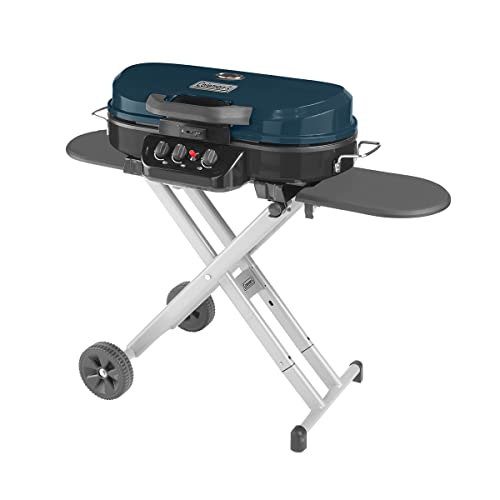
Coleman RoadTrip 285 Portable Propane Grill — Best Versatility
The RoadTrip 285 is the system grill: a three-burner, 20,000 BTU portable on a folding stand, with Coleman’s swappable cooktop idea at its heart. Grill grates for steaks, a griddle plate for breakfast, a stove grate for a pot of beans — the same base changes jobs with the menu. It suits RV campers who cook varied meals and longer stays, where one appliance doing three jobs saves real storage space.
Strengths
- Three burners give the finest heat control of any portable here
- Swappable cooktops turn one grill into a grill, griddle and stove
- Instastart push-button ignition lights reliably in campsite conditions
Trade-offs
- The stand and body are bulkier packed than a pure tabletop grill
- Swappable tops are extra purchases beyond the base grill
- More parts to clean after a greasy cook
| Fuel | Propane |
| Burners | 3 |
| Output (listing) | 20,000 BTU |
| Ignition | Instastart |
Three burners on a portable is a statement. It means a hot zone, a medium zone and a warm zone at once — sear steaks on the left, finish chicken in the middle, hold vegetables on the right. For campers cooking for a family with mixed tastes, that control ends the batch-cooking shuffle that single-burner portables impose. The RoadTrip has been a campground fixture for years largely because of this layout.
The swappable tops are the second act. A griddle plate makes it a breakfast station; a stove grate boils water for coffee or corn without firing up the RV kitchen and heating the whole rig — a genuine comfort win in summer. Budget honestly: the base grill is the start, and the tops you will actually use add to the total. Most owners settle on the griddle as the one essential addition.
Packed, the RoadTrip is a known quantity: it folds to a flat-ish package that slides into a bay or stands in a corner of the garage between trips. It is not the lightest pick here and does not pretend to be. It is the pick for campers who cook seriously at the site and want one system that covers nearly every meal of the trip.
If you run the RoadTrip from the RV’s propane system or a refillable tank, buy the hose once and coil it with the grill. Owners who keep fuel, hose, scraper and lighter in one bay compartment report the fastest setups — the system works because the kit lives together, not because any single part is special.
Best for: Long-stay campers and varied menus / Not suited for: Minimalists who want the smallest possible package
Check the current price on Amazon

Weber Q 1200N Portable Propane Gas Grill — Best Compact Propane
The Q 1200N is the tabletop answer for RV campers who prioritize cooking quality per cubic inch. One 10,000 BTU burner under porcelain-enameled cast-iron grates, electronic ignition, and a cast body that shrugs off road life — it is a small grill that cooks with big-grill manners. It suits couples and small families, class B and small trailer owners with tight bays, and anyone who sets up on the picnic table rather than a stand.
Strengths
- Cast-iron grates deliver the best sear of any tabletop pick here
- Compact, lid-locked package stores almost anywhere in the rig
- Runs on 1 lb canisters or a hose to a larger supply
Trade-offs
- Single burner means one temperature zone
- Tabletop format needs a stable, heat-safe surface at the site
- Cooking area suits two to four, not a crowd
| Fuel | Propane |
| Output (listing) | 10,000 BTU, 1 burner |
| Grates | Porcelain-enameled cast iron |
| Ignition | Electronic |
What you are buying is grate quality. Cast iron stores heat, so the Q sears through the temperature dip when cold burgers land — the moment cheap portables turn gray and steamy. Steaks get crust, chicken skin crisps, and the lid-down heat stays steady enough for thicker cuts. For campers who judge a grill by the food rather than the feature list, this is the tabletop benchmark.
The travel routine is equally considered. The lid latches, the side handles stay cool enough to move the grill once it has cooled, and the whole unit wipes down and slides into a bay without ceremony. A drip pan catches grease so the bay stays clean. It is the grill equivalent of good luggage: unremarkable to pack, excellent to use.
Its limit is capacity and zones, stated plainly. Four people is a comfortable ceiling, and everything cooks at one temperature, managed by position and timing. Couples and small families will never feel the constraint. Bigger crews should step up to the Traveler or the RoadTrip and accept the larger packed size as the price of feeding everyone at once.
The Q also earns a mention as the best second grill in this guide. Many larger-rig owners carry a big system for base camp and keep a Q-class tabletop for quick stops, beach days and picnic detours away from the site. If your travels split that way, this is the small half of the pair to own.
Best for: Couples and small families who prize sear quality / Not suited for: Cooking for six or more in one round
Check the current price on Amazon

Traeger Tailgater Portable Wood Pellet Grill and Smoker — Best Wood-Fired Flavor
The Tailgater exists for the camper who refuses to leave barbecue behind. It is a true pellet grill — 300 square inches of cooking space, foldable legs, and Traeger’s 6-in-1 versatility spanning grilling, smoking, baking, roasting, braising and barbecuing. Ribs at a lakeside site, a smoked chicken while you hike, brisket-flat cooking on a long weekend: this is the only pick here that does low-and-slow with set-and-forget temperature control.
Strengths
- Genuine wood-fired smoke flavor no gas portable can imitate
- Digital control holds smoking temperatures for hours unattended
- Folding legs keep a full pellet grill RV-transportable
Trade-offs
- Needs electricity — shore power, generator or a serious battery setup
- Heaviest and bulkiest pick here; pellets are extra cargo too
- Slower to heat and to cool than any gas pick
| Fuel | Wood pellets (electric auger/ignition) |
| Cooking area (listing) | 300 sq in |
| Versatility (listing) | 6-in-1 |
| Legs | Foldable |
The honest first question is power. A pellet grill is an electric appliance that burns wood: the auger, fan and igniter need a supply for the whole cook. On shore power that is nothing. Off-grid, it means planning — a generator during allowed hours or a battery system sized for hours of draw. Campers who already run that infrastructure get barbecue anywhere; campers who boondock lean should look at the gas picks instead.
Given power, the cooking is in another category from everything else in this guide. Set the temperature and the grill holds it through wind and evening chill, feeding pellets as needed. That is how ribs and pork shoulders happen at a campsite without babysitting a fire — you set up camp, start the cook, and go live your day. The 300 square inches is family-sized for smoking, where food is usually one or two large pieces rather than a dozen burgers.
Transport is the compromise you accept: folding legs help, but this is still the biggest, heaviest package here, and a bag of pellets rides along too. For the camper whose trips are built around the food — barbecue weekends, competition practice, holiday cooks at the lake — the trade is obviously worth it. For the weekender grilling two burgers, it is glorious overkill.
Pellet choice matters on the road: store pellets bone-dry in a sealed container, because humidity-swollen pellets crumble, jam augers and burn dirty. A single ruined bag at a remote campsite ends the barbecue plan, so treat pellet storage with the same respect you give the freshwater tank.
Best for: Smoke lovers with shore power or strong batteries / Not suited for: Boondockers without power to spare
Check the current price on Amazon

Cuisinart Grillster Portable Gas Grill CGG-059A — Best Ultralight Budget Pick
The Grillster is the minimalist’s grill: 13 pounds, a single 8,000 BTU burner that Cuisinart rates to reach 600°F, 146 square inches of grate, and a dishwasher-safe cooking surface. It suits solo RVers, couples in small rigs, and anyone whose storage is a single tote. If your camping style is two burgers, a couple of sausages and a small pan of vegetables, this is all the grill you need and nothing you do not.
Strengths
- Featherweight 13 lb package that stores in a tote or cabinet
- Burner reaches true searing temperature despite the tiny size
- Dishwasher-safe grate makes cleanup at home effortless
Trade-offs
- 146 square inches cooks for one or two, period
- Light construction will not outlast the Weber picks
- No lid thermometer or warming space — simple by design
| Fuel | Propane |
| Output (listing) | 8,000 BTU |
| Max temperature (listing) | 600°F |
| Cooking area / weight (listing) | 146 sq in / 13 lbs |
Small grills usually apologize with weak heat; the Grillster does the opposite. A compact firebox and a properly sized burner get the grate genuinely hot, so a steak for one cooks with a crust instead of a simmer. The trick with any tiny grill is preheating fully and not crowding — with 146 square inches, two portions is a load, and cooking in that discipline the results punch far above the price tier.
The travel math is the real argument. Thirteen pounds and a tote-sized footprint means the Grillster can live in rigs where the Traveler simply cannot go — van conversions, teardrops, pop-ups. It also comes out for quick stops: a one-night stay where deploying a big grill makes no sense, the little one is lit in a minute and packed in five.
Durability is the fair caveat. This is a light-gauge grill built to a budget, and heavy full-time use will age it faster than the cast-aluminum Weber. Occasional and seasonal campers will get years from it. Judge it as what it is — the lightest honest grill in this guide — and it earns its badge easily.
One honest upgrade path: many Grillster owners later add a larger grill for home and keep this one in the rig permanently. Its size makes it the grill that never gets unloaded — and a grill that is always aboard is the one that saves the unplanned picnic, the roadside lunch stop and the sunset burger.
Best for: Solo travelers, van lifers and tiny rigs / Not suited for: Families or full-timers cooking daily
Check the current price on Amazon
Comparison Table
The pattern to notice: packed convenience and cooking power pull in opposite directions. The Traveler balances both best; the specialists — griddle, pellet, ultralight — win their niches by giving something up.
| Pick | Badge | Key spec | Best for |
|---|---|---|---|
| Weber Traveler Portable Gas Grill | Best Overall | Folding cart grill with wheels, fits 15 burgers, propane | Most RV families who want one grill that does everything well |
| Blackstone 1813 Original 22-Inch Tabletop Griddle with Hood | Best Griddle for RV Camping | 22-inch flat top, 2 burners, hood included, tabletop | Families and breakfast lovers who cook big at the campsite |
| Coleman RoadTrip 285 Portable Propane Grill | Best Versatility | 3 burners, 20,000 BTU, Instastart ignition, swappable cooktops | Long-stay campers and varied menus |
| Weber Q 1200N Portable Propane Gas Grill | Best Compact Propane | 1 burner, 10,000 BTU, porcelain-enameled cast-iron grates, electronic ignition | Couples and small families who prize sear quality |
| Traeger Tailgater Portable Wood Pellet Grill and Smoker | Best Wood-Fired Flavor | Pellet grill/smoker, 300 sq in, foldable legs, 6-in-1 versatility | Smoke lovers with shore power or strong batteries |
| Cuisinart Grillster Portable Gas Grill CGG-059A | Best Ultralight Budget Pick | 8,000 BTU, reaches 600°F, 146 sq in, 13 lbs, dishwasher-safe grate | Solo travelers, van lifers and tiny rigs |
How to Choose the Best BBQ Grills for RV Camping: Size and Weight First
Start with a tape measure, not a product page. Measure your storage bay’s door opening and interior, your truck bed, or the cabinet the grill must live in — then shop only grills whose packed dimensions clear those numbers with room for the inevitable extras: a hose, a scraper, a small bag of pellets or a couple of canisters. A grill that fits exactly fits never, once real life adds a carrying case and a grease cup.
Weight is the second gate, and it is about your back as much as your payload. You will move this grill twice every stop, often on gravel, sometimes in the dark. If a grill’s weight makes you hesitate, you will start leaving it packed — the most common way RV grills die. Tabletop models in the teens and twenties of pounds get used daily; cart grills earn their weight with wheels; the pellet grill earns its weight only if barbecue is a headline activity of your trips.
Finally, check the setup count. Legs that fold with one motion, lids that latch for transport, stands that are part of the grill rather than a separate puzzle — these details decide whether the grill comes out for a one-night stop. The best RV grill is the one that is cooking ten minutes after you level the rig.
Fuel Planning: Canisters, RV Propane and Pellets
One-pound canisters are the universal donor: every gas pick in this guide runs on them, they are sold at every campground store, and they store safely in a ventilated bay. Their weakness is cost per cook and waste on long trips. For stays beyond a few days, most RV campers graduate to a hose: either a refillable tank with an adapter, or a quick-connect tap into the RV’s own propane system where the rig provides one. Confirm thread and regulator compatibility on the listing and with your rig’s manual before relying on either.
Consumption planning is simple once you have a trip or two behind you: a 1 lb canister typically covers a few ordinary grilling sessions, fewer in cold or wind. Carry one more canister than your estimate, store spares upright and ventilated, and never store propane inside the living space of the rig.
Pellets are a different logistics chain: dry storage, a bag or two per long cook, and electricity for the grill itself. Pellet campers plan power first — shore hookups, generator hours, or a battery bank sized for a multi-hour cook — and treat pellets like food cargo. It is more planning, and for smoke lovers it is planning well spent.
Campground Rules and Courtesy: Fire Bans, Quiet Hours and Smoke
Campgrounds are not the open range. Many prohibit charcoal during fire season, some restrict all open flame under red-flag conditions, and pellet grills are occasionally classed with wood fires rather than appliances — ask at check-in when conditions are dry. Propane grills with a shutoff valve are the most widely accepted category, which is another quiet reason they dominate this guide.
Generator hours matter if you run a pellet grill off-grid: a long smoke must fit inside the campground’s generator window or run on batteries. Plan cook start times around quiet hours the way you plan them around dinner.
Courtesy is the unwritten rulebook. Grill on your own site, keep smoke in mind when the wind aims at your neighbor’s open windows, and leave the picnic table cleaner than you found it — a scraper and a wipe, every time. The campers invited back are the campers who clean up.
Matching the Grill to Your RV Style
Weekenders live by deployment speed. If your trips are two nights and a tailgate, the grill must go from bay to burgers in minutes and pack just as fast, or it will be left behind by the third trip. The folding Traveler and the tote-sized Grillster bracket that lifestyle: pick by crew size. The worst weekender grill is a great grill that takes twenty minutes of assembly at each end of a short trip.
Long-stay campers should optimize differently. When the rig parks for a month, packed size matters once and cooking control matters ninety times. That is the RoadTrip 285’s home turf — three burners, swappable tops, room to run a real kitchen outdoors so the RV interior stays cool and clean. Snowbirds also get the most from a hose connection to a refillable tank, ending the canister shuffle for the season.
Boondockers and dry campers are governed by resources: water for cleanup, power for appliances, storage for fuel. Gas tabletop grills are their natural fit — instant light, scrape-and-wipe cleaning, no electrical draw. Pellet grills join this lifestyle only behind a deliberate power system, and charcoal is usually excluded by both fire rules and ash logistics.
Full-timers should buy for durability above all. A grill that cooks three hundred nights a year needs cast aluminum, cast iron and replaceable parts from a maker who will still sell them in five years. That is why the Weber picks anchor this guide’s recommendations for people who live on the road: the purchase price spreads across years of daily use, and a cheap grill replaced twice costs more than a good one bought once.
How to Set Up, Cook and Pack Away at the Campsite
A smooth campsite routine protects your grill, your storage bay and your dinner. This is the sequence experienced RV grillers run on autopilot.
- Position first. Set the grill on a stable, level surface — the picnic table with a heat-safe mat, or its own stand on flat ground — clear of the awning, the rig’s sidewall and dry grass. Level matters: grease should run to the drip tray, not across the grate.
- Connect fuel outdoors. Thread the canister or hose by hand until snug, then check with a drop of soapy water if anything smells off. Bubbles mean stop, reseat, retest.
- Preheat with the lid down. Ten minutes for gas grills and griddles; longer for the pellet grill to reach and settle at temperature. Season the griddle top lightly if it has been stored a while.
- Cook in zones. Even a single-burner grill has a hotter center and cooler edges — use them. Keep a cooler corner as a holding area so finished food rests while the last pieces catch up.
- Scrape while warm. The moment food comes off, scrape the grate or flat top and wipe with a folded paper towel held in tongs. Ninety percent of cleanup happens in this minute.
- Cool, then pack. Let everything cool fully, empty the drip tray into the trash — never onto the ground — latch the lid, and stow the grill. Canisters come off and store upright in a ventilated compartment.
- Leave the site clean. Check under and around the grill for grease spots and food scraps. Critters grade your cleanup even when the campground does not.
Run this loop a few times and it compresses into minutes at each end of the meal. That efficiency is the real luxury in RV camping: the grill becomes part of the rhythm of the trip rather than a project competing with it.
Common Buying Mistakes
Every one of these has ended a camp dinner or a grill’s traveling career. They are all avoidable with five minutes of forethought.
- Buying by cooking area instead of packed size. A grill that does not fit the bay does not come on the trip. Packed dimensions and weight are the first specs an RV camper should read — cooking area is the second.
- Grilling under the awning. Heat, smoke and grease vapor rise straight into the awning fabric and the rig’s sidewall. Set up in the open, downwind of your own doors and windows.
- Forgetting wind. Campsite wind steals heat and blows out weak flames. Position the grill shielded, keep the lid down, and budget extra fuel and time on exposed sites.
- Packing a warm grill. A “mostly cool” grill in a sealed bay warms everything around it and bakes grease smells into the compartment. Full cool-down, every time.
- Running a pellet grill without a power plan. Pellet grills are electric appliances. Arriving at a dry campsite with no hookup, no generator window and a small battery means the brisket plan dies on night one.
- Dumping grease at the site. Grease on the ground attracts animals and violates the spirit and usually the letter of campground rules. Cool it, trash it, carry it out.
Final Recommendation
If you buy one grill from this guide, make it the Weber Traveler: it folds, rolls, cooks for a family and stores like luggage. Couples who prize searing above all should take the Weber Q 1200N, and breakfast-first campers will get more joy from the Blackstone 22-inch griddle than from any grate ever made.
Long-stay cooks belong with the RoadTrip 285’s three burners and swappable tops; smoke devotees with power to spare belong with the Tailgater; and the Grillster is the honest ultralight for rigs where every pound argues its case. Measure your bay, count your crew, and check the current price on Amazon before you order — then get out there and cook something worth the drive.
Best Bbq Grills For Rvs Best Bbq Grills For Apartments Best Bbq Grills Propane Best Bbq Grills Traeger Best Bbq Grills Guide
Frequently Asked Questions
Can I run a portable grill from my RV’s propane system?
Often, yes — many rigs have a low-pressure quick-connect port, and many portable grills accept a compatible hose once their own regulator setup is accounted for. The details vary by grill and rig, so confirm the connection type on the product listing and in your RV manual. When in doubt, 1 lb canisters always work.
What is the best fuel for RV camping grills?
Propane, for most people: it is available everywhere, allowed in the most campgrounds, lights instantly and stores safely. Pellets win on flavor for campers with reliable power. Charcoal is the most restricted fuel in campgrounds and the messiest to transport, which is why it does not appear among these picks.
How big a grill do I need for a family of four?
Look for room to cook four burgers or chicken portions plus vegetables at once — the Traveler class, or a 22-inch griddle. Couples can go a full size smaller. Remember that a slightly small grill cooking in two quick batches beats a big grill that does not fit your storage.
Are pellet grills practical in an RV?
Yes, with power planning. On shore power they are effortless and produce real barbecue. Off-grid they need generator hours or a substantial battery system, and you must carry dry pellets. If your camping is mostly dry and lean, a gas portable is the practical choice.
How do I keep a travel grill from rusting in storage?
Clean it warm, dry it fully, oil grates or the griddle top lightly, and store it latched in a dry bay. Coastal and humid storage is the hardest on steel — a breathable cover and a mid-winter check keep small rust spots from becoming holes.
Can I use my RV grill at home too?
Absolutely — most owners do. The tabletop and folding picks here work on a patio or balcony table exactly as they do at a picnic table, and the griddle is a genuine home upgrade for weekend breakfasts. One grill, two lives, is part of the value.
Should my RV grill live in the bay or in the truck?
Wherever it stays clean, dry and legal. Storage bays keep the grill with the rig and out of the living space; truck beds suit grills used at day stops away from the campsite. Either way, transport it cool, latched and with the grease tray emptied — a tidy grill is welcome in any compartment.


