Disclosure: As an Amazon Associate, airfryerkitchensupply.com earns from qualifying purchases. Links to Amazon on this page are affiliate links; they cost you nothing extra. Listing details such as price and availability change often, so check the current Amazon listing before you buy.
Towels are bulky, they are damp half the time, and they seem to land wherever there is a spare hook. Choosing the best bathroom towel storage means deciding where towels will dry, where the clean stack lives, and how much floor, wall or door you can spare. This guide looks at five real products that cover those different answers, so you can match one to your room rather than buying whatever happens to be on the first page of results.
Whether you are fitting out a small rental bathroom, a family bathroom that must hold six towels at once, or a guest bathroom that only needs to look tidy, the right rack changes how the room feels. We cover freestanding stands, adhesive bars, wall-mounted racks with a shelf, and over-the-door options, followed by plain advice on measuring, mounting and keeping towels fresh.
You will also find a set of bathroom towel storage solutions grouped by situation, a care table, and a short set of answers to the questions we hear most.

Quick Comparison
| Product | Best for | Main point | Link |
|---|---|---|---|
| Yamazaki Home Tower Bath Towel Hanger | Floor space without drilling | Freestanding steel frame with a slim footprint | Check on Amazon |
| Umbra Flex Adhesive Bathroom Towel Bar | Renters | Sticks on instead of being screwed in | Check on Amazon |
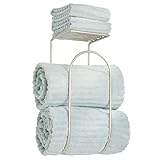
| mDesign Metal Wall Mount Towel Rack with Shelf | Rolled towels on display | Wall rack with a shelf above the bars | Check on Amazon |
| Zenna Home Over-the-Door Towel Rack | Rooms with no spare wall | Hooks over the door, no tools | Check on Amazon |
| Simple Houseware Freestanding Bathroom Towel Stand with Shelf | Bigger families | Stand with bars and a top shelf | Check on Amazon |
In this guide
How These Options Were Chosen
We aimed for variety: one freestanding stand, one adhesive bar, one wall rack with a shelf, one over-door hanger, and one larger family stand. The comparison rests on manufacturer listings and published specifications. We have not handled these products ourselves, so the notes below describe what the listings say and how that is likely to suit different bathrooms.
Because model details and finishes change over time, check the current page for dimensions and mounting hardware before you order.
The Best Bathroom Towel Storage Racks and Holders
Yamazaki Home Tower Bath Towel Hanger
Yamazaki is known for slim, minimal home organisers, and the Tower range follows that style. This freestanding hanger holds towels on a vertical frame, so it can stand beside a tub or in a corner without any wall fixing. It suits people who want a clean look and cannot, or would prefer not to, drill into tile.
The benefit is flexibility. You can move it when you clean the floor, or take it with you when you move house. The compromise is footprint and stability: a stand takes up a patch of floor and tall frames can be knocked in a narrow room, so confirm the dimensions fit your layout.
Skip it if your bathroom is tight and the floor is already crowded, or if you need to hang more than a couple of towels at once.
Umbra Flex Adhesive Bathroom Towel Bar
The Umbra Flex adhesive bar is aimed at people who cannot fix things to the wall. It attaches with an adhesive system rather than screws, so it suits rental flats and tiled surfaces where drilling is a problem. It is a straightforward single bar, enough for a hand towel or one bath towel beside the vanity.
The advantage is speed and low commitment. The limits are in the nature of adhesive systems: they depend on a clean, smooth, suitable surface, and they are not made for heavy, soaked bath sheets. Read the listing for the weight guidance and the maker’s surface and cure-time instructions.
Skip it if you want to hang several heavy towels or if your wall is rough, textured or painted with a flaking finish.
mDesign Metal Wall Mount Towel Rack with Shelf
This type of rack combines bars with a shelf, which is the layout many people picture when they think of a spa-style bathroom. Rolled towels or a basket sit on the shelf, and the bars below hold used towels. It is a good choice for a bathroom where the wall behind the toilet or beside the vanity is free.
The strength is capacity within a small footprint, because it uses vertical space rather than floor. The caveat is mounting: it goes into the wall using supplied hardware, so you need to follow the maker’s instructions and use proper anchors for your wall type. If you are not confident, use a qualified handyman.
Skip it if you rent and cannot drill, or if your wall is thin plasterboard with no stud nearby and you have no suitable anchors.
Zenna Home Over-the-Door Towel Rack
An over-door rack is the fastest fix in a room that has plenty of door and very little wall. It hooks over the top of the door and offers several bars at different heights. There is nothing to drill, so it is helpful for guest bathrooms, student housing and rented flats.
Think about how the door closes before you buy. Some doors have thin gaps and a rack may stop them latching, or it may rub the frame. Wet towels can also drip onto the door surface, so keep an eye on the finish. Check the listing for the door thickness range.
Skip it if the door is a heavy solid type with a tight frame, or if the bathroom door is opened and closed constantly by lots of people.
Simple Houseware Freestanding Bathroom Towel Stand with Shelf
The Simple Houseware stand is a larger freestanding unit with bars and a shelf at the top, which suits a bathroom shared by several people. Each family member can have a bar, and the shelf holds spare towels or a small basket of washcloths.
It gives you capacity without tools, but it needs floor space and can look bulky in a narrow room. Assemble it on a level floor and check that the legs sit flat, since a wobbling stand is a nuisance with heavy wet towels.
Skip it if you have a compact bathroom, or if you want a stand that blends in with a minimal look.
Best for Small Bathrooms
Where space is tight, go vertical or use the door. The Zenna Home rack uses a surface you already have, and a slim Yamazaki Tower hanger can stand in a gap beside the tub without taking much width.
Best for Renters
The Umbra Flex adhesive bar and the over-door Zenna rack both avoid drilling. Test the surface with a small, inconspicuous area first, and follow the cure time on the packaging.
Best for Large Families
A stand like the Simple Houseware unit gives each person a bar and keeps towels from piling on one hook. Assign colours or labels so everyone knows which towel is theirs.
Best for Guest Bathrooms
The mDesign wall rack with a shelf looks tidy and lets you display one rolled towel and a folded hand towel for visitors, with space for extras below.
How to Choose Bathroom Towel Storage
Begin with a count. How many towels hang in the room on an ordinary day, and how many spare ones should be stored? A couple living together might manage with two bars. A household of five needs bars for each person plus a shelf for the clean stack.
Then measure. For wall racks, record the free width, the height from the floor, and the distance from the toilet, shower door and door swing. Leave enough room that nothing is brushed against when someone steps past. For freestanding stands, measure the floor footprint and consider how the stand will sit beside a bath mat.
Decide how you will mount it. Drilled hardware is the most secure, but it requires a suitable wall and the right anchors. Adhesive bars suit light loads. Over-door racks are the quickest but depend on the door. Matching the mounting method to your wall and your tenancy narrows the list quickly.
Consider airflow. Towels dry best when air can pass around them, so spread them on separate bars rather than folding one over another. A rack in a damp corner far from a window may never dry a towel fully. Placing a rack near a vent or a window helps, and so does leaving the door open after a shower.
Think about finish. Chrome, powder-coated steel and painted metal all cope with bathroom humidity differently. Choose a finish that matches your taps and holders if appearance matters, and check the listing for the coating type.
Common mistakes include buying a rack that is too short for a bath sheet, placing it where it blocks a door, and assuming adhesive will hold a heavy wet load. Another is forgetting that towels are heavier when they are wet, so a rack that looks sturdy with dry cotton may sag after a shower.
Bathroom Towel Storage Solutions for Different Layouts
A narrow galley bathroom behaves differently from a square family room. In a galley, the wall opposite the tub is often the only place for a rack, so a slim wall bar or the door itself carries most of the load. In a square room, you might fit a stand in a corner and still leave a clear path to the shower.
Think about where you step out of the bath or shower. A towel should be within one arm’s reach, not across the room, and it should not sit where a splash from the basin can reach it. Many people place the main bar next to the shower and a hand towel ring beside the basin.
If you share the room, give each person a distinct spot. Different bars, hooks or colours reduce the habit of using the nearest damp towel. Children often manage better with a low hook at their own height.
For clean spares, a basket or shelf above the toilet keeps a few rolled towels dry and handy. Keep the full stock in a linen cupboard outside the bathroom if humidity is a concern, and bring in only what you need for the week.
Installation, Safety and Legal Notes
Follow the maker’s instructions for every product. For drilling into walls, use the right bit and anchors for tile, plasterboard or masonry, and take care to avoid hidden pipes and cables behind the surface. If you are unsure, ask a qualified professional to mount the rack. Do not install any rack near a switch, outlet or heater in a way that could create a hazard.
If you rent, check your tenancy terms before drilling or using adhesives, and ask the landlord when in doubt. Place freestanding stands where nobody will trip on them, especially in the dark.
Care and Troubleshooting
| Problem | What to try |
|---|---|
| Towels stay damp | Spread them on separate bars and open a window or fan |
| Rust spots on metal | Wipe dry after use and clean off marks promptly |
| Adhesive bar slips | Remove it, clean the surface and follow the maker’s cure time |
| Stand wobbles | Check the assembly screws and the evenness of the floor |
Wipe racks with a soft cloth and mild cleaner. Avoid harsh abrasives that scratch the finish. Wash towels regularly so that damp, musty fabric does not mark the rack.
A Quick Checklist Before You Choose Towel Storage
Towel storage looks simple until you try to fit it into a real bathroom. Run through these questions before you shop and write the answers down.
- How many towels do you need to store or hang at one time?
- Do you want towels spread out to dry, folded on shelves or rolled in baskets?
- Is there open wall space, and what is the wall made of: drywall, tile, plaster or something else?
- Can you drill, or do you need a renter-friendly option?
- How much floor space can you spare, and how close is it to the shower or bath?
- Is the door suitable for an over-the-door rack, and how much clearance does it have?
- Do you want closed storage to hide towels, or open storage that looks decorative?
Answering these first narrows your choices quickly and avoids buying hardware that does not suit your walls or your habits.
Storage Types Compared
| Type | Good for | Trade-offs |
|---|---|---|
| Wall bar or hook | Daily towels that need to dry | Needs secure fixing, limited capacity |
| Wall shelf with bar | Folded spares plus a hanging towel | Needs a strong mount, more wall space |
| Over-the-door rack | Rentals and quick setups | Depends on door thickness, can rub the door |
| Freestanding stand | No drilling, flexible placement | Takes floor space, can tip if overloaded |
| Basket or bin | Rolled spares and guest towels | Not designed for drying wet towels |
| Adhesive hook or bar | Light use, rentals | Weight limits, surface preparation matters |
Adhesive products are convenient, but they depend on a clean, smooth surface and the weight limit stated by the maker. Textured tile or damp walls can reduce hold. If you have any doubt, choose a method designed for your surface.
Mistakes That Lead to Damp Towels and Damaged Walls
- Hanging towels too close together, so air cannot dry them between uses.
- Placing a bar directly over a radiator or heater without checking the maker’s guidance.
- Using the wrong wall anchor for the wall material.
- Overloading a hook or bar beyond its stated weight limit.
- Putting damp towels into closed baskets, which can trap moisture and odors.
- Ignoring ventilation in the bathroom, which affects how fast towels dry.
- Installing at an awkward height that is difficult for children or shorter adults to reach.
Pay attention to airflow. A towel that dries between uses stays fresher for longer, regardless of the type of storage.
Fixing to Walls: Anchors, Studs and When to Call Help
A wall-mounted rack must hold the weight of wet towels and people tugging them. Use the hardware that comes with the product only if it suits your wall, and follow the maker’s instructions. Locate studs with a stud finder when the manual asks you to, and use the right type of anchor for drywall, tile or masonry. Drilling into tile requires the correct bit and a steady hand, and slips can crack the surface.
Before drilling, think about hidden pipes and electrical wiring. If you are unsure what lies behind the wall, or the job involves tile, plaster or a wall near water supply lines, ask a qualified handyman or plumber. For renters, check your lease and talk to your landlord about what is allowed, and choose removable options when drilling is not permitted.
Keeping the System Tidy
A towel system works best when it fits your routine. Assign one hook or bar per person, or color-code towels so that everyone knows which is theirs. Keep a small basket of fresh towels within reach, and place a laundry basket nearby for used ones. Launder towels regularly following the care label, and rotate spares so none sits unused for too long.
Wipe racks and bars periodically with a damp cloth, since steam and splashes leave marks. Check fixings every few months and tighten screws if they have loosened. If a rack feels loose or a wall anchor has begun to pull out, stop using it until it has been fixed.
Making Space for Towels in a Tiny Bathroom
Small bathrooms need creative thinking, because floor and wall space are limited. Begin with vertical room. Narrow shelves above the toilet, tall slim stands in a corner and hooks on the back of the door can store a surprising number of towels without crowding the room.
- Roll towels instead of folding them, which saves shelf depth and looks tidy.
- Use the back of the door for a hook or over-the-door rack that holds the daily towel.
- Place a slim basket or shelf unit beside the sink for hand towels and washcloths.
- Keep spares in a hall cupboard or linen closet and bring out only what you need.
- Choose thinner, quick-drying towels if space is tight, since they fold smaller.
Think about clearance as well. A rack that sticks out too far can catch hips and elbows in a narrow room, and a freestanding unit near the bath can get splashed. Measure the space and imagine walking past with a towel in hand. A solution that looks neat on a listing photo must also work when someone is hurrying in the morning.
Planning in More Depth Before You Buy
The reviews above compare individual pieces, but the decision that shapes daily satisfaction is simpler: how the storage fits your bathroom, your routine and the damp reality of the room. Start with measurement. Bathrooms are unforgiving spaces — a cabinet a fraction too deep blocks a door, a unit a fraction too wide crowds the basin — so measure the wall, the floor area and the swing of every door and drawer before you fall for a photograph. Note where pipes, taps and the toilet sit, because storage that fights the plumbing loses every time.
Next, be precise about what needs a home. Count what will live in this storage once the novelty wears off: towels, spare toilet rolls, cleaning products, medicines, cosmetics, hair tools, perhaps a scale or a laundry basket. Group items by how often you reach for them and by who uses them. Daily items want to be at hand height and easy to grab with wet hands; occasional items can live higher, lower or behind a door. Be wary of storage that looks generous in photos but is divided into spaces too small for your tallest bottle — measure the biggest thing you plan to store, not the smallest.
Finally, respect the water. A bathroom is the wettest, steamiest room in the house, so think about splashes, condensation and ventilation before you think about style. Materials, finishes and fixings all behave differently in damp air, and a piece that thrives in a bedroom can suffer beside a shower. The best choice is the one that fits the room’s moisture, gives every bottle and towel a place, and can be wiped clean in seconds — because in a bathroom, easy cleaning is not a bonus, it is the whole job.
Three Everyday Situations, Worked Through
A family bathroom with towels everywhere
Picture a family bathroom with towels everywhere. The bathroom is prime territory: it is where the day starts at speed and ends in a rush, so storage that wastes your time or hides what you need is felt twice a day. Before choosing bathroom towel storage, list what genuinely needs to live within reach — usually towels, toiletries, a toothbrush, cleaning basics and the small things that otherwise colonise the basin edge — and be honest about what only ends up there because there is nowhere else for it. That short list decides whether you need shelves, doors, baskets, hooks, or some mix of them all.
Then look at the room itself. Note which wall is driest, where the door swings, whether the floor gets splashed, and how the steam from a shower travels. In this situation the best choice is rarely the biggest unit that can be squeezed in; it is the one whose size matches the wall, whose storage matches the list you just made, and whose finish can shrug off damp air. Measure the space, check the fixings your wall can take, and only then compare styles and details.
A small bathroom with no airing cupboard
Picture a small bathroom with no airing cupboard. The bathroom is prime territory: it is where the day starts at speed and ends in a rush, so storage that wastes your time or hides what you need is felt twice a day. Before choosing bathroom towel storage, list what genuinely needs to live within reach — usually towels, toiletries, a toothbrush, cleaning basics and the small things that otherwise colonise the basin edge — and be honest about what only ends up there because there is nowhere else for it. That short list decides whether you need shelves, doors, baskets, hooks, or some mix of them all.
Then look at the room itself. Note which wall is driest, where the door swings, whether the floor gets splashed, and how the steam from a shower travels. In this situation the best choice is rarely the biggest unit that can be squeezed in; it is the one whose size matches the wall, whose storage matches the list you just made, and whose finish can shrug off damp air. Measure the space, check the fixings your wall can take, and only then compare styles and details.
A guest bathroom that needs towels ready and fresh
Picture a guest bathroom that needs towels ready and fresh. The bathroom is prime territory: it is where the day starts at speed and ends in a rush, so storage that wastes your time or hides what you need is felt twice a day. Before choosing bathroom towel storage, list what genuinely needs to live within reach — usually towels, toiletries, a toothbrush, cleaning basics and the small things that otherwise colonise the basin edge — and be honest about what only ends up there because there is nowhere else for it. That short list decides whether you need shelves, doors, baskets, hooks, or some mix of them all.
Then look at the room itself. Note which wall is driest, where the door swings, whether the floor gets splashed, and how the steam from a shower travels. In this situation the best choice is rarely the biggest unit that can be squeezed in; it is the one whose size matches the wall, whose storage matches the list you just made, and whose finish can shrug off damp air. Measure the space, check the fixings your wall can take, and only then compare styles and details.
Setting It Up Carefully, Step by Step
When the piece arrives, unpack it somewhere dry with space to work and check every panel, fitting and shelf against the instructions before you begin. Bathrooms are small, so build or assemble in another room if you can, and carry the finished piece in — trying to work in a cramped bathroom is how panels get chipped and screws get lost down the plughole. If the piece needs wall fixing, identify what your wall is made of and use the fixings the maker specifies for that material; a heavy cabinet on the wrong plugs is a genuine hazard.
Positioning deserves the same patience. Hold the piece in place and test it in use: open doors and drawers fully, check they clear the basin, the toilet and the door swing, and stand where you would stand to wash or dry your hands. Leave an air gap where you can, since storage pressed hard against a damp wall traps moisture behind it. If the piece stands on the floor, level it so doors hang true and bottles do not slide; if it hangs on the wall, double-check it is level before the fixings are final.
Finish by loading it deliberately, because that is the part you live with. Put daily items where your hand expects them, heavy bottles low, and anything that must stay dry farthest from the shower’s splash zone. Keep cleaning products and medicines in their proper places, out of reach of children. A bathroom store that starts organised, with a home for each category, tends to stay organised with very little effort — and in a small room, that order is what makes the space feel calm instead of cramped.
Cleaning, Care and Keeping It Fresh
A bathroom store lives in steam, splashes and spilled products, so its worst enemy is moisture left sitting. Wipe up splashes and drips promptly, especially around basins and baths, and leave doors or cabinets open for a while after a shower if the room has no fan, so damp air can escape instead of settling into corners and joints. Ventilation is the cheapest care there is: a window opened or an extractor run for a short time after bathing protects every surface in the room, not just this piece.
Care for the material in front of you rather than following generic advice. Wood and wood-based panels prefer to be kept as dry as possible and dislike standing water on edges and seams; metal parts can spot or corrode if they stay wet, so dry them after splashes; plastic and baskets shrug off water but collect soap film and dust. Follow the maker’s care guidance where it is given, avoid harsh or abrasive cleaners on finishes, and check the hidden places — behind, beneath and inside — where grime and mildew quietly start.
Once in a while, do a short reset. Empty the storage completely, wipe every shelf and corner, throw out the empties and the long-expired products that gather at the back, and put back only what is actually used. Bathroom storage slowly fills with hotel bottles, spare razors and half-finished tubes that nobody chose to keep, and that drift is what turns a tidy cabinet into a rummage. A ten-minute reset every month or so keeps the piece doing its real job: holding the right things, dry, clean and findable.
Comparing the Picks Above, Side by Side in Your Mind
With the individual reviews above in mind, it helps to step back and compare the shortlist as a group: Yamazaki Home Tower Bath Towel Hanger, Umbra Flex Adhesive Bathroom Towel Bar, mDesign Metal Wall Mount Towel Rack with Shelf, Zenna Home Over-the-Door Towel Rack, and Simple Houseware Freestanding Bathroom Towel Stand with Shelf. Looked at together, the differences that matter are rarely decorative. They are about how each option stores things — doors that hide, shelves that show, baskets that lift out — and about the footprint each one takes from a room that has none to spare. Compare them first against your everyday list of bathroom items: the right piece is the one whose storage shape matches that list with the least forcing.
Then compare the practicalities. Which size fits your wall without crowding the basin or the door swing? Which material will cope best with steam and splashes in your household? Which can you clean fastest on an ordinary busy morning? A useful exercise is to score each pick, on paper, against those questions, and to imagine each one in place during the morning rush rather than in a styled photograph. The storage that wins under those conditions is the one that will still feel right long after the novelty has worn off.
More Mistakes Worth Avoiding
The most common mistake is measuring the wall but forgetting the room. Doors swing, drawers pull out, people need to stand somewhere, and storage that technically fits can still make the bathroom feel impossible once it is installed. Leave breathing room, check every swing and opening, and remember the path between the door, the basin and the shower. A piece that looks perfect in a listing but blocks the towel rail or the toilet-roll holder in real life is not a good fit, however handsome it is.
Another frequent error is buying storage for a tidier household than the one you have. Open shelves suit people who genuinely fold towels and line bottles up; they will not reform a household that drops things wherever they land. Be honest, and let doors hide what you do not want to see. People also overlook the damp: unsealed edges beside a bath, metal that stays wet, and fixings chosen for the wrong wall type. Read the listing carefully, check what is actually included, and your expectations will match what arrives.
More Practical Notes From Everyday Use
Grouping Items So the Morning Rush Stays Calm
Bathroom storage works best when it is organised by moment rather than by object. Keep the morning kit — toothbrush, toothpaste, deodorant, face things — together where it can be reached half asleep, the evening kit somewhere equally predictable, and the weekly things, such as nail clippers and spare blades, in a less prime spot. When every category has a fixed home, nobody has to hunt, and the basin edge stops being the default shelf. Small trays, cups and dividers earn their keep here: they turn a jumble into neighbourhoods, and they lift out for cleaning, which in a bathroom matters more than in any other room.
Towels: The Bulkiest Problem in the Room
Towels defeat more bathroom storage than any toiletry, because they are bulky, they multiply, and they need air as much as they need space. Store the in-use towels where a wet hand can reach them without dripping across the room, and keep the clean spares somewhere dry — a steamy shelf beside the shower will leave them smelling less than fresh. Fold or roll consistently, because a mixed pile collapses into a heap. If towels are overflowing the storage you have, the honest fix is usually fewer towels in rotation rather than a bigger cabinet.
Keeping Medicines and Cleaning Products Properly
Some bathroom contents deserve stricter homes than others. Medicines should be stored as their labels direct, in a closed container or cabinet, out of reach of children — and many labels advise a cool, dry place, which a steamy bathroom is not, so a hall cupboard may serve better for anything important. Cleaning products belong low, contained, and away from toiletries so nothing can be grabbed by mistake in a hurry. A storage plan that separates the everyday, the occasional and the hazardous is not fussy; it is simply how a shared bathroom stays safe.
Small Bathrooms: Thinking Vertically
When floor space runs out, the walls are the remaining territory. Storage that climbs — tall cabinets, shelves above the door line, hooks and rails on unused wall — adds capacity without stealing the room you stand in. The discipline is to store by frequency: daily items between knee and shoulder height, occasional items higher, and almost never-used items in the hardest spots. Going vertical also lifts things away from floor-level splashes, which keeps stored items drier. Just fix everything properly for its weight and your wall type, and never hang heavy storage where it could fall into a bath or basin area.
Guests, Children and Shared Bathrooms
A bathroom used by several people needs storage that survives several habits at once. Give each regular user a defined zone — a basket, a shelf, a section of cabinet — so belongings stop migrating, and keep a small, obvious home for guest basics such as a spare towel and an unopened toothbrush. For children, put their everyday items low and safe, and keep razors, medicines and cleaning products genuinely out of reach, not just pushed back. Shared bathrooms stay calm when the storage makes the right thing easy and the wrong thing difficult.
What to Check in the First Week of Use
The first week with new bathroom storage tells you whether the choice was right, so pay attention while changes are still simple. Notice whether the morning routine flows or stalls, whether doors and drawers are opened with wet hands without a struggle, whether anything steams up, drips or sits in a puddle, and whether any daily item has failed to find a home. Small fixes — moving a shelf’s contents, adding a hook or a basket, shifting the splash-prone items — solve most niggles. If the size itself feels wrong every single morning, that is a genuine mismatch, and it is better acted on early than adapted to for years.
Renting, Drilling and Damage-Free Options
Not every bathroom can be drilled into, and renters in particular need storage that leaves no trace. Freestanding units, over-door racks, suction and adhesive systems, and tension fittings all add capacity without a single hole — but each has limits, and adhesive or suction fixings on steamed-up tiles should be checked regularly and never trusted with heavy or breakable loads above a bath. If you can drill, keep the fixings where a future change of mind can hide them. The best rental storage is the kind you can take with you and reuse in the next home.
When Storage Is Full: The One-In, One-Out Rule
Bathroom cabinets fill by accumulation, not by decision: a new shampoo arrives while the old one still has an inch left, and somehow both stay. A gentle one-in, one-out rule keeps any storage system working at its best — a replacement comes in, the finished or forgotten item goes out. Once a season, check dates on medicines and cosmetics and dispose of anything expired as local guidance advises. Storage that is only ever added to eventually stops being storage at all; a little regular editing is what keeps the piece you chose actually useful.
A Note on Buying Less, But Better
It is worth saying plainly: the most sustainable bathroom storage is the piece you buy once. Cheap units that swell in the damp, rust at the hinges or crack at the corners get replaced again and again, and each replacement costs more in money, time and waste than one solid choice would have. Where you can, favour materials and fixings that tolerate steam, simple shapes that will suit the next bathroom as well as this one, and sizes based on what you truly store rather than on hope. Buying less, but better, is not a luxury position — in the wettest room in the house, durability is simply the practical option.
Frequently Asked Questions
Where should towels hang in a small bathroom?
Use the back of the door or a slim wall bar, so that the floor stays clear.
How many towels can one bar hold?
Usually one or two bath towels if they are spread out. Check the weight guidance on the listing.
Are adhesive towel bars safe for wet towels?
They suit light loads on suitable surfaces. For heavy bath sheets, choose a drilled mount.
Can I store clean towels in the bathroom?
Yes, on a shelf or in a basket, as long as the room is ventilated and the towels stay dry.
Do over-the-door racks damage the door?
They can mark the finish or stop the door latching, so check the thickness range first.
What height should a towel bar be?
Choose a height where the lowest hanging towel clears the floor, and where adults and children can reach it comfortably.
How do I stop towels smelling musty?
Hang them flat, ventilate the room, and wash them often.
How do I stop bathroom storage going mouldy?
Moisture control matters more than any product: ventilate the room after showers, wipe splashes dry, and leave cabinet doors open for a while if damp air lingers. Keep stored items off wet floors, check hidden corners regularly, and clean any early mildew promptly with a suitable cleaner used as its label directs. If a piece sits in a constantly wet spot, move it or choose a material that tolerates water better — no storage performs well standing in puddles.
Where should towels be stored in a small bathroom?
Keep the towels in daily use within reach of the bath or shower, on a rail, hook or small shelf, and store clean spares in the driest spot available — which may be a linen cupboard outside the bathroom rather than a steamy cabinet inside it. Rolling towels takes less room than folding and lets air circulate. If space is truly tight, keep fewer towels in the room and rotate them from storage elsewhere.
Can I put storage over the toilet?
The wall above a toilet is often wasted space and can work well for shelves or a cabinet, provided the fixing suits the wall and the storage sits high enough to use the toilet comfortably. Keep heavy or breakable items elsewhere, since anything dropped there lands badly, and make sure nothing overhangs where someone standing up could strike it. Check local building guidance if you are unsure, and use a qualified person for fixings you do not trust yourself.
How do I keep bathroom storage tidy with several people sharing?
Zones beat rules. Give each person a basket, shelf or section, keep shared items in one obvious place, and put a small bin within reach so rubbish stops landing on surfaces. A quick reset of the shared areas whenever the bathroom is cleaned stops slow drift. If one category keeps overflowing — towels and hair products are the usual suspects — give it more space honestly rather than letting it colonise the rest.
What should I do if a wall-mounted cabinet feels loose?
Take the weight out of it straight away and do not keep using it until it is checked. Looseness usually means a fixing has failed in the wall or the wrong fixing was used for that wall type, and a loaded cabinet that falls can injure someone. Refix it with the hardware the maker specifies for your wall, or have a qualified person do it. Never simply tighten a screw into a crumbling hole and hope.
How often should bathroom storage be cleaned out?
A light wipe of shelves and surfaces whenever the bathroom itself is cleaned, and a full empty-and-sort a few times a year, is enough for most homes. Bathrooms collect expired medicines, finished bottles and forgotten products faster than any other room, so the sort-out matters as much as the wipe-down. If you cannot remember what is at the back of a cabinet, that is the sign it is due.
Bottom Line
The best bathroom towel storage depends on your wall, your lease and your household. The Umbra Flex bar and Zenna Home over-door rack suit renters, the Yamazaki Tower hanger suits a minimal floor-standing setup, the mDesign wall rack gives a spa feel with a shelf, and the Simple Houseware stand serves bigger families. Measure first, match the mounting to the room, and let towels dry properly.
