Disclosure: airfryerkitchensupply.com is reader-supported. When you buy through links on our site, we may earn an affiliate commission at no extra cost to you.
Where to buy
Shopping the best bath tubs for babies toddlers shortlist below is fastest through the retailer link under each pick. Availability and colour options change often, so use the links below to check the current price on Amazon and confirm the exact size or configuration before you order:
- The First Years Newborn to Toddler Baby Bath Tub (3-in-1, Sure Comfort) — Check on Amazon
- Stokke Flexi Bath Bundle with Newborn Support — Check on Amazon
- OXO Tot Splash & Store Bathtub — Check on Amazon
- Boon Soak 3 Stage Baby Bathtub — Check on Amazon
- Ingenuity Tuckaway Toddler Folding Tub — Check on Amazon
- Munchkin Inflatable Baby Bathtub — Check on Amazon
The best bath tubs for babies toddlers have to serve two very different bathers: a newborn who cannot hold up their own head, and a toddler who treats bath time as a contact sport. A tub that only suits one of those stages becomes clutter within months, which is why the strongest designs in this category are staged — a sling or insert for the newborn weeks, a reclined position for young infants, and an upright, roomier basin once your baby can sit. Every tub below was verified, and every age range, fold and feature mentioned comes from what the listing title actually confirms.
Three honest points before the picks. First, no baby tub makes bath time unsupervised-safe: these products support a baby in shallow water, and an adult hand or arm stays with the baby at all times regardless of what any sling promises. Second, storage is a real feature — a tub that folds flat or hangs to dry earns its keep in a small bathroom every single day. Third, the age ranges in titles are the makers’ stated ranges; your baby’s size and development matter more than the calendar, and most babies outgrow a tub by comfort and leg room before they outgrow it by the printed range.
In this guide
Quick Picks
The First Years Newborn to Toddler Baby Bath Tub (3-in-1, Sure Comfort) — Best Overall
The classic convertible: a removable sling for newborns, then a 3-in-1 basin that carries a baby from the first bath to a stated 24 months. Check on Amazon
Stokke Flexi Bath Bundle with Newborn Support — Best Premium
A foldable, spacious tub bundled with its newborn support, with a stated range from birth to four years — the longest runway on this list. Check on Amazon
OXO Tot Splash & Store Bathtub — Best for Small Bathrooms
Folds flat, hangs to store, and its narrow end cradles newborns — a stated infant-to-18-months tub designed around storage. Check on Amazon
Boon Soak 3 Stage Baby Bathtub — Best Temperature Clue
Three support positions in one basin, plus a drain plug that changes colour with water temperature — a small feature new parents actually use. Check on Amazon
Ingenuity Tuckaway Toddler Folding Tub — Best for Toddlers in Showers
A folding tub that turns a shower stall into a toddler bath, with a stated 12-month to 5-year range — the big-kid end of this list. Check on Amazon
Munchkin Inflatable Baby Bathtub — Best for Travel
An inflatable tub for the stated 6 to 24 month stage that packs into a suitcase — the hotel and holiday solution. Check on Amazon
How These Picks Were Chosen
Each tub was confirmed through the airfry site Amazon listing data by searching baby and toddler tub models, matching the returned Amazon title to the product, and recording the ASIN from the response. Only listing-confirmed tubs carry purchase links. We balanced the list across the formats that genuinely differ: convertible staged tubs, fold-flat tubs for small bathrooms, a shower-conversion toddler tub, and an inflatable travel option. We favoured stated age ranges and stated mechanisms (sling, newborn support, folding) over marketing language, and we did not print prices, because they change; each pick links out so you can check the current price on Amazon. Safety framing is deliberately conservative throughout: a tub is a bathing aid used with constant adult supervision, never a restraint and never a seat outside the bath.
The 6 Best Bath Tubs for Babies and Toddlers

The First Years Newborn to Toddler Baby Bath Tub (3-in-1, Sure Comfort) — Best Overall
If you buy one tub and use it for two years, this is the shape of that purchase. The removable sling cradles a newborn in a reclined, supported position; remove it and the contoured basin handles the infant stage; the toddler end gives a sitting child room to splash. The stated range of 0 to 24 months is the widest honest claim in the mainstream category, and the design has been a registry staple for years because the staging actually works.
Strengths
- Removable sling supports the newborn stage without buying a separate insert
- Stated 0 to 24 month range covers newborn, infant and toddler stages in one tub
- Contoured basin gives an older baby a defined sitting position
Trade-offs
- A full-size convertible tub does not fold — it needs a storage spot or lives in the bath
- The sling is a support aid, not a hands-free device; a newborn still needs your hand on them
- Toddlers at the large end of the range will find it snug before 24 months
| Detail | What the listing confirms |
|---|---|
| Stages | 3-in-1 convertible (per listing title) |
| Newborn support | Removable sling |
| Stated age range | 0 to 24 months |
The reason convertibles like this outsell single-stage tubs is arithmetic: one purchase, three stages, no mid-year replacement. In practice the sling stage lasts weeks, the reclined basin months, and the upright toddler stage longest of all — so judge a convertible mainly by its toddler basin, and on that measure this one is sensibly shaped, with room to sit and a profile that fits inside a standard bath. Rinse and stand it to dry after use; like every tub here, it should be emptied, rinsed and dried rather than left holding water.
Best for: most families wanting one tub from first bath to toddlerhood / Not suited for: very small bathrooms with nowhere to store a rigid tub
Check the current price on Amazon

Stokke Flexi Bath Bundle with Newborn Support — Best Premium
Stokke’s Flexi Bath answers the two usual objections to premium baby tubs: it folds, so it stores like a budget tub, and its stated range runs from birth to four years, so it lasts like no other pick here. The bundle includes the newborn support, which matters because with folding tubs the insert is often a separate purchase discovered later. The white-grey colourway is neutral enough to hand down between siblings.
Strengths
- Folds flat for storage despite a spacious bathing area
- Bundle includes the newborn support — no separate insert to buy
- Stated birth to 4 years range is the longest on this list
Trade-offs
- Premium positioning in the range; check the current price on Amazon before committing
- Folding mechanisms need a rinse-and-dry habit to stay clean at the hinges
- Larger footprint when open needs a bath or floor area that fits it
| Detail | What the listing confirms |
|---|---|
| Format | Foldable tub, bundle |
| Newborn support | Included |
| Stated age range | Birth to 4 years |
| Colour | White Grey |
The Flexi Bath is the pick for families who will bathe a baby in a shower stall, a small bathroom or a kitchen — anywhere a rigid tub cannot live permanently. Folding tubs live or die by their fold: this one collapses to a slim profile that slides beside a cabinet or hangs on a hook. The four-year stated range also makes it the natural hand-me-down and the best cost-per-year proposition in the category despite its premium shelf position. If you expect a second child, this is the tub that survives to meet them.
Best for: small bathrooms, shower-only homes and families planning siblings / Not suited for: buyers who want the lowest possible spend for a single short stage
Check the current price on Amazon

OXO Tot Splash & Store Bathtub — Best for Small Bathrooms
OXO designed this tub around the reality that baby gear competes for the same few hooks and shelves. It folds flat to store, and the basin shape does the staging work: the narrow end cradles a newborn in a reclined position, while the wider end suits an older, sitting baby. The stated range is infant to 18 months — shorter than the Stokke’s, but honest for a compact tub.
Strengths
- Folds flat and is designed to hang or stow in narrow spaces
- Narrow end cradles newborns without a separate fabric sling to wash
- Smooth basin rinses clean quickly
Trade-offs
- Stated range ends at 18 months — big toddlers graduate sooner
- Compact basin gives a splashy toddler less room than full-size tubs
- No included extras; it is a tub, purely and simply
| Detail | What the listing confirms |
|---|---|
| Format | Fold-flat tub |
| Stated age range | Infant to 18 months |
| Newborn position | Narrow end cradles newborns (per listing title) |
Choose this tub if your bathroom is small and your storage is smaller. The fold-flat design disappears after bath time instead of colonising the bath, and the two-ended basin is a genuinely clever way to stage support without loose parts. The trade-off is longevity: plan on this being the newborn-and-infancy tub, with a move to the main bath or a toddler tub like the Ingenuity below once your child is a confident, roomy sitter.
Best for: apartments and small bathrooms where the tub must vanish after use / Not suited for: families wanting one tub to last well into the toddler years
Check the current price on Amazon
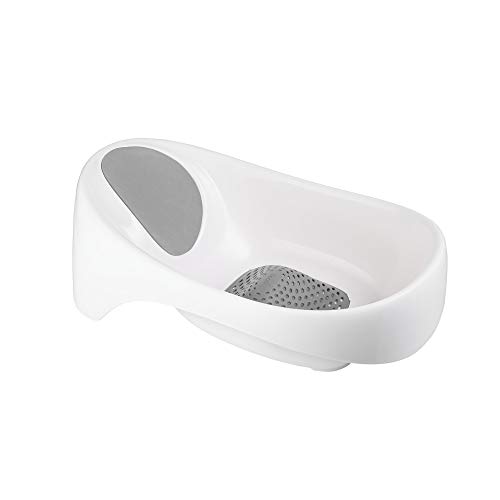
Boon Soak 3 Stage Baby Bathtub — Best Temperature Clue
The Boon Soak stages support inside a single moulded basin: an adjustable insert position supports newborns, then repositions as the baby grows through infant to toddler stages, with a stated range of 0 to 18 months and up. Its signature detail is the colour-changing drain plug, which gives a visual cue about water temperature. Treat it as a helpful hint alongside the classic inner-wrist or elbow check, never as a thermometer substitute.
Strengths
- Three support positions grow with the baby inside one basin
- Colour-changing drain plug gives an at-a-glance temperature cue
- Drain plug means emptying without tipping a heavy, water-filled tub
Trade-offs
- Stated range tops out around 18 months and up — large toddlers will be snug
- The plug is a cue, not a measurement; always test water temperature yourself
- Grey colourway only in this listing
| Detail | What the listing confirms |
|---|---|
| Stages | 3 support positions |
| Stated age range | 0 to 18 months and up |
| Feature | Colour-changing drain plug (per listing title) |
First-time parents worry most about two things: holding a slippery newborn and judging water temperature. The Soak speaks to both — staged support for the first, a visible temperature cue for the second. The drain plug also earns its place at the end of every bath, when a tub full of water is heavy and awkward to tip. It is a thoughtful middle option: more guided than a plain basin, less multi-part than a sling convertible.
Best for: first-time parents who want staged support plus a temperature cue / Not suited for: families needing a tub that folds away
Check the current price on Amazon

Ingenuity Tuckaway Toddler Folding Tub — Best for Toddlers in Showers
This is the only pick aimed at the stage the others graduate from: toddlers from a stated 12 months to 5 years. Its job is specific — it converts a shower into a tub, which solves the real problem in shower-only bathrooms where a toddler has outgrown a baby tub but is not ready for a full shower routine. It folds to store, needs no assembly, and travels well.
Strengths
- Stated 12 months to 5 years range covers the toddler years the baby tubs miss
- Converts a shower stall into a contained bath
- Folds to store and is portable for travel and grandparents’ houses
Trade-offs
- Not for newborns or young infants — it starts at a stated 12 months
- A toddler still needs the same constant supervision in any tub
- Shower floors vary; measure your stall before ordering
| Detail | What the listing confirms |
|---|---|
| Format | Folding toddler tub |
| Stated age range | 12 months to 5 years |
| Use | Converts shower to tub (per listing title) |
| Assembly | None required |
Families in shower-only homes usually improvise this stage with storage bins, which are the wrong shape, the wrong plastic and tippy. A purpose-built folding tub is the safer, calmer answer, and the wide stated age range means it covers the whole toddler period rather than a season. It is also the grandparent-house pick: folds flat in a cupboard, comes out for visits, and gives a toddler a familiar bath away from home.
Best for: shower-only bathrooms, travel and grandparents’ houses / Not suited for: newborns and young infants — choose a staged tub above instead
Check the current price on Amazon

Munchkin Inflatable Baby Bathtub — Best for Travel
Inflatable tubs exist for one reason: baths away from home. Hotel rooms, holiday rentals and relatives’ houses rarely offer a safe, right-sized bathing option for a baby in the stated 6 to 24 month range, and this Munchkin tub inflates inside a bath or shower to create one, then deflates flat into luggage. At home it doubles as a spare for garden paddling-style water play under supervision.
Strengths
- Packs nearly flat — the only truly luggage-friendly pick here
- Inflated walls are forgiving when a sitting baby topples sideways
- Works inside a hotel bath, a shower tray or on a bathroom floor
Trade-offs
- Stated range starts at 6 months — not a newborn tub
- Inflatables need checking for punctures and slow leaks before a trip
- Must be fully dried before packing away to avoid mildew
| Detail | What the listing confirms |
|---|---|
| Format | Inflatable travel tub |
| Stated age range | 6 to 24 months |
Judge this tub as travel equipment, not as your daily driver: inflation takes a few minutes, and a rigid tub is faster for the nightly routine. But on the road it turns an unfamiliar bathroom into a controlled, familiar bath, and babies bathe better in a small contained space than in a vast hotel tub. Rinse it, dry it thoroughly, and store it loosely folded; that routine is the difference between a tub that lasts several trips and one that smells by the second holiday.
Best for: travel, holidays and as a spare tub for visits / Not suited for: newborns, or as the only everyday tub at home
Check the current price on Amazon
Comparison Table
| Pick | Badge | Key spec | Best for |
|---|---|---|---|
| The First Years Newborn to Toddler Baby Bath Tub (3-in-1, Sure Comfort) | Best Overall | 3-in-1, removable sling, 0–24 months stated | most families wanting one tub from first bath to toddlerhood |
| Stokke Flexi Bath Bundle with Newborn Support | Best Premium | Foldable, newborn support included, birth–4 yrs stated | small bathrooms, shower-only homes and families planning siblings |
| OXO Tot Splash & Store Bathtub | Best for Small Bathrooms | Fold flat, infant–18 months stated | apartments and small bathrooms where the tub must vanish after use |
| Boon Soak 3 Stage Baby Bathtub | Best Temperature Clue | 3-stage, colour-changing drain plug | first-time parents who want staged support plus a temperature cue |
| Ingenuity Tuckaway Toddler Folding Tub | Best for Toddlers in Showers | Folding, shower conversion, 12M–5Y stated | shower-only bathrooms, travel and grandparents’ houses |
| Munchkin Inflatable Baby Bathtub | Best for Travel | Inflatable, 6–24 months stated | travel, holidays and as a spare tub for visits |
How to Choose the Best Bath Tubs for Babies and Toddlers
Match the tub to the stage you are in and the stage that is coming. Newborns need reclined support — a sling, an insert or a cradling narrow end — because they cannot sit or hold their heads steady. From roughly the point a baby sits independently, the requirement flips: an upright basin with room to sit, splash and play. Toddlers need containment and space more than support. A convertible or staged tub buys all three phases in one product; a single-stage tub is cheaper and simpler but has a planned retirement date.
Then be honest about your bathroom. A rigid convertible is wonderful if it can live in the bath or on a hook; it is a daily annoyance if it must be carried from a cupboard down the hall. Folding and inflatable designs exist precisely for small or shower-only homes. Measure the space the tub will actually be used in — inside your bath, inside your shower tray, or on the floor — because a tub that does not fit where you bathe is a return waiting to happen.
Finally, weigh the small features by how often they occur. A drain plug matters every single bath. A temperature cue matters most in the first months. A sling matters intensely for a few weeks and then never again. None of these features changes the non-negotiable rule of baby bathing: an adult stays within arm’s reach, always, and a tub is never a place to park a baby while you fetch a towel. Set up everything — towel, clothes, soap — before the water runs, and the best tub is simply the one whose shape suits your baby’s stage and your bathroom’s reality.
Baby Tub Safety and Water Basics, Without the Panic
Water depth for a baby bath is shallow — enough to keep the baby warm and let them kick, not enough to float them. Water temperature should feel warm, not hot, on the inside of your wrist or elbow; visual cues like the Boon Soak’s colour-changing plug are a helpful second opinion, never the only check. Babies lose heat quickly, so a warm room and a towel within reach matter as much as the water itself.
After every bath, empty the tub completely, rinse it, and dry it or stand it to drain. Tubs stored wet grow mildew in seams and folds — folding and inflatable tubs need the most discipline here. Never use a baby tub as a seat outside the bath, never carry a tub with the baby in it, and retire any tub with cracked plastic or a damaged support. These are plain habits, and they are the whole safety story: the right tub, shallow warm water, dry storage, and your hands and eyes on the baby from first splash to towel.
Where Should You Bathe the Baby? Tub Placement, Honestly Compared
The tub’s location shapes the whole routine. Inside the main bath is the classic setup: easy filling and draining, contained splashing, but you kneel on a hard floor at an awkward height — a folded towel under your knees is not a luxury. A shower stall suits the folding and shower-conversion picks, and is the only option in shower-only homes; keep the water shallow and the stall’s floor rinsed clean first. A kitchen counter or sink-height stand saves your back in the newborn weeks and demands the most discipline: everything within reach, no exceptions, and a clear, stable surface. The floor of a warm bathroom, with the tub on a large towel, is the underrated fourth option once a baby splashes seriously — the mess is contained by the towel and the baby is at the safest possible height. None of these is the “right” answer; the right answer is the location you can set up completely, every time, without carrying a wet baby through the house looking for the towel you forgot.
Bath Toys, Seats and Other Add-Ons: What Is Actually Needed
The bath-accessory market will try to sell you a second bathroom. Resist most of it. What genuinely earns its place: a soft kneeling pad or folded towel for the adult, a simple rinse cup, a hooded towel that keeps a wet baby warm in the transfer seconds, and a mesh bag so toys dry instead of stewing. Bath seats and rings deserve a specific caution: they are bathing aids, not safety devices, and babies have slipped in products that made adults feel the bath was “handled.” The rule does not change with accessories — an adult within arm’s reach, always. Temperature gadgets fall in the same honest category: useful cues, never substitutes for your wrist. Spend the accessory budget on the towel, the kneeler and the toy bag, and let the rest of the catalogue go.
Toys themselves matter more at the toddler stage than the newborn one: cups that pour, boats that float, anything that can be fully emptied and dried. Squeeze toys that trap water inside grow mould in the dark — cut them open at the first sign or choose solid toys from the start.
From Baby Tub to the Big Bath: Making the Transition
Children outgrow the baby tub by confidence before they outgrow it by size. The signs: sitting steadily, pulling to stand on the tub’s edge, treating the small basin as a climbing frame. The transition that works is gradual — the baby tub inside the big bath for a few sessions, so the room is new but the container is familiar; then the big bath itself with shallow water, a non-slip mat, and the same toys and routine. Keep the water shallower than your instinct suggests and the first big baths short; a toddler who loved the small tub can find the big one echoey and strange for a week. Siblings change the equation pleasantly: an older child in the big bath is the best advertisement for it, with the same supervision rules applied to both. When the baby tub retires, clean it, dry it fully and store it dry — folding and convertible tubs in good condition are exactly the hand-me-downs younger siblings and cousins actually use.
Newborn Bathing in the First Weeks: What Changes
The first baths are their own category. Until the cord stump has healed, many clinicians advise sponge baths rather than immersion — follow your own clinician’s guidance for your baby, because that advice is individual, not a product question. When immersion baths begin, they are short, warm and two-handed: one hand supporting head and shoulders at all times, the other washing, with the sling or support doing only the positioning work underneath. Newborns also lose heat fast, so the room, the towel and the prepared clothes matter as much as the tub. Frequency surprises new parents too: a newborn does not need a daily full bath, and over-bathing dries newborn skin — a few baths a week, with daily cleaning of face, neck folds and the nappy area, is the rhythm many paediatric sources describe. Ask your clinician what suits your baby.
This is the stage the staged tubs are designed around, and it is mercifully brief. Buy the tub for the whole first two years, but set up the newborn weeks with extra care: everything within reach, water tested twice, phone in another room. The confidence comes quickly — by the tenth bath the routine feels ordinary — and the tub that felt enormous around a newborn becomes the right size around a sitting six-month-old faster than anyone warns you.
Twins, Siblings and Bathing More Than One Child
Twins rewrite the tub calculation: bathe them one at a time in the baby stage, always — two newborns and one pair of hands is not a bathing plan, it is a juggling act with water. Sequential baths in the same tub of water are the practical pattern while both are small, with the second baby kept warm and supervised by another adult or safely in a bouncer within sight and reach rules your household sets conservatively. As twins become sitting toddlers, a larger basin or the main bath with two sets of hands becomes the shared-bath stage, and a wide tub like the Stokke earns its footprint. For siblings of different ages, the older child in the big bath and the baby in the tub beside it — or the baby tub inside the big bath — keeps both contained and both supervised by one adult who never has to choose where to stand.
The gear conclusion is simple: multi-child households should weight longevity and width higher than every other feature, because their tubs work double shifts for double years. A four-year stated range stops looking like marketing and starts looking like the specification it is.
Cleaning, Drying and Storing the Tub Itself
A baby tub is a hygiene product, and its own hygiene is a routine, not an event. After each bath: empty it fully, rinse away soap residue, and dry it or stand it where air reaches every surface. Weekly, wash it with mild soap and a soft cloth, paying attention to the places water sits — drain plugs, fold hinges, the underside of slings and supports. Slings and fabric supports should be washed and dried per their makers’ guidance, because damp fabric against a drain is where mildew starts. Never store a tub with water in it, never store a folding tub folded while damp, and keep inflatables loosely stored, fully dry, out of direct heat.
Retirement rules are equally plain: cracks, a damaged support or sling, a plug that no longer seals, or any mould that survives a proper clean ends a tub’s service — especially a tub destined for a younger sibling. Stored dry and clean, the good tubs in this guide hand down happily; stored wet, none of them do. Five minutes after each bath is the entire cost of the difference.
Sink Baths, Bath Seats and Other Alternatives, Assessed
New parents meet three alternatives to the baby tub and deserve straight assessments. Sink baths work in the first weeks in a scrupulously cleaned, generously sized sink, and stop working the moment the baby is bigger than the basin or the tap becomes a climbing target — a phase, not a system. Bath seats and supports promise hands-free bathing and must never be believed: they are positioning aids with a documented history of giving adults false confidence, and the supervision rule exists precisely because of them. Bathing with the baby — an adult in the big bath holding the baby — is lovely bonding and genuinely slippery logistics; if a household loves it, a second adult handing the baby in and out is the safe choreography. The standalone tub remains the default recommendation because it is the only option designed around one adult, one baby, shallow water and a controlled space, at every stage from sling to sitting. Alternatives have their moments; the tub has the years.
What Grandparents and Second Homes Actually Need
The second-location bath is its own brief: the tub lives in a cupboard, comes out for visits, and must work for a baby whose stage changes between trips. That brief favours exactly two designs from this guide — the folding Ingenuity, whose stated range runs from 12 months to 5 years and which turns any shower into a bath, and the inflatable Munchkin for the travelling family rather than the visited home. What grandparents should not do is resurrect a decades-old tub from the attic without inspection: plastic ages, supports perish, and a cracked or brittle tub is a false economy measured against a grandchild. Buy the folding tub once, store it dry, and the visit bath becomes a pleasure instead of an improvisation. The same logic serves holiday rentals and caravans, where the tub must travel, store flat and forgive unfamiliar bathrooms.
Bath Time as Routine: Building the Habit That Makes Tubs Work
The tub is equipment; the routine is the product. Babies bathe best inside a ritual: same time of day, same sequence, same songs if your household is that household — because a predictable bath is a calm bath, and a calm bath is where the safety habits live. Build the ritual around the tub’s staging: the newborn weeks are parent-led and quiet, the sitting months add pouring cups and naming games, the toddler stage adds “washing” their own arms and hair-wash negotiations that every parent recognises. Each stage uses the same tub differently, which is the deep reason convertible designs dominate this category: the object stays constant while the ritual grows up around it.
Evening baths earn their popularity honestly — warm water, a feed, a darkened room is a sleep cue a baby’s body learns — but the right time is the time the supervising adult is least rushed, whenever that is. A hurried bath is where corners get cut; a ritual bath is where they never occur to anyone. Choose the tub that fits the stage and the bathroom, then invest the real effort in the unhurried ten minutes around it. That is what the best bath tubs for babies and toddlers actually buy you: not the plastic, but the calm.
Choosing Between the Six: A Decision Walk-Through
Work the decision in the order real households face it. Question one: where will the baby actually be bathed? If the answer is a standard bath in a bathroom with storage, the convertible First Years is the default against which everything else must argue. If the answer is a small bathroom or a shower stall, the argument flips: folding designs stop being a compromise and become the point, and the Stokke bundle’s included newborn support makes it the complete version of that idea, while the OXO wins when the storage space is the tightest constraint of all. Question two: whose bath is it? First-time parents who want every cue available will feel the Boon Soak’s staged positions and temperature plug as genuine help; experienced parents on their second child usually reach for the simplest staged tub and their own judgement. Question three: what stage are you really buying for? A family adopting or fostering an older baby, or buying for a grandchild’s visits, should skip the newborn engineering entirely and take the Ingenuity’s toddler range. Question four: does this tub need to travel? Only the inflatable answers yes.
Notice what is not in the walk-through: colour, brand loyalty, and the contents of a gift registry compiled by someone else. Tubs are bathed in, knelt beside and stored daily; the right one is the one whose shape matches your bathroom and whose stages match your child. Answer the four questions honestly and the six picks sort themselves — which is, in the end, what a buying guide is for.
A Note on Second-Hand Tubs and Hand-Me-Downs
Baby tubs circulate through families like few other products, and mostly that is a virtue — a sound convertible tub on its second baby is money and plastic saved. The hand-me-down deserves the same inspection as any safety-adjacent product, though: flex the plastic for cracks and whitening stress marks, check the sling or support for perished fabric and secure attachment, run the drain plug through a fill test, and wash the whole tub thoroughly before its first bath in your home. Folding tubs need their hinges worked through their full travel; inflatables need a full inflation and an hour’s patience to prove they hold air. Anything that fails inspection is retired, not passed on — the rule that keeps the hand-me-down culture healthy. And one generational caution: very old tubs predate current design expectations for stability and supports, so age alone is a reason to choose the new folding tub instead. With those checks, the second-hand route is exactly how the long-range picks in this guide justify their build quality — they were made to be handed down, and a family that buys the Stokke or the First Years with a sibling or a cousin in mind is reading the category correctly.
How to Bathe a Baby in a Tub, Stage by Stage
Before the water: gather towel, washcloth, mild baby wash, a clean nappy and clothes, and lay them within arm’s reach of the tub. Fill and check: run shallow warm water and test it on your inner wrist or elbow — warm, never hot. Newborn stage: with the sling or support in place, lower the baby in feet-first, keeping one hand supporting the head and shoulders at all times; wash with the other hand, keeping the baby’s head above water throughout. Infant stage: once head control is steady, use the reclined basin position, still with a supporting arm behind the baby. Sitting stage: when your baby sits independently, move to the upright end of the tub, stay within arm’s reach, and let them splash — this is also when bath toys earn their keep. After: lift the baby straight onto the towel, drain the tub through its plug or by tipping, rinse, and stand or hang it to dry fully before storing. At every stage: if the doorbell rings or you need something from another room, the baby comes with you, wrapped in the towel. No exceptions, no thirty-second dashes.
Common Buying Mistakes
Buying for the newborn stage only. A beautiful newborn-only tub is outgrown in months. Unless storage and budget are unlimited, staged or convertible designs are the rational buy. Leaving a baby “just for a second.” The single most dangerous mistake in this category. Everything you need must be within reach before the bath starts. Trusting a temperature gadget alone. A colour-changing plug is a cue; your wrist is the check. Storing the tub wet. Mildew in folds and seams is the usual end of folding and inflatable tubs — dry storage is the fix. Ignoring your own bathroom’s shape. A tub that does not fit your bath or shower tray will not be used, however good it is. Using the tub as a seat or carrier. Baby tubs are for bathing, in water, with you there — not for sitting a baby in on the floor or carrying them around.
Final Recommendation
Most families should start with The First Years 3-in-1: one purchase, three stages, a stated two-year range. If your bathroom is small or shower-only, the Stokke Flexi Bath bundle folds away and lasts longest, while the OXO Tot folds flat for the tightest storage. First-time parents who want a temperature cue will like the Boon Soak. For the toddler years in a shower stall, the Ingenuity Tuckaway is the specialist pick, and the Munchkin inflatable is the travel answer. Check the current price on Amazon for the tub that fits your stage and your bathroom. Related reading: Best Infant Tubs, Best Baby Tubs For Girls, Best Bath Tubs For Four Year Olds and Best Hooded Towels For Babies.
Quick links to the top three picks: The First Years Newborn to Toddler Baby Bath Tub (3-in-1, Sure Comfort) · Stokke Flexi Bath Bundle with Newborn Support · OXO Tot Splash & Store Bathtub
Frequently Asked Questions
When should a baby move from a sling to sitting in the tub?
When they can sit independently and steadily — the sling supports babies who cannot yet do that. Use the maker’s stated stage guidance for your tub and your baby’s own development rather than a fixed age.
How long do babies use a baby tub?
The stated ranges here run from 18 months to a generous 4–5 years for toddler-specific designs. In practice, most children move to the main bath when they are steady sitters who want more room — the tub’s fit and your child’s size decide it.
Can I bathe a newborn in a folding tub?
Yes, if the tub provides newborn support — the Stokke bundle includes a newborn support for exactly this. A folding tub without any insert or cradling shape is an older-baby product.
How do I stop a baby tub going mouldy?
Empty, rinse and fully dry it after every use, and store it dry. Folds, hinges and inflatable seams need the most attention. A tub that stays wet between baths will mildew regardless of brand.
Is a temperature-changing plug accurate enough on its own?
No. It is a useful visual cue, but always confirm water temperature on the inside of your wrist or elbow before the baby goes in.
Can a toddler tub go in a shower stall?
That is exactly what the Ingenuity Tuckaway is designed for. Measure your shower tray first, keep the water shallow, and supervise exactly as you would in a bath.


