Disclosure: airfryerkitchensupply.com is reader-supported. When you buy through links on our site, we may earn an affiliate commission at no extra cost to you.
Where to buy
Lint is a construction problem before it is a laundry problem, so every towel below was chosen for a weave or fiber that resists shedding by design, then verified as a current listing. If you are searching for the best bath towels that don’t shed lint, start with the microfiber and waffle picks — they are structurally incapable of the fluff storm a cheap terry towel produces.
- JML Microfiber Bath Towel, 2 Pack, 30 x 60 — check price on Amazon
- POLYTE Waffle Microfiber Bath Towel, 430 GSM, 30 x 60, 4 Pack — check price on Amazon
- COTTON CRAFT Euro Spa Waffle Weave Bath Towels, Set of 4 — check price on Amazon
- Madison Park Zero Twist Cotton Bath Towels, 4 Piece — check price on Amazon
- COZYART Luxury Zero Twist Turkish Cotton Bath Towels, 4 Piece — check price on Amazon
- ecolook Microfiber Bath Towels, Set of 4, 31 x 63 — check price on Amazon
Few household annoyances are as petty and persistent as towel lint: the grey fuzz on the bathroom floor, the fibers on your skin after drying, the lint screen in the dryer packed like felt after every load. If you are looking for the best bath towels that don’t shed lint, the first thing to understand is that shedding is not random bad luck. It is the predictable behavior of short, loosely twisted cotton fibers in a high-pile terry weave — and it can be engineered away almost entirely by choosing a different construction.
There are three honest routes to a low-lint towel. Microfiber towels have no loose staple fibers to shed at all; the best of them are explicitly made and sold as lint-free. Waffle-weave towels trap their yarns in a tight grid that holds fibers in place, and quality cotton waffle is sold as low-lint for exactly that reason. And zero-twist cotton towels use untwisted yarns that, counterintuitively, shed less than cheap terry because the long-staple fibers are continuous rather than chopped and spun.
The six picks below cover all three routes, from explicitly lint-free microfiber to low-lint cotton waffle and premium zero-twist sets, with the laundry practices that keep any towel’s shedding at its minimum. Every pick was verified as a current listing; where a towel’s low-lint character comes from its listing’s own description, that is stated plainly.
Key Takeaways
- Lint comes from short, stressed cotton fibers; every real fix changes the fiber or the weave.
- Microfiber is the only structurally zero-shed route; waffle and zero-twist cotton cut shedding to background levels.
- Judge any towel at its third wash, never its first.
- Fabric softener makes both shedding and poor absorbency worse — skip it on all towels.
In this guide
Quick Picks
JML Microfiber Bath Towel, 2 Pack, 30 x 60 — Best Overall Lint-Free. The direct answer to the search: a full-size microfiber bath towel sold explicitly as lint free, with a hanging loop and fast-drying build in a 2 pack.
Check the current price on Amazon
POLYTE Waffle Microfiber Bath Towel, 430 GSM, 30 x 60, 4 Pack — Best Lint-Free Value Pack. Waffle texture plus microfiber plus a 4 pack: 430 GSM poly-blend towels, oversize at 30 x 60, sold as lint free — the economical way to re-towel a whole bathroom.
Check the current price on Amazon
COTTON CRAFT Euro Spa Waffle Weave Bath Towels, Set of 4 — Best Cotton Low-Lint. Proof that cotton can behave: a ringspun cotton waffle set of 4, oversized at 30 x 56, sold explicitly as low lint — the pick for people who want cotton and an end to the fuzz.
Check the current price on Amazon
Madison Park Zero Twist Cotton Bath Towels, 4 Piece — Best Zero-Twist Cotton. Zero-twist yarn is the quiet technology of low-shed cotton: untwisted long fibers that feel plush, dry fast, and release far less lint than hard-twisted terry — here at 500 GSM in a 4 piece set.
Check the current price on Amazon
COZYART Luxury Zero Twist Turkish Cotton Bath Towels, 4 Piece — Best Plush Low-Shed. The heavyweight: 650 GSM of zero-twist ring-spun Turkish cotton — the plushest towel here, using fiber quality and yarn design to keep a thick towel’s shedding under control.
Check the current price on Amazon
ecolook Microfiber Bath Towels, Set of 4, 31 x 63 — Best Extra-Large Lint-Free. The big-towel version of lint-free: 31 x 63 inches of microfiber in a set of 4 — bath-sheet coverage with microfiber’s zero-shed nature, for tall bathers and wrap-around coverage.
Check the current price on Amazon
How These Picks Were Chosen
Construction was the filter, not brand. We looked for towels whose low-shedding is structural: microfiber listings that state lint-free performance, waffle weaves whose grid construction locks fibers down, and zero-twist or low-twist cotton made from longer-staple yarn. Plush, high-pile terry from short-staple cotton — the worst shedder in the category — was excluded no matter how luxurious the listing sounded.
Each candidate was then verified against its exact listing, because towel names are generic and listings churn constantly; the towel linked here is the towel whose description supports the low-lint claim, not a similar-looking substitute. We also favored sets and sizes that work as a household’s main towels — full bath sizes, multi-packs — over novelty pieces.
Finally, we were honest about the trade-offs in print. Microfiber feels different from cotton, and some people never convert. Waffle dries fast and sheds little but feels less plush. Zero-twist cotton is the closest thing to a normal luxury towel that behaves. The reviews below tell you which compromise you are actually making with each pick, because a low-lint towel you hate touching is not a solution.
The 6 Best Bath Towels That Don’t Shed Lint

JML Microfiber Bath Towel, 2 Pack, 30 x 60 — Best Overall Lint-Free
JML’s microfiber towel is the pick for buyers whose lint problem is severe and whose patience is gone. Microfiber has no staple fibers to release — the material is a continuous synthetic filament — and this listing says “lint free” in plain words, at a full 30 x 60 bath size with a hanging loop for the fast drying microfiber needs. The 2 pack makes it easy to trial the microfiber feel before committing the whole linen closet.
Strengths
- Explicitly lint-free construction — the strongest anti-shedding claim on this list
- Full bath size at 30 x 60, not a travel-towel compromise
- Dries fast and packs light, suiting gyms, travel, and small bathrooms
Trade-offs
- Microfiber’s feel is smooth rather than plush; committed cotton lovers may not convert
- Microfiber should be washed separately from cotton, which will lint onto it
- Absorbency works by wicking and pressing rather than the rub-and-soak of terry
| Size | 30 x 60 in |
| Material | Microfiber |
| Pack | 2 towels |
| Feature | Hanging loop, lint free per listing |
Understand what you are trading and this towel is easy to love. It will never felt your dryer screen, never dust your shoulders, and never leave the bathroom floor fuzzy. In exchange it asks you to dry by pressing and patting rather than scrubbing, and to keep it out of the cotton wash where other garments’ lint will migrate onto it. Households that make that small adjustment routinely end up converting the whole closet.
The hanging loop is a small feature with outsized value in humid bathrooms: microfiber dries fastest with airflow, and a loop on a hook beats a folded drape over a bar every time.
Best for: anyone whose lint problem is the priority, plus gym and travel use / Not suited for: bathers devoted to the plush terry feel

POLYTE Waffle Microfiber Bath Towel, 430 GSM, 30 x 60, 4 Pack — Best Lint-Free Value Pack
POLYTE combines the two best anti-lint ideas — microfiber filament and a waffle weave — in a 430 GSM towel that has more body than most microfiber, and sells it in a 4 pack sized for real bathrooms. If the JML is the trial, this is the commitment: enough towels to retire the shedding set entirely, which matters, because one linting towel in a load re-lints everything it touches.
Strengths
- Microfiber waffle construction is doubly resistant to shedding
- 430 GSM gives more substance than typical flat microfiber towels
- 4 pack lets you replace a whole household set at once
Trade-offs
- 85/15 polyester-polyamide blend is fully synthetic; no cotton feel at all
- Waffle microfiber needs separate washing from cotton to stay lint-free
- Thicker microfiber takes longer to dry than the lightest travel towels
| Size | 30 x 60 in |
| Material | Microfiber poly blend, 85/15 |
| Weight | 430 GSM (per listing) |
| Pack | 4 towels |
The waffle grid does real work here: it adds surface area for faster drying, gives the towel grip and structure in the hand, and keeps the microfiber from feeling like a flat sheet. For families converting a whole bathroom, the 4 pack arithmetic plus genuine lint-free performance is the strongest value case on this list.
Wash these together as their own load, warm water, no fabric softener — softener coats microfiber and kills the absorbency that justifies it. Cared for that way, they hold performance far longer than the cotton towels they replace.
Best for: households replacing a whole shedding towel set at once / Not suited for: buyers who want any natural fiber in their towels

COTTON CRAFT Euro Spa Waffle Weave Bath Towels, Set of 4 — Best Cotton Low-Lint
If microfiber is a step too far, this is your towel. COTTON CRAFT’s Euro Spa set is 100% ringspun cotton — ringspun yarns are smoother and stronger than ordinary open-end cotton — woven in a waffle that locks the fibers into a grid. The listing states low lint outright, and the 30 x 56 size is a true bath towel, in a set of four white towels with a spa-clean look.
Strengths
- Real cotton feel with a stated low-lint waffle construction
- Ringspun cotton is smoother and more durable than basic cotton yarn
- Oversized 30 x 56 in a coordinated set of 4
Trade-offs
- Low lint is not zero lint; the first few washes will still release some fiber
- White shows everything and asks for occasional brightening
- Waffle feels textured rather than plush against the skin
| Size | 30 x 56 in |
| Material | 100% ringspun cotton |
| Weave | Waffle |
| Pack | Set of 4 |
Waffle cotton is how European spas solved this problem decades ago: the weave dries fast, packs flat, and holds its fibers. The first-wash honesty matters — even low-lint cotton sheds a little early as loose surface fiber clears — but by the third wash the difference from a terry towel is unmistakable, in the dryer screen and on the floor.
White is the practical color here despite appearances: it tolerates hot washes and brightening that keep spa towels looking like spa towels, and any lint that does appear is at least the same color as the towel.
Best for: cotton loyalists who want shedding cut to a minimum / Not suited for: anyone demanding literally zero lint from day one

Madison Park Zero Twist Cotton Bath Towels, 4 Piece — Best Zero-Twist Cotton
Madison Park’s zero-twist set is the closest thing on this list to a conventional luxury towel that behaves. Zero-twist construction spins the yarn without twisting it, so the fibers lie open and soft instead of being chopped and torqued — and open, continuous fibers both absorb faster and shed less. At 500 GSM with a diagonal ribbed finish, in a warm beige, it looks like a normal premium towel because it is one.
Strengths
- Zero-twist cotton sheds notably less than standard terry while feeling plush
- 500 GSM is a substantial, hotel-like weight
- Quick drying for a cotton towel, thanks to the open yarn structure
Trade-offs
- Still cotton: expect a small amount of early-wash lint before it settles
- Beige is the shown colorway; check the range if your bathroom is grey or white
- Premium construction sits at a mid-to-upper tier within this list
| Size | 30 x 56 in |
| Material | 100% zero-twist cotton |
| Weight | 500 GSM (per listing) |
| Pack | 4 piece |
The mechanism deserves a sentence of understanding: ordinary terry yarn is twisted hard, which stresses and shortens fibers, and those shortened fibers are exactly what becomes lint. Zero-twist yarn skips the stress, so the fibers stay long, stay in the towel, and present more open surface to water. It is the rare case where the softer technology is also the cleaner one.
For households that tried microfiber and bounced off the feel, this is the landing spot — a towel that feels like the towels you already love and simply stops redecorating your bathroom floor.
Best for: buyers who want a normal luxury towel that sheds far less / Not suited for: zero-tolerance lint households (choose microfiber instead)

COZYART Luxury Zero Twist Turkish Cotton Bath Towels, 4 Piece — Best Plush Low-Shed
COZYART’s set answers the obvious objection to this whole category: “but I like a thick towel.” At 650 GSM it is genuinely plush, and it keeps shedding down the honest way — zero-twist, ring-spun, Turkish cotton, where long fibers and gentle yarn construction do the work that a cheap thick towel’s chopped fibers cannot. White, 27 x 54, four pieces: a primary-bathroom set.
Strengths
- 650 GSM plushness with low-shed yarn technology
- Ring-spun Turkish cotton is the premium end of cotton fiber
- Zero-twist structure keeps it quick-drying for its weight
Trade-offs
- A thick towel still sheds more than microfiber, especially early — low, not zero
- 27 x 54 is a standard rather than oversize cut
- Heavy towels take the longest dryer time on this list
| Size | 27 x 54 in |
| Material | Zero-twist ring-spun Turkish cotton |
| Weight | 650 GSM (per listing) |
| Pack | 4 piece |
Fiber length is destiny in cotton towels. Turkish cotton’s long staples, ring-spun for smoothness and left untwisted for softness, produce a pile whose fibers are anchored along their length instead of snapping into lint. The first two washes will still clear some surface fiber — wash them separately and do not panic — after which this set settles into the low-shed behavior its construction promises.
Skip fabric softener entirely with this set. Softener coats long cotton fibers, reducing both absorbency and the natural fiber cohesion that keeps shedding down; vinegar in the rinse is the experienced owner’s substitute.
Best for: primary bathrooms that refuse to give up plush / Not suited for: anyone wanting the absolute minimum lint regardless of feel
ecolook Microfiber Bath Towels, Set of 4, 31 x 63 — Best Extra-Large Lint-Free
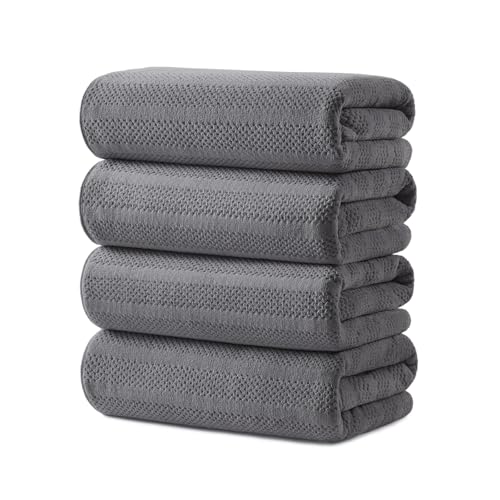
Most microfiber bath towels top out at standard sizes, which leaves tall bathers and anyone who wraps a towel around themselves short of coverage. ecolook’s set stretches to 31 x 63 — bath-sheet territory — in a set of four grey towels that work from bathroom to gym to pool. The lint logic is the same as the JML: continuous synthetic filament has nothing to shed.
Strengths
- Extra-large 31 x 63 size is rare in microfiber
- Set of 4 covers a household or a heavy rotation
- Lightweight and quick-drying despite the size
Trade-offs
- Large microfiber takes drawer and machine space to match its coverage
- Fully synthetic feel, like all microfiber picks
- Grey is the shown color; check the range for your bathroom
| Size | 31 x 63 in |
| Material | Microfiber |
| Pack | Set of 4 |
| Color shown | Gray |
Size is this pick’s whole argument, and it is a good one: the most common complaint about switching to microfiber is that the towels feel skimpy, and at 31 x 63 that complaint evaporates. Wrap coverage, hair-towel duty, a poolside sheet — the extra inches convert microfiber from a compromise into a preference for many households.
Because they are large and synthetic, wash these as their own load and dry on medium. They will come out ready in a fraction of a cotton load’s time, which quietly becomes one of the pleasures of the microfiber switch: laundry day gets shorter.
Best for: tall bathers and anyone who wants bath-sheet coverage without lint / Not suited for: small bathrooms with minimal towel storage
Comparison Table
The anti-lint strategies divide the table: microfiber (structurally lint-free), waffle cotton (fibers locked in a grid), and zero-twist cotton (long fibers, gently handled). Choose your strategy first, then your towel.
| Pick | Badge | Key spec | Best for |
|---|---|---|---|
| JML Microfiber Bath Towel, 2 Pack, 30 x 60 | Best Overall Lint-Free | 30 x 60 in microfiber, lint free per listing | anyone whose lint problem is the priority, plus gym and travel use |
| POLYTE Waffle Microfiber Bath Towel, 430 GSM, 30 x 60, 4 Pack | Best Lint-Free Value Pack | 430 GSM waffle microfiber, 4 pack, lint free | households replacing a whole shedding towel set at once |
| COTTON CRAFT Euro Spa Waffle Weave Bath Towels, Set of 4 | Best Cotton Low-Lint | 100% ringspun cotton waffle, low lint per listing | cotton loyalists who want shedding cut to a minimum |
| Madison Park Zero Twist Cotton Bath Towels, 4 Piece | Best Zero-Twist Cotton | Zero-twist cotton, 500 GSM, 30 x 56 | buyers who want a normal luxury towel that sheds far less |
| COZYART Luxury Zero Twist Turkish Cotton Bath Towels, 4 Piece | Best Plush Low-Shed | 650 GSM zero-twist Turkish cotton, 27 x 54 | primary bathrooms that refuse to give up plush |
| ecolook Microfiber Bath Towels, Set of 4, 31 x 63 | Best Extra-Large Lint-Free | 31 x 63 in microfiber, set of 4 | tall bathers and anyone who wants bath-sheet coverage without lint |
How to Choose Bath Towels That Don’t Shed Lint
Understand where lint actually comes from
Lint is fiber that was never securely part of the towel: short cotton staples, stressed by hard yarn twisting and cut pile loops, working loose with friction and water. Every anti-lint strategy attacks that chain somewhere. Microfiber removes the staple fiber entirely. Waffle weaves lock yarns into a grid so fibers cannot migrate. Zero-twist and ring-spun yarns keep fibers long and unstressed so they stay anchored. When a listing claims low lint, ask which of those mechanisms it is using — if the answer is none of them, the claim is decoration.
Match the strategy to your tolerance
If lint has made you genuinely angry — black clothes dusted, a baby crawling through fuzz, a dryer screen like a felt pad — go microfiber and accept the different feel; it is the only structurally zero-shed option. If you want the problem reduced to background levels while keeping a cotton towel, waffle and zero-twist both deliver, with zero-twist feeling most like the plush towel you are replacing. Many households end up mixed: microfiber for the gym and guest bath, zero-twist cotton for the primary bath.
Size and GSM still matter after lint
A low-lint towel in the wrong size is still the wrong towel. Standard bath towels run 27 x 54 to 30 x 56; bath sheets start around 30 x 60 and give wrap coverage. GSM describes cotton weight: 400-500 is quick-drying and moderate, 600-plus is plush and slow. Microfiber plays by different rules — its GSM runs lower for the same absorbency — so compare microfiber to microfiber, not to cotton numbers.
The First Three Washes Decide Everything
Even the best low-lint towel sheds some surface fiber in its first washes, and how you handle those washes decides whether it settles or keeps shedding. Wash new towels separately — never with the household load they would dust — in warm water with no fabric softener, which coats fibers and loosens the pile’s grip. A cup of white vinegar in the first rinse helps strip the factory finish that makes new towels shed and repel water at the same time. Dry with a clean lint screen, and judge any towel on its third wash, not its first: by then, an honest low-lint towel has cleared its loose fiber and settled into its real behavior.
Why Expensive Towels Shed and Cheap Ones Sometimes Don’t
Price and shedding correlate weakly, and understanding why saves money. A costly towel made from short-staple cotton, spun hard and piled high for shelf softness, will shed impressively despite its tag — the luxury was engineered into the hand-feel, not the fiber. A modest microfiber or waffle towel, built from continuous filament or locked yarns, sheds almost nothing because its construction leaves nothing loose to shed. The fiber’s staple length and the yarn’s treatment are the destiny; everything else is styling.
This is also why the famous “hotel towel” experience misleads home buyers. Hotels use mid-weight, tightly constructed towels and launder them industrially — hot, harsh, and often — which strips loose fiber fast and keeps the survivors performing. A home buyer copying the hotel towel’s look without its fiber quality or laundry regime gets the shedding without the system that managed it. Buy the construction, not the aesthetic.
The practical test when a listing tempts you: find the fiber and weave words. “Ringspun,” “zero-twist,” “long-staple,” “waffle,” and “microfiber” are mechanisms. “Ultra-plush,” “spa-like,” and “cloud soft” are moods. Moods shed; mechanisms behave. The picks in this guide were chosen by mechanism first, and their reviews say which mechanism each one uses so you can shop the logic, not just the list.
Matching Towel Strategy to Household Reality
A household with a baby, a black wardrobe, and white towels has a different lint equation than a household of two adults in grey. Lint is most visible — and most maddening — when it contrasts: dark towels on light skin and floors, light towels against dark clothes. One underused tactic is simply choosing towel colors close to the household’s dominant clothing and flooring tones, so the small amount of lint any cotton towel releases becomes invisible rather than eliminated. Pair that with a low-shed construction and the problem effectively disappears from daily life.
Volume matters too. A guest bathroom used twice a month can keep a plush zero-twist set looking perfect for years, while the primary bathroom’s daily rotation punishes any towel. Put your most lint-proof towels — microfiber or waffle — in the highest-traffic bathroom and the plush cotton in the guest room, and each towel is doing the job its construction suits. Households that assign towels by traffic, rather than buying one set for everywhere, consistently report the lint problem “just stopped.”
Finally, count the dryer as part of the system. A household that line-dries will see more residual lint on towels than one that tumble-dries, because the dryer’s lint screen is the final extraction step. If you line-dry, a brief low-heat tumble after washing — even ten minutes — performs that extraction and is the single easiest upgrade to a low-lint routine.
When to Retire a Towel That Won’t Stop Shedding
Some towels never settle, and knowing when to stop negotiating with them is a skill. The fair trial is three to five washes by the rules in this guide: separate load, no softener, vinegar early, medium dryer heat, clean screen. A towel whose lint output is clearly falling across those washes is breaking in normally. A towel still producing a full felt pad at wash five has a construction problem — short fibers throughout its pile — and no laundry technique will fix what is woven into it.
Demote rather than discard. A chronic shedder still works as a car towel, a pet towel, a gym-bag towel, or a cleaning cloth — roles where lint is irrelevant. What it should not do is stay in the primary rotation dusting every surface it touches and shedding onto its well-behaved shelf-mates in every shared load. One bad towel in a load re-lints the good ones, which is why households often believe “all towels shed” when only one does.
Replace with intent: buy one towel from this list first, run it through the three-wash trial, and confirm the behavior in your own machines before committing to a set. Laundry chemistry varies by household — water hardness, detergent, dryer temperament — and a single-towel trial is the cheapest possible certainty. Then replace the rotation in one move, because a clean break is what finally empties the lint screen.
Building the Low-Lint Linen Closet: A Practical Plan
Knowing the right towels is half the project; converting a household is the other half, and it goes best in a deliberate sequence. Week one: buy a single trial towel from this list in the strategy you favor — microfiber for certainty, waffle or zero-twist for cotton loyalty — and run it through the three-wash trial in your own machines. Your water, detergent, and dryer are the laboratory; a towel that behaves there will behave at scale. Week two: if the trial passes, order the full rotation for the highest-traffic bathroom first, because that is where the lint is generated and where the victory will be visible.
Size the rotation honestly. A towel needs a day to dry fully between uses in most bathrooms, so the working minimum is two per person in daily rotation plus a guest reserve; households that try to run on one towel per person end up reusing damp towels, which mildew — and mildew, unlike lint, cannot be fixed by construction. Retire the old shedders in the same move, demoting them to car, pet, and cleaning duty as the retirement section advised, so the new towels never share a load with a lint factory.
Then lock in the laundry rules as household policy, ideally on a small card in the laundry area: towels with towels, microfiber separate from cotton, no softener ever, medium dryer heat, screen cleaned every load. Policies survive because they are written and simple; intentions fade by the third week. Within a month, the evidence accumulates in the pleasant direction — a lint screen holding a whisper of fiber, dark clothes emerging clean, a bathroom floor that stays swept-looking between cleanings.
The total cost of the conversion is a set of towels and a card on the wall. The return is the permanent end of a daily petty annoyance, which is a trade any household should take — and the reason this category, unglamorous as it sounds, generates some of the most grateful mail in home goods.
Lint Beyond the Bathroom: What Your Towel Choice Fixes Elsewhere
Towel lint does not stay in the bathroom, and ending it pays dividends in rooms this guide has not yet visited. The laundry room is the first beneficiary: a dryer that stops producing felt pads of towel fiber runs more efficiently, dries faster, and — the serious point — accumulates less of the material that makes dryer vent maintenance a fire-safety chore rather than a suggestion. Households that convert to low-lint towels routinely find their vent-cleaning intervals stretching, because the largest lint source in the home has been engineered down at the origin.
The wardrobe is the second beneficiary. Dark clothing washed or dried after towels inherits their lint, and the lint-roller ritual before leaving the house is, for many people, a towel problem wearing a clothing costume. Break the cycle at the towel and the rollers retire. The third beneficiary is anyone in the home with a dust sensitivity: shed towel fiber becomes household dust, and household dust is the reservoir that cleaning temporarily relocates. Fewer fibers shed means less dust generated at the source — the same source-control logic this guide applied to air purifiers’ cousins in the linen closet.
None of these dividends requires believing towels are a grand topic. They require only noticing that a towel is used twice a day, washed weekly, and owned for years — a leverage point disguised as a commodity. Choosing its construction deliberately, once, is among the highest-return small decisions in the running of a home.
Towels for Guests, Gyms, and Travel: Extending the System
Once the primary bathroom is converted, the low-lint logic extends naturally to the towels that live elsewhere. Guest towels are judged in a single use, and a waffle or zero-twist set gives guests the two signals that matter — the towel feels considered, and it leaves nothing on their dark clothes in the morning. Gym towels are microfiber’s home turf: they pack small, dry between sessions, and never dust the inside of a gym bag with fiber, which is why the JML and ecolook picks list gym and travel among their stated uses rather than as afterthoughts.
Travel deserves its own sentence because it is where lint hides best: a shedding towel in a suitcase distributes its fiber across every packed garment, and the damage is discovered at the destination. A microfiber towel in the luggage ends that entirely, at a fraction of the packed volume of cotton. Households that travel often end up with a dedicated travel pair living in the suitcase, and the primary-bathroom conversion usually starts, in hindsight, with that pair proving the concept on the road.
How to Wash Towels So They Stop Shedding
If your current towels shed, this routine will cut it dramatically; if you are breaking in a low-lint set from this list, it will get them to their best behavior fastest.
- Sort ruthlessly: towels wash with towels only, and microfiber never washes with cotton — cotton lint migrates onto microfiber and makes a lint-free towel look like a liar.
- Wash warm with a moderate amount of detergent. Excess detergent leaves residue that stiffens fibers and increases friction shedding; more soap is not more clean.
- Add white vinegar to the rinse for the first few washes of any new towel. It strips factory finishes and loose dye, the two main sources of early shedding and poor absorbency.
- Never use fabric softener or dryer sheets on towels. They coat fibers, which reduces absorbency and weakens the fiber anchoring that keeps lint in the towel.
- Clean the dryer lint screen every load and dry on medium heat. Overheating bakes cotton fibers brittle, and brittle fibers break — and broken fibers are tomorrow’s lint.
Follow this for a month and audit the evidence: the lint screen should hold a fraction of what it used to, and dark clothes dried after a shower should come away clean. If one towel in the set still sheds heavily while its siblings behave, it is a defective towel, not a failed strategy — replace that one.
Common Buying Mistakes
Judging a towel by its first wash
Every cotton towel sheds some loose fiber initially. Condemning a low-lint set after one wash — or praising a cheap terry towel that was pre-washed for the shelf — gets the verdict exactly backwards. Third wash is the honest test.
Using fabric softener to make towels “nice”
Softener is a coating, and coated towels absorb worse and shed more. It is the single most common self-inflicted cause of both problems this article exists to solve.
Washing microfiber with cotton
The cotton sheds, the microfiber collects, and the owner concludes microfiber lints too. Separate loads keep each material’s behavior honest.
Buying plush short-staple terry and hoping
The thickest, softest-feeling budget towel is usually the worst shedder, because its pile is made of short fibers loosely held. Plush and low-lint only coexist at quality fiber lengths, as in the zero-twist picks here.
Overloading the dryer
Crowded towels abrade each other for an extended cycle, generating the very lint you are trying to avoid. Half loads dry faster and shed less.
Final Recommendation
If lint is the enemy and feel is negotiable, buy the JML or the POLYTE 4 pack and end the problem structurally. If you want cotton that behaves, the COTTON CRAFT waffle is the classic answer, and the two zero-twist sets — Madison Park for balanced weight, COZYART for full plush — are the towels for people who refuse to compromise on feel. The ecolook set covers the tall and the wrap-minded with lint-free microfiber at bath-sheet size.
Whichever route you take, run the first three washes by the rules above. Construction chooses your towel’s potential; laundry decides whether you get it.
Start your shortlist here: JML Microfiber Bath Towel, 2 Pack, 30 x 60 · POLYTE Waffle Microfiber Bath Towel, 430 GSM, 30 x 60, 4 Pack · COTTON CRAFT Euro Spa Waffle Weave Bath Towels, Set of 4
Keep exploring the same cluster: Best Bath Towels Best Bath Towel Sets Best Waffle Weave Towels Best Microfiber Towels Best Bath Sheets
Related guides
Frequently Asked Questions
Do microfiber towels really shed zero lint?
Essentially yes. Microfiber is a continuous synthetic filament, so there are no short staple fibers to work loose. The lint people sometimes see on microfiber arrived from other garments in a mixed wash — wash microfiber separately and it stays clean.
Why do my new cotton towels shed so much at first?
Loose surface fiber from manufacturing clears in the first few washes. Wash new towels separately, skip softener, add vinegar to the first rinse, and judge shedding at the third wash. Quality low-lint cotton settles sharply by then.
What weave sheds the least in cotton?
Waffle weave, because its grid locks yarns in place, and zero-twist terry, because its fibers are long and unstressed. Standard high-pile terry from short-staple cotton sheds the most.
Does fabric softener make shedding worse?
Yes. Softener coats fibers, reducing absorbency and weakening the pile’s hold on its own fibers. It is the most common avoidable cause of both lint and towels that push water around instead of absorbing it.
Are zero-twist towels as absorbent as regular towels?
More so, at first contact: untwisted yarns present open fiber surface that takes up water immediately. They also dry faster than hard-twisted terry of the same weight.
How long should a low-lint towel stay low-lint?
With sane laundry — no softener, medium dryer heat, sorted loads — the picks here should hold their behavior for years. Rising lint over time usually traces to overheated drying making cotton fibers brittle, not to the towel wearing out.
Do dark towels show lint more than white ones?
Dark towels show light lint; white towels show everything else. The worst combination is a dark, short-staple terry towel. If your bathroom is dark-toned, the grey microfiber picks here minimize both shedding and its visibility.
Can vinegar really reduce towel shedding?
In the first washes, yes — it helps strip the factory finishes and loose dye that bind surface fibers loosely, so they clear in the wash instead of on your floor. It is a break-in aid, not a permanent treatment, and it also improves new-towel absorbency.
Why is there still lint in my dryer screen with low-lint towels?
Some lint is normal forever — towels abrade slightly in every cycle, and other loads contribute. Judge by trend and volume: a thin film after a towel load is success; a thick felt pad is a towel telling you it does not belong in the rotation.
Do low-lint towels need special detergent?
No special detergent is required — an ordinary quality detergent at a moderate dose is correct, and overdosing is itself a shedding contributor because residue stiffens fibers. The rules that matter are sorting, no fabric softener, medium dryer heat, and a clean lint screen, all of which cost nothing.
How do I test a towel’s lint before buying a whole set?
Buy one towel and run the three-wash trial from this guide: wash it separately, dry it alone, and inspect both the lint screen and a dark garment dried with it on the third cycle. One towel and three washes tell you the truth about the entire set, because shedding is a construction trait, not a per-towel lottery.
Should I wash new low-lint towels before first use?
Yes — always. The first wash removes factory finishes that block absorbency and releases the loose surface fiber every new towel carries. A towel used unwashed will feel oddly waterproof and shed its break-in lint onto you instead of into the wash, which is the worst possible first impression for a good towel.


