Disclosure: airfryerkitchensupply.com is reader-supported. When you buy through links on our site, we may earn an affiliate commission at no extra cost to you.
Where to buy
Every grill in this guide to the best barbecue grills under 200 dollars was confirmed against a live Amazon listing before being shortlisted, so each link opens the exact model reviewed. Prices in this tier move constantly with promotions, so check the current price on Amazon for each pick — a model that lives in the under-$200 tier can drift above it between sales, and the check takes seconds.
- Charbroil Classic 2-Burner Propane Gas Grill — Check the current price on Amazon
- Megamaster Deluxe 2 Burner Gas Grill — Check the current price on Amazon
- Nexgrill Deluxe 2-Burner Gas Grill — Check the current price on Amazon
- Royal Gourmet GT1001 Stainless Portable Propane Gas Grill — Check the current price on Amazon
- Cuisinart Grillster Portable Gas Grill CGG-059A — Check the current price on Amazon
- Kenmore 2-Burner Portable Gas Grill Tabletop — Check the current price on Amazon
Introduction: The Honest Truth About Grills Under $200
Let us start with the fact most roundups bury: the best barbecue grills under 200 dollars are compact and portable grills, not full-size patio cabinets. Under $200, the propane market gives you well-chosen two-burner cart grills and a strong field of tabletop portables — and it does not give you a four-burner cabinet grill with cast-iron everything, no matter what a headline promises. Full-size grills that appear at this price are built down to it in ways that show within a season. The six picks in this guide are the models that spend the under-$200 budget wisely: on burners that light reliably, grates that cook properly, and frames that survive being moved, stored, and used.
It also helps to say who this tier is not for, right up front. If you regularly cook for eight or more, if you want to smoke brisket for fourteen hours, or if you expect a grill to serve a decade as patio furniture and appliance in one, the under-$200 tier will frustrate you no matter which model you choose — and the under-$500 guide in this cluster is where your search should live. Matching the tier to the life is the whole game.
That framing is good news, not a warning. A compact two-burner or a good tabletop is the right grill for a large share of households — couples, small families, apartment and condo balconies where gas is permitted, campers, tailgaters, and anyone whose grilling happens in more places than their own yard. These grills preheat fast, sip propane, store in a corner, and cook the weeknight repertoire — burgers, chicken, sausages, vegetables, skewers — without apology. What they ask in return is honest expectations about capacity and longevity, which the reviews below state plainly for each pick.
Every model here was verified against a current Amazon listing, and each one genuinely lives in the under-$200 tier. We also flag, per pick, where the manufacturer saved money — because at this price, knowing what you traded away is the difference between a smart budget purchase and a disappointing one.
In this guide
Quick Picks
- Best Overall Under $200 — Charbroil Classic 2-Burner Propane Gas Grill: 280 square inches, 20,000 BTU, porcelain-coated grates, and side shelves in a compact standing cart — the most complete home grill in the tier. Check the current price on Amazon
- Best Cart-Style Value — Megamaster Deluxe 2 Burner Gas Grill: 418 square inches of total cooking space, cast-iron grates, foldable shelves, and a built-in thermometer — the biggest spec sheet in the tier. Check the current price on Amazon
- Best with Warming Rack — Nexgrill Deluxe 2-Burner Gas Grill: 401 square inches including a warming rack, foldable shelves, and tool hooks — thoughtful extras at a budget price. Check the current price on Amazon
- Best Tabletop — Royal Gourmet GT1001 Stainless Portable Propane Gas Grill: a 10,000 BTU stainless tabletop with folding legs, a lockable lid, and 285 square inches for camping and tailgating. Check the current price on Amazon
- Best Ultra-Portable — Cuisinart Grillster Portable Gas Grill: 146 square inches, an 8,000 BTU burner that reaches 600°F, and a dishwasher-safe grate in a grill weighing about 13 pounds. Check the current price on Amazon
- Best for Camping — Kenmore 2-Burner Portable Gas Grill Tabletop: two stainless burners, a warming rack, foldable legs, and compatibility with both 5 lb and 20 lb tanks — the base-camp pick. Check the current price on Amazon
How These Picks Were Chosen
We verified the under-$200 propane field, confirming that each candidate is a real, current listing that genuinely belongs to this price tier, then scored the field on what matters when the budget is fixed. Ignition reliability came first — a budget grill whose igniter fails becomes a match-light grill, and match-light is where cheap grills go to be hated. Burner and grate materials followed: stainless burners and cast-iron or heavy coated grates scored highest, because at this price the cooking components are where smart manufacturers concentrate their limited dollars.
We also scored honest capacity — primary cooking area, not marketing totals — and the practicalities of small-grill life: does it fold, roll, or carry easily; does the lid lock for transport; can it run on a full-size tank as well as 1-pound cylinders; and are replacement parts available from a real brand ecosystem? Charbroil, Nexgrill, Royal Gourmet, Cuisinart, and Kenmore all maintain parts channels, which matters enormously in a tier where a single failed burner can otherwise total the grill.
One more screening note: this tier is full of no-name grills with impressive renders and no parts support, and we excluded them even when their spec sheets looked competitive. In the under-$200 world, the brand behind the grill is a functional feature — it is the difference between ordering a replacement igniter for a few dollars and replacing the whole grill in year two. Every pick here comes from a manufacturer with a real catalog, a real manual, and a real parts channel.
Finally, we deliberately mixed formats — two standing carts, one cart with a warming rack, and three tabletops of descending size — because “under $200” shoppers are really shopping for three different lives: a small home patio, a campsite, and a balcony or tailgate. Each pick below is the strongest verified answer for its format.
The 6 Best Barbecue Grills Under 200 Dollars

Charbroil Classic 2-Burner Propane Gas Grill — Best Overall Under $200
The Classic 2-Burner is the under-$200 grill that feels most like a “real” home grill: a standing cart with 280 square inches of cooking area, 20,000 BTU across two burners, porcelain-coated grates, and side shelves for your plate and tongs. It suits the small household that wants to grill at home — on a patio, deck, or permitted balcony — without paying for capacity it will never use or wrestling a portable onto a table every time.
Strengths
- Proper standing format with shelves and a compact footprint — a home grill, not a camping accessory pressed into home service.
- Two burners allow a basic two-zone setup: sear on one side, finish on the other with the heat low or off.
- Charbroil’s parts ecosystem means igniters, grates, and burners are findable and inexpensive years later.
Trade-offs
- Porcelain-coated steel grates are lighter than cast iron — adequate searing, faster heat loss when the lid opens.
- 280 square inches feeds two to four; bigger groups cook in batches.
- Budget-tier lid and firebox steel lose heat in wind; a sheltered spot and a cover are part of the deal.
Mini spec box: 2 burners · 20,000 BTU · 280 sq. in. cooking area · porcelain-coated grates · side shelves.
In everyday use the Classic 2-Burner covers the repertoire that matters: weeknight chicken, burgers for four, a tray of vegetables on the gentle side while sausages crisp on the hot side. It lights reliably, heats in about ten minutes, and rolls aside for storage or cleaning. Manage expectations on longevity — with a cover and basic care, expect solid seasons rather than a decade — and it is the most satisfying way to spend this budget on a home grill. It is also, not incidentally, the grill in this guide most likely to teach a new owner what they actually want in a grill, which makes it a fine first purchase even for buyers who suspect they will upgrade someday.
Best for: small households wanting a standing home grill at the lowest sensible price. / Not suited for: large groups or buyers expecting cast-iron grates and decade-long build. Check the current price on Amazon

Megamaster Deluxe 2 Burner Gas Grill — Best Cart-Style Value
Megamaster’s Deluxe 2 Burner is the spec-sheet overachiever of the tier: 28,000 BTU, 418 square inches of total cooking space, cast-iron grates, foldable shelves, a built-in thermometer, electronic ignition, and four-wheel transport. Cast-iron grates at this price are the headline — they are the component budget grills usually cheapen first — and they transform what a two-burner can do to a steak.
Strengths
- Cast-iron grates deliver the best searing in this guide and hold heat through a full load of burgers.
- Generous total cooking space for the tier, with foldable shelves that shrink the footprint for storage.
- Built-in thermometer and electronic ignition — small comforts many budget rivals omit.
Trade-offs
- Total area includes secondary space; the primary grate is more modest than the headline number suggests.
- Frame and panel quality is budget-tier; the money clearly went to the grates and burners.
- Cast iron needs its seasoning kept up — a light oil coat after cooks keeps rust away.
Mini spec box: 2 burners · 28,000 BTU · 418 sq. in. total cooking space · cast-iron grates · foldable shelves · built-in thermometer.
Cooking on the Megamaster feels a class above its price at the moment food meets the grate: proper marks, confident crusts, and enough heat recovery to run back-to-back batches for a small gathering. The four-wheel base makes it the easiest cart here to reposition — chase the shade, dodge the wind, roll it to the garage for winter. If your under-$200 priority is cooking performance per dollar in a home format, this is the pick.
Best for: home grillers in the tier who prioritize searing and cooking space. / Not suited for: buyers who want the lightest possible grill or a big-brand badge. Check the current price on Amazon

Nexgrill Deluxe 2-Burner Gas Grill — Best with Warming Rack
Nexgrill’s Deluxe 2-Burner takes the same budget cart formula and adds the details a cook actually uses: 28,000 BTU, 401 square inches of total cooking space including a warming rack, foldable shelves, two tool hooks, a built-in thermometer, and electronic ignition. The warming rack is the differentiator — buns toast, finished burgers hold, and delicate vegetables wait their turn without crowding the main grate, which on a two-burner is a genuine capacity upgrade.
Strengths
- Warming rack multiplies the useful space for mixed menus — the two-burner that behaves like a slightly bigger grill.
- Foldable shelves and tool hooks make a tidy, compact cooking station that stores small.
- Four-wheel transport and electronic ignition keep the daily routine effortless.
Trade-offs
- Like the Megamaster, the headline area counts the rack; judge it as a two-burner with excellent holding space.
- Budget-tier panels and hardware — cover it and treat the shelves kindly.
- Grate material is the standard coated class for the tier, a step behind the Megamaster’s cast iron for searing.
Mini spec box: 2 burners · 28,000 BTU · 401 sq. in. total cooking space with warming rack · foldable shelves · built-in thermometer.
The Deluxe 2-Burner is the thoughtful cook’s budget cart. Its party trick is sequencing: burgers sear on the main grate while buns warm above and the first batch holds at serving temperature instead of going cold on a plate. For households whose grilling is burgers-and-sides for four to six people, that workflow is worth more than raw grate inches. It is a close contest with the Megamaster — choose cast iron and searing (Megamaster) or the rack and workflow (Nexgrill).
Best for: burger-and-sides cooks feeding four to six who value a warming rack and tidy storage. / Not suited for: sear purists, who should take the Megamaster’s cast iron instead. Check the current price on Amazon

Royal Gourmet GT1001 Stainless Portable Propane Gas Grill — Best Tabletop
The GT1001 is the tabletop benchmark in this tier: a stainless-steel portable with a 10,000 BTU U-shaped burner, 285 square inches of cooking area, folding legs, and a lockable lid that makes it a true travel grill rather than a home grill that can be carried. That cooking area is remarkable for a portable — it feeds a campsite crew, not just a couple — and the stainless body shrugs off the knocks of transport better than painted rivals.
Strengths
- 285 square inches is family-sized for a tabletop — burgers for the whole campsite in one or two batches.
- Lockable lid and folding legs make transport genuinely tidy; it rides in a trunk without rattling apart.
- Stainless construction resists the rust that ends painted portables’ lives early.
Trade-offs
- A single burner means one heat zone; indirect cooking is a matter of placement and lid use.
- Tabletop format needs a stable, heat-safe surface at the site — plan for a picnic table or stand.
- Heavier than the ultra-portables below; it is a car-camping grill, not a hiking grill.
Mini spec box: 1 burner · 10,000 BTU · 285 sq. in. cooking area · stainless steel · folding legs · lockable lid.
At the site, the GT1001 cooks like a small home grill that happens to travel: even heat from the U-burner, enough room for a mixed load, and a lid that lets you roast chicken pieces instead of only searing thin cuts. Cleanup is a wipe and a grease-tray check, and the whole unit stores on a shelf. For campers and tailgaters who cook for four or more, it is the strongest under-$200 answer.
Best for: camping and tailgating groups of four or more who want a durable stainless tabletop. / Not suited for: solo ultralight travelers or multi-zone cooking. Check the current price on Amazon

Cuisinart Grillster Portable Gas Grill CGG-059A — Best Ultra-Portable
The Grillster is the smallest complete grill in this guide and the easiest to own: 146 square inches of cooking space, an 8,000 BTU burner that reaches 600°F, push-button ignition, a dishwasher-safe enameled grate, and a body that weighs about 13 pounds. It is the grill for one or two people — the studio balcony, the solo camper, the couple at the picnic table — where every other pick is simply more grill than the life requires.
Strengths
- Truly grab-and-go: about 13 pounds, compact enough for a shelf, a car footwell, or a boat locker.
- Reaches 600°F — real searing heat from a grill that fits in a tote.
- Dishwasher-safe grate makes cleanup the easiest in this entire guide.
Trade-offs
- 146 square inches cooks for one to two people, three at a stretch with batching.
- Single burner, single zone — this is a sear-and-serve grill, not a roasting oven.
- Runs on 1-pound cylinders; frequent users will feel the per-pound fuel cost.
Mini spec box: 1 burner · 8,000 BTU · up to 600°F · 146 sq. in. · dishwasher-safe grate · approx. 13 lbs.
The Grillster’s charm is immediacy: out of the closet, onto the table, lit, and cooking in minutes, then washed up — grate in the dishwasher — and gone again. Steaks for two, a pair of salmon fillets, vegetables for a stir-fry-style side: it handles the small-format repertoire with heat to spare. Buyers who grill small and often will use it more than any grill on this list, and used-often is the highest praise a budget grill can earn.
Best for: solo cooks, couples, and the smallest spaces and trips. / Not suited for: groups, roasting, or multi-zone cooking. Check the current price on Amazon
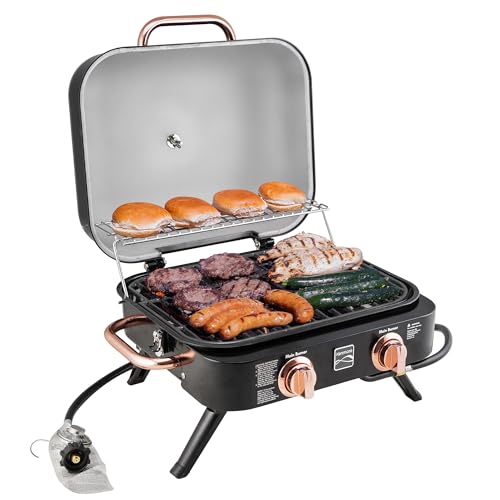
Kenmore 2-Burner Portable Gas Grill Tabletop — Best for Camping
Kenmore’s portable is the base-camp specialist: two stainless-steel burners, a warming rack, foldable legs, and — the detail campers will appreciate most — compatibility with both 5 lb and 20 lb propane tanks as well as the usual small cylinders. Two burners in a portable means real temperature control and a simple two-zone setup at the campsite, and the warming rack keeps the first batch hot while the second finishes.
Strengths
- Two burners in a tabletop — genuine zoning and gentler control for chicken and vegetables at camp.
- Flexible fueling: small cylinders for trips, a 20 lb tank for a week at base camp or home patio use.
- Warming rack included, plus a retro-styled body that looks as good on the patio as at the site.
Trade-offs
- Larger and heavier than single-burner portables — a two-handed carry to the picnic table.
- Like all tabletops, it needs a stable surface and its legs folded carefully for transport.
- Budget-tier finish; the black and copper styling wants a cover or indoor storage between trips.
Mini spec box: 2 burners · stainless-steel burners · warming rack · foldable legs · fits 5 lb and 20 lb propane tanks.
Where the Kenmore earns its badge is the week-long camp: connected to a full-size tank, it cooks breakfast through dinner for a family with the control of a home grill — low zone for bacon and eggs in a pan on the grate, hot zone for evening burgers, rack keeping everything warm. It doubles as a perfectly good small patio grill back home, which makes its price easier to justify than a single-purpose camping toy. That dual citizenship is worth pausing on, because it is the budget tier’s secret strength: a portable that also serves at home gets used fifty weeks a year instead of five, and cost-per-cook — the only honest price metric — collapses accordingly. The Kenmore, the GT1001, and even the tiny Grillster all share this trait, and it is why so many owners of expensive patio grills quietly report that the little portable is the one they actually cook on. Buy the format your life will use weekly, and the under-$200 tier stops looking like a compromise and starts looking like the smartest money in the yard.
Best for: campers and RVers who cook full meals outdoors, and small patios that want one grill for both. / Not suited for: ultralight or solo-minimalist trips. Check the current price on Amazon
Comparison Table
| Pick | Badge | Key spec | Best for |
|---|---|---|---|
| Charbroil Classic 2-Burner | Best Overall Under $200 | 280 sq. in., 20,000 BTU, standing cart | Small home patios |
| Megamaster Deluxe 2 Burner | Best Cart-Style Value | Cast-iron grates, 418 sq. in. total | Searing on a budget |
| Nexgrill Deluxe 2-Burner | Best with Warming Rack | 401 sq. in. total, warming rack | Burgers and sides for 4–6 |
| Royal Gourmet GT1001 | Best Tabletop | 285 sq. in., stainless, lockable lid | Group camping, tailgates |
| Cuisinart Grillster | Best Ultra-Portable | 146 sq. in., 600°F, ~13 lbs | Solo and couple grilling |
| Kenmore 2-Burner Portable | Best for Camping | 2 burners, warming rack, 20 lb tank fit | Base-camp cooking |
How to Choose a Barbecue Grill Under $200
Choose the format first. A standing cart (Classic 2-Burner, Megamaster, Nexgrill) suits a home patio where the grill lives in place. A tabletop (GT1001, Grillster, Kenmore) suits travel, storage shelves, and borrowed surfaces. This single decision narrows the field more honestly than any spec comparison, because format determines how the grill fits your life every day, not just how it cooks.
Then judge the cooking components. In this tier, rank grates and burners above everything. Cast iron (Megamaster) sears best; heavy porcelain-coated grates cook well and clean easily; stainless burners outlast plain steel. Electronic or push-button ignition is close to mandatory — it is the feature whose failure most ruins budget grills.
Read area numbers carefully. Compare primary cooking area. Totals that fold in warming racks are useful only if you will actually use the rack, as Nexgrill and Kenmore owners do for holding and buns. For a household of two to four, roughly 250–300 square inches of primary space is the comfortable zone; tabletops below 200 square inches are one-to-two-person tools.
Plan the fuel. All six picks run on propane. Tabletops default to 1-pound cylinders — convenient, pricier per cook — and most accept an adapter hose for a 20-pound tank, which is the economical move for home use and long camps (the Kenmore takes big tanks natively). Budget the hose into the purchase if you will grill weekly.
Set the longevity expectation — and buy the cover. Under $200 buys honest seasons, not decades. A fitted cover, indoor or sheltered storage for portables, and a two-minute cleanup routine are what separate the three-season grill from the six-season grill at this price. The picks above were chosen partly because their brands sell the parts that let a cared-for budget grill keep going.
Safety Notes Specific to Small Propane Grills
Small grills invite casual placement, and casual placement is where accidents come from. A few habits keep the budget tier as safe as it is convenient. Set tabletop grills only on stable, heat-resistant surfaces — a wooden picnic table wants a grill mat or a metal tray beneath the unit, and no portable belongs on a plastic table, a dry grass slope, or the floor of a tent or vehicle, ever. Carbon monoxide from any propane burner is a real hazard in enclosed spaces; portables are outdoor equipment, full stop, including in garages with the door open.
Respect clearances as you would on a full-size grill: away from siding, railings, overhangs, and anything that flutters — awnings, umbrellas, and paper decorations have no business near a lit grill of any size. Keep the 1-pound cylinders upright, connected only when in use, and stored in a ventilated spot away from heat; never store spare cylinders under a hot grill or inside a living space. When the cook is done, close the cylinder or tank valve first and let the burners consume the line gas before shutting the knobs — a small routine that keeps residual propane out of hoses in storage.
Finally, supervise like the grill is bigger than it is. Small grills reach full temperature quickly, stay hot after shutdown, and sit at heights that invite curious hands. A clear zone, a cool-down before packing, and a check that the lid is latched and the gas is disconnected before the grill goes into a trunk — that is the whole discipline, and it costs nothing.
How to Set Up and Care for a Budget Grill So It Lasts
- Assemble carefully and keep every screw honest. Budget hardware rewards patience: do not overtighten into thin metal, confirm burners sit level over their valves, and keep the manual and model number for parts.
- Leak-test at setup and at every tank change. Soapy water on the connections, valve open, burners off. Bubbles get fixed by reseating, never ignored — this matters doubly with adapter hoses and portable cylinders.
- Burn off and season before the first food. Fifteen minutes on high clears factory coatings. Oil cast-iron or coated grates lightly while warm to start the protective seasoning layer.
- Cook with the lid and zones you have. Single-burner portables roast by placement — food at the grate’s edge, lid down — while two-burners run a true hot side and gentle side. Learn your grill’s warm corner with a few slices of white bread toasted on medium.
- Clean in the two-minute window. While the grill is still hot after cooking: burn off, brush or scrape, and check the grease cup or tray. Budget grease systems are small; empty them before they are full, not after.
- Store like you mean it. Cover on the carts; portables wiped, latched, and shelved indoors. A budget grill stored dry will outlive a premium grill stored wet — storage is the great equalizer of this tier.
Making a Small Grill Cook Bigger: Batch Strategy and Menu Planning
The honest limitation of every grill in this guide is area, and the honest answer is technique. Cooks who plan around a compact grate feed groups from grills that look too small for the job — here is the method they use.
Sequence by cooking time, not by course. Start the items that hold best — sausages, chicken thighs, corn in husks — and let them rest or hold warm (on the Nexgrill’s or Kenmore’s rack, or wrapped at the grate’s cool edge) while the fast, fragile items cook last: burgers, shrimp, thin vegetables. A resting tent of foil keeps the first batch at serving temperature without overcooking it.
Use the whole menu, not just the grate. A cast-iron skillet on the grate turns a two-burner into a sauté station for onions and peppers while steaks sear beside it. Skewers pack more food per square inch than any other format and cook fast. Flatbreads and tortillas take thirty seconds each at the end and make a modest grill feel like a feast.
Pre-cook strategically. There is no rule that says every second of cooking must happen on the grill. Chicken wings par-baked in the oven and finished over high heat emerge crisp and fully cooked in half the grate time; ribs can be wrapped and tenderized indoors, then glazed on the grill. Purists may object, but guests will not — they will be too busy eating.
Keep the grate hot between batches. A compact grill’s enemy is the temperature sag after a cold load. Give the grate two lid-down minutes between batches to recover, and the third round sears like the first. This one habit is the difference between “the little grill did great” and a tray of steamed burgers.
Budget Grill Troubleshooting: Five Common Problems and Their Fixes
Budget grills develop a short list of predictable ailments, and nearly all of them are user-fixable in minutes. Knowing the list in advance turns a frustrating evening into a small detour.
Problem: the grill will not light, or lights weakly. The usual cause is the regulator’s safety flow limiter, tripped by opening the tank valve too fast or with a burner open. Close everything, disconnect the regulator, wait a minute, reconnect, and open the tank valve slowly with all burners off. If ignition is the issue instead, check the electrode for grease buildup and confirm the battery or piezo clicker is alive.
Problem: yellow, lazy flames or a burner section that stays dark. Blocked burner ports — rust flakes, grease, or a spider nest in the venturi tube. With the grill cold and the gas disconnected, clear ports with a thin wire and brush out the tubes. This single fix restores most “my grill got weak” complaints.
Problem: hot spots and flare-ups. Hot spots follow burner layout; map them with the bread test and cook accordingly. Flare-ups follow grease: empty the cup or tray, scrape the firebox, and move fatty food to the gentle zone to finish. A spray bottle of water is for charcoal, not gas — on propane, close the lid and cut the oxygen instead.
Problem: rust spots on grates or body. Catch them early. Grates: scrub, dry thoroughly on the heat, and re-season with a thin oil coat. Body panels: clean, dry, and touch up with high-heat paint. Then fix the cause — almost always a missing cover or storage in the rain.
Problem: the grill runs out of gas mid-cook. Prevention beats cure: weigh the tank or fit a gauge, and keep a spare cylinder for portables. If it happens anyway, finish thick items in a hot oven without shame — the grill did the flavor work in the first sear, and dinner is saved rather than ruined.
Common Buying Mistakes
- Expecting a full-size cabinet grill at this price. Under $200 done right means compact carts and portables. A “big” grill at this price is built down in ways that surface within a season.
- Comparing total area instead of primary area. Warming racks are bonuses, not cooking space. Compare the main grate.
- Ignoring the ignition. Match-light and flaky sparkers are the top budget-grill regret. Every pick here lights electronically or by push button.
- Forgetting the tank math. One-pound cylinders are convenient and costly per cook; weekly grillers should budget the adapter hose and a standard tank.
- Skipping the cover to stay under budget. In this tier the cover is not an accessory; it is half the lifespan. Buy it with the grill.
- Buying capacity you cannot store. A grill that lives assembled in a hallway gets used less than a smaller one that shelves away. Match the format to your storage, not just your appetite.
- Treating the warranty card as the plan. In this tier, prevention beats paperwork: covers, dry storage, and grease discipline protect you more than any warranty clause. Register the product, yes — then go buy the cover.
What Under $200 Cannot Buy — and When Stepping Up Makes Sense
Knowing a tier’s limits is part of shopping it well. Under $200, you cannot honestly buy: a four- or five-burner cabinet grill built to last; thick-gauge stainless construction; a dedicated sear or infrared burner system; decade-class warranties on burners and firebox; or the grate area to cook a full meal for eight at once. Listings that imply otherwise are describing dimensions and totals, not capability. The grills in this guide succeed precisely because they do not pretend to be those things.
Step up to the under-$500 tier when any of these becomes true: your household grows past four regular eaters; you host monthly and batching has become a burden; you grill three or more times a week and want cast-iron-everything build and stronger parts support; or your first budget grill has served its seasons and you know exactly which features your cooking actually uses. That last path — budget grill first, informed upgrade second — is one of the smartest in outdoor cooking, because the cook who has spent two seasons on a Classic 2-Burner knows precisely what they want from a bigger grill, and buys it once.
And if none of those is true — if your life is two-to-four-person dinners, campsite weekends, and a balcony or small patio — then this tier is not a compromise at all. It is the correct tool, at the correct price, and the money you did not spend is available for the ingredients that actually make barbecue memorable.
Final Recommendation
For a home grill under $200, buy the Charbroil Classic 2-Burner — unless searing is your priority, in which case the Megamaster Deluxe and its cast-iron grates are the pick, or your menus run to burgers-and-sides for a group, where the Nexgrill Deluxe’s warming rack earns its place. For travel, the Royal Gourmet GT1001 is the tabletop that feeds a crew, the Kenmore 2-Burner is the base-camp cook’s choice, and the Cuisinart Grillster is the tiny grill that solo cooks and couples will use constantly. Every one of these is an honest tool at an honest price — choose by format and headcount, buy the cover, and grill. And take the tier’s real lesson with you to every future purchase: the best grill is never the one with the longest spec sheet, but the one whose size, format, and upkeep fit the life you actually live. Under $200, that lesson comes cheap — which is the finest thing this budget buys.
Ready to compare against the next tiers? See Best Barbecue Grills Under $500 for what a mid-range budget adds, Best Barbecue Grills Under $200 Charcoal for the charcoal side of this exact budget, Best Barbecue Grills To Buy for the general shortlist, Best Bang For Buck Propane Grills for propane value at every tier, and Best Bar Bq Grills for the full cross-fuel roundup.
Frequently Asked Questions
Can you really get a good barbecue grill for under $200?
Yes — if “good” is matched to the right format. Compact two-burner carts and quality tabletops in this tier cook weeknight food properly and last for seasons with basic care. What under $200 does not buy is a large, premium-material patio grill; shoppers who need that should look at the under-$500 tier rather than a built-down big grill at this price.
How long will a grill under $200 last?
Realistically, several seasons of regular use — longer with a cover, sheltered storage, and a working cleanup routine, shorter if it lives uncovered in the rain. Brands with real parts channels, like the picks here, extend that further because an igniter or burner replacement is cheap and available.
Is a two-burner grill enough for a family of four?
Yes — comfortably, for the way families actually eat. Around 280 square inches of primary space cooks a family meal in one batch for most menus, and two burners still allow a hot zone and a gentle zone. Families who regularly host six or more should either batch comfortably or step up to the under-$500 tier for a four-burner.
Are tabletop grills powerful enough for steaks?
The good ones are. The Grillster reaches 600°F, and the GT1001’s U-burner under a closed lid sears properly with a full preheat. What tabletops give up is area and zoning, not the ability to cook a steak — preheat thoroughly, dry the meat’s surface, and do not crowd the grate.
Should I use 1-pound cylinders or a full-size tank?
Cylinders for travel and occasional use; a 20-pound tank with an adapter hose for home use and long camps. The per-cook cost difference is significant for weekly grillers, and the Kenmore portable accepts larger tanks natively. Always leak-test after any connection change.
Is assembly difficult on grills in this tier?
The tabletops are nearly assembly-free — legs unfold, a grate drops in, and you are cooking. The two-burner carts are a modest one-person build with basic tools; the instructions in this class are generally clear, and the main discipline is to keep fasteners snug without overtightening into thin metal. If a cart’s burner does not sit level at the end, revisit that step before the first light — alignment is the difference between even cooking and a hot corner.
Can I leave a budget grill outside year-round?
You can, but you will shorten its life — this tier’s thinner steels and coatings forgive weather less than premium builds do. A fitted cover is the minimum; a covered porch, garage corner, or storage shelf for the portables is better. If the grill must live fully exposed, choose the stainless GT1001 for travel duty or keep the cart under the tightest cover you can fit, and oil the grates before any long idle stretch.
Charcoal or propane under $200 — which is better?
They split the virtues. Propane — this guide’s field — wins on speed, cleanliness, and balcony practicality where gas is permitted. Charcoal under $200 buys the excellent kettle format, with live-fire flavor no gas grill matches, at the cost of startup time and ash handling. Our companion guide to the best barbecue grills under 200 charcoal covers that field pick by pick; many households eventually own one of each.
Do budget grills work in winter?
Yes, with adjusted expectations. Propane pressure dips in deep cold and wind steals heat from light lids, so preheats run longer and a sheltered position matters. Keep the tank as full as practical, cook with the lid down, and favor the cast-iron Megamaster’s heat retention when winter grilling is a habit rather than an event.
What is the first thing to buy alongside a budget grill?
The fitted cover — in this tier it is effectively part of the grill’s lifespan. After that: an instant-read thermometer, a bristle-free brush, and the adapter hose if you will run a full-size tank. Those four items together protect the purchase better than any extended warranty.


